Outcomes of Critical Pathway in Laparoscopic and Open Surgical Treatments for Gastric Cancer Patients:
Patients Selection for Fast-Track Program through Retrospective Analysis
Ji Woo Choi, Yi Xuan, Hoon Hur, Cheul Su Byun, Sang-Uk Han, and Yong Kwan Cho Department of Surgery, Ajou University School of Medicine, Suwon, Korea
Purpose: The aim of this study is to investigate the clinical factors affecting on the cure rate by invasive and open surgery for gastric cancer and to establish a subgroup of patients who can be applied by the early recovery after surgery program through this retrospective analysis.
Materials and Methods: In this retrospective study, we analyzed 425 patients who underwent gastric cancer surgery between January 2011 and December 2011 and were managed with conventional clinical therapies. This clinical algorithm was made when the patient was in minimally invasive surgery group and discharged from hospital one day faster than them in open surgery group.
Results: The completion rate of the clinical pathway was 62.4%. Despite the different applications of clinical pathway, completion rate in minimally invasive surgery group was significantly higher than that of open group (P<0.001). In multivariate analysis, the surgical procedure of minimally invasive surgery (odds ratio=4.281) was the most predictable factor to complete clinical pathway. Additionally, younger patients (odds ratio=1.933) who underwent distal gastrectomy (odds ratio=1.999) without combined resection (odds ra- tio=3.069) were predicted to accomplish the clinical pathway without any modifications.
Conclusions: We concluded that high efficacy of the clinical pathway for gastric cancer surgery was expected to selected patients through retrospective analysis (expected completion rate=85.4%). In addition, these patients would become enrolled criteria for early recovery program in gastric cancer surgery.
Key Words: Stomach neoplasms; Critical pathways; Gastrectomy; Minimally invasive
Correspondence to: Hoon Hur
Department of Surgery, Institute for Gastric Cancer Mechanism, Ajou University School of Medicine, 206 WorldCup-ro, Yeongtong-gu, Suwon 443-749, Korea
Tel: +82-31-219-5200, Fax: +82-31-219-5756 E-mail: [email protected]
Received Aprill 12, 2013 Revised Aprill 27, 2013 Accepted Aprill 27, 2013
Copyrights © 2013 by The Korean Gastric Cancer Association www.jgc-online.org
This is an open-access article distributed under the terms of the Creative Commons Attribution Non-Commercial License (http://creativecommons.org/
licenses/by-nc/3.0) which permits unrestricted noncommercial use, distribution, and reproduction in any medium, provided the original work is properly cited.
Introduction
Although the incidence of gastric cancer has been decreased world wide, it is still one of the most common solid tumors in Asian countries like Korea and Japan.1 The standard treatment
to be able to improve the survival of the patients diagnosed with the gastric cancer without distant metastasis is surgical resection.2 Therefore, most of patients who have been diagnosed with gastric cancers in Asian countries require the surgical resection for their treatments, and then gastric cancer surgery has become the most of popular surgical procedures.2
The critical pathway (CP) for surgical patients is a standardized plan including preoperative preparation and postoperative manage- ments. For the popularly performed surgery, the standardization of patients care is one of the ways to improve surgical outcomes, reduce the postoperative length of stay and hospital cost.3-6 Re- garding with gastric cancer surgery, CP has been rarely suggested due to complicated procedures performed in gastric cancer surgery.
However, recent development in gastric cancer surgery has been made the surgical outcome to be improved, and the possibility of application of the CP for perioperative care has been increased.
In particular, minimally invasive surgery (MIS) for early gas- tric cancer showed the improved surgical outcomes like enhanced postoperative recovery and reduced the length of stay.7-9 Based on these clinical studies, we established different CP according to laparoscopic and open surgeries. The CP was planned as the pa- tients in MIS group start the diet one day faster than them in open group. To date, there had been no report to evaluate the different efficacy about the application of CP according to approach meth- ods in gastric cancer surgery. In this study, we reviewed the results of application of the CP to investigate the clinical factors affecting on the drop from the CP in MIS and open surgery.
After the analysis of this retrospective study, we will progress more advanced CP in which the perioperative care programs for early recovery after surgery (ERAS), so called fast-track CP, like early oral feeding were included. Several results in colon surgery have been reported that it could enhance the recovery of patients, and reduced the length of hospital stay. However, it is not estab- lished that ERAS program is acceptance in gastric surgery. There- fore, it is impossible to apply the ERAS program on all patients who underwent gastric cancer surgery. Here, we want to investigate a subgroup of patients who can be applied by the ERAS program through this retrospective analysis for the patients managed with conventional CP.
Materials and Methods
Our clinical study for ERAS program in gastric cancer sur- gery was approved by the Institutional Review Board at the Ajou University Hospital, Suwon, Korea (AJIRB-MED-OBS-11-420).
Approved clinical study included the retrospective review about the results from patients managed under conventional CP and pro- spective clinical trial for ERAS. Here, we reported the results from retrospective study.
The Gastric Cancer Center, Ajou University Hospital introduced a standard CP in order to guide perioperative care of the patients who underwent gastric cancer surgery from 2008. Revised version of CP was established to differently manage the patients who un- derwent MIS including laparoscopic and robotic procedures from 2010, since several prospective researches has been reported that laparoscopic surgery for gastric caner has been improved the re- covery after surgery.7,9,10
We operated consecutive 441 patients diagnosed with gastric ad- enocarcinoma at the Gastric Cancer Center, Ajou University Hos- pital from January 2011 to December 2011. They did not receive neoadjuvant treatment for gastric cancer diagnosed at this time.
Sixteen patients who could not undergo tumor resection for severe advanced disease were excluded. Finally, we analyzed 425 patients in this retrospective study.
Three surgeons (Cho YK, Han SU and Hur H) who had more than 50 gastric cancer surgeries per year were participated in this study. Preoperative gastrofiberscope and computed tomography were performed to exclude the patients with metastatic lesions and to plan the operation including the range of resection, the extent of lymphadenectomy and combined resection. Before surgery, we discussed with patients about the surgical procedures and possibility of postoperative complication. We explained the plan for manage- ment after surgery, and obtained informed consents from all pa- tients enrolled in this study. We applied MIS for patients relatively less advanced disease (clinical stage I and stage IIA, American Joint Committee on Cancer [AJCC] 7th edition), but robotic surgery were selected by patients themselves because of the higher cost of it. We have been managed two kinds of CP for gastric cancer surgery in our institution according the approach methods (MIS vs.
open surgery). Different and common points of these two pathways were listed in Table 1. These pathways included preoperative bowel preparation by enema, non-per oral diet at one day before surgery in common. Surgical procedures including the resection of primary
Table 1. Critical pathway for gastrectomy with lymphadenecetomy in gastric cancer patients at Ajou university hospital, 2011
Variables Critical pathway
MIS Open
Admission 2 days before operation
Preperation • Non per oral 1 day before
• Enema for bowel preparation
• No nasogastric tube
• No subclavian line
Fluid 3,000 ml /d (60 kg)
Pain control PCA (fentanyl)
Sips of water POD 2 POD 3
Liquid diet POD 3 POD 4
Soft diet POD 5 POD 6
Discharge POD 6 POD 7
MIS = minimally invasive surgery; PCA = patients controlled anesthesia; POD = postoperative day.
tumor and lymphadenectomy were performed according to the guideline suggested by Japanese Gastric Cancer Association.11 We planed that the soft diet start at postoperative 5 days for patients underwent MIS and six day for open conventional surgery. All patients were recommended the discharge from a hospital when the patients exhibited tolerability three times of soft diet without complaint and had normal physical condition. As results, there was
a difference of one day at the time of discharge from the hospital between two procedures.
The ‘Complete’ of CP was defined when it was progressed fa- vorably without schedule change, and the patients discharged or recommended at planned schedule. The ‘Drop’ was defined when that surgeon intentionally changed the schedule because of the preoperative or postoperative observation of the patients’ condition and the postoperative complication, or patients were readmitted for various reasons.
Statistical analyses were performed using Statistical Package for Social Science ver. 18.0 (IBM Corp., Armonk, NY, USA). Chi- square tests were adopted to analyze the difference of distribution among the categorized data. We performed the binary logistic re- gression test for multivariate analysis to predict the drop from CP.
A P-value was of 0.05 or less was considered statistically signifi- cant.
Results
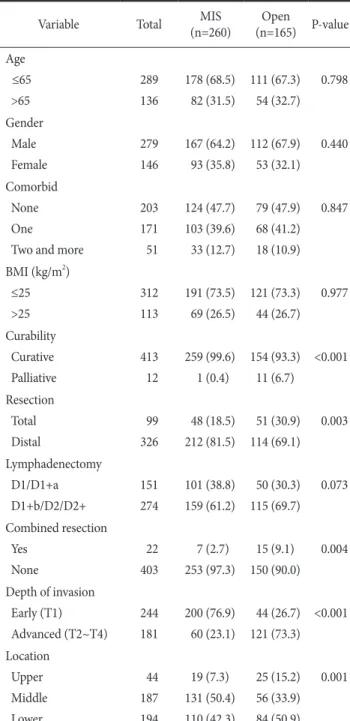
Comparison between MIS and open groups. During 12 months, we performed MIS for 260 and open surgery for 165 patients. MIS was including 222 patients who operated by laparoscopic surgery and 38 patients by robotic surgery. Although there was no dif- ference in clinical features like age, gender and so on, the rate of palliative resection (P<0.001), total gastrectomy (P=0.003) and combined resection (P=0.004) in MIS group were significantly lower than those in open group (Table 2). In pathologic finding, the proportion of early gastric cancer in the patients who underwent MIS was significantly higher than that in open surgery (P=0.001).
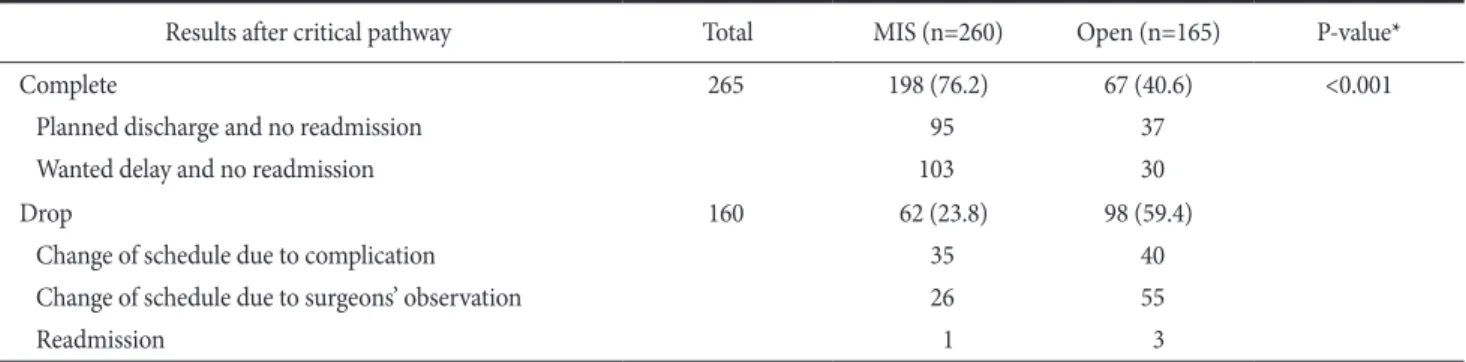
There was significant difference in the complete rate of CP be- tween two procedures (P<0.001). Of 260 patients who underwent MIS for gastric cancer, 198 patients (76.2%) showed the scheduled postoperative recovery without any complaint, and were recom- mended discharge from hospital. On the other hand, only 67 pa- tients (40.6%) of 165 in open group completed the CP. Common cause of drop from in MIS group was to take care of postoperative complication. However, it was most common cause of drop in open group that surgeons adjusted the planned schedule of CP to ob- serve the patients without postoperative complication. This category included to improve preoperative condition using nutritional sup- port or to manage patients’ comorbidity before surgery or to delay discharge due to perioperative non-specific symptom without any complication. This group is called ‘desired delay and no readmis- sion group’.
Table 2. Clinicopathologic characteristics of enrolled patients in this study
Variable Total MIS
(n=260) Open
(n=165) P-value Age
≤65 >65
289 136
178 (68.5) 82 (31.5)
111 (67.3) 54 (32.7)
0.798
Gender Male Female
279 146
167 (64.2) 93 (35.8)
112 (67.9) 53 (32.1)
0.440
Comorbid None One
Two and more
203 171 51
124 (47.7) 103 (39.6) 33 (12.7)
79 (47.9) 68 (41.2) 18 (10.9)
0.847
BMI (kg/m2) ≤25 >25
312 113
191 (73.5) 69 (26.5)
121 (73.3) 44 (26.7)
0.977
Curability Curative Palliative
413 12
259 (99.6) 1 (0.4)
154 (93.3) 11 (6.7)
<0.001
Resection Total Distal
99 326
48 (18.5) 212 (81.5)
51 (30.9) 114 (69.1)
0.003
Lymphadenectomy D1/D1+a D1+b/D2/D2+
151 274
101 (38.8) 159 (61.2)
50 (30.3) 115 (69.7)
0.073
Combined resection Yes
None
22 403
7 (2.7) 253 (97.3)
15 (9.1) 150 (90.0)
0.004
Depth of invasion Early (T1) Advanced (T2~T4)
244 181
200 (76.9) 60 (23.1)
44 (26.7) 121 (73.3)
<0.001
Location Upper Middle Lower
44 187 194
19 (7.3) 131 (50.4) 110 (42.3)
25 (15.2) 56 (33.9) 84 (50.9)
0.001
Values are presented as number (%). MIS = minimally invasive surgery; BMI = body mass index.
Factors affecting on the drop from CP. Besides open conven- tional surgery, the rate of drop from CP was significantly increased in old age (P=0.011) and patients who underwent palliative surgery (P=0.007), total gastrectomy (P=0.001) or combined resection (P=0.002) (Table 4). Palliative resection, total gastrectomy and patients’ age were predicting factors for the drop from CP in multi- variate analysis (Table 5). However, open surgery showed the most obvious factor to predict it (odd ratio=4.281, 2.771 <95 percent c.i.
<6.613).
Suggested indications for ERAS in gastric cancer. In our ret- rospective cohort, 137 patients (32.2%) had the all kinds of factors suggested in multivariated analysis. In these patients, the complete rate of CP was 85.4%, and only 11 patients were dropped due to surgical complication (Fig. 1).
We compared the surgical outcomes of 137 patients who had those factors with them of other 123 patients who underwent MIS (Table 6). Drop from CP and postoperative complication were sig- nificantly less frequent in patients who had four factors (P<0.001 and P=0.014). Two case of mortality were occurred only in other group. The postoperative recovery including bowel motility, diet Table 3. Results of critical pathway in the patients enrolled in this study
Results after critical pathway Total MIS (n=260) Open (n=165) P-value*
Complete
Planned discharge and no readmission Wanted delay and no readmission
265 198 (76.2)
95 103
67 (40.6) 37 30
<0.001
Drop
Change of schedule due to complication Change of schedule due to surgeons’ observation Readmission
160 62 (23.8)
35 26 1
98 (59.4) 40 55 3
Values are presented as number (%). MIS = minimally invasive surgery. *P-value was analyzed by chi-square test the proportion of the drop between MIS and open groups.
Table 4. Clinicopathologic factors which effected on the drop from critical pathway
Variable Total Drop P-value*
Age (year old) ≤65 >65
289 136
97 (33.6) 63 (46.3)
0.011
Gender Male Female
279 146
105 (37.6) 55 (37.7)
0.994
Comorbid None One
Two and more
203 171 51
67 (33.0) 70 (40.9) 23 (45.1)
0.145
BMI (kg/m2) ≤25 >25
312 113
114 (36.2) 46 (40.5)
0.422
Invasiveness MIS Open
260 165
62 (23.8) 98 (59.4)
<0.001
Curability Curative Palliative
413 12
151 (36.6) 9 (75.0)
0.007
Resection Total Partial
99 326
51 (51.5) 109 (33.4)
0.001
Lymphadenectomy D1/D1+a D1+b/D2/D2+
151 274
64 (42.4) 96 (35.0)
0.135
Combined resection Yes
None
22 403
15 (68.2) 145 (36.0)
0.002
Values are presented as number (%). BMI = body mass index; MIS = minimally invasive surgery. *P-value was analyzed by chi-square test the proportion of the drop according to clinicopathologic factors.
Table 5. Predicting factors which can predict the drop from critical pathway in gastric cancer surgery by multivariable analysis
Variable b P-value Odd ratio 95% C.I.
Invasiveness
Open vs. MIS 1.454 <0.001 4.281 2.771~6.613 Combined
Yes vs. None 1.121 0.031 3.069 1.110~8.486 Resection
Total vs. Partial 0.692 0.007 1.999 1.212~3.295 Age >65 vs. ≤65 0.659 0.005 1.933 1.223~3.057
C.I. = confidence interval; MIS = minimally invasive surgery.
progress and the length of stay of patient who had those factors were faster than those of others.
We investigated the surgical outcomes of complications in patients with indications for ERAS. Except for two patients who diagnosed with wound infection and anastomosis stricture, first symptoms like abdominal pain, fever and abnormality of laboratory were occurred within postoperative four days in most patients. The complications were treated by non-operative managements without mortality (Table 7). Based on those results, we could suggest, 1) MIS 2) no combined resection 3) distal gastrectomy and 4) 65 year old and less, as indications for ERAS in gastric cancer.
Discussion
We found out the several factors to predict the accomplishment
of conventional CP in this retrospective study. According to these results, the surgical procedure of MIS was most predictable factor to complete CP, in spite of faster diet and discharge schedule in CP for patients who underwent MIS. In addition, younger patients who underwent distal gastrectomy without combined resection were predicted to accomplish the CP without modification.
In this study, we want to investigate the subclass of patients with reasonable completion rate for the CP in gastric cancer surgery.
The CP in surgical procedure was well established that it could reduce the cost and the length of hospital stay.12,13 However, a pre- vious clinical study reported that the CP for gastrectomy in gastric cancer patients is less effective compared with that in patients with other benign disease.14 The completion rate of the CP was only 19% in that study, on the other hand, 45 to 58% in mastectomy, thyroidectomy and laparoscopic cholecystectomy.14 They assumed that this low efficacy of the CP for gastric cancer surgery resulted from serious operative procedures following with requiring addi- tional medical care. Additional care was mainly required when the postoperative complications were occurred, and the complication rate in gastric cancer surgery was generally known as from 17.5%
to 20.1% in cohort studies with large-scale series.15-17 Moreover, these studies suggested that age, combined resection, extension of lymphadectomy or the method of reconstruction would be con- tributing factors for postoperative morbidities.15,16 Therefore, we expected that the efficacy of the CP for gastric cancer surgery will be increased if the patients for application of the CP were well se- lected. In our study, 32.2% of all patients had all kinds of factors, which could predict the completion of the CP. They showed the lower complication rate (8.0%) and available complete rate (85.4%) of CP enough to apply it on them.
Table 6. Surgical outcome in patients who underwent minimally invasive surgery for gastric cancer
Variables Indications for
ERAS (n=137) Others
(n=123) P-value
Drop from CP 20 (14.6) 42 (34.1) <0.001
Complications 13 (9.5)* 25 (20.3) 0.014
Mortality 0 (0.0) 2 (1.6) 0.134
Bowel motility† 1.98±0.65 2.54±0.86 <0.001
Water start 2.21±0.47 2.68±0.98 <0.001
Soft diet 5.39±1.54 6.09±1.63 0.001
The length of hospital stay 7.24±2.33 8.77±6.72 0.013 Values are presented as number (%) or mean±standard deviation.
ERAS = early recovery after surgery; CP = critical pathway. *Non- drop patients were included. †The postoperative day of first flatus.
Fig. 1. Outcomes of patients selected by novel criteria for early recovery pro- gram in gastric cancer surgery.
Recent trends in gastric cancer surgery, which MIS for early gastric cancer has become a widely acceptable procedure, should be considered in this selection.18 Minimally invasive approach to gastric cancer surgery has showed the several benefits like reduc- ing postoperative pain and surgical trauma, enhanced recovery and improved quality of life.8,9,19 As results, most of clinical studies reported that the length of postoperative ileus and hospital stay af- ter surgery were significantly reduced in the gastric cancer patients who underwent MIS.8,9,20 Therefore, we made the different CP between minimally invasive and open surgery for gastric cancer.
Based on the results from these previous studies, the diet schedule was delayed one day in the CP for the group of open surgery, and it was planned to stay the postoperative one-day more comparing with it in MIS group. Nevertheless, the complete rate (41.7%) of the CP for open group was significantly lower than it (76.2%) for MIS group. Although there were differences in the distribution of cancer progression, extend of gastric resection and so on, the multivariate analysis showed the MIS was most significant factor for predicting the completion of CP (odd ratio: 4.281). We assumed that increased complication like wound problem and prolonged postoperative ileus, and surgeons’ intention of observation in patients who under- went open surgery were contributed to increasing drop rate from the CP.
Besides open surgery, combined resection (odd ratio: 3.069), total gastrectomy (odd ratio: 1.999) and old age (odd ratio: 1.933) were other independent factors which could predict the drop from the CP. Several studies have already reported the morbitidy and mortality after gastric cancer surgery were significantly increased
in the elderly.21-23 In addition, other report presented that extent of gastric resection could be significant factors to predict the length of hospital stay.24 Regarding the combined resection, some studies, which evaluated the efficacy of additional splenectomy or pancre- atectomy to total gastrectomy in gastric cancer, presented that the combined resection could increase the postoperative complica- tion.25,26 Therefore, it is possible that surgeons predict the frequent occurrence of complication and additional medical care in patients with those factors. In addition, most surgeons want to observe more duration the patients who have the risk factors, despite they present mild symptomatic or laboratory change not related to complica- tions. These reasons might affect on increasing the drop rate from the CP.
These retrospective results were analyzed before design for the prospective clinical study about the ERAS program in patients who underwent gastrectomy with lymphadenectomy for gastric cancer (as NCT01642953 registered in www.clinicaltrials.gov). ERAS pro- gram in gastric cancer surgery has been unusually applied due to concerning about the early oral feeding after upper gastrointestinal surgery. However, recent prospective clinical trial of single center reported that the early oral feeding after gastric cancer surgery was feasible.27 This trial showed the complication rate of 25% and the length of hospital stay of 7 days in early oral feeding group.
In spite of postoperative early oral feeding, these results were not remarkable outcomes compared with recent outcomes of MIS for gastric cancer. Therefore, we tired to make a plan in order to en- hance recovery more after gastric cancer surgery. Developed ERAS program for gastric cancer surgery includes the liquid diet without Table 7. Clinical outcomes of complications in patients under suggested indication for ERAS
Number Age Gender Operation Complication Symptom development (POD) Management
1 32 F LADG Cholecystitis 4 Conservative
2 44 F LADG Pancreatitis 3 Conservative
3 46 F TLDG Fluid collection 4 Percutaneous drainage
4 48 F TLDG Atelectasis 2 Conservative
5 48 M TLDG Ileus 3 Conservative
6 52 M LADG Wound infection 7 Conservative
7 55 M LADG Skin burn 1 Conservative
8 56 M TLDG Ileus 4 Conservative
9 57 M LADG Fluid collection 4 Percutaneous drainage
10 51 M LAPG Stricture 10 Endoscopic ballooning
11 63 M TLDG Urinary track infection 4 Conservative
ERAS = early recovery after surgery; POD = postoperative days; F = female; M = male; LADG = laparoscopy-assisted distal gastrectomy; TLDG = totally laparoscopy distal gastrecotmy; LAPG = laparoscopy-assisted proximal gastrectomy.
bowel preparation at the preoperative one day, proper pain man- agement combined with non-opioid drug, fluid restriction, early oral feeding and early discharge at postoperative 4th day. However, under the situation as less evidence of fast track-CP, we thought that it is important to select indicated patients who are expected to perform the ERAS program without sever complications. Of en- rolled patients in this retrospective study, selected patients showed the lower complication rate and even the most of complications were detected within 4th postoperative day. Although recent several clinical trials about fast-track surgery for gastric cancer were de- signed as postoperative 4 days stay in hospital,28,29 we suggested that the application of this schedule on selected patients with suggested indication would be more effective.
In conclusion, high efficacy of the CP for gastric cancer surgery was expected to selected patients through retrospective analysis.
In addition, these patients would become enrolled criteria for early recovery program in gastric cancer surgery.
Acknowledgments
We especially thank to physician assistants (Nr. Yun Hwa Cho and Nr. Seon Mi Eom) and coordinator (Nr. Mi Sun Yang) in Gas- tric Cancer Center, Ajou University Hospital, who contributed to the record of clinical data and management for patients enrolled in this study.
This study was supported by a grant from the National R&D Program for Cancer Control, Ministry of Health & Welfare, Re- public of Korea (1320270).
References
1. Shin A, Kim J, Park S. Gastric cancer epidemiology in Korea. J Gastric Cancer 2011;11:135-140.
2. Kim JP. Current status of surgical treatment of gastric cancer. J Surg Oncol 2002;79:79-80.
3. Bradshaw BG, Liu SS, Thirlby RC. Standardized perioperative care protocols and reduced length of stay after colon surgery. J Am Coll Surg 1998;186:501-506.
4. Kulkarni RP, Ituarte PH, Gunderson D, Yeh MW. Clinical pathways improve hospital resource use in endocrine surgery. J Am Coll Surg 2011;212:35-41.
5. Lin YK, Chen CP, Tsai WC, Chiao YC, Lin BY. Cost-effective- ness of clinical pathway in coronary artery bypass surgery. J Med Syst 2011;35:203-213.
6. Uchiyama K, Takifuji K, Tani M, Onishi H, Yamaue H. Effec- tiveness of the clinical pathway to decrease length of stay and cost for laparoscopic surgery. Surg Endosc 2002;16:1594-1597.
7. Hayashi H, Ochiai T, Shimada H, Gunji Y. Prospective ran- domized study of open versus laparoscopy-assisted distal gas- trectomy with extraperigastric lymph node dissection for early gastric cancer. Surg Endosc 2005;19:1172-1176.
8. Kim YW, Baik YH, Yun YH, Nam BH, Kim DH, Choi IJ, et al.
Improved quality of life outcomes after laparoscopy-assisted distal gastrectomy for early gastric cancer: results of a prospec- tive randomized clinical trial. Ann Surg 2008;248:721-727.
9. Kitano S, Shiraishi N, Fujii K, Yasuda K, Inomata M, Adachi Y.
A randomized controlled trial comparing open vs laparoscopy- assisted distal gastrectomy for the treatment of early gastric cancer: an interim report. Surgery 2002;131:S306-311.
10. Lee JH, Han HS, Lee JH. A prospective randomized study comparing open vs laparoscopy-assisted distal gastrectomy in early gastric cancer: early results. Surg Endosc 2005;19:168- 173.
11. Japanese Gastric Cancer Association. Japanese gastric cancer treatment guidelines 2010 (ver. 3). Gastric Cancer 2011;14:113- 123.
12. Dy SM, Garg P, Nyberg D, Dawson PB, Pronovost PJ, Morlock L, et al. Critical pathway effectiveness: assessing the impact of patient, hospital care, and pathway characteristics using quali- tative comparative analysis. Health Serv Res 2005;40:499-516.
13. Pritts TA, Nussbaum MS, Flesch LV, Fegelman EJ, Parikh AA, Fischer JE. Implementation of a clinical pathway de- creases length of stay and cost for bowel resection. Ann Surg 1999;230:728-733.
14. Jeong SH, Yoo MW, Yoon HM, Lee HJ, Ahn HS, Cho JJ, et al.
Is the critical pathway effective for the treatment of gastric can- cer? J Korean Surg Soc 2011;81:96-103.
15. Park DJ, Lee HJ, Kim HH, Yang HK, Lee KU, Choe KJ. Pre- dictors of operative morbidity and mortality in gastric cancer surgery. Br J Surg 2005;92:1099-1102.
16. Persiani R, Antonacci V, Biondi A, Rausei S, La Greca A, Zoc- cali M, et al. Determinants of surgical morbidity in gastric can- cer treatment. J Am Coll Surg 2008;207:13-19.
17. Wu CW, Hsieh MC, Lo SS, Wang LS, Hsu WH, Lui WY, et al.
Morbidity and mortality after radical gastrectomy for patients with carcinoma of the stomach. J Am Coll Surg 1995;181:26- 32.
18. Hur H, Xuan Y, Ahn CW, Cho YK, Han SU. Trends and out-
comes of minimally invasive surgery for gastric cancer: 750 consecutive cases in seven years at a single center. Am J Surg 2013;205:45-51.
19. Yasunaga H, Horiguchi H, Kuwabara K, Matsuda S, Fushimi K, Hashimoto H, et al. Outcomes after laparoscopic or open distal gastrectomy for early-stage gastric cancer: a propensity- matched analysis. Ann Surg 2013;257:640-646.
20. Lee SI, Choi YS, Park DJ, Kim HH, Yang HK, Kim MC. Com- parative study of laparoscopy-assisted distal gastrectomy and open distal gastrectomy. J Am Coll Surg 2006;202:874-880.
21. Katai H, Sasako M, Sano T, Fukagawa T. Gastric cancer sur- gery in the elderly without operative mortality. Surg Oncol 2004;13:235-238.
22. Kunisaki C, Akiyama H, Nomura M, Matsuda G, Otsuka Y, Ono HA, et al. Comparison of surgical outcomes of gas- tric cancer in elderly and middle-aged patients. Am J Surg 2006;191:216-224.
23. Winslet MC, Mohsen YM, Powell J, Allum WH, Fielding JW.
The influence of age on the surgical management of carcinoma of the stomach. Eur J Surg Oncol 1996;22:220-224.
24. Bozzetti F, Marubini E, Bonfanti G, Miceli R, Piano C, Crose N, et al. Total versus subtotal gastrectomy: surgical morbidity
and mortality rates in a multicenter Italian randomized trial.
The Italian Gastrointestinal Tumor Study Group. Ann Surg 1997;226:613-620.
25. Csendes A, Burdiles P, Rojas J, Braghetto I, Diaz JC, Maluenda F. A prospective randomized study comparing D2 total gas- trectomy versus D2 total gastrectomy plus splenectomy in 187 patients with gastric carcinoma. Surgery 2002;131:401-407.
26. Otsuji E, Yamaguchi T, Sawai K, Okamoto K, Takahashi T. To- tal gastrectomy with simultaneous pancreaticosplenectomy or splenectomy in patients with advanced gastric carcinoma. Br J Cancer 1999;79:1789-1793.
27. Hur H, Kim SG, Shim JH, Song KY, Kim W, Park CH, et al. Ef- fect of early oral feeding after gastric cancer surgery: a result of randomized clinical trial. Surgery 2011;149:561-568.
28. Kim JW, Kim WS, Cheong JH, Hyung WJ, Choi SH, Noh SH.
Safety and efficacy of fast-track surgery in laparoscopic distal gastrectomy for gastric cancer: a randomized clinical trial.
World J Surg 2012;36:2879-2887.
29. Wang D, Kong Y, Zhong B, Zhou X, Zhou Y. Fast-track surgery improves postoperative recovery in patients with gastric can- cer: a randomized comparison with conventional postopera- tive care. J Gastrointest Surg 2010;14:620-627.