http://dx.doi.org/10.3988/jcn.2014.10.1.17 J Clin Neurol 2014;10:17-23
Outcomes of Endovascular Mechanical Thrombectomy and Intravenous Tissue Plasminogen Activator for the Treatment of Vertebrobasilar Stroke
Waleed Brinjikji,a Alejandro A Rabinstein,b Harry J Clofta,c
aDepartments of Radiology, bNeurology, and cNeurosurgery, Mayo Clinic, Rochester, MN, USA
Received May 4, 2013 Revised July 10, 2013 Accepted July 10, 2013 Correspondence Waleed Brinjikji, MD Department of Radiology, Mayo Clinic, OL 1-115 200 First Street SW Rochester, MN 55905, USA Tel +507-266-3350 Fax +507-255-0706
E-mail [email protected]
Background and PurposezzAggressive treatment of posterior-circulation occlusions is im- portant due to the high rates of morbidity and mortality associated with these infarctions. A large administrative database was evaluated to determine the outcomes of mechanical throm- bectomy and intravenous tissue plasminogen activator (IV-tPA) for the treatment of posterior- circulation (vertebrobasilar) strokes. Outcomes were compared across age groups.
MethodszzThe United States Nationwide Inpatient Sample was used to evaluate the outcomes of patients treated for posterior-circulation acute ischemic stroke between 2006 and 2010. Pa- tients who underwent endovascular mechanical thrombectomy and IV-tPA were selected. Pri- mary outcomes were discharge status and mortality; secondary outcomes were length of stay, rate of intracranial hemorrhage, tracheostomy, and percutaneous endoscopic gastrostomy/jeju- nostomy tube placement. Outcomes were grouped according to age (i.e., <50, 50–64, and ≥65 years). Chi-squared test and Student’s t-test were used for comparisons of categorical and con- tinuous variables, respectively.
ResultszzDuring 2006–2010 there were 36,675 patients who had discharge International Clas- sification of Diseases (9th edition) codes indicating posterior-circulation strokes. Of these, 631 (1.7%) underwent mechanical thrombectomy and 1554 (4.2%) underwent IV-tPA. The in-hos- pital mortality rate for mechanical thrombectomy patients was significantly lower for those aged <50 years than for those aged 50–64 years (30.4% versus 47.4%, p<0.01) and those aged
≥65 years (30.4% versus 43.0%, p≤0.01). Age had no effect on the in-hospital mortality for IV- tPA patients, with an incidence of 22.7% for patients aged <50 years, compared to 25.4% for patients aged 50–64 years (p=0.46) and 23.0% for patients aged ≥65 years (p=0.92).
ConclusionszzPatients requiring IV-tPA and/or mechanical thrombectomy for the treatment of posterior-circulation strokes suffer from high mortality rates. Increased age is associated with significantly higher mortality rates among posterior-circulation stroke patients who require me-
chanical thrombectomy. J Clin Neurol 2014;10:17-23
Key Wordszz stroke, brain infarction, posterior circulation, endovascular techniques, tissue-type plasminogen activator.
Open Access
cc This is an Open Access article distributed under the terms of the Cre- ative Commons Attribution Non-Commercial License (http://creative- commons.org/licenses/by-nc/3.0) which permits unrestricted non-com- mercial use, distribution, and reproduction in any medium, provided the ori- ginal work is properly cited.
Introduction
Intravenous tissue plasminogen activator (IV-tPA) and me- chanical thrombectomy are known to improve the outcomes
of acute ischemic stroke among certain patients.1-5 Patients suffering from posterior-circulation (vertebrobasilar) occlu- sions suffer high morbidity and mortality rates, and previous studies have demonstrated that those with posterior-circula- tion occlusions have a poor prognosis regardless of the treat- ment modality used.6-10 It has also been demonstrated that in- creasing age is associated with worsening morbidity and mortality for acute ischemic stroke patients treated with ei-
ther IV-tPA or mechanical thrombectomy.11-13 The present study evaluated Nationwide Inpatient Sample (NIS) data from the period 2006–2010 in order to determine the real-world outcomes in patients with posterior-circulation occlusions treated with endovascular clot retrieval (i.e., mechanical throm- bectomy) or IV-tPA in the general population. Data were com- pared across age groups.
Methods
Patient population
The NIS hospital discharge database for the period 2006–
2010 were purchased from the Healthcare Cost and Utiliza- tion Project of the Agency for Healthcare Research and Qual- ity (Rockville, MD, USA). The NIS is a hospital discharge database that represents 20% of all inpatient admissions to nonfederal hospitals in the USA.
Patients who had an ischemic stroke were identified using International Classification of Diseases (9th edition, ICD-9) codes 433, 434, 436, 437.0, and 437.1. Patients with posteri- or-circulation occlusions were identified using ICD-9 modi- fier codes 433.00, 433.01, 433.20, and 433.21 (occlusion of the basilar and vertebral arteries). Separate analyses were performed for patients receiving IV-tPA (ICD-9 procedure code 99.10) and those undergoing endovascular mechanical thrombectomy (ICD-9 procedure code 39.74). Patients who received both IV-tPA and endovascular mechanical throm- bectomy were analyzed with the endovascular mechanical thrombectomy group. The patients were stratified into three age groups: <50, 50–64, and ≥65 years. The age of 65 years is commonly used as the cutoff between middle-aged and old- er patients, and 50 years is the age below which strokes are considered to occur in the young. These cutoffs were defined a priori in order to facilitate age comparisons. Other demo- graphic variables studied included patient gender and race.
The Charlson Comorbidity Index (CCI) was calculated for each patient. Other comorbidities studied include diabetes mellitus, hypertension, and cardiac dysrhythmia.
Outcomes
The primary outcomes for this study were in-hospital mortali- ty, discharge to home/short-term facility, and discharge to a long-term facility. Length of stay, intracranial hemorrhage (ICH; ICD-9 diagnosis code 430-432.9), tracheostomy (Clini- cal Classifications Software procedure code 34), and percuta- neous endoscopic gastrostomy/jejunostomy (PEG/PEJ) tube placement (ICD-9 procedure codes 4311 and 4632) were sec- ondary endpoints. Length of stay was reported only for patients who did not suffer in-hospital mortality. A subgroup analysis of mortality and ICH rates was performed for patients receiv-
ing mechanical thrombectomy and concomitant IV-tPA versus patients receiving mechanical thrombectomy only and IV-tPA only. A subgroup analysis of mortality rates relating to cardi- ac dysrhythmia, diabetes mellitus, and hypertension was per- formed for mechanical thrombectomy and IV-tPA patients.
Statistical analysis
For the purposes of statistical analysis, the data from 2006–
2010 were summed. Chi-square testing was used to compare categorical variables and Student’s t-test was used to com- pare continuous variables. No adjustments were made for multiple comparisons. National estimates were obtained by applying discharge weights. All statistical analyses were per- formed using the SAS-based statistical package JMP (www.
jmp.com). Multivariate logistic regression analysis was per- formed to determine the variables associated with in-hospital mortality. Separate models were constructed for patients treated with IV-tPA and those treated with mechanical throm- bectomy. Independent variables studied included the CCI,14 age group, gender, and race. For patients treated with me- chanical thrombectomy, IV-tPA utilization was included in addition to the previously mentioned variables. Diabetes, hy- pertension, and cardiac dysrhythmia were not included as in- dependent variables in the multivariate analysis, as they are already a component of the CCI.
Results
Patient demographics
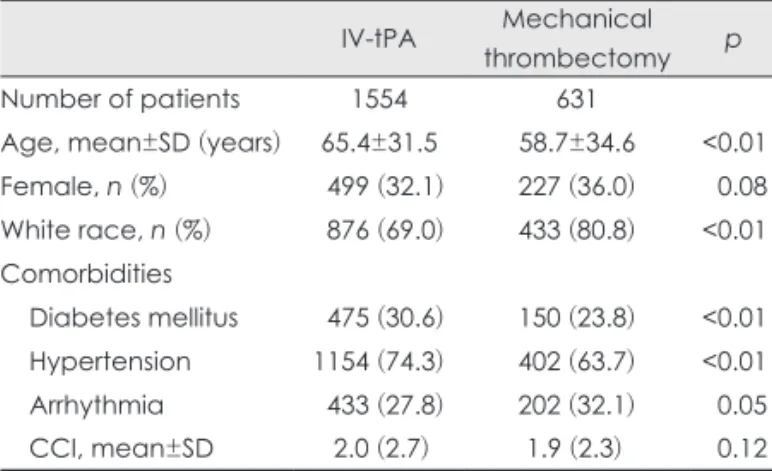
Acute ischemic stroke caused by posterior-circulation occlu- sion was diagnosed in 36,675 patients between 2006 and 2010, of which 631 (1.7%) were treated with mechanical throm- bectomy and 1554 (4.2%) were treated with IV-tPA. 340 (53.9%) of mechanical thrombectomy patients also received IV-tPA. The patients undergoing mechanical thrombectomy were 58.7±34.6 years old (mean±SD) and had a CCI of 1.9±2.3, 227 (36.0%) were female, and 433 (80.8%) were white. The patients receiving IV-tPA were 65.4±31.5 years old and had a CCI of 2.0±2.7; 499 (32.1%) of them were fe- male, and 876 (69.0%) were white. These data are summa- rized in Table 1.
Mechanical thrombectomy outcomes according to age
The in-hospital mortality rate for mechanical thrombectomy patients aged <50 years was 30.4% (55/180). The in-hospital mortality rate was significantly higher for patients aged 50–
64 years than for their younger (47.4%, 101/218; p<0.01) and older (43.0%, 98/233; p<0.01) counterparts. Patients aged <50 years were discharged to home/short-term facilities in 44.1%
of cases (79/180), while those aged 50–64 years (18.9%, 41/218) and ≥65 years (18.3%, 42/233) had significantly low- er rates of discharge to home/short-term facilities (p<0.01 for both). The tracheostomy rate was 14.9% (26/180) for patients aged <50 years, 13.8% (30/218) for patients aged 50–64 years (p=0.77), and 13.8% (31/233) for patients aged ≥65 years (p=0.77); the corresponding PEG/PEJ tube placement rates were 17.0% (31/180), 18.4% (40/218, p=0.73) and 9.4%
(22/233, p=0.02). The length of stay and ICH rate did not dif- fer significantly between those aged <50 years and the other two age groups. These data are summarized in Table 2.
Comparison of mechanical thrombectomy with IV-tPA versus mechanical thrombectomy only and IV-tPA only
A total of 340 patients treated with mechanical thrombecto- my (53.9%) received concomitant IV-tPA. IV-tPA adminis-
tration did not significantly alter the mortality rate: this was 38.7% (132/340) and 43.4% (122/280) among mechanical thrombectomy patients receiving and not receiving IV-tPA, respectively (p=0.24); the corresponding ICH rates were 11.1% (38/345) and 21.3% (61/286, p<0.01).
The mortality rate was significantly higher among mechan- ical thrombectomy patients receiving IV-tPA (38.7%, 132/340) than among those receiving IV-tPA alone (23.8%, 370/1554;
p<0.01). The ICH rate among patients receiving IV-tPA alone was 7.4% (115/1554, p=0.02).
IV-tPA outcomes according to age
In-hospital mortality did not differ between IV-tPA patients aged <50 years (22.7%, 41/179), 50–64 years (25.4%, 134/529;
p=0.46), and ≥65 years (23.0%, 195/846; p=0.92). Patients aged <50 were discharged to home/short-term facilities in 52.1% of cases (93/179), compared to 38.7% (205/529) for patients aged 50–64 years (p=0.01) and 26.9% (227/846) for those aged ≥65 years (p<0.01). Tracheostomy rates were 11.4% (20/179) for patients aged <50 years, compared to 8.4% (44/529) for those aged 50–64 years (p=0.23) and 8.3%
(70/846) for those aged ≥65 years (p=0.18); the correspond- ing PEG/PEJ tube placement rates were 7.7% (14/179), 10.5%
(56/529, p<0.28), and 13.6% (115/846, p=0.03). The length of stay did not differ significantly between patients aged <50 years and the other two age groups. These data are summa- rized in Table 3.
Comorbidities and outcomes
The mortality rates was higher among mechanical thrombec- tomy patients with a diagnosis of diabetes mellitus than Table 1. Demographics of patients in the intravenous tissue plas-
minogen activator (IV-tPA) and mechanical thrombectomy groups IV-tPA Mechanical
thrombectomy p
Number of patients 1554 631
Age, mean±SD (years) 65.4±31.5 58.7±34.6 <0.01
Female, n (%) 499 (32.1) 227 (36.0) 0.08
White race, n (%) 876 (69.0) 433 (80.8) <0.01 Comorbidities
Diabetes mellitus 475 (30.6) 150 (23.8) <0.01 Hypertension 1154 (74.3) 402 (63.7) <0.01
Arrhythmia 433 (27.8) 202 (32.1) 0.05
CCI, mean±SD 2.0 (2.7) 1.9 (2.3) 0.12
CCI: Charlson comorbidity index.
Table 2. Mechanical thrombectomy outcomes in posterior-circulation stroke according to age
<50 years 50–64 years p* ≥65 years p* All patients
n 180 218 - 233 - 631
Demographics
Female, n (%) 75 (41.5) 72 (33.0) 0.08 81 (34.6) 0.15 227 (36.0)
White race, n (%) 121 (83.1) 161 (85.6) 0.53 151 (74.7) 0.06 433 (80.8)
CCI, mean±SD 1.5±1.7 1.8±2.0 0.16 2.3±2.8 <0.01 1.9 (2.3)
Primary outcomes
In-hospital mortality 55 (30.4) 101 (47.4) <0.01 98 (43.0) <0.01 253 (40.8) Discharge to long-term care facility 46 (25.6) 76 (34.9) 0.04 88 (38.7) <0.01 210 (33.6) Discharge to home/short-term care facility 79 (44.1) 41 (18.9) <0.01 42 (18.3) <0.01 162 (25.9) Secondary outcomes
ICH 35 (19.4) 35 (16.2) 0.40 29 (12.4) 0.05 99 (15.7)
Tracheostomy 26 (14.9) 30 (13.8) 0.77 31 (13.8) 0.77 87 (14.1)
PEG/PEJ 31 (17.0) 40 (18.4) 0.73 22 (9.4) 0.02 92 (14.7)
LOS (ignoring deaths) 11.8 (18.8) 12.2 (21.6) 0.88 11.7 (32.3) 0.97 12.0 (24.7)
*Compared to age <50 years.
CCI: Charlson comorbidity index, LOS: length of stay, ICH: intracranial hemorrhage, PEG/PEJ: percutaneous endoscopic gastrostomy/
percutaneous endoscopic jejunostomy.
among those without such a diagnosis (49.1% versus 38.2%, p=0.02). Similar findings were seen in the IV-tPA group (31.6%
versus 20.3%, p<0.01). Hypertension was a significant predic- tor of mortality in the mechanical thrombectomy group (45.3%
versus 32.9%, p<0.01) but not in the IV-tPA group (23.2% ver- sus 25.5%, p=0.35). Cardiac dysrhythmia was not associated with mortality in either the mechanical thrombectomy group (41.0% versus 40.8%, p=0.97) or the IV-tPA group (21.2% ver- sus 24.8%, p=0.14). These data are summarized in Table 4.
Multivariate analysis
For patients receiving mechanical thrombectomy, multivari- ate analysis demonstrated that compared to patients aged
<50 years, those aged 50–64 years had a higher odds ratio (OR) for in-patient mortality [OR=1.79, 95% confidence in- terval (CI)=1.14–2.83; p=0.01], as did patients aged ≥65 years (OR=1.62, 95%CI=1.02–2.58; p=0.04). IV-tPA administration was not associated with any difference in in-hospital mortali- ty (OR=0.86, 95%CI=0.59–1.24; p=0.42). Multivariate logis- tic regression analysis for patients receiving IV-tPA demon- strated no significant difference in mortality for age. These data are summarized in Table 5.
Discussion
The NIS provides data on real-world outcomes and practice data for patients treated with IV-tPA and endovascular me- chanical thrombectomy across the USA. The findings of the present study demonstrate a relatively high rate of poor out- comes among patients requiring IV-tPA and/or mechanical thrombectomy for the treatment of acute posterior-circulation
stroke. Overall, almost 75% of patients receiving mechanical thrombectomy and 66% of those receiving IV-tPA either died or were discharged to long-term care facilities. Both mechani- cal thrombectomy and IV-tPA were associated with increas- ingly worse outcomes with advancing age, although the rela- tionship between age and mortality was stronger among patients treated with endovascular therapy.
Several studies have examined the outcomes of mechani- cal thrombectomy for the treatment of posterior-circulation stroke. Reported mortality rates for mechanical endovascular recanalization for the treatment of vertebrobasilar stroke range from 20% to 45%, with a good clinical outcome seen in 20- 50% of patients.15-21 Recanalization rates are generally high, ranging from 80% to 100%.15-21 In a pooled analysis of pa- tients with vertebrobasilar stroke in the Mechanical Embolus Table 3. IV-tPA outcomes in posterior-circulation stroke according to age
<50 years 50–64 years p* ≥65 years p* All patients
n 179 529 846 1554
Demographics
Female, n (%) 69 (38.6) 150 (28.4) 0.01 280 (33.1) 0.16 499 (32.1)
White race, n (%) 69 (53.6) 287 (63.9) 0.03 520 (75.2) <0.01 876 (69.0)
CCI, mean±SD 1.6±2.6 1.9±2.3 0.29 2.2±2.9 <0.01 2.0±2.7
Primary outcomes
In-hospital mortality 41 (22.7) 134 (25.4) 0.46 195 (23.0) 0.92 370 (23.8)
Discharge to long-term care facility 45 (25.3) 190 (36.0) <0.01 424 (50.1) <0.01 659 (42.4) Discharge to home/short-term care facility 93 (52.1) 205 (38.7) <0.01 227 (26.9) <0.01 525 (33.8) Secondary outcomes
ICH <10 (5.5) 25 (4.7) 0.66 80 (9.5) 0.08 115 (7.4)
Tracheostomy 20 (11.4) 44 (8.4) 0.23 70 (8.3) 0.18 135 (8.7)
PEG/PEJ 14 (7.7) 56 (10.5) 0.28 115 (13.6) 0.03 185 (11.9)
LOS (ignoring deaths) 11.0 (22.7) 9.9 (26.0) 0.63 11.9 (45.4) 0.75 11.1 (37.7)
*Age <50 years.
CCI: Charlson comorbidity index, LOS: length of stay, ICH: intracranial hemorrhage, IV-tPA: intravenous tissue plasminogen activator, PEG/PEJ: percutaneous endoscopic gastrostomy/percutaneous endoscopic jejunostomy.
Table 4. Mortality rate according to comorbidity Mechanical
thrombectomy group
p IV-tPA
group p
Total number of patients
631 - 1554 -
Diabetes mellitus
Yes, n (%) 74 (49.1) 0.02 150 (31.6) <0.01
No, n (%) 180 (38.2) 219 (20.3)
Hypertension
Yes, n (%) 180 (45.3) <0.01 268 (23.2) 0.35
No, n (%) 73 (32.9) 102 (25.5)
Cardiac arrythmia
Yes, n (%) 83 (41.0) 0.97 92 (21.2) 0.14
No, n (%) 170 (40.8) 278 (24.8)
IV-tPA: intravenous tissue plasminogen activator.
Removal in Cerebral Ischemia (MERCI) and multi-MERCI trials, Lutsep et al.18 found that clot retrieval resulted in re- canalization rates of nearly 80%. However, the mortality rate in their analysis was 44%, and good outcomes were only seen in 41% of patients.18 In a study of a “drip, ship, and retrieve”
protocol in which patients treated in a community setting were given IV-tPA and sent to stroke centers that provided en- dovascular mechanical recanalization, Pfefferkorn et al. found a recanalization rate of 85%, a mortality rate of 31%, and good clinical outcomes in 20% of patients.21 Mordasini et al.
found that stent retrieval for the treatment of acute basilar ar- tery occlusion resulted in a 100% recanalization rate, with a mortality rate of 36% and good clinical outcomes in approxi- mately 30% of patients.20 These results are similar to those of the present study, which included a much larger population;
nearly 40% of the mechanical thrombectomy patients suf- fered in-hospital mortality and only 25% of patients were dis- charged to home. The ICH rate in the present study was ap- proximately 16%; those reported elsewhere for mechanical clot retrieval for vertebrobasilar stroke have ranged from 6%
to 21%.15-21
Several studies have examined the outcomes of IV-tPA for the treatment of vertebrobasilar stroke.7,9,13 In a systematic me- ta-analysis comparing intravenous thrombolysis (IVT) to in- tra-arterial thrombolysis, Lindsberg et al. found a recanaliza- tion rate with IVT of 53%, a mortality rate of 50%, and good clinical outcomes in approximately 25% of patients.7 The Bas- ilar Artery International Cooperation Study (BASICS) found that 16% and 30.6% of IV-tPA patients presenting with a mild- to-moderate deficit died and had significant morbidity, respec- tively; the corresponding rates for patients with a severe deficit were 46% and 28%.9 Sairanen et al.13 reported a recanalization rate of 65%, a mortality rate of 41%, and a good clinical out- come in 26% of patients receiving IV-tPA; they also found that increasing age was associated with increased morbidity and mortality. ICH rates with IV-tPA in these large studies have ranged between 10% and 15%.7,13 Similar to these studies,
IV-tPA in the present study was associated with an in-hospital mortality rate of approximately 25%, a discharge to home rate of 33%, and an ICH rate of approximately 7%. Similar to the BASICS, we found that gender was not associated with an in- creased rate of poor outcomes with IV-tPA22; the present find- ings demonstrate that increasing age is associated with wors- ening outcomes for both mechanical thrombectomy and IVT in patients treated for vertebrobasilar stroke. In the mechanical thrombectomy group, approximately 44% of patients under the age of 50 years were discharged to home/short-term care facilities, while less than 20% of patients over the age of 50 years were discharged to home/short-term care facilities. Simi- larly, in the IV-tPA group, more than 50% of patients under the age of 50 years were discharged to home/short-term care facil- ities, while the rates for patients aged 50–64 and ≥65 years were approximately 40% and 25%, respectively. These find- ings are consistent with those of previous studies demonstrat- ing that increasing age is associated with significantly wors- ening outcomes for mechanical thrombectomy and IV-tPA patients.11-13
In the current context of recently published studies that have demonstrated no significant difference in outcomes be- tween IV-tPA and mechanical thrombectomy for the treatment of acute ischemic stroke,23 the role of mechanical thrombec- tomy needs to be examined further, especially in younger pa- tients. Approximately 40% of the patients included in the re- cent study of Ciccone et al. were ≤67 years old, among which a good functional outcome occurred in 42% of the endovas- cular treatment patients versus 38% of the IV-tPA patients (p=0.75).23 Future randomized controlled studies of the ben- efit of endovascular versus intravenous treatment could focus on this younger cohort of patients in order to demonstrate im- proved endovascular outcomes.
The NIS does not provide data on stroke severity (e.g., Na- tional Institutes of Health Stroke Scale), functional outcome (e.g., modified Rankin Scale score), or 90-day mortality, and hence it is not possible to compare the present results with the Table 5. Results of multivariate logistic regression analysis
Variable Mechanical thrombectomy IV-tPA
Mortality, OR (95%CI) p Mortality, OR (95%CI) p
Age group (years)
<50 Ref Ref Ref Ref
50–64 1.79 (1.14–2.83) 0.01 1.60 (0.99–2.64) 0.05
≥65 1.62 (1.02–2.58) 0.04 1.28 (0.80–2.10) 0.32
CCI 0.89 (0.74–1.09) 0.25 1.09 (0.98–1.20) 0.11
Female 0.60 (0.41–0.89) 0.01 1.22 (0.92–1.62) 0.17
Nonwhite race 0.72 (0.44–1.16) 0.17 1.76 (1.34–2.32) <0.01
IV-tPA 0.86 (0.59–1.24) 0.42 NA NA
CCI: Charlson comorbidity index, IV-tPA: intravenous tissue plasminogen activator, NA: not applicable, OR: odds ratio, Ref: reference, 95%CI: 95% confidence interval.
outcomes reported for prospective registries and clinical tri- als. Instead, discharge status was used as a measure of mor- bidity in the present study, as in previous studies that also used this administrative database.11,24 Thus, when assessing mortal- ity, it is not possible to account for patients who received pal- liative care and may have died shortly after their hospitaliza- tion. The severity of clinical presentation is one of the most important determinants of clinical outcome, as demonstrated by the BASICS.9,25 It is likely that patients with a higher stroke severity were directed toward endovascular therapy rather than IV-tPA, but because information on stroke severity at pre- sentation was not available, the effect of such a bias on mor- bidity and mortality within the endovascular and IV-tPA sub- groups could not be assessed in the present study. Therefore, the outcomes were not compared between IV-tPA and me- chanical thrombectomy patients.
The NIS database does not contain information regarding the time-to-treatment and degree of recanalization, both of which are significant predictors of clinical outcome. In a BA- SICS subgroup analysis, time to recanalization was found to be a significant predictor of clinical outcome.25 Previous stud- ies have demonstrated that recanalization is associated with improved outcomes with both IV-tPA and endovascular re- canalization.6,7,9,10,13,16,18-20 Coding errors are also a potential limitation of the present study, as with any study utilizing a large administrative database.
In conclusion, patients requiring recanalization for acute posterior-circulation strokes have high morbidity and mortal- ity rates. Regardless of the treatment modality, outcomes for posterior-circulation infarctions receiving recanalization worsen with increasing age. Further studies are needed to op- timize the outcome in patients with posterior-circulation oc- clusions who undergo IV-tPA and mechanical thrombectomy.
Conflicts of Interest
The authors have no financial conflicts of interest.
REFERENCES
1. Bose A, Henkes H, Alfke K, Reith W, Mayer TE, Berlis A, et al. The Penumbra System: a mechanical device for the treatment of acute stroke due to thromboembolism. AJNR Am J Neuroradiol 2008;29:
1409-1413.
2. Hacke W, Donnan G, Fieschi C, Kaste M, von Kummer R, Broderick JP, et al. Association of outcome with early stroke treatment: pooled analysis of ATLANTIS, ECASS, and NINDS rt-PA stroke trials. Lan- cet 2004;363:768-774.
3. Hacke W, Kaste M, Fieschi C, Toni D, Lesaffre E, von Kummer R, et al. Intravenous thrombolysis with recombinant tissue plasminogen ac- tivator for acute hemispheric stroke. The European Cooperative Acute Stroke Study (ECASS). JAMA 1995;274:1017-1025.
4. Smith WS, Sung G, Saver J, Budzik R, Duckwiler G, Liebeskind DS, et al. Mechanical thrombectomy for acute ischemic stroke: final re- sults of the Multi MERCI trial. Stroke 2008;39:1205-1212.
5. Smith WS, Sung G, Starkman S, Saver JL, Kidwell CS, Gobin YP, et
al. Safety and efficacy of mechanical embolectomy in acute ischemic stroke: results of the MERCI trial. Stroke 2005;36:1432-1438.
6. Davis SM, Donnan GA. Basilar artery thrombosis: recanalization is the key. Stroke 2006;37:2440.
7. Lindsberg PJ, Mattle HP. Therapy of basilar artery occlusion: a sys- tematic analysis comparing intra-arterial and intravenous thromboly- sis. Stroke 2006;37:922-928.
8. Mattle HP, Arnold M, Lindsberg PJ, Schonewille WJ, Schroth G.
Basilar artery occlusion. Lancet Neurol 2011;10:1002-1014.
9. Schonewille WJ, Wijman CA, Michel P, Rueckert CM, Weimar C, Mattle HP, et al. Treatment and outcomes of acute basilar artery oc- clusion in the Basilar Artery International Cooperation Study (BA- SICS): a prospective registry study. Lancet Neurol 2009;8:724-730.
10. Schulte-Altedorneburg G, Hamann GF, Mull M, Kühne D, Liebetrau M, Weber W, et al. Outcome of acute vertebrobasilar occlusions treat- ed with intra-arterial fibrinolysis in 180 patients. AJNR Am J Neurora- diol 2006;27:2042-2047.
11. Brinjikji W, Rabinstein AA, Kallmes DF, Cloft HJ. Patient outcomes with endovascular embolectomy therapy for acute ischemic stroke: a study of the national inpatient sample: 2006 to 2008. Stroke 2011;42:
1648-1652.
12. Nasr DM, Brinjikji W, Cloft HJ, Rabinstein AA. Utilization of intra- venous thrombolysis is increasing in the United States. Int J Stroke 2013;8:681-688.
13. Sairanen T, Strbian D, Soinne L, Silvennoinen H, Salonen O, Artto V, et al. Intravenous thrombolysis of basilar artery occlusion: predictors of recanalization and outcome. Stroke 2011;42:2175-2179.
14. Charlson ME, Pompei P, Ales KL, MacKenzie CR. A new method of classifying prognostic comorbidity in longitudinal studies: develop- ment and validation. J Chronic Dis 1987;40:373-383.
15. Andersson T, Kuntze Söderqvist Å, Söderman M, Holmin S, Wahl- gren N, Kaijser M. Mechanical thrombectomy as the primary treat- ment for acute basilar artery occlusion: experience from 5 years of practice. J Neurointerv Surg 2013;5:221-225.
16. Costalat V, Machi P, Lobotesis K, Maldonado I, Vendrell JF, Riquelme C, et al. Rescue, combined, and stand-alone thrombectomy in the management of large vessel occlusion stroke using the solitaire de- vice: a prospective 50-patient single-center study: timing, safety, and efficacy. Stroke 2011;42:1929-1935.
17. Espinosa de Rueda M, Parrilla G, Zamarro J, García-Villalba B, Hernández F, Moreno A. Treatment of acute vertebrobasilar occlusion using thrombectomy with stent retrievers: initial experience with 18 patients. AJNR Am J Neuroradiol 2013;34:1044-1048.
18. Lutsep HL, Rymer MM, Nesbit GM. Vertebrobasilar revasculariza- tion rates and outcomes in the MERCI and multi-MERCI trials. J Stroke Cerebrovasc Dis 2008;17:55-57.
19. Miteff F, Faulder KC, Goh AC, Steinfort BS, Sue C, Harrington TJ.
Mechanical thrombectomy with a self-expanding retrievable intracra- nial stent (Solitaire AB): experience in 26 patients with acute cerebral artery occlusion. AJNR Am J Neuroradiol 2011;32:1078-1081.
20. Mordasini P, Brekenfeld C, Byrne JV, Fischer U, Arnold M, Heldner MR, et al. Technical feasibility and application of mechanical throm- bectomy with the Solitaire FR Revascularization Device in acute basi- lar artery occlusion. AJNR Am J Neuroradiol 2013;34:159-163.
21. Pfefferkorn T, Holtmannspötter M, Schmidt C, Bender A, Pfister HW, Straube A, et al. Drip, ship, and retrieve: cooperative recanalization therapy in acute basilar artery occlusion. Stroke 2010;41:722-726.
22. Arnold M, Fischer U, Compter A, Gralla J, Findling O, Mattle HP, et al. Acute basilar artery occlusion in the Basilar Artery International Cooperation Study: does gender matter? Stroke 2010;41:2693-2696.
23. Ciccone A, Valvassori L, Nichelatti M, Sgoifo A, Ponzio M, Sterzi R, et al. Endovascular treatment for acute ischemic stroke. N Engl J Med 2013;368:904-913.
24. Hassan AE, Chaudhry SA, Grigoryan M, Tekle WG, Qureshi AI. Na- tional trends in utilization and outcomes of endovascular treatment of
acute ischemic stroke patients in the mechanical thrombectomy era.
Stroke 2012;43:3012-3017.
25. Vergouwen MD, Algra A, Pfefferkorn T, Weimar C, Rueckert CM,
Thijs V, et al. Time is brain(stem) in basilar artery occlusion. Stroke 2012;43:3003-3006.