ⓒ 2012 The Korean Academy of Prosthodontics
This is an Open Access article distributed under the terms of the Creative Commons Attribution Non-Commercial License (http://creativecommons.org/licenses/by- nc/3.0) which permits unrestricted non-commercial use, distribution, and reproduction in any medium, provided the original work is properly cited.
INTRODUCTION
Fixed partial dentures have become a well-established treat- ment modality for many partially edentulous patients. Because these restorations are made indirectly in a dental laboratory, several days or weeks are usually required for their com- pletion. Therefore provisional restoration is an essential step in fixed prosthodontics.1The word provisional means ‘esta- blished for the time being’. During the prosthetic rehabilitation procedures, provisional restorations are commonly used to pro- vide both pulpal and periodontal protection until the final restora- tions are placed. Such temporary restorations should have good marginal integrity, esthetics and sufficient durability to with- stand the forces of mastication. Material strength is important when selecting resins for provisional restorations. For patients with treatment plan which requires long-term use of provisional restorations like full mouth rehabilitation, improved mechan-
ical properties are required. Materials commonly used to fabricate provisional restorations are polymethyl methacrylate (PMMA) resin, polyethyl methacrylate resin, bis-acryl com- posite (BAC) resin, and epimine. Historically, ethyl methacry- lates have shown poor wear resistance and poor esthetics. Thus, the PMMA and bis-acryl resin composite materials possess a larger market value.2 Previous studies have evaluated the marginal fit, polymerization shrinkage, periodontal response, temperature rise, color stability, and fracture resistance of the various provisional restorative materials.3Several methods and materials have been attempted to reinforce provisional restora- tive resins such as use of a stainless steel wire, cast metal on lingual side, a processed acrylic resin, and fibers such as polyethylene and glass.4Considering the high incidence of frac- tures, numerous studies have been conducted on individual rein- forcement methods to improve the strength of the provision- al restoration.1,2,4 It would be worth knowing, up to what
The effect of different fiber reinforcements
on flexural strength of provisional restorative resins:
an in-vitro study
Vaibhav Deorao Kamble1*, MDS, Rambhau D. Parkhedkar2, MDS, Tushar Krishnarao Mowade1, MDS
1Department of Prosthodontics, VSPM’s Dental College and Research Center, Nagpur, India
2Department of Prosthodontics, Saraswati Dhanwantri Dental College, Parbhani, India
PURPOSE. The aim of this study was to compare the flexural strength of polymethyl methacrylate (PMMA) and bis-acryl composite resin rein- forced with polyethylene and glass fibers. MATERIALS AND METHODS. Three groups of rectangular test specimens (n = 15) of each of the two resin/fiber reinforcement were prepared for flexural strength test and unreinforced group served as the control. Specimens were loaded in a universal testing machine until fracture. The mean flexural strengths (MPa) was compared by one way ANOVA test, followed by Scheffe analysis, using a significance level of 0.05. Flexural strength between fiber-reinforced resin groups were compared by independent samples t-test. RESULTS. For control groups, the flexural strength for PMMA (215.53 MPa) was significantly lower than for bis-acryl composite resin (240.09 MPa). Glass fiber reinforcement produced significantly higher flexural strength for both PMMA (267.01 MPa) and bis-acryl compos- ite resin (305.65 MPa), but the polyethylene fibers showed no significant difference (PMMA resin- 218.55 MPa and bis-acryl composite resin- 241.66 MPa). Among the reinforced groups, silane impregnated glass fibers showed highest flexural strength for bis-acryl composite resin (305.65 MPa). CONCLUSION. Of two fiber reinforcement methods evaluated, glass fiber reinforcement for the PMMA resin and bis-acryl composite resin materials produced highest flexural strength. Clinical implications. On the basis of this in-vitro study, the use of glass and polyethylene fibers may be an effective way to reinforce provisional restorative resins. When esthetics and space are of concern, glass fiber seems to be the most appropriate method for reinforcing provisional restorative resins. [J Adv Prosthodont 2012;4:1-6]
KEY WORDS: 3-point bend test; Fixture; Rollers; Stress applicator rod; Provisional restorative resins
Corresponding author: Vaibhav Deorao Kamble
Department of Prosthodontics, VSPM’s Dental College and Research Center Digdoh Hills, Hingna Road, Nagpur, Maharashtra, India
Tel. 91 9561381468: e-mail, [email protected]
Received April 27, 2011 / Last Revison January 6, 2012 / Accepted January 27, 2012
extent the fiber reinforced resin fulfills the strength requirement of an ideal provisional restorative material.
The purpose of this study was to evaluate and compare the effect of two different fiber reinforcement i.e. polyethyl- ene fibers and glass fibers on the flexural strength of PMMA and BAC resins.
MATERIALS AND METHODS
The master die was fabricated in stainless steel with dimen- sions of 30 mm×10 mm×2 mm. The master die had one threaded hole on each end to facilitate easy removal from the investing material. After verification of the dimensions, four dies were selected for preparation of a gypsum mold.
Gypsum molds were prepared with the help of preformed met- al dies. Each threaded hole of master die was filled up with mod- eling wax (Deepti denal products, Ratnagiri, Maharashtra, India).
A thin layer of petroleum jelly was applied over the die and it was invested with Type IV gypsum product (Ultrarock;
Kalabhai Karson, Mumbai, Maharashtra, India) in the dental flask (Varsity Flasks; National Dental Supply Company, New Delhi, India). Ensuring metal to metal contact between the base and its counterpart, the flask was closed under constant pres- sure on bench clamp. After setting, the flask was opened and the modeling wax within the holes was removed. The dies were carefully removed from the investing material. The molds were evaluated for any porosities and roughness. The prepared molds were immersed in hot water to remove any traces of impurities and to facilitate the application of separating medi- um (Stellon cold mould seal; Dental Products of India, Mumbai, Maharashtra, India). The mold cavities obtained were used for the preparation of test specimens.
For control group test specimens of PMMA resin (DPI Heat cure, 792, Mumbai, Maharashtra, India), polymer and monomer in the ratio of 2:1 by weight was mixed and allowed to reach dough stage. It was kneaded and packed in the mold.
The trial closures were performed and excess was removed.
The flask was clamped and a constant pressure of 500 gm was maintained for 20 minutes to allow bench cure and even flow of material in the molds. The flask was kept for poly- merization in water at 90℃ for 2 hours. After completion of polymerization cycle, the flask was allowed to cool in water bath to room temperature. Specimens were finished and pol- ished after deflasking. BAC resin specimens (Protemp 4 Garant; 3M ESPE, B008, Seefeld, Germany) were prepared with similar procedure, except it was supplied in an auto mixing syringe. The mix was packed directly into the mold using appli- cation tips supplied with the kit. Using this procedure, 15 spec- imens of PMMA and BAC resin were prepared.
Polyethylene fibers (Lotus polytwist; 30805-43, Daman, India) were soaked in monomer for 10 minutes in a petridish for improved adhesion of the fibers with PMMA resin
matrix.4,5The fibers were removed from the monomer and excess liquid was allowed to dry. Polymer and fibers were mixed thor- oughly to disperse the fibers. The monomer and polymer containing fibers was mixed in the ratio of 2:1 by weight and allowed to reach the dough stage. Mix was packed into the pre- pared mold. The specimens were polymerized and retrieved in the same manner as the control group. For BAC resin specimens, bonding agent (AdperTM; 3M ESPE, 4 AR Seefeld, Germany) was applied on polyethylene fibers and cured for 40 seconds with halogen light cure unit (Megalux CS; Megadenta, Radeberg, Germany). With Garant dispenser, both base and cat- alyst pastes were dispensed on the mixing pad. The mix was hand-spatulated after incorporation of polyethylene fibers for 30 seconds and immediately transferred to applicator syringe for placement into the mold and the mold was assem- bled.5
Glass fibers (Saint Gobain Vetrotex International; 1652060, Chambery, France) used in this study had the length of 48 mm and a thickness of 8 to 12 μm. These fibers were rolled in an aluminium foil to form the bundles and these bundles of fibers were chopped into 6 mm length using a sharp scalpel blade.
2% by weight of 6 mm length glass fibers were soaked in silane (Ultradent products; B0DMV, South Jordon, USA) for 5 minutes in a petridish for better bonding of these fibers with the resin matrix.6The fibers were removed from silane and allowed to air dry completely. The specimens were poly- merized and retrieved. The exposed fibers at the peripheral bor- der of specimens were trimmed by diamond point at slow speed to avoid delamination of the reinforcement. Specimens were stored in saline at 37℃ for 24 hours in an incubator before test- ing. Specimens were labeled on each end prior to testing so that fractured pieces could be reunited and examined after testing.
Total 90 specimens were tested to measure the flexural strength of PMMA and BAC resin. Specimens were distrib- uted into 6 groups.
�Group I - Control group (Unreinforced PMMA)
�Group II - Reinforced with monomer impregnated poly- ethylene fibers.
�Group III - Reinforced with silane impregnated glass fibers.
�Group IV - Control group (Unreinforced BAC)
�Group V - Reinforced with monomer impregnated poly- ethylene fibers.
�Group VI - Reinforced with silane impregnated glass fibers
For flexural strength, specimens were tested by 3-point bend test on Universal Testing Machine (Instron 4467;
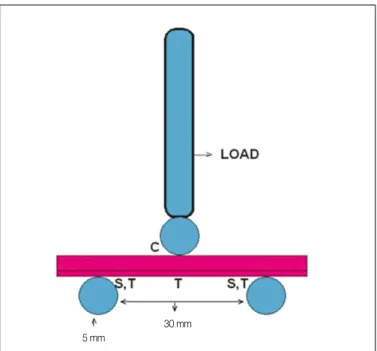
Buckinghamshire, England) at a cross head speed of 1 mm/min. For the 3-point bend test, a fixture was fabricated with the dimensions of 50 mm×30 mm×30 mm. On top of the fix- ture two plates were welded at a distance of 15 mm from the centre on either side. A roller with diameter of 5 mm was placed on top of each plate. A customized “T”shaped stress applicator
rod with the dimension of 80 mm×20 mm was fabricated, by which stress can be applied in the centre of specimen.
The specimen was placed on the rollers in such a way that the centre of the specimen coincided with the centre of the dis- tance between the two rollers. This whole unit was mounted on the lower jaw of the universal testing machine and the stress applicator rod was fixed on the upper jaw. A load was applied with “T”shaped rod on the centre of specimen until fracture occurred and peak force (F) values were recorded at this point in Newtons. Diagrammatic representation of 3-point bend test (Fig. 1) illustrates ‘C’as the compressive stress applied on the specimen via the applicator rod, ‘T’as the tensile stress acting on the under surface of the specimen, and ‘S’as the shear stress acting on the junction of the roller and the specimen.7 The peak force (F), from the stress strain curve of each specimen, was recorded and used to calculate the flexural strength in MPa from the following equation2:
δβ= 3FI 2Bh2 Where,
δβ= Flexural strength in MPa
F = Maximum applied load in newtons I = Supporting width in millimeters
B = Breadth of test specimens in millimeters h = Height of the test specimen in millimeters
The data was tabulated and analyzed by Statistical Package for Social Scienceⓒ10.0 (SPSS, Inc; Chicago, IL, USA). The mean difference, standard deviation and standard error were calculated for each variable. The data of each resin type were analyzed for difference by use of one-way analysis of vari-
ance (ANOVA) followed by Scheffe analysis, using a significance level of 0.05 to determine the mean differences. As the intent of this study was to make comparisons between the different materials tested, independent samples t-test was used for analysis.
RESULTS
The results for mean flexural strength values are shown in Table 1. One-way ANOVA was used to study whether reinforcement with polyethylene and glass fibers signifi- cantly improved flexural strength when compared to unrein- forced (control) group. The hypothesis of means was reject- ed at 5% level of significance with P value =.0000 and the means of 3 groups differs significantly. This shows that group III spec- imens were superior to group I and II and group VI specimens were superior to group IV and V. As the means were not equal, a pair wise comparison of means was carried out using Scheffe analysis. Group III showed significantly higher flex- ural strength than group I but no significant difference was found between group I and II. Similarly, group VI showed significantly higher flexural strength than group IV but no significant dif- ference found between group IV and V (Table 2).
Fig. 1. Diagrammatic representation of 3-point bend test.
5 mm
30 mm
Table 2. Multiple comparisons by Scheffe analysis between control and fiber-reinforced group
PMMA and BAC Mean
P value Result
resin groups difference
Group I Group II -3.024 .261 not significant Group I Group III -51.4773 .000 Significant*
Group II Group III -48.4533 .000 Significant*
Group IV Group V -1.5733 .872 not significant Group IV Group VI -65.5667 .000 Significant*
Group V Group VI -636.9933 .000 Significant*
PMMA- Polymethyl methacrylate resin, BAC- Bis-acryl composite resin.
Symbol * indicates the statistical significant difference between groups.
Symbol shows significant improvements in the fiber reinforced groups and comparison.
Table 1. Mean flexural strength values of polymethyl methacrylate and bis-acrylic composite resin (control group and fiber-reinforced group)
PMMA and BAC Mean flexural resin groups strength (MPa) SD
Group I 215.53 2.8414
Group II 218.55 2.7604
Group III 267.01 7.6431
Group IV 240.09 2.2812
Group V 241.66 4.6080
Group VI 305.65 13.2844
PMMA- Polymethyl methacrylate resin, BAC- Bis-acryl composite resin.
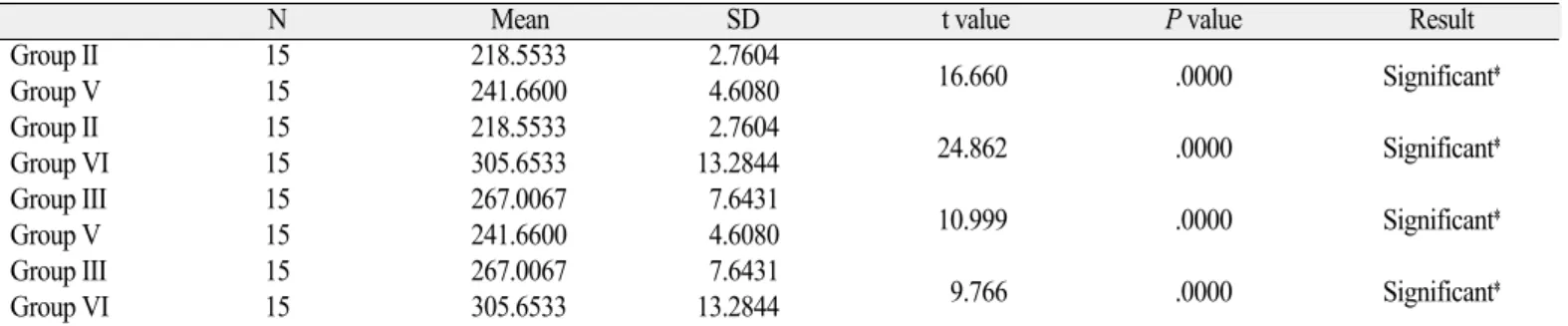
By using independent samples t-test, the results revealed sta- tistically significant difference between flexural strength of fiber reinforced PMMA and BAC resin group. Group VI showed high- est flexural strength followed by group III, V and group II in order (Table 3). The comparative mean values of the flexur- al strength of group II, III, V and VI are presented in Fig. 2.
DISCUSSION
The use of fibers to reinforce a provisional restoration has an acceptable success rate mainly because of the advancements in fiber-reinforcing materials.5 Reinforcement with fibers enhances the mechanical strength characteristics such as transverse strength, ultimate tensile strength, and impact strength.8Although laboratory flexural strength values under
static loading may not reflect intraoral conditions; these val- ues are nevertheless helpful as useful predictors of clinical per- formance.4
Glass fiber is an inorganic substance, which has been cooled to a rigid condition without crystallization. ‘E’glass fibers, based on an alumina-lime-borosilicate composition are con- sidered the predominant reinforcement for polymer matrix due to their high mechanical properties like strength and fracture resistance, low susceptibility to moisture, resistance to chem- icals, thermal stability, and high melting point. Polyethylene fibers are naturally crystalline polymers, which are drawn at temperature below their melting point to produce materials of enhanced modulus in the axial direction. Characteristics of these fibers include light weight, high strength, high modulus, abrasion resistance, resistance to moisture absorption, and resilience.8,9
BAC resins are supplied in automixing cartridge, presumably providing more homogeneous mix than hand mixing the PMMA resin.10However this is not supported by Haselton et al.,3who found no lower standard deviations for the BAC resins compared to hand mixed PMMA resin. This study confirms the higher flexural strength of the control BAC resin as com- pared to PMMA resin. Traditional PMMA resins are mono- functional and have low molecular weight linear molecules that exhibit reduced strength and rigidity. In contrast, BAC resins are difunctional and have ability to cross- link with monomer chains; resulting in greater toughness and strength.11
BAC resin has been marketed as Protemp 4 Garant. This includes a newly modified monomer system, not with the rigid intermediate chain characteristic of BAC resin, but with flex- ible chain in comparison to other synthetic resins. This mod- ification allows a balance between high mechanical strength and limited elasticity of the BAC resin resulting in a materi- al that can withstand higher stresses until fracture and that can tolerate brief deformation.2
The reinforcing effect of fibers on different polymer types increased the mechanical properties of provisional restorative Table 3. Independent samples t-test: Comparison of flexural strength between fiber-reinforced polymethyl methacrylate and bis-acrylic composite resin
N Mean SD t value P value Result
Group II 15 218.5533 2.7604
16.660 .0000 Significant*
Group V 15 241.6600 4.6080
Group II 15 218.5533 2.7604
24.862 .0000 Significant*
Group VI 15 305.6533 13.2844
Group III 15 267.0067 7.6431
10.999 .0000 Significant*
Group V 15 241.6600 4.6080
Group III 15 267.0067 7.6431
9.766 .0000 Significant*
Group VI 15 305.6533 13.2844
Symbol * indicates the statistical significant difference between groups.
Symbol shows significant improvements in the fiber reinforced groups and comparison.
Fig. 2. Graph showing mean flexural strength of control and fiber-rein- forced polymethyl methacrylate and bis-acrylic composite resin. (n = 15), P value<.05.
Mean flexural strength (MPa)
350 300 250 200 150 100 50
0
Group I Group II Group III Group IV Group V Group VI Groups
resins.11The possible reason for the increase was the transfer of stress from the weak polymer matrix to the fibers that have high tensile strength. The stronger the adhesion between the fiber and the matrix, the greater the strengthening effect.
One approach to increase the adhesion of fibers is resin impregnation of the fibers before application. An effective impreg- nation procedure allows the resin to come into contact with the surface of each fiber. Wetting the fibers with monomer is com- monly used method but may impair other properties because of residual monomer.4
In the present study, polyethylene fibers did not produce high- er flexural strength in either material than unreinforced group which may be attributed to poorly bonded fibers, thus creat- ing the equivalent of voids. Improper impregnation also increases water sorption that might result in a detrimental hydrolytic effect and decreases the mechanical properties of reinforced resin. To increase the reinforcing effect of polyethylene fibers, different surface treatments should be carried out that includes plasma spraying, chemical, flame, and radiation treatments.4 There was a statistically significant improve- ment in flexural strength of silane impregnated glass fiber group, which may be attributed to the effect of silane coupling agent that chemically bonds inorganic glass fibers to the organic resin matrix and may make the mixture more homogenous result- ing in strong PMMA and BAC resin.6Kolbeck et al. stated that the reinforcing effect of glass fibers was more effective than polyethylene fibers, and was attributed to the difficulty of obtain- ing good adhesion between polyethylene fibers and the resin matrix.12,13This study showed that significant effect is produced by random orientation of fibers in the specimens of most groups. The ease and simplicity of their inclusion would make this technique more acceptable for widespread use, avoiding the necessity of interruption of packing procedures and time consuming placement of oriented fibers or woven fil- aments. Fiber incorporation beyond 3% by weight will affect the flow of the dough and represents a large volume of mate- rial to be wetted by monomer during mixing and produce dry friable dough. This will provide no beneficial effect on strength. For this reason, 2% by weight of each type of fiber was added to each specimen.8Glass fiber reinforcement pro- vides the best esthetic qualities for dental applications though more research is necessary to determine whether glass fibers are carcinogenic in the mouth, attract more plaque, or cause gingival disorders.13,14
During the specimen preparation some variability is intro- duced in the selection of the materials, storage of the specimens, finishing and polishing of the specimens. In vitro static load tests differ from the dynamic oral conditions. No cyclic load- ing in a moist environment was performed in the present study, and this is a study limitation. It is important to note that flexural strength is only one of the behaviors in response to a particular stress and that strength is just one property of pro-
visional crown materials. A strong material may possess other less desirable characteristics such as tendency to strain, lack of polishability, difficult manipulation, or poor esthetics.
A provisional crown placed on single anterior tooth will have different clinical requirements than a long span provisional fixed partial denture. The clinician must be aware of all attributes of various materials and choose the provisional material appropriate for each patient.2
The clinical implication of this study is that glass and poly- ethylene fibers used did not compromise esthetic qualities of provisional restoration and strength achieved exceeded the nor- mal strength of PMMA and BAC resin. Fiber reinforcement is a potential technique for strengthening provisional fixed par- tial dentures at the connector sites to avoid fractures which may be used for extended periods.
CONCLUSION
Within the limitations of this study, the following conclusions were drawn:
1. PMMA resin has significantly lower flexural strength than BAC resin.
2. Reinforcement with 2% by weight of glass and poly- ethylene fibers improved the flexural strength of the specimens compared to unreinforced PMMA and BAC resin.
This shows that use of fibers is an effective method to increase mechanical properties of provisional restora- tive resins.
3. Silane impregnated glass fiber reinforcement produce significantly higher flexural strength for both PMMA and BAC resin compared to monomer impregnated poly- ethylene fiber reinforcement. This shows that silanized glass fibers seems to be the most appropriate method for rein- forcing provisional restorative resins where esthetics and space are of concern.
REFERENCES
1. Rosenstiel SF, Land MF, Fujimoto J. Contemporary fixed prosthodontics. 3rd ed. St. Louis; Mosby; 2001. p. 380-6.
2. Osman YI, Owen CP. Flexural strength of provisional restora- tive materials. J Prosthet Dent 1993;70:94-6.
3. Haselton DR, Diaz-Arnold AM, Vargas MA. Flexural strength of provisional crown and fixed partial denture resins. J Prosthet Dent 2002;87:225-8.
4. Hamza TA, Rosenstiel SF, Elhosary MM, Ibraheem RM. The effect of fiber reinforcement on the fracture toughness and flexural strength of provisional restorative resins. J Prosthet Dent 2004;91:258-64.
5. Vallittu PK. Flexural properties of acrylic resin polymers reinforced with unidirectional and woven glass fibers. J Prosthet Dent 1999;81:318-26.
6. Solnit GS. The effect of methyl methacrylate reinforcement with silane-treated and untreated glass fibers. J Prosthet Dent 1991;66:310-4.
7. Dagar S, Pakhan A, Tunkiwala A. An in-vitro evaluation of flex-
ural strength of direct and indirect provisionalization materials.
J Indian Prosthodont Soc 2005;5:132-5.
8. Uzun G, Hersek N, Tinçer T. Effect of five woven fiber rein- forcements on the impact and transverse strength of a denture base resin. J Prosthet Dent 1999;81:616-20.
9. Gutteridge DL. The effect of including ultra-high-modulus polyethylene fibre on the impact strength of acrylic resin. Br Dent J 1988;164:177-80.
10. Koumjian JH, Nimmo A. Evaluation of fracture resistance of resins used for provisional restorations. J Prosthet Dent 1990;64:
654-7.
11. Geerts GA, Overturf JH, Oberholzer TG. The effect of differ- ent reinforcements on the fracture toughness of materials for in-
terim restorations. J Prosthet Dent 2008;99:461-7.
12. Vallittu PK. Ultra-high-modulus polyethylene ribbon as rein- forcement for denture polymethyl methacrylate: a short com- munication. Dent Mater 1997;13:381-2.
13. Kolbeck C, Rosentritt M, Behr M, Lang R, Handel G. In vitro study of fracture strength and marginal adaptation of polyeth- ylene-fibre-reinforced-composite versus glass-fiber-reinforced- composite fixed partial dentures. J Oral Rehabil 2002;29:
668-74.
14. Stipho HD. Effect of glass fiber reinforcement on some mechanical properties of autopolymerizing polymethyl methacrylate. J Prosthet Dent 1998;79:580-4.