submit.radiology.or.kr J Korean Soc Radiol 2011;65(4):421-424
421 INTRODUCTION
Glomus tumors are rare benign neoplsms arising from neu- romyoarterial glomus bodies (1). Most occur in a distal pha- lanx, often subungally, but they may be found anywhere throughout the body (1, 2). The tumors in unusual locations- extradigial glomus tumors-are extremely rare and difficult to accurately diagnose before surgery (1-8). To our knowledge, only a few cases of extradigital glomus tumors with their radio- logic findings have been reported. We report on a case of a glo- mus tumor unusually located in the upper arm with typical magnetic resonance imaging (MRI) and pathologic findings.
CASE REPORT
A 61-year-old man presented to our hospital with a 10-year history of pain in right upper arm, which was diagnosed as a mass. The pain became more intense with light touch or clothing, but was not related to arm movements.
On physical examination, the man made a soft, mobile, and painful lesion in the mid lateral aspect of the right upper arm,
measuring 1 × 1 cm. The lesion seemed superficial, but was with no overlying skin change.
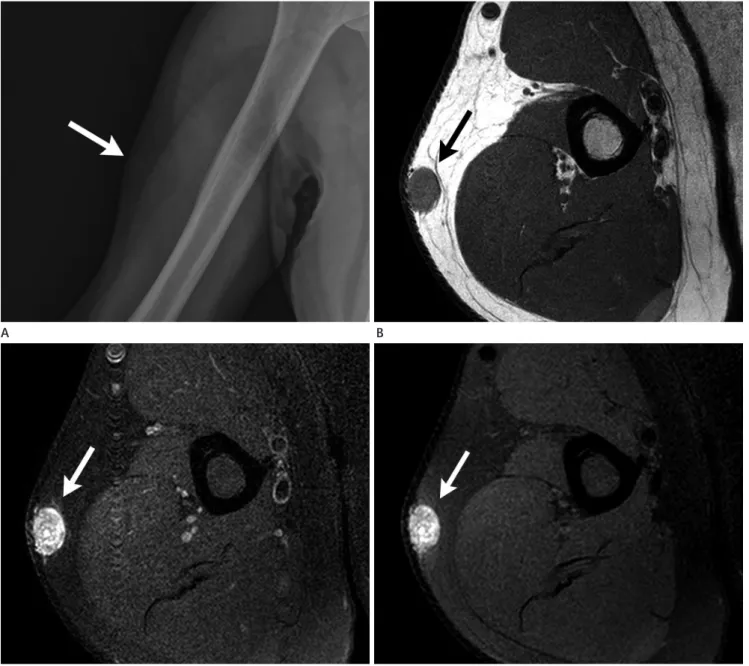
The upper extremity MRI demonstrated a well-demarcated nodule, 1.3 × 0.9 × 1.4 cm in size, located in the subcutaneous layer, mid lateral aspect of the right upper arm that showed hypointensity on axial T1-weighted images and homoge- neously enhanced by injection of gadolinium. The axial T2- weighted image was hyperintense (Fig. 1).
The patient underwent surgery with an initial diagnosis of a glomus tumor in an unusual location. The lesion was com- pletely excised and a histopathologic diagnosis confirmed the clinical and radiologic diagnoses. The histologic examination showed a well circumscribed tumor located in the subcutis. is the lesion was composed of sheets of uniform cells with small amounts of eosinophilic cytoplasm, well defined cell margins, and round or ovoid puched-out central nuclei. There are di- lated, cavernous-like, thin walled vascular spaces surrounded by glomus cells (Fig. 2).
The patient experienced immediate relief of pain and has remained asymptomatic without any complications or recur- rence one year postoperatively.
Case Report
pISSN 1738-2637
J Korean Soc Radiol 2011;65(4):421-424
Received July 18, 2011; Accepted August 8, 2011 Corresponding author: Seunghun Lee, MD Department of Radiology, Hanyang University Hospital, 17 Haengdang-dong, Seongdong-gu, Seoul 133-792, Korea.
Tel. 82-2-2290-9163 Fax. 82-2-2293-2111 E-mail: [email protected]
Copyrights © 2011 The Korean Society of Radiology
Glomus tumors are rare benign soft tissue neoplasms arising from neuromyoarterial glomus bodies. Although the typical location of the tumors is the distal phalanx, they can occur in extradigital locations. We report a case of a glomus tumor unusually lo- cated in the upper arm with typical magnetic resonance imaging findings and patho- logic findings.
Index terms Glomus Tumor Arm
Magnetic Resonance Imaging
An Extradigital Glomus Tumor in the Upper Arm: A Case Report
1 상완에 발생한 수지 외 사구종양: 증례 보고1Jeong-Ah Lee, MD
1, Seunghun Lee, MD
1, Kyung Bin Joo, MD
1, Jeong Ah Ryu, MD
2, Bong Keun Lee, MD
3, Chan Kum Park, MD
41Department of Radiology, Hanyang University Hospital, Seoul, Korea
2Department of Radiology, Hanyang University Guri Hospital, Guri, Korea
Departments of 3Orthopedics Surgery, 4Pathology, Hanyang University Hospital, Seoul, Korea
An Extradigital Glomus Tumor in the Upper Arm
submit.radiology.or.kr
J Korean Soc Radiol 2011;65(4):421-424
422
gates, nests, and masses of specialized glomus cells that have electron microscopic features of smooth-muscle cells (9).
Glomus tumors have been reported to account for 1.6% of all soft tissue tumors and 1-5% of hand tumors (10). They occur most commonly in the nail beds of the hands (1). However, a significant proportion (up to 35%) of glomus tumors are extra- digital, and have been reported in many cases, including most sites of the upper and lower extremities, visceral organs, lungs, and trachea (1-8). Extradigital glomus tumors involving the upper arm have been rarely reported. In a comprehensive re-
DISCUSSION
Glomus tumors are benign hamartomatous growths of neuromyoarterial glomus bodies (1). Glomus bodies are pres- ent in the stratum reticularis of the dermis throughout the body, but they are highly concentrated in the digits, palms, and soles of the feet. Glomus tumors are composed of an af- ferent arteriole, arteriovenous complex, and efferent venules (2). Histologic examination reveals branching vascular chan- nels separated by connective tissue stroma containing aggre-
Fig. 1. A. A plain radiograph of the right humerus showing a soft tissue nodule (arrow).
B, C, D. MRI demonstrating a well-demarcated subcutaneous nodule in the mid lateral aspect of the right upper arm, and showing hypointensi- ty on axial T1WI (B), homogeneous enhancement on gadolium-enhanced axial T1WI (C), and hyperintensity on axial T2WI (D) (arrows).
C A
D B
Jeong-Ah Lee, et al
submit.radiology.or.kr J Korean Soc Radiol 2011;65(4):421-424
423
The diagnosis of extradigital glomus tumors remains a challenge. Their unusual location and nonspecific clinical findings, except for pain, make the diagnosis difficult. There- fore, history, clinical examination and proper radiologic ex- amination are essential (4).
In this case, the patient presented specific pain and the le- sion was palpable superficially on physical examination.
Therefore, clinicians could suspect glomus tumors. For fur- ther evaluation and differential diagnosis of the lesion, MRI was performed with the radiologic marker on the painful site.
The lesion showed typical MRI findings of the glomus tumor with characteristic signal changes and enhancement pattern.
The broad differential diagnosis includes a neural tumor such as a neurofibroma, vascular tumor including hemangio- ma, angioma, or hemangiopericytoma, as well as a leiomyo- ma or metastasis (6). A glomus tumor should be considered in the differential diagnosis of any painful soft tissue mass (8).
In conclusion, we presented a histologically proven extra- digital glomus tumor in the upper arm. Presurgical MRI de- picted lesion characteristics and location. Radiologists should be aware of the existence of these lesions, particularly in the setting of chronic pain and focal tenderness. This rare differ- ential should be considered, despite its unusual location.
view of 56 patients with extradigital glomus tumors, 28 tumors (50%) were in the upper extremity, and very few cases were in the upper arm of the world’s literature (2). Moreover, the dis- cussion of the MRI findings of extradigital glomus tumors in- volving the upper arm is limited and restricted to case reports.
A typical glomus tumor of the hand is readily diagnosed with clinical and radiologic findings. Most of the tumors in the subungal locations present the classic symptom triad of pain, pinpoint tenderness, and hypersensitivity to a cold (1).
Ultrasonography and MRI have been used to localize and char- acterize the tumors. As a first line method, ultrasonography is helpful to detect the lesion, despite its low specificity and tu- mor presentation as a well-defined hypoechoic mass (5, 6, 8).
MRI has proven to be the most sensitive imaging modality for the diagnosis of glomus tumors and was most successful when a radiographic marker was placed directly over the ex- act point where the patient experienced pain (2). MRI also gives more details of the lesion and its relationship to adjacent structures, which facilitated complete removal by excision (8).
The typical appearance of glomus tumors on MRI is a cir- cumscribed mass of intermediate or low signal on T1-weight- ed images and high signal on T2-weighted images, with dif- fuse enhancement after gadolinium administration (2).
Fig. 2. A. The histologic examination showing a well circumscribed tumor located in the subcutis. There are dilated, cavernous-like, thin walled vascular spaces surrounded by glomus cells (Hematoxylin and eosin stain, x 20).
B. The tumor is composed of sheets of uniform cells with a small amount of eosinophilic cytoplasm, well defined cell margins, and round or ovoid punched-out central nuclei (Hematoxylin and eosin stain, x 400).
A B
An Extradigital Glomus Tumor in the Upper Arm
submit.radiology.or.kr
J Korean Soc Radiol 2011;65(4):421-424
424
6. Perks FJ, Beggs I, Lawson GM, Davie R. Juxtacortical glo- mus tumor of the distal femur adjacent to the popliteal fossa. AJR Am J Roentgenol 2003;181:1590-1592
7. Nakamura Y, Nomura T, Ookubo M, Adati T, Harada D. Ex- tradigital glomus tumor causing para-Achilles tendon pain. A case report. Acta Orthop Belg 2000;66:503-506 8. Amillo S, Arriola FJ, Muñoz G. Extradigital glomus tumour
causing thigh pain: a case report. J Bone Joint Surg Br 1997;79:104-106
9. Tsuneyoshi M, Enjoji M. Glomus tumor: a clinicopathologic and electron microscopic study. Cancer 1982;50:1601- 1607
10. Oztekin HH. Popliteal glomangioma mimicking Baker’s cyst in a 9-year-old child: an unusual location of a glo- mus tumor. Arthroscopy 2003;19:E19-E23
REFERENCES
1. McDermott EM, Weiss AP. Glomus tumors. J Hand Surg Am 2006;31:1397-1400
2. Schiefer TK, Parker WL, Anakwenze OA, Amadio PC, In- wards CY, Spinner RJ. Extradigital glomus tumors: a 20- year experience. Mayo Clin Proc 2006;81:1337-1344 3. Akgün RC, Güler UÖ, Onay U. A glomus tumor anterior to
the patellar tendon: a case report. Acta Orthop Traumatol Turc 2010;44:250-253
4. Panagiotopoulos E, Maraziotis T, Karageorgos A, Dimopou- los P, Koumoundourou D. A twenty-year delay in diagnos- ing a glomus knee tumor. Orthopedics 2006;29:451-452 5. Bhangu A, Joseph S, Dias R. Glomus tumour of the fore-
arm. J Orthopaedics 2008;5:e18
상완에 발생한 수지 외 사구종양: 증례 보고1
이정아
1· 이승훈
1· 주경빈
1· 류정아
2· 이봉근
3· 박찬금
4사구종양은 신경근동맥 사구로부터 기원하는 드문 양성 연부 종양이다. 종양의 전형적인 발생 위치는 수지 원위부이나, 수지 외 부위에도 드물게 발생할 수 있다. 이에 저자들은 보기 드문 위치인 상완에 발생한 사구종 1예를 전형적인 MRI 및 병리 소견과 함께 보고하고자 한다.
1한양대학교의료원 영상의학과, 2한양대학교 구리병원 영상의학과, 한양대학교의료원 3정형외과, 4병리과