Printed in the Republic of Korea http://dx.doi.org/10.5012/jkcs.2013.57.1.35
Bonding and Elastic Properties in Ti
2AC (A = Ga or Tl)
Dae-Bok Kang*
Department of Chemistry, Kyungsung University, Busan 608-736, Korea
*E-mail: [email protected]
(Received November 23, 2012; Accepted December 28, 2012)
ABSTRACT. The chemical bonding and elastic properties of Ti2AC (A = Ga, Tl) have been investigated by means of extended Hückel tight-binding band structure calculations. The bulk modulus of Ti2AC decreases as Ga is replaced with Tl at the A sites. This can be understood by considering the relative strength of Ti−A bonds resulting from the different atomic size of 3A-group elements. The analysis of the projected density of states (PDOS) and the crystal orbital overlap population (COOP) for the respective phases shows that Ti−Ga bonds in Ti2GaC are stronger than Ti−Tl bonds in Ti2TlC.
Key words: Electronic structure, Elastic properties, MAX phase
INTRODUCTION
Recently, the so-called Mn+1AXn (MAX) phases, where n = 1, 2 or 3, M is an early transition metal, A is an A- group (mostly 3A and 4A) element, and X is C or N, have attracted much attention due to their diverse properties associated with metals and ceramics (see ref.1 for details).
Generally, the MAX phases are good thermal and elec- trical conductors; they are elastically stiff and exhibit high modulus, but are damage tolerant and readily machinable.
These unusual elastic properties are attributed to their lay- ered structure and the bonding characteristics of alternately stacking of the strong M−X bonds and relatively weak M−A bonds along one direction.
Over the past decade, a concerted effort was devoted to the experimental and theoretical studies2−18 of these com- pounds to understand the relationship between their crys- tal structures and elastic properties. Zhou and co-workers reported that the mechanical properties of M2AC ceram- ics are dominated by the weak coupling between transition metal carbide slabs and weakly bonded A atom layers.16−18 They suggested that by properly tuning the valence elec- tron concentration an enhancement in mechanical prop- erties could be achieved. Sun et al. investigated the effect of valence electron population on bonding and elastic properties of M2AlC (M = Ti, V, Cr) phases by means of ab initio total energy calculations.13 They found that the increase in the bulk modulus of M2AlC, as Ti is replaced with V and Cr, is associated with an extensive increase in the M−Al and M−C bond energy. In order to better under- stand the mechanism of the change of bulk modulus, a thorough theoretical investigation of the bonding proper-
ties of the layered ternary carbides is necessary. Bulk mod- ulus measures the resistance of a material to a volume change and fracture, and so the changes in bulk modulus are directly correlated to the interatomic bond strength between adjacent atomic planes within these ternary car- bides. The high modulus can be traced to the strong inter- layer covalent bonding.
In this paper, we concentrate on exploring the relations between the electronic structure and elastic properties of Ti2AC (A = Ga, Tl) as a function of the different atomic size of the 3A-group elements. Special attention is devoted to the bonding properties between Ti and A atoms. It is believed that the strengthening of the softer Ti−A bonds results in an increase of the bulk modulus of the compound.
The knowledge of the bonding features of the Ti2AC com- pounds with different A-site elements will provide a guide for improving mechanical properties of the MAX phases.
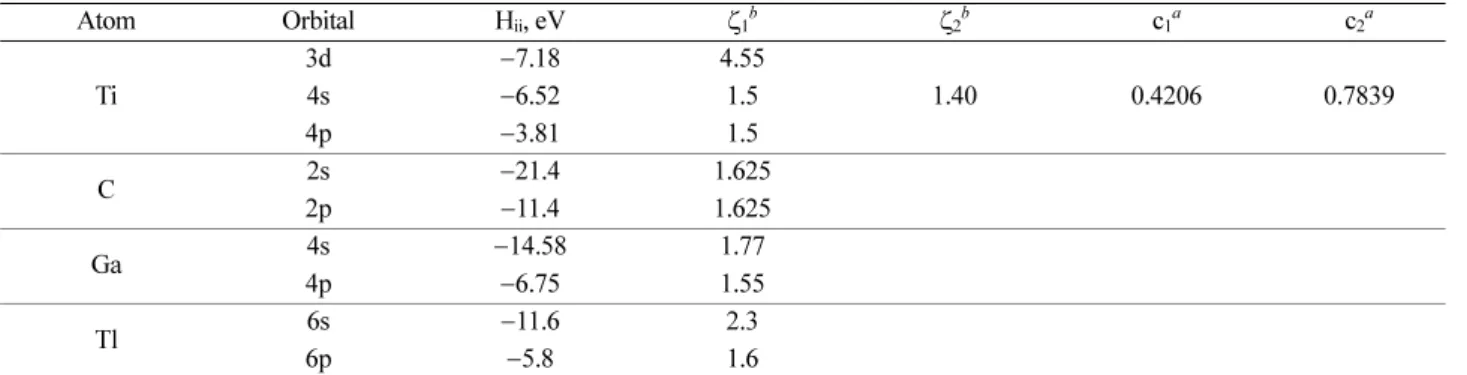
We use the total and projected density of states (PDOS) and crystal orbital overlap population (COOP) techniques to examine the chemical bonding features in Ti2GaC and Ti2TlC phases. The COOP curves are indicative of the nature and strength of the bonds between constituent atoms, with positive and negative regions indicating bonding and anti- bonding states, respectively. These calculations have been performed using the extended Hückel tight-binding (EHTB) method;19,20 parameters are given in Table 1.
STRUCTURE DESCRIPTION
Ti2AC (A = Ga, Tl) compounds crystallizes in the hex- agonal P63/mmc space group (no. 194), with two formula units per unit cell.21,22 The crystal structure of Ti2AC can
be described as the hexagonal closest packing of Ti and A atoms with alternating blocks of titanium carbide (Ti2C) and networks of A atoms. The Ti2C blocks contain a sin- gle layer of edge-sharing Ti6C octahedra adjacent to the networks of A atoms and the Ti2AC structure possesses a layer stacking sequence (along the c-axis) of C−Ti−A−Ti−C−
Ti−A−Ti−C, as shown in Fig. 1. The Ti layer exists in every other layer and the C atoms occupy octahedral holes or anti-prismatic sites between slabs of edge-sharing Ti6A trigonal prisms. The layered structure consists of three types of slabs, lower Ti−A−Ti, middle Ti−C−Ti, and upper Ti−
A−Ti along the c-axis (Fig. 1). Both Ti−A−Ti slabs are made of edge-sharing Ti6A trigonal prisms. The hexagonal
lateral Wyckoff positions of Ti and A atoms in the lower Ti−A−Ti slab are the 4f site (1/3, 2/3) and the 2d site (2/3, 1/3), respectively. Those in the upper Ti−A−Ti slab exchange their sites relative to the lower Ti−A−Ti slab. The C atoms in the Ti−C−Ti slabs occupy only the 2a site (0, 0). No Ti and A atoms exist right below and above the C atoms along the c-axis. The structure is thus defined by two lattice con- stants a and c, and the only free positional parameter z for the Ti atoms. Table 2 shows a summary of the structural data for Ti2AC (A = Ga, Tl).
The bulk modulus values of elasticity are also listed in Table 2. One notices that the bulk modulus of Ti2GaC (146 GPa) is slightly higher than that of Ti2TlC (125 GPa). The decrease in bulk modulus through the replacement of Ga by Tl can be understood by considering the changes in the electronic structure and Ti−A bond strength associated with the different sizes of the Ga and Tl atoms. Detailed elec- tronic and bonding properties are analyzed in the sections that follow.
RESULTS AND DISCUSSION
Electronic Properties
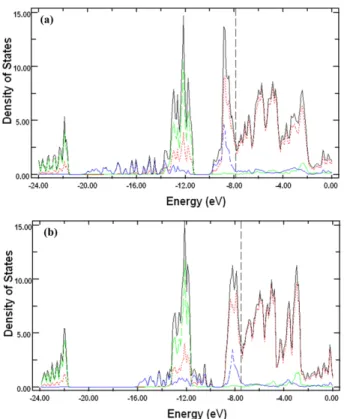
In order to understand the nature of the electronic band structures of Ti2AC (A = Ga, Tl), we have calculated the PDOS for these compounds. The total and projected DOS curves are displayed in Fig. 2. In the two compounds stud- ied, the Fermi level (EF) crosses the lower part of the Ti 3d bands. It is observed that titanium contributes the most to the total DOS around the Fermi level. The contribution of Table 1. Parameters for EH calculations
Atom Orbital Hii, eV ζ1b ζ2b c1a c2a
3d −7.18 4.55
Ti 4s −6.52 1.5 1.40 0.4206 0.7839
4p −3.81 1.5
C 2s −21.4 1.625
2p −11.4 1.625
Ga 4s −14.58 1.77
4p −6.75 1.55
Tl 6s −11.6 2.3
6p −5.8 1.6
aCoefficients used in double-ζ expansion. bSlater-type orbital exponents.
Fig. 1. Primitive unit cell of Ti2GaC.
Table 2. Structural data for Ti2AC (A = Ga, Tl). The bulk modulus B is also shown
Compound a (Å) c (Å) z B (GPa)
Ti2GaC 3.0314 13.219 0.0852 146
Ti2TlC 3.18 14.16 0.0777 125
A elements around the Fermi level is small, and it is almost negligible for C. This implies that as for the great majority of the MAX phases, the electrical conductivity of these compounds comes from the electronic states of the transition metal, specifically the Ti 3d electrons.
As seen in Fig. 2(a), the lowest valence bands of Ti2GaC centered at around −22 eV arise mainly from the carbon 2s orbital. The higher valence bands in the range −13.5 to −11 eV are composed almost entirely of C 2p orbitals with a mix- ture of Ti 3d orbitals. This is an indication of the strong orbital mixing between C 2p and Ti 3d. This covalent bond- ing interaction may play an important role in explaining the structure stability of Ti2GaC, a general trend in MAX phases. The structure ranging from −10 eV to −2 eV consists mainly of Ti 3d orbitals. The DOS just below the Fermi level is derived from Ti 3d states with an admixture of Ga 4p orbitals, suggesting the formation of Ti−Ga bonds. The higher lying structure up to −2 eV consists of a mixture of mostly Ti d and C/Ga p states. Their antibonding states are seen above EF in the energy range −4 to −2 eV. Also, the PDOS profile exhibits another interesting feature: the bonding peaks of C 2p−Ti 3d orbitals (−13.5 to −11 eV) are much more delocalized and stronger than those of Ti
3d−Ga 4p orbitals (−10 to −8 eV). This suggests that Ti−C bonds are stronger than Ti−Ga bonds. This conclusion is consistent with the fact that in the majority of MAX phases, the M−X bonds are stronger than the M−A bonds.
The DOS for Ti2TlC is illustrated in Fig. 2(b). It is found that the Ti 3d−C 2p bonding states in Ti2TlC have a similar energy range to those in Ti2GaC, which indicates the sim- ilar bond strength. However, Ti 3d−Tl 6p bonding states, ranging from −9 to −7.5 eV, are shifted to higher energy, compared to Ti 3d−Ga 4p bonding states at −10 to −8 eV (Fig. 2(a)). It is also clear from Figs. 2(a) and 2(b) that Ti 3d−Ga 4p bonding states in Ti2GaC are much more delo- calized than Ti 3d−Tl 6p bonding states in Ti2TlC, sug- gesting a stronger covalent character for the Ti−Ga bond as compared with Ti−Tl. This result explains higher elas- tic bulk modulus of Ti2GaC than Ti2TlC. Another com- mon feature is the metallic bonding states in the vicinity of the Fermi level that originate from the d−d interactions between the Ti atoms in Ti−C−Ti slab. They contribute slightly to the bonding.
With the Ti2GaC and Ti2TlC structures, the Ti6C octa- hedra are compressed along z in all compounds. The in- plane Ti−Ti distances in Ti2GaC and Ti2TlC are 3.03 and 3.18 Å, while the interlayer Ti−Ti distances in Ti2GaC and Ti2TlC are 2.85 and 2.87 Å, respectively. For comparison, the Ti−Ti distance in bulk Ti metal is 2.89 Å. Thus, d−d interactions between the Ti atoms in the Ti2C sublattice should play an appreciable role in the bonding. The Ti−C distances in Ti2GaC and Ti2TlC is 2.08 and 2.14 Å, respec- tively, which are slightly less than that in binary carbide TiC (2.16 Å).23 Thus, presumably strong orbital interac- tions of Ti with C should be expected. The Ti−Ga distance is 2.79 Å. This distance is a lot larger than the sum of sin- gle-bond metallic radii for Ti and Ga (2.57 Å).24 The Ti−Tl separation is 3.05 Å, which is much larger than a value of 2.87 Å expected for a Ti−Tl single bond.24 This probably indicates the weaker bonding interactions between Ti and Ga/Tl in contrast to the Ti−C interaction. The Ga−Ga bond distance in Ti2GaC (3.03 Å) is much longer than the one in pure Ga (2.44 Å). The bonding contribution of the Ga atoms results from their bonding to the Ti6C blocks via presum- ably p−d overlap out of the basal planes, and not from bonding formed between them.
At this point the discussion of the mixing features solely from the PDOS cannot give detailed information about the chemical bonding in these compounds. A further step must be undertaken by examining the COOP. Let us now turn our attention to their bonding properties.
Fig. 2. Total DOS (black line) and the contributions of Ti (red line), C (green line), and A (blue line) orbitals to it in (a) Ti2GaC and (b) Ti2TlC. The vertical dashed lines denote the Fermi level.
Bonding Properties
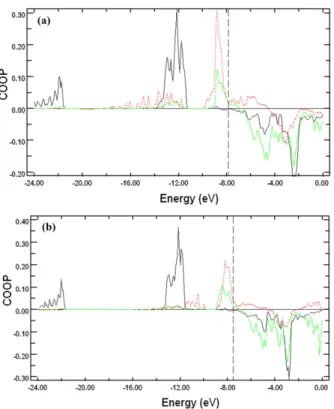
The calculated COOP provides valuable insight to under- stand the nature of the chemical bonding controlling the properties of these structures, which can be assessed fur- ther by Mulliken population analysis. We show in Fig. 3 the calculated COOP curves for atom pairwise interac- tions in the Ti2GaC and Ti2TlC systems. Note the general characteristics of COOP curve: positive regions that are bonding and negative regions that are antibonding.
Analysis of the orbital interactions via COOP indicates that the Ti−C bonding is optimized in both compounds.
From Figs. 3(a) and 3(b), it is seen that the bonding states of Ti 3d−Ga 4p and Ti 3d−Tl 6p are present at approxi- mately −9 and −8 eV, respectively, and stronger Ti 3d−C 2p bonding states are lying deeper in energy (around −12 eV).
Not all bonding states are filled for both Ti−Ga and Ti−Tl interactions. In fact, the degree of the bond strength does not only depend on the relative COOP peak positions below the Fermi level but also on the relative intensity of the peaks. For a given bond, the integrated overlap pop- ulation up to the Fermi level reflects its bond strength. The difference in the bond strength of Ti−Ga and Ti−Tl is attrib- uted to the change of the electronic structure with increas- ing the atomic size of A element from Ga to Tl. As shown
in Figs. 3(a) and 3(b), the peak of Ti 3d−Tl 6p bonding states slightly shifts toward the Fermi level and becomes weak, compared with that of Ti 3d−Ga 4p bonding states.
In Ti2GaC and Ti2TlC, below EF, the Ti−C bonding inter- actions predominate. All antibonding counterparts of Ti− Ga/Tl as well as Ti−C interactions can be seen in the con- duction bands (approximately −4 to −2 eV). Therefore, the Ti−Tl bonding results in the weaker coupling between the transition metal carbide slabs and A-group atom layers, compared to Ti−Ga bonding.
The covalent strength of a specified bond can be deter- mined by the total overlap population obtained by sum- ming up the area under the COOP curve up to the Fermi level. We list in Table 3 the calculated overlap populations (OP) and bond distances for some covalent bonds in Ti2GaC and Ti2TlC. The overlap population yields ca. 0.39−0.40 for Ti−C bonds in these compounds. This shows that the degree of covalency for Ti−C bonds is very strong. The larger OP value of Ti−Ga bonds in Ti2GaC indicates that there occurs a strengthening of Ti−A bonds as the A element switches from Tl to Ga. The elastic properties in Ti2AC (A
= Ga, Tl) compounds are strongly related to the covalent bond strength of Ti−A bonds with the different atom sizes of Ga and Tl elements in a group. More filled bonding states of Ti−Ga bonds, compared to Ti−Tl bonds, nicely explain the larger bulk modulus of Ti2GaC than that of Ti2TlC. Therefore, the strengthening of Ti−A bond gives rise to the enhancement of elasticity in Ti2AC.
CONCLUSION
We have performed EHTB band structure calculations for the layered Ti2AC (A = Ga, Tl) carbides to study the relationship between their electronic structure and elastic properties. Our results show that replacing Ga by Tl affects considerably the Ti−A bonding and elastic properties. It is concluded that the lower bulk modulus is related to the weaker Ti−A bonds. Compared to Ti−Tl bonds, the larger overlap population of Ti−Ga bonds results in the stronger Fig. 3. Crystal orbital overlap populations for the Ti−C (black
line), Ti−A (red line), and Ti−Ti (green line) bonds in (a) Ti2GaC and (b) Ti2TlC. The vertical dashed lines denote the Fermi level.
Table 3. Overlap populations (OP) for Ti−C, Ti−A, and Ti−Ti bonds in Ti2AC (A = Ga, Tl)
Compound Bond Bond length (Å) OP
Ti2GaC Ti−C 2.081 0.40
Ti−Ga 2.794 0.28
Ti−Ti 2.852, 3.031 0.10
Ti2TlC Ti−C 2.140 0.39
Ti−Tl 3.053 0.21
Ti−Ti 2.866, 3.180 0.11
coupling between the transition metal carbide slabs and A-group atom layers and hence the higher bulk modulus.
We also find that Ti 3d−Ga 4p bonding states are located deeper in energy below the Fermi level and much more delocalized as the Ga 4p orbitals lie lower in energy than Tl 6p. These observations are compatible with the mechan- ical behavior of Ti2AC compounds above.
Acknowledgments. This work was supported by the Kyungsung University Research Grant in 2012.
REFERENCES
1. (a) Barsoum, M. W. Prog. Solid State Chem. 2000, 28, 201. (b) Eklund, P.; Beckers, M.; Jansson, U.; Hogberg, H.; Hultman, L. Thin Solid Films 2010, 518, 1851.
2. Liao, T.; Wang, J. Y.; Zhou, Y. C. J. Phys. Condens. Matter 2006, 18, L527.
3. Medkour, Y.; Bouhemadou, A.; Roumili, A. Solid State Com- mun. 2008, 148, 459.
4. Shein, I. R.; Ivanovskii, A. L. Phys. C 2010, 470, 533.
5. Romero, M.; Escamilla, R. Comput. Mater. Sci. 2012, 55, 142.
6. Ghebouli, M. A.; Ghebouli, B.; Fatmi, M.; Bouhemadou, A. Intermetallics 2011, 19, 1936.
7. Sun, Z. M.; Li, S.; Ahuja, R.; Schneider, J. M. Solid State Commun. 2004, 129, 589.
8. Bouhemadou, A. Mod. Phys. Lett. B 2008, 22, 2063.
9. Cover, M. F.; Warschkow, O.; Bilek, M. M. M.; McK-
enzie, D.R. J. Phys. Condens. Matter 2009, 21, 305403.
10. Wang, J. M.; Wang, J. Y.; Zhou, Y. C.; Hu, C. F. Acta Mater.
2008, 56, 1511.
11. Bai, Y. L.; He, X. D.; Li, Y. B.; Zhu, C. C.; Li, M. W.
Solid State Commun. 2009, 149, 2156.
12. Zhou, Y. C.; Sun, Z. M.; Wang, X. H.; Chen, S. Q. J. Phys.
Condens. Matter 2001, 13, 10001.
13. Sun, Z. M.; Ahuja, R.; Li, S.; Schneider, J. M. Appl. Phys.
Lett. 2003, 83, 899.
14. Sun, Z. M.; Music, D.; Ahuja, R.; Li, S.; Schneider, J. M.
Phys. Rev. B 2004, 70, 092102.
15. Hug, G. Phys. Rev. B 2006, 74, 184113.
16. Wang, J. Y.; Zhou, Y. C. Phys. Rev. B 2004, 69, 214111.
17. Liao, T.; Wang, J. Y.; Zhou, Y. C. J. Mater. Res. 2009, 24, 556.
18. Liao, T.; Wang, J. Y.; Zhou, Y. C. Phys. Rev. B 2006, 73, 214109.
19. Whangbo, M.-H.; Hoffmann, R. J. Am. Chem. Soc. 1978, 100, 6093.
20. Whangbo, M.-H.; Hoffmann, R.; Woodward, R. B. Proc.
R. Soc. A 1979, 366, 23.
21. Bouhemadou, A.; Khenata, R. J. Appl. Phys. 2007, 102, 043528.
22. Warner, J. A.; Patil, S. K. R.; Khare, S. V.; Masiulaniec, K. C. Appl. Phys. Lett. 2006, 88, 101911.
23. Jeitschko, W.; Nowotny, H.; Benesovsky, F. J. Less-com- mon Met. 1964, 7, 133.
24. Pauling, L. The Nature of the Chemical Bond; Cornell Univer- sity Press: Ithaca, New York, 1960.