Special Issue Paper
Enhanced Mechanical Properties of Functionalized Graphene Oxide/linear Low Density Polyethylene Composites
Prepared by Melt Mixing
Suman Chhetri*, Pranab Samanta*, Naresh Chandra Murmu*, Tapas Kuila*†, Joong Hee Lee**†
ABSTRACT:Graphene oxide (GO) was concurrently reduced and functionalized using long alkyl chain dodecyl amine (DA). The DA functionalized GO (DA-G) was assumed to disperse homogenously in linear low density polyethylene (LLDPE). Subsequently, DA-G was used to fabricate DA-G/LLDPE composites by melt mixing technique. Fourier transform infrared spectra analysis was performed to ascertain the simultaneous reduction and functionlization of GO.
Field emission scanning electron microscopy analysis was performed to ensure the homogenous distribution and dispersion of DA-G in LLDPE matrix. The enhanced storage modulus value of the composites validates the homogenous dispersion of DA-G and its good interfacial interaction with LLDPE matrix. An increased in tensile strength value by ~ 64% also confirms the generation of good interface between the two constituents, through which efficient load transfer is possible. However, no significant improvement in glass transition temperature was observed.
This simple technique of fabricating LLDPE composites following industrially viable melt mixing procedure could be realizable to developed mechanically strong graphene based LLDPE composites for future applications.
Key Words: Functionalization, Composites, Melt mixing, Mechanical properties
1. INTRODUCTION
The intriguing properties of graphene have led to the devel- opment of light weight, yet strong polymer composites mate- rials. The idea of integrating graphene or its derivatives with polymer matrix has been appealing from various perspectives.
Graphene, as reinforcing filler have outperformed the perfor- mance of other widely used nanofiller such as CNT or MWCNT [1]. The physical properties of polymer composites were found to depend upon dispersion of filler and its inter- action with the polymer system. The improvement in the mechanical properties of the composites is basically the func- tion of degree of adhesion of filer to the polymer matrix and efficient stress transfer. Various technique such as solution processing [2], melt mixing [3], in-situ polymerization [4], have been utilized to combine the graphene with polymer and
to maximize the dispersion and homogenous distribution of graphene or functionalized graphene.
Graphene oxide (GO), precursor of graphene being hydro- philic in nature has less compatibility with most of the organic polymer. Moreover, strong π-π interaction and van der Waal's force between the graphene sheets restrain its complete exfo- liation in polymer matrix. Thus, transfer of fundamental prop- erties of graphene into polymer system necessitates homogenous distribution of filler, good dispersion and strong interaction at the graphene-matrix interface and junction cohesion. As GO surface is crowded with several chemically vulnerable groups, upon which various chemical entities can be introduced through chemical reaction. By introducing organic moieties, the surface of GO can be subtly tuned to enhance the com- patibility of graphene with polymer matrix and junction cohe- sion can also be improved.
Received 16 August 2016, received in revised form 30 August 2016, accepted 30 August 2016
*
**
†
Surface Engineering & Tribology Division, Council of Scientific and Industrial Research-Central Mechanical Engineering Research Institute, Durgapur-713209, India
Advanced Materials Research Institute for BIN Convergence Technology (BK Plus Global, Program), Department of BIN Convergence Technology, Chonbuk National University, Jeonju, Jeonbuk 54896, Korea
Corresponding authors, Dr. Tapas Kuila (E-mail: [email protected]) and Prof. Joong Hee Lee (E-mail: [email protected])
Myriad of works are reported on the chemical function- lization of GO, in an attempt to exploit most of its properties for instance, isocyanate modification, amination esterification [5-9]. Nucleophilic addition of various organic groups to GO surface is more viable way to the production of bulk amount of surface modified graphene [10]. Kuila et al. modified surface of GO by dodecyl amine and fabricated linear low-density polyethylene (LLDPE) composite and reported 46% enhance- ment in tensile strength at 3% weight of DA-G [6]. Jang et al.
modified surface of GO by different alkyl chain length alkyl amine, prepared composite with polystyrene and reported enhancement in storage modulus and thermal stability [11].
Kim et al used ethylenediamine for the simultaneous func- tionalization, reduction and stitching of GO and investigated its effect on the mechanical properties of the LLDPE com- posites [12]. It is assumed that the introduction of alkyl chain amine on GO enhance the compatibility, dispersion and junc- tion cohesion, which is crucial for stress transfer at the junc- tion and in some cases it also reduced GO without using additional hazardous reducing agents [9]. However, in most of the cases, the composites were prepared by solution mixing, where chemically hazardous solvent was used to finely disperse graphene.
Herein, we used dodecyl amine to concurrently function- alized and reduced GO, and its impact on mechanical prop- erties of the LLDPE composites was studied. We choose to study LLDPE polymer as it is one of the most widely used thermoplastic polymers, having enormous applications, mainly for plastic films, tubes etc. due to its excellent tear and impact strength, large elongation, and superb puncture resis- tance. Nevertheless, pure LLDPE has low mechanical prop- erties, which impairs its applicability in different area. Melt mixing technique was employed to fabricate the DA-func- tionalized GO/LLDPE composites. Melt mixing can be con- sidered more viable than solution mixing technique, as this process does not require hazardous solvent.
2. EXPERIMENTAL
2.1 Materials
Natural graphite flakes were purchased from Sigma- Aldrich., hydrochloric acid, sulphuric acid, potassium per- manganate and hydrogen peroxide were purchased from E- Mark, Mumbai; India. DA was procured from Sisco research Laboratories, Mumbai, India. LLDPE polymer pellets were supplied by Reliance industries Limited, Gujarat, India. All the reagents were of analytical grade and used as received without further purification.
2.2 Preparation of DA modified GO (DA-G)
Graphite oxide was prepared through modified Hummer’s method as reported earlier by our group [13]. DA-G was pre- pared following the method as reported from our previous
publication [2]. In brief, ~1 g of graphite oxide was dispersed in 100 ml of DI water by continuous water-bath sonication (Emmi20, Germany) with applied frequency of 45 kHz for about 30 min. The un-exfoliated graphite oxide was removed via centrifugation at 3000 rpm for about 15-20 min. About 3 g of DA was dissolved in 100 ml of ethanol. The mixture was stirred at room temperature for ~24 h and another ~16 h under refluxing condition. The conversion of brown to black colour aggregates confirmed the simultaneous surface func- tionlization and partial reduction of GO [9]. The black pre- cipitate was vacuum filtered by washing repeatedly with water- ethanol mixture and dried under vacuum at 60oC for ~72 h to achieve black dry powder of DA-G.
2.3 DA-G/LLDPE composite preparation
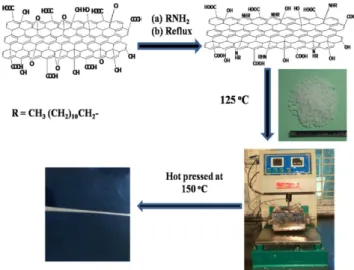
LLDPE composites using different weight fraction of DA-G were prepared by melt compounding using sigma melt mix- ture, at a processing temperature of 125oC, screw speed of 60 rpm and the mixing time of 15 min. The melt mixing was carried out by slowly adding the LLDPE pellets into the mix- ing site. DA-G was added to the melt polymer. The materials obtained after melt mixing were cooled to room temperature and collected as a lump. It was then hot pressed into sheet of thickness of 2 mm using an electrically heated hydraulic press for ~15 min at 150oC. After cooling to room temperature, the samples were cut from the sheet for various testing. Fig. 1 shows the schematic of the functionlization of GO with DA and preparation of its composites with LLDPE matrix by melt mixing.
2.4 Characterizations
Fourier transform infrared (FT-IR) spectra were recorded with PerkinElmer RXI FT-IR in the frequency range of 4000- 400 cm-1. Field emission scanning electron microscopy (FE- SEM) was carried out with Σigma HD, Carl Zeiss, Germany.
Fig. 1.Schematic for the functionlization of graphene oxide by DA and preparation of LLDPE composites by melt mixing
The tensile measurements were carried out according to ASTMD-638 standard using a Tinius Olsen h10KS universal testing machine at 25oC with a crosshead speed of 2 mm min-1. The dimension of the tensile sample was 77 mm length (work- ing length of sample was 31 mm), 1 mm width and 1.5-2 mm thickness. Five specimens of each composite were tested to obtain the standard deviation. Dynamic mechanical analysis (DMA) was carried out with DMA 8000 Perkin Elmer in the temperature range of -90 to 90oC with a heating rate of 3oC min-1 at a constant frequency of 1 Hz at a load strain of 0.010 mm. Rectangular specimens of dimension 10 × 9 × 2.5 mm3 were prepared for DMA measurements.
3. RESULTS AND DISCUSSION
3.1 FT-IR Spectra analysis
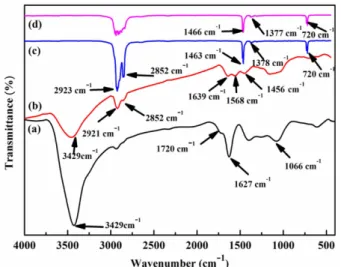
Fig. 2 shows the FT-IR spectra of GO, DA-G, pure LLDPE and DA-G/LLDPE composites at 0.25 wt%. The peaks at 1720 and 1066 cm-1 of GO are assigned to the -C=O stretching vibration and -C-O-C- in epoxide group of GO, respectively.
The bands at 1627 and 3429 cm-1 can be attributed to the gra- phitic sp2 C and hydroxyl group. The appearance of the peak at 1639 cm-1 in DA-G corresponding to the C-O stretching vibration established amide bonds formation. The reaction between the epoxide group of graphene oxide and amine group of DA can be confirmed by peaks at 1568 and 1456 cm-1, which could be accounted for N-H and C-N stretching vibra- tion. The appearance of peaks at 2852 and 2921 cm-1, which is due to the C-H stretching vibration of -CH2 and -CH confirms the grafting of DA on the surface of GO. Pure LLDPE and its composites with DA-G exhibited bands at 2923 and 2852 cm-1, which is assigned to the -C-H bond symmetric and asym- metric stretching respectively. The spectrum of neat LLDPE showed peak at 1463 and 1378 cm-1 which is due to the defor-
mation of -CH2 and -CH3 groups were shifted slightly to 1466 and 1377 cm-1 in DA-G/LLDPE composites, which could be due to the possible interaction between the LLDPE matrix and DA-G. The peak of the DA-G/LLDPE composites at the region of 2800~3000 cm-1 is quite different from that of the pure LLDPE. The appearance of not distinct but fused multiple peak may be assigned to the -C-H bond symmetric and asym- metric stretching of DA entity and LLDPE polymer matrix.
Small interaction of DA-G with LLDPE matrix may be respon- sible for the multiple nature of the peak. Though the shift is very small (just 1~3 cm-1), possible interaction between the LLDPE matrix and DA-G cannot be rule out. The observed small shift may be due to the little amount of DA-G (0.25 wt%) relative to the polymer matrix. The broad band that appeared in spectrum (a & b) at 3429 cm-1 may be due to the -O-H stretching in both graphene oxide and DA-G spectra indi- cating incomplete reduction of graphene oxide [14].
3.2 Stress-Strain properties
Fig. 3 represents the typical stress-strain curve of melt pro- cessed DA-G/LLDPE composites. The DA-G incorporated LLDPE composites exhibit enhanced tensile properties, the maximum tensile strength enhancement of 60.62% was observed at 0.5 wt % of DA-G against neat LLDPE. The improvement in tensile strength may be accounted to the fine dispersion of high surface area DA-G and its strong interfacial adhesion with the LLDPE matrix, thereby, facilitating the effi- cient transfer of stress across interface. The addition of 3 wt%
DA-G, decreased the tensile strength but it was found higher than the neat LLDPE. The decreased at higher loading may be due the agglomeration of the DA-G sheets. However, the elon- gation at the break of the DA-G/LLDPE composites was found to decrease, which may be attributed to the constrained move- ment of the polymer matrix due to the addition of filler par- ticles.
Fig. 2.FT-IR spectra of (a) graphene oxide, (b) DA-G, (c) LLDPE and (d) 0.25 wt% DA-G/LLDPE composites
Fig. 3.Stress- strain curve of neat LLDPE and its composites with DA-G at various loadings
3.3 FE-SEM analysis of the composites
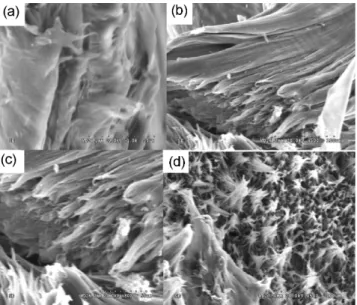
To examine the differences in the tensile fracture morphol- ogy of pure LLDPE and its composites with DA-G, FE-SEM images were analyzed in detail. Fig. 4(a-d) represents the over- view of the fracture morphology of the LLDPE and DA-G/
LLDPE composites. The fracture surface morphology of the pure LLDPE was smooth plain which suggest the failure of the material take placed at lower stress. In contrary to pure LLDPE, DA-G/LLDPE composites revealed comparatively rough fracture surface, which accounts for the improved mechanical properties. As can be seen from the Fig. 4c&d the sheets of the carbon layered of the polymer matrix are pro- trude which manifest the strong interfacial interaction between the DA-G and LLDPE polymer matrix and validate the improvement in storage modulus, strength value, which was improved by ~64% against neat LLDPE polymer. This simple strategy to produce functionalized GO/LLDPE com- posites by industrially viable technique could be promising in the direction of developing mechanically strong graphene based composites.
3.4 Dynamic mechanical properties
The storage modulus (E'), loss modulus (E''), and tan δ (loss factor) of the DA-G/LLDPE composites are presented in Fig.
5-7 as a function of temperature. E' measures the capability of material to store energy under cyclic load, and it also accounts the stiffness of the materials, whereas, E'' quantifies the amount of unrecoverable energy dissipation per cycle. Tan δ or damping is the ratio of the E'' to E' and is associated with the segmental motion of the polymer chains. DMA values of the DA-G/LLDPE composites are shown in Table 1. The storage modulus of the composites was found to increase with the
content of DA-G, except for 0.25 wt% DA-G. The highest improvement in the E' was recorded at 0.5 wt% of DA-G, which may be due to the maximum degree of dispersion at this weight fraction and good degree of interfacial interaction.
The good interfacial interaction generates strong junction cohesion, which helps in efficient load transfers and also inhibits the segmental mobility of the polymer chain. The intrinsic stiffness characteristics of the graphene contributes to improve the E' of the LLDPE composites. Thus, incorporation of DA-G endows the stiffness to the LLDPE composites. The decrease in E' at 0.25 wt% of DA-G, may be due to the low content of DA-G, which might not generate good interface with the matrix and thus, could not produce enough lamellar barrier effect sufficient to inhibit the segmental motion of LLDPE polymer matrix.
The tan δ curve of the neat LLDPE and its composites is shown in Fig. 6. As can be observe from the figure, neat LLDPE and its composites showed two relaxation one one at -24 to -20oC (β-relaxation) and another in the range of 79- Fig. 4.FE-SEM images of the tensile fractured surface of (a) at
LLDPE (b) (0.25 wt%) and (c&d) (0.5 wt%) DA-G/LLDPE composites
Fig. 5.Variations of the storage modulus of DA-G/LLDPE com- posites at different weight fraction
Fig. 6. Variation of tan δ of DA-G/LLDPE composites against temperature
90 oC (α-relaxation). The tan δ peak which is very sensitive to structural transformation can be used to derive Tg from its peak position. However, the tan δ peak in the study as evident from the figure is not completely discernible. There was very little change in the and β value for both LLDPE and its com- posites with DA-G. The decreased height of the tan δ peak suggests decreased damping property of the DA-G/LLDPE composites.
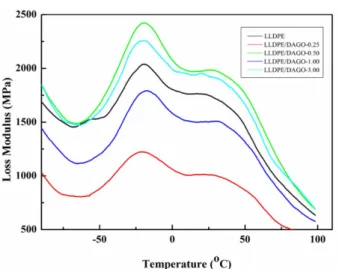
The peak position of E'' curve is also helpful to determine the Tg value in instances when tan δ peak fails to provide. Fig.
7 shows the E'' curve, which also shows marginal changes in relaxation.
4. CONCLUSIONS
Long alkyl chain DA functionalized GO was used to fab- ricate LLDPE composites via economically viable and envi- ronmentally friendly melt mixing technique. FT-IR spectra analysis was performed to substantive the functionlization and partial reduction of GO. FE-SEM micrograph was analyzed to study the fracture surface morphology of pure LLDPE and its composites. The presence of alky chain on DA helped to gen- erate good interfacial interaction with the LLDPE matrix, which reflected in the enhanced storage modulus of the com-
posites. The reinforcing capability of the DA-G endows stiff- ness to the LLDPE matrix. The efficient junction cohesion was also reflected in the improved tensile strength value, which was improved by ~ 64% against neat LLDPE polymer. The fab- rication of LLDPE/graphene composites with enhanced mechanical properties through industrially viable and envi- ronmentally friendly technique could be promising in the direction of developing high performance composites.
ACKNOWLEDGEMENT
Authors are thankful to the Director of CSIR-CMERI.
Authors are also thankful to Department of Science and Tech- nology, New Delhi, India for the financial supports (GAP041212) and Council of Scientific and Industrial Research, New Delhi, India for funding MEGA Institutional project (ESC0112/RP- II). Also supported by Nano Material Technology Develop- ment Program (2016M3A7B4900117) through the Ministry of Science, ICT & Future Planning, Republic of Korea.
REFERENCES
1. Rafiee M.A., Rafiee, J., Wang, Z., Song, H., Yu, Z.Z., and Korat- kar, N., “Enhanced Mechanical Properties of Nanocomposites at Low Graphene Content,” ACS Nano, Vol. 3, No.12, 2009, pp. 3884-3890.
2. Chhetri, S., Samanta, P., Murmu N.C., Srivastava, S.K., and Kuila, T., “Effect of Dodecyal Amine Functionalized Graphene on the Mechanical and Thermal Properties of Epoxy-based Composites,” Polymer Engineering and Science, 2016 (In Press) DOI 10.1002/pen.24355.
3. Kim, S., Do, I., and Drzal, L.T., “Multifunctional xGnP/LLDPE Nanocomposites Prepared by Solution Compounding Using Various Screw Rotating Systems,” Macromolecular Material and Engineering, Vol. 3, No. 294, 2009, pp. 196-205.
4. Kuila, T., Bose, S., Khanra, P., Kim, N.H., Rhee, K.Y., and Lee, J.H., “Characterization and Properties of in situ Emulsion Polymerized Poly(methyl methacrylate)/graphene Nanocom- posites,” Composites Part A, Vol. 42, No. 11, 2011, pp. 1856- 1861.
5. Stankovich, S., Piner, R.D., Nguyen, S.T., and Ruoff, R.S., “Syn- thesis and Exfoliation of Isocyanate-treated Graphene Oxide Nanoplatelets,” Carbon, Vol. 44, No. 15, 2006, pp. 3342-3347.
6. Kuila, T., Bose, S., Hong, C.E., Uddin, Md E., Khanra, P., Kim, N.H., and Lee, J.H., “Preparation of Functionalized Graphene/
linear Low Density Polyethylene Composites by a Solution Mixing Method,” Carbon, Vol. 49, No. 3, 2011, pp. 1033-1051.
7. Bourlinos, A.B., Gournis, D., Petridis, D., Szabo, T., Szeri, A., and Dékány, I., “Graphite Oxide: Chemical Reduction to Graphite and Surface Modification with Primary Aliphatic Amines and Amino Acids,” Langmuir, Vol. 19, No. 15, 2003, pp.
6050-6055.
8. Wang, J.Y., Yang, S.Y., Huang, Y.L., Tien, H.W., Chin, W.K., and Ma, C.C.M., “Preparation and Properties of, Graphene Oxide/
Fig. 7.Variation of loss modulus of DA-G/LLDPE composites against temperature
Table 1. DMA values of neat LLDPE and DA-G/LLDPE composites
Sample E' MPa
(-90oC)
E'' MPa (-90oC)
Tan δα-max At 80oC
LLDPE 60316.06 1677.05 0.134
LLDPE-0.25 48884.98 1027.36 0.1195
LLDPE-0.5 84521.51 1846.76 0.1446
LLDPE-1 75724.31 1841.15 0.1244
LLDPE-3 64503.95 1440.00 0.1344
polyimide Composite Films with Low Dielectric Constant and Ultrahigh Strength via in situ Polymerization,” Journal of Mate- rial Chemistry, Vol. 21, No. 35, 2011, pp 13569-13575.
9. Xu, Y., Liu, Z., Zhang, X., Wang, Y., Tian, J., Huang, Y., Ma, Y., Zhang, X., and Chen, Y., “Graphene Hybrid Material Cova- lently Functionalized with Porphyrin: Synthesis and Optical Limiting Property,” Advanced Material, Vol. 21, No. 12, 2009, pp. 1275-1279.
10. Stankovich, S., Dikin, D.A., Dommett G.H.B., Kohlhaas, K.M., Zimney, Eric, J., Stach, Eric A., Piner, R. D., Nguyen, Son B.T., and Ruoff, R.S., “Graphene-based Composite Materials,”
Nature, Vol. 442, 2006, pp. 282-286.
11. Jang, J., Pham, V.H., Rajagopalan, B., Hur, S.H., and Chung, J.S.,
“Effects of the Alkylamine Functionalization of Graphene Oxide on the Properties of Polystyrene Nanocomposites,"
Nanoscale Research Letters, Vol. 9, No. 1, 2014, pp. 265.
12. Kim, N.H., Kuila, T., and Lee, J.H., “Simultaneous Reduction, Functionalization and Stitching of Graphene Oxide with Eth- ylenediamine for Composites Application,” Journal Material Chemistry A, Vol. 1, No. 4, 2013, pp. 1349-1358.
13. Jana, M., Khanra, P., Murmu, N.C., Samanta, P., Lee, J.H., and Kuila T., “Covalent Surface Modification of Chemically Derived Graphene and Its Application as Supercapacitor Electrode Material,” Physical Chemistry and Chemical Physics, Vol. 16, 2014, pp. 7618-7626.
14. Kuila, T., Bose, S., Mishra, A.K., Khanra, P., Kim, N.H., and Lee, J.H., “Effect of Functionalized Graphene on the Physical Properties of Linear Low Density Polyethylene Nanocompos- ites,” Polymer Testing, Vol. 31, No. 1, 2012, pp. 31-38.