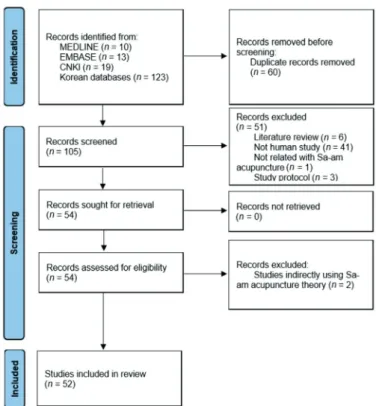
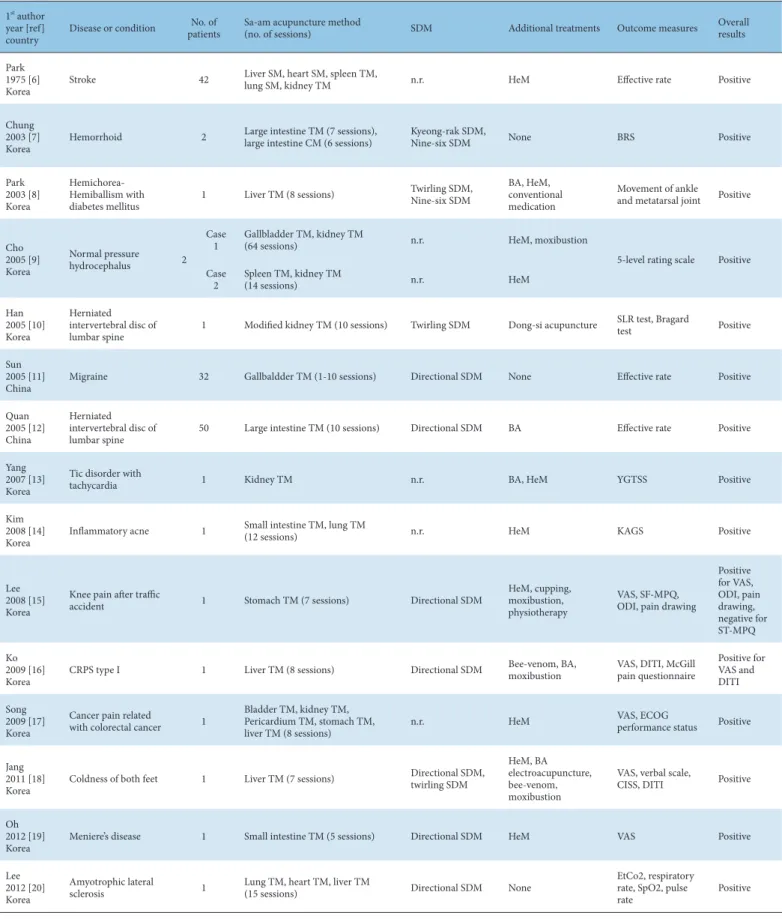
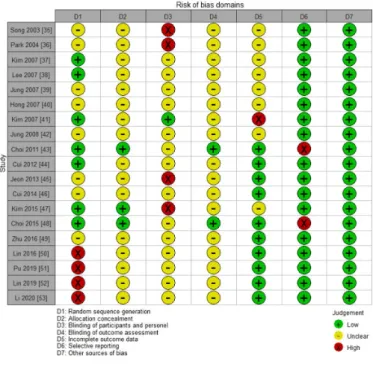
Sa-am acupuncture originated in the Chosun Dynasty and is a distinct feature of Korean medicine. It has been used to treat various diseases and conditions in clinical practice however, there is insufficient scientific evidence to support the use of Sa-am acupuncture. We aimed to comprehensively review the clinical studies of Sa-am acupuncture retrieved from national and international databases (MEDLINE, EMBASE, the China National Knowledge Infrastructure, and 3 Korean databases). There were 52 articles reviewed including 29 case studies, 19 randomized controlled trials (RCTs), and 4 uncontrolled trials. Neurological disorders were the most frequently studied, and kidney tonification, and directional supplementation and draining were the most frequently used methods. Overall, the outcomes were generally positive however, there were many additional treatments together with Sa-am acupuncture reported in the case reports, and the quality of evidence was low in the RCTs. Future studies should report the detailed method of practicing Sa- am acupuncture treatment and focus on the specific effect of Sa-am acupuncture with rigorous design to scientifically support the clinical use of Sa-am acupuncture.
©2021 Korean Acupuncture & Moxibustion Medicine Society. This is an open access article under the CC BY- NC-ND license (http://creativecommons.org/licenses/by-nc-nd/4.0/).
Article history:
Submitted: June 28, 2021 Revised: July 13, 2021 Accepted: July 16, 2021 Keywords:
Sa-am acupuncture, Korean medicine, review
https://doi.org/10.13045/jar.2021.00115 pISSN 2586-288X eISSN 2586-2898
Review Article
A Literature Review of Clinical Studies Using Sa-am Acupuncture
Jinwoong Lim 1, *, Yong-hwa Kim 1 , Yu-gon Kim 2 , Hyeon-gyo Jeong 2 , Kyung-moon Shin 1 , Dong-hoon Shin 1 , Hwe-joon Jeong 2 , Deok Kang 2 , Jae-woo Yang 1 , Ji-hoon Oh 1 , Hong-ryoul Yoon 2 , Jae-sung Jo 2
1. Department of Acupuncture and Moxibustion, Mokhuri Neck and Back Hospital, Seoul, Korea 2. Department of Korean Medicine Rehabilitation, Mokhuri Neck and Back Hospital, Seoul, Korea
ABSTRACT
Journal of Acupuncture Research
Journal homepage: http://www.e-jar.org
Introduction
Sa-am acupuncture was invented by Sa-am in the Chosun Dynasty and is a method of acupuncture which originated in Korea [1]. It uses the characteristics of acupuncture points and meridians based on Huangdineijing, which is different from conventional acupuncture [2]. In a survey of clinical practice in Korea in 2005, Sa-am acupuncture was the 2
ndmost frequently used acupuncture method following conventional acupuncture, and 50.6% of Korean medicine doctors used Sa-am acupuncture [3].
Sa-am acupuncture uses the 5 Shu acupuncture points, and the main principles are “tonification-sedation between deficiency and excess” and “tonification-sedation between coldness and heat [4].”
If a patient is diagnosed with lung deficiency, the lung-tonification method is used in Sa-am acupuncture by tonifying LU9, SP3, and sedating HT8 and LU10. The 4 acupuncture points are selected
based on the 5 Shu acupuncture points theory, and the practitioner can use a supplementation and draining method (SDM). However, there is no generally approved SDM. Consequently, this is an obstacle when using Sa-am acupuncture in clinical practice and describing the possible benefits of Sa-am acupuncture.
Clinical studies of Sa-am acupuncture are being conducted however, Sa-am acupuncture is usually assessed alongside conventional acupuncture, and has not been paid as much attention as conventional acupuncture. A comprehensive review of clinical studies (rather than classic text books) using Sa- am acupuncture, has not been conducted therefore, we aimed to comprehensively review clinical studies investigating Sa-am acupuncture, and suggest directions for future studies using Sa-am acupuncture.
* Corresponding author. Jinwoong Lim
Department of Acupuncture and Moxibustion, Mokhuri Neck and Back Hospital, 338, Seocho-daero, Seocho-gu, Seoul, 06632, Korea E-mail: [email protected]
ORCID: Jinwoong Lim https://orcid.org/0000-0003-2080-9432, Yong-hwa Kim https://orcid.org/0000-0001-9515-2418, Yu-gon Kim https://orcid.org/0000-0003-2238-5282,