and Wan-Young Chung*****
Abstract
This paper describes a robust mobile u-healthcare system with multiple physiological signs measurement capability in real time with integration of WSN(wireless sensor network) technology and CDMA(code division multiple access) network. A cellular phone receives health data in WSN and performs local physiological signs analysis at a phone processor, and then transmits abnormal data to server for further detail or precise health signal evaluation by a medical doctor over a CDMA network. Physiological signs of the patients are continuously monitored, processed and analyzed locally at cellular phone process to produce useful medical information for diagnosis and tracking purposes. By local simple analysis in cellular phone processor we can save the data transmission cost in CDMA network. By using the developed integrate ubiquitous healthcare service architecture, patients can realize self-health checking so that the prevention actions can be taken earlier. Appropriate self-monitoring and self-management can cure disease and relieve pain especially for patients who suffer from chronic diseases that need long term observation.
Key Words : physiological signs, wireless sensor network, code division multiple access, mobile u-healthcare system
1. Introduction
With an increasing wide spread of mobile phone and the worldwide deployment of mobile and wireless net- work, many healthcare applications are supported by wireless infrastructure which brings tremendous poten- tial like reducing the long-term cost to improve higher quality of healthcare services for today's healthcare industry [1] . Main objective of using mobile phone for healthcare area is mainly because they can be monitored anywhere, anytime and would not be impeded by the physical constraints imposed by the cables, continue their normal life despite their diseases. This allows healthcare providers to minimize the time that patients spend in hospital where the cost of resources is so expensive.
Multiple vital signs such as ECG(electrocardiogram), blood pressure and blood glucose are standard in most medical settings and can be monitored via a series of relevant peripherals. This paper focuses on stand-alone simple diagnosis algorithm which is developed at cel- lular phone processor with inter-working of CDMA (code division multiple access) network and IEEE 802.15.4. Mobile monitoring is adapted to suit patients' individual needs and guarantees the highest level of accuracy. By using stand-alone signal analysis function at the cellular phone, the data transmission cost in CDMA network can be reduced very largely. And also patient itself can monitor his/her health status roughly without any data cost of the cellular phone. Our current study on a conceptual framework for the development of personal mobile physiological monitoring and man- agement system is summarized in the following parts.
This paper is organized as follows: in section two we introduce our proposed system architecture for this mobile monitoring which is a wireless, lightweight sys- tem that uses sensors connected to medical devices to measure vital values in real time continuously. The patient is attached with number of sensors connected to a cellular phone. Vital values are measured and sent to
*Graduate School of Design & IT, Dongseo University
**Dept. of Electronic Engineering, Pukyong National University
***
,****Division of Computer & Information Engineering, Dongseo University
*****Division of Electronics, Computer & Telecommunication Engineer- ing, Pukyong National University
†
Corresponding author: [email protected]
(Received : April 29, 2009, Revised : June 25, 2009,
Accepted : July 31, 2009)
the cellular phone via WSN [2] , analyzed on cellular phone locally and send the information from cellular phone to the doctor over CDMA network [3,4] . Process- ing algorithms for the vital values are described. In sec- tion three, we introduce hardware devices needed to build up this system. Finally, we conducted an experi- ment to prove that our proposed solution works prop- erly.
2. Experimental Methods
2.1. System Design
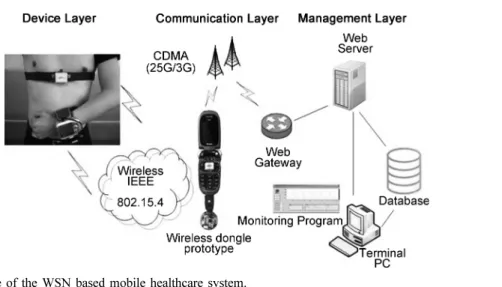
Fig. 1 shows the framework of our mobile healthcare system architecture which consists of device, commu- nication and management layers. The core of device layer includes sensors and wearable devices which are integrated with ECG signal, blood pressure and blood glucose parameters which can aggregate and transmit the collected physiological signs to monitoring program to wireless dongle and then relayed to hospital through cellular phone. Communication layer performs bi-direc- tional data or command exchange via IEEE 802.15.4 network and CDMA to connect between the sensor layer and management layer. This layer is designed to capture, record and work as a distinctive feature to locally analyze physiological signs in cellular phone.
Management layer has a monitoring program in server to monitor and analyze the physiological signs of patients continuously. Only the suspicious abnormal vital signs will be transmitted to hospital server for doc- tor’s evaluation.
2.2. Methodology
ECG processing has two main stages which are QRS Detection Module and Decision Rule Module that based on a set of if-then rules. In the first stage, QRS detection algorithm detects 99.3 percent of the QRS complexes correctly with the standard MIT/BIH arrhythmia data- base based on the originally developed QRS detection algorithm by Pan Tompkins [5] which consists of digital bandpass filter, differentiation, squaring and moving window integration steps as shown in Fig. 2.
The signal passes through digital bandpass filter com- poses of low-pass filter(1) to cut off the frequency at 11 Hz and a high-pass filter(2) to cut off the frequency at 5 Hz. The gain for the low-pass filter is 36 with the fil- tering process delay of 6 samples while the gain for the high-pass filter is 32 with the 16 samples of the filtering processing delay. The differentiation stage(3) is to dif- ferentiate the electrical signs obtained from the band- pass filtering stage to provide the information of the QRS complex stage. The filtered signal is then being squared to make sure all data are positive to obtain higher frequencies(4). Finally, the moving window inte- gration(5) where the averaging window is selected to
Fig. 1. Architecture of the WSN based mobile healthcare system.
Fig. 2. ECG signal processing step.
y(nT)=1/8T[ − x(nT − 2T) − 2x(nT − T)+2x(nT+T) +x(nT+2T)] (3)
y(nT)=[x(nT)] 2 (4)
y(nT)=1/N[x(nT − (N − 1)T+x(nT − (N − 2)T)
+ … + x(nT)] (5)
N: Width of Window T: Sample Period
In the second stage, the information of real-time QRS detection bases on analysis of slope, amplitude and R- to-R interval acquired from first stage is important to categorize the ECG signals into normal or abnormal.
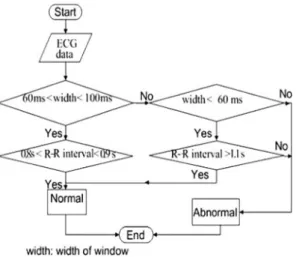
Fig. 3 shows that if width of signal is between 60 ms and 100 ms and R-to-R interval is between 0.8 s and 0.9 s or width is less than 60 ms and the R-to-R interval exceeds 1.1 s, it is categorized as normal. Otherwise, abnormal or unknown waveform will be send to the server monitoring program for further analysis and eval- uation.
Blood pressure is recorded as two numbers − the systolic pressure over diastolic pressure. According to National Heart Lung and Blood Institute(NHLBI) [6] , the typical values for a resting, healthy adult human are
3. Hardware Devices
There are three main hardware components in this proposed architecture: medical devices, a fixed base sta- tion and a wireless dongle prototype. In order for all these devices can provide interoperability layer to access and compatible with each others, they are designed by
Fig. 3. The decision rule for ECG signals normality cate- gorization.
Fig. 4. (a) Screen captured views of cellular phone with a
wireless dongle, (b) a sensor node integrated with
ECG interface and (c) wireless sensor node
connected to combined blood glucose and wrist
blood pressure monitor.
adopting IEEE 802.15.4 standard [5] .
Fig. 4 shows wireless dongle prototype(a) and sensor node built on hardware specifications as shown in Table 1. The dongle is designed at our laboratory and its func- tion is similar to commercial Maxfor’s TelosB mote (TIP710CM). The fabricated sensor node with same specifications of the dongle is integrated with ECG sen- sors in (b). While Hybus’s TelosB mote(moteiv) is inte- grated with blood pressure and blood glucose interfaces in (c).
4. Experimental Result and Discussion
Our experimental set-up uses ECG, blood pressure and blood glucose sensors attach to the real human body to validate the framework that we have proposed and implemented. The data are transmitted from the sensors via wireless sensor network to the wireless dongle that connected to the cellular phone. Cellular phone is embedded with diagnosis program for data evaluation and visualization. The measured data and evaluation result are displayed for monitoring and analyzing pur- poses [7,8] .
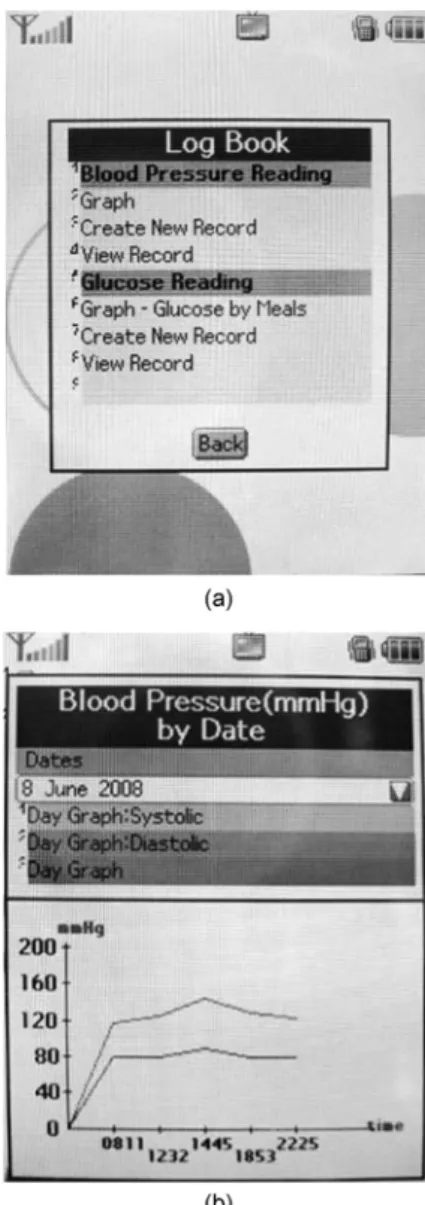
Patients can dramatically reduce the risks of devel- oping long-term complications and of premature death by maintain safe physiological measurements. This “log book” allows patients to monitor and record physiolog- ical signs measurements through the systematic file record management as shown in Fig. 5(a). The records of physiological signs are displayed in graph according to the date selected by patients as shown in Fig. 5(b).
This standalone application provides a friendly user interface where it processes the received data by apply- ing QRS detection algorithm and further classifies the normality of the signals. Patients are able to measure their ECG waves and also their blood pressure or blood glucose simultaneously in real time. Fig. 6 shows screen captured view of ECG graph and blood glucose meas- urements which are performed together. ECG graph is
displayed with the notice of abnormal ECG status of patient and additional information provided such as sus- pected disease, RR interval peak, RR interval time, QRS interval time and ECG values. Normal blood pres- sure measurement with a summary report screen dis- played includes systolic, diastolic, pulse and status of patient is available as shown in Fig. 6(b).
5. Conclusions
ECG, blood pressure and blood glucose analysis are
Table 1. Specifications of a dongle prototype or a sensor node
MCU MSP430F1611
RF Transceiver CC2420
Bandwidth 2.4 GHz
RF Range ~100 m
Power 2.5~4.0 V
Fig. 5. (a) Screen captured “ log book ” and (b) past medi-
cal records on the cellular phone.
monitored with integrated wireless sensor network tech- nology and mobile application to build an efficient health- care monitoring system. This application is implemented
[1] Department of Economic and Social Affairs Popu- lation Division, “World population ageing: 1950- 2050”, Available at: http://www.un.org/esa/popula- tion/publications/worldageing19502050/pdf/
preface_web.pdf, 2001.
[2] 이대석 , 정완영 , “ QRS 검출에 의한 ECG 분석 기능
을 갖춘 무선센서노드를 활용한 u- 헬스케어 시스템 ,
센서학회지” , 제 16 권 , 제 5 호 , pp. 361-368, 2007.
[3] A. Takeuchi, K. Kobayashi, N. Mamorita, and N.
Ikeda, “A cell phone-based diary for chronic dis- eases”, The 4
thIET International Conference on Advances in Medical, Signal and Information Pro- cessing MEDSIP 2008 , Santa Margherita Ligure , Italy , pp. 1-4, 2008.
[4] K-S. Park, N-J. Kim, J-H. Hong, M-S. Park, E-J.
Cha, and T-S. Lee, “PDA based point-of-care per- sonal diabetes management system”, IEEE-EMBS 2005 , Shanghai, China, pp. 3749-3752, 2005.
[5] J. Pan And WJ. Tompkins, “A real-time QRS detec- tion algorithm”, IEEE Transactions on Biomedical Engineering , vol. BME-32, No. 3, pp. 230-236, 1985.
[6] Department of Health & Human Services, “High blood pressure”. Available at: http://www. nhlbi.
nih.gov/health/dci/Diseases/Hbp/HBP_WhatIs.html, 2008.
[7] 이승철 , 이영동 , 정완영 , “실내환경 모니터링시스템
을 위한 무선 센서네트워크에서의 플러딩 방식의
질의모델 설계 및 구현” , 센서학회지 , 제 17 권 , 제 3
호 , pp. 168-177, 2008.
[8] S. Bhardwaj, G. Walia, R. Myllylae and W-Y.
Chung, “Query based ecg monitoring and analyzing system via wireless sensor network”, In proc. of the 2nd International Conf. on Wireless Communication
& Sensor Networks, Allahabad, India, pp. 146-153, 2006.
Fig. 6. (a) Screen captured view of ECG and blood glu-
cose measurements conditions in diagnosis pro-
gram, (b) blood pressure measurement with simple
summary report screen that implemented in cellu-
lar phone.
토 싱 후 이
• 2006
년말레이시아Multimedia University
• 2009
학사년동서대학교디자인& IT
전문대학원유비쿼터스
IT
학과석사• 2009
년R&D engineer, Panasonic Ltd.
•
주관심분야:
모바일헬스케어,
생체신호분석
,
모바일모니터링이 훈 재
• 1985
년경북대학교전자공학과졸업(
공 학사)
• 1987
년경북대학교전자공학과졸업(
공 학석사)
• 1998
년경북대학교전자공학과졸업(
공 학박사)
• 1997
년국방과학연구소선임연구원• 1998
년~2002
년경운대학교조교수• 2002
년3
월~
현재동서대학교 컴퓨터정 보공학부부교수•
주관심분야:
암호이론,
네트워크보안,
부 채널공격정 완 영
• 1987
년경북대학교전자공학과졸업(
공 학사)
• 1989
년동대학원전자공학과(
공학석사)
• 1998
년일본규슈대학총합이공학연구과(
공학박사)
• 1999
년~2008
년동서대학교 컴퓨터정보 공학부부교수• 2008
년~
현재부경대학교전자컴퓨터정보 통신공학부교수•
주관심분야:
유비쿼터스센서네트워크응 용,
마이크로센서, u-
헬스케어이 승 철
• 1999
년경운대학교컴퓨터공학과졸업(
공학사
)
• 2005
년동서대학교소프트웨어전문대학원컴퓨터네트워크학과졸업
(
공학석사)
• 2009
년~
현재부경대학교전자공학과박•
사과정주관심분야:
무선센서네트워크,
무선센서 라우팅알고리즘,
가스센서,
환경시스템,
인공지능