• 검색 결과가 없습니다.

A Comparative Study of Optimal Stretch Intensity For Flexibility of Hamstrings; Hand Held Dynamometer and Verbal Rating Scale

N/A
N/A
Protected

Academic year: 2021

Share "A Comparative Study of Optimal Stretch Intensity For Flexibility of Hamstrings; Hand Held Dynamometer and Verbal Rating Scale"

Copied!
8
0
0

로드 중.... (전체 텍스트 보기)

전체 글

(1)

Introduction

Muscular flexibility is an important aspect in in- ducing an athlete’s optimal movements and is related primarily to successful sports and motor skills performance. However, when an athlete lacks the re- quired muscular flexibility, he or she is more likely to suffer lasting muscular damages from sport-re- lated injuries such as hamstring strain. Hamstring strain is one of the most typical injuries resulting from a lack of flexibility in the muscle (Petersen and Hölmich, 2005). Although not much evidence-based study has been carried out in preventing injury, stretch the muscles to prevent hamstring strain pre-

vails in the field of many sports.

To improve muscle flexibility, the most common type of stretch is static stretch, which is considered safe and effective for improving overall flexibility of muscles (Anderson and Burke, 1991; Palmieri et al, 2004; Sady et al, 1982). In general, there are three types of stretch: static stretch, ballistic stretch, and proprioceptive neuromuscular facilitation (PNF) stretch (Anderson and Burke, 1991; Sady et al, 1982). Of these methods, the static stretch method involves reaching forward to a point of tension using sub- jective perceptions of stretch intensity and often leads to difficulty in determining the optimal intensity (Hortobagyi et al, 1985; Wallin et al, 1985), position Corresponding author: Bong-sam Choi [email protected]

This study wan funded by Woosong University.

A Comparative Study of Optimal Stretch Intensity For Flexibility of Hamstrings; Hand Held Dynamometer and Verbal Rating Scale

Bong-sam Choi, PhD, MPH, PT

Dept of Physical Therapy, College of Health and Welfare, Woosong University

Abstract  

Background: To improve muscle flexibility, static stretch is the most common type and is considered safe and effective for improving overall flexibility of muscles. During the stretch, the intensity is more likely to be determined by the degree of an athlete’s pain and practitioner’s skills rather than quantitative measures of stretch. It is necessary to determine the optimal intensity for the stretch.

Objects: The purpose of this study is to explore the relationship between hand held dynamometer (HHD) and verbal rating scale (VRS) in comparison of the effects of continuance time on active (walking) and inactive (sitting) movement after static stretch.

Methods: A cross-sectional study was conducted with a sample (n=62) recruited from a university.

Participants were randomly assigned to 2 different groups (n=31 for each group) based on participants’

positions either remaining in sitting or freely walking around for a series of re-assessments. Data was collected at pre-warm up, pre-stretch, post-stretch, and additional assessments at the time of 3, 6, 9, 12, 15, 20 and 30 minutes after the stretch.

Results: Relationship between VRS and HHD scores represents very weak correlation (Spearman’s p=-.16, p>.05). Pearson’s correlation analysis was conducted following the logarithmic transformation of the two scores. Pearson’s correlation after the transformation still showed a very low relationship and a poor linear relationship between the two scores (Pearson’s r=-.18, p>.05).

Conclusion: The optimal intensity for stretch cannot be solely determined by the subjective pain perception. The objective measurement such as HHD could be used in conjunction with the pain perception.

Key Words: Athelete, Measurement, Muscle stretch exercise, Range of motion.

(2)

(Hortobagyi et al, 1985), frequency and duration (Bandy and Irion, 1994; Bandy et al, 1997; Borms et al, 1987). This may be due to the fact that the ten- sion applied pertains to the multifactorial nature of determination; the active and passive tension of the muscle, the musculo-tendinous unit, as well as the proprioceptors of the musculoskeletal system, the muscle spindles, and the Golgi tendon organs partic- ipation (Abdel-aziem et al, 2013; Guissard and Duchateau, 2006; Knudson, 2006; Nikolaou et al, 1987).

Static stretch is widely regarded as an important pre-warm up and a tool for injury prevention through improving muscle flexibility. A study re- ported that optimal duration of stretch would require approximately 5 minutes for a meaningful outcome on targeted muscles and a total of 20 minutes for effective stretch both on agonist and antagonist muscle groups (McHugh and Cosgrave, 2010).

Additionally, few studies suggested that a single ap- plication of 30-second stretch bout may be more ef- fective than a 30-second or more stretch bouts (Bandy and Irion, 1994, Bandy et al, 1997), while several studies recommended that stretch applications should be maintained for at least 15 to 60 seconds for effective outcomes. However, none of these stud- ies have focused on objectively gathered data (Beaulieu, 1981; Ekstrand et al, 1983; Worrell et al, 1994). Notwithstanding widespread use, the optimal intensity of passively applied static stretch that re- sult in lasting length gains is also yet to be determined. For these reasons, it is now necessary to explore a potential objective measure of tension to be applied and to set an exact quantified stretch intensity. The intensity of stretch is more likely to be determined by the degree of an athlete’s pain and practitioner’s skills rather than quantitative measures of stretch. In general, instructions during passive stretch exercise appear to be inconsistent, while stretch based on the pain threshold has frequently been referred to (Nelson et al, 2005). This implies that stretch may be applied beyond the optimal range of the individual musculatures being stretched, but

this interpretation is not clear (Young et al, 2006).

In addition, subjective verbal rating scales (VRS) as an indicator for the optimal stretch is not an ob- jectively collected information for muscular flexibility.

As previously stated, the stretch intensity can be in- fluenced by subjectively collected information such as the condition of athletes’ individual muscle or practi- tioners’ application skills. Thus, this would lead novice practitioners to greater challenges on determining the optimal intensity. Moreover, the intensity is the mag- nitude of force or torque being applied to the partic- ular muscle being stretched and a critical component resulting in stimulating the muscle spindle or golgi tendon organ system. The muscle will eventually be injured and followed by inflammatory responses and inefficient structure of sarcomere (Brand, 1984).

Dynamometry has been accepted as reliable meas- urement system for objectively quantifying forces be- ing applied to muscles (Baldwin et al, 2013; O’Shea et al, 2007). The device records the force produced by loading through tension or compression. It is found to be sensitive in detecting muscle strength changes of chronically ill patients (Baldwin et al, 2013), however there is a lack of literature concerning the handheld dynamometer (HHD) quantifying the force applying on muscles being stretched. Hence, objectively quan- tifying measures in determining the intensity are re- quired to document the effectiveness of flexibility.

The aims of the study are to explore the relationship between HHD and VRS in comparison of the effects of continuance time on dynamic (walking) and static (sitting) movement after static stretch.

Methods

Participants and Instrumentation

A total of 62 university students were recruited

and participated in the present study. Informed con-

sent was obtained from all participants prior to

participation. Participants with any previous history

of trunk or lower extremity injury or any other sig-

(3)

nificant disorders were excluded from the study.

Participants were randomly assigned to 2 different groups (n=31 for each group) based on participants’

positions either remaining in sitting or freely walking around for a series of re-assessments.

Participants were initially asked to position them- selves in the supine position on a exercise mat with 0 degree of flexion on both hips and knees, and per- formed active knee extension (AKE) with 90 degree hip flexion, and the degree of AKE, the angle be- tween the full knee extension and the leg position, was measured. A standard goniometer with 360 de- gree head and 30.48 centimeter arm was used to measure the AKE. The landmarks used in the pres- ent study for the extension were the lateral epi- condyle and greater trochanter of the femur and the lateral malleolus of the fibula. Throughout the proce- dure, extension of the contralateral leg was main- tained on the mat while the hip flexion remained 0 degree. A metal frame was used as a reference for maintaining 90 degree of the hip flexion. All partic- ipants performed a total of 5 trials for pre-warm ups and the 6th trial was recorded for pre-stretch data.

Stretch was applied with an intensity of 90 N as measured with a HHD for both groups. The HHD (MicroFET3, Hoggan Health Industries Co., UT, USA) was used for measuring the target strength intensity during stretch. The amount of pain per- ceived by the participant during the stretch was measured using VRS ranging 0 to 10. The HHD was placed under the heel, while the constant target val- ues of for each group were maintained by the practitioner. Each stretch was performed once for 30 seconds and then the AKE was immediately meas- ured for a post stretch value. A resting period with- out any movement was provided to participants after each assessment and was followed by additional AKE assessments at 9 time points.

Data Analysis

Data was analyzed with IBM SPSS version 23.0 (SPSS Inc., Chicago, IL, USA) for Windows. To com-

pare the configuration changes of AKE across the 9 assessment points following the stretch, per- cent-normalized data was used. The inter-quartile range as well as Spearman’s and Pearson’s correlation analysis were used for the sitting/standing groups to determine whether participants’ positions had beneficial effects on either remaining in sitting or freely walking around for a series of AKE assessments. Because the difference in measurements scales in the VRS and HHD scores, Due to the VRS and HHD scores are two different measurement scales (i.e., ordinal versus interval scale, respectively), Pearson’s correlation anal- ysis was used to determine how the amount of pain perceived by participant was associated with the ob- jective (i.e., quantitative) values measured by HHD following the logarithmic transformation.

Results

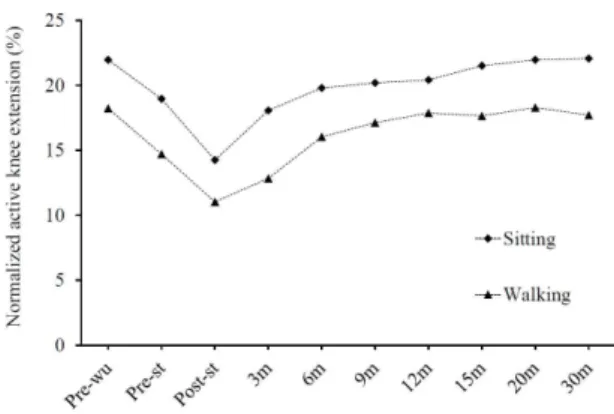
A total of 62 participants (23 males and 39 fe- males, mean age 20.1±1.5 years, range 19∼24) were selected and analyzed in this study. There were no significant statistical differences in hamstring flexi- bility across 9 assessments on AKE following the stretches. However the normalized percent mean val- ues of hamstring flexibility showed 18% to 23% of its normal range of motion at the time of pre-warm-up and decreased to 15% to 19% and 11%

to 14% at the time of after pre/post-stretch. The values continued to increase until the 9th AKE as- sessment (Figure 1).

Table 1 represents that the mean values of stretch intensity applied during stretch, which are 5.61 for

Group Mean±SD

a

Min Max

VRS

b

(n

1

=31) 5.61±1.90 1 9

HHD

c

(n

2

=31) 73.45±27.30 28 133

a

standard deviation,

b

verbal rating scale,

c

hand held dynamometer.

Table 1. Descriptive statistics of the VRS and HDD

groups

(4)

the VRS and 73.45 N for the HHD group.

The VRS and HDD scores represented very weak correlation (Spearman’s p=-.16, p>.05). Pearson’s cor- relation analysis was conducted following the loga- rithmic transformation of the two scores. Pearson’s correlation after the transformation still showed a very low relationship and a poor linear relationship between the two scores (Pearson’s r=-.18, p>.05) (Figure 2, 3).

Discussion

This comparative study explored whether the HHD could be applied in conditions where practitioners commonly apply passive stretch on an athlete and determining the optimal stretch intensity how much stretch intensity can be quantitatively optimal for athletes. To our knowledge, this study is the first attempt to investigate the effective static stretch and to quantify assessment for improving hamstring flexibility.

The stretch procedure is typically determined by the practitioner’s experience in determining the amount of pain perceived by an athlete. The primary findings of this study revealed that the measure of HHD and VRS exhibited a weak linear relationship.

In addition, the stretch effect following the static stretch was compared by dividing participants into two groups (i.e., static versus dynamic effect) to ob- serve the change of thixotrophy. There was no stat- istical difference determined by the poor correlation.

This may indicate that the flexibility of participant’s hamstrings was not influenced by either static or dynamic rests among the assessments. Although the finding failed to confirm any linear relationship be- tween the two groups, it indicates that one measure Figure 1. Changes of active knee extension at

the time of pre-warm up (Pre-wu), pre/post- stretch (Pre-st/Post-st), followed by additional assessments with the lapse of time (3 minutes through 30 minutes). The flexibility of hamstrings showed increments following the pre-warmup/pre-stretch and gradual decrements following the post-stretch.

Figure 2. The comparisons of mean±standard deviation based on the positions with which

participants’ positions were either remaining in sitting or freely walking around for a series of AKE

assessments following the stretch (VRS: verbal rating scale, HHD: hand held dynamometer). The

ranges measured by VRS and HDD showed a similar fashion, in which measures for sitting group

more dispersed than standing group. The correlation were very weak and not statistically

significant at p=.05.

(5)

has no effect on the other.

Traditionally, the HHD device has been regarded as one of the most reliable measurement systems for objectively quantifying forces being applied to mus- cles (Baldwin et al, 2013; O’Shea et al, 2007, Riddle et al, 1989). In the present study, the VRS measure perceived by an individual who receive the stretch had no relationship with the objectively quantified HHD measure. This would indicate that the optimal intensity of stretch may not be solely determined by a subjective pain level as well as individual’s deter- minations (Freitas et al, 2015). Several studies re- ported that there are high correlations between stretch intensity and injury incidence rate (Apostolopoulos et al, 2015, Freitas et al, 2015, Freitas et al, 2016) and high intensity stretch can trigger potential risks as well as inflammatory re- action of muscle tissues (Faulkner et al, 2013; Safran et al, 1988; Witvrouw et al, 2004). Moreover, a study reports that low intensity also may give rise to only elastic responses and yields little gain in range of motion when a stretch is applied with too low of an intensity (Cipriani et al, 2003). Conversely, applying too much force may injure tissue and induce an in- flammatory response in the muscles (Jacobs and

Sciascia, 2011). In general, selecting an optimal stretch program with varied intensities has been de- termined by tension depending on an individual’s sensitivity to receptors located in Golgi tendon organ during lengthening muscle fiber (Jacobs and Sciascia, 2011). Due to its sensitivity to tension during stretch, the tendon needs to be improved by lengthening it with individual quantified intensity, which will induce the tendon viscoelasticity in response to the stretch (Smith, 1994). The findings of low correlation be- tween the VRS and HHD scores indicate that pain perceived by participants may not be a good in- dicator and quantified stretch intensity may be com- bined with pain perception to reduce the risk of po- tential injuries to muscle tissues.

Another finding in the present study was that there was no significant difference of a series of AKE assessment between the walking and sitting groups. However, significant positive effects on AKE were noted immediately after the stretch (i.e., at the time of post-stretch). Later, the AKE angle started showing decrements and continued to the point of the 9th assessment. As observed in Figure 1, the AKE angle had a tendency of returning to the angle at the time of pre-warm up from the 7th assessment Figure 3. The correlations and scatterplots for the scores of verbal rating scale (VRS) and hand

held dynamometer (HHD) during stretch. Scatterplots with filled circles represents the weak

correlation between raw scores for VRS and HHD, while scatterplots with filled triangles appears

slightly larger correlation following the logarithmic transformation for the two scores. Two

correlation between the groups are not statistically significant at p=.05.

(6)

(i.e., 15 minutes after stretch). Since goniometric measurement of knee extension angle was measured by the notion in which full knee extension at 0 de- gree, the smaller values indicate better flexibility of the hamstring muscle. Several studies reported that the effect of static stretch on muscles can be sus- tained longer in the walking than sitting group due to its thixotrophic property (Froske et al, 2014;

Vernooij et al, 2016). The thixotrophic change is de- fined as the dependence of muscle stiffness on the history of length changes (Vernooij et al, 2016). It alters the mechanical property of muscles in response to artificial stimulations and imposed movements. The muscles become stiff and resistant to lengthening or shortening at rest and thixotrophic stiffness will en- sure stability at rest. Despite the dynamic movement such as walking, the hamstring muscle stiffness must be substantially decreased following static stretch.

The present study carries some inherent limi- tations because the participants recruited from a uni- versity students who variated in their physical activ- ity level. It was unknown whether the participants were physically active or not, which may be influ- enced the results. This may be a source of latent errors of this study. Future studies should consider a group distinction based on participant’s level of physical activity.

Conclusion

The HHD device has been considered as reliable measurement system to quantify forces being applied to muscle stretch. Practitioners may use the device for quantitatively measuring the force applying on muscles being stretched to determine the optimal force on the muscles. This study explored the rela- tionship between the HHD and VRS in comparisons of the effects of continuance time on dynamic (walking) and static (sitting) movements after static stretch of hamstring muscle. There was a very weak relationship between the HHD and VRS measures

dtermined by the correlations as well as between dynamic and static movement. This may indicate that the optimal intensity for stretch cannot be solely dtermined by the subjective pain perception and the objective measurement system such as HHD could be sued in conjunction with the pain perception.

References

Abdel-aziem AA, Draz AH, Mosaad DM, et al.

Effect of body position and type of stretch on hamstring flexibility. Int J Med Res Health Sci.

2013;2:399-406.

Anderson B, Burke ER. Scientific, medical, and prac- tical aspects of stretch. Clin Sports Med.

1991;10(1):63-86.

Apostolopoulos N, Metsios GS, Flouris AD, et al.

The relevance of stretch intensity and position-a systematic review. Front Psychol. 2015;6:1128.

http://doi.org/10.3389%2Ffpsyg.2015.01128

Baldwin KM, Haddad F, Pandorf CE, et al. Alterations in muscle mass and contractile phenotype in re- sponse to unloading models: Role of transcrip- tional/pretranslational mechanisms. Front Physiol.

2013;4:1-13. http://doi.org/10.3389/fphys.2013.00284 Bandy WD, Irion JM. The effect of time on static

stretch on the flexibility of the hamstring muscles. Phys Ther. 1994;74(9):845-850.

Bandy WD, Irion JM, Briggler M. The effect of time and frequency of static stretch on flexibility of the hamstring muscles. Phys Ther. 1997;77(10):

1090-1096.

Beaulieu JE. Developing a stretch Program. Phys Sports med. 1981;9(11):59-69.

Borms J, Van Roy P, Santens JP, et al. “Optimal duration of static stretch exercises for improve- ment of coxo-femoral flexibility.” J Sports Sci 1987;5(1):39-47.

Brand PW. Clinical Mechanics of the Hand. 1st ed.

St Louis, MO Mosby, 1984:72-77.

Cipriani D, Abel B, Pirrwitz D. A comparison of two

(7)

stretch protocols on hip range of motion:

Implications for total daily stretch duration. J Strength Cond Res. 2003;17(2):274-278.

Ekstrand J, Gillquist J, Liljedahl SO. Prevention of soccer injuries. Supervision by doctor and physiotherapist. Am J Sports Med. 1983;11(3):

116-120.

Faulkner SH, Ferguson RA, Gerrett N, et al.

Reducing muscle temperature drop after warm-up improves sprint cycling performance.

Med Sci Sports Exerc. 2013;45(2):359-365.

http://doi.org/10.1249/MSS.0b013e31826fba7f Freitas SR, Vaz JR, Bruno PM, et al. stretch effects:

High-intensity & moderate-duration vs. low-in- tensity & long-duration. Int J Sports Med. 2016;

37(3):239-244. http://doi.org/10.1055/s-0035-1548946 Freitas SR, Vilarinho D, Rocha Vaz J, et al.

Responses to static stretch are dependent on stretch intensity and duration. Clin Physiol Funct Imaging. 2015;35(6):478-484. http://do- i.org/10.111/cpf.12186

Froske U, Tsay A, Allen T. Muscle thixotrophy as a tool in the study of proprioception. Exp Brain Res. 2014;232(11):3397-3412. http://doi.org.10.1007/

s00221-014-4088-5

Guissard N, Duchateau J. Neural aspects of muscle stretch. Exerc Sport Sci Rev. 2006;34(4):154-158.

Hortobagyi T, Faludi J, Tihanyi J, et al. Effects of intense “stretch”-flexibility training on the me- chanical profile of the knee extensors and on the range of motion of the hip joint. Int J Sports Med 1985;6(6):317-321.

Jacobs CA, Sciascia AD. Factors that influence the efficacy of stretch programs for patients with hypomobility. Sports Health. 2011;3(6):520-523.

Knudson D. The biomechanics of stretch. J Exerc Sci Phys. 2006;2:3-12.

McHugh MP, Cosgrave CH. To stretch or not to stretch: the role of stretch in injury prevention and performance. Scand J Med Sci Sports. 2010;

20(2):169-181. http://doi.org/10.1111/j.1600-0838.2009.

01058.x

Nelson AG, Driscoll NM, Landin DK, et al. Acute effects of passive muscle stretch on sprint performance. J Sports Sci. 2005;23(5):449-454.

Nikolaou PK, Macdonald BL, Glisson RR, et al.

Biomechanical and histological evaluation of muscle after controlled strain injury. Am J Sports Med. 1987;15(1):9-14. http://doi.org/10.1080/02640 410410001730205

O’Shea SD, Taylor NE, Paratz JD. Measuring muscle strength for people with chronic obstructive pul- monary disease: Retest reliability of hand-held dynamometry. Arch Phys Med Rehabil. 2007;

88(1):32-36.

Palmieri RM, Ingersoll CD, Hoffman MA. The hoff- mann reflex: Methodologic considerations and applications for use in sports medicine and ath- letic training research. J Athl Train. 2004;

39(3):268-277.

Petersen J, Hölmich P. Evidence based prevention of hamstring injuries in sport. Br J Sports Med.

2005;39(6):319-323.

Proske U. The role of muscle proprioceptors in human limb position sense: A hypothesis. J Anat.

2015;227(2):178-183. http://doi.org/10.1111/joa.12289 Riddle DL, Finucane SD, Rothstein JM, et al.

Intrasession and intersession reliability of hand-held dynamometer measurements taken on brain-damaged patients. Phys Ther. 1989;69(3):

182-194.

Sady SP, Wortman M, Blanke D. Flexibility training:

ballistic, static or proprioceptive neuromuscular facilitation? Arch Phys Med Rehabil. 1982;63(6):

261-263.

Safran MR, Garrett WE Jr, Seaber AV, et al. The role of warmup in muscular injury prevention.

Am J Sports Med. 1988;16(2):123-129.

Smith CA. The warm-up procedure: To stretch or not to stretch. A brief review. J Orthop Sports Phys Ther. 1994;19(1):12-17.

Vernooij CA, Reynolds RF, Lakie M. Physiological

tremor reveals how thixotropy adapts skeletal

muscle for posture and movement. R Soc Open

(8)

Sci. 2016;3(5):160065. http://doi.org/10.1098/rsos.

160065

Wallin D, Ekblom B, Grahn R, et al. Improvement of muscle flexibility. A comparison between two techniques. Am J Sports Med. 1985;13(4):263-268.

Witvrouw E, Mahieu N, Danneels L, et al. Stretch and injury prevention: An obscure relationship.

Sports Med. 2004;34(7):443-449.

Worrell TW, Smith TL, Winegardner J. Effect of ham- string stretch on hamstring muscle performance. J Orthop Sports Phys Ther. 1994;20(3):154-159.

Young W, Elias G, Power J. Effects of static stretch volume and intensity on plantar flexor explosive force production and range of motion. J Sports Med Phys Fitness. 2006;46(3):403-411.

This article was received September 19, 2017, was

reviewed September 19, 2017, and was accepted

November 9, 2017.

수치

Table 1 represents that the mean values of stretch intensity applied during stretch, which are 5.61 for
Figure  2.  The comparisons of mean±standard deviation based on the positions with which participants’ positions were either remaining in sitting or freely walking around for a series of AKE assessments following the stretch (VRS: verbal rating scale, HHD:

참조

관련 문서

The purpose of this study was to analyze the relationship between children’s playfulness and peer competence, focusing on the parent-child interaction

The purpose of this study is to examine the relationship between the social support and mental health of university taekwondo athletes, and clearly clas sify

The purpose of this study is to analyze the effects of word- recording on learning vocabulary, reading and listening of English. control groups to answer

The purpose of this study is to verify whether The mediating effects of planned happenstance skills on the relationship between perceived social support

The purpose of this study is to analyze the effects of sports marketing strategy fit on organizational attitude and organizational citizenship behavior

The purpose of this study is to analyze the interest and self-confidence of middle school students in learning English grammar and to examine the

The purpose of this study is to examine the effects of flow experience through the dance sports media, a dance sports image, and identification on

The purpose of this study is to analyze the relationship between dance performances, which is a part of social contribution activities of local governments,