• 검색 결과가 없습니다.

Thermal and Mechanical Properties of Waste Ground Nut-shell Reinforced Polyester Composites

N/A
N/A
Protected

Academic year: 2021

Share "Thermal and Mechanical Properties of Waste Ground Nut-shell Reinforced Polyester Composites"

Copied!
6
0
0

로드 중.... (전체 텍스트 보기)

전체 글

(1)

Paper

Thermal and Mechanical Properties of Waste Ground Nut-shell Reinforced Polyester Composites

M.N. Prabhakar*, Atta ur rehman Shah*, Jung-Il Song*

ABSTRACT: In the current study explain about the bio-based composites made by groundnut shell as reinforcement with polyester resin matrix. Groundnut shell is an abundantly available natural waste byproduct and poly ester resin is widely used to fabricate of composites for good balance of mechanical properties because it is relatively low price and ease of handling. Evaluate the mechanical properties of manufactured groundnut shell/polyester composites by varying the amounts (wt %) of groundnut shell. Particulate shell reinforced polyester composites incorporating varying amounts of groundnut shell (5, 10, 15 and 20%) were characterized for their tensile strength, flexural strength, and impact strength. The mechanical properties improved with increasing particle loading up to 15% and decreased thereafter. Increasing in strength with increased particle shell loading was attributed to increase in surface area which enhanced load transfer between the polyester matrix and ground shall particulates. Scanning electron microscopic studies have been carried out to study the morphology of the composite. Thermal studies and water absorption properties of the composites also studied in this paper.

Key Words: Tensile strength, Modulus, Weight fraction, Bio-filler, Ground nut shell

1. INTRODUCTION

Present polymer composite researchers showing much interest on bio material in general and their by-products in particular for the preparation of composite materials, due to better strength properties such as easy availability, light weight, high toughness, non-corrosive nature, low density, low cost, good thermal properties, reduced tool wear, less dermal and respiratory irritation, less abrasion to processing equipment and renewability [1-3].

There is a growing interest in the use of natural/bio fibers as reinforcing components for thermoplastics and thermosets.

Although thermoplastics have the added advantage of recy- cling possibilities; thermosets are targeted to obtain much improved mechanical properties as compared to thermoplas- tics in the resulting bio-composites. Synthetic resin is widely used in industrial scale. Macromolecules are obtained through chemical reactions in reactors using the appropriate mono- mers. Depending on the resin the obtainment appears occurs through of addition or condensation reactions. The physical

properties of polyester composites are predominately con- trolled by reinforcement; the physical properties of polyester resin do affect the durability and thermal performance [4-6].

Natural fiber reinforced polyester composites have received much commercial success in the infrastructure area primarily for low cost housing applications. Using a reinforcing fiber to produce polyester composite dramatically improves both the tensile and flexural properties.

The use of renewable biomass as a raw material in com- posites production was one approaches and the use of renew- able biomass may result in several benefits such as environmental and socioeconomic. Today renewable biomass are mostly accepted as waste materials and are mostly ploughed into the soil or burnt in the field. It seems that the use of renewable bio-mass in the forest industry will gain more importance. Peanuts have been cultivated worldwide for hun- dreds, if not thousands, of years. However, most peanuts are sold without the shell, and so large quantities of peanut shells remain as byproducts in the field, not being used properly [7,8]. Literature includes only limited information about the

Received 28 May 2015, accepted 12 June 2015

* *

Department of Mechanical Engineering, Changwon National University

Department of Mechanical Engineering, Changwon National University, Corresponding author (E-mail: [email protected])

(2)

feasibility of using peanut shell in composite production.

Therefore, the objective of this study is to give value to bio waste material and make value based composite materials.

In recent years, major industries such as automotive, con- struction and packaging industries have shown enormous interest in the development of new bio-composite materials and are currently engaged in searching for new and alternate products to synthetic fiber reinforced composites. A major deficiency in the natural fiber-plastic composites is the poor bonding between the natural fiber and the plastic, mainly due to dissimilar chemical nature of both the materials. Recent studies showed that surface modification techniques, namely, chemical treatments, acetylation and graft co-polymerization are used to overwhelm the incompatible surface polarities between the natural fiber and the polymer matrix, but most work on natural fiber is based on melt mixing of natural fibers and polymer matrix granules in an extruder with subsequent injection molding. Such tow stage processing techniques, expose natural fibers to high shear and thus damage the natural fibers.

To eliminate fiber damage, the application of shells impregnation technology is a new method in fabrication of natural fiber composites with improved mechanical properties.

The purpose of this present research work is to report the mechanical properties of groundnut shell [9] reinforced poly- ester [10] composites by varying the weight fractions of the groundnut shell. The effect of peanut shell on thermal studies and water absorption tendencies of the bio-shell reinforced polyester composites has also been studied.

2. EXPERIMENTAL

2.1 Materials

The basing raw materials used to prepare the experimental composites, all reagents and solvents used in the experiments were reagent-grade unless specified otherwise. Groundnut shell powder used as reinforcement material in this study was obtained from local agricultural fields. Polyester (PE) resin, catalyst (methyl ethyl ketone peroxide) and accelerator (cobalt naphthanate) were obtained from South Korea. Chemical like sodium hydroxide (NaOH) is obtained from sigma Aldrich, South Korea.

2.2 Preparation of peanut shell

The Peanut shells (Arachis hypogaea) was extensively washed in rurrning tap water for 1-2 hours to remove dirt, sand and other impurities, and then washed with distilled water several times. The greasy material and lignin were removed from the shell by soaking them in 2% NaOH solution for 30min as described elsewhere. These shells were then washed thoroughly in distilled water and dried under the sun light for 2 days. The washed sorbent was transferred to an oven maintained at 120

o

C for one day to reduce the moisture

content. The dried sorbent was micronized using a kitchen grinder. The shells were stored in air tight glass bottles to pro- tect it from moisture.

2.3 Preparation of composites

For making the composite laminates by the hand layup pro- cess, a glass mould covered with teflon sheet and having dimensions of 160 × 160 × 3 mm was used. Laminates were made from PE resin, catalyst and accelerator taken in the ratio of 100, 1.5 and 1.5 parts by weight, respectively. The mould was filled with a mixture of matrix and groundnut shells and allowed to cure at room temperature for 24 h. The cured lam- inates were demoulded and post cured in a hot air oven at 70

o

C for 3 h.

2.4 Tensile test

Tensile tests were carried out according to ASTM D3039-78 standard using a Universal testing machine (UTM // R&B 304) with a load cell of 10 kN, maintaining a crosshead speed of 5 mm/min.

2.5 Flexural test

Flexural tests were performed as per ASTM D5943-96 stan- dard utilizing the three-point bending mode on the above machine with a crosshead speed of 2 mm/min and a support span length of 50 mm.

2.6 Impact Test

Izod impact tests were performed on the composites accord- ing to ASTM D256-88 standard using an impact testing machine (Izod impact tester // QC-639F). The test specimen was supported as a vertical cantilever beam and broken by a single swing of pendulum. Five specimens were used for each test and the average values recorded.

2.7 Water Absorption test

Test was performed according to ASTM D570. Condition- ing and reconditioning were carried out at 55

o

C for 24 hours each. Specimens were immersed into distilled water. For the water absorption measurements, the specimens were with- drawn from the water, wiped dry to remove surface moisture, and then weighted using and electronic balance (accurate to 10

-4

g) to monitor the mass during the aging process. The moisture content M (%), absorbed by each specimen was cal- culated from its weight before, M

0

and after, M

1

absorption, as follows:

(1)

where M(%), is the moisture content in percentage; M

1

(g) the weight of the wet sample at a given time, and M

0

(g) the initial weight of the sample.

M ( ) 100 % ( M

1

M

0

) M

0

---

×

=

(3)

2.8 Thermal analysis

The primary thermograms of ground nut shell reinforced composites were recorded using DSC-TGA Q-600 as per ASTM E1131 standard at a heating rate of 10

o

C/min in the temperature range 28-700

o

C in nitrogen atmosphere with the flow rate of 50 ml/min. The sample weight was taken approx- imately between 9 and 15 mg, which were placed in a plat- inum pan.

2.9 Scanning electron microscopy (SEM) analysis JSM-5610 (Jeol, Japan) scanning electron microscopy (SEM) was used to visualize the surface morphology of composites at the range of Acc voltage 05~30 kV and EDS energy resolution 133 eV. The dried sample was mounted on a metal stub with the help of double sticky carbon tape and coated with gold for conductivity.

3. RESULTS AND DISCUSSION

Four samples were prepared for this investigation and named as C-1 to C-4 (2% NaOH - 5, 10, 15 and 20 wt% of groundnut shell). These samples were analyzed and discussed.

3.1 Mechanical properties

3.1.1 Tensile strength and modulus

Ground nut shell reinforcement effect on the tensile strength of polyester resin matrix demonstrated in Fig. 1. At the com- posite of 5%, 10%, 15% and 20% of groundnut shell, the tensile strength of the composites were found to be 41.2, 59.8, 79.91, 75.3 MPa respectively. As depicted in the figure 1, the tensile strength increased linearly up to 15 wt%, after that it tends to decrease despite the further rise in the wt% of groundnut shell reinforcement. This may be associated with fact that, as the wt% of the reinforcement ground nut shell increased the weak interfacial area and the micro spaces increased between the shell and the matrix, accordingly bringing down the tensile

strength. It is also true that, at high percentage reinforcement, it is more difficult for the resin to fully impregnate the shells thus leading to poor interfacial bonding and consequently lower mechanical properties. Thus, poor wetting results in poor stress transfer efficiency across the shell-resin interface, which leads to agglomeration, and stress transfer gets blocked.

As a result, there is a decreasing trend in tensile strength which increasing shell content in the composites. Whereas as shown in Fig. 2, the tensile modulus was increased with the increasing of wt% of groundnut shell. This may be due to the fact that further rise in the wt.% of groundnut shell in polyester matrix slightly reduces the matrix mobility, which increases the stiff- ness of the composites.

3.1.2 Flexural Strength and modulus

The flexural properties of the composites vary significantly with matrix type and reinforcement. The strength property is related to the composites ability to transfer a stress load with- out creating microscopic cracks. Flexural stiffness is a criterion

Fig. 1. Effects of variation of weight fraction on the tensile strength of groundnut shell/polyester composite

Fig. 2. Effects of variation of weight fraction on the tensile mod- ulus of groundnut shell/polyester composite

Fig. 3. Effects of variation of weight fraction on the flexural

strength of groundnut shell/polyester composite

(4)

of measuring deformability.

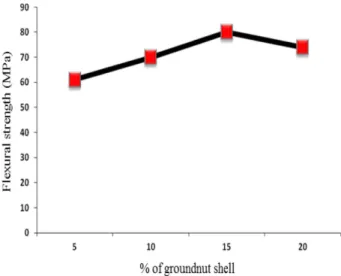
Fig. 3 illustrate the flexural strength of ground nut shell rein- forced composites at different fiber weight content. The flex- ural properties of composites showed a similar trend as that of their tensile properties. At the composite of 5%, 10%, 15% and 20% of groundnut shell, the flexural strength of the composites were found to be 1850, 2800, 3200, 2900 MPa respectively. Fig.

2, shows flexural strength going up linearly with an increase in the amount of groundnut shell reinforcement up to 15% then abruptly, the value of the strength starts going down while the shell reinforcement was further increased. This may be due to the tensile and compressive stresses created as the result of flexural test, and various defects happen due to shell com- pression. These shell defects produce shell ends with stress concentration sites, as the shell content increases beyond the 15% the crack initiation points increase due to high stress con- centration at the shell ends. As a result there will be weak adhesion of the polyester with groundnut shell, accordingly flexural strength decreases. In contrast to flexural strength, the flexural modulus (Fig. 4) exhibits an increasing trend with an increase in amount of groundnut shell reinforcement.

3.1.3 Impact strength

Impact test are used in studying the toughness of material.

Generally synthetic fibers produce interface having lower strength with matrix due to which energy absorption increase at these interfaces. A natural fiber exhibits greater fiber/matrix strength which does not allow energy to be absorbed at inter- faces. The impact strength is the ability of a material to with- stand fracture or the amount of energy required to propogate a crack. It depends on certain factors such as fiber and matrix strength, load transfer efficiency, resistance to crack propa- gation, bonding strength, volume fraction, fiber distribution, and geometry.

The impact strength of the groundnut shell/poly ester com- posite is presented in Fig. 3. The impact properties of com- posite materials were directly related to their overall toughness.

The impact performance of filler reinforced composites

depended on many factors, including the nature of the con- stituent, fill/matrix interface, the construction and geometry of the composite and test conditions. The applied load trans- ferred by shear to fillers may exceed the filler/matrix interfacial bond strength. It is observed that impact strength increases with increasing content of groundnut shell. Hence, ground nut shell composites have potential applications where light weight and resistance to impact are primary requirements. The mechanical and thermal properties of the waste ground nut shell/poly ester composites indicate the feasibility of develop- ing low cost and high strength light weight insulating com- posites with ground nut shell which are abundantly available as waste. These composites can be considered for manufac- turing sports goods, low cost building materials, automobile interior parts etc.

3.1.4 Thermal analysis

Thermogravimetric analysis (TGA) is employed to analyze the thermal stability of composites. Thermal stability is Fig. 4. Effects of variation of weight fraction on the flexural

modulus of groundnut shell/polyester composite

Fig. 5. Effects of variation of weight fraction on the impact strength of groundnut shell/polyester composite

Fig. 6. Thermal properties of ground nut shell/Polyester com-

posite

(5)

believed to be one of the limiting factors in the use of natural fibers when compared to synthetic fibers. Hence, thermal sta- bility of groundnut shell reinforced polymer composites has been investigated in the current investigation.

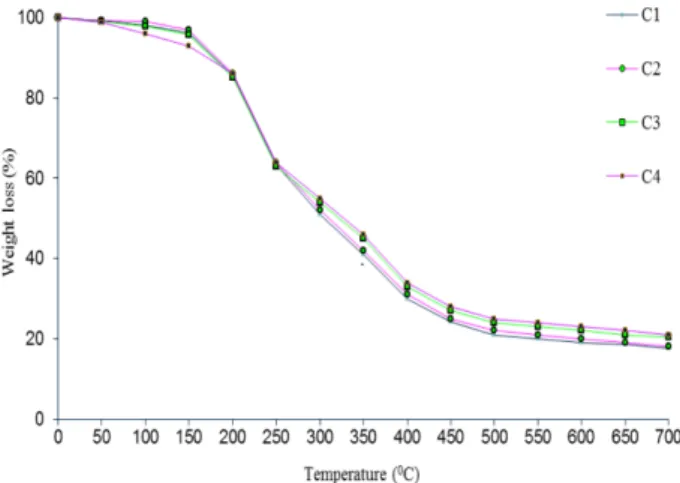
As shown in Fig. 6, the first mass loss, in the range of 20- 100

o

C is due to evaporation of moisture. The second mass loss between 170

o

C and 450

o

C is due to the decomposition the hemicellulose, cellulose and lignin. Overall, the thermal dis- integration of lignocellulosic fibers comprises of four phases.

The initial phase involves the breakdown of hemicelluloses, tracked by that of cellulose, and of lignin, and forth of their ash. TGA experimental values of the 5, 10, 15 and 20% ground nut-shell/polyester composites are shown in the Fig. 6. The percentage residual weight of the composite specimen shows better values with 20% ground nut-shell/polyester composite.

This is in line with the mechanical behavior which may be due to better interfacial characteristics with the polyester matrix.

3.1.5 Scanning electron microscopy (SEM) analysis The surface characteristics of the composite material used for the investigation is studied through scanning electron microscopy. The cross sectional view of the fabricated com- posite materials consisting of ground nut shell and poly ester resin.

Surface morphology of ground nut shell filled polyester composite is shown in Fig. 7. Ground nut shells were clearly seen to be solid in nature, but irregular in size with platy like structure can also be observed in figure. The ground nut shells surface morphology plays a vital role in case of composite materials. The surface features of particles such as contours, defects and damage and surface layer were not observed in the SEM. It is observed that ground nut shell particulates are vis- ible and a good dispersion of the particulates in polyester resin is evident. From figure it is found to have good interfacial bonding and no micro cracks which has given the composite little positive strength to the tensile load.

3.1.6 Physical properties of ground nut shell reinforced poly- ester matrix composite

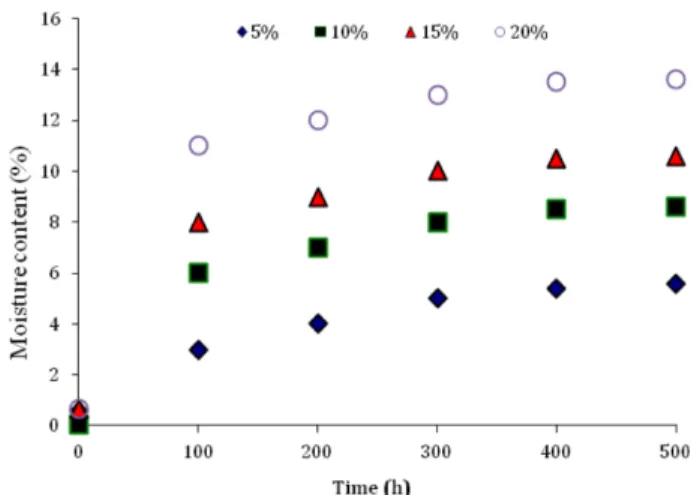
The physical properties obtained from the test are shown in Fig. 7. From figure, it can be seen that the sample with the highest volume of ground nut shell has most consistent rate of absorption in water. This is due to the higher contents of ground nut shell in composites that can absorb more water. As the ground nut shell content increases, the formation of agglomerations increases due to the difficulties of achieving a homogeneous dispersion of ground nut shell at high content.

4. CONCLUSIONS

The present study investigates the feasibility of the utiliza- tion of groundnut shell in the manufacture of composite lam- inates. The addition of groundnut shell improved the mechanical properties. Groundnut shell reinforced composites can be fur- ther attractive by a suitable cost-effective method of composite production and may increase its application to a greater extent.

From the results obtained, the following conclusions are drawn:

1. This investigation has found that the 15 wt% ground nut shell reinforced polyester composite exhibited the highest ten- sile strength. However, the tensile strength decreased with fur- ther increase in the wt% of ground nut shell reinforcement. By contrast, tensile modulus uniformly increased with increase in wt% of ground nut shell reinforcement.

2. The flexural strength linearly increased until the amount of ground nut shell reinforcement reached about 15%, and then suddenly went down with further increase in the fibre reinforcement. In contrast to flexural strength, the flexural modulus demonstrated a rising trend with an increase in the ground nut shell reinforcement content. However, after 15 wt% the significance of the enhancement of the flexural strength was not much.

Fig. 7. Scanning electron micrographs of 15% groundnut shell filled polyester resin composite

Fig. 8. Effect of exposure time on the water absorption of

ground nut shell/polyester composites with different

Wt% of ground nut shell

(6)

3. Thermo-gravimetric analyses of ground nut shell and polyester have proved the thermal stability of the developed composites.

The results of this study indicate that the waste ground nut shell reinforced composites are light in weight, economical and possess good thermal stability and mechanical properties.

Hence, the newly developed composite material can be used for applications such as automobile interior parts, electronic packages, building construction, and sport goods.

ACKNOWLEDGEMENT

This work is supported financially by Changwon National University (CWNU) during 2013-2014.

REFERENCES

1. Sudhakara, P., Kannan, P., Obireddy, K., and Varada Rajulu, A.,

“Flame Retardant Diglycidylphenylphosphate and Diglycidyl Ether of bisphenol-A Resins Containing Borassus Fruit Fiber Composites”, Journal of Materials Science, Vol. 46, pp. 5176–

5183, 2011.

2. Duval, A., Bourmaud, A., Augier, L., and Baley, C., “Influence of the Sampling Area of the Stem on the Mechanical Properties of Hemp Fibers”, Materials Letters, Vol. 65, No. 4, pp. 797-800, 2011.

3. Teulé, F., Furin, W.A., Cooper, A.R., Duncan, J.R., and Lewis,

R.V., “Modifications of Spider Silk Sequences in an Attempt to Control the Mechanical Properties of the Synthetic Fibers”, Journal of Material Science, Vol. 42, pp. 8974-8985, 2007.

4. Baiardo, M., Zini, E., and Scandola, M., “Flax Fibre–polyester Composites”, Composites Part A: Applied Science and Manufac- turing, Vol. 35, No. 6, pp. 703-710, 2004.

5. Satyanarayana, K.G., Sukumaran, K., Kulkarni, A.G., Pillai, S.G.K., and Rohatgi, P.K., “Fabrication and Properties of Nat- ural Fibre-reinforced Polyester Composites”, Composites, Vol.

17, No. 4, pp. 329-333, 1986.

6. Rout, J., Misra, M., Tripathy, S.S., Nayak, S.K., and Mohanty, A.K., “The Influence of Fibre Treatment on the Performance of Coir-polyester Composites”, Composites Science and Technology, Vol. 61, Issue 9, pp. 1303-1310, 2001.

7. Tao, X.U. and Xiaoqin, L.I.U., “Peanut Shell Activated Carbon:

Characterization, Surface Modification and Adsorption of Pb2+ from Aqueous Solution”, Chinese Journal of Chemical Engineering, Vol. 16, Issue 3, pp. 401-406, 2008.

8. Batalla, L., Nuñez, A.J., and Marcovich, N.E., “Particleboards from Peanut-shell Flour”, Journal of Applied Polymer Science, Vol. 97, pp. 916–923, 2005.

9. Bertiolia, D.J., Seijo, G., Freitas, F.O., Valls, J.F.M., Leal-Bertioli, S.C.M., and Moretzsohn, M.C., “An Overview of Peanut and Its Wild Relatives”, Plant Genetic Resources, Vol. 9, No.1, pp. 134- 149, 2011.

10. Bindal, A., Singh, S., Batra, N.K., and Khanna, R., “Develop-

ment of Glass/Jute Fibers Reinforced Polyester Composite”,

Indian Journal of Materials Science, Article ID 675264, 2013.

수치

Fig. 2. Effects of variation of weight fraction on the tensile mod- mod-ulus of groundnut shell/polyester composite
Fig. 6. Thermal properties of ground nut shell/Polyester com- com-posite
Fig. 7. Scanning electron micrographs of 15% groundnut shell filled polyester resin composite

참조

관련 문서

[r]

Summerscales, "An investigation into the effects of fabric architecture on the processing and properties of fibre reinforced composites produced by resin

Effects of vacuum, mold temperature and cooling rate on mechanical properties of press consolidated glass fiber/PET composite , Composites Part A: Applied Science

However, the short beam strength of the basalt fiber reinforced composites was higher than those of the glass fiber reinforced composites in the case of the Vacuum

A representative material, carbon fiber reinforced composite material, has not only high strength of carbon fiber, high elastic modulus, high thermal conductivity, low

• What are the distinctive physical and mechanical properties of nonferrous alloys?.. Materials Design‐for‐Properties : “Alloyed Pleasure”..

• Mechanical Properties of Materials Elasticity Plasticity and Creep.. • Elasticity,

Effect of electric current on the microstructure and mechanical properties of hard-to-sinter materials with high melting point.. Effect of electric current on the