Safety of Megestrol Acetate in Palliating Anorexia-Cachexia Syndrome in Patients with Castration-Resistant Prostate Cancer
There are concerns whether megestrol acetate (MA) stimulates the growth of prostate cancer in castration-resistant prostate cancer (CRPC). We evaluated the effect of cumulative doses of MA on the disease-specific survival (DSS) in patients with CRPC who were receiving Docetaxel-based chemotherapy. From July 2003 through June 2009, we identified 109 consecutive patients with CRPC and who had received docetaxel-based chemotherapy. Of these patients, 68 (62.4%) have not received MA, whereas 21 patients (19.3%) and 20 patients (18.3%) had received low dose MA (total ≤ 18,400 mg) and high dose MA (total > 18,400 mg), respectively. We assessed the effect of several variables on DSS. None of the clinicopathological variables differed among the three groups. When comparing DSS using Kaplan-Meier analysis, there was no statistically significant survival differences among the three groups (P = 0.546). Using multivariate Cox proportional analyses with backward elimination, the number of docetaxel cycles was only significant factor predicting DSS (HR: 0.578, 95% CI: 0.318-0.923, P = 0.016). Cumulative doses of MA as adjuvant treatment for patients with CRPC and who are receiving docetaxel-based chemotherapy, did not affect their DSS. Therefore, MA can be safely administered in cachexic patients with CRPC.
Key Words: Cachexia; Castration-Resistant Prostate Cancer; Docetaxel; Megestrol Acetate;
Survival Sungwoo Hong,1 In Gab Jeong,1
Dalsan You,1 Jae-Lyun Lee,2 Jun Hyuk Hong,1 Hanjong Ahn,1 and Choung-Soo Kim1
1Department of Urology and 2Oncology, University of Ulsan College of Medicine, Asan Medical Center, Seoul, Korea
Received: 29 August 2012 Accepted: 12 March 2013 Address for Correspondence:
Choung-Soo Kim, MD
Department of Urology, University of Ulsan College of Medicine, Asan Medical Center, 88 Olympic-ro 43-gil, Songpa-gu, Seoul 138-736, Korea
Tel: +82.2-3010-3734, Fax: +82.2-477-8928 E-mail: [email protected]
http://dx.doi.org/10.3346/jkms.2013.28.5.687 • J Korean Med Sci 2013; 28: 687-692 Oncology & Hematology
INTRODUCTION
In 2012, Jung et al. (1) announced that an estimated 11,016 new cases (9.3% of total cancers in men) of prostate cancer would be diagnosed in Korea and that approximately 1,540 men (3.4%) would be expected to die from prostate cancer. Although, Kore- an men have one of the lowest rates of prostate cancer in the world, the onset of prostate cancer has been sharply increasing since 1999 (2). Approximately 15% of men with prostate cancer present with metastatic disease, and 30% of men with localized disease treated with definitive local therapy subsequently de- velop metastatic disease (3). While the great majority of patients with metastatic disease demonstrate a temporary response to androgen deprivation therapy (ADT), eventually all patients develop castration-resistant prostate cancer (CRPC) and virtu- ally all prostate cancer deaths are due to the development of metastatic CRPC (4, 5). During recent years, docetaxel-based chemotherapy has been used as a standard treatment in pa- tients with metastatic CRPC (6-8). Despite several studies dem- onstrating that it helps to increase the survival, the prognosis is poor in that the median survival time from the starting point of treatment is merely 16 to 20 months (8).
Cachexia is one of the most frequent effects of malignancy,
with up to one-half of untreated cancer patients losing some weight and approximately one-third losing more than 5% of their original body weight (9). Cachexia is a pathological state of loss of skeletal muscle and fat; it occurs in the presence of underlying illness (10) and usually indicates that patients with advanced prostate cancer and suffering from cachexic symp- toms, will need some palliative support.
A potential role for megestrol acetate (MA) in the treatment of patients with prostate cancer was suggested after documen- tation of its capacity to lower the luteinizing hormone, follicle- stimulating hormone, and testosterone in men who underwent transurethral resection of the prostate for benign prostatic hy- pertrophy (11). MA, a synthetically derived progesterone, blocks androgen receptors and lowers the serum androgen levels through inhibition of the release of luteinizing hormone and 5 alpha-reductase (12). However, it has been reported that MA has limited activity on PSA in patients with CRPC (13). Also, MA has a powerful effect on appetite; it is currently administered to improve appetite and to increase weight in cancer-associated cachexia (14). MA is also the most extensively studied agent for treating cancer-associated anorexia and has a well-established track record for alleviating this symptom and for promoting weight gain in patients with advanced cancer (15, 16).
Mutations in the androgen receptor gene have been identi- fied in tissue samples from patients with advanced prostate cancer and represent a possible mechanism underlying the de- velopment of CRPC (17). It has been also reported that muta- tion in the steroid binding domain of the androgen receptor was found in the human prostatic carcinoma cell line or in tis- sue from men with advanced prostate cancer (18). In this con- text, three case reports showed rapid progression of advanced CRPC during palliative treatment with MA for cancer cachexia (19). Therefore, MA might induce the proliferation of CRPC via the mutated androgen receptor.
Even though MA has been used in clinical practice for palli- ating cancer-cachexia anorexia syndrome in patients with CRPC, to our knowledge, there have no studies which demonstrated the influence of the cumulative doses of MA on survival in pa- tients with CRPC and who were receiving docetaxel-based che- motherapy. Therefore, we retrospectively investigated the effect of MA on DSS in patients with CRPC and who were receiving docetaxel-based chemotherapy.
MATERIALS AND METHODS Patient population
We studied 126 patients with CRPC who had received docetax- el-based chemotherapy and prednisone at our institution be- tween July 2003 and June 2009. However, 17 of these patients were found to be ineligible, 10 owing to < 3 docetaxel cycle, and seven because of a > 3 ECOG performance status. All 109 eligi- ble patients had histologic proof of adenocarcinoma of the pros- tate and progressive visceral metastases or progressive regional lymph node disease after ADT, as determined by the individual investigators.
Demographic information, date of prostate cancer diagnosis, baseline laboratory findings, the cumulative doses of MA, con- comitant hormonal therapy, and date of the last follow-up or death were taken directly from the medical charts. The baseline ECOG performance status was estimated according to the clini- cal progress notes at the beginning of docetaxel-based chemo- therapy. We defined CRPC in the following cases: when the se- rum testosterone is castration levels; three consecutive rises of PSA two weeks apart and resulting in two, 50% increases over the nadir; PSA progression observed despite secondary hor- monal manipulation or for at least four weeks of antiandrogen withdrawal; and bone metastases and soft tissue metastases progression (20).
The number of docetaxel cycles was divided by the median value; ≤ 7 vs > 7. The ECOG performance status and the Glea- son score were evaluated 1-2 vs 3 and ≤ 7 vs 8-10, respectively.
We classified patients into two groups according to the existence of other predicting variables such as visceral metastases, lymph node metastasis, bone metastasis, and concomitant hormonal
therapy administered during the docetaxel-based chemotherapy.
Docetaxel-based chemotherapy
The scheduled interval in our study was three weeks, at which time patients received 75 mg/m2 of docetaxel (Taxotere, Aven- tis) as a one-hour intravenous infusion and prednisone 5 mg was given orally six hours before and six hours after treatment.
Pretreatment supportive medications were given according to our institutional practice. Dose adjustment was performed ac- cording to toxicity.
Megestrol acetate dosage
Patients complaining of cachexic symptoms received 800 mg MA daily. The cumulative doses of MA were investigated from their medical chart, and the calculation of MA was counted from the date of the beginning of docetaxel-based chemotherapy to the date of the last follow-up. Patients were classified into three different groups based on the median amount (18,400 mg) of the MA dose administered cumulatively as follows: 68 patients who were not administered MA (group 1); 21 patients who re- ceived low dose MA (total ≤ 18,400 mg; group 2); and 20 pa- tients who received high dose MA (total > 18,400 mg; group 3).
Statistical analysis
Differences in the basic demographic variables were compared using Pearson’s chi-square test and the one-way ANOVA using Scheffe’s test as post-hoc analysis. Quantitative data were ex- pressed as the mean value (± standard deviation) or median value (range). To evaluate the effect of cumulative doses of MA on DSS, the relative risks and the 95% CI were calculated as HR derived from the Cox proportional hazards regression model.
Survival curves were generated by means of the Kaplan-Meier estimates, and differences in survival were compared using the log-rank test. For all statistical analyses, P < 0.05 was consid- ered significant, and all P values were two-sided. SPSS®, version 12.0 was used for the statistical analysis.
Ethics statement
The study protocol was approved by the institutional review board of Asan Medical Center (IRB No. 2012-0047), and the need for informed consent was waived.
RESULTS
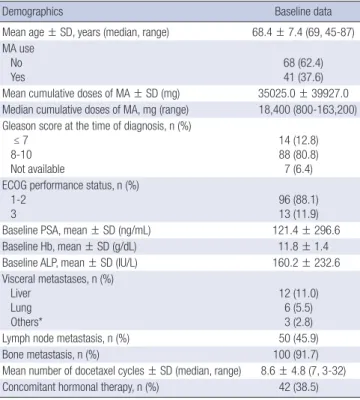
The demographic and baseline characteristics of our study pa- tients are shown in Table 1. The mean baseline PSA, Hb, and ALP were 121.4 ng/mL, 11.8 g/dl, and 160.2 IU/L, respectively.
The mean number of docetaxel cycles was 8.6, and 41 (37.6%) patients received MA in order to relieve their cachexic symp- toms. Visceral metastases and lymph node metastasis were found in 21 (19.3%) and 50 (45.9%) of our patients, respectively,
and bone metastasis was detected in 100 (91.7%) of these pa- tients.
Table 2 presents the demographic and baseline characteris- tics of the three groups. There were 109 eligible patients with a median age of 69 yr (range 45 to 87), including 68 (range 45 to 87), 70 (range 56 to 80), and 71 yr (range 51 to 86) in groups 1, 2, and 3, respectively (P = 0.977). The median MA dose was 3,200 mg (range 800 to 18,400) in group 2 and 40,800 mg (range 21,600 to 163,200) in group 3.
Table 3 shows the univariate and multivariate Cox propor- tional analysis for DSS. In the univariate Cox regression analy- ses, no variable was a statistically significant predictor for DSS after starting docetaxel-based chemotherapy, except for lung metastasis and the docetaxel cycles (HR: 3.001, 95% CI: 1.258- 7.142, P = 0.013; and HR: 0.633, 95% CI: 0.408-0.982, P = 0.041, respectively). In multivariate Cox regression analysis using back- ward the elimination method, the docetaxel cycles was only significant factor (HR: 0.578, 95% CI: 0.318-0.923, P = 0.016).
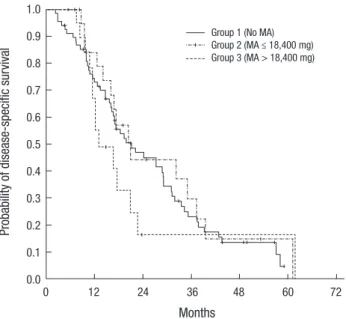
Survival status is available for 109 patients. Fifty-four of 68 patients in the group 1 have died, 14 of 21 patients in the group 2 have died, and 7 of 20 patients in the group 3 have died, re- spectively. When comparing DSS using the Kaplan-Meier, there were no statistically significant survival differences among the three groups, with a median overall survival time of 19.3 months Table 1. Demographics and baseline data
Demographics Baseline data
Mean age ± SD, years (median, range) 68.4 ± 7.4 (69, 45-87) MA use
No Yes
68 (62.4) 41 (37.6) Mean cumulative doses of MA ± SD (mg) 35025.0 ± 39927.0 Median cumulative doses of MA, mg (range) 18,400 (800-163,200) Gleason score at the time of diagnosis, n (%)
≤ 7 8-10 Not available
14 (12.8) 88 (80.8) 7 (6.4) ECOG performance status, n (%)
1-2 3
96 (88.1) 13 (11.9) Baseline PSA, mean ± SD (ng/mL) 121.4 ± 296.6
Baseline Hb, mean ± SD (g/dL) 11.8 ± 1.4
Baseline ALP, mean ± SD (IU/L) 160.2 ± 232.6
Visceral metastases, n (%) Liver
Lung Others*
12 (11.0) 6 (5.5) 3 (2.8)
Lymph node metastasis, n (%) 50 (45.9)
Bone metastasis, n (%) 100 (91.7)
Mean number of docetaxel cycles ± SD (median, range) 8.6 ± 4.8 (7, 3-32) Concomitant hormonal therapy, n (%) 42 (38.5)
*One adrenal and one pleura metastases in group 1, and one pleura metastasis in group 2. SD, standard deviation; MA, megestrol acetate; PSA, prostate-specific anti- gen; Hb, hemoglobin; ALP, alkaline phosphatase; ECOG, Eastern Cooperative Oncolo- gy Group.
Table 2. Patient baseline characteristics according to the cumulative doses of MA
Characteristics Group 1 (n = 68) Group 2 (n = 21) Group 3 (n = 20) P value*
Median cumulative doses of MA, mg (range) 0 3,200 (800-18,400) 40,800 (21,600-163,200)
Mean age ± SD, years (median, range) 68.4 ± 7.1 (68, 45-87) 68.2 ± 6.5 (70, 56-80) 68.4 ± 7.4 (71, 51-86) 0.977† ECOG performance status, n (%)
1-2 3
62 (91.2) 6 (8.8)
16 (76.2) 5 (23.8)
18 (90.0) 2 (10.0)
0.172
Bone metastasis, n (%) No
Yes
6 (8.8) 62 (91.2)
2 (9.5) 19 (90.5)
1 (5.0) 19 (95.0)
0.838
Lymph node metastasis, n (%) No
Yes 41 (60.3)
27 (39.7) 12 (57.1)
9 (42.9) 6 (30.0)
14 (70.0)
0.055
Liver metastasis, n (%) No
Yes 60 (88.2)
8 (11.8) 18 (85.7)
3 (14.3) 19 (95.0)
1 (5.0)
0.604
Lung metastasis, n (%) No
Yes 64 (94.1)
4 (5.9) 19 (90.5)
2 (9.5) 20 (100.0)
0
0.399
Mean Hb ± SD, g/dL (median, range) 11.9 ± 1.4 (12.0, 9.4-14.8) 11.7 ± 1.4 (11.8, 9.6-13.9) 11.8 ± 1.4 (11.8, 9.7-14.7) 0.760† Mean PSA ± SD, ng/dL (median, range) 133.5 ± 351.9 (182.6, 1-2420) 126.8 ± 238.9 (75.1, 3.7-597) 79.4 ± 79.0 (68.4, 5.5-218) 0.759† Mean ALP ± SD, IU/L (median, range) 151.2 ± 267.3 (152.4, 25-1939) 224.1 ± 210.4 (231.8, 37-810) 133.0 ± 87.4 (126.0, 38-308) 0.403† Gleason score at the time of diagnosis, n (%)
≤ 7 8-10
12 (17.6) 52 (76.5)
2 (9.5) 18 (85.7)
0 18 (90.0)
0.296
Not available 4 (5.9) 1 (4.8) 2 (10.0)
Mean docetaxel cycles ± SD (median, range) 8.3 ± 5.1 (7, 3-32) 8.6 ± 3.9 (8, 3-20) 9.7 ± 4.6 (8, 3-15) 0.622† Concomitant hormonal therapy, n (%)
No
Yes 46 (67.6)
22 (32.4) 11 (57.9)
8 (42.1) 10 (45.5)
12 (54.5)
0.167
*Unless otherwise specified, P values were calculated using the Chi-square test; †P value from one-way ANOVA using Scheffe’s test as post-hoc analysis. MA, megestrol ace- tate; SD, standard deviation; ECOG, Eastern Cooperative Oncology Group; Hb, hemoglobin; PSA, prostate-specific antigen; ALP, alkaline phosphatase.
Table 3. Cox proportional hazards model of disease-specific survival
Variables Univariate
HR (95% CI) P value Multivariate
HR (95% CI) P value
Age (median) (yr)
> 70 vs ≤ 69 0.864 (0.553-1.350) 0.522
ECOG performance status
3 vs 1-2 0.946 (0.498-1.795) 0.865
Bone metastasis
Yes vs No 0.971 (0.446-2.115) 0.941
Lymph node metastasis
Yes vs No 1.492 (0.913-2.392) 0.097
Liver metastasis
Yes vs No 0.481 (0.186-1.202) 0.115
Lung metastasis
Yes vs No 3.001 (1.258-7.142) 0.013 1.215 (0.263-3.372) 0.133
Baseline Hb (median) (g/dL)
> 12.0 vs ≤ 12.0 1.089 (0.705-1.683) 0.700
Baseline PSA (median) (ng/dL)
> 42 vs ≤ 42 0.788 (0.502-1.237) 0.301
Baseline ALP (median) (IU/L)
> 86 vs ≤ 86 1.063 (0.689-1.639) 0.784
Gleason score
8-10 vs ≤ 7 1.242 (0.626-2.431) 0.533
Docetaxel cycles (median)
> 7 vs ≤ 7 0.633 (0.408-0.982) 0.041 0.578 (0.318-0.923) 0.016
Concomitant hormonal therapy
Yes vs No 0.770 (0.491-1.206) 0.253
Cumulative doses of MA Group 2 vs Group 1 Group 3 vs Group 1
0.962 (0.531-1.743) 1.108 (0.606-2.008)
0.905 0.744
0.852 (0.512-3.061) 1.063 (0.629-2.163)
0.812 0.753 HR, hazard ratio; CI, confidence interval; ECOG, Eastern Cooperative Oncology Group; Hb, hemoglobin; PSA, prostate-specific antigen; ALP, alkaline phosphatase; MA, meges- trol acetate.
Fig. 1. Kaplan-Meier survival curve for disease-specific survival. There was no signif- icant difference among the three groups (log rank P = 0.546).
Probability of disease-specific survival
Months
0 12 24 36 48 60 72
1.0 0.9 0.8 0.7 0.6 0.5 0.4 0.3 0.2 0.1 0.0
Group 1 (No MA) Group 2 (MA ≤ 18,400 mg) Group 3 (MA > 18,400 mg)
(log rank P = 0.546). The median, DSS time was 21.2 months in group 1, 20.4 months in group 2, and 16.8 months in group 3, respectively. The one year, DSS rate was 73.0% in group 1, 84.2%
in group 2, and 67.1% in group 3, respectively, and the two year,
DSS rate was 46.8% in group 1, 44.3% in group 2, and 16.3% in group 3, respectively (Fig. 1).
DISCUSSION
In our study, we attempted to investigate the effect of cumula- tive doses of MA on the DSS in cachexic patients with CRPC who were receiving docetaxel-based chemotherapy. However, our study has several limitations. First, although we attempted to carefully select our study population, the problems inherent in a retrospective study are unavoidable and can influence the results. Secondly, as MA was mostly administered for the im- provement of cachexic symptoms rather than as a secondary hormonal manipulation in prostate cancer, MA might be pre- scribed according to the demand of patients complaining of ca- chexic symptoms rather than based on the decisions of physi- cians. In addition, follow-up studies were not carried out focus- ing on weight gain, pain relief, and the quality of life enhance- ment. On the basis of the data from other studies using high doses of MA, several theoretical side effects should be consid- ered and include weight gain, thromboembolic disorders, ede- ma, lipid changes, cardiovascular disease, and the possible in- fluence of MA on bone structure. In addition, male impotence has been reported with high doses of MA (21).
To our knowledge, however, there have been no studies re- viewing DSS according to the cumulative doses of MA in pa- tients with CRPC and who are receiving docetaxel-based che- motherapy. Although several, early clinical trials conducted in men who failed first-line hormonal therapy using 160 mg MA daily as secondary hormonal manipulation, have been exam- ined recently (22, 23), the purpose of MA to be used as the sec- ond-line hormonal therapy for advanced prostate cancer, was considerably decreased. In our study, we administered MA to treat cancer-associated cachexia in approximately one-third of the patients with CRPC and who were receiving docetaxel-based chemotherapy. However, there are still concerns whether MA might stimulate prostate cancer cell growth via mutated andro- gen receptors in patients with CRPC. Dawson et al. demonstra- ted that withdrawal responses might occurred with steroidal and non-steroidal antiandrogens, as they observed a significant decrease in PSA in response to the withdrawal of MA (24). Tas- sinari et al. also reported the cases of three patients with advanc- ed “hormone-resistant” prostate cancer, each of whom had rapid disease progression during their treatment with MA for cancer-associated cachexia. However, when MA was discontin- ued for inefficacy reasons, serum PSA values quickly stopped increasing, bone pain decreased, and patient performance sta- tus improved (19). Although it was not case regarding the ad- ministration of MA in patients with CRPC, one case report show- ed that patients with prostate cancer who were given MA for symptomatic relief of hot flashes after administration of a lu- teinizing hormone-releasing hormone analog, experienced a PSA value which declined more than 60% when MA therapy was stopped (25). Perhaps the functional changes in the andro- gen receptors have been hypothesized, and antiandrogens may act on the mutated androgen receptor, thus having a promoting role on tumor growth and progression of the disease under to- tal androgenic blockade.
The recommended MA doses range for appetite enhance- ment from 40mg three times daily, to 30 min before meals, to 800 mg once a day. MA has demonstrated dose-dependent im- provements (starting at 160 mg/day) in appetite, fatigue, and general well-being in more than 60% of the patients studied (26, 27). Approximately 480-800 mg/day is optimal for weight gain, although it is prudent to start at a lower dose and titrate upward as adverse effects and expense are dose-related (28). In our study, 800 mg of MA was administered equivalently and daily in order to improve appetite in nearly all patients, and which is relatively higher than the 640 mg administered in other study for high- dose patient groups (13). In fact, patients who administered MA might seem to be more likely to have advanced disease and poorer comorbidity than those who did not administered MA.
However, compared to patients who did not administer MA there were no significant differences with regard to visceral or bone metastasis or to the ECOG performance status noted in
our study. When comparing DSS using the Kaplan-Meier me- thod, there was no statistically significant difference among the three groups. Also, in multivariate Cox regression analysis after adjusting the influencing factors for patients with CRPC and re- ceiving docetaxel-based chemotherapy, the cumulative doses of MA were not an independent factor predicting DSS.
Dawson et al. reported that one noteworthy example of tox- icity in their trial was the apparent flare in bone pain in 7% of the patients with CRPC. Therefore, although MA may occasion- ally be beneficial, they concluded that the potential for pain flare as well as other serious complications such as thrombosis, hypertension, and hyperglycemia, makes the standard use of MA in clinical practice inadvisable (13). In our study, although it was not a randomized prospective study, the result demon- strating that relatively higher doses of MA proved to be safe, is expected to be very helpful and supportive in the cachexia mana- gement of patients with CRPC when considering the fact that the prevalence of cachexia increases from 50% to more than 80% before death and that in more than 20% of patients, cachex- ia is the main cause of death (29).
In Korea, more than half of newly diagnosed prostate cancer is of an advanced stage (30). Therefore, it is a noteworthy fact that MA has been safely used for patients with CRPC when con- sidering the considerable number of those who complain of cachexic symptoms. Finally, chemotherapy has traditionally been used in patients with CRPC, however, treatment of meta- static CRPC after progression on docetaxel-based chemothera- py is a challenging clinical scenario with only limited availabili- ty of treatment options. Some recent studies are in progress re- garding other second-line systemic treatment for patients with metastatic CRPC that progressed following docetaxel-based chemotherapy (31). We think that further evaluation of the rela- tionship between other promising, post-docetaxel agents and MA will be especially worthy of note in the near future.
In conclusions, MA administered in patients with CRPC as an adjuvant treatment in docetaxel-based chemotherapy in- tended to treat anorexia-cachexia syndrome, did not affect the DSS. Therefore, MA can be considered as a safe, adjuvant treat- ment for anorexia-cachexia syndrome in patients with CRPC.
DISCLOSURE
The authors have no conflicts of interest to disclose.
REFERENCES
1. Jung KW, Park S, Won YJ, Kong HJ, Lee JY, Seo HG, Lee JS. Prediction of cancer incidence and mortality in Korea, 2012. Cancer Res Treat 2012;
44: 25-31.
2. Chi BH, Chang IH. Prostate cancer: recent trends in Korea. Urol Int 2010;
85: 88-93.
3. Small EJ, Schellhammer PF, Higano CS, Redfern CH, Nemunaitis JJ, Va- lone FH, Verjee SS, Jones LA, Hershberg RM. Placebo-controlled phase III trial of immunologic therapy with sipuleucel-T (APC8015) in patients with metastatic, asymptomatic hormone refractory prostate cancer. J Clin Oncol 2006; 24: 3089-94.
4. Kim SJ, Kim SI. Current treatment strategies for castration-resistant pros- tate cancer. Korean J Urol 2011; 52: 157-65.
5. Vogelzang NJ. One hundred thirteen men with hormone-refractory pros- tate cancer died today. J Clin Oncol 1996; 14: 1753-5.
6. Galsky MD, Vogelzang NJ. Docetaxel-based combination therapy for castration-resistant prostate cancer. Ann Oncol 2010; 21: 2135-44.
7. Tannock IF, de Wit R, Berry WR, Horti J, Pluzanska A, Chi KN, Oudard S, Théodore C, James ND, Turesson I, et al. Docetaxel plus prednisone or mitoxantrone plus prednisone for advanced prostate cancer. N Engl J Med 2004; 351: 1502-12.
8. Petrylak DP, Tangen CM, Hussain MH, Lara PN Jr, Jones JA, Taplin ME, Burch PA, Berry D, Moinpour C, Kohli M, et al. Docetaxel and estra- mustine compared with mitoxantrone and prednisone for advanced re- fractory prostate cancer. N Engl J Med 2004; 351: 1513-20.
9. Dewys WD, Begg C, Lavin PT, Band PR, Bennett JM, Bertino JR, Cohen MH, Douglass HO Jr, Engstrom PF, Ezdinli EZ, et al. Prognostic effect of weight loss prior to chemotherapy in cancer patients: Eastern Coopera- tive Oncology Group. Am J Med 1980; 69: 491-7.
10. Acharyya S, Ladner KJ, Nelsen LL, Damrauer J, Reiser PJ, Swoap S, Gut- tridge DC. Cancer cachexia is regulated by selective targeting of skeletal muscle gene products. J Clin Invest 2004; 114: 370-8.
11. Geller J, Albert J, Geller S, Lopez D, Cantor T, Yen S. Effect of megestrol acetate (Megace) on steroid metabolism and steroid-protein binding in the human prostate. J Clin Endocrinol Metab 1976; 43: 1000-8.
12. Geller J, Albert J, Yen SS. Treatment of advanced cancer of prostate with megestrol acetate. Urology 1978; 12: 537-41.
13. Dawson NA, Conaway M, Halabi S, Winer EP, Small EJ, Lake D, Vogel- zang NJ. A randomized study comparing standard versus moderately high dose megestrol acetate for patients with advanced prostate carcino- ma: cancer and leukemia group B study 9181. Cancer 2000; 88: 825-34.
14. Mateen F, Jatoi A. Megestrol acetate for the palliation of anorexia in ad- vanced, incurable cancer patients. Clin Nutr 2006; 25: 711-5.
15. Timpone JG, Wright DJ, Li N, Egorin MJ, Enama ME, Mayers J, Galetto G.
The safety and pharmacokinetics of single-agent and combination ther- apy with megestrol acetate and dronabinol for the treatment of HIV wast- ing syndrome: the DATRI 004 Study Group: division of AIDS Treatment Research Initiative. AIDS Res Hum Retroviruses 1997; 13: 305-15.
16. Loprinzi CL, Kugler JW, Sloan JA, Mailliard JA, Krook JE, Wilwerding MB, Rowland KM Jr, Camoriano JK, Novotny PJ, Christensen BJ. Ran- domized comparison of megestrol acetate versus dexamethasone versus fluoxymesterone for the treatment of cancer anorexia/cachexia. J Clin Oncol 1999; 17: 3299-306.
17. Jiang Y, Palma JF, Agus DB, Wang Y, Gross ME. Detection of androgen receptor mutations in circulating tumor cells in castration-resistant pros- tate cancer. Clin Chem 2010; 56: 1492-5.
18. Veldscholte J, Berrevoets CA, Brinkmann AO, Grootegoed JA, Mulder E.
Anti-androgens and the mutated androgen receptor of LNCaP cells: dif- ferential effects on binding affinity, heat-shock protein interaction, and transcription activation. Biochemistry 1992; 31: 2393-9.
19. Tassinari D, Fochessati F, Panzini I, Poggi B, Sartori S, Ravaioli A. Rapid progression of advanced “hormone-resistant” prostate cancer during palliative treatment with progestins for cancer cachexia. J Pain Symp- tom Manage 2003; 25: 481-4.
20. Aus G, Abbou CC, Bolla M, Heidenreich A, Schmid HP, van Poppel H, Wolff J, Zattoni F; European Association of Urology. EAU guidelines on prostate cancer. Eur Urol 2005; 48: 546-51.
21. Loprinzi CL, Michalak JC, Quella SK, O’Fallon JR, Hatfield AK, Nelimark RA, Dose AM, Fischer T, Johnson C, Klatt NE, et al. Megestrol acetate for the prevention of hot flashes. N Engl J Med 1994; 331: 347-52.
22. Daniel F, MacLeod PM, Tyrrell CJ. Megestrol acetate in relapsed carci- noma of prostate. Br J Urol 1990; 65: 275-7.
23. Patel SR, Kvols LK, Hahn RG, Windschitl H, Levitt R, Therneau T. A phase II randomized trial of megestrol acetate or dexamethasone in the treat- ment of hormonally refractory advanced carcinoma of the prostate. Can- cer 1990; 66: 655-8.
24. Dawson NA, McLeod DG. Dramatic prostate specific antigen decrease in response to discontinuation of megestrol acetate in advanced prostate cancer: expansion of the antiandrogen withdrawal syndrome. J Urol 1995; 153: 1946-7.
25. Sartor O, Eastham JA. Progressive prostate cancer associated with use of megestrol acetate administered for control of hot flashes. South Med J 1999; 92: 415-6.
26. Loprinzi CL, Michalak JC, Schaid DJ, Mailliard JA, Athmann LM, Gold- berg RM, Tschetter LK, Hatfield AK, Morton RF. Phase III evaluation of four doses of megestrol acetate as therapy for patients with cancer an- orexia and/or cachexia. J Clin Oncol 1993; 11: 762-7.
27. Bruera E, Macmillan K, Kuehn N, Hanson J, MacDonald RN. A con- trolled trial of megestrol acetate on appetite, caloric intake, nutritional status, and other symptoms in patients with advanced cancer. Cancer 1990; 66: 1279-82.
28. Kornblith AB, Hollis DR, Zuckerman E, Lyss AP, Canellos GP, Cooper MR, Herndon JE 2nd, Phillips CA, Abrams J, Aisner J, et al. Effect of me- gestrol acetate on quality of life in a dose-response trial in women with advanced breast cancer: the Cancer and Leukemia Group B. J Clin On- col 1993; 11: 2081-9.
29. Bruera E. ABC of palliative care: anorexia, cachexia, and nutrition. BMJ 1997; 315: 1219-22.
30. Kim DI, Song JM, Chung HC. Clinical significance of free-to-total pros- tate-specific antigen (PSA) ratio in advanced prostate cancer patients with PSA less than 0.1 ng/ml after hormone treatment. Korean J Urol 2012; 53: 149-53.
31. Ansari J, Hussain SA, Alhasso A, Mahmood R, Ansari A, Glaholm J. Role of second-line systemic treatment post-docetaxel in metastatic castrate resistant prostate cancer- current strategies and future directions. Anti- cancer Agents Med Chem 2011; 11: 296-306.