Korean Circulation Journal
Introduction
Ventricular premature complexes (VPCs) are frequently observed on 12-lead electrocardiography (ECG) in healthy populations and in patients with ischemic/structural heart disease.
1)According to a population-based study in the United States, >6% of middle-aged adults have VPCs, and prevalence increases with age.
1)2)Accumulating evidence suggests that frequent VPCs are a possible cause of sudden
cardiac death and reversible cardiomyopathy (CMP) in the general population.
1)3-5)However, most of the data on the characteristics and features of VPCs have been obtained from Western population and in-hospital patient-based studies. The aim of this study was to define the clinical characteristics and features of idiopathic VPCs in the Korean population. We focused on outpatient clinic patients in a single center and analyzed the clinical and electrocardiographic characteristics of patients with frequent idiopathic VPCs.
Subjects and Methods
Study population
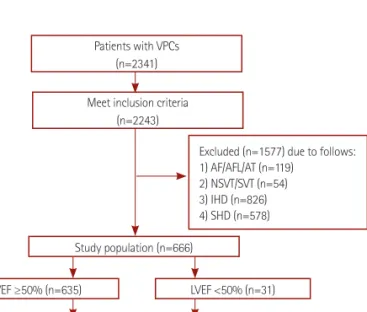
A total of 2341 patients diagnosed with frequent VPCs in the outpatient clinic regardless of the reason for their visit to Samsung Medical Center from January 1994 to December 2013 were included in a retrospective, single-center VPC registry. Among them, 666 patients were finally enrolled in this study according to the following inclusion criteria (Fig. 1): 1) frequent VPCs (>1% or >1000 beats/day) on 24-hr Holter ECG (SEER Light Extend Compact Holter Recorders, GE Medical Systems, Fairfield, Conn., USA) monitoring at
Print ISSN 1738-5520 • On-line ISSN 1738-5555
Clinical Characteristics and Features of Frequent Idiopathic Ventricular Premature Complexes in the Korean Population
Jin Kyung Hwang, MD, Seung-Jung Park, MD, Young Keun On, MD, June Soo Kim, MD, and Kyoung-Min Park, MD
Division of Cardiology, Department of Medicine, Samsung Medical Center, Sungkyunkwan University School of Medicine, Seoul, Korea
Background and Objectives: Frequent ventricular premature complexes (VPCs) increase the risk of cardiomyopathy (CMP). However, most data regarding VPCs have been obtained from Western population and in-hospital patient-based studies. The objective of this study was to define the clinical characteristics and features of idiopathic VPCs in the Korean population.
Subjects and Methods: We investigated subjects undergoing transthoracic echocardiography and documented VPC burdens >1% by Holter monitoring in an outpatient clinic at Samsung Medical Center, Korea. We analyzed demographic and clinical features and the nature of the VPCs by electrocardiography (ECG).
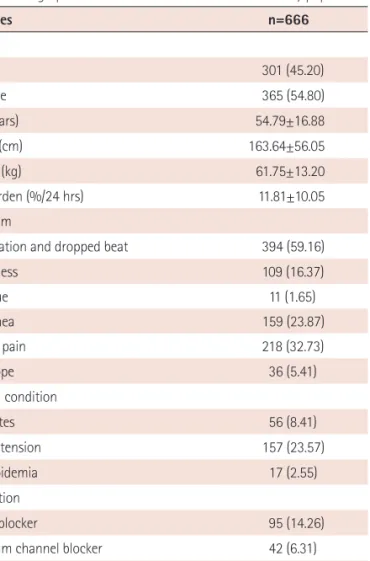
Results: A total of 666 patients were registered. Mean age was 54.7±16.8 years, and 365 (54.8%) patients were female. Typical VPC-related symptoms, such as palpitation and a dropped beat, were observed in 394 (59.2%) patients. Some patients received beta-blockers (n=95; 14.3%) and anti-arrhythmic agents (n=14; 2.1%). The ECG analysis was performed in 405 patients; 322 (79.5%) exhibited left bundle branch block (LBBB) and 347 (85.8%) exhibited an inferior axis. The precordial R-wave transition was predominantly distributed over V3 in 230 patients (56.6%). Thirty-one patients (4.5%) were diagnosed with VPC-induced CMP.
Conclusion: The incidence of frequent VPCs was slightly higher in females, and palpitation was the most frequent complaint. The most common ECG features were LBBB, inferior axis, and late precordial R-wave transition. (Korean Circ J 2015;45(5):391-397)
KEY WORDS: Ventricular premature complexes; Cardiomyopathies; Electrocardiography; Korean.
Received: November 8, 2014 Revision Received: March 9, 2015 Accepted: April 2, 2015
Correspondence: Kyoung-Min Park, MD, Division of Cardiology, Department of Medicine, Samsung Medical Center, Sungkyunkwan University School of Medicine, 81 Irwon-ro, Gangnam-gu, Seoul 06351, Korea
Tel: 82-2-6190-5242, Fax: 82-2-3410-3849 E-mail: [email protected]
• The authors have no financial conflicts of interest.
This is an Open Access article distributed under the terms of the Creative Commons Attribution Non-Commercial License (http://creativecommons.
org/licenses/ by-nc/3.0) which permits unrestricted non-commercial use,
distribution, and reproduction in any medium, provided the original work
is properly cited.
enrollment, 2) symptoms fully described in medical records, and 3) underwent baseline and follow-up echocardiography within 6 months from enrollment. Exclusion criteria were: 1) history of atrial fibrillation, atrial flutter, atrial tachycardia, non-sustained ventricular tachycardia, and sustained ventricular tachycardia, or documented arrhythmias by 12-lead ECG (PageWriter TC30, Philips Medical Systems, Amsterdam, Netherlands) or Holter ECG monitoring, 2) history of myocardial infarction, structural heart disease, or heart valve replacement/repair, and 3) any evidence of ischemic/structural heart disease based on echocardiography, a radionuclide evaluation, and/or cardiac catheterization. All transthoracic echocardiography (TTE) data and Holter monitoring data were reviewed. Symptoms related to VPCs were evaluated by a cardiologist based on the patient’s medical records. Palpitation and dropped beats were regarded as typical VPC-related symptoms, and all other symptoms, such as fatigue, dizziness, syncope, and shortness of breath, were defined as atypical symptoms. The ECG analysis was performed on 405 patients with ECG containing VPC and taken anytime during the follow up period. All procedures were performed following the institutional guidelines of Samsung Medical Center, and all patients provided their written informed consent.
Echocardiography analysis
TTE was performed with subjects in the left lateral decubitus position. Left ventricular (LV) systolic function was measured using the modified Simpson’s method (biplane method) according to the
recent American Society of Echocardiography committee recommendations.
6)Normal LV systolic function was defined as ejection fraction (EF) ≥50% based on American College of Cardiology Foundation (ACCF)/American Heart Association (AHA) guidelines.
7)According to this definition, EF<50% was classified as LV systolic dysfunction. In addition, TTE and a quantitative assessment of LV function was repeated at 3–6 month intervals in patients with LV dysfunction.
Electrocardiography analysis
Patients available for a 12-lead ECG assay were included in this sub-group. The initial ECG taken during the study period was the criterion. We investigated the pattern and axis of VPCs, and the distributions of the precordial R wave transition. The parameters were defined as follows: 1) VPC patterns: left bundle branch block (LBBB) and right bundle branch block (RBBB) were defined in accordance with recent ACCF/AHA/Heart Rhythm Society recommendations;
8)2) VPC axes: positive and negative axes were determined by the vector of the dominant VPC deflection in leads II, III, and aV
F; 3) precordial R wave transition: the R-wave transition at leads V
1–V
2was defined as below V
3, and a transition at leads V
4–V
6was defined as above V
3.
Holter monitoring
Holter monitoring was performed before treatment to determine VPC burden. Follow-up Holter monitoring was repeated 3-6 months after treatment (radiofrequency ablation or anti-arrhythmic drugs)
Fig. 1. Study scheme. Search flow diagram of the study population. VPCs:
ventricular premature complexes, AF: atrial fibrillation, AFL: atrial flutter, AT: atrial tachycardia, NSVT: non-sustained ventricular tachycardia, SVT:
sustained ventricular tachycardia, IHD: ischemic heart disease, SHD:
structural heart disease, LVEF: left ventricular ejection fraction, ECG:
electrocardiography.
Patients with VPCs (n=2341)
Meet inclusion criteria (n=2243)
Study population (n=666)
Excluded (n=1577) due to follows:
1) AF/AFL/AT (n=119) 2) NSVT/SVT (n=54) 3) IHD (n=826) 4) SHD (n=578)
ECG analysis (n=405) LVEF ≥50% (n=635)
LVEF ≥50% (n=386)
LVEF <50% (n=31)
LVEF <50% (n=19)
Fig. 2. Age distribution of the study population. The prevalence of ventricular premature complexes was slightly higher in females than that in males, particularly in 40–60 year old women. The peak age for females was 50–70 years; however the peak age for males was 60–80 years. Age was normally distributed in the study population.
110 100 90 80 70 60 50 40 30 20 10 0 (n)
Age Female
Male
<10 10-19 20-29 30-39 40-49 50-59 60-69 70-79 80-89 90≤