Although the roles of endoscopic retrograde biliary procedures and computed tomography / magnetic reso- nance imaging have increased, percutaneous biliary pro-
cedures including PTC, PTBD, and percutaneous stent placement remains significant in the evaluation and treatment of biliary obstructive diseases, especially for biliary hilar obstruction (1-3).
PTBD has been regarded as a drainage-first procedure.
Thus, a duct puncture is commonly followed by the in- sertion of an introducing system to deliver a 0.035inch wire followed by a drainage catheter. However, during PTBD, it is not uncommon to encounter situations that
Usefulness of a Biliary Manipulation Catheter in Percutaneous Transhepatic Biliary Drainage
1Auh Whan Park, M.D., Je Hwan Won, M.D.2, Jei Hee Lee, M.D.2, Joo Sung Sun, M.D.2, Kyu Sung Kwak, M.D.2, Jae-Ik Bae, M.D.2
1Department of Radiology, Virginia University Health Center, 1215 Lee Street, Charlottesville, VA 22908, Unites States
2Department of Radiology, Ajou University School of Medicine, Korea Received Nocember 16, 2010 ; Accepted February 2, 2011
Address reprint requests to : Jae-Ik Bae, M.D., Department of Radiology, Ajou University School of Medicine, San-5, Woncheon-dong, Yeongtong- gu, Suwon-si, Gyeonggi-do 443-721, Korea.
Tel. 82-31-219-5829 Fax. 82-31-219-5862 E-mail: [email protected]
Purpose: To evaluate usefulness of a manipulation catheter in percutaneous transhep- atic biliary drainage (PTBD).
Materials and Methods: A biliary manipulation catheter was used for the aspiration of retained bile and lesion crossing during an initial PTBD in 91 consecutive patients over a 6 month period. This catheter allowed for a 0.035 inch guide wire made of 5F short steel braided polyurethane. The terminal 1 cm segment was tapered and 45。angulat- ed. Two side holes were made in the terminal segment to facilitate the aspiration of bile. The safety of this procedure was evaluated based on whether the catheters caused complications during insertion and manipulation, and whether cholangitis was aggravated after the procedure. Effectiveness of the procedure was evaluated based on the ability to aspirate retained bile and to cross the lesion.
Results: Both the insertion of a 0.035 inch hydrophilic guide wire and aspiration of sufficient retained bile were successful with the catheter. Crossing the common bile duct (CBD) lesion had a 98.1% success rate during the initial PTBD. Crossing the hilar obstruction lesion was had a 94.7% success rate to the CBD and 92.1% to the con- tralateral lobe. Cholangitis improved in 97% of cases, and aggravated transiently in on- ly 3% of cases after PTBD.
Conclusion: A biliary manipulation catheter should be considered as a useful tool for a safe and effective PTBD, attributed to the facilitation of bile aspiration and lesion crossing.
Index words :Bile Ducts
Radiography, Interventional Cholangitis
require manipulations in the bile duct, which cannot be achieved with an introducing system only. For instance, when evaluating an obstructing lesion below the ob- structing segment, when an approach to most appropri- ate site for effective biliary drainage fails, when crossing a tight stricture or an obstructing segment, and when as- pirating retained bile before the drainage catheter inser- tion (3-8).
To overcome these problems, we designed a catheter dedicated to percutaneous biliary intervention which have a short stiff shaft and an angled tip for good torque and direction control, as well as terminal side holes for aspiration. We aimed to evaluate the usefulness of this catheter in facilitating the representative percutaneous biliary interventional procedure; PTBD.
Materials and Methods
Catheter
The manipulation catheter (Park’s bright; A & A,
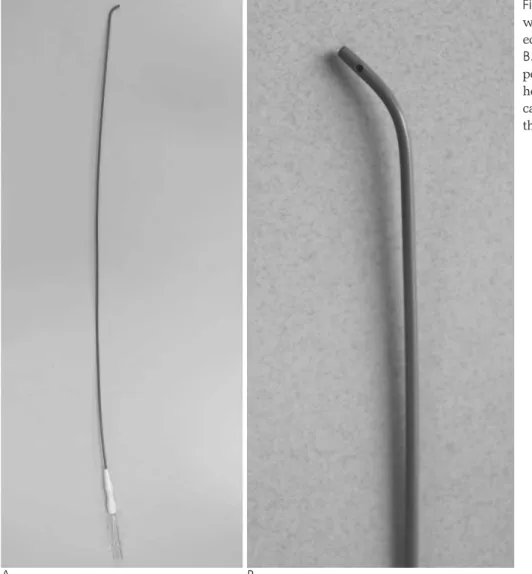
Seongnam, Korea) has a short (40 cm in length) and stiff- braided shaft made of polyurethane. The terminal 1 cm segment is tapered with a 45。angle (Fig. 1). The stiff shaft and tip make it possible to insert the catheter through the 0.035 inch guide wire into the liver. The an- gulated tip facilitates direction control and negotiation of the obstructed segment. The catheter has two side holes in the terminal segment to facilitate the aspiration of bile during manipulation.
Patients
Between July 2007 and December 2007, 105 consecu- tive patients underwent an initial PTBD procedure in our angiographic suite. The catheter was used in all PTBD procedures unless unnecessary or harmful. Thus, 14 of 105 patients were excluded because of septic shock (n=3), endoscopic nasobiliary drainage status (n=2), complex hilar stenting (n=3), hepatocellular car- cinoma (n=1), and hemobilia distension of the bile duct during puncture (n=2); the remaining 91 patients were
A B
Fig. 1. A. The manipulation catheter was 40 cm in length with a stiff braid- ed shaft.
B. The terminal 1 cm segment was ta- pered and 45。angulated. Two side holes made in the terminal segment can facilitate aspiration of bile during the manipulation
included. The level and causes of obstruction were the distal common bile duct (CBD) in 53 patients by stones (n=20) or malignancies (n=33), and the hilum in 38 pa- tients by stones (n=18) or malignancies (n=20).
Procedure
Pre-procedural antibiotic regimens, including a 3rd generation cephalosporin and metronidazole, were in- fused at least 1 hour prior to the procedure. Sedation was achieved with remifentanil, which was continuously in- fused by an infusion pump. The puncture was made with a 21G Skinny needle (PTC needle; A & A). If dilated peripheral ducts were visible on USG, a definitive punc- ture was performed with a 21G skinny needle under ul- trasonographic guidance. If dilated peripheral ducts were
not visible, a central duct was punctured under ultra- sonographic guidance and the definitive puncture was made with another needle under fluoroscopic guidance.
Following the definitive puncture, a 0.018 inch hairwire (A & A, Seongnam, Korea) was inserted through the nee- dle to the bile duct. The hairwire was then changed to a 0.035-inch hydrophilic guide wire (Radifocus; Terumo, Tokyo, Japan) with the help of an introducing system (Yellow Sheath; A & A), which consisted of a 5F teflon dilator with an inner metal stiffener. The manipulation catheter was inserted over the 0.035-inch guide wire.
After insertion of the manipulation catheter, the retained bile above the obstruction was aspirated, followed by cholangiographic evaluation with careful injection of contrast media. An attempt was made to cross all of the
A B
C
Fig. 2. Malignant biliary hilar obstruction in a 65-old-male pa- tient.
A. A manipulation catheter was inserted through a right bile duct access. Retained bile was successfully aspirated.
B. A cholangiogram with the manipulation catheter demonstrat- ed hilar lesion extension.
C. Crossing the lesion to the left duct was successful with the help of the manipulation catheter. Bilobar external drainage was performed.
lesions, and the status of the bile duct beneath the ob- structing lesion was also evaluated. For the hilar lesions, crossing the lesion was attempted to the contralateral duct and CBD. Finally, a drainage catheter was inserted into the most appropriate position to drain as much of the functioning liver as possible (Fig. 2).
Evaluation
The effectiveness of the catheter was evaluated based on the ability to aspirate retained bile and to cross the le- sion. Crossing the lesion refers to passing the catheter in- to the duodenum in the CBD obstruction, and passing it into either the duodenum or contralateral lobe in the hi- lar obstruction. The safety of the catheter was evaluated based on whether or not insertion and manipulation of the catheter led to complications, and whether or not cholangitis was aggravated after the procedure. The severity of cholangitis was graded as follows: mild cholangitis was defined as laboratory testing, including a complete blood cell count, coagulation parameters, and renal function tests, within normal limits, as well as clear bile, whether or not it is black, yellow, or white in color;
moderate cholangitis was defined as a fever >38。C with leukocytosis (>11,000>μL) despite initial medical treat- ment or turbid or purulent bile; and severe cholangitis was defined when there were signs of organ dysfunc- tion.
Results
Insertion of the manipulation catheter over a 0.035 hy- drophilic guide wire was successful without a dilator in 85 of 91 patients (93.4%), of whom 82 underwent right access and 9 underwent left access. A 6F dilator was needed in 6 patients (6.6%; 5 for right access and 1 for left access). Aspiration of retained bile was successful in all patients (100%). The volume of aspirated bile ranged from 10-230 cc (mean, 59 cc). The aspirated bile was clear black (n=13), clear yellow (n=15), clear white (n=10), turbid green (n=25), or purulent (n=28).
The results of crossing obstructive lesions are summa- rized in Table 1. For the CBD obstructive lesions, cross-
ing the lesion was successful in 98.1% of cases ( 1 case failed due to an impacted CBD stone). Crossing the le- sion to the CBD in hilar obstructions was successful for 94.7% of cases (2 cases failed due to cholangiocarcinoma and iatrogenic surgical ligation). Crossing the lesion to the contralateral duct in hilar obstructions was success- ful in 92.1% of cases (3 cases failed due to cholangiocar- cinoma).
Changes in the degree of cholangitis after PTBD are summarized in Table 2. Eighteen patients with mild cholangitis before the procedure improved within 3 days of the procedure. Of the 63 patients with moderate cholangitis, 2 patients (3%) had transient aggravation af- ter PTBD, but improved within 7 days. Of the 10 pa- tients with severe cholangitis, 9 (90%) improved within 7 days of PTBD and 1 (10%) improved 3 weeks after PTBD. In summary, cholangitis improved or in 89 of 91 patients (97%), and transiently aggravated in 2 patients (3%). Septic shock did not occur in any patients.
Discussion
PTBD has been regarded as a drainage procedure for retained bile, rather than for patient evaluation, because of the potential to exacerbate cholangitis secondary to an elevation in intraductal pressure caused by catheter manipulation and contrast media. However, excessive restrictions for catheter manipulation in the biliary tract during the initial PTBD have limited the evaluation of obstructing lesions and bile duct anatomy, as well as di- recting the guide wire to the ideal position (1-10). The most effective way to avoid elevation of intraductal pressure during PTBD is the aspiration of sufficient re- tained bile during the procedure (1-4). However, the commonly used biliary introducing systems, which were designed to be inserted over a 0.018 inch wire are not suitable for bile aspiration, especially if there is blood-staining or thick purulent bile, because the intro- ducing systems are thin and have an end-holed tip.
Furthermore, these systems mostly consist of a straight dilator and an inner stiffener, so directional control is impossible. Another commercially available biliary ma- Table1. Obstructive Lesion Crossing on Initial PTBD with the Manipulation Catheter
Lesions For CBD Obstruction (n=53) For Hilar Obstruction (n=38)
Crossing to CBD Crossing to CL
Crossing success 52 (98.1%) 36 (94.7%) 35 (92.1%)
Crossing failure 01 (1.9%) 2 (5.3%) 3 (3%).1
Note.─CL = contralateral lobe
nipulation catheter (Cook-Europe, Bjaeverskov, Denmark), which is a 6.5 Fr polyethylene catheter with a short angled tip, can facilitate directing of a wire with good torque control, but this is also unsuitable for aspi- ration of bile because it has a tapered end-holed tip (10- 12). Other angled tip angiographic catheters are helpful for directing a guide wire within the biliary tree, but the insertion of an angled angiographic catheter into the bil- iary tree can be difficult and even fail.
The biliary manipulation catheter used herein had suf- ficient stiffness and a tapered tip to allow for the easy in- sertion through a 0.035 inch guide wire. Only 6.6% of cases required a dilator for insertion of the catheter. The catheter was also effective in the aspiration of retained bile. We were able to aspirate nearly all of the retained bile with the catheter before further manipulation in all cases. The easily controllable tip and distal side holes improved the ability to aspirate, even through bile was purulent or blood-stained. Finally, good torque control- lability was achieved with the short and stiff shaft, and the terminal angulated tip made it easy to cross lesions.
For the CBD-obstructing lesions, we were able to cross all lesions except for one; due to a large impacted CBD stone. We did not try aggressive manipulation with the catheter in an attempt to avoid inducing pancreatitis.
For the hilar-obstructing lesions, we were able to cross the lesion to the CBD in most cases (94.7%); the failed cases involved cholangiocarcinoma or an iatrogenic-lig- ated duct. On the second attempt, 2-3 days after the PTBD, we were successful in crossing all cholangiocar- cinoma, but failed again with the ligated duct. The ligat- ed duct was repaired by surgical revision. Crossing a wire to the contralateral duct is distinctly different from crossing a wire to the CBD, so we evaluated the con- tralateral crossing success rate separately. Contralateral crossing success is essential for either bilobar external drainage or bilobar T-configured stenting. We were also
able to cross to the contralateral duct in most cases (92.1%), with the exception of 3 cholangiocarcimas, which had an acute (< 45 degrees) hilar angle. All the patients with a contralateral crossing failure were unre- sectable and underwent Y-configured bilobar stenting through the bilateral access.
There are a variety of different definitions of acute cholangitis in the literature. Some authors have defined acute cholangitis based on clinical signs, such as Charcot’s triad (fever and/or chill, abdominal pain, and jaundice), while other authors have emphasized the properties of the bile. According to the Tokyo guide- lines, the basic concepts of the criteria are as follows: 1) Charcot’s triad is a definite diagnostic criterion for acute cholangitis; and 2) if a patient does not have all of the components of Charcot’s triad, then a definite diagnosis can be achieved if both an inflammatory response and biliary obstruction are demonstrated by the laboratory data and imaging findings (13). Severity assessment cri- teria are based on the onset of organ dysfunction and re- sponse to initial medical treatment. Mild cholangitis is defined if there is response to initial medical treatment without organ dysfunction. Moderate cholangitis is de- fined if there is no response to initial medical treatment or organ dysfunction. Severe cholangitis is defined if there is organ dysfunction. Organs include cardiovascu- lar, nervous, respiratory, renal, hepatic, and hematolog- ic systems. As differentiation between mild and moder- ate cholangitis is ambiguous despite the above men- tioned criteria, we made some modifications in the crite- ria based on blood test data and the properties of the as- pirated bile during the procedure; specifically, if the body temperature was >38 C with leukocytosis (>11,000>μL) despite initial medical treatment (includ- ing antibiotics) or the aspirated bile was turbid or puru- lent, severity was defined as moderate. In this study, cholangitis improved in 97% of patients, and was tran- Table 2. Changes of Cholangitis Degree After PTBD Using the Manipulation Catheter
Initial Cholangitis Changes of Cholangitis After 3 Days After 7 Days
Mild (n=18) To normal/mild 18 (100%) 18 (100%)
To moderate 0 0
To Severe 0 0
Moderate (n=63) To normal/mild 12 (13%)0 63 (100%)
To moderate 49 (84%)0 0
To Severe 2 (3%)0 0
Severe (n=10) To normal/mild 0 4 (40%)
To moderate 4 (40%) 5 (50%)
To Severe 6 (60%) 1 (10%)
siently aggravated in only 3% of patients. Septic shock did not occur in any patients.
Although the reported complication rates of PTBD are variable because of differences in techniques and re- porting standards, hemobilia is known to occur in 2.6- 9.0% of patients, and sepsis may occur in 5-26% of pa- tients undergoing PTBD (1-8). In our study, minor bleeding occurred during needling in two patients, which was transient and controlled spontaneously. No bleeding complications occurred during insertion or ma- nipulation of the catheter, as well as the following steps.
With respect to cholangitic complications, our results were similar to or better than previous reports (1-8).
There were some limitations to this study. Precise classification of the severity of cholangitis was not possi- ble during the follow-up period in some cases due to a lack of blood tests; such cases were categorized similar to the initial categorization. In addition, there was no control group which underwent PTBD without the use of a biliary manipulation catheter.
In conclusion, based on our results, the biliary manip- ulation catheter described herein is safe and effective for PTBD, attributed to the facilitation of bile aspiration and lesion crossing. The catheter can also be used for other percutaneous biliary procedures, such as percutaneous stone extraction and percutaneous stenting.
References
1. Venbrux AC, Ignacio EA, Soltes AP, Washington SB. Malignant ob- struction of the hepatobiliary system. In : Baum S, Pentecost MJ.
Abram’s angiography interventional radiology. 2nd ed. Philadelphia:
Lippincort Williams & Wilkins, 2006:553-559
2. Gordon RL. Benigh biliary obstruction. In : Baum S, Pentecost MJ.
Abram’s angiography interventional radiology. 2nd ed. Philadelphia:
Lippincort Williams & Wilkins, 2006:536-552
3. Harbin WP, Mueller PR, Ferrucci JT. Transhepatic cholangiogra- phy: complications and use patterns of the fine-needle technique:
a multi-insitutional survey. Radiology 1980;135:15-22
4. Clark CD, Picus A, Dunagan WC. Bloodstream infections after in- terventional procedures in the biliary tract. Radiology 1994;191:
495-499
5. Sacks-Berg A, Calubiran OV, Epstein HY, Cunha BA. Sepsis associ- ated with transhepatic cholangiography. J Hosp Infect 1992;20:43- 50
6. Venbrux AC, Osterman FA Jr. Percutaneous management of be- nign biliary strictures. Semin Intervent Radiol 1996;13:207-214 7. Lameris JS, Obertop H, Jeekel J. Biliary drainage by ultrasound-
guided puncture of the left hepatic duct. Clin Radiol 1985:36:269- 274
8. Gunther RW, Schild H, Ehelen M. Percuntaneous transhepatic bil- iary drainage. Experience with 311 procedures. Cardiovasc Interv Radiol 1988;11:65-71
9. Van Delden OM, Lameris JS. Percutaneous drainage and stenting for palliation of malignant bile duct obstruction. Eur Radiol 2008;18:448-456
10. Yedlicka JW, Tadavarthy SM, Letournean JG, Castaneda F, Castaneda-Zuniga WR. Biliary tract intervention. In : Castaneda- Zuniga WR. Interventional radiology. 3rd ed. Baltimore: Williams &
Wilkins, 1997:1439-1608
11. Gibson RN. Percutaneous transhepatic cholangiography and biliary drainage. In : Adam A, Gibson RN. Practical interventional radiology of the hepatobiliary system and gastrointestinal tract. Kent: Edward Arnold, 1994:13-31
12. Garcia-Vila JH, Bordon F, Gonzalea-Anon M, Ambit S, Cortes V.
Endoluminal biopsy of the bile duct with a biliary manipulation catheter. J Vasc Interv Radiol 1999;10:1394-1396
13. Wada K, Takada T, Kawarada Y, Nimura Y, Yoshida M, Mayumi T, et al. Diagnostic criteria and severity assessment of acute cholangitis: Tokyo guidelines. J Hepatobiliary Pancreat Surg 2007;14:52-58
대한영상의학회지 2011;64:317-323
피부경유담즙배액술에서 담관조작용카테터의 유용성1
1Department of Radiology, Virginia University Health Center, 1215 Lee Street, Charlottesville, VA 22908, Unites States
2아주대학교 의과대학 영상의학과
박오환∙원제환2∙이제희2∙선주성2∙곽규성2∙배재익2
목적: 피부경유담즙배액술(percutaneous transhepatic biliary drainage, 이하 PTBD) 시행 시 담관조작용카 테터(biliary manipulation catheter)사용의 유용성을 알아보고자 하였다.
대상과 방법: 6개월간 91명의 연속적인 PTBD 시행환자에서 배액관 삽입 전 고인 담즙을 흡인해내고 폐쇄병변을
평가하는 목적으로 담관조작용카테터를 사용하였다. 이는 5F 굵기 40 cm 길이의 짧고 빳빳한 카테터로서 끝 1 cm 부분은 45도 각으로 휘어져 있고 2개의 측공이 있어, 담관 내에서 길을 찾거나 고여 있는 담즙을 흡인하는데 유리할 수 있는 디자인을 하고 있다. 카테터 사용에 따른 안전성은 삽입과 조작에 따른 문제발생 여부 및, 담관염의 악화여 부로 평가하였고, 효용성은 고인 담즙의 흡인능력과 병변을 찾고 통과하는 능력을 기준으로 평가하였다.
결과: 유도철사를 통한 카테터의 삽입과 이를 이용한 고인 담즙의 흡인은 전 예에서 성공적이었다. 이 카테터를 이 용하여 PTBD시에 바로 폐쇄 병변을 찾고 이를 통과하는 데에는 95%에서 성공하였다; 총담관폐쇄의 경우 98.1%, 간문부폐쇄의 경우 총담관으로는 94.7%, 반대쪽 엽으로는 92.1%, 배액관 삽입 전 카테터 조작과 병변부 평가를 시 행하였음에도 불구하고 PTBD직후 담관염은 97%에서 호전되었고, 3%에서만 일시적으로 악화되었으나 패혈성 쇼 크는 없었으며 모두 7일 이내에 정상으로 회복되었다.
결론: 담관조작용카테터는 담관염의 악화 없이도 PTBD시행 시 바로 폐쇄병변부의 평가나 이의 통과를 가능하게 하여 효과적인 담즙배액을 유도하는데 유용하다.