• 검색 결과가 없습니다.

Whitening Activity of Abeliophyllum distichum Nakai Leaves According to the Ratio of Prethanol A in the Extracts

N/A
N/A
Protected

Academic year: 2021

Share "Whitening Activity of Abeliophyllum distichum Nakai Leaves According to the Ratio of Prethanol A in the Extracts"

Copied!
8
0
0

로드 중.... (전체 텍스트 보기)

전체 글

(1)

Introduction

The skin, which separates the epidermis from the dermis, mainly functions to protect the body from physical or chemical stimulation and prevents disproportionate moisture loss (Chung et al., 2003; Fisher et al., 2002; Kim et al., 2014).

Skin aging is the cumulative result of oxidative damage to cutaneous tissue (Wickens, 2001), and is caused by intrinsic and extrinsic factors, which include exposure to ultraviolet radiation, causing photoaging (Chung et al., 2003; Seo et al., 2001). Melanin is synthesized in the melanocytes through the process of melanogenesis, in response to extrinsic aging factors (Tsatmali et al., 2002). Reactive oxidant species

(ROS) are known to cause skin aging as well as other human diseases (Luft, 1994), and oxidative stress can lead to an abnormal redox state of cell membrane proteins in skin cells, resulting in melanogenesis (Kim and Uyama, 2005). Under normal conditions melanin has a beneficial effect on the photo-protection of human skin (Costin and Hearing, 2007).

However, an excessive accumulation of melanin causes dermatological diseases such as freckles, solar lentigo (age spots), and melanocarcinoma (Ahn et al., 2006, Brenner and Hearing, 2008; Iozumi et al., 1993; Li et al., 2003; Unver et al., 2006). Melanin synthesis is similar to the oxidative stress caused by ROS. Therefore, antioxidant activity is supposed to suppress melanogenesis (Eberlein-Konig et al., 1998). Mela- nogenesis regulates tyrosinase, tyrosinase-related protein 1 (TRP-1) and tyrosinase-related protein 2 (TRP-2), which are

Whitening Activity of Abeliophyllum distichum Nakai Leaves According to the Ratio of Prethanol A in the Extracts

Tae-Won Jang 1 , Ji-Soo Choi 2 , Hoi-Ki Kim 3 , Eun-Ja Lee 3 , Man-Wook Han 3 , Ki-Beom Lee 4 , Do-Wan Kim 5 and Jae-Ho Park 6 *

1

Graduate Student, Department of Medicinal Plant Resources, Andong National University, Andong 36729, Korea

2

Graduate Student, Department of Medicinal Plant Science, Jungwon University, Goesan 28024, Korea

3

Researcher, Fanipinkorea Co., Ltd, Cheongju 28162, Korea

4

Senior Researcher, Incheon Business Information Technopark. Biotechnology & Business Center, Incheon 21999, Korea

5

Professor, Department of Food Science and Industry, Jungwon University, Goesan 28024, Korea

6

Professor, Department of Pharmaceutical Science, Jungwon University, Goesan 28024, Korea

Abstract - In this study, we evaluated the whitening activity of prethanol A and water extracts from Abeliophyllum distichum Nakai. The extracts were prepared using 0, 50, 70, and 100% prethanol A at 121 ℃, 1.2 atm for 15 minutes. To confirm effective extraction, the acteoside content of each extract was analyzed with the HPLC-PDA method. The antioxidant activity was evaluated using DPPH and ABTS scavenging activity assays, and the whitening activity was evaluated based on inhibitory activities on the protein and mRNA expression of tyrosinase, tyrosinase-related protein 1 (TRP-1), tyrosinase-related protein 2 (TRP-2), and microphthalmia-associated transcription factor (MITF) in B16 F10 cells. Each extract showed strong antioxidant and whitening activity. IC

50

values of antioxidant activity from each extract were in order of 100%, 70%, 50%, and 0%. In addition, whitening activity inhibited the protein and mRNA expression of melanin synthesis factor, following the same pattern as antioxidant activity. In conclusion, water and prethanol A extracts of A.

distichum showed effective antioxidant and whitening activity and are thus considered to be valuable materials for whitening cosmetics. The results of this study will also provide basic data for the safe and efficient production of A.

distichum as a cosmetic material.

Key words – Abeliophyllum distichum, MITF, TRP-1, TRP-2, Tyrosinase

*Corresponding author. E-mail : [email protected] Tel. +82-43-830-8614

ⓒ 2018 by The Plant Resources Society of Korea

Original Research Article

(2)

modulated by microphthalmia-associated transcription factor (MITF) in melanogenesis (Ahn et al., 2008). Thus, the downregulation of tyrosinase, TRP-1, TRP-2, MITF activity has been proposed to be responsible for decreasing melanin production (Curto et al., 1999). Abeliophyllum distichum Nakai is a deciduous shrub of in the family Oleaceae, and is regarded as a valuable plant resource because there is only one species in the world (Park, 2011). We evaluated the antioxidant and whitening activity of extracts by water and prethanol A to develop A. distichum as a safe and effective material for cosmetic use.

Materials and Methods

Experimental materials

A. distichum Nakai (voucher number: JWU-031) was collected from Misun-hyang Theme park, Seongbul-Mountain Recreation Forest, 78, Chungmin-rogigok-gil, Goesan-eup, Goesan-gun, Chungcheongbuk-do, Korea. Acetonitrile, chloroform, dimethyl sulfoxide, ethyl acetate, methanol, petroleum ether and prethanol A (HPLC-grade) were purchased from Merck (Darmstadt, Germany). Dulbecco’s modified Eagle’s medium (DMEM), 10% (v/v) fetal bovine serum, penicillin/streptomycin, and trypsin were purchased from Hyclone (Logan, UT, USA).

The primary and secondary antibodies were purchased from Abcam (Cambridge, UK) and Santa Cruz Biotechnology (Dallas, TX, USA). All electrophoresis chemicals were purchased from Bio-Rad Labs (Hercules, CA, USA). All chemicals were purchased from Sigma-Aldrich (St. Louis, MO, USA), unless otherwise specified. Standard acteoside was purchased from Sigma-Aldrich.

Sample extraction

A. distichum was extracted with 100% water and 50, 70, 100% prethanol A using a autoclave (121℃, 1.2 atm) for 15 min. The prethanol A extracts were filtered and concentrated by using a vacuum evaporator (N-1110S, EYELA, Shanghai, China). The water extracts were freeze drying and stored in a refrigerator until use.

DPPH radical scavenging activity

DPPH radical scavenging activity was measured according to

Bondet method (Bondet et al., 1997) with some modifications.

DPPH solution containing 1,1-diphenyl-2-picryl hydrazyl (DPPH) in ethanol was prepared. Sample and DPPH solution were mixed and incubated for 20 min in the dark at room temperature. Absorbance was measured using a UV/Visible spectrophotometer (Xma-3000PC, HumanCorp, Seoul, Korea) at 515 ㎚. DPPH radical scavenging activity was calculated according to the following equation:

DPPH radical scavenging activity (%) = [1 − (A

Sample

− A

Blank

)/A

Ccontrol

] × 100

A

Sample

=Absorbance values of DPPH radicals after treatment with sample.

A

Blank

=Absorbance values of DPPH radicals with ethanol.

A

Control

=Absorbance values of DPPH radicals.

ABTS radical scavenging activity

ABTS radical scavenging activity was measured as described by Van den Berg et al. (1999) with some modifications. ABTS solutions containing 2,2'-azino-bis (3-ethylbenzothiazoline- 6-sulfonic acid) diammonium salt and potassium persulfate in distilled water were prepared 24 h prior to the experiment.

Sample and ABTS solution were mixed and incubated for 20 min in the dark at room temperature. Absorbance was measured using a UV/Visible spectrophotometer at 732 ㎚.

ABTS radical scavenging activity was calculated according to the following equation:

ABTS radical scavenging activity (%) = [1 − (A

Sample

− A

Blank

)/A

Ccontrol

] × 100

A

Sample

=Absorbance values of ABTS radicals after treatment with sample.

A

Blank

=Absorbance values of ABTS radicals with ethanol.

A

Control

=Absorbance values of ABTS radicals.

Reducing power

Reducing power was measured according to Oyaizu method

(Oyaizu, 1986) described with some modifications. The

mixture, sample, potassium phosphate buffer (pH 6.6) and

potassium hexacyanoferrate (Ⅲ), was reacted at 50℃ for 20

(3)

min. After that, it was cooled and added to trichloroacetic acid (TCA). The mixture was centrifuged at 2000 × g for 5 min. Ferric chloride was mixed to the supernatant properly.

Absorbance was measured using a UV/Visible spectrophoto- meter at 700 ㎚. Reducing power was calculated according to the following equation:

Reducing power (Relative value of A

control

, %) = [1 − (A

Sample

− A

Blank

)/A

control

] × 100

‘A

Sample

’=Absorbance values of Reducing power after treat- ment with sample.

‘A

Blank

’=Absorbance values of Reducing power with ethanol.

‘A

Control

’=Absorbance values of Reducing power after treat- ment with positive control (L-ascorbic acid).

Quantification of acteoside by HPLC-PDA analysis A Waters 2695 system (Milford, MA, USA) equipped with Waters 2996 Photodiode array detector (PDA) was used to analyze the prethanol A and water extracts from A. distichum and the standard acteoside. Separation was carried out on an Xbridge-C18 (250 × 4.6 ㎜, 5 ㎛) with a C18 guard column.

The binary mobile phase consisted of acetonitrile (solvent A) and water containing 1% acetic acid (solvent B). All solvents were filtered through a 0.45 ㎛ filter prior to use. The flow-rate was kept constant at 1.0 ㎖/min for a total run time of 20 min. The system was run with a gradient program: 0–20 min: 90% B to 50% B. The sample injection volume was 10

㎕. Peaks of interest were monitored at 200–400 ㎚ by a PDA detector and compared with the standard acteoside.

Cell culture

B16 F10 cells were purchased from American Type Culture Collection (ATCC, Manassas, VA, USA) and grown in DMEM supplemented with 10% (v/v) fetal bovine serum, 100 U/ ㎖ penicillin, and 100 ㎍/㎖ streptomycin. The cells were maintained at 37°C under a humidified atmosphere of 5% CO

2

.

Immunoblotting

B16 F10 cells were cultured in 6-well plates at 37°C in an incubator with a humidified atmosphere of 5% CO

2

. The cells

were washed with 1 × phosphate-buffered saline and lysed in radio immuno precipitation assay buffer (Thermo Scientific, Waltham, MA, USA) supplemented with protease inhibitor cocktail (Sigma-Aldrich), and then centrifuged at 12,000 × g for 15 min at 4°C. The protein concentration of the sample was determined by the Bradford protein assay (Bio-Rad, Hercules, CA, USA). The proteins were mixed with Laemmli buffer and boiled at 95 ℃ for 5 min. The proteins were separated by 10% SDS-PAGE and transferred to a poly- vinylidene fluoride membrane (Bio-Rad). The membranes were blocked for non-specific binding with 5% nonfat dry milk in Tris-buffered saline containing 1% Tween 20 (TBS-T) for 30 min at room temperature and then incubated with specific primary antibodies in 3% nonfat dry milk at 4℃

overnight. After washing three times with TBS-T, the blots were incubated with horseradish peroxidase-conjugated im- munoglobulin G for 1 h at room temperature and chemilu- minescence was detected using ECL Western blotting substrate (Bio-Rad) and visualized with FluorChem E (Cell Biosciences).

Revers transcription-Polymerase chain reaction

Total RNA was prepared from B16 F10 cells using a NucleoSpin® RNA Plus (Macherey-Nagel, Düren, Germany) and total RNA was synthesized using ReverTra Ace- α- (Toyobo, Osaka, Japan) according to the manufacturer’s pro- tocol for cDNA synthesis. PCR was carried out using Quick Taq® HS DyeMix (Toyobo) with primers for Tyrosinase forward 5’-GAG AAG CGA GTC TTG ATT AG-3’, reverse 5’-TGG TGC TTC ATG GGC AAA ATC-3’, TRP-1 forward 5’-GCT GCA GGA GCC TTC TTT CTC-3’, reverse 5’-AAG ACG CTG CAC TGC TGG TCT-3’, TRP-2 forward 5’-CCT GTC TCT CCA GAA GTT TG-3’, reverse 5’-CGT CTG TAA AAG AGT GGA GG-3’, MITF forward 5’-AGC GTG TAT TTT CCC CAC AG-3’, reverse 5’-TAG CTC CTT AAT GCG GTC GT-3’, GADPH forward 5'-AAC TTT GGC 223 ATT GTG GAA GG-3', reverse 5'-ATG CAG GGA TGA TGT TCT GG-3'.

Statistical analysis

Statistical analysis was carried out using SPSS 18.0 (SPSS,

Inc., Chicago, IL, USA). All experiments were performed at

(4)

least three times. The data are shown as the mean ± SD of triplicate experiments. Differences were considered statis- tically significant when the p value was < 0.05.

Results and Discussion

Quantification of acteoside

According to Bremer et al. (2002), many plants in the Oleaceae family contain acteoside.A. distichum contains various glycosides such as acteoside, isoacteoside, rutin, and hirsutrin (Oh et al., 2003), and as such its potential bioactivities have remarkable value in the industry and

research fields. In our previous study, we investigated the relationship between various biological activities of A.

distichum and its acteoside contents (Jang and Park, 2018).

Acteoside is known to have high antioxidant (He et al., 2000), anti-inflammatory (Schlesier et al., 2002), and whitening activity (Son et al., 2011); it was identified in all extracts by HPLC-PDA method. The retention time and absorbance pattern analysis were similar to that of standard acteoside.

Acteoside showed a peak at 10.6 minutes with high absorbance at 330 ㎚ (Fig. 1). The concentration of acteoside in A. distichum was 171.3 ㎎/g (water extract), 240.1 ㎎/g (50% prethanol A extract), 269.4 ㎎/g (70% prethanol A extract), and 326.1 ㎎/g (100% prethanol A extract). These

Fig. 1. Acteoside chromatograms from Abeliophyllum distichum Nakai leaves according to the ratio of prethanol A in the extracts by

HPLC-PDA.

(5)

results indicate that the higher the prethanol A concentration, the higher the extraction of acteoside content.

Antioxidant activity

Antioxidants suppress the oxygen, electron, and hydrogen atoms generated by intracellular metabolism, protecting cells against the harmful effects of ROS, i.e. oxidative stress. If this metabolic process was impaired, oxidative damage would occur (Maxwell, 1995), potentially resulting in the develop- ment of premature skin aging, cancers, and various others conditions (Marnett, 2000). DPPH and ABTS radicals are stable chromogen compounds commonly used to measure the antioxidant activity of biological material (Que et al., 2006).

As shown in Table 1, the water and prethanol A extracts of A.

distichum effectively scavenged the DPPH and ABTS radicals. The IC

50

values for DPPH scavenging activity were:

water extract (25.1 ㎍/㎖), 50% prethanol A extract (20.4 ㎍/

㎖), 70% prethanol A 70% prethanol A extract (20.2 ㎍/㎖), 100% prethanol A extract (19.0 ㎍/㎖). The IC

50

values for ABTS scavenging activity were: water extract (8.05 ㎍/㎖),

50% prethanol A extract (6.69 ㎍/㎖), 70% prethanol A extract (7.45 ㎍/㎖) and 100% prethanol A extract (4.25 ㎍/

㎖). Antioxidants have been attributed to the prevention of chain reactions, chelating metals, reducing capacity, radical scavenging ability, etc. educing power used a mechanism that converts yellow to green or blue by electron reduction. The reducing capacity of a compound may serve as an indicator of its potential antioxidant capacity (Ferreira et al., 2007).

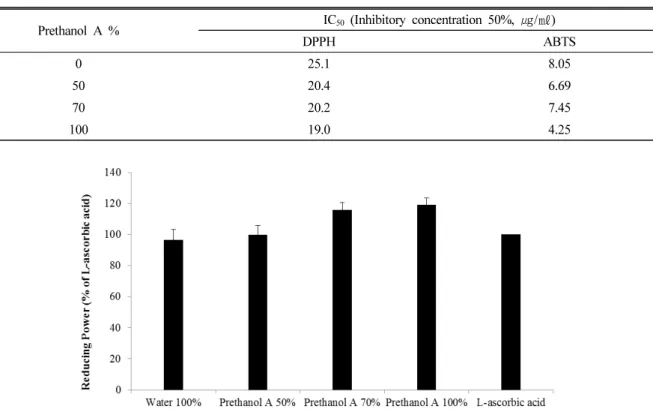
Reducing power was compared with L-ascorbic acid (100) relatively. As shown in Fig. 2, the reducing power of water extract (96.7), 50% prethanol A extract (99.8), 70% prethanol A extract (115.8), and 100% prethanol A extract (119.1) is shown. These results are consistent with the acteoside content of the extracts described above. Many studies have shown the antioxidant activity of acteoside (Jang and Park, 2018; Li et al., 2018) and therefore it was confirmed that acteoside content determines the antioxidant activity of extracts from A. distichum.

Table 1. DPPH and ABTS radical scavenging activity of Abeliophyllum distichum Nakai leaves according to the ratio of prethanol A in the extracts

Prethanol A % IC

50

(Inhibitory concentration 50%, ㎍/㎖)

DPPH ABTS

0 25.1 8.05

50 20.4 6.69

70 20.2 7.45

100 19.0 4.25

Fig. 2. Reducing power of Abeliophyllum distichum Nakai leaves according to the ratio of prethanol A in the extracts.

(6)

Whitening activity

Whitening is caused by the inhibition of melanin synthesis (melanogenesis) and is a complex pathway with enzymatic catalyzed reactions. Melanogenesis is initiated with the oxidation of L-tyrosine to 3,4-dihydroxyphenylalanine (DOPA) by tyrosinase, or the biosynthesis of DOPA into DOPA- quinone by tyrosinase (Hearing and Tsukamoto, 1991;

Jimenez-Cervantes et al., 1994). DOPA-quinone will serve as a substrate for the synthesis of eumelanin and pheomelanin.

Inhibition of tyrosinase is important for the suppression of melanogenesis. As shown in Fig. 3, water and prethanol A extract of A. distichum inhibited the expression of tyrosinase.

Inhibition of tyrosinase on prethanol A extracts were effective than water extract. The inhibition of tyrosinase on 100% prethanol A extracts was the most effective. As shown in Fig. 4, water and prethanol A extract of A. distichum inhibited the mRNA levels of tyrosinase. Prethanol A extracts were effective in inhibiting tyrosinase. TRP-1 catalyzes the

oxidation of 5,6-dihydroxyindole-2-carboxylic acid (DHICA) to carboxylate indole-quinone (Hearing and Jimenez, 1987).

TRP-2 known as dopachrome tautomerase (DCT) is oxidized to dihydroxyindole. These enzymes also catalyze eumelanin and pheomelanin (Que et al., 2009). As shown in Fig. 3, water and prethanol A extract of A. distichum inhibited the expression of TRP-1. Prethanol A extracts better inhibited TRP-1 than the water extracts. As shown in Fig. 4, water and prethanol A extracts of A. distichum inhibited the mRNA levels of TRP-1. Both prethanol A and water extracts inhibited TRP-1. As shown in Fig. 3 and Fig. 4, water and prethanol A extracts of A. distichum did not inhibit the expression of TRP-2. MITF, the key factor in melanogenesis, modulates tyrosinase, TRP-1, and TRP-2 (Ahn et al., 2008).

Akt, p38, and ERK, which are mitogen-activated protein kinases (MAPKs), induce the transcription of MITF by binding to M-box sequences (Bentley et al., 1994). As shown in Fig. 3, water and prethanol A extracts of A. distichum inhibited the expression of MITF. As shown in Fig. 4, water and prethanol A extracts of A. distichum inhibited the mRNA levels of tyrosinase. Prethanol A inhibited tyrosinase.

Inhibition of tyrosinase, TRP-1, TRP-2, and MITF could translate into a whitening effect on the skin. Therefore, antioxidants such as arbutin and ascorbic acid are used in functional cosmetics (Yang et al., 2008). Various pharma- cological activities of plant flavonoid compounds are associated with antioxidant activities (Lee et al., 2005;

Masaki et al., 1995). Water and prethanol A extracts of A.

distichum inhibited the expression of melanogenesis-related factors. The antioxidant and whitening activity of 100%

prethanol A extract was the greatest. These inhibitory effects were related to the antioxidant capacity of acteoside. In conclusion, prethanol A extract of A. distichum can be effectively utilized as a natural skin whitening agent in cosmetics and medicines.

Acknowledgement

This research was supported by the Ministry of Trade, Industry

& Energy (MOTIE), Korea Institute for Advancement of Technology (KIAT) through the Encouragement Program for The Industries of Enconomic Cooperation Region (P0001037).

Fig. 3. Whitening activities on melanin synthesis related proteins of Abeliophyllum distichum Nakai leaves according to the ratio of prethanol A in the extracts.

Fig. 4. Whitening activities on melanin synthesis related mRNA

levels of Abeliophyllum distichum Nakai leaves according to

the ratio of prethanol A in the extracts.

(7)

References

Ahn, J.H., S.H. Jin and H.Y. Kang. 2008. LPS induces melanogenesis through p38 MAPK activation in human melanocytes. Arch. Dermatol. Res. 300(6):325-329.

Ahn, S.J., M. Koketsu, H. Ishihara, S.M. Lee, S.K. Ha, K.H.

Lee, T.H. Kang and S.Y. Kim. 2006. Regulation of melanin synthesis by selenium-containing carbohydrates.

Chem. Pharm. Bull. 54(3):281-286.

Bentley, N.J., T. Eisen, and C.R. Goding. 1994. Melanocyte- specific expression of the human tyrosinase promoter:

activation by the microphthalmia gene product and role of the initiator. Mol. Cell. Biol. 14(12):7996-8006.

Bondet, V., W. Brand-Williams and C. Berset. 1997. Kinetics and mechanisms of antioxidant activity using the DPPH free radical method. LWT Food Sci. Technol. 30(6):

609-615.

Bremer, B., K. Bremer, N. Heidari, P. Erixon, R.G. Olmstead, A.A. Anderberg, M. Källersjö and E. Barkhordarian. 2002.

Phylogenetics of asteroids based on 3 coding and 3 non-coding chloroplast DNA markers and the utility of non-coding DNA at higher taxonomic levels. Mol.

Phylogenet. Evol. 24(2):274-301.

Brenner, M. and V.J. Hearing. 2008. The protective role of melanin against UV damage in human skin. Photochem.

Photobiol. 84(3):539-549.

Chung, J.H., V.N. Hanft and S. Kang. 2003. Aging and photoaging. J. Am. Acad. Dermatol. 49(4):690-697.

Costin, G.E. and V.J. Hearing. 2007. Human skin pigmentation:

melanocytes modulate skin color in response to stress.

FASEB J. 21(4):976-994.

Curto, E.V., C. Kwong, H. Hermersdörfer, H. Glatt, C.

Santis, V. Virador, V.J. Hearing and T.P. Dooley. 1999.

Inhibitors of mammalian melanocyte tyrosinase: in vitro comparisons of alkyl esters of gentisic acid with other putative inhibitors. Biochem. Pharmacol. 57(6):663-672.

Eberlein-Konig, B., M. Placzek and B. Przybilla. 1998.

Protective effect against sunburn of combined systemic ascorbic acid (vitamin C) and d-α-tocopherol (vitamin E). J Am Dermatol 38(1):45-48.

Ferreira, I.C., P. Baptista, M. Vilas-Boas and L. Barros. 2007.

Free-radical scavenging capacity and reducing power of wild edible mushrooms from northeast Portugal: Individual cap and stipe activity. Food Chem. 100(4):1511-1516.

Fisher, G.J., S. Kang, J. Varani, Z. Bata-Csorgo, Y. Wan, S.

Datta and J.J. Voorhees. 2002. Mechanisms of photoaging and chronological skin aging. Arch. Dermatol. 138(11):

1462-1470.

He, Z.D., K.M. Lau, H.X. Xu, P.C. Li and B.P. Pui-Hay.

2000. Antioxidant activity of phenylethanoid glycosides from Brandisia hancei. J. Ethnopharmacol. 71(3):483-486.

Hearing, V.J. and M. Jimenez. 1987. Mammalian tyrosinase – the critical regulatory control point in melanocyte pigmen- tation. Int. J. Biochem. 19(12):1141-1147.

Hearing, V.J. and K. Tsukamoto. 1991. Enzymatic control of pigmentation in mammals. FASEB J. 5(14):2902-2909.

Iozumi, K., G.E. Hoganson, R. Pennella, M.A. Everett and B.B. Fuller. 1993. Role of tyrosinase as the determinant of pigmentation in cultured human melanocytes. J. Invest.

Dermatol. 100(6):806-811.

Jang, T.W. and J.H. Park. 2018. Antioxidant activity and inhibitory effects on oxidative DNA damage of callus from Abeliophyllum distichum Nakai. Korean J. Plant. Res.

31(3):228-236.

Jimenez-Cervantes, C., F. Solano, T. Kobayashi, K. Urabe, V.J. Hearing, J.A. Lozano and J.C. Garcia-Borron. 1994. A new enzymatic function in the melanogenic pathway. The 5,6-dihydroxyindole-2-carboxylic acid oxidase activity of tyrosinase-related protein-1 (TRP-1). J. Biol. Chem.

269(27):17993-18000.

Kim, B., Y.E. Choi and H.S. Kim. 2014. Eruca sativa and its flavonoid components, quercetin and isorhamnetin, improve skin barrier function by activation of peroxisome proliferator- activated receptor (PPAR)-α and suppression of inflamma- tory cytokines. Phytother. Res. 28(9):1359-1366.

Kim, Y.J. and H. Uyama. 2005. Tyrosinase inhibitors from natural and synthetic sources: structure, inhibition mecha- nism and perspective for the future. Cell. Mol. Life Sci.

62(15):1707-1723.

Li, G., Ju, H.K. and H.W. Chang, Y. Jahng, S.H. Lee and J.K.

Son. 2003. Melanin biosynthesis inhibitors from the bark of Machilus thunbergii. Biol. Pharm. Bull. 26(7):1039- 1041.

Lee, S.Y., E.J. Hwang, G.H. Kim, Y.B. Choi, C.Y. Lim and S.M. Kim. 2005. Antifungal and antioxidant activities of extracts from leaves and flowers of Camellia japonica L.

Korean J. Med. Crop Sci. 13(3):93-100.

Li, X., Y. Xie, K. Li, A. Wu, H. Xie, Q. Guo, P. Xue, Y.

Maleshibek, W. Zhao, J. Guo, and D. Chen. 2018. Anti-

(8)

oxidation and cytoprotection of acteoside and its derivatives:

Comparison and mechanistic chemistry. Molecules 23(2):

498.

Luft, R. 1994. The development of mitochondrial medicine.

PNASU. 91(19):8731-8738.

Marnett, L. 2000. Oxiradicals and DNA damage. Carcino- genesis 21(3):361-370.

Masaki, H., S. Sakaki, T. Atsumi, and H. Sakurai. 1995.

Active oxygen scavenging activity of plant extracts. Biol.

Pharm. Bull. 18(1):162-166.

Maxwell, S.R. 1995. Prospects for the use of antioxidant therapies. Drugs 49(3):345-361.

Oh, H.C., D.G. Kang, T.O. Kwon, K.K. Jang, K.Y. Chai, Y.G. Yun, H.T. Chung and H.S. Lee. 2003. Four glycosides from the leaves of Abeliophyllum distichum with inhibitory effects on angiotensin converting enzyme. Phytother. Res.

17(7):811-813.

Oyaizu, M. 1986. Studies on products of browning reaction:

antioxidative activities of products of browning reaction prepared from glucosamine. Jpn J. Nutr. 44(6): 307-315.

Park, H.Y., M. Kosmadaki, M. Yaar and B.A. Gilchrest.

2009. Cellular mechanisms regulating human melanogenesis.

Cell. Mol. Life Sci. 66(9):1493-1506.

Park, J.H. 2011. Antioxidant activities and inhibitory effect on oxidative DNA damage of extracts from Abeliophylli distichi Folium. Korean J. Herbol. 26(4):95-99.

Que, F., L. Mao and X. Pan. 2006. Antioxidant activities of five Chinese rice wines and the involvement of phenolic compounds. Food Res. Int. 39(5):581-587.

Schlesier, K., M. Harwat, V. Böhm and R. Bitsch. 2002.

Assessment of antioxidant activity by using different in vitro methods. Free Radic. Res. 36(2):177-187.

Seo, J.Y., K.H. Cho, H.C. Eun and J.H. Chung. 2001. Skin aging from phenotype to mechanism. Korean J. Investig.

Dermatol. 8(1):187-194.

Son, Y.O., S.A. Lee, S.S. Kim, Y.S. Jang, J.C. Chun and J.C.

Lee. 2011. Acteoside inhibits melanogenesis in B16F10 cells through ERK activation and tyrosinase down- regulation. J. Pharm. Pharmacol. 63(10):1309-1319.

Tsatmali, M., J. Ancans and A.J. Thody. 2002. Melanocyte function and its control by melanocortin peptides. J.

Histochem. Cytochem. 50(2):125-133.

Unver, N., P. Freyschmidt-Paul, S. Hörster, H. Wenck, F.

Stäb, T. Blatt and H.P. Elsässer. 2006. Alterations in the epidermal melanin axis and factor XIIIa melanophages in senile lentigo and ageing skin. Br. J. Dermatol. 155(1):

119-128.

Van den Berg, R., G.R. Haenen, H. Van den Berg and A. Bast.

1999. Applicability of an improved Trolox equivalent antioxidant capacity (TEAC) assay for evaluation of antioxidant capacity measurements of mixtures. Food Chem. 66(4):511-517.

Wickens, A.P. 2001. Ageing and the free radical theory.

Respir. Physiol. 128(3):379-391.

Yang, E.S., J.S. Hwang, H.C. Choi, R.H. Hong and S.M.

Kang. 2008. The effect of genistein on melanin synthesis and in vivo whitening. Korean J. Soc. Microbiol. Biotechnol.

36(1):72-81.

(Received 30 October 2018 ; Revised 6 December 2018 ; Accepted 12 December 2018)

수치

Fig. 1. Acteoside chromatograms from Abeliophyllum distichum Nakai leaves according to the ratio of prethanol A in the extracts by  HPLC-PDA.
Table 1. DPPH and ABTS radical scavenging activity of Abeliophyllum distichum Nakai leaves according to the ratio of prethanol  A in the extracts
Fig. 3. Whitening activities on melanin synthesis related  proteins of Abeliophyllum distichum Nakai leaves according to  the ratio of prethanol A in the extracts.

참조

관련 문서

Globally was common sense that modernity was the opportunity for women to acquire the right of education, political activity and social labor.. The independence from

This study was conducted to investigate the effects of 12 weeks after school physical activity program on body composition and PAPS in obese elementary

This paper aims at analyzing the relationship among social support, intense factor, and exercise maintenance according to the participation activity in sports

The purpose of this study was to examine the effects of football on PAPS in sports club activity for 12 weeks in middle school boys.. The following

This study was to do a comparative analysis on kinematic differences and differences in muscle activity between the skilled and the unskilled in windsurfing

 In the present study, as a preliminary study, a LACC-based Compton CT was developed to estimate the activity of the spot inside the radioactive waste drum. To

The results of analysis on the difference of psychological happiness according to frequency of participation of external physical activity of female middle school

– Late Finish (LF): latest possible time an activity can finish based on the logic and durations identified in the network without extending the completion date of the