https://doi.org/10.20307/nps.2018.24.3.213
213
A New Flavonol Glycoside from Tristemma hirtum (Melastomataceae)
Joseph Nandjou Kenfack
1, Beaudelaire Kemvoufo Ponou
1, Jonas Kühlborn
2,Rémy Bertrand Teponno
1, Raymond Ngansop Nono
1, Romuald Tématio Fouedjou
1,
Till Opatz
2, Hee Juhn Park
3,*, and Léon Azefack Tapondjou
1,*
1
Department of Chemistry, Faculty of Science, University of Dschang, Box 67, Dschang, Cameroon
2
Johannes Gutenberg University Mainz, Institute of Organic Chemistry, Duesbergweg 10-14, D-55128 Mainz, Germany
3
Department of Pharmaceutical Engineering, Sangji University, 26339 Wonju, Korea
Abstract − Chemical investigation of the plant Tristemma hirtum P. Beauv (Melastomataceae) resulted to the isolation of a new flavonol glycoside named quercetin-7-O- α-D-arabinofuranoside (1), together with nine known compounds including 3'-hexadecanoyl-2'-(9aZ)-tetradecanoyl-glycerol 1'-O-[β-D-galactopyranosyl-(1'' → 6'')-α- D-galactopyranoside] (2), arjunolic acid (3), β-sitosterol-3-O-β-D-glucopyranoside (4), terminolic acid (5), quercetin (6), asiatic acid (7), maslinic acid (8), 1β-O-galloylpedunculagin (9) and 6-hydroxyapigenin 7-O-β-D- glucopyranoside (10) from the methanol extract using normal and reversed phase column chromatography. The structures of these compounds were determined by comprehensive interpretation of their spectral data mainly including 1D- 2D-NMR (
1H-
1H COSY, HSQC, and HMBC) spectroscopic and ESI-TOF-MS mass spectro- metric analysis.
Keywords − Tristemma hirtum, Melastomataceae, flavonol glycoside
Introduction
Melastomataceae are among the most abundant and diversified groups of plants throughout the tropics in the world, mainly widespread in many regions of Africa and West Cameroon. They are predominantly pantropical plants, including approximately 163 genera and 4300 species.
1Many species of this family are known by their different uses in folk medicine as antioxidant,
2,3antihy- pertensive,
4antihyperglycemic,
5hemostatic
6and antihepatitis drugs.
7Antiinflammatory,
6antimicrobial,
3,8and cytotoxic effects
2have also been investigated. Cumulative phyto- chemical studies of Melastomataceae plants have indicated an abundance of polyphenols
9, flavonoids
10, fatty acids, steroids, and free triterpenoids.
11A great variety of natural compounds found in this family and their pharmacological properties prompted us to study the chemical constituents of Tristemma hirtum P. Beauv.
As a rare species, T. hirtum is widely used in the West
Region of Cameroon for the treatment of typhoid, skin diseases, hemorrhoids and pregnancy control as declared by the ethnical population. Despite of the traditional use of this plant, no scientific report or information was found in the literature regarding either its biologica activity or its chemical constituents. In our continuous investigation of secondary metabolites from Cameroonian medicinal plants belonging to Melastomataceae family
3, the present study was undertaken in order to characterize the chemical constituents of the aerial part of this plant. The study led to the isolation and structural elucidation of ten compounds from both ethyl acetate and n-butanol soluble fractions of its methanol extract, amongst which one new flavonol glycoside (1) and nine known compounds (2 – 10) were characterized.
Experimental
General experimental procedures − UV spectra were recorded using a PhotoLab 6600 UV-VIS 143320661 2.17-WTW-2.20 and the IR spectra were recorded as KBr discs on a Shimadzu FTIR-8400S. The
1H-NMR, COSY, HMQC and HMBC spectra were performed in deuterated solvents on a Bruker DRX-500 Spectrometer at 500 MHz/125 MHz and on a Bruker AVANCE 700 spectro-
*Author for correspondence
Hee Juhn Park, Department of Pharmaceutical Engineering, Sangji University, 26339 Wonju, Korea
Tel: +82-33-730-0564; E-mail: [email protected]
Léon Azefack Tapondjou, Department of Chemistry, Faculty of Sci-
ence, University of Dschang, Box 67, Dschang, Cameroon
Tel: +237-675004826; E-mail: [email protected]
meter (Bruker, Germany) at 700 MHz/175 MHz. All chemical shifts ( δ) are given in ppm units with reference to tetramethylsilane (TMS) as an internal standard, and the coupling constants (J) are in Hz. ESI mass spectra were carried out on an Agilent 6210 ESI-TOF mass spectrometer (Agilent Technologies, Santa Clara, CA, USA). Column chromatography was performed using 70 - 230 mesh and 230 - 400 mesh silica gel 60 (Merck), and sephadex LH-20. Fractions were monitored by TLC using Merck pre-coated silica gel sheets (60 F
254), and spots were visualized under UV light (254 and 365 nm) and by spraying with 50% H
2SO
4and heating at 110
oC.
Plant material − The aerial part of Tristemma hirtum P. Beauv (Melastomataceae) was collected in the Bam- boutos sub-division, Bangang village near Mbouda (West Region of Cameroon) in January 2015. The plant was identified at the Cameroon National Herbarium, Yaoundé, Cameroon by comparison with an existed specimen (33937/HNC).
Extraction and isolation − The air-dried plant of Tristemma hirtum P. Beauv (3 kg) were extracted three times (each time for 24 h) by maceration with MeOH (15 L) at room temperature. The filtrate obtained was concentrated under reduced pressure to yield a dark crude extract (543.3 g). A part of this extract (519 g) was suspended in water (500 mL) and successively extracted with EtOAc and n-BuOH which were concentrated to dryness under reduced pressure to afford EtOAc (130 g) and n-BuOH (136 g) fractions, respectively.
A part of the EtOAc extract (100 g) was subjected to column chromatography (CC) over silica gel using hexane-EtOAc (95:5 → 0:100) and EtOAc-MeOH (100:0
→ 70:30) to afford 64 fractions of 300 mL each. These fractions were combined on the basis of their TLC profiles into six main fractions F1 →F6. Fraction F6 (6.5 g) was rechromatographed on silica gel column using the tertiary system of EtOAc-MeOH-H
2O (90:10:5) to afford ten sub-fractions (F6
a-F6
j). Subfraction F6
j(200 mg) was further purified on the reverse phase (RP-18) column chromatography, eluting with MeOH-H
2O (95:5) to yield compound 2 (58.9 mg). Fraction F5 (21 g) was subjected to column chromatography over sephadex LH- 20 using MeOH as the eluent to yield 3 (98 mg) as well as a complex mixture which was purified using a system of n-hexane-EtOAc (20:80) to yield 4 (6.1 mg) and 5 (8.4 mg). Fraction F3 (15 g) was rechromatographed on silica gel column with hexane-EtOAc (40:60) to afford four sub-fractions (F3
a-F3
d). Compound 6 (40 mg) was cry- stalized from sub-fractions F3
a(150 mg) in MeOH. The subfraction F3
dwas subjected to CC over sephadex LH-
20 gel using MeOH and then purified on silica gel column using hexane-EtOAc (40:60) as eluent to yield 1 (18.4 mg), 7 (14 mg) and 8 (10.6 mg). Fraction F4 (11 g) was subjected to sephadex LH-20 gel column chromato- graphy to obtain 3 sub-fractions (F4
a-F4
c). Sub-fraction F4
c(350 mg) was purified on the reverse phase silica (RP-18) column chromatography eluting with MeOH- H
2O (30:70) to yield compound 9 (25 mg). Subfractions (F6
a-F6
i) (6 g) were combined mainly on the basis of TLC to a part of n-BuOH extract (100 g). The resulting fraction was subjected to column chromatography over silica gel eluted with (EtOAc-MeOH with increasing polarity) to yield five main fractions (A-E). Fraction C (EtOAc-MeOH 80:20) (8.8 g) was subjected to sephadex LH-20 gel column chromatography to obtain 10 (125 mg) upon recrystallization from MeOH and a mixture C2.
Compound (1) − Yellow amorphous powder. UV λ
max(MeOH) nm: 229, 306, 351; IR ν
max(KBr) cm
−1: 3292, 1730, 1589, 1500, 1370; ESIMS (positive mode) m/z:
434.9 [M+H]
+and ESIMS (negative mode) m/z: 432.9 [M-H]
−(molecular formula C
20H
18O
11);
1H and
13C NMR:
see Table 1.
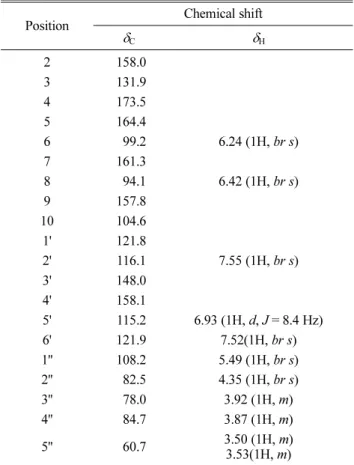
Table 1.
1H-NMR (CD
3OD, 500 MHz) and
13C-NMR (CD
3OD, 125 MHz) data of compound 1 (J in Hz)
Position Chemical shift
δ
Cδ
H2 158.0
3 131.9
4 173.5
5 164.4
6 99.2 6.24 (1H, br s)
7 161.3
8 94.1 6.42 (1H, br s)
9 157.8
10 104.6
1' 121.8
2' 116.1 7.55 (1H, br s)
3' 148.0
4' 158.1
5' 115.2 6.93 (1H, d, J = 8.4 Hz)
6' 121.9 7.52(1H, br s)
1'' 108.2 5.49 (1H, br s)
2'' 82.5 4.35 (1H, br s)
3'' 78.0 3.92 (1H, m)
4'' 84.7 3.87 (1H, m)
5'' 60.7 3.50 (1H, m)
3.53(1H, m)
3'-hexadecanoyl-2'-(9aZ)-tetradecanoylglycerol 1'- O- [β-D-galactopyranosyl-(1''→6'')-α-D-galactopyranoside]
(2) − Yellow oil. ESIMS (positive mode): m/z 863.4 [M+H]
+(C
45H
82O
15).
1H NMR (CD
3OD, 500 MHz) δ
H: 0.90 (3H, t, J = 7.1 Hz), 0.90 (3H, t, J = 7.1 Hz) 1.30 (2H, m), 1.20 - 1.40 (4H, m), 1.63 (2H, m), 2.06 (2H, m), 2.34 (4H, t, J = 6.9 Hz), 3.94 - 3.51 (4H, m), 3.92 - 3.73 (4H, m), 3.97 (1H, d, J = 5.4 Hz, H
a-1'), 3.75 (1H, d, J = 2.2 Hz, H
b-1'), 4.45 (1H, d, J = 12.2 Hz, H
a-3'), 4.23 (1H, d, J = 6.6 Hz, H
b-3'), 4.26 (1H, d, J = 9.4 Hz, H-1''), 4.88 (1H; d, J = 3.7 Hz, H-1'''), 5.26 (1H, m, H-2'), 5.37 (2H, m);
13C-NMR (CD
3OD, 125 MHz): δ
C173.7, 173.3, 103.9 (C-1''), 73.3 (C-2''), 70.0 (C-3'') 71.2 (C-4''), 71.3 (C-5''), 66.4 (C-6''), 99.2 (C-1'''), 68.9 (C-2'''), 71.1 (C-3'''), 73.2 (C-4'''), 69.8 (C-5'''), 61.5 (C-6'''), 67.4 (C-1'), 70.3 (C-2'), 62.5 (C-3').
Arjunolic acid (3) − White powder.
1H-NMR (CD
3OD, 500 MHz) δ
H: 3.68 (1H, m, H-2), 3.34 (1H, d, J = 7.8 Hz, H-3), 5.23 (1H, m, H-12), 3.26 (1H, d, J = 11.4 Hz, H- 23a), 3.50 (1H, d, J = 11.4 Hz, H-23b), 0.70 (3H, s, H- 24), 0.83 (3H, s, H-25), 1.06 (3H, s, H-26), 1.29 (3H, s, H-27), 0.90 (3H, s, H-29), 0.95 (3H, s, H-30);
13C (CD
3OD, 125 MHz) δ
C: 47.5 (C-1),69.8 (C-2), 78.2 (C- 3), 44.3 (C-4), 48.5 (C-5), 19.2 (C-6), 33.6 (C-7), 40.7(C- 8), 48.3 (C-9), 38.9 (C-10), 24.1 (C-11), 123.6 (C-12), 145.4 (C-13),42.5 (C-14), 29.0 (C-15), 24.5 (C-16), 47.1 (C-17), 43.0 (C-18), 44.5(C-19), 31.5 (C-20), 34.0 (C-21), 33.5 (C-22), 66.3 (C-23), 14.1 (C-24),17.8 (C-25), 17.6 (C-26), 26.6 (C-27), 182.1 (C-28), 32.1 (C-29), 24.8 (C- 30).
β-Sitosterol-3-O-β-D-glucopyranoside (4) − White powder.
1H-NMR (CD
3OD, 500 MHz) δ
H: 0.66 - 1.25 (CH
3groups), 3.50 (1H, m, H-3), 5.35 (1H, m, H-5) for aglycone; 5.02 (1H, d, J = 7.5 Hz, H-1') representing the anomeric proton of the sugar;
13C (CD
3OD,125 MHz) δ
C: 37.3 (C-1), 30.2 (C-2), 78.5 (C-3), 39.2 (C-4), 140.8 (C- 5), 121.7 (C-6),31.9 (C-7), 31.9 (C-8), 51.2 (C-9), 36.5 (C-10), 21.1 (C-11), 39.8 (C-12), 42.3 (C-13), 56.8 (C- 14), 24.3 (C-15), 28.3 (C-16), 56.0 (C-17), 11.9(C-18), 19.4 (C-19), 36.2 (C-20), 18.8 (C-21), 33.9 (C-22), 26.1 (C-23), 45.9 (C-24), 29.2 (C-25), 19.8 (C-26), 19.3 (C- 27), 23.1 (C-28), 12.2(C-29) for aglycone, 102.5 (C-1'), 75.3 (C-2'), 78.6 (C-3'), 71.6 (C-4'),78.1 (C-5'), 62.5 (C- 6') for sugar moiety.
Terminolic acid (5) − White powder. ESIMS (positive mode): m/z 527.3 [M+Na]
+(C
30H
48O
6Na).
1H-NMR (CD
3OD, 700 MHz) δ
H: 3.52 (1H, m, H-2), 3.10 (1H, m, H-3), 4.26 (1H, m, H-6), 5.22 (1H, m, H-12), 3.20 (1H, m, H-23a), 3.40 (1H, m, H-23b), 0.92 (3H, s, H-24), 1.28 (3H, s, H-25), 0.98 (3H, s, H-26), 1.06 (3H, s, H-27), 0.89
(3H, s, H-29), 0.89 (3H, s, H-30).
13C-NMR (CD
3OD, 175 MHz) δ
C: 49.3 (C-1), 67.7 (C-2), 76.2 (C-3), 44.2 (C-4), 47.2 (C-5), 66.2 (C-6), 40.1 (C-7), 39.5 (C-8), 47.9 (C-9), 37.2 (C-10), 23.1 (C-11), 122.2 (C-12), 144.0 (C-13), 42.1 (C-14), 27.5 (C-15), 27.6 (C-16), 47.0 (C-17), 42.5 (C- 18), 47.1 (C-19), 31.5 (C-20), 33.6 (C-21), 34.0 (C-22), 65.1 (C-23), 16.3 (C-24), 18.6 (C-25), 18.3 (C-26), 26.2 (C-27), 179.1 (C-28), 33.5 (C-29), 24.5 (C-30).
Quercetin (6) − Yellow powder. ESIMS (positive mode):
m/z 302.2 [M+H]
+(C
15H
10O
7).
1H-NMR (CD
3OD, 500 MHz) δ
H: 7.75 (1H, d, J = 2.1 Hz, H-2'), 7.65 (1H, dd, J = 8.5 Hz, H-6'), 6.90 (1H, d, H-5'), 6.40 (1H, d, J = 2.0 Hz, H-8), 6.19 (1H, d, H-6).
13C-NMR (CD
3OD, 125 MHz) δ
C: 176.2 (C-4), 164.1 (C-2), 161.1(C-4’), 157.1 (C-7), 147.5 (C-9), 146.5 (C-5), 144.7 (C-3'), 135.8 (C-3), 123.3 (C-1'), 120.3 (C-6'), 115.1 (C-5'), 114.5 (C-2'), 103.2 (C-10), 98.2 (C-6), 93.2 (C-8).
Asiatic acid (7) − White powder.
1H-NMR (CD
3OD, 500 MHz) δ
H: 3.67 (1H, m, H-2), 3.37 (1H, d, J = 9.2 Hz, H-3), 5.28 (1H, m, H-12), 2.88 (1H,d, J = 11.3 Hz, H-18), 3.29 (1H, m, H-23a), 3.52 (1H, m, H-23b), 0.71 (3H, s, H- 24), 0.84 (3H, s, H-25), 0.87 (3H, s, H-26), 1.16 (3H, s, H-27), 0.82 (3H, d, J = 6.7 Hz, H-29), 0.88 (3H, d, J = 7.0 Hz, H-30).
13C-NMR (CD
3OD, 125 MHz) δ
C: 46.8 (C-1), 70.4 (C-2), 77.3 (C-3), 42.5 (C-4), 46.3 (C-5), 19.2 (C-6), 33.7 (C-7), 40.5 (C-8), 48.9 (C-9), 37.2 (C- 10), 23.5 (C-11), 126.3 (C-12), 139.1 (C-13), 42.6 (C-14), 29.0 (C-15), 24.5 (C-16), 47.1 (C-17), 41.6 (C-18), 37.5 (C-19), 37.8 (C-20), 31.6 (C-21), 35.4 (C-22), 65.1 (C- 23), 13.4 (C-24), 17.6 (C-25), 18.5 (C-26), 22.9 (C-27), 175.2 (C-28), 21.4 (C-29), 17.5 (C-30).
Maslinic acid (8) − White powder.
1H-NMR (CD
3OD, 500 MHz) δ
H: 3.64 (1H, m, H-2), 2.93 (1H, d, J = 7.5 Hz, H-3), 5.28 (1H, m, H-12), 2.87 (1H, m, H-18), 0.83 (1H, s, H-23), 1.03 (3H, s, H-24), 1.28 (3H, s, H-25), 0.98 (3H, s, H-26), 1.18 (3H, s, H-27), 0.96 (3H, s, H-29), 0.93 (3H, s, H-30).
13C-NMR (CD
3OD, 125 MHz) δ
C: 47.5 (C-1), 68.6 (C-2), 83.2 (C-3), 40.5 (C-4), 55.1 (C-5), 19.5 (C-6), 33.9 (C-7), 39.5 (C-8), 47.9 (C-9), 37.1 (C-10), 23.1 (C- 11), 121.9 (C-12), 144.2 (C-13), 42.1 (C-14), 27.5 (C-15), 27.6 (C-16), 39.4 (C-17), 41.8 (C-18), 47.2 (C-19), 31.6 (C-20), 34.9 (C-21), 33.8 (C-22), 16.2 (C-23), 28.9 (C- 24), 15.5 (C-25), 16.3 (C-26), 23.7 (C-27), 180.1 (C-28), 34.5 (C-29), 26.5 (C-30).
1 β-O-galloylpedunculagin (9) − Yellowish powder.
ESIMS (negative mode): m/z 935.0 [M-H]
−(C
41H
28O
26).
1
H-NMR (CD
3OD, 500 MHz) δ
H: glucose moiety - 6.14
(1H, d, J = 8.5 Hz, H-1), 5.21 (1H, dd, J = 3.6, 9.9 Hz,
H-2), 5.48 (1H, t, J = 9.7 Hz, H-3), 5.21 (1H, m, H-4),
4.38 (1H, m, H-5), 3.92 (1H, m, H-6a), 5.37 (1H, dd,
J = 6.6, 13.1 Hz, H-6b); 7.12 (2H, s, galloyl-H), 6.64 (1H, s, C-3 HHDP moiety), 6.41 (1H, s, C-6 HHDP moiety), 6.55 (1H, s, C-3’ HHDP moiety), 6.70 (1H, s, C- 6' HHDP moiety);
13C-NMR (CD
3OD, 125 MHz) δ
C: glucose moiety - 91.6 (C-1), 75.5 (C-2), 76.8 (C-3), 68.2 (C-4), 72.7 (C-5), 62.3 (C-6). 120.0; C-1 galloyl moiety - 109.9, 147.0, 140.0, 147.0, 109.9, 166.2 (ester); C-2 HHDP moiety - 115.5, 124.0, 108.0, 145.8, 137.5, 144.0, 169.7 (ester); C-3 HHDP - 115.5, 124.0, 108.0, 145.8, 137.5, 144.0, 170.8 (ester); C-4 HHDP moiety - 116.7, 124.0, 108.0, 146.0, 137.6, 144.4, 169.3 (ester); C-6 HHDP moiety - 115.5, 124.0, 146.3, 137.5, 144.1, 169.8 (ester).
6-Hydroxyapigenin-7-O-β-D-glucopyranoside (10) − Yellow powder. ESIMS (negative mode): m/z 446.9 [M- H]
−and ESIMS (positive mode): m/z 448.9 [M+H]
+(C
21H
20O
11).
1H-NMR (CD
3OD, 500 MHz) δ
H: 7.94 [2H,
d, J = 8.8 Hz, H-2', 6'], 7.02 (1H, s, H-8), 6.94 [2H, d (BB'), H-3', 5'], 6.84 (1H, s, H-3), 5.01 (1H, d, J = 7.5 Hz, H-1''), 3.48 (1H, d, J = 2.1 Hz, H-6''a), 3.76 (1H, d, J = 3.9 Hz, H-6''b), 3.46 – 3.36 (m, H-2'', 3'', 5''), 3.46 (1H, dd, J = 9.2, 9.2 Hz, H-4'');
13C-NMR (CD
3OD, 125 MHz) δ
C: 182.9 (C-4), 164.5 (C-2), 161.7(C-4’), 149.5 (C-9), 151.8 (C-7), 147.0 (C-5), 130.9 (C-6), 128.4 (d, C- 2'/C-6'), 121.3 (C-1'), 115.9 (C-3', 5'), 106.2 (C-10), 102.9 (C-3), 101.4 (C-1''), 94.5 (C-8), 75.5 (C-5''), 70.3 (C-3''), 76.5 (C-2''), 78.1 (C-4''), 61.0 (C-6'').
Result and Discussion
A dry aerial part of T. hirtum (3 kg) was extracted with methanol. The crude extract (519 g) suspended in water was successively extracted with EtOAc and n-BuOH to yield 130 g and 136 g of EtOAc and n-BuOH extracts,
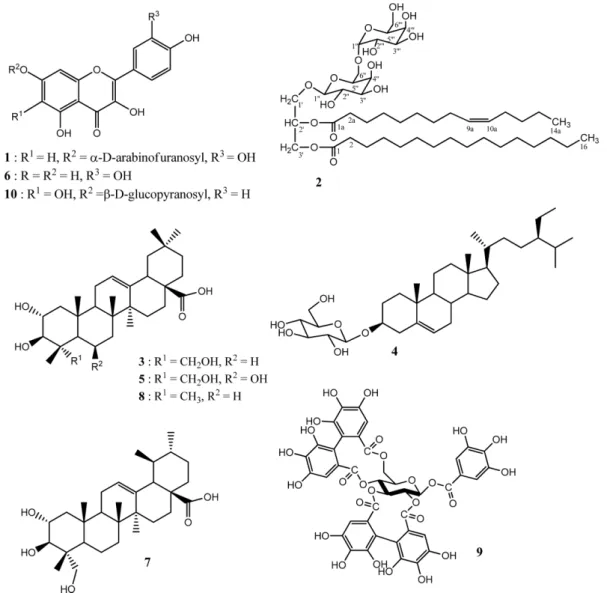
Fig. 1. Chemical structures of compounds isolated from T. hirtum.
respectively. Parts of EtOAc and n-BuOH fractions were subjected to column chromatography over silica gel and sephadex LH-20 gel to yield ten secondary metabolites (1 - 10) (Fig. 1). Nine among them were identified as 3'- hexadecanoyl-2'-(9aZ)-tetradecanoylglycerol 1'-O-[ β-D- galactopyranosyl-(1'' →6'')-α-D-galactopyranoside] (2),
12arjunolic acid (3),
3β-sitosterol-3-O-β-D-glucopyranoside (4),
13terminolic acid (5),
14quercetin (6),
15asiatic acid (7),
16maslinic acid (8),
171 β-O-galloylpedunculagin (9)
18and 6-hydroxyapigenin-7-O- β-D-glucopyranoside (10)
19by spectroscopic means and comparison with reported data.
Compound (1) was isolated as a yellow amorphous powder. The molecular formula C
20H
18O
11was suggested by HRESIMS (positive mode) with a [M+H]
+peak at m/z 434.9235 and HRESIMS (negative mode) with a [M-H]
−peak at m/z 432.9123 indicating the molecular formula C
20H
18O
11. An important ion peak was observed at m/z 301.9 [M+H −133.1228]
+, corresponding to the perdition of a pentose sugar moiety (C
5H
9O
4). The
1H-NMR (CD
3OD, 500 MHz) spectrum (Table 1) confirmed many of the above features and revealed a set of quercetin signals and arabinofuranose moiety. The presence of quercetin was suggested by the following signals: two broad single at δ
H6.24 (1H, br s, H-6) and 6.42 (1H, br s, H-8); an ABX spin system due to the aromatic ring protons at δ
H6.93 (1H, d, J = 8.4 Hz, H-5'), 7.52 (1H, dd, J = 8.4, 2.1 Hz, H-6') and 7.55 (1H, br s, H-2').
16The total assignment of the
1H-NMR [( δ
H5.49, br s, H- 1''), 4.35 (1H, br s, H-2”), 3.92 (1H, m, H-3''), 3.87 (1H, m, H-4''), 3.50 (1H, m, H
a-5'' and 3.53 (1H, m, H
b-5'') and
13
C-NMR [ δ
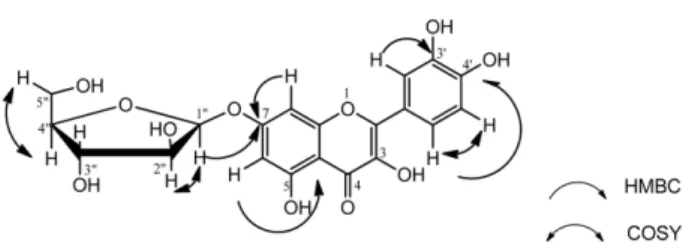
C108.2 (C-1''), 84.7 (C-4''), 82.5 (C-2''), 78.0 (C-3'') and 60.7 (C-5'')] data of the pentose moiety (Fig.
2), were achieved on the basis of the HSQC, HMBC and
1