Notes Bull. Korean Chem. Soc. 2014, Vol. 35, No. 12 3665 http://dx.doi.org/10.5012/bkcs.2014.35.12.3665
A New Amaryllidaceae Alkaloid from the Bulbs of Lycoris radiata
Ji Young Lee,†,‡ Mi-Ran Cha,† Ji Eun Lee,†,‡ Jinhee Kim,† Heeyeong Cho,† Woo Kyu Park,† Sang Un Choi,† and Shi Yong Ryu†,‡,*
†Korea Research Institute of Chemical Technology, Daejeon 305-600, Korea. *E-mail: [email protected] ‡Graduate School of New Drug Discovery and Development, Chungnam National University, Daejeon 305-764, Korea
Received July 30, 2014, Accepted August 29, 2014
Key Words : Lycoris radiata, Amaryllidaceae alkaloids, Acetylcholinesterase inhibition
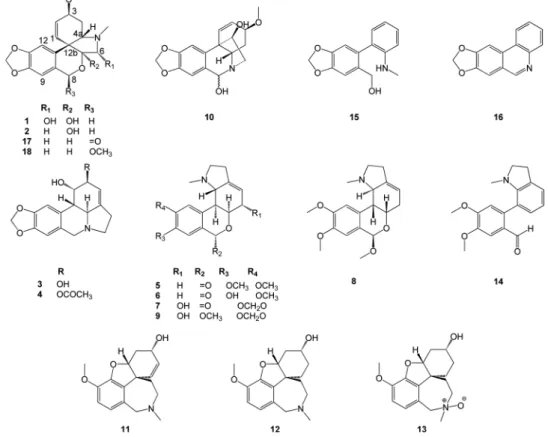
Lycoris radiata (red spider lily) is a bulbous perennial plant in Amaryllidaceae widely distributed in Korea, Japan and China. It is commonly used as an ornamental flower or sometimes as an antidote in Traditional Chinese Medicine (TCM).1 The species is also known as a botanical source of galantamine, a clinically used medicine for the treatment of Alzheimer’s diseases and various other memory impair-ments.2 Actually, the bulbs of the species contains a lot of isoquinoline-based amine components, so called Amarylli-daceae alkaloids, which have been reported to possess a variety of pharmacological activities such as anti-cancer,3 anti-viral,4 anti-acetylcholinesterase5 and anti-inflammatory6 activities. Amaryllidaceae alkaloids are produced almost by plants of galanthus genus7 in Amaryllidaceae and are classi-fied with three distinct scaffolds, lycorine (3-9, 14), hae-manthamine (1-2, 10, 15-18) and galanthamine (11-13) series, which are classified depending on the pattern of
oxidative phenolic coupling. For the purpose of searching for bioactive alkaloids from natural resources, extensive phytochemical investigation of the bulbs extract of L. radiata had undertaken and finally resulted in the isolation of a new amaryllidaceae alkaloid (1), together with seventeen related alkaloids (2-18). The chemical structures of isolated 1-18 (Fig. 1) were established by spectroscopic analyses as 6-hydroxytazettine (1), tazettine (2), lycorine (3), 2-O-acetyl-lycorine (4), homo2-O-acetyl-lycorine (5), 9-O-demethylhomo2-O-acetyl-lycorine (6), hippeastrine (7), O-methyllycorenine (8), 2-α-hydroxy-6-O-methyloduline (9), haemanthidine (10), galantamine (11), dihydrogalantamine (12), lycoramine N-oxide (13), lycosinineB (14), ismine (15), trisphaeridine (16), 3-epi-macronine (17), and 6-O-methylpretazettine (18),8-18 respec-tively. In the present paper, we describe briefly the isolation and identification of a new Amaryllidaceae alkaloid (1), as well as the inhibitory activities of isolated alkaloids (1-18)
3666 Bull. Korean Chem. Soc. 2014, Vol. 35, No. 12 Notes
on acetylcholinesterase, in vitro assay.
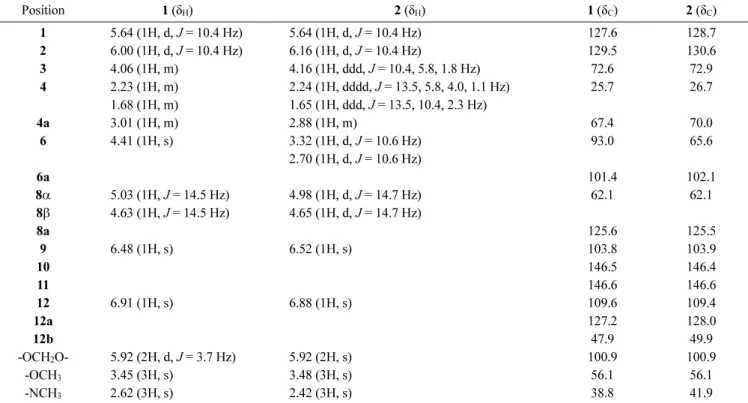
Compound 1 was obtained as a white amorphous powder. The molecular formula of 1 was established as C18H21NO6, m/z 347.1424 (calcd. 347.1369) by HREIMS. The 1H-NMR data, particularly signals in lower field were quite similar with those of tazettine (2), which suggested that 1 is a kind of congener of 2 (Table 1). 2 has been isolated previously from other plants in Amaryllidaceae family, i.e., Narcissus tazetta and Pancratium maritimum, and the chemical struc-ture of 2 as well as the absolute configuration was establish-ed by X-ray diffraction analysis.19
The 1H-NMR data of 1 implied the presence of a tetra-substituted benzene ring (δH 6.91, 6.48), a pair of olefin (δH 6.00, 5.64), a methylendioxy group (δH 5.92), and another methylene group (δH 5.03, 4.63). However, when the 1 H-NMR spectrum of 1 was compared with that of 2, a pair of methylene signals of H-6 observed at δH 3.32 and 2.70 in 1 H-NMR of 2 was disappeared, instead, a singlet proton signal at δH 4.41 was observed in 1H-NMR of 1. These 1H-NMR results suggested that one of methylene protons of 2 was replaced with hydroxyl group to yield 1, and this assumption was supported by the mass differences (Δ 16) between 1 and 2.
Thus, All proton and carbon signals of 1 were completely assigned by the aid of two-dimensional NMR experiments such as COSY, DEPT, HSQC, HMBC, and NOESY, which led to the conclusion that one of methylene protons at C-6 of 2 was replaced with hydroxyl group to become 1, thus 1 is established as 6-hydroxytazettine. In HMBC experiment of 1, the H-6 (δH 4.41) signal was observed to give correlations with C-12b, C-6a, and N-methyl carbon, respectively (Fig.
2). Supposing that the stereochemistry of C-4a, C-12b and C-6a of 2 were identical with those of 1, the relative configu-ration of 1, particularly the C-6 chirality was proposed by the NOESY experiment; the signal of H-6 was correlated with H-4a and H-8α, which strongly suggested a β-orienta-tion of the hydroxyl group attached at C-6 (Fig. 2) and the R configuration of C-6. Thus, 1 was proposed as 6 β-hydroxy-tazettine as illustrated in Figure 1 and Figure 2. The other purified components (2-18) were identified by direct com-parison of their spectral data with those in the literatures.8-18 All isolated Amaryllidaceae alkaloids (1-18) were evaluated for the inhibitory effect on acetylcholinesterse (EC 3.1.1.7. electric eel) using acetylcholine as substrate in vitro20 and it was observed that galantamine (11) and ismine (15) ex-hibited a significant inhibitory effect on the acetylcholine-sterase with IC50 values of 27.9 and 109.7 µM, when other isolated compounds showed poor inhibitions (IC50> 300 µM) on acetylcholinesterse, in vitro assay.
Table 1. 1H and 13C NMR Spectroscopic Data of 1 and 2a
Position 1 (δH) 2 (δH) 1 (δC) 2 (δC) 1 5.64 (1H, d, J = 10.4 Hz) 5.64 (1H, d, J = 10.4 Hz) 127.6 128.7 2 6.00 (1H, d, J = 10.4 Hz) 6.16 (1H, d, J = 10.4 Hz) 129.5 130.6 3 4.06 (1H, m) 4.16 (1H, ddd, J = 10.4, 5.8, 1.8 Hz) 72.6 72.9 4 2.23 (1H, m) 2.24 (1H, dddd, J = 13.5, 5.8, 4.0, 1.1 Hz) 25.7 26.7 1.68 (1H, m) 1.65 (1H, ddd, J = 13.5, 10.4, 2.3 Hz) 4a 3.01 (1H, m) 2.88 (1H, m) 67.4 70.0 6 4.41 (1H, s) 3.32 (1H, d, J = 10.6 Hz) 93.0 65.6 2.70 (1H, d, J = 10.6 Hz) 6a 101.4 102.1 8α 5.03 (1H, J = 14.5 Hz) 4.98 (1H, d, J = 14.7 Hz) 62.1 62.1 8β 4.63 (1H, J = 14.5 Hz) 4.65 (1H, d, J = 14.7 Hz) 8a 125.6 125.5 9 6.48 (1H, s) 6.52 (1H, s) 103.8 103.9 10 146.5 146.4 11 146.6 146.6 12 6.91 (1H, s) 6.88 (1H, s) 109.6 109.4 12a 127.2 128.0 12b 47.9 49.9 -OCH2O- 5.92 (2H, d, J = 3.7 Hz) 5.92 (2H, s) 100.9 100.9 -OCH3 3.45 (3H, s) 3.48 (3H, s) 56.1 56.1 -NCH3 2.62 (3H, s) 2.42 (3H, s) 38.8 41.9
aAssignments are based on DEPT, HSQC, and HMBC experiments, and chemical shifts are given in ppm
Figure 2. Key HMBC (H→C) (a) and NOESY (H↔H) (b) correlations of 1.
Notes Bull. Korean Chem. Soc. 2014, Vol. 35, No. 12 3667
Experimental Section
General Experimental Procedures. NMR spectra were obtained by a Brucker AM 300 and 500 spectrometers using TMS as an internal standard for 1H NMR, 13C NMR, DEPT, COSY, HSQC, HMBC, and NOESY. Preparative-HPLC was performed on a Futecs P-4000 system with a Shim-pack prep-ODS(H) kit column (5 µm, 20 mm × 25 cm). Isolation and purification was also carried out using a medium-pressure liquid chromatographic (MPLC) system [BUCHI pump Module C-601, silica gel 60 (230-400 mesh, Merck), ODS (Cosmosil 140 C18)].
Plant Material. The bulbs of L. radiata were collected on November 2013 at the flower garden of Korea Research Institute of Chemical Technology (KRICT) and were authenti-cated by Dr. Young sup Kim. A voucher specimen (KR1315) was deposited at the herbarium of the KRICT.
Extraction and Isolation. The dried bulbs (6 Kg) of L. radiata were soaked twice in 90 L of methanol at room temperature for 7 days. The concentrated methanol extract (700 g) was suspended in 4 L of distilled water and adjusted to pH 12.0 with 1 N NaOH, and then extracted successively with equal volume of ethylacetate (EtOAc) and n-butanol (BuOH). The resultant EtOAc layer and BuOH layer was collected and extracted with equal volume 5% citric acid, respectively. The 5% citric acid layer was pooled up and neutralized with 1 N NaOH to pH 12.0 and then extracted with BuOH, which gave 39 g of the alkaloids rich fraction. The alkaloids rich fraction (39 g) was subjected to column chromatography on silica gel eluted with dichloromethane : MeOH (0.5 to 100% MeOH gradient) to yield four fractions (Fr. 1 - Fr. 4). Fr. 3 (6.2 g) was dissolved in methanol and allowed to crystallize at room temperature to give compound 3 (2.33 g). Fr. 1 (1.6 g) was subjected to column chromato-graphy with NH2 gel (Merck Lichroprep NH2) eluted with a hexane : EtOAc (0.5 to 100% EtOAc gradient) to give seven fractions (Fr. 11 - Fr. 17). Fr. 12 afforded compound 18 (2.3 mg) by repeated preparative HPLC (50 to 100% MeOH). Fr. 13 was further purified through sephadex LH-20 chromato-graphy and preparative HPLC (30 to 90% MeOH) to yield compounds 17 (4.5 mg), 1 (2.2 mg), 16 (3.4 mg). Fr. 14 was chromatographed on a sephadex LH-20 columns to give compounds 4 (5.1 mg) and 15 (7.5 mg). Fr. 2 (5.5 g) was further purified to column chromatography on silica gel eluted with dichloromethane : MeOH (1 to 100% MeOH gradient) to give four fractions (Fr. 21 - Fr. 24). Fr. 22 was purified further by preparative HPLC (50-90% MeOH) to yield compound 5 (38.7 mg) and 14 (3.1 mg). Compound 2 (27.4 mg) was crystallized from Fr. 24 in MeOH. Fraction 3 (6.17 g) was isolated to five fractions (Fr. 31 - Fr. 35). Fr. 33 was repeatedly chromatographed by preparative HPLC (30 -90% MeOH) to afford compounds 8 (125.0 mg), 9 (5.0 mg), 11 (14.1 mg) and 7 (44.2 mg). Fr. 35 was subjected to column chromatography on silica gel eluted with dichloromethane : MeOH (1 to 20% MeOH gradient) to yield compound 6
(150.0 mg). Fr. 4 was subjected to column chromatography with silica gel eluted with dichloromethane : MeOH (2 to 50% MeOH gradient) to give five fractions (Fr. 41 - Fr. 45). Fr. 44 was isolated by preparative HPLC (10 to 80% MeOH) and finally purified through sephadex LH-20 to afford compounds 10 (34.2 mg), 12 (74.0 mg) and 13 (4.8 mg).
6-Hydroxytazettine (1): White amorphous powder; +35.9 (c 0.05, CHCl3); UV (MeOH) λmax 240, 291 nm; 1H NMR (CDCl3, 500 MHz); 13C NMR (CDCl3, 125 MHz) (Table 1); HREIMS m/z 347.1424 (calcd. for C18H21NO6, 347.1369).
Acknowledgments. This research was supported by the basic research project (KK-1403-C0) of KRICT and also by a grant of the Technology Innovation Program (10038744) of Korea Evaluation Institute of Industrial Technology (KEIT) funded by Ministry of Trade, Industry & Energy, Republic of Korea.
References
1. Huang, S. D.; Zhang, Y.; He, H. P.; Li, S. F.; Tang, G. H.; Chen, D. Z.; Cao, M. M.; Di, Y. T.; Hao, W. J. Chinese Journal of Natural Medicines 2013, 11, 406.
2. Berkov, S.; Georgieva, L.; Kondakova, V.; Atanassov, A.; Viladomat, F.; Bastida, J.; Codina, C. Biotechnol. & Biotechnol. Eq. 2009, 23, 1170.
3. Antonio, E.; Alexander, K. Phytochem. Rev. 2009, 8, 449. 4. He, J.; Qi, W. B.; Wang, L.; Tian, J.; Jiao, P. R.; Liu, G. Q.; Ye, W.
C.; Liao, M. Influenza Other Respir Viruses 2013, 6, 922. 5. Susana, L.; Jaume, B.; Francesc, V.; Carles, C. Life Sciences 2002,
71, 2521.
6.Saltan, C. G.; Dahadir, A. O.; Sever, Y. B.; Ozbek, H. Fitoterapia 2012, 83, 81.
7. Nehir, U. Phytochem. Rev. 2007, 6, 125.
8. Pham, L. H.; Grundemann, E.; Wagner, J.; Bartoszek, M.; Dopke, W. Phytochemistry 1999, 51, 327.
9. Evidente, A.; Cicala, M. R.; Giudicianni, I.; Randazzo, G.; Riccio, R. Phytochemistry 1983, 22, 581.
10. Szlavik, L.; Gyuris, A.; Minarovits, J.; Forgo, P.; Molnar, J.; Hohmann, J. Planta Med. 2004, 70, 871.
11. Kihara, M.; Konishi, K.; Xu, L.; Kobayashi, S. Chem. Pharm. Bull. 1991, 39, 1849.
12. Almanza, Z. R.; Fernandez, J. M.; Wakori, E. W. T.; Viladomat, F.; Codina, C.; Bastida, J. Phytochemistry 1996, 43, 1375. 13. Jegorov, A.; Buchta, M.; sedmera, P.; Kuzma, M.; Havlicek, V. J.
Mass Spectrum. 2006, 41, 544.
14. Kobayashi, S.; Satoh, K.; Numata, A.; Shingu, T.; Kihara, M. Phytochemistry 1991, 30, 675.
15. Yang, Y.; Huang, S. X.; Zhao, Y. M.; Zhao, Q. S.; Sun, H. D. Helvetica Chimica Acta 2005, 88, 2550.
16. Kihara, M.; Koike, Y.; Imakura, Y.; Kida, K.; Shingu, T.; Kobayashi, S. Chem. Pharm. Bull. 1987, 35, 1070.
17. Vdovin, A. D.; Kadyrov, K. H.; Yagudaev, M. R.; Allayarov, K. B.; Nistryan, A. K. Chemistry of Natural Compounds 1981, 17, 279.
18. Cabezas, F.; Ramirez, A.; Viladomat, F.; Codina, C.; Bastida, J. Chem. Pharm. Bull. 2003, 51, 315.
19. Ide, S.; Sener, B.; Temizer, H.; Konukol, S. Cryst. Res. Technol. 1996, 31, 617.
20. Lee, J. Y.; Cha, M. R.; Choi, C. W.; Kim, Y. S.; Lee, B. H.; Ryu, S. Y. Kor. J. Pharmacogn. 2012, 43, 122.
α [ ]D20