Factors Associated with Treatment Outcomes in Mindfulness-Based Cognitive Therapy for Panic Disorder
Borah Kim,1 Sung Joon Cho,1 Kang Soo Lee,2 Jun-Yeob Lee,3 Ah Young Choe,1 Ji Eun Lee,1 Tai Kiu Choi,1 and Sang-Hyuk Lee1
1Department of Psychiatry, CHA Bundang Medical Center, CHA University, Seongnam;
2Department of Psychiatry, CHA Kangnam Medical Center, CHA University, Seoul;
3Department of Psychiatry, CHA Gumi Medical Center, CHA University, Gumi, Korea.
Received: November 21, 2012 Revised: December 12, 2012 Accepted: January 11, 2013
Corresponding author: Dr. Sang-Hyuk Lee, Department of Psychiatry,
CHA Bundang Medical Center, CHA University, 59 Yatap-ro, Bundang-gu,
Seongnam 463-712, Korea.
Tel: 82-31-780-5694, Fax: 82-31-780-5862 E-mail: [email protected]
∙ The authors have no financial conflicts of interest.
© Copyright:
Yonsei University College of Medicine 2013 This is an Open Access article distributed under the terms of the Creative Commons Attribution Non- Commercial License (http://creativecommons.org/
licenses/by-nc/3.0) which permits unrestricted non- commercial use, distribution, and reproduction in any medium, provided the original work is properly cited.
Purpose: Although the effectiveness of Mindfulness-Based Cognitive Therapy (MBCT) for panic disorder (PD) has been studied previously, data on the predictors of treatment outcomes in MBCT for PD are scarce. Materials and Methods:
Eighty patients with PD were screened to analyze treatment outcomes such as MBCT completion, treatment response, and remission after undergoing MBCT for PD. Sociodemographic characteristics, comorbid personality disorders, and base- line medication doses were examined. The study administered the Panic Disorder Severity Scale, Hamilton Anxiety Rating Scale, Hamilton Depression Rating Scale and Anxiety Sensitivity Inventory-Revised to patients at baseline and at eight weeks. Results: Sixty-five participants were enrolled in the present study. Comor- bid personality disorder was significantly associated with MBCT non-completion.
We found that anxiety sensitivity (AS) improvement after an eight week MBCT program was a statistically significant factor associated with treatment response.
Using logistic regression analysis, AS improvement after MBCT showed signifi- cant association with PD remission after MBCT. Conclusion: Comorbid personali- ty disorders of participants could be a potential predictor of MBCT non-completion.
Furthermore, AS improvement after MBCT may predict treatment response and re- mission after MBCT for PD. However, better designed studies with a larger number of patients are needed to confirm our findings.
Key Words: Mindfulness-Based Cognitive Therapy, panic disorder, treatment outcome, anxiety sensitivity, comorbid personality disorder
INTRODUCTION
Mindfulness-based interventions, such as Mindfulness-Based Stress Reduction, has been applied to various clinical populations including chronic pain, cancer, and anxiety disorders.1-3 Mindfulness-Based Cognitive Therapy (MBCT) was devel- oped for relapse prevention in depression;4 furthermore, previous reports on MBCT showed a possibility for its use in treating anxiety symptoms.5,6
Similar to previous studies that reported an effect of MBCT on anxiety symptoms
fective enough to treat depression in patients with high initial severity of disease and a few sociodemographic findings.21,22 In addition, improvement of AS after mindfulness training may be associated with treatment outcomes.7,19 These find- ings might imply that certain characteristics of patients are more responsive to particular psychotherapeutic modalities.
However, as far as we know, only one study has investi- gated the predictors of MBCT,23 and it was conducted with depression patients. No study has investigated the predic- tors of MBCT in PD. Therefore, the present study sought to provide further information on the factors associated with treatment outcomes from MBCT in PD. We hypothesized that factors such as comorbid personality disorders, base- line depression or anxiety symptom severity, and improve- ment of AS after MBCT would affect MBCT completion, treatment response, and remission in patients with PD.
MATERIALS AND METHODS
Participants
For this study, 80 patients with PD were screened. The sub- jects were recruited via advertisements from among patients treated on an outpatient basis at the Department of Psychia- try, CHA Bundang Medical Center, CHA University, be- tween September 2006 and June 2010. Subjects were 20-60 years old and fulfilled the DSM-IV criteria for PD with or without agoraphobia, as diagnosed by two psychiatrists through a structured clinical interview to assess DSM-IV (SCID) Axis I disorders (inter-rater reliability κ: 0.82).24,25 After more than 3 months of pharmacotherapy, all subjects had shown a response, but had not achieved remission as defined according to Ballenger’s criteria.26 They had stabi- lized and their remaining symptoms had not changed in clinical global impression27 for at least two months prior to commencement of MBCT as confirmed by psychiatrists.
Prior to the commencement of the study, subjects were treat- ed with antidepressants, including paroxetine, escitalopram, or venlafaxine, and benzodiazepines as anxiolytics, includ- ing alprazolam, diazepam or clonazepam. Kinds and dosag- es of medications prescribed were not altered during the study. Exclusion criteria included comorbid Axis I disor- ders, mental retardation, significant medical problems (e.g.
chronic obstructive pulmonary disease, bronchial asthma, tuberculosis, cardiac disease, diabetes mellitus, pheochro- mocytoma, and thyroid disease), participation in medita- tion, yoga or regular psychotherapy on their own and in- among patients with bipolar disorder6 or generalized anxiety
disorder,5 MBCT for panic disorder (PD), considering the particular characteristics of PD, has been introduced.7-9 Ac- cording to previous studies on MBCT for PD, PD patients treated with MBCT stayed in remission without relapse for 12 months.7,8 Although some MBCT studies were limited by a small sample size, lack of follow-up measures, problems with control groups or lack of randomization,10 recent stud- ies have supported the usefulness of adapted versions of MBCT for a greater variety of anxiety disorders including generalized anxiety disorders and social phobia.5,11-15
Conceptually, mindfulness, i.e. a mindful state of being, involves a quality of consciousness with attention to one’s current experience.16 It was proposed that present-moment mindful awareness could be a useful, alternative way of re- sponding to future-directed worry in anxiety disorder.5 Also, MBCT participants may be able to stem negative thought processes from worsening to anxiety with the essential skill of being able to de-center from their thoughts and feelings.11
While MBCT for depression has been designed to ad- dress rumination to prevent depressive patients from relaps- ing,17 it has been reported that MBCT for PD could reduce worries and phobia in PD or generalized anxiety disorder.7-9 Above all, according to a report in 2010,7 MBCT could re- duce anxiety sensitivity (AS), as well as symptoms in pa- tients with PD, even though the study was small in size (n=17) and non-controlled. AS is a trait-like cognitive char- acteristic that predisposes individuals to the development of panic problems and may be regarded a risk factor in the de- velopment of anxiety disorders.18 Development of mindful- ness in individuals with PD was proposed to be beneficial in dealing with high AS, cognitive misinterpretation, and phobic avoidance via a decentralized perspective and ac- ceptance in mindfulness based intervention.19 However, the characteristics of patients who would experience a better response to MBCT have not been explored appropriately.
With increased demand for more cost-effective and acces- sible treatments, it has become increasingly important to con- sider patient factors that could influence treatment outcomes.
For these reasons, some previous studies made considerable efforts to explore the “predictors” of treatment outcomes us- ing other psychotherapeutic approaches. A recent study ex- amined the predictors of response to interpersonal psycho- therapy (IPT) and cognitive behavior therapy (CBT) in depression, reporting that increasing comorbid personality disorder symptomatology was associated with poorer re- sponse to IPT.20 Other studies showed that CBT was not ef-
session, the participants received homework and an audio CD that the authors recorded in Korean. Program adher- ence, which was assessed with a homework checklist con- sisting of everyday practice before beginning each session by psychiatrists leading the program, was good (>80%). While reviewing homework, there were intensive discussions with the participants to ensure that they could understand the im- portant concepts of MBCT and use them in daily life.
Assessments
Subjects participated in weekly MBCT sessions for PD for eight weeks. Written questionnaires administered at baseline collected data on sociodemographic data of all subjects.
Also, two psychiatrists assessed comorbid Axis I disorders using SCID-I modules A (mood episodes), C (psychotic dis- orders), D (mood disorders), E (substance use disorders), F (anxiety disorders), G (somatoform disorders), H (eating disorders) and I (adjustment disorders). Comorbid Axis II disorders, such as personality disorders, were examined ac- cording to the Structured Clinical Interview for DSM-IV Axis II Personality Disorders (SCID-II) covering eleven DSM-IV Personality Disorders (including personality disor- der not otherwise specified), as well as the appendix catego- ries for depressive personality disorder and passive-aggres- sive personality disorder (inter-rater reliability κ=0.71).30,31
Participants were assessed at baseline (0 week) and eight weeks using self-reporting measures and clinician-rated scales, including Panic Disorder Severity Scale (PDSS),32,33 Anxiety Sensitivity Inventory-Revised (ASI-R),34,35 Hamilton Depression Rating Scale (HAM-D),36 and Hamilton Anxiety Rating Scale (HAM-A).37 Especially, AS and panic symptom severity improvement were analyzed as the proportion of re- duction in ASI-R (or PDSS) score after eight weeks in the MBCT program compared to baseline ASI-R (or PDSS) score as a primary outcome measure: AS improvement=
[(baseline ASI-R score-ASI-R score at eight weeks)/baseline ASI-R score×100 (%)]; PDSS improvement=[(baseline PDSS score-PDSS score at eight weeks)/baseline PDSS score×100 (%)].
Treatment outcomes were determined based on the three components of MBCT completion, treatment response, and remission. MBCT completion was considered as participat- ing more than six out of eight MBCT sessions. Treatment response was defined as at least a 40% reduction in PDSS score from the baseline level.38,39 We defined remission of PD at 1-year follow-up as HAM-D≤7, HAM-A≤7, freedom from panic attacks, no or mild agoraphobic avoidance, and volvement in litigation or compensation. Generally, there
are a fair amount of PD patients with comorbid Axis I disor- ders in clinical settings; however, we excluded them because we aimed to determine factors associated with treatment out- comes of MBCT in “pure” PD. All study procedures com- plied with CHA Bundang Medical Center Institutional Re- view Board regulations, the Declaration of Helsinki, and the principles of Good Clinical Practice. Written informed consent was obtained after providing subjects with a full description of the study.
MBCT program
Our MBCT program for PD has been described in detail elsewhere8 (Table 1). Briefly, the MBCT program was led by three specialist psychiatrists with three years of MBCT education and training experience. All sessions were moni- tored and feedback was exchanged by those three psychia- trists. The manual for the MBCT program was written in Korean in order to maintain treatment integrity. The MBCT program used in the present study was devised for PD pa- tients based on Segal, et al.’s17 MBCT for depression and Korean mindfulness meditation,28 which is substantially the same as mindfulness meditation,29 but reframed in the Kore- an language with regard to culture. The MBCT for PD in- cluded mindfulness techniques (e.g., body scan, three-min- ute breathing space, sitting meditation, mindful walking, etc.), cognitive approaches, education about PD and cogni- tive distortions specific to PD, and homework to encourage the use of mindfulness in everyday life through regular prac- tice. The program was conducted in 13 separate groups, each of which comprised up to 12 participants. The duration of the weekly MBCT program was about 90 minutes, and a total of eight sessions was conducted. At the end of each Table 1. Eight Week Program of Mindfulness-Based Cogni- tive Therapy (MBCT) for Panic Disorder
Session 1 Psychoeducation of panic disorder, automatic pilot Session 2 Dealing with barriers
Session 3 Mindfulness of the breath Session 4 Staying present
Session 5 Allowing/letting be Session 6 Thoughts are not facts Session 7
How can I best take care of myself?
(including encouraging to face the agoraphobia and brief interoceptive exposure training, focusing to 3-minute breathing space) Session 8 Using what has been learned to deal with future
anxiety
Components different from MBCT for depression are shown in italic letters.
tics, Somers, New York, NY, USA) was used to conduct all statistical analyses.
RESULTS
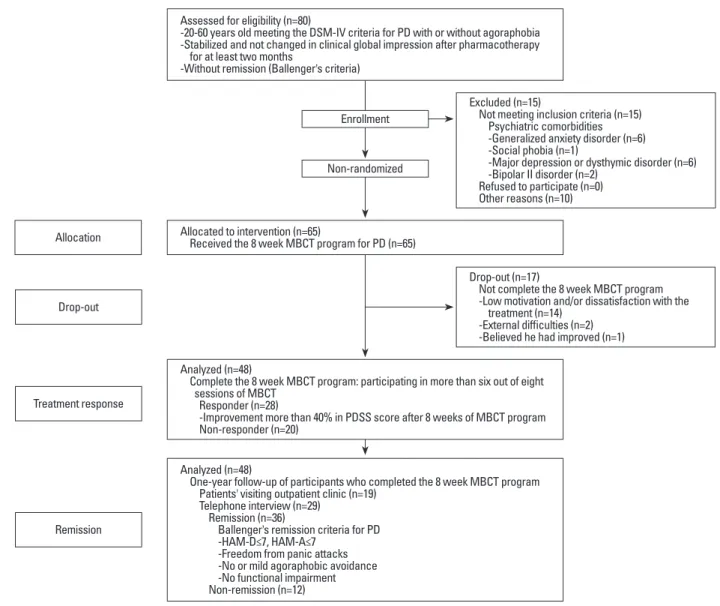
Sociodemographic characteristics of the participants Eighty participants were screened in this study. Fifteen par- ticipants were excluded from the analysis as they met the criteria of Axis I comorbidities including generalized anxi- ety disorder (n=6), major depressive disorder or dysthymic disorder (n=6), bipolar II disorder (n=2), and social phobia (n=1). A detailed flow diagram of the data is shown in Fig.
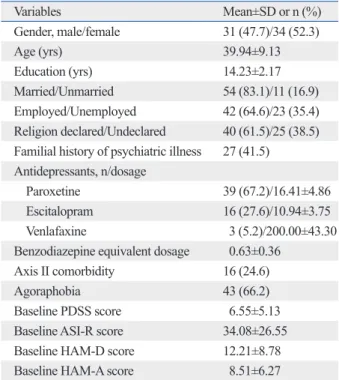
1. Also, sociodemographic characteristics and clinical fea- tures, such as comorbid personality disorders, baseline anx- iety, and depressive symptom severities of sixty-five subjects no functional impairment according to Ballenger’s remis-
sion criteria for PD.26 One-year follow-up was conducted with patients visiting an outpatient clinic or through tele- phone interview for all participants.
Statistical analysis
Independent t-test, χ2 test, Mann-Whitney U test, or Fisher’s exact test was used to compare sociodemographic and clin- ical characteristics between groups according to treatment outcome (completers vs. non-completers, responders vs.
non-responders, and remission vs. non-remission). In addi- tion, with variables significantly correlated to treatment out- come, such as MBCT completion, response, or remission after MBCT, multivariate logistic regression analysis was conducted to examine the factors associated with treatment outcome. IBM SPSS Statistics Ver. 20 (IBM SPSS Statis-
Fig. 1. Flow diagram of the study of MBCT for panic disorder. MBCT, Mindfulness-Based Cognitive Therapy; PD, panic disorder; PDSS, Panic Disorder Severity Scale; HAM-D, Hamilton Depression Rating Scale; HAM-A, Hamilton Anxiety Rating Scale.
Allocation
Drop-out
Treatment response
Remission
Assessed for eligibility (n=80)
-20-60 years old meeting the DSM-IV criteria for PD with or without agoraphobia -Stabilized and not changed in clinical global impression after pharmacotherapy for at least two months
-Without remission (Ballengerʼs criteria)
Allocated to intervention (n=65)
Received the 8 week MBCT program for PD (n=65)
Analyzed (n=48)
Complete the 8 week MBCT program: participating in more than six out of eight sessions of MBCT
Responder (n=28)
-Improvement more than 40% in PDSS score after 8 weeks of MBCT program Non-responder (n=20)
Analyzed (n=48)
One-year follow-up of participants who completed the 8 week MBCT program Patientsʼ visiting outpatient clinic (n=19)
Telephone interview (n=29) Remission (n=36)
Ballengerʼs remission criteria for PD -HAM-D≤7, HAM-A≤7
-Freedom from panic attacks -No or mild agoraphobic avoidance -No functional impairment Non-remission (n=12)
Excluded (n=15)
Not meeting inclusion criteria (n=15) Psychiatric comorbidities -Generalized anxiety disorder (n=6) -Social phobia (n=1)
-Major depression or dysthymic disorder (n=6) -Bipolar II disorder (n=2)
Refused to participate (n=0) Other reasons (n=10)
Drop-out (n=17)
Not complete the 8 week MBCT program -Low motivation and/or dissatisfaction with the treatment (n=14)
-External difficulties (n=2) -Believed he had improved (n=1) Enrollment
Non-randomized
(4.29±0.47 sessions). Among sociodemographic and clinical characteristics, comorbid personality disorders (p<0.001) and a family history of psychiatric illness (p=0.049) were significantly associated with completion of MBCT for PD according to Fisher’s exact test. Considering multiple com- parison correction (Bonferroni correction, level of signifi- cance alpha=0.05/15·=·0.003), comorbid personality disor- ders (p<0.001) were the only factor associated with MBCT completion. Also, evaluating factors associated with com- pletion of MBCT program according to logistic regression analysis, only comorbid personality disorders were shown to have a significant association (Table 3).
The main reasons for not completing MBCT were grouped into three categories in line with previous studies.40 Of all the subjects who did not complete MBCT (n=17), 14 pa- tients (82.4%) missed sessions due to low motivation and/
or dissatisfaction with the treatment, two patients (11.8%) because of external difficulties, and one patient (5.9%) who believed he had improved.
Treatment response
Treatment response was assessed as improvement of more than 40% in PDSS score after eight weeks in the MBCT pro- gram among those who completed the MBCT program (n=48). Comparing responders (n=28) and non-responders (n=20) in regards to sociodemographic and clinical variables, treatment responders showed a significantly greater reduction in ASI-R score after eight weeks in the MBCT program [(baseline ASI-R score-ASI-R score at eight weeks)/ baseline ASI-R score×100 (%)] [Responder (median, %), 87.74;
non-responder, 50.00; Z=-2.94, p=0.003] (Mann-Whitney U test for variables without normal distribution; Bonferroni correction, level of significance alpha=0.05/16·=·0.003).
Remission
Overall, 36 out of 48 subjects (75%) satisfied the Ballenger’s remission criteria26 at one-year follow-up after the MBCT program. Remission was attained in participants who had shown greater improvement in AS after undergoing MBCT according to ASI-R score [(baseline ASI-R score-ASI-R score at eight weeks)/baseline ASI-R score×100 (%)], great- participating MBCT, are described in Table 2. Comorbid per-
sonality disorders (n=16) included obsessive-compulsive (n=6), histrionic (n=3), avoidant (n=3), narcissistic (n=2), or dependent personality traits (n=2). Assessed by the SCID-II, no participants met criteria for the remaining personality disorders such as paranoid, schizoid, schizotypal, antisocial, borderline, depressive, passive-aggressive or personality disorder not otherwise specified. The mean number of MBCT sessions attended for all participants was 6.88±1.65.
Factors associated with treatment outcomes of MBCT MBCT completion
Of 65 subjects enrolled in the present study, 48 completed the MBCT program (defined as participating in more than six out of eight sessions of MBCT; participating 7.79±0.62 sessions), but 17 participants did not complete the program
Table 3. Logistic Regression Analysis Evaluating Factors Associated with Completion of the MBCT Program in Patients with Panic Disorder (n=65)
β Wald Odds ratio 95% CI p value
Family history of psychiatric illness 0.77 1.17 2.16 0.54-8.71 0.28
Comorbid personality disorders -2.78 14.07 0.06 0.02-0.27 <0.001
MBCT, Mindfulness-Based Cognitive Therapy; CI, confidence interval.
Table 2. Sociodemographic and Clinical Characteristics of All Participants Who Underwent the MBCT Program (n=65)
Variables Mean±SD or n (%)
Gender, male/female 31 (47.7)/34 (52.3)
Age (yrs) 39.94±9.13
Education (yrs) 14.23±2.17
Married/Unmarried 54 (83.1)/11 (16.9)
Employed/Unemployed 42 (64.6)/23 (35.4) Religion declared/Undeclared 40 (61.5)/25 (38.5) Familial history of psychiatric illness 27 (41.5) Antidepressants, n/dosage
Paroxetine 39 (67.2)/16.41±4.86
Escitalopram 16 (27.6)/10.94±3.75
Venlafaxine 3 (5.2)/200.00±43.30
Benzodiazepine equivalent dosage 0.63±0.36
Axis II comorbidity 16 (24.6)
Agoraphobia 43 (66.2)
Baseline PDSS score 6.55±5.13
Baseline ASI-R score 34.08±26.55
Baseline HAM-D score 12.21±8.78
Baseline HAM-A score 8.51±6.27
MBCT, Mindfulness-Based Cognitive Therapy; SD, standard deviation;
PDSS, Panic Disorder Severity Scale; ASI-R, Anxiety Sensitivity Inventory- Revised; HAM-D, Hamilton Depression Rating Scale; HAM-A, Hamilton Anxiety Rating Scale.
DISCUSSION
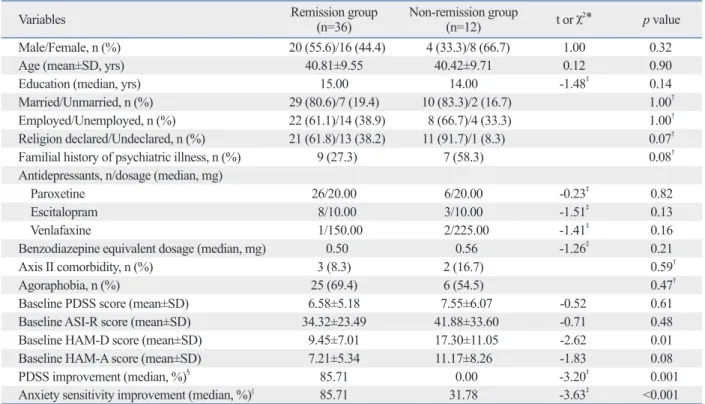
The aim of this study was to explore the potential predic- tors of treatment outcomes after MBCT for PD. Our group has previously reported on the results of MBCT applied to anxiety disorders, focusing on the effectiveness of MBCT in terms of reducing worry, insomnia, AS, phobia, and PD severity.7-9 In this study, we evaluated various characteris- tics of participants in relation to MBCT completion, treat- ment response, and remission to examine factors involved er improvement in PDSS score after MBCT [(baseline PDSS
score-PDSS score at eight weeks)/baseline PDSS score×100 (%)], and lower baseline HAM-D score, compared to the non-remission group (Table 4). After multiple comparison correction (Bonferroni correction, level of significance al- pha=0.05/17·=·0.003), improvements in AS (p<0.001) and PDSS (p=0.001) were significantly different between the remission and non-remission groups. Furthermore, when we analyzed factors according to logistic regression analy- sis, only improvement in AS after MBCT was associated with remission in PD (Table 5).
Table 5. Logistic Regression Analysis Evaluating Factors Associated with Remission in Panic Disorder Patients Who Partici- pated in the MBCT Program (n=48)
β Wald Odds ratio 95% CI p value
Baseline HAM-D score -0.14 3.54 0.87 0.76-1.01 0.060
PDSS improvement* 0.01 0.55 1.01 0.99-1.03 0.457
Anxiety sensitivity improvement† 0.05 4.41 1.05 1.00-1.09 0.036
CI, confidence interval; MBCT, Mindfulness-Based Cognitive Therapy; HAM-D, Hamilton Depression Rating Scale; PDSS, Panic Disorder Severity Scale.
*Reduction in PDSS score after eight weeks of MBCT=[(baseline PDSS score-PDSS score at eight weeks)/baseline PDSS score]×100 (%).
†Reduction in ASI-R score after eight weeks of MBCT=[(baseline ASI-R score-ASI-R score at eight weeks)/baseline ASI-R score]×100 (%).
Table 4. Comparison of Sociodemographic and Clinical Characteristics between Remission and Non-Remission Groups of Panic Disorder Patients after Completion of the MBCT Program (n=48)
Variables Remission group
(n=36) Non-remission group
(n=12) t or χ2* p value
Male/Female, n (%) 20 (55.6)/16 (44.4) 4 (33.3)/8 (66.7) 1.00 0.32
Age (mean±SD, yrs) 40.81±9.55 40.42±9.71 0.12 0.90
Education (median, yrs) 15.00 14.00 -1.48‡ 0.14
Married/Unmarried, n (%) 29 (80.6)/7 (19.4) 10 (83.3)/2 (16.7) 1.00†
Employed/Unemployed, n (%) 22 (61.1)/14 (38.9) 8 (66.7)/4 (33.3) 1.00†
Religion declared/Undeclared, n (%) 21 (61.8)/13 (38.2) 11 (91.7)/1 (8.3) 0.07†
Familial history of psychiatric illness, n (%) 9 (27.3) 7 (58.3) 0.08†
Antidepressants, n/dosage (median, mg)
Paroxetine 26/20.00 6/20.00 -0.23‡ 0.82
Escitalopram 8/10.00 3/10.00 -1.51‡ 0.13
Venlafaxine 1/150.00 2/225.00 -1.41‡ 0.16
Benzodiazepine equivalent dosage (median, mg) 0.50 0.56 -1.26‡ 0.21
Axis II comorbidity, n (%) 3 (8.3) 2 (16.7) 0.59†
Agoraphobia, n (%) 25 (69.4) 6 (54.5) 0.47†
Baseline PDSS score (mean±SD) 6.58±5.18 7.55±6.07 -0.52 0.61
Baseline ASI-R score (mean±SD) 34.32±23.49 41.88±33.60 -0.71 0.48
Baseline HAM-D score (mean±SD) 9.45±7.01 17.30±11.05 -2.62 0.01
Baseline HAM-A score (mean±SD) 7.21±5.34 11.17±8.26 -1.83 0.08
PDSS improvement (median, %)§ 85.71 0.00 -3.20‡ 0.001
Anxiety sensitivity improvement (median, %)|| 85.71 31.78 -3.63‡ <0.001
MBCT, Mindfulness-Based Cognitive Therapy; SD, standard deviation; PDSS, Panic Disorder Severity Scale; ASI-R, Anxiety Sensitivity Inventory-Revised;
HAM-D, Hamilton Depression Rating Scale; HAM-A, Hamilton Anxiety Rating Scale.
*χ2 statistics with continuity correction were used to analyze frequencies and t tests were used to test mean differences.
†Fisher’s exact test.
‡Mann-Whitney U test, z-score value for variables without normal distribution.
§Reduction in PDSS score after eight weeks of MBCT=[(baseline PDSS score-PDSS score at eight weeks)/baseline PDSS score]×100 (%).
||Reduction in ASI-R score after eight weeks of MBCT=[(baseline ASI-R score-ASI-R score at eight weeks)/baseline ASI-R score]×100 (%).
emotional, and interpersonal skills training tailored to bor- derline personality disorder,50 whereas MBCT used in this study was focused on treatment of PD.
On the other hand, even though comorbid personality dis- order was a significant predictor of MBCT non-completion, we found comorbid personality disorders did not have a sig- nificant effect on treatment response and remission among MBCT completers. This could imply that, so long as we can prevent them from dropping out, the treatment outcomes of MBCT for PD would not be significantly different despite the presence of comorbid personality problems.
Treatment response and remission after participating MBCT were associated with greater improvement in AS according to ASI-R score. AS has been suggested as a pre- dictor of panic-related pathology with direct influence on the clinical course of panic disorder.51 As we reported in 2010,7 MBCT could reduce AS in patients with PD. Fur- thermore, according to the present results of this study, AS improvement after MBCT program might be a predictor of remission of PD at 1-year follow-up, as well as symptom reduction after 8 weeks of MBCT.
Through an adoption of a decentralized perspective on ex- periences in mindfulness training,52 decreased levels of AS might be achieved by virtue of an increased level of tolerance for anxiety, especially given that it is possible to become very aware of thoughts, feelings, and body sensations just as they are.7 It may be that remission can be achieved in MBCT par- ticipants who are able to effectively reduce AS and increase tolerance for anxiety through mindfulness training.
The present study has some limitations. First, it was a small-sized study and the statistical power was limited. Also, the present study was an uncontrolled design, which limits its significance and the possibility to generalize the results. In addition, we could not completely rule out the delayed effect of medication. Though participants were stable without any changes in medication dosages during the study period, it would be hard to determine the impact of medications on the findings, as medications varied across participants. Lastly, cognitive measures as well as Mindful Attention and Aware- ness Scale (MAAS)16 were not reported in this study. Since MAAS has not been well-validated in Koreans yet, it was not included in the present analysis.
In conclusion, the present study suggested that comorbid personality disorders of participants could be associated with non-completion of MBCT. Furthermore, it could be considered that AS improvement might predict treatment response and remission after MBCT for PD. However, bet- in treatment outcome. To our knowledge, this is the first
study to investigate the potential predictors of treatment outcomes in MBCT for PD.
In our study, completers and non-completers differed sig- nificantly in terms of family history of psychiatric illness and comorbid personality disorders. Among them, comor- bid personality disorder was a predictor of MBCT comple- tion. In terms of treatment response, participants demon- strating treatment response after MBCT showed greater improvement in AS according to ASI-R score. In addition, the remission group showed a significantly greater treat- ment response after eight weeks of MBCT according to PDSS score, greater improvement in AS after MBCT ac- cording to ASI-R score, and lower baseline HAM-D score compared to the non-remission group. Of these factors, im- provement in AS after MBCT showed significant associa- tion with remission of PD after undergoing MBCT.
Previous studies have indicated comorbidity as a factor associated with poorer treatment outcome when utilizing CBT or IPT to treat psychiatric disease.21,22,41 Dow, et al.42,43 suggested comorbidity as a prognostic index with brief and standard CBT for PD. Especially, according to Martinsen, et al.,44 the presence of severe personality disorders was as- sociated with high dropout rate among those participating in CBT for PD.
However, according to another study that explored major depression patients comorbid with one of DSM-III axis II per- sonality disorders, except schizotypal and antisocial personali- ty disorder, personality pathology did not significantly worsen the outcome of treatment including CBT, IPT or antidepres- sants.45 Also, a study that only included cluster C personality disorders, showed that cluster C personality did not worsen outcomes in those receiving cognitive therapy.46 Another re- view article mentioned that some personality disorders might have had an adverse effect on outcomes to CBT in anxiety disorder, but did not identify direct predictors.47
We also intended to analyze the effect of comorbid per- sonality disorders on treatment outcomes in MBCT for PD in this study. According to our present findings, comorbid personality disorders predicted non-completion of MBCT for PD. While other mindfulness-based therapies such as DBT have been reported as effective treatments with low drop-outs in borderline personality disorders,48,49 PD sub- jects with comorbid personality disorders who underwent MBCT were less likely to complete the eight week MBCT program in this study. This difference could be related to the fact that DBT includes specific behavioral, cognitive,
try Res 2011;187:441-53.
13. Finucane A, Mercer SW. An exploratory mixed methods study of the acceptability and effectiveness of Mindfulness-Based Cogni- tive Therapy for patients with active depression and anxiety in pri- mary care. BMC Psychiatry 2006;6:14.
14. Sharplin GR, Jones SB, Hancock B, Knott VE, Bowden JA, Whit- ford HS. Mindfulness-based cognitive therapy: an efficacious community-based group intervention for depression and anxiety in a sample of cancer patients. Med J Aust 2010;193(5 Suppl):
S79-82.
15. Williams MJ, McManus F, Muse K, Williams JM. Mindfulness- based cognitive therapy for severe health anxiety (hypochondria- sis): an interpretative phenomenological analysis of patients’ expe- riences. Br J Clin Psychol 2011;50:379-97.
16. Brown KW, Ryan RM. The benefits of being present: mindfulness and its role in psychological well-being. J Pers Soc Psychol 2003;84:822-48.
17. Segal ZV, Williams JM, Teasdale JD. Mindfulness-based cogni- tive therapy for depression: a new approach to preventing relapse.
New York: Guilford Press; 2002.
18. Schmidt NB, Zvolensky MJ, Maner JK. Anxiety sensitivity: pro- spective prediction of panic attacks and Axis I pathology. J Psy- chiatr Res 2006;40:691-9.
19. Bishop SR, Lau M, Shapiro S, Carlson L, Anderson ND, Carmo- dy J, et al. Mindfulness: a proposed operational definition. Clin Psychol Sci Pract 2004;11:230-41.
20. Carter JD, Luty SE, McKenzie JM, Mulder RT, Frampton CM, Joyce PR. Patient predictors of response to cognitive behaviour therapy and interpersonal psychotherapy in a randomised clinical trial for depression. J Affect Disord 2011;128:252-61.
21. Jarrett RB, Eaves GG, Grannemann BD, Rush AJ. Clinical, cogni- tive, and demographic predictors of response to cognitive therapy for depression: a preliminary report. Psychiatry Res 1991;37:245-60.
22. Thase ME, Reynolds CF 3rd, Frank E, Simons AD, McGeary J, Fasiczka AL, et al. Do depressed men and women respond simi- larly to cognitive behavior therapy? Am J Psychiatry 1994;151:
500-5.
23. Michalak J, Hölz A, Teismann T. Rumination as a predictor of re- lapse in mindfulness-based cognitive therapy for depression. Psy- chol Psychother 2011;84:230-6.
24. First MB, Spitzer RL, Gibbon M, Williams JBW. Structured Clini- cal Interview for DSM-IV Axis I Disorders (SCID). Washington, D.C.: American Psychiatric Press, Inc.; 1996.
25. Han OS, Hong, JP. Structured Clinical Interview for DSM-IV Axis I Disorders (SCID) Korean version. Seoul: Hana Medical;
2000.
26. Ballenger JC. Treatment of anxiety disorders to remission. J Clin Psychiatry 2001;62 Suppl 12:5-9.
27. Guy W. Clinical Global Impressions (CGI). ECDEU Assessment Manual for Psychopharmacology revised. Rockville: National In- stitute of Mental Health; 1976.
28. Lee SH, Ahn SC, Lee YJ, Choi TK, Yook KH, Suh SY. Effective- ness of a meditation-based stress management program as an ad- junct to pharmacotherapy in patients with anxiety disorder. J Psy- chosom Res 2007;62:189-95.
29. Kabat-Zinn J, Massion AO, Kristeller J, Peterson LG, Fletcher KE, Pbert L, et al. Effectiveness of a meditation-based stress re- duction program in the treatment of anxiety disorders. Am J Psy- chiatry 1992;149:936-43.
30. First MB, Gibbon M, Spitzer RL, Williams JBW, Benjamin LS.
ter designed studies with larger numbers of patients are needed to confirm our findings.
ACKNOWLEDGEMENTS
This research was supported in part by the Basic Science Research Program through the National Research Founda- tion of Korea funded by the Ministry of Education, Science and Technology (2011-0023359) to S.H. Lee.
REFERENCES
1. Kabat-Zinn J. An outpatient program in behavioral medicine for chronic pain patients based on the practice of mindfulness medita- tion: theoretical considerations and preliminary results. Gen Hosp Psychiatry 1982;4:33-47.
2. Kabat-Zinn J. Full Catastrophe Living: Using the Wisdom of Your Body and Mind to Face Stress, Pain, and Illness. New York: Dell Publishing; 1990.
3. Miller JJ, Fletcher K, Kabat-Zinn J. Three-year follow-up and clinical implications of a mindfulness meditation-based stress re- duction intervention in the treatment of anxiety disorders. Gen Hosp Psychiatry 1995;17:192-200.
4. Teasdale JD, Segal ZV, Williams JM, Ridgeway VA, Soulsby JM, Lau MA. Prevention of relapse/recurrence in major depression by mindfulness-based cognitive therapy. J Consult Clin Psychol 2000;68:615-23.
5. Evans S, Ferrando S, Findler M, Stowell C, Smart C, Haglin D.
Mindfulness-based cognitive therapy for generalized anxiety dis- order. J Anxiety Disord 2008;22:716-21.
6. Williams JM, Alatiq Y, Crane C, Barnhofer T, Fennell MJ, Dug- gan DS, et al. Mindfulness-based Cognitive Therapy (MBCT) in bipolar disorder: preliminary evaluation of immediate effects on between-episode functioning. J Affect Disord 2008;107:275-9.
7. Kim B, Lee SH, Kim YW, Choi TK, Yook K, Suh SY, et al. Effec- tiveness of a mindfulness-based cognitive therapy program as an adjunct to pharmacotherapy in patients with panic disorder. J Anx- iety Disord 2010;24:590-5.
8. Kim YW, Lee SH, Choi TK, Suh SY, Kim B, Kim CM, et al. Ef- fectiveness of mindfulness-based cognitive therapy as an adjuvant to pharmacotherapy in patients with panic disorder or generalized anxiety disorder. Depress Anxiety 2009;26:601-6.
9. Yook K, Lee SH, Ryu M, Kim KH, Choi TK, Suh SY, et al. Use- fulness of mindfulness-based cognitive therapy for treating insom- nia in patients with anxiety disorders: a pilot study. J Nerv Ment Dis 2008;196:501-3.
10. Coelho HF, Canter PH, Ernst E. Mindfulness-based cognitive therapy: evaluating current evidence and informing future re- search. J Consult Clin Psychol 2007;75:1000-5.
11. Lovas DA, Barsky AJ. Mindfulness-based cognitive therapy for hypochondriasis, or severe health anxiety: a pilot study. J Anxiety Disord 2010;24:931-5.
12. Chiesa A, Serretti A. Mindfulness based cognitive therapy for psy- chiatric disorders: a systematic review and meta-analysis. Psychia-
panic disorder: II. Moderators of outcome. Psychol Med 2007;37:
1503-9.
43. Dow MG, Kenardy JA, Johnston DW, Newman MG, Taylor CB, Thomson A. Prognostic indices with brief and standard CBT for panic disorder: I. Predictors of outcome. Psychol Med 2007;37:
1493-502.
44. Martinsen EW, Olsen T, Tønset E, Nyland KE, Aarre TF. Cogni- tive-behavioral group therapy for panic disorder in the general clinical setting: a naturalistic study with 1-year follow-up. J Clin Psychiatry 1998;59:437-42.
45. Shea MT, Pilkonis PA, Beckham E, Collins JF, Elkin I, Sotsky SM, et al. Personality disorders and treatment outcome in the NIMH Treatment of Depression Collaborative Research Program.
Am J Psychiatry 1990;147:711-8.
46. Hardy GE, Barkham M, Shapiro DA, Stiles WB, Rees A, Reyn- olds S. Impact of Cluster C personality disorders on outcomes of contrasting brief psychotherapies for depression. J Consult Clin Psychol 1995;63:997-1004.
47. Dreessen L, Arntz A. The impact of personality disorders on treat- ment outcome of anxiety disorders: best-evidence synthesis. Be- hav Res Ther 1998;36:483-504.
48. Kliem S, Kröger C, Kosfelder J. Dialectical behavior therapy for borderline personality disorder: a meta-analysis using mixed-ef- fects modeling. J Consult Clin Psychol 2010;78:936-51.
49. Linehan MM, Comtois KA, Murray AM, Brown MZ, Gallop RJ, Heard HL, et al. Two-year randomized controlled trial and follow- up of dialectical behavior therapy vs therapy by experts for suicid- al behaviors and borderline personality disorder. Arch Gen Psy- chiatry 2006;63:757-66.
50. Rosenthal MZ, Lynch TR. Dialectical Behavior Therapy. In: Sa- dock BJ, Sadock VA, Ruiz P, editors. Kaplan & Sadock’s Com- prehensive Textbook of Psychiatry. 9th ed. Baltimore: Lippincott Williams & Wilkins; 2009. p.2884-93.
51. Stewart SH, Taylor S, Jang KL, Cox BJ, Watt MC, Fedoroff IC, et al. Causal modeling of relations among learning history, anxiety sensitivity, and panic attacks. Behav Res Ther 2001;39:443-56.
52. Safran JD, Segal ZV. Interpersonal process in cognitive therapy.
New York: Basic Books; 1990.
Structured Clinical Interview for DSM-IV Axis II Personality Dis- orders (SCID-II). Washington, D.C.: American Psychiatric Press, Inc.; 1997.
31. Kim CG. Structured Clinical Interview for DSM-IV Axis II Per- sonality Disorders (SCID-II) Korean version. Seoul: Hana Medi- cal; 2005.
32. Lim YJ, Yu BH, Kim JH. Korean panic disorder severity scale:
construct validity by confirmatory factor analysis. Depress Anxi- ety 2007;24:95-102.
33. Shear MK, Rucci P, Williams J, Frank E, Grochocinski V, Vander Bilt J, et al. Reliability and validity of the Panic Disorder Severity Scale: replication and extension. J Psychiatr Res 2001;35:293-6.
34. Taylor S, Cox BJ. An expanded anxiety sensitivity index: evi- dence for a hierarchic structure in a clinical sample. J Anxiety Disord 1998;12:463-83.
35. Lim YJ, Yu BH, Kim JH. Korean Anxiety Sensitivity Index-Re- vised: its factor structure, reliability, and validity in clinical and nonclinical samples. Depress Anxiety 2007;24:331-41.
36. Hamilton M. A rating scale for depression. J Neurol Neurosurg Psychiatry 1960;23:56-62.
37. Hamilton M. The assessment of anxiety states by rating. Br J Med Psychol 1959;32:50-5.
38. Aaronson CJ, Shear MK, Goetz RR, Allen LB, Barlow DH, White KS, et al. Predictors and time course of response among panic dis- order patients treated with cognitive-behavioral therapy. J Clin Psychiatry 2008;69:418-24.
39. Furukawa TA, Katherine Shear M, Barlow DH, Gorman JM, Woods SW, Money R, et al. Evidence-based guidelines for inter- pretation of the Panic Disorder Severity Scale. Depress Anxiety 2009;26:922-9.
40. Bados A, Balaguer G, Saldaña C. The efficacy of cognitive-be- havioral therapy and the problem of drop-out. J Clin Psychol 2007;63:585-92.
41. Robinson LA, Berman JS, Neimeyer RA. Psychotherapy for the treatment of depression: a comprehensive review of controlled outcome research. Psychol Bull 1990;108:30-49.
42. Dow MG, Kenardy JA, Johnston DW, Newman MG, Taylor CB, Thomson A. Prognostic indices with brief and standard CBT for