KISEP Original Articles 생생 물물물물 정신의 학생생 정신의 학정신의 학정신의 학 Vol. 7, No. 2, December 2000
인지행동치료 후 약물 중단 예측 요인에 관한 연구
최영희*†·박기환**·김한석*·하오령**
Predicting Factors of Discontinuation of Medication after Cognitive Behavioral Therapy for Panic Disorder
Young Hee Choi, M.D.,*
††††Kee Hwan Park, Ph.D.,** Han Seok Kim, M.D.,* Oh Ryeong Ha, M.A.**
bjective:The authors experienced that cognitive behavioral therapy(CBT) could replace medication for controlling panic attacks and anticipatory anxiety symptoms. The objective of this study was finding out predicting factors of discontinuation of medication after CBT for patients with panic disorder.
Method:A hundred forty-eight patients who met DSM-Ⅳ criteria for panic disorder with or without agoraphobia for at least 3 months had completed 12 weekly sessions of Panic Control Therapy(PCT;Barlow et al). Eighty-one patients who could discontinue medication and sixty-seven patients who could not discontinue medication were measured with several scales as the pre- and post-treatment aassessment. The scales were Beck Depression Inventory(BDI), Clinical Global Im- pression(CGI), Spielberger State Anxiety Inventory(STAI-state), Anxiety Sensitivity Index(ASI), Body Sensation Questionnaire (BSQ), Panic Belief Questionnaire(PBQ), Agoraphobic Cognition Questionnaire(ACQ), Fear Questionnaire(FQ), Toronto Alexithymia Scale(TAS).
Results:At the pre-treatment assessment, the scores of BDI, CGI, STAI-state, ACQ, BSQ were higher in the patients who could discontinue medication than in the patients who could not discontinue medication(t=-2.68, t=-4.88, t=-3.07, t=-3.68, t=-3.35, p<0.01).
Conclusion:Patients with panic disorder who were less depressed, less anxious, less agoraphobic and who had less negative cognitions for the bodily sensation and who had higher scores in the therapist’s assessment could discontinue their medications.
KEY WORDS:Panic disorder・Cognitive behavioral therapy・Discontinuation of medication.
서 론
공황장애의 다양한 생물학적인 원인이 많은 연구들을 통하여
밝혀지게 되었고, 이에 대한 약물치료가 공황장애의 중요한 치 료 방법으로 자리잡게 되었다. 그 동안 공황장애의 약물치료에 는 항우울제인 삼환계항우울제(TCA), 단가아민 효소 차단제 (MAOI) 및 선택적 세로토닌 재흡수 차단제(SSRI)와 항불안제 인 벤조다이아제핀(Benzodiazepine)계 약물이 주로 사용되었 다. 그러나, 삼환계 항우울제와 단가아민 효소 차단제는 치료 효 과가 늦게 나타나고 여러 가지 부작용의 위험이 있으며(Ball- enger등 1987;Noyes등 1989;Schatzberg 1993;Shee- han등 1980), 선택적 세로토닌 재흡수 차단제 또한 치료 효과 가 나타나기까지 시간이 걸리고 과민 현상을 비롯한 부작용도
OOOO
ABSTRACT
*인제대학교 의과대학 서울백병원 신경정신과학교실
Department of Neuropsychiatry, Seoul Paik Hospital, Inje University, Seoul, Korea
**인제대학교 의과대학 서울백병원 임상심리학교실
Department of Neuropsychology, Seoul Paik Hospital, Inje University, Seoul, Korea
†교신저자:최영희, 100-032 서울 중구 저동 2가 85번지 전화) (02) 2270-0289, 전송) (02) 2270-0344
제한점으로 지적되었다(Kaplan과 Sadock 1993;Schatzberg 1993). 항불안제인 벤조다이아제핀은 즉각적인 증상의 호전이 있지만 장기 투여시 발생하는 의존성과 투여 중단시 발생하는 금단증상 등의 문제점이 있다(Fontaine등 1984;Pecknold 1990;Rickels등 1990;Schatzberg 1993 ;Schweiser등 1990). 더구나 벤조다이아제핀 계열의 약물은 공황발작의 억 제에는 상당히 효과적이어서 이를 복용하는 환자들이 심리적 으로 의존할 가능성이 많아 장기간 투여하게 되는 경우가 많았다 (Bruce등 1995).
최근 항공황 효과가 있는 여러 가지 약물들이 개발되었지만, 이러한 약물들의 복용을 중단했을때 공황장애의 재발율이 높아 서(Ballenger 1992) 공황장애 환자는 최소한 6개월간 지속적 으로 약을 복용해야 하고, 대다수의 환자에서 1년 혹은 그 이상 의 약물 치료가 필요하다는 연구 결과도 있다(Burrow 1990 ; Roy-Byrne과 Wingerson 1992;Schatzberg와 Ballenger 1991;Schweizer등 1993). 결국 대다수 공황장애 환자들이 장기간 약을 복용할 수밖에 없게 되고(Nagy등 1989), 이에 따 라 보조적 치료의 병행에 대한 필요성이 대두되었고, 이에 인 지행동치료가 주목을 받은 뒤로 최근 공황장애에 대한 인지행 동치료의 기법이 괄목할만한 발전을 이루게 되었다(Brown등 1992;Clum 1988). 인지행동치료가 공황장애 환자에서 단기 및 장기적으로 공황과 관련된 증상을 현저히 감소시킨다는 결 과가 나왔고(최영희와 이정흠 1998;Clark등 1994;Craske 등 1991;Sokol등 1989;Telch등 1993), 인지행동치료를 병 행하면서 약물을 중단하는 것이 그냥 중단하는 것보다는 수월 했다고 한다(Otto등 1993;Spiegel등 1994). 단기 및 장기간 의 치료 모두에서 인지행동치료가 약물치료보다 공황 소실율 이 높고 증상 재발율은 낮으며 증상이 없는 기간이 길었다는 연구 결과도 있고(Barlow등 1989;Beck등 1992;Craske등 1991 ;Margraf등 1993;Pollack등 1993;Tesar등 1991), 약물치료와 인지행동치료의 병합 요법이 통상적인 약물치료와 역동적 정신치료의 병합 요법보다 효과적이라는 연구 결과도 있 다(채정호 등 1999). 이처럼 여러 연구를 통해서 인지행동치료 가 공황장애의 치료에 있어 약물치료의 보조 치료로서, 또는 대 체 치료로서 효과가 있다는 사실이 확인되었다. 그러나 우리나 라에서는 인지행동치료에 대한 치료자들의 경험 부족으로 주로 약물치료가 행하여지고 있으며, 약물도 보다 빠른 효과를 위해 벤조다이아제핀 계열의 항불안제를 처방하는 경우가 많다. 약물 치료의 중단에 있어서 인지행동치료의 효과는 다수 보고되었으 나(Spiegel등 1994), 약물 복용 환자에서 인지행동치료 후에 약 물 중단에 기여하는 요인에 대한 연구는 부족하였다. 이에 저자 들은 실제 임상에서 공황장애 환자의 인지행동치료를 통하여 약 물을 중단할 정도의 탁월한 치료 효과를 바탕으로, 약물을 복용 하던 공황장애 환자들에게 있어 인지행동치료 후 약물 중단 여
부를 예측할 수 있는 요인들에 관심을 가지게 되어 본 연구를 시 행하였다.
연구대상 및 방법
1. 연구 대상
연구 대상은 인제대학교 서울백병원 공황장애 클리닉에서 DSM-Ⅳ의 진단 기준에 따라 최근 3개월 동안 광장공포증을 동 반하거나 하지 않은 공황장애를 지닌 178명의 환자들을 대상으 로 하였다. 연구 대상에서 기질성 정신장애, 정신분열병, 주요 우 울증, 혹은 강박장애의 진단기준에 해당하는 환자는 제외되었고, 지난 1년간 정신증이나 약물의존의 병력이 있는 환자, 내과 질 환이 있는 환자, 임신 혹은 수유 중인 환자들도 제외되었다. 또 한 이전에 공황장애 인지행동치료를 받았거나 최근 정신치료를 받았던 환자 또한 대상군에서 제외하였다.
2. 연구 방법
178명의 공황장애 환자 중 처음부터 약을 복용하지 않은 18명 과 인지행동치료 도중 치료에서 탈락한 12명을 제외한 148명 을 대상으로 인지행동치료 전후의 상태에 대하여 설문지를 통해 알아보았다. 148명의 환자에게 총 12회(주 1회)의 인지행동치 료(Panic Control Therapy;Barlow등 1989)를 실시하였다.
공황장애의 인지행동치료 종료 후 약물 복용을 중단한 78명의 환자군과 약물 복용을 중단하지 못한 70명의 환자군으로 나누 어, 치료 전과 치료 후에 시행한 Beck Depression Inventory (BDI), Clinical Global Impression(CGI), Spielberger State- Trait Anxiety Inventory-State(STAI-state), Anxiety Se- nsitivity Index(ASI), Body Sensation Questionnaire(BSQ), Panic Belief Questionnaire(PBQ), Agoraphobic Cognition Questionnaire(ACQ), Fear Questionnaire(FQ), Toronto Al- exithymia Scale(TAS) 점수들을 비교 분석하였다.
통계는 SPSS PC+ version 9.0을 사용하여 Independent t-test로 검증하였다.
결 과
1. 사회인구학적 특징
성별은 남성이 81명(54.7%), 여성이 67명(45.3%)으로 남성 이 좀 많았다. 결혼 상태를 보면, 전체 148명 중 기혼자가 122 명으로 82.4%였으며 미혼자가 24명으로 16.2%를 차지하였다.
그 외 2명은 이혼, 별거 상태였다. 연령은 남성의 경우 평균 37.
3세, 여성의 경우는 평균 36.9세였다. 평균 유병기간은 53.2개 월이었다. 직업은 사무직이 53명(35.8%)으로 가장 많았고 다 음으로 주부가 36명(24.3%), 자영업이 21명(14.2%)으로 많
았다. 전문직은 13명(8.8%)이었고 무직도 12명(8.1%)이었다.
나머지는 학생이 5명, 기타 직업이 6명, 생산직이 2명이었다 (표 1).
2. 약물 중단군과 약물 지속군의 치료 전 특성
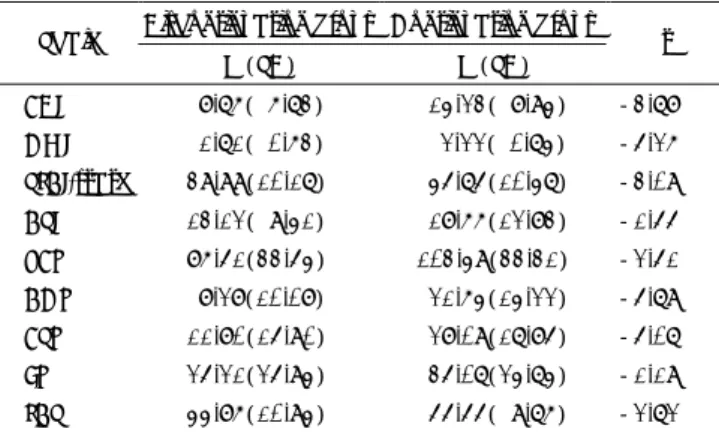
공황장애의 인지행동치료를 받기 전에 약물 중단군과 약물 지 속군 사이에 유의한 차이가 있었던 척도는 BDI, CGI, STAI- state, ACQ, BSQ였다. 그 외의 ASI, PBQ, FQ, TAS의 척도에
서는 유의한 차이가 없었다(표 2).
3. 약물 중단군과 약물 지속군의 치료 후 특성
12주간의 인지행동치료를 받은 뒤 약물 복용을 중단한 군과 약물을 중단하지 못한 군 사이에서 유의한 차이를 보였던 척도는 BDI, CGI, STAI, ACQ, BSQ, TAS, PBQ였다. TAS와 PBQ를 제외한 나머지 척도는 치료 전과 마찬가지로 유의한 차이를 보 였다(표 3).
고 찰
대부분의 공황장애 환자들은 약물치료를 받고 있으며, 공황 증상의 주관적인 고통과 불편 때문에 약물치료에 많이 의존하 고 있다. 본 연구에서도 환자들이 대부분 작용시간이 빠르고 임상적 효과가 큰 Alprazolam이나 Clonazepam 등의 고강도 benzodiazepine계열의 약물을 복용 중이었다. 이러한 benzo- diazepine계열의 약물들은 공황장애의 급성기에 효과적으로 증상 을 조절할 수 있다는 것은 입증이 되었고(Ballinger등 1987 ; Schweizer등 1993), 항불안 효과에 대한 내성이 없이 약물 효 과가 8개월 간 지속된다고 보고되었다(Schweizer 등 1993).
하지만 복용하던 약물의 용량을 줄이게 되면, 약 20~30%의 환자들이 다시 공황 증상을 경험하게 되고, 성공적으로 약을 중 단한 환자들도 6개월 후에는 약 50%에서 재발하게 된다는 보고 들도 있다(Spiegel등 1994;Marks등 1994). 결국 공황장애 환자의 약물을 중단할 때, 이러한 금단 증상과 심리적 의존이 문제가 되고 이에 대한 해결이 약물 중단 성공의 열쇠가 될 것 이다.
본 연구에서는 공황장애 환자들이 12주간의 인지행동치료를 받은 뒤 치료 전부터 복용하던 약물을 성공적으로 중단하게 되 는 환자들과 그렇지 못한 환자들 사이에 어떤 차이가 있는지에 대해 알아보았다. 결과에서 보듯이 인지행동치료를 받고 난 후
Table 1. Demographic data
Number(%)
Sex
Male 81(54.7)
Female 67(45.3)
Age(mean year±SD)
Male 37.3± 6.5 Female 36.9± 6.5 Duration Of illness(month±SD) 53.2±50.9 Matital status
Married 122(82.4)
Unmarried 24(16.2)
Divorced 2( 1.4)
Occupation Office workers 53(35.8)
Housewives 36(24.3)
Sellers 21(14.2)
Experts 13( 8.8)
Students 5( 3.4)
Labors 2( 1.4)
Unemployed 12( 8.1)
Others 6( 4.1)
SD:Standard deviation
Table 2. A comparison of scores between two groups before treatment
Discontinuation group Continuation group Scale
M(SD) M(SD) t BDI 14.27( 7.91) 18.75(10.36) -2.68**
CGI 5.26( 1.06) 6.22( 1.26) -4.88***
STAI-state 47.12(12.92) 54.37(13.09) -3.07**
ASI 29.35(12.76) 30.34(15.06) -0.89 PBQ 147.10(35.04) 157.49(38.29) -1.54 ACQ 14.32(17.18) 27.39(21.59) -3.68***
BSQ 19.81(23.88) 34.69(26.08) -3.35**
FQ 48.29(22.00) 46.62(21.23) 0.22 TAS 51.87(10.29) 55.60( 8.89) -1.72 BDI:Beck Depression Inventory:CGI:Clinical Global Impre- ssion ; STAI-state : Spielberger State-Trait Anxiety Inventory- State;ASI:Anxiety Sensitivity Index:BSQ:Cognition Ques- tionnaire;FQ:Fear Questionnaire:TAS:Toronto Alexithymia Scale
*:p<0.05, **:p<0.01, ***:p<0.001 M:Mean;SD:Stand-ard deviation
Table 3. A comparison of scores between two groups after treatment
Discontinuation group Continuation group Scale
M(SD) M(SD) t BDI 8.76( 6.73) 14.23( 8.94) -3.78***
CGI 1.71( 0.63) 2.22( 0.74) -5.26***
STAI-state 39.99(10.17) 45.75(10.47) -3.09**
ASI 13.12( 9.41) 18.66(12.83) -1.55 PBQ 86.51(33.54) 103.49(33.31) -2.51*
ACQ 8.28(10.08) 21.64(14.22) -5.79***
BSQ 11.80(15.90) 28.09(17.85) -5.07***
FQ 25.21(25.94) 35.07(24.74) -1.19 TAS 44.86(10.94) 55.55( 9.76) -2.72*
*:p<0.05, **:p<0.01, ***:p<0.001 M:Mean;SD:Standard deviation
성공적으로 약을 중단할 수 있었던 환자들은 그렇지 못한 환자들 에 비해 치료 전에 우울 증상과 불안 증상, 그리고 광장공포 중 상이 적었고 자신의 신체 감각에 대한 부정적인 인지가 적었다.
또한 치료자가 임상적으로 평가한 환자의 증상 호전도가 높은 환자일수록 약물을 성공적으로 중단할 수 있었다.
여기서 인지행동치료를 받기 전 환자의 상태에 따라 향후 인지 행동치료 후 성공적으로 약물을 중단할 가능성을 미리 예측할 수 있고, 인지행동치료 전 환자의 우울 증상과 공황 증상의 정도가 양호할수록 약물 중단의 가능성이 높음을 알 수 있었다. 증상 호 소가 심한 환자일수록 장기간 약물을 복용하고, 특히, 증상 개선 의 효과가 빠른 고강도 benzodiazepine계열의 약물을 고용량 으로 장기간 복용했을 가능성이 높기 때문에 인지행동치료 후 에 약물 중단이 더욱 어렵다는 것도 짐작할 수 있었다. 약물 중단 군과 약물을 중단하지 못한 군의 비교에서 공황과 연관된 사고 들을 평가하는 Panic Belief Questionnaire(PBQ)의 결과가 치 료 전과 달리 치료 후에 유의한 집단간 차이를 보이고, 약물 중단 군에서 수치가 현저히 감소한 결과를 보인 것은 공황장애 인지 행동치료의 효과에 의해 환자들이 자신의 공황 증상에 대한 해 석의 긍정적 변화에 기인한 것으로 설명할 수 있을 것이다.
본 연구를 통하여 공황장애 환자가 주관적으로 평정하는 다 양한 보고와 치료자의 객관적인 임상적 평가가 약물 중단을 예 측할 수 있는 자료를 제공하여 준다는 사실을 알 수 있었으며, 인지행동치료 전에 충분한 정보 수집 및 대책이 이루어진다면 향후 인지행동치료 뿐만 아니라 약물치료를 포함한 환자의 전 반적인 치료에서 효과적인 전략을 세워 나갈 수 있을 것으로 예 상된다.
결 론
본 연구를 통하여 공황장애 환자의 우울 증상이 적을수록, 치 료자의 임상적 호전도 평가가 높을수록, 불안증상이 적을수록, 광 장공포증상이 적을수록, 신체감각에 대한 부정적 인지가 적을수 록, 인지행동치료 후에 약물을 중단할 가능성이 높은 것을 알 수 있었다.
중심 단어:공황장애・인지행동치료・약물중단.
참고문헌
채정호·안희원·이정준·박원명·전태연·김광수((((1999)))) :::: 공 황장애에서 인지행동치료와 약물치료 병합요법의 단기 효과.
정신병리학 8:168-174
최영희·이정흠((((1998)))) :::: 공황장애의 인지행동치료. 신경정신의 학 37:603-619
Ballenger JC((((1992)))):::Medication discontinuation in panic disorder. :
J Clin Psychiatry 53(3, suppl):26-31
Ballenger JC, Howell EF, Laraia M, Lydiard RB((((1987))))::::Com- parison of Four Medicines in Panic Disorder. The 140th An- nual Meeting of the American Psychiatric Association, Chicago, May 14
Barlow DH, Craske MG, Cerny JA, Klosko JS((((1989))))::::Behavioral treatment of panic disorder. Behav Ther 20:261-282
Beck AT, Sokol L, Clark DA, Berchick R, Wright FA((((1992))))::::Cro- ssover study of focused cognitive therapy for panic disorder. Am J Psychiatry 149:778-783
Brown TA, Hertz RM, Barlow DH((((1992)))):::New developments in : cognitive-behavioral treatment of anxiety disorders. In A. Ta- sman(Ed.). American Psychiatry Press review of psychiatry, Washington DC, American Psychiatric Press 11:285-306 Bruce TJ, Spiegel DA, Gregg SF, Nuzzarello A((((1995))))::::Predictors
of alprazolam discontinuation with or without cognitive behavior therapy in panic disorder. Am J Psychiatry 152:1156-1160 Burrows GD((((1990)))):::Managing long term therapy for panic dis-:
order, J Clin Psychiatry 51(11, Suppl):9-12
Clark DM, Salkovskis PM, Hackmann A, Middleton H, Anastasiades P, Gelder M((((1994)))):::A comparison of cognitive : therapy, applied relaxation, and Imipramine in the treatment of panic disorder. Br J Psychiat 164:759-769
Clum GA((((1988))))::::Psychological interventions vs. drugs in the treat- ment of panic. Behavioral Therapy 20:429-457
Craske MG, Brown TA, Barlow DH((((1991))))::::Behavioral treatment of panic disorder:A two-year follow-up. Behavior Therapy 22: 289-304
Fontaine R, Chouinard G, Annable L((((1984)))):::Rebound anxiety in : anxious patients after abrupt withdrawal of benzodiazepine trea- tment. Am J Psychiatry 141:848-852
Kaplan HI, Sadock BJ((((1993))))::::Pocket handbook of psychiatric drug treatment:Serotonin-specific reuptake inhibitors. 1st ed, Mar- yland, Williams & Wilkins press:pp157-167
Margraf J, Barlow DH, Clark DM((((1993))))::::Psychological treatment of panic:Work in progress on outcome, active ingredients, and follow-up. Behav Res Ther 31:1-8
Marks IM, Swinson RP, Basoglu M, Kuch K, Noshirvani H, O Sullivan G, Lelliott PT, Kirby M, McNamee G, Sengun S, Wic- kwire K((((1994))))::::Alprazolam and exposure alone and combined in panic disorder with agoraphobia:a controlled study in Lon- don and Toronto. Br J Psychiatry 162:776-787, 1993
Nagy LM, Krystal JH, Woods SW, Charney DS((((1989))))::::Clinical and medication outcome after short-term alprazolam and beha- vioral group treatment in panic disorder, Arch Gen Psychiatry 46:993-999
Noyes R Jr, Garvey MJ, Cook BL, Samuelson L((((1989))))::::Problems with tricyclic antidepressant use in patients with panic disorder or agoraphobia, Results of a naturalistic follow-up study. J Clin Psychiatry 50:163-169
Otto MW, Pollack M, Sachs GS, Rritor SR, Meltzer-Brody S, Rosenbaum J F((((1993))))::::Discontinuation of benzodiazepine tre- atment:Efficacy of cognitive-behavioral therapy for patients with panic disorder. Amer J Psychiatry 150(10):1485-1490 Pecknold JC((((1990))))::::Discontinuation Reactions to Alprazolam in
Panic Disorder. Panic Conference, Carlsbad, California, Novem-
ber:27-30
Pollack MH, Otto MW, Tesar GE, Cohen LS, Meltzer-Brody S, Ro- senbaum J F((((1993))))::::Long-term outcome after acute treatment with clonazepam and alprazolam for panic disorder. Am J Psy- chiatry. In press
Rickels K, Schweizer B, Case WG, Greeblatt DJ((((1990)))):::Long-term : therapeutic use of benzodiazepines. I. Effects of abrupt discon- tinuation. Arch Gen Psychiatry 47:899-907
Roy-Byrne PP, Wingerson D((((1992))))::::Pharmacotherapy of anxiety disorders, in Review of Psychiatry, edited by Tasman A, Riba MB, vol 11, Washington DC, American Psychiatric Press, pp262-267 Schatzberg AF((((1993))))::::Pharmacological treatment of anxiety dis- order:Emphasis on panic disorder, presented in American Psy- chiatric Association 1993 Annual Meeting, San Francisco, CA Schatzberg AF, Ballenger JC((((1991))))::::Decision for the clinician in
the treatment of panic disorder:When to treat, which treatment to use, how long to treat, J Clin Psychiatry 52(2, suppl):26-31 Schweizer E, Rickels K, Case WG, Greeblatt DJ((((1990)))):::Long-term : therapeutic use of benzodiazepines. II. Effects of gradual taper.
Arch Gen Psychiatry 47(10):908-915
Schweizer E, Rickels K, Weiss S, Zavodnick S((((1993)))):::Mainten-: ance drug treatment of panic disorder, I. Results of a prospective, Placebocontrolled comparison of alprazolam and imipramine, Arch Gen Psychiatry 50:51-60
Sheehan DV, Ballenger J, Jacobsen G((((1980))))::::Treatment of endog- enous anxiety with phobic, hysterical and hypochondrical symp- toms. Arch Gen Psychiatry 37:51-59
Sokol L, Beck AT, Greenberg RL, Wright FD, Berchick RJ((((1989)))):::: Cognitive therapy of panic disorder:A nonpharmacological alt- ernative. J Nerv Ment Dis 177:711-716
Spiegel DA, Bruce TJ, Gregg SF, Nuzzarello A((((1994)))):::Does cog-: nitive behavior therapy assist slow-taper alprazolam discontin- uation in panic disorder? Amer J Psychiatry 151(6):876-881 Telch MJ, Lucas JA, Schmidt NB, Hanna HH, Jaimez TL, Lucas
RA((((1993))))::::Group cognitive-behavioral treatment of panic dis- order. Behav Res and Ther 31:279-287
Tesar GE, Rosenbaum JF, Pollack MH((((1991))))::::Double-blind pla- cebo-controlled comparison of clonazepam and alprazolam for panic disorder. J Clin Psychiatry 52(2):69-76