INTRODUCTION
Dairy products including milk have been reported to have a beneficial effect on hypertension1 and insulin sensitivity,2 as they are rich in various nutrients, such as calcium, magnesium, potassium, and other food components. Despite their contri-
bution of saturated fatty acid to the diet, there is no clear evi- dence that dairy products are associated with a higher risk of cardiovascular disease (CVD).3 In prospective cohort studies, milk intake was not associated with total mortality but may have been inversely associated with overall CVD risk4 and myo- cardial infarction risk.5 Furthermore, three servings of dairy food consumption per day was found to lead to a better nutri- ent status, improved bone health, lower blood pressure, and re- duced risk of CVD and type 2 diabetes.6,7 In a Japanese study, drinking milk 1–2 times a month and 3–4 times a week were as- sociated with lower all-cause mortality in men and women, re- spectively, compared to those who never drank milk.8
On the other hand, harmful effects of milk consumption have been reported as well. Although the role of dairy product con- sumption in mortality generally appeared to be neutral in men, dairy fat intake was reported to be associated with slightly in- creased all-cause and ischemic heart disease mortality.9 In a
Milk Consumption and Framingham Risk Score:
Analysis of the Korea National Health and Nutrition Examination Survey Data (2008–2011)
Nam-Seok Joo1, Sung-Won Yang1, Soo-Jung Park1, Sung-Jin Choi1, Byeng Chun Song2, and Kyung-Jin Yeum2
1Department of Family Practice and Community Health, Ajou University School of Medicine, Suwon;
2Division of Food Bioscience, College of Biomedical and Health Sciences, Konkuk University, Chungju, Korea.
Purpose: The benefit of milk intake remains controversial. The association between milk consumption and Framingham Risk Score (FRS) in a population consuming relatively low amounts of dairy products is undetermined.
Materials and Methods: A total of 13736 adults (5718 male and 8018 female) aged 20–80 years from the Korea National Health and Nutrition Examination Survey (2008–2011) were divided into groups according to milk consumption (rarely, monthly, weekly, and daily) and compared according to FRS after relevant variable adjustments.
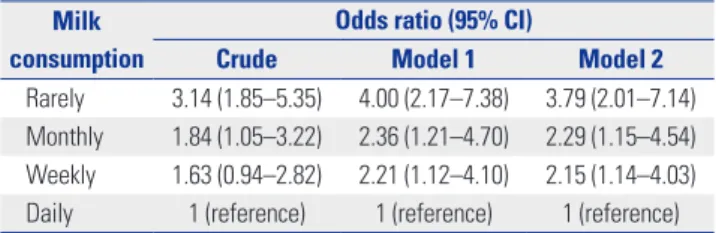
Results: The mean FRS in males and females were 6.53 and 5.74, respectively. Males who consumed milk daily (15.9%) had a sig- nificantly lower FRS than males having milk rarely (31.6%) or monthly (17.4%; p=0.007). Females who consumed milk daily (22.3%) also had significantly lower FRS than rarely (29.8%), monthly (13.8%), or weekly (34%; p=0.001) consumers. In particular, males ≥60 years old who consumed milk daily had a significantly lower FRS than males who consumed less milk (p<0.001). The odds ratio in this age group showed a significant and gradual increase in the weekly [OR=2.15; 95% confidence interval (CI) 1.14–4.03], monthly (OR=2.29; 95% CI 1.15–4.54), and rarely (OR=3.79; 95% CI 2.01–7.14) milk consumption groups when compared with the daily milk consumption group.
Conclusion: Milk consumption was associated with a lower FRS in a low milk-consuming population. In particular, daily milk con- sumption in males over 60 years old may be beneficial for those at risk for cardiovascular disease.
Key Words: Milk consumption, Framingham Risk Score, Koreans Yonsei Med J 2016 Jan;57(1):197-202
http://dx.doi.org/10.3349/ymj.2016.57.1.197 pISSN: 0513-5796 · eISSN: 1976-2437
Received: December 30, 2014 Revised: April 15, 2015 Accepted: May 28, 2015
Corresponding author: Dr. Kyung-Jin Yeum, Division of Food Bioscience, College of Biomedical and Health Sciences, Konkuk University, 268 Chungwon-daero, Chungju 27478, Korea.
Tel: 82-43-840-3586, Fax: 82-43-840-3585, E-mail: [email protected]
•The authors have no financial conflicts of interest.
© Copyright: Yonsei University College of Medicine 2016
This is an Open Access article distributed under the terms of the Creative Com- mons Attribution Non-Commercial License (http://creativecommons.org/ licenses/
by-nc/3.0) which permits unrestricted non-commercial use, distribution, and repro- duction in any medium, provided the original work is properly cited.
recent large cohort study (mean follow-up of 20.1 years), three or more glasses of milk a day was associated with higher mor- tality in men and women and higher fracture incidence in wo- men.10 In addition, one meta-analysis reported that dairy prod- uct consumption was associated with a non-significant incre- ased risk of gastric cancer.11 The Framingham Risk Score (FRS), which is based on data obtained from the Framingham Heart Study, is generally considered to be a useful tool for assessing future cardiovascular risk.12 It is a gender-specific algorithm used to estimate the 10-year cardiovascular risk of an individu- al. The FRS can be calculated based on gender, age, total cho- lesterol (TC), high-density lipoprotein cholesterol (HDLC), blood pressure, and smoking status. The original FRS was pub- lished in 1998,13 and the current version of the FRS was pub- lished in 2002.14 A recent study15 indicated that 70% of subjects aged 40 years or older from the National Health and Nutrition Examination Survey (2003–2004) were found to have low (<10%) 10-year CVD risk, while 19% had intermediate (10–20%) risk and 11% had high (≥20%) risk.
Given this controversy surrounding the effect of milk con- sumption on CVD risk and the lack of a related report in Korea, the association between milk consumption and FRS in the Korean population, which consumes relatively low amounts of dairy products, was evaluated using data from the Korean Na- tional Health and Nutrition Examination Survey (KNHANES, 2008–2011).
MATERIALS AND METHODS
Study data
The KNHANES has been conducted periodically by the Korea Centers for Disease Control and Prevention. This study pro- vides comprehensive information on health status, health be- havior, nutritional status, and socio-demographics in 600 na- tional districts in Korea. For this cross-sectional study, data were used from the fourth (IV-2 and IV-3; 2008, 2009) and fifth (V-1 and V-2; 2010, 2011) KNHANES; these contained infor- mation on milk consumption and elements required for FRS calculation, such as age, gender, TC, HDLC, smoking status, systolic blood pressure (SBP), and presence of hypertension or medication for hypertension. In our data, the ranges (means) of FRS in men and women were -10 to 19 (8.5) and -8 to 26 (7.4), respectively. Data on demographic characteristics, diet, and health-related variables were collected through personal in- terviews and self-administered questionnaires. Physical ex- aminations and blood sampling were carried out at a mobile examination center. From an initial total of 37753 men and women, 18796 people were excluded due to missing data from FRS elements and age limitations (<20 and >80 years). Addi- tionally, 5221 subjects were also excluded due to missing data from 25-hyroxyvitamin D [25(OH)D], milk consumption, and any supplement use. Ultimately, the analysis in this study was
conducted using data from 13736 subjects (5718 males and 8018 females), as shown in Fig. 1. Although we excluded a large number of subjects due to the exclusion criteria, the se- lected data were nevertheless representative, considering their relatively even distribution for each year (25.8% in 2008, 27.9% in 2009, 23.7% in 2010, and 22.6% in 2011). All partici- pants provided written informed consent before the survey.
Measurements
Blood samples, after an 8-h fast, were collected year-round.
They were immediately processed, refrigerated, and trans- ported in cold storage to the central testing institute (NeoDin Medical Institute, Seoul, Korea), where they were analyzed within 24 hours. Serum 25(OH)D concentration was mea- sured with a radioimmunoassay kit (DiaSorin Inc., Stillwater, MN, USA) using a γ-counter (1470 Wizard; PerkinElmer, Turku, Finland) at the same institute, which conducted quality con- trol every other week throughout the analysis period to mini- mize the analytical variation. The TC, triglyceride (TG), HDLC, and creatinine concentrations were measured using an Hitachi 7600-110 chemistry analyzer (Hitachi, Tokyo, Ja- pan). Fasting blood sugar was measured using an automated analyzer with an enzymatic assay (Pureauto S GLU: Daiichi, Tokyo, Japan).
Physical examinations were performed by a trained exam- iner following a standardized procedure. Body weight and hei- ght were measured in light indoor clothing without shoes to the nearest 0.1 kg and 0.1 cm, respectively. Body mass index (BMI) was calculated as the ratio of weight/height2 (kg/m2). SBP and diastolic blood pressure were measured in the right arm using a standard mercury sphygmomanometer (Baumanometer, Ba- um, Copiague, NY, USA). We used a self-administered question-
Fig. 1. Selection of study data. KNHANES, Korea National Health and Nutrition Examination Survey; FRS, Framingham Risk Score.
n=37753 assessed for eligibility
• KNHANES (2008–2011)
n=18957
• Men, n=8185
• Women, n=10772
n=13736
• Men, n=5718
• Women, n=8018
n=18796 excluded
• Age <20, >80 (10550)
• Missing data for FRS calculation (8246)
n=5221 excluded due to
• Missing data of 25(OH)D (592)
• Missing data of milk consumption (2492)
• Supplement users (2137)
naire to collect information on hypertension, smoking status, alcohol intake, job, moderate physical activity, and total ener- gy intake. In women, the questionnaire further collected infor- mation about menopausal status, hormone replacement ther- apy, and oral contraceptive use, which was used to make app- ropriate adjustments. Current smokers were defined as those who had smoked more than five packs of cigarettes during their life and were currently smoking, past smokers were those who had smoked in the past but had quit smoking, and nonsmok- ers had no history of smoking. Regular alcohol drinkers were defined as those who had one drink or more at least once a month, and others were all deemed nondrinkers. Nutrient in- take including total calories was assessed with a 24-hour di- etary recall questionnaire administered by a trained examiner.
The results were calculated using the Food Composition Table developed by the National Rural Resources Development In- stitute (seventh revision).16 Milk consumption was determined by a food frequency questionnaire, and the results were re- corded by a trained examiner. We categorized milk consump- tion into four groups, according to the food-frequency questi- onnaire: rarely (almost never or several times per year), mont- hly (several times per month), weekly (several times per week), and daily (1–3 times per day). In this study, milk intake refers to consuming whole milk, low-fat milk, skim milk, processed milk, or nonfat dry milk. Physical activity was assessed using a questionnaire and categorized as yes or no, with yes meaning
>30 minutes of moderate physical activity three or more times in the last week in which the subject was tired compared to ordinary levels.
Statistical analysis
A complex sample analysis was used for the KNHANES data so as to weigh all values according to the statistical guidelines of the Korea Centers for Disease Control and Prevention. General characteristics including age, BMI, blood pressure, TC, HDLC, TG, fasting blood glucose, smoking status, alcohol intake, and moderate physical activity were presented for both genders after weighting the data. An ANCOVA was performed to eval- uate the differences in FRS (as a dependent variable) among the milk consumption groups (as fixed factors; rarely, month- ly, weekly, and daily) in both genders after adjusting for age, BMI, job, alcohol intake, moderate physical activity, and se- rum 25(OH)D. In women, menopause, hormone replacement therapy, and oral contraceptive use were also used as adjust- ment factors. For further comparison of FRS, we divided the data into age groups (20–39 years, 40–59 years, and ≥60 years) and compared FRS in each age group via ANCOVA after rele- vant factor adjustment. Finally, the odds ratio for the highest quartile of FRS was determined in men over 60 years old, in whom significant differences in FRS were found according to milk consumption. A logistic regression analysis was performed (FRS quartile as a dependent factor, milk consumption group as a fixed factor) after adjusting for age, BMI, job, alcohol in-
take, moderate physical activity, and serum 25(OH)D in Model 1 and further adjusting for total calorie intake and calcium in- take in Model 2. All p values were used to assess the signifi- cance of all analyses, and p values <0.05 were considered sta- tistically significant. Data were analyzed using SPSS 19.0 (SPSS Inc., Chicago, IL, USA).
RESULTS
With respect to general characteristics, the mean ages of males Table 1. Framingham Risk Scores and General Health-Related Charac- teristics of Study Subjects
Variables Men (n=5718) Women (n=8018) p value
Age (yrs) 43.3 (0.3) 44.8 (0.3) <0.05
20–39 1740 (30.4) 2685 (33.5)
40–59 2182 (38.2) 3064 (38.2)
≥60 1796 (31.4) 2269 (28.3)
BMI (kg/m2) 24.1 (0.1) 23.2 (0.1) <0.05
SBP (mm Hg) 117.7 (0.3) 113.4 (0.3) <0.05
DBP (mm Hg) 77.4 (0.2) 72.6 (0.2) <0.05
TC (mg/dL) 186.8 (0.6) 185.8 (0.2) <0.05
HDL (mg/dL) 49.4 (0.2) 55.5 (0.2) <0.05
Triglyceride (mg/dL) 157.4 (2.2) 109.3 (1.1) <0.05
FBS (mg/dL) 98.4 (0.4) 95.1 (0.3) <0.05
25(OH)D (ng/mL) 19.4 (0.2) 16.8 (0.2) <0.05
Energy intake (kcal/day) 2363.8 (16.2) 1660.3 (10.5) <0.05 Calcium intake (mg/day) 574.4 (5.7) 453.8 (4.8) <0.05
FRS 6.53 (1.14) 5.74 (0.14) <0.05
Q1 -10–4 -8–0
Q2 5–10 1–8
Q3 11–13 9–14
Q4 14–19 15–26
Smoking, n (%) <0.05
Yes 2449 (42.8) 423 (5.3)
No 3269 (57.2) 7595 (94.7)
Alcohol, n (%) <0.05
Yes 4192 (73.6) 3058 (38.3)
No 1505 (26.4) 4930 (61.7)
Activity, n (%) <0.05
Yes 815 (14.3) 1119 (14.0)
No 4902 (85.7) 6887 (86.0)
Milk consumption, n (%) <0.05
Rarely 1806 (31.6) 2389 (29.8)
Monthly 995 (17.4) 1106 (13.8)
Weekly 2010 (35.2) 2727 (34.0)
Daily 907 (15.9) 1796 (22.4)
BMI, body mass index; SBP, systolic blood pressure; DBP, diastolic blood pressure; TC, total cholesterol; HDL, high-density lipoprotein; FBS, fasting blood sugar; FRS, Framingham Risk Score; 25(OH)D, serum 25-hyroxyvitamin D; energy intake, total calorie intake; smoking, current smoking status; alco- hol, current alcohol consumption; activity, moderate physical activity.
Data are expressed as mean (standard error). p values are from a general lin- ear model and χ2 test after data weighting.
and females were 43.3 and 44.8 years old, respectively. The mean 25(OH)D levels were 19.4 ng/mL (males) and 16.8 ng/
mL (females), and dietary calcium intake levels were 574.4 mg/day (males) and 453.8 mg/day (females). As presented in Table 1, 31.6% of Korean adults consumed milk rarely, and only 15.9% of adults drank milk daily. The mean FRSs in males and females were 6.53 and 5.74, respectively. Other metabolic parameters were within their normal ranges (Table 1).
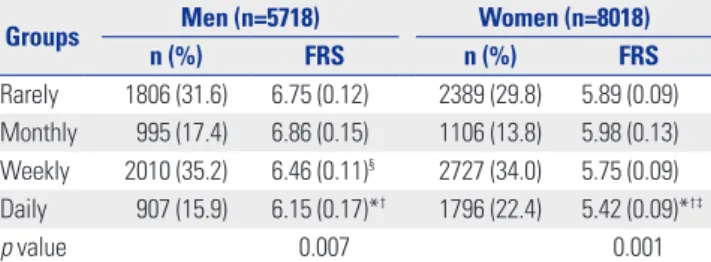
On comparing FRS according to milk consumption in each gender, FRS decreased as milk consumption increased after adjustment for age, BMI, job, alcohol intake, moderate physi- cal activity, and serum 25(OH)D, as well as menopause, oral contraceptive use, and hormone replacement therapy in wom- en. Particularly, FRS in males of the daily milk consumption group was significantly lower than that in males of the rarely and monthly groups (p=0.007). FRS in females of the daily milk
consumption group was also significantly lower than that in females of the rarely, monthly, and weekly groups (p=0.001) (Table 2). To further compare FRS, we stratified the data into different age groups (20–39 years, 40–59 years, and ≥60 years) for each gender. In males over 60 years old, the FRS of the dai- ly milk consumption group was significantly lower than that of those in the other groups (p<0.001). In females (Table 3), al- though not clinically significant, the FRS of the 20–39 years age group showed a significant p for trend (p=0.018). Finally, the odds ratio for the highest quartile of FRS in males over 60 years old significantly increased in the weekly [OR=2.21; 95%
confidence interval (CI) 1.12–4.10], monthly (OR=2.36; 95%
CI 1.21–4.70), and rarely (OR=4.00; 95% CI 2.17–7.38) milk con- sumption groups in Model 1 [adjustment for age, BMI, job, al- cohol intake, moderate physical activity, serum 25(OH)D]. In Model 2 (further adjusted for total calorie intake and calcium intake), the odds ratio was also increased in the weekly (OR=
2.15; 95% CI 1.14–4.03), monthly (OR=2.29; 95% CI 1.15–4.54), and rarely (OR=3.79; 95% CI 2.01–7.14) milk consumption groups (Table 4).
DISCUSSION
In this cross-sectional study, we found that milk consumption was inversely associated with FRS in males and females who consumed relatively low amounts of dairy products. In addi- tion, daily milk consumption in males over 60 years old was found to be beneficial in lowering the risk of a high FRS.
Previous studies suggest higher mortality rates from fracture17 and ischemic heart disease,18 as well as from certain cancers,19,20 in countries with high milk consumption. In addition, those Table 2. Framingham Risk Score (FRS) According to Milk Consumption
Groups Men (n=5718) Women (n=8018)
n (%) FRS n (%) FRS
Rarely 1806 (31.6) 6.75 (0.12) 2389 (29.8) 5.89 (0.09) Monthly 995 (17.4) 6.86 (0.15) 1106 (13.8) 5.98 (0.13) Weekly 2010 (35.2) 6.46 (0.11)§ 2727 (34.0) 5.75 (0.09) Daily 907 (15.9) 6.15 (0.17)*† 1796 (22.4) 5.42 (0.09)*†‡
p value 0.007 0.001
FRS are expressed as mean (standard error). p values represent p for trends found via ANCOVA after adjusting for age, body mass index, job, alcohol in- take, moderate physical activity, and serum 25-hydroxyvitamin D. Further ad- justments were made for menopause, oral contraceptive use, and hormone replacement therapy in cases of women.
*p<0.05 in the comparison between rarely vs. daily, †p<0.05 in the compari- son between monthly vs. daily, ‡p<0.05 in the comparison between weekly vs. daily, §p<0.05 in the comparison between monthly vs. weekly.
Table 3. Framingham Risk Score (FRS) According to Milk Consumption by Age
Variables FRS, mean (SE)/n (%)
20–39 yrs 40–59 yrs ≥60 yrs
Men (n) 1740 2182 1796
Rarely 1.41 (0.39)/255 (14.7) 9.63 (0.12)/699 (32.0) 13.56 (0.06)/852 (47.4)
Monthly 1.53 (0.34)/261 (15.0) 9.83 (0.16)/417 (19.1) 13.36 (0.11)/317 (17.7)
Weekly 1.06 (0.18)/812 (46.7) 9.71 (0.12)/770 (35.3) 13.32 (0.08)§/428 (23.8)
Daily 0.92 (0.23)/412 (23.7) 9.45 (0.20)/296 (13.6) 12.96 (0.12)*†‡/199 (11.1)
P for trend 0.383 0.512 <0.001
Women (n) 2685 3064 2269
Rarely -1.61 (0.20)/405 (15.1) 8.40 (0.12)/831 (27.1) 16.69 (0.09)/1153 (50.8)
Monthly -1.20 (0.29)/336 (12.5) 8.21 (0.14)/468 (15.3) 16.50 (0.14)/302 (13.3)
Weekly -1.77 (0.14)/1102 (41.0) 8.11 (0.11)/1116 (36.4) 16.56 (0.14)/509 (22.4)
Daily -2.10 (0.15)/842 (31.4) 8.19 (0.13)/649 (21.2) 16.35 (0.15)/305 (13.4)
P for trend 0.018 0.332 0.222
FRS are expressed as mean (standard error). p values represent p for trends found via ANCOVA after adjusting for age, body mass index, job, alcohol intake, moderate physical activity, and serum 25-hydroxyvitamin D. Further adjustments were made for menopause, oral contraceptive use, and hormone replacement therapy in cases of women.
*p<0.05 in the comparison between rarely vs. daily, †p<0.05 in the comparison between monthly vs. daily, ‡p<0.05 in the comparison between weekly vs. daily,
§p<0.05 in the comparison between monthly vs. weekly.
who consumed high amounts of non-fermented milk were re- ported to have less favorable cardiovascular risk factor profiles, with higher blood pressure, lower HDLC levels, and higher in- sulin resistance.21 On the other hand, cheese and fermented milk consumption has been reported to be associated with an increased HDLC levels, reduced insulin resistance, and a low- er risk of CVD. A possible mechanism for such different re- sponses may be related to the D-galactose content in different types of dairy products,10,22 which is associated with oxidative stress, chronic inflammation,23 and the development of such diseases.24
In accordance with the current study, a prospective study (22.8 years of follow-up) reported that SBP was 10.4 mm Hg lower in the group with the highest milk consumption than in a group that did not consume milk.25 In addition, consump- tion of milk and dairy products was inversely associated with CVD death among women in Japan26 and related to lower lev- els of specific CVD risk factors in China,27 where milk con- sumption is relatively low. We used the FRS to evaluate CVD risk according to different milk consumption groups. FRS is a simple tool to assess future CVD risk,12 and it significantly pre- dicts coronary heart disease events.28 In our study, we were not able to determine the association between FRS and high milk consumption, as only 0.7% and 0.3% of males and 1.2% and 0.3% of females were found to drink milk 2 and 3 times per day, respectively. In this low milk-consuming population, dai- ly milk consumption was beneficial for lower FRS than week- ly, monthly, or rare consumption. A more interesting result was that the odds ratio for the top quartile of FRS showed a gradu- al increase with a decrease in milk consumption in older men (≥60 years old) even after adjustments for 25(OH)D, total cal- ories, and calcium intake. This may indicate that proper con- sumption of milk may be related to a lower FRS in men over 60 years old who have a relatively higher risk of CVD. However, it is not clear why women over 60 years old did not show a simi- lar effect on CVD risk. These results may be partially due to gender difference and different metabolic risks.
The current study has several limitations. First, this study used a cross-sectional design to evaluate the association be- tween milk consumption and FRS in one ethnic group. Second,
only the frequency of milk consumption was considered, and quantitative information on milk consumption was not. How- ever, this is the first study to evaluate the association between milk consumption and FRS, a future CVD risk factor, using rep- resentative data from the KNHANES.
In conclusion, milk consumption was inversely associated with FRS in males and females. In addition, males over 60 years old who drank milk daily had a lower FRS and a lower risk of a higher FRS after relevant variable adjustment. A large and prospective study is warranted to determine the exact amount of milk consumption required and future CVD risk and mor- tality in this ethnic group with low milk consumption.
ACKNOWLEDGEMENTS
This work was carried out with the support of the “Cooperative Research Program for Agriculture Science & Technology De- velopment” (grant number PJ010059) from the Rural Develop- ment Administration, Republic of Korea.
REFERENCES
1. Steffen LM, Kroenke CH, Yu X, Pereira MA, Slattery ML, Van Horn L, et al. Associations of plant food, dairy product, and meat intakes with 15-y incidence of elevated blood pressure in young black and white adults: the coronary artery risk development in young adults (CARDIA) study. Am J Clin Nutr 2005;82:1169-77.
2. Turner KM, Keogh JB, Clifton PM. Dairy consumption and insu- lin sensitivity: a systematic review of short- and long-term inter- vention studies. Nutr Metab Cardiovasc Dis 2015;25:3-8.
3. German JB, Gibson RA, Krauss RM, Nestel P, Lamarche B, van Sta- veren WA, et al. A reappraisal of the impact of dairy foods and milk fat on cardiovascular disease risk. Eur J Nutr 2009;48:191-203.
4. Soedamah-Muthu SS, Ding EL, Al-Delaimy WK, Hu FB, Engberink MF, Willett WC, et al. Milk and dairy consumption and incidence of cardiovascular diseases and all-cause mortality: dose-response meta-analysis of prospective cohort studies. Am J Clin Nutr 2011;
93:158-71.
5. Patterson E, Larsson SC, Wolk A, Åkesson A. Association between dairy food consumption and risk of myocardial infarction in women differs by type of dairy food. J Nutr 2013;143:74-9.
6. Rice BH, Quann EE, Miller GD. Meeting and exceeding dairy rec- ommendations: effects of dairy consumption on nutrient intakes and risk of chronic disease. Nutr Rev 2013;71:209-23.
7. Markey O, Vasilopoulou D, Givens DI, Lovegrove JA. Dairy and cardiovascular health: friend or foe? Nutr Bull 2014;39:161-71.
8. Wang C, Yatsuya H, Tamakoshi K, Iso H, Tamakoshi A. Milk drink- ing and mortality: findings from the Japan collaborative cohort study. J Epidemiol 2015;25:66-73.
9. Goldbohm RA, Chorus AM, Galindo Garre F, Schouten LJ, van den Brandt PA. Dairy consumption and 10-y total and cardiovascular mortality: a prospective cohort study in the Netherlands. Am J Clin Nutr 2011;93:615-27.
10. Michaëlsson K, Wolk A, Langenskiöld S, Basu S, Warensjö Lem- ming E, Melhus H, et al. Milk intake and risk of mortality and frac- tures in women and men: cohort studies. BMJ 2014;349:g6015.
11. Sun Y, Lin LJ, Sang LX, Dai C, Jiang M, Zheng CQ. Dairy product consumption and gastric cancer risk: a meta-analysis. World J Gastroenterol 2014;20:15879-98.
Table 4. Odds Ratios According to Milk Consumption in Men Over 60 Years Old for the Highest Quartile of Framingham Risk Scores
Milk consumption
Odds ratio (95% CI)
Crude Model 1 Model 2
Rarely 3.14 (1.85–5.35) 4.00 (2.17–7.38) 3.79 (2.01–7.14) Monthly 1.84 (1.05–3.22) 2.36 (1.21–4.70) 2.29 (1.15–4.54) Weekly 1.63 (0.94–2.82) 2.21 (1.12–4.10) 2.15 (1.14–4.03) Daily 1 (reference) 1 (reference) 1 (reference) Data represent odds ratios with a 95% confidence interval (CI) based on lo- gistic regression analysis after adjustment for age, body mass index, job, moderate physical activity, alcohol intake, and serum 25-hydroxyvitamin D in Model 1 and further adjustment for total calorie intake and calcium intake in Model 2.
12. Zhu B, Haruyama Y, Muto T, Yamasaki A, Tarumi F. Evaluation of a community intervention program in Japan using Framingham risk score and estimated 10-year coronary heart disease risk as out- come variables: a non-randomized controlled trial. BMC Public Health 2013;13:219.
13. Wilson PW, D’Agostino RB, Levy D, Belanger AM, Silbershatz H, Kannel WB. Prediction of coronary heart disease using risk factor categories. Circulation 1998;97:1837-47.
14. National cholesterol education program (NCEP) expert panel on detection, evaluation, and treatment of high blood cholesterol in adults (adult treatment panel III). Third report of the national cho- lesterol education program (NCEP) expert panel on detection, evaluation, and treatment of high blood cholesterol in adults (adult treatment panel III) final report. Circulation 2002;106:3143-421.
15. Ferket BS, van Kempen BJ, Hunink MG, Agarwal I, Kavousi M, Franco OH, et al. Predictive value of updating Framingham risk scores with novel risk markers in the U.S. general population. PLoS One 2014;9:e88312.
16. National Rural Resources Development Institute. Food Composi- tion Table. 7th ed. Suwon: Rural Development Administration;
2006.
17. Hegsted DM. Fractures, calcium, and the modern diet. Am J Clin Nutr 2001;74:571-3.
18. Segall JJ. Hypothesis: is lactose a dietary risk factor for ischaemic heart disease? Int J Epidemiol 2008;37:1204-8.
19. Song Y, Chavarro JE, Cao Y, Qiu W, Mucci L, Sesso HD, et al. Whole milk intake is associated with prostate cancer-specific mortality among U.S. male physicians. J Nutr 2013;143:189-96.
20. Lampe JW. Dairy products and cancer. J Am Coll Nutr 2011;30(5 Suppl 1):464S-70S.
21. Sonestedt E, Wirfält E, Wallström P, Gullberg B, Orho-Melander M, Hedblad B. Dairy products and its association with incidence of cardiovascular disease: the Malmö diet and cancer cohort. Eur J Epidemiol 2011;26:609-18.
22. Gross KC, Acosta PB. Fruits and vegetables are a source of galac- tose: implications in planning the diets of patients with galactosae- mia. J Inherit Metab Dis 1991;14:253-8.
23. Cui X, Zuo P, Zhang Q, Li X, Hu Y, Long J, et al. Chronic systemic D- galactose exposure induces memory loss, neurodegeneration, and oxidative damage in mice: protective effects of R-alpha-lipoic acid.
J Neurosci Res 2006;84:647-54.
24. Jumbo-Lucioni PP, Hopson ML, Hang D, Liang Y, Jones DP, Fridov- ich-Keil JL. Oxidative stress contributes to outcome severity in a drosophila melanogaster model of classic galactosemia. Dis Model Mech 2013;6:84-94.
25. Livingstone KM, Lovegrove JA, Cockcroft JR, Elwood PC, Pickering JE, Givens DI. Does dairy food intake predict arterial stiffness and blood pressure in men?: evidence from the Caerphilly prospective study. Hypertension 2013;61:42-7.
26. Kondo I, Ojima T, Nakamura M, Hayasaka S, Hozawa A, Saitoh S, et al. Consumption of dairy products and death from cardiovascular disease in the Japanese general population: the NIPPON DATA80. J Epidemiol 2013;23:47-54.
27. Sun Y, Jiang C, Cheng KK, Zhang W, Leung GM, Lam TH, et al. Milk consumption and cardiovascular risk factors in older Chinese: the Guangzhou biobank cohort study. PLoS One 2014;9:e84813.
28. Gander J, Sui X, Hazlett LJ, Cai B, Hébert JR, Blair SN. Factors re- lated to coronary heart disease risk among men: validation of the Framingham risk score. Prev Chronic Dis 2014;11:E140.