Value recognition and eating patterns of Kimchi in female middle school students and their mothers
Jung-Hyun Kim
1§, Min-June Lee
2and In-Kyung Yoon
31
Department of Home Economics Education, PaiChai University, Daejeon 302-735, Korea
2
Research Institute of Food and Nutritional Sciences, Yonsei University, Seoul 120-749, Korea
3
Department of Home Economics Education, Korea National University of Education, Chung-Buk 363-791, Korea
Received April 21, 2007; Revised May 2, 2007; Accepted June 14, 2007
Abstract
This study analyzed Kimchi eating culture in 178 households with female middle school children located in Incheon and Seosan areas, investigated the Kimchi eating patterns of female middle school students, and also analyzed the differences in value recognition for Kimchi between mothers and their female middle school students. Results showed that 23.0% of subject households answered eat Kimchi at every meal and the main reason for eating Kimchi in most households was good for taste. Most households made their own Kimchi, and only 12.3% of households bought Kimchi.
Subject households preferred hot and spicy taste (34.8%) and pleasing taste (20.2%), and 44.4% of middle school children answered as eating Kimchi at every meal, and the source for information on Kimchi was home in 51.6% and mass media in 33.7%, suggesting the lack of school education.
Both mothers and their female middle school students placed high value on Kimchi for its nutritional aspect and on Kimchi from the market for its convenience. Mothers showed significantly higher value (p<0.05) on the storage aspect of Kimchi compared to their middle school students, and female middle school students showed significantly higher value (p<0.05) on the value recognition for Kimchi as an international food compared to their mothers. Also, the value for hot pepper powder was high among other additional ingredients, and both mothers and middle school students had high values for Kimchi stew among other food dishes using Kimchi, and middle school students showed higher values (p<0.001) on foreign dishes using Kimchi such as Kimchi pizza and Kimchi spaghetti compared to the mothers group. Therefore, based on these results, the development of educational programs on Kimchi is needed not only at home but also at schools, by re-emphasizing the importance of value recognition for KImchi in our food culture.
Key Words: Eating pattern of Kimchi, value recognition of Kimchi, female middle school student
Introduction
11)Food culture is unique to any country or any race which had begun with their culture and developed while being influenced by surrounding environments, that is, geographical and historical circumstances, and thus a unique dietary tradition has been established during the developmental process.
Kimchi is the center of eating habits of Koreans and a representative Korean food which uses several vegetables as ingredients and is aged through fermentation (Kim & Yoon, 2002; Lee et al., 1998). As the nutritional excellence of Kimchi has been reported recently, the interest in Kimchi has increased internationally and is widely known world-wide as a repre- sentative food of Korea. The interest in Kimchi for its scientific aspects has increased. Kimchi is used as a source of vitamins, minerals and dietary fiber. There are important roles in nutritional supply and health maintenance of Koreans such as the prevention of constipation, hyperlipidemia, lowering serum cholesterol, inhibition of oxidative modification of LDL, inhibition of
thrombus, prevention of lipid peroxidation and also an antiaging effect (Kim & Lee, 2001).
Despite these advantages, the preparation and cooking of Kimchi have gradually reduced recently because of several social changes. Also, it has been reported that the changes in eating habits have relatively lowered our recognition and preference for Kimchi, our unique traditional food, which has raised some concerns (Kim & Yoon, 2002). The process of making Kimchi is complicated and takes a longer time than making other foods and is also difficult to make an even taste, and thus the need for commercially-made Kimchi has increased recently. The consumption of commercially-made Kimchi, compared to the annual total Kimchi demand, has increased 27.7% in 1997, 28.8%
in 1998, 30.1% in 1999, and 31.3% in 2000 with ever increasing tendency annually (Kim & Lee, 2001).
Eating habits are most established before the adolescence and is greatly affected by dishes eaten at home during childhood and by experiences with foods during adolescence, which then contributes to food selection thereafter (Stasch et al., 1970). The
§
Corresponding Author: Jung-Hyun Kim, Tel. 82-42-520-5424, Fax. 82-42-520-5421, Email. [email protected]
recognition of foods established during this period can influence not only the future of individuals but also their future family members (Howe & Vaden, 1980). According to a study on Kimchi eating habits during the growing period (Song et al., 1995), reasons for eating Kimchi were good for health and our traditional food, showing positive recognition for eating Kimchi.
It was also reported that Kimchi intake had increased from the recommendation for eating Kimchi from parents was stronger or grandparents living in the same household. Kimchi can have various tastes depending on the person making Kimchi, or weather, but the taste is greatly affected depending on the selection of good quality ingredients, mixing of the ingredients, methods and storage conditions. Song et al. (1995) reported that children liked Korean cabbage Kimchi most and disliked ingredients with strong flavor such as ginger, garlic, green onion, and salted fish, and thus it would be desirable to use Korean cabbage for making Kimchi rather than radish and to use less ingredients with strong flavors. Also, the type of Kimchi children wanted was somewhat sweet, less spicy, no strong flavor, well fermented Kimchi with fruits such as pears, apples, or mandarin oranges, and small pieces in size. In case of middle school students, it was reported that reasons for liking Kimchi were due to hot and spicy taste, crunching sensation, and sourish taste (Kim
& Yoon, 2002). The preference for Kimchi in the aspect of degree of fermentation was well-fermented Kimchi (57.0%) (Song et al., 1995). The reason for preferring Korean cabbage Kimchi and cubed radish Kimchi could be interpreted as adaptation in taste due to the fact that most households prepared Kimchi using Korean cabbage and radish. If this phenomenon is true, children should be provided with opportunities for experiencing various types of traditional Kimchi as early as possible, not only to increase Kimchi consumption, but also to inherit the traditional culture for Kimchi. Also, it is considered that various types of Kimchi should be on the market and supplied in meal services because the ratio of home-made Kimchi has already decreased and that of commercially-made Kimchi in the market has increased.
It is necessary to make children have positive values for Kimchi from childhood, to show the process of making it at home, and to practice nutritional education and guidance for proper recognition while parents are eating meals with children.
Studies on Kimchi so far have been interested in the ingredients (Cho, 1988; Yoon & Rhee, 1997), physical characteristics (Lee, 1988), storage & additional ingredients (Lee et al.,1998; Lee, 1988) and more, but studies on the recognition are very few.
In addition, almost no comparative study on the recognition for Kimchi between mothers and their female middle school children in the same households was searched.
Thus, this study was performed to analyze the Kimchi eating patterns in subject households and to investigate the Kimchi eating patterns of female middle school children in subject households. Also, through comparative analysis for Kimchi between mothers and their children, the differences between
generations in the recognition for Kimchi and eating patterns were investigated.
The research questions of this study were as follows:
First, what are Kimchi eating patterns in subject households?
Second, what are the recognition and eating patterns of Kimchi in middle school children?
Third, what is the difference in value recognition for Kimchi between mothers and middle school children?
Subjects and Methods
Subjects
This study was performed for 200 households with female middle school students, by selecting 100 households each in the Incheon and Seosan areas, to investigate the value recognition for Kimchi and the Kimchi eating patterns. The questionnaire was developed to each female middle school student and her mother in the same household. The survey was performed for 13 days from April 18 to April 30, 2005. The questionnaires were distributed to 200 households were collected from 178 households.
Questionnaires
The questionnaire of this study was reconstructed for the purposes of the study based on the survey tool presented in the previous study (Kang & Han, 2002) and then modified and complemented through a preliminary study (n=50), to analyze the recognition for Kimchi and eating patterns in female middle school students and their mothers.
The contents of the survey included Kimchi eating patterns in subject households, Kimchi eating patterns of middle school children, and the differences in the recognition for Kimchi between mothers and their middle school children.
(1) For Kimchi eating patterns in subject households, the degree of Kimchi intake in subject households, reasons for eating Kimchi, and sources for Kimchi supply were investigated. Also, the degree of preference for Kimchi in subject households was investigated for the areas of type, taste, and degree of fermentation.
(2) Kimchi eating patterns of middle school children were analyzed. For the degree of recognition for Kimchi, and how to make Kimchi, sources for information on Kimchi, and the number of types of Kimchi recognized by middle school students were investigated. Also for the analysis of Kimchi eating patterns, the number of Kimchi intakes per day, Kimchi intake per meal, and major types of Kimchi intake were investigated.
(3) For the analysis of differences in values for Kimchi between
mothers and their middle school children, each of 4 questions
Table 1. General characteristics of subjects
Characteristics n (%)
Age of mothers
30~34 years 8 ( 4.5)
35~39 years 68 (38.2)
40~44 years 80 (44.9)
Over 45 years 22 (12.4)
Age of female children
13 years 24 (13.5)
14 years 101 (56.7)
15 years 53 (29.8)
Occupation of mothers
Housewives 70 (39.3)
Full-time 40 (22.5)
Part-time 38 (21.4)
Self-employed 30 (16.8)
Meal manager of household
Father 20 (11.2)
Mother 140 (78.7)
Grand parent Children
10 ( 5.6) 8 ( 4.5)
Total 178 (100.0)
Table 2. Recognition Kimchi in subject households
Variables n (%)
Recognition for eating Kimchi
Should eat at every meal 41 (23.0) Should eat if possible 117 (65.7) May or may not eat 20 (11.3)
Reasons for eating Kimchi
Good for taste 95 (53.4)
Always eating 35 (19.6)
Good for health 26 (14.6) Traditional food 8 ( 4.5)
Others 14 ( 7.9)
Source of Kimchi supply
Made at home 81 (45.5)
From parents or relatives 69 (38.8)
From market 22 (12.3)
Others 6 ( 3.4)
Total 178 (100.0)
Table 3. Preference for Kimchi in subject households
Variables n (%)
Taste
Hot & Spicy 62 (34.8)
Refreshing 47 (26.4)
Pleasing 36 (20.2)
Sourish 25 (14.1)
Salty 8 ( 4.5)
Degree of fermentation
Unfermented 32 (18.0)
Less fermented 34 (19.1) Well fermented 68 (38.2)
Over-fermented 44 (24.7)
Kinds
Korean cabbage Kimchi 155 (87.1) Radish root Kimchi 9 ( 4.9) Cubed radish Kimchi 4 ( 2.3)
Watery Kimchi 3 ( 1.3)
Cucumber Kimchi 6 ( 3.3)
Others 4 ( 2.3)
Total 178 (100.0)
were asked for nutritional aspects, cooking aspects, economical aspects, preference aspects, and cultural aspects, respectively.
Also, the degree of values following the addition of ingredients and seasonings and the degree of values for dishes using Kimchi were analyzed. The scores for the degree of recognition for Kimchi as food value were 1 point for strongly disagree, 2 points for disagree, 3 points for so-so, 4 points for agree, and 5 points for strongly agree, and the scores for the degree of preference for ingredients and seasonings and for dishes using Kimchi were I point for strongly dislike, 2 points for dislike, 3 points for so-so, 4 points for like, and 5 points for strongly like.
Statistical analysis
A total of 178 survey questionnaires were used in the final data analysis, which was performed using an SPSS program. For statistical methods, frequency, percentage, mean, standard deviation, and paired t-test were used.
Results
General Characteristics
General characteristics of subjects were presented in Table 1.
The age distribution of mothers in subject households showed 80 (44.9%) for 40~45 years, the highest ratio, and 68 (38.2%) for 35~40 years, and 22 (12.4%) for over 45 years. The age distribution of middle school children showed 101 (56.7%) for 14 years, the highest ratio, and 53 (29.8%) for 15 years, and 24 (13.5%) for 13 years. The occupation of mothers in subject households was in the order of housewife (39.3%), full-time job (22.5%), and self-employed (16.8%). The meal manager of household was mother (78.7%) and father (11.2%).
Kimchi eating patterns in subject households
1) Recognition for Kimchi in subject households
The degrees of recognition for Kimchi in subject households
were investigated. As presented in Table 2, 41 households
(23.0%) answered as eating Kimchi at every meal and 117
households (65.7%) answered as eating Kimchi at every meal
if possible. Also, 11.3% of total subjects answered as not eating
much. The results of reasons for eating Kimchi showed
preference (good taste) (53.4%), general eating (19.6%), good
for health (14.6%), and tradition (4.5%). The home-made Kimchi
(45.5%) was the main source of supply and 12.3% of total
subjects got commercially-made kimchi. The ratio of con-
sumption of commercially-made Kimchi from the market was
considerably high in this study.
Table 4. Recognition on Kimchi in female middle school students
Variables n (%)
How to make Kimchi
Well acknowledged 22 (12.4) Little acknowledged 122 (68.5) Never acknowledged 34 (19.1)
Channel of information of Kimchi
Home 92 (51.6)
Mass media 60 (33.7)
Book/magazine 9 ( 5.1)
School 8 ( 4.5)
Others 9 ( 5.1)
Number of kinds of Kimchi that you know
Less than 4 23 (12.9)
4-6 70 (39.3)
6-8 52 (29.2)
More than 8 33 (18.6)
Total 178 (100.0)
Table 5. Kimchi eating patterns of female middle school students
Variables n (%)
Number of intakes per day
Every meal 79 (44.4)
Two meals 58 (32.6)
One meal 36 (20.2)
Seldom eat 5 ( 2.8)
Intake per meal
More than 5 pieces 98 (55.1)
3~4 pieces 57 (32.0)
1~2 pieces 18 (10.1)
Never eat 5 ( 2.8)
Major types of Kimchi eaten
Korean cabbage Kimchi 153 (86.0) Cucumber Kimchi 8 ( 4.6) Cubed radish Kimchi 6 ( 3.4)
Radish Kimchi 7 ( 2.8)
Watery Kimchi 4 ( 2.2)
Total 178 (100.0)
2) Preference for Kimchi in subject households
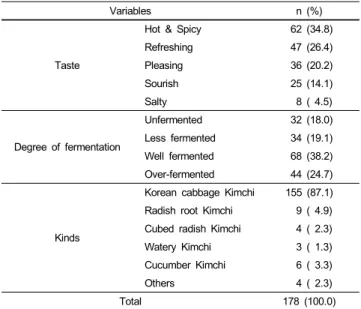
The taste of Kimchi preferred by subject households was presented in the order of hot and spicy taste (34.8%) and refreshing taste (26.4%). In addition, pleasing taste was answered in 36 households (20.2%) and sourish taste was answered in 25 households (14.1%). We know that the preference taste of Kimchi is hot and spicy in this study Table 3.
Kimchi eating patterns of female middle school students 1) Degree of recognition for Kimchi
The degree of recognition for Kimchi in female middle school students was presented in Table 4. Female middle school students answered for the knowledge on how to make Kimchi as little acknowledged in 122 students (68.5%) and well acknowledged in 22 students (12.4%). The channels of information on Kimchi answered by female middle school students were home in 92 students (51.6%) and mass media in 60 students (33.7%). In addition, school was answered only in 8 students (4.5%). The numbers of kinds of Kimchi that female middle school students knew was 4-6 in 70 students (39.3%) and 6-8 in 52 students (29.2%). This result showed that there was little role in education for Kimchi at school.
2) Kimchi eating patterns
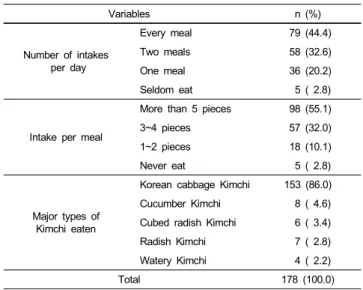
Kimchi eating patterns of female middle school students were shown in Table 5. For the number of Kimchi intakes per day, eat at every meal per day was answered in 79 students (44.4%), eat at two meals per day in 58 students (32.6%), and eat at one meal per day in 36 students (20.2%). The amount of Kimchi intake per meal was more than 5 pieces in 98 students (55.1%), 3~4 pieces in 57 students (32.0%), and 1~2 pieces in 18 students (10.1%). The kind of Kimchi most frequently taken was Korean cabbage Kimchi in 86.0% of total subjects.
Value recognition for Kimchi by mothers and their female middle school students
The value recognition for Kimchi was analyzed in mothers and their female middle school students of same subject households. The value recognition for Kimchi was evaluated in 5 aspects for food scientific values of Kimchi, and also analyzed in the aspects of value recognition after the addition of ingredients and seasonings and for dishes using Kimchi.
1) Recognition of food scientific values of Kimchi The recognition of food scientific values of Kimchi was asked in 5 aspects including nutritional and health aspects, preferential aspects, cooking and storage aspects, economical aspects, and cultural aspects, with 4 questions for each aspect, and also comparative questions for Kimchi on the market were added for each aspect.
(1) Nutritional and health aspect
The results in the nutritional and health aspect, as presented
in Table 6, were analyzed that both mothers (4.52) and female
middle school students (4.50) showed higher agreement on the
value for nutrition and health aspects of Kimchi. Thus in the
aspects of Kimchi is nutritious and Kimchi is helpful in the
prevention of diseases, both mothers and students showed higher
agreements of over 4 points, without significant differences
among groups. However, the recognition of Kimchi as a dieting
food showed significantly higher agreement (p<0.001) in the
mothers group (3.86) than in the students group (3.53). On the
other hand, the question that Kimchi from the market was more
nutritious than homemade Kimchi showed no difference between
mothers (2.27) and students (2.23), showing overall low
agreement.
Table 6. Value recognition for Kimchi by mothers and their female middle school students
Value Mothers Middle school
students t-value Nutrition and Health Aspect
Kimchi is excellent in nutritional aspect 4.52(0.58)1) 4.50(0.61) -0.33 Kimchi is helpful in the prevention of
diseases 4.34(0.68) 4.32(0.74) -0.21
Kimchi is a dieting food 3.86(0.91) 3.53(1.05) -2.91**
Kimchi on the market is hygienic 2.27(0.80) 2.23(1.02) -0.37 Cooking and Storage Aspect
Kimchi has good storage 4.51(0.63) 4.27(0.84) -2.73**
Kimchi should be made at home 4.35(9.80) 4.27(1.01) -0.78 Various kinds of Kimchi are available 2.78(1.01) 3.03(1.22) 1.90 Kimchi on the market is convenient 3.57(1.00) 3.10(1.01) -3.94***
Economic Aspect
Homemade Kimchi costs less 4.04(0.86) 3.70(1.04) -3.85**
Making Kimchi takes long time 2.01(0.75) 1.95(0.98) -0.56 One type of Kimchi is good enough for
side dishes
2.51(1.00) 2.54(1.10) 0.25
Kimchi on the market is more
economical 2.51(1.00) 2.54(1.10) 0.25
Preference Aspect
Kimchi is tasty 4.40(0.64) 4.29(0.89) -1.13
Kimchi is too hot (spicy) 2.17(0.71) 1.80(0.70) -4.41***
Kimchi has unique flavor 2.50(1.06) 1.99(0.99) -4.27***
Kimchi on the market is more delicious 2.01(0.75) 1.95(0.98) -0.56 Cultural Aspect
Kimchi is an everyday food 3.66(1.04) 3.59(1.06) -0.56 Kimchi gets along well with other
foreign foods
3.82(0.90) 3.33(1.16) -4.01***
Kimchi is an international food 3.73(1.04) 4.09(1.07) 2.92**
Kimchi on the market has various kinds 2.25(0.755) 2.23(1.02) -0.25
* p<0.05 ** p<0.01 *** p<0.001
1) Mean (SD) (1~5 point scale: 1 point for strongly disagree, 2 points for disagree, 3 points for so-so, 4 points for agree, and 5 points for strongly agree)
Table 7. Degree of preference ingredients and seasonings
Items Mothers Middle school
students t-value
Additional ingredients
Oyster 3.61(1.12)1) 2.57(1.40) -6.87***
Crown 2.99(1.20) 2.28(0.98) -5.55***
Daisy 4.08(0.71) 2.89(1.10) -10.56***
Green 3.31(1.00) 2.57(1.17) -5.74***
Onion 3.74(0.89) 2.46(1.02) -11.20***
Carrot 3.30(1.05) 3.32(1.24) 0.17 Leaf 3.99(0.78) 3.16(1.16) -6.90***
seasonings
Ginger 3.75(0.90) 2.07(1.32) -12.29***
Salted fish 3.90(0.87) 2.94(1.17) -7.78***
Garlic 4.08(0.72) 2.44(1.11) -14.39***
Sugar 3.25(0.99) 3.12(0.97) -1.12 Hot pepper
powder
4.22(0.76) 3.38(1.16) -7.02***
*** p<0.001
1) Mean (SD) (1~5 point scale: 1 point for strongly disagree, 2 points for disagree, 3 points for so-so, 4 points for agree, and 5 points for strongly agree)
(2) Cooking and storage aspect
The statistical results in the cooking and storage aspect showed that mothers (4.51) had significantly higher agreement (p<0.05) to the value of Kimchi has good storage than students (4.27).
For the value Kimchi should be made at home, both mothers (4.35) and students (4.27) showed higher agreement. On the other hand, for the value various kinds of Kimchi are available, both groups showed lower agreements. For the value Kimchi on the market is convenient’, mothers (3.57) showed significantly higher agreement (p<0.001) than students.
(3) Economical aspect
The statistical results in the economical aspect of Kimchi showed that mothers (4.04) had significantly higher agreement (p<0.05) than their students (3.70) for the item homemade Kimchi costs less. In addition, for items such as making Kimchi takes long time, one type of Kimchi is good enough for side
dishes, and Kimchi on the market is more economical, both groups showed lower agreements.
(4) Preferential aspect
The statistical results in the preferential aspect of Kimchi showed that both mothers (4.40) and students (4.29) had higher agreements for the item Kimchi is tasty, and mothers (2.17) had significantly higher agreement (p<0.001) than students (1.80) for the value item Kimchi is too hot (spicy). Also, for the item Kimchi has a unique flavor, mothers (2.50) showed significantly higher agreement (p<0.001) than students (1.99). On the other hand, for the item Kimchi from the market is more delicious, both groups showed lower agreements.
(5) Cultural aspect
Both groups showed relatively higher agreements for the aspect that Kimchi is an everyday food that people always eat, and mothers (3.82) showed significantly higher agreements (p<0.001) than students (3.33) for the item Kimchi gets along well with other foreign foods. For the item Kimchi is an international food, students (4.09) showed significantly higher agreement (p<0.05) than mothers (3.73).
2) Degree of preference for ingredients and seasoning used in Kimchi
The degree of values for additional ingredients used in Kimchi
was shown in Table 7. The results for the difference of values
in mothers and their children depending on additional ingredients
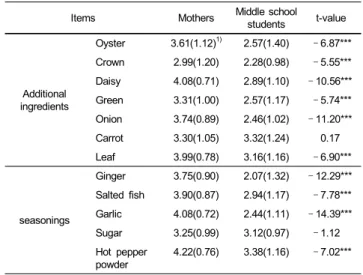
and seasonings were analyzed, in which items with the agreement
of over 3 points were in the order of green onion (4.08), leek
(3.99), leaf mustard (3.74), oyster (3.61), carrot (3.31), and perilla
leaf (3.30) in mothers, and perilla leaf (3.32) and leek (3.16)
in middle school students. It suggested a relatively higher
Table 8. Degree of preference for dishes using Kimchi
Items Mothers Middle school
students t-value
Kimchi stew 4.43(0.72)1) 4.49(0.75) 0.60
Kimchi soup 3.96(0.75) 3.62(1.11) -2.91**
Kimchi jun 4.11(0.75) 4.35(0.87) 2.55*
Stir-fried Kimchi 4.02(0.80) 4.32(0.85) 3.11**
Stir-fried rice with Kimchi 3.95(0.77) 4.56(0.72) 6.97***
Kimchi gimbap 3.59(0.92) 4.03(1.10) 3.60***
Kimchi ramyeon 3.59(0.85) 4.10(0.98) 4.60***
Kimchi noodle 3.74(0.83) 3.85(1.15) 0.89
Kimchi dumpling 3.93(0.85) 4.26(1.03) 2.83**
Kimchi pizza 2.94(0.91) 3.49(1.23) 4.12***
Kimchi hamburger 2.88(0.98) 3.33(1.31) 3.17**
Kimchi spaghetti 2.87(0.93) 3.49(1.23) 4.61***
* p<0.05 ** p<0.01 *** p<0.001
1) Mean(SD)(1~5 point scale: 1 point for strongly disagree, 2 points for disagree, 3 points for so-so, 4 points for agree, and 5 points for strongly agree)