Biotechnological Approaches on Pulp and Papermaking Technology
- Effect of New Mediator with Fungal Laccase on Degradation of Non-Phenolic Lignin Model Compound -
Nam-Seok Cho
Wood and Paper Science, Chungbuk National University, Cheongju, Korea
Summary
In the presence of laccase, generation of monomeric aromatic acids from nonphenolic lignin model dimer veratrylglycerol- β -vanillate ether (VVE) was observed. The addition of acetovanillone (AV) or acetosyringone (AS) intensified this process, i.e. transformation was more extensive than in the experiments omitting mediators. Among the products isovanillic (IA) and vanillic (VA) acids were identified.
Keywords Laccase, Veratrylglycerol-β -vanillate ether, Cerrena unicolor, Mediators, Acetovanillone, Acetosyringone, HBT, Isovanillic acid, Vanillic acid
1. Introduction
Fungal laccases (benzenediol:oxygen oxireductases, EC 1.10.3.2) are a multicopper inducible oxidases reducing oxygen to water and simultaneously performing one- electron oxidation of aromatic hydrogen donors (Leonowicz et al. 2001; Mayer and Staples 2002; Youn et al. 1995). Because of their capability in oxidation of phenols they are receiving increasing interest as potential industrial enzymes in various applications such as pulp bleaching processes (Bourbonnais et al. 1997a, 1997b and 1998; Li et al. 1997), delignification (Leonowicz and Trojanowski 1975), wood fiber modification (Leonowicz et al. 2001) or remediation of contaminated water (Leonowicz et al. 1997b). They have however a limited effect on lignin degradation due to their oxidative specificity (Leonowicz et al. 1999; Szklarz and Leonowicz 1986). Moreover, the measurement of pore sizes in wood shows that large molecules such as enzymes
(e.g. laccase) does limits the penetration of the undegraded plant cell wall except where the wood cell wall is already partially decayed (Evans et al. 1994; Flournoy et al. 1991). Therefore, in recent years research has been focused on such potential low-molecular mass mediators of internal or external origin, which poses high enough redox potentials (>900 mV) to attack lignin and can migrate from the enzymes into tight lignocellulose complex. Many possible low-molecular mass compounds have been suggested as candidates for a mobile factor to permeate wood cell walls and indicate decay. Some of these, such as veratryl alcohol, oxalate, malate, fumarate, and 3-hydroxyanthranilic acid, are produced as a result of fungal metabolism and their secretion enables the fungi to colonize and degrade the wood cell structure more effectively than other organisms (Eggert et al. 1996; Hofrichter et al. 1998; Lundquist and Kirk 1978; Potthast et al. 1999; Traquair 1987). Most of the fungal enzymes are always located within the extracellular polysaccharide sheath surrounding the hyphae i.e. at the cell wall surfaces. The mediators are capable of diffusing from enzymes into the middle of wood cell wall structure and open up the pore size in wood what allow enzymes to penetrate and complete the degradative processes (Evans et al. 1994; Call and Mücke 1997).
It was also found that delignification of kraft pulp by laccase can be supported by some external (i.e. non-produced by fungi and absent in pulp) low molecular dyes or other aromatic hydrogen donors as acting mediators such as 2,2'-azinobis-(3- ethylbenzenthiazoline-6-sulfonic acid - ABTS) (Bourbonnais et al. 1997a, 1997b and 1998) or 1-hydroxybenzotriazole - HBT) (Bourbonnais et al. 1998; Call 1994;
Srebotnik et al. 1988; Srebotnik and Hammel 2000).
This paper focuses on the laccase and mediator co-operation in modelling lignin dimer veratrylglycerol- β -vanillate ether (VVE) oxidation. Earlier we stated that constitutive laccase isolated from Cerrena unicolor can cooperate with acetovanillone (AV) and acetosyringone (AS) in degradation of high molecular fraction of lignosulfonates (Leonowicz et al. 2001). The fungus C. unicolor is known as a very good producer of cheap constitutive laccase form (Gianfreda et al. 1998; Leonowicz et al. 1997a and 1997b). Its cultivation for this reason does not require stimulation by the expensive and toxic for environment compounds like 2,5-xylidine (Leonowicz et al.
1997b). The main aim of present work is to examine capability of C. unicolor laccase to oxidise VVE, which is a non-phenolic lignin model compound in concerto with external mediator HBT, and also AV and AS in order to choose one, most efficient system.
2. Materials and Methods
Strain and culture conditions
Cerrena unicolor (Bull. ex Fr.) Murr., Einfarbige Tramete Strain T 143 was kindly provided by the Collection Molitoris, Botanic Institute, University of Regensburg. The fungus was maintained in 2% (w/v) malt agar slants. As an inoculum, pieces of agar were grown in the Lindenberg and Holm (1952) medium in non-agitated conical flasks for 7 days at 28oC. The mycelial mats were subsequently collected and homogenized in a Warring blender.
The fermenter scale cultivation was performed at 28oC in a 2.5 l Bioflo III (New Brunswick) fermenter containing 2 l of the Lindenberg and Holm (1952) medium. The fermenter was inoculated with crumbled fungal mats (10 % total volume), aerated by 1 l air per minute and stirred at 300 rpm. Antifoam 289 emulsion (Sigma, St. Louis, USA) was occasionally added to the fermenter cultures.
Reagents
Veratrylglycerol-β -vanillate ether (VVE) was synthesized and kindly supplied by Dr. Atsumi Nishida; agar was from Junsei Chemical Co. (Tokyo, Japan); malt and yeast extracts were from DIFCO (Milwaukee, Wi. U.S.A.); syringaldazine (4-hydroxy- 3,5-dimethoxybenzaldehydazine), acetovanillone (AV, 4-hydroxy-3- methoxyacetophenone), acetosyringone (AS, 3,5-dimethoxy-4- hydroxyacetophenone), HBT (1-hydroxybenzotriazole), alpha-methyl mannoside, and bovine liver catalase were from Aldrich-Chemie (Steinheim, Germany); bovine serum albumin and isovanillic acid (IA) were from Sigma (St. Louis, Mo. U.S.A.); AH- Sepharose-4B, DEAE-Cellulose and Sephadex G-50 'fine' were from Pharmacia (Uppsala, Sweden); syringaldehyde and vanillic acid (VA) were from Fluka A.G.
(Buchs, Switzerland).
Determination of protein
The protein content both in the culture fluids and in laccase preparations was determined according to Bradford (1976). Bovine albumin was used as a standard.
Laccase purification
For the enzyme purification the method of Leonowicz et al. (1997a) with some our and Gianfreda et al. (1998) modifications was applied as follows. The aerated cultures
at the tops of laccase activity were filtered through Miracloth (Calbiochem, Lucerne, Switzerland). Each filtrate was desalted on the Sephadex G-50 column. The enzyme solutions were concentrated to ca. one tenth of the volume at 4oC with the Amicon ultrafiltration system equipped with a filter type PTGC (cut off 10 kDa). Then 50 ml portions of enzyme preparations were applied onto DEAE-Cellulose column (25x1.5 cm) preequilibrated with 5 mM TRIS/HCL buffer (pH 6.0) The fractions showing the highest laccase activity were poured onto a column of AH-Sepharose 4B coupled with syringaldehyde column (25x1.5 cm) equilibrated with 0.01 M citrate-phosphate buffer pH 5.0 prepared according to McIlvaine (1921). The fractions bounded with the carrier were removed by using 0.5 M (NH4)2SO4 and stored freeze dried. The enzyme activity both in the culture fluids and in laccase preparations was determined spetrophotometrically at 525 nm using syringaldazine on a Shimadzu UV-160 spectrophotometer according to Leonowicz and Grzywnowicz (1981). The activity was expressed in nkat per litre. To exclude endogenous peroxide, the 10 min.
preincubation of the enzyme sample with catalase (10 mg/ml), was performed. No lignin peroxidase activity was found in the enzyme preparation. (Tien and Kirk 1988).
Enzyme reaction
To a flask with 5 ml of 0.1 M McIlvaine buffer pH 5.3 laccase (300 nkat) was added, VVE (50 μ l of 10 mM), HBT, AV or AS, each 50 μ l of 15 μ M. The flasks were rotary shacked (180 rpm) at 28oC. Control experiments lacked either laccase or mediators in the reaction mixture. The reaction products after alkalisation with 1 M NaOH (to melt the sediment) were extracted twice with one volume of diethyl ether, evaporated under IR lamp and redissolved in 50% ethanol.
Thin-layer chromatography
Extracts were evaporated to small volumes and analyzed by TLC on silica-gel plates (DC-Alurolle Kieselgel 60 F 254 from Merck) according to Leonowicz et al.
(1984) using the solvent system benzene : methanol : propionic acid (88:8:4). The phenolics were visualized with diazosulphamide reagent according to the procedure described by Leonowicz et al. (1968).
Capillary electrophoresis
Micellar electrokinetic chromatography (MEKC) analyses were performed on Spectra 100 Thermo Separation Products (San Jose, USA). The separations were
carried out using fused silica capillary with a total length of 69 cm (44 cm to detection window) and an inner diameter of 50 μ m. Applied voltage was 29 kV and the capillary temperature was maintained at 25oC. Injection was done in the hydrodynamic mode for 0.5 s. Detection was performed by measuring absorbance at 210 nm. Buffer solution used was 100mM boric acid with 100 mM SDS at pH 8.8 (adjusted with NaOH). All samples, buffer solutions, and conditionings before use were filtered through 0.22 μ m filters .
3. Results and Discussion
Laccase isolation and purification
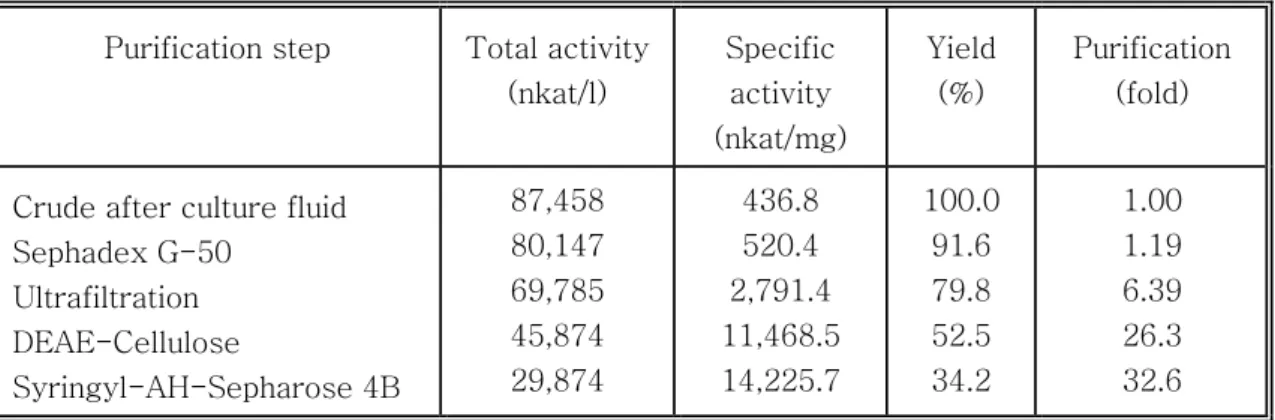
The C. unicolor extracellular laccase was isolated and purified from aerated fermenter culture. The final enzyme preparation was purified more than 32-fold (Table 1). No lignin peroxidase activity was found in the enzyme preparation (Tien and Kirk 1988). It seems that our laccase using 4 steps of purification was sufficiently purified to carry out the investigations whose are presented in this paper.
Table 1. Isolation and purification of C. unicolor laccase Purification step Total activity
(nkat/l)
Specific activity (nkat/mg)
Yield (%)
Purification (fold)
Crude after culture fluid Sephadex G-50
Ultrafiltration DEAE-Cellulose
Syringyl-AH-Sepharose 4B
87,458 80,147 69,785 45,874 29,874
436.8 520.4 2,791.4 11,468.5 14,225.7
100.0 91.6 79.8 52.5 34.2
1.00 1.19 6.39 26.3 32.6 Transformation of substrate (VVE veratrylglycol-β -vanillate ether) by laccase and laccase/mediator couples
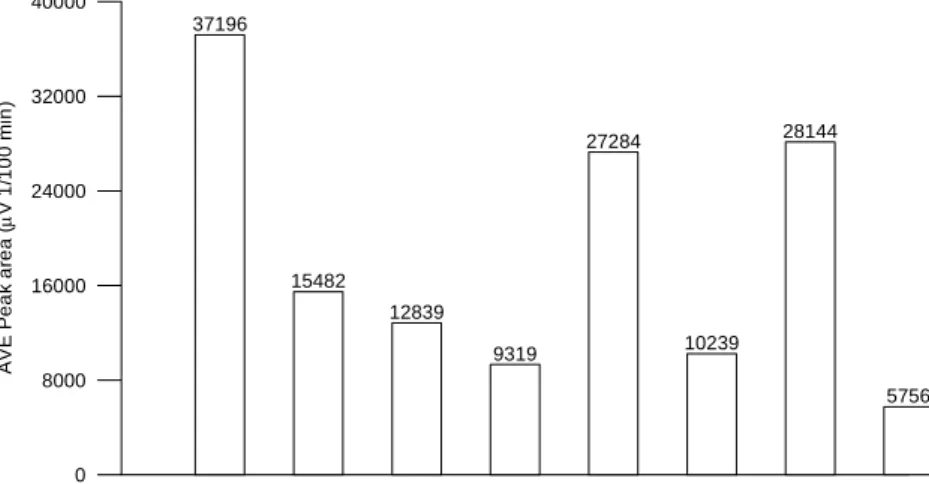
Transformations of VVE by laccase alone and laccase/mediator systems (their chemical structures illustrates Fig. 1) are different. The results shown in Fig. 2 confirm much more efficient reaction with laccase/mediator systems than with laccase
alone.
OH COCH3
OCH3
OH COCH3
OCH3 H3CO
N N OH
N
(HBT)
Acetosyringone 1-hydroxybenzotriazole Acetovanillone
(AV) (AS)
Fig. 1. Structure and shortened name of mediating compounds.
The transformation efficiency (mediating activity) of laccase/AV and laccase/AS systems (Fig. 2) was comparable to laccase/HBT system and even better in the case of laccase/AS than laccase/HBT. This result shows that AV and AS can work as laccase mediators.
0 1 2 3 4 5 6 7 8
0 8000 16000 24000 32000 40000
AVE Peak area (μV 1/100 min)
37196
15482 12839
9319
27284
10239 28144
5756
Fig. 2. VVE (veratrylglycol- β -vanillate ether) transformations by laccase, and laccase/mediator systems. 1 = laccase + VVE after 6 h incubation; 2 = 12 h; 3 = laccase/HBT + VVE after 6 h; 4 = 12h; 5 = laccase/AV (acetovanillone) + VVE, 6h; 6
= 12h; 7 = laccase/AS (acetosyringone) + VVE, 6h; 8 = 12h.
Mediation efficiency
Studying the VVE depolymerization process further we examined the products of
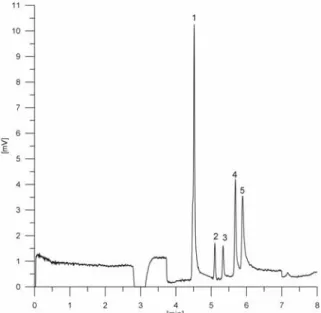
mediating activity. When laccase and the mediators were incubated with VVE depolymerization occurred. The resulted vanillic acid (VA) and isovanillic acid (IA) were detected both chromatically (Table 2) and by capillary electrophoresis (Fig. 3, Fig. 4 and Fig. 5). The control map (without laccase) of capillary electrophoresis of substrate, mediators and products is presented in Fig. 3.
Table 2. Aromatic acids produced from VVE (veratrylglycol-β -vanillate ether) detected by thin layer chromatography
Aromatic acid Rf of commercial compounds
Rf of reaction products
Isovanillic acid (IA) Vanillic acid (VA)
0.5912 0.6759
0.5898 0.6777
As shown in Table 2 and illustrated in Fig. 4, Fig. 5 and Fig. 6 with reference to control map (Fig. 3) laccase and laccase/mediator systems partly transform the substrate VVE (veratrylglycol-β -vanillate ether) into IA (isovanillic acid) and VA (vanillic acid). No significant difference was observed between 6 h and 12 h incubation. At the moment we do not have an reliable mechanistic explanation for this result, however, a similar observation has previously been reported by Li et al.
(1997) studying the degradation of a lignin β -O-4 dimer, 1-(3,4-dimethoxy) propan- 1,3-diol. The presented in this report results show that some laccase is able for transformation model lignin dimer and that AV and AS stimulated the process. As can be seen in Figure 2, AS was even more efficient than HBT. As well AV as AS (contrary to known already mediators, like HBT or ABTS), are produced in the processes of wood transformation, have less complicated formulae and are cheaper than ABTS or HBT. The sources of lignocellulose that occur in various forms in nature (mainly as wood) are so vast that they can only be compared to those of water (Leonowicz et al. 2001). The results presented in this report show that laccase with using of some compounds as mediators is able for degradation of dimer being a model compound of lignin, which is the most undegradable constituent of lignocellulose complex. It may be one more (biotechnological) system for the bleaching of kraft pulps, in combination with oxygen delignification techniques.
Fig. 3. Capillary electrophoresis of substrate, mediators and products (control map): 1
= VVE (veratrylglycol-β -vanillate ether); 2 = IA (isovanillic acid); 3 = VA (vanillic acid); 4 AV (acetovanillone); 5 AS (acetosyringone).
Fig. 4. Capillary electrophoresis of laccase reaction on VVE (veratrylglycol- β -
vanillate ether): A - after 6h incubation; B - after 12 h: 1 = VVE; 2 unknown; 3 = IA (isovanillic acid); 4 = VA (vanillic acid); 5 unknown.
Fig. 5. Capillary electrophoresis of laccase and laccase/acetovanillone reaction on VVE (veratrylglycol-β -vanillate ether): A - after 6h incubation; B - after 12 h: 1 = VVE; 2 unknown; 3 = IA (isovanillic acid); 4 = VA (vanillic acid); 5 AV (acetovanillone); 6 and 7 unknown.
Fig. 6. Capillary electrophoresis of laccase and laccase/acetosyringone reaction on VVE (veratrylglycol-β -vanillate ether): A - after 6h incubation; B - after 12 h: 1 =
VVE; 2 unknown; 3 = IA (isovanillic acid); 4 = VA (vanillic acid); 5 AS (acetosyringone); 6 unknown.
O C H2
C O
OH COOH O O
H COOH
CH3 COOH
OCH3 OCH3
OCH3
+
laccase
OCH3 mediator
veratrylglycerol-β-vanillate ether (VVE)
vanillic acid (VA)
isovanillic acid (IA) Fig. 7. Possible route of VVE transformation by laccase/mediator systems.
4. Acknowledgements
Author is grateful to Dr. Andrzej Leonowicz, Department of Biochemistry, Maria- Curie Sklodowska University, Poland and Professor Tae- Ho Choi, Wood and Paper Science, Chungbuk National University, Korea for their cooper-ative researches and valuable advices.
5. References
1. Bourbonnais, R., D. Leech and M.G. Paice. 1998. Electrochemical analysis of the interactions of laccase mediators with lignin model compounds. Biochem. Biophys.
Acta 1379,381-390.
2. Bourbonnais, R., M.G. Paice, I.D. Reid and B. Freiermuth. 1997a. Reactivity and mechanism of laccase mediators for pulp delignification. TAPPI Proc. Biol. Sci. Sy mp. TAPPI Press. 1997,335-338.
3. Bourbonnais, R., M.G. Paice, I.D. Reid and B. Freiermuth. 1997b. Reactivities of various mediators and laccases with kraft pulp and lignin model compounds. Appl.
Environ. Microbiol. 63:4627-4632
4. Bradford, M.M. 1976. A rapid and sensitive method for the quantitation of microg ram quantities of protein utilizing the principle of protein-dye binding. Anal.
Biochem. 72,248-254.
5. Call, H.P. 1994. Process for modifing, breaking down or bleaching lignin, materia ls containing lignin or like substances. PCT World Pat. Appl. WO94/29510.
6. Call, H.P. and I. Mücke. 1997. History, overview and application of mediated lign olytic systems, especially laccase-mediator-systems(Lignozym-process).
J. Biotechnol.53,163-202.
7. Eggert, C., U. Temp, J.F. Dean and K.E. Eriksson. 1996. A fungal metabolite med iates degradation of non-phenolic lignin structures and synthetic lignin by laccase.
FEBS Lett. 391,144-148.
8. Evans, C.S., M.V. Dulton, F. Guillen and R.G. Veness. 1994. Enzymes and small molecular mass agents involved with lignocellulose degradation. FEMS Microbiol. R ev. 13,235-240.
9. Fluornoy, D.S., T.K. Kirk and T.L. Highley. 1991. Wood decay by brown- rot fungi: changes in pore structure and cell wall volume. Holzforschung 45,383- 388.
10. Gianfreda, L., F. Sannino, M.T. Lilazzola and A. Leonowicz. 1998. Catalytic beh a
vior and detoxyfying ability of laccase from the fungal strain Cerrenaunicolor.J. Mo l. Cat. 4, 13-23.
11. Hofrichter, M., D. Ziegenhagen, T. Vares, M. Friedrich, M.G. Jager, W. Frische and A. Hatakka. 1998. Oxidative decomposition of malonic acid as basis for the acti on of manganese peroxidase in the absence of hydrogen peroxide. FEBS Lett. 434, 362-366.
12. Leonowicz, A. and J.Trojanowski. 1975. Induction of a new laccase form in the fungus Pleurotusostreatusbyferulicacid.Microbios.13,167-174.
13. Leonowicz, A. and K. Grzywnowicz. 1981. Quantitative estimation of laccase fo rms in some white-rot fungi using syringaldazine as a substrate. Enz. Microb.
Technol. 3,55-58.
14. Leonowicz, A., B. Wojtowicz and J. Trojanowski. 1968. Model experiments on t he humification of rye rots. I. Phenolic products in the humification process. Polish J. Soil Sci. 1,120-136.
15. Leonowicz, A., J. Rogalski, M. Jaszek, J. Luterek, M. Wojtas-Wasilewska, E. Malarczyk, G. Ginalska, M. Fink-Boots and N.-S. Cho. 1999. Cooperation of fungal laccase and glucose 1- oxidase in transformation of Bjorkman lignin and some phenolic compounds. Holzforschung 53,376-380.
16. Leonowicz A., L. Gianfreda, J. Rogalski, M. Jaszek, J. Luterek, M. Wojtas- Wasilewska, E. Malarczyk, A. Dawidowicz, M. Fink-Boots, G. Ginalska and N.S. Cho. 1997a. Purification of extracellular Cerrena unicolor laccase by means of affinity chromatography,J. Korea Tech. Assoc. Pulp and Paper Ind., 29, 7- 17.
17. Leonowicz, A., L. Gianfreda, J. Rogalski, M. Jaszek, J. Luterek, M. Wojtas-Wasilewska, E. Malarczyk,
A. Dawidowicz, M. Fink-Boots, G. Ginalska, M. Staszczak and N.S.Cho. 1997b. Appearance of lacase in wood-rotting fungi and its inducibility. J. Kor. Wood Sci. Technol. 25,29-36.
18. Leonowicz, A., N.S. Cho, J. Luterek, A. Wilkolazka, M. Wojtas-Wasilewska, A. Matuszewska, M. Hofrichter, D. Wesenberg and J. Rogalski. 2001. Fungal laccase: properties and activity on lignin. J. Basic. Microbiol. 41,185-227.
19. Leonowicz. A., R.U. Edgehill and J.M. Bollag. 1984. The effect of pH on the tra nsformation of syringic and vanillic acids by the laccase of Rhizoctonia praticola an d Trametes versicolor. Arch. Microbiol.137,89-96.
20. Li, K., H. Bermek and K.E. Eriksson. 1997. A new technique for screening of la ccase mediators., Biological Sciences Symposium 1997,349-353.
21. Lindenberg, G. and G. Holm. 1952. Occurance of tyrosinase and laccase in fruit bodies and mycelia of some Hymenomycetes.Physiol.Plant.5,100-114.
22. Lundquist, K. and T.K. Kirk. 1978. De novo synthesis and decomposition of ver atryl alcohol by a lignin-degrading basidiomycete. Phytochem., 17,1676.
23. Mayer, A.M. and R.C. Staples. 2002. Laccase: new functions for an old enzyme.
Phytochemistry. 60,551-565.
24. McIlvaine, T.C. 1921. A buffer solution for colorimetric comparison. J. Biol. Ch em. 49,183-186.
25. Potthast, A., T. Rosenau, P. Kosma and K. Fisher. 1999. Chemistry and kinetics of the laccase-mediator system. In: Proceeding of the 10th International
Symposium on Wood and Pulping Chemistry. Yokohama, Japan 1999:vol1.pp.596- 601.
26. Srebotnik, E. and K.E. Hammel. 2000. Degradation of nonphenolic lignin by the laccase/1-hydroxybenzotriazole system. J. Biotechnol. 81,178-188.
27. Srebotnik, E., K.A. Jensen and K.E. Hammel. 1988. Cleavage of nonphenolic lig nin structures by laccase in the presence of 1-hydroxybenzotriazole. In:
Proceedings of the 7th International Conference on Biotechnology in the Pulp and Paper Industry. Vancouver, Canada 1988;pp.B195-B197.
28. Szklarz, G. and A. Leonowicz. 1986. Cooperation between fungal laccase and gl ucose oxidase in the degradation of lignin derivatives. Phytochem. 25,2537-2539.
Tien, M. and T.K. Kirk. 1988. Lignin peroxidase ofPhanerochaetechrysosporium.In:
Methods in Enzymology Vol. 161B. Eds. D.A. Wood, S.T. Kellogg. Academic Press, SanDiego,CA.pp.238-249.
29. Traquair, J.A. 1987. Oxalic acid and calcium oxalate produced by Leucostoloma cincta and L. personii in cultures and in peach bark tissue. Can. J. Bot., 65, 1952- 1956.
30. Youn, H.D., K.J. Kim, J.S. Maeng, Y.H. Han, G. Jeon, S.O. Kang and Y.C. Hah. 19 95. Single electron trasfer by an extracellular laccase from white- rot fungus Pleurotus ostreatus, Microbiology 141,393-398.