Korean J. Environ. Biol. 35(3) : 289~295(2017) https://doi.org/10.11626/KJEB.2017.35.3.289
INTRODUCTION
Algae are responsible for photosynthesis and it generates a significant portion of the Earth’s oxygen as well as pro- duces many organic carbons that are used as food for other organisms. The quantitative changes of the algae commu- nity also uses as important data in the evaluation of water quality (Stoermer and Ladewski 1978). Moreover, several species are cultivated for the production of nutritional sup- plements or food additives such as β-carotene (Ben-Amotz et al. 1982; Alonso et al. 1996). The common freshwater colonial green algae Chrorella saccharophila is an example of another type of algae that produces large amounts of lip- ids. More than 300 lipid-producing algae strains have been identified as having economic potential for producing the biofuel (Roessler 1990; Graham et al. 2009; Chinnasamy et al. 2010).
In the case of Chlorophyceae of Chlorophyta, a total of 3,607 taxa have been reported worldwide (Guiry and
Guiry 2017). A total of 4,062 taxa of Conjugatophyceae of Charophyta have been reported worldwide. Domestically, a total of 484 taxa for the Chlorophyceae and 872 taxa for the Conjugatophyceae have been reported (Lee and Kim 2015). It shows the study of Korean flora must be further researched.
Among the existing research, the floristic studies by Chung (1968) and Chung (1993) stand out, regarding the chlorophytes of Korea. Furthermore, in the monographic studies conducted by The National Institute of Biological Resources and the Ministry of Environment, many species have been newly discovered and have been added to the flora of Korea (Kim 2012; Kim and Kim 2012). The unre- corded species of Korea have continuously been added to the Korean flora each year (Shin et al. 2013; Kim 2013a, 2014a, b; Kim 2013b, c, 2014c; Song and Lee 2014a, b).
Six taxa of Cosmarium were added at lowland swamps, reservoirs, mountainous wetlands and the Sphagnum bogs (Lee 2015). Nine taxa of chlrophytes collected at artificial wetlands (Shin et al. 2015), as well as two genera and five species of filamentous blue-green algae were collected at aquatic plants, submerged land plants and rocks (Song and
* Corresponding author: Ok Min Lee, Tel. 031-249-9643, Fax. 031-241-0860, E-mail. [email protected]
ⓒ2017. Korean Society of Environmental Biology.
Four Newly Recorded Taxa of Charophytes and Chlorophytes
(Charophyta and Chlorophyta, Viridiplantae) in Korea
Hyun-Chul Jung, Nam-Ju Lee, Do-Hyun Kim and Ok Min Lee*
Department of Life Science, College of Natural Science, Kyonggi University, Suwon 16227, Republic of Korea
Abstract - The freshwater algae were collected at reservoirs and small ponds in Gyeonggi-do and Jeju-do on June 2016. Four species of Korean previously unrecorded algae were collected in domestic fresh waters: Coelastrum rugosum, Cosmarium baccatum, Cosmarium norimbergense and Staurastrum connatum var. pseudoamericanum. The morphological characteristics of the four taxa identified in this study were showed mostly similar to the characteristics of the previously reported characteristics. However, Cosmarium baccatum was larger than the previously recorded species and Staurastrum connatum var. pseudoamericanum was wider than the previously recorded species.
Key words : Chlorophyceae, Conjugatophyceae, newly recorded species, phytoplankton
<Original article>
These samples were collected at the Seo-ho and Buk-ri reservoir at Gyeonggi-do in 2016 (Table 1). We collected phytoplanktonic algae using at 25 μm-mesh phytoplankton net with a 30 cm diameter. The periphytic algae was collect- ed by scrubbing off aquatic plants, submerged land plants and rocks (Sournia 1978).
The collected specimens were separated using a Pasteur pipette under a light microscope and they were cultured in solid media. Once a colony was formed by a single species, it was subsequently transferred to liquid media. The unial- gal specimens were cultured in Bold’s basal media under the following conditions: a temperature of 25℃, light/dark cycle of 16 : 8, and 40 μmol m
-2s
-1light (Stein 1973; Bold and Wynne 1978).
Each sample was examined using an ×400-1000 mag- nification under a Zeiss Microscope (Axio Imager A2; Carl Zeiss, Germany) and was photographed using an AxioCam HRC camera (Carl Zeiss, Germany).
The taxonomic classification system was based on Algae- Base (Guiry and Guiry 2017) and Komárek and Fott (1983).
The taxa were identified based on information taken from West and West (1908), Hirose et al. (1977), Prescott et al.
(1981, 1982) and Komárek and Fott (1983).
RESULTS AND DISCUSSION
The four newly added Korean species were Coelastrum rugosum, Cosmarium baccatum, Cosmarium norimber-
Phylum Chlorophyta Class Chlorophyceae Order Sphaeropleales Family Scenedesmaceae Genus Coelastrum Nägeli 1849
Coelastrum rugosum
(Rich) Tsarenko 2011 (Fig. 1) The cells are oval to triangular shaped, with distinct wrinkles on the surface of the cells. The spherically shaped colony consists of 8 or 16 cells, and the cells are directly adjacent to one another without connecting strands. The dia- meter of the cell is 6-11 μm and the length is 7-12 μm.
Ecology: We collected this species in planktonic samples from eutrophic reservoirs.
Distribution: Europe: Germany, Hungary (Hegewald et al.
2010); Romania (Caraus 2002); Asia: Taiwan (Shao 2003- 2014)
Site of collection: Seo-ho, Gyeonggi-do (June 15, 2016) Specimen Locality: KTSN 120000207733
Phylum Charophyta
Class Conjugatophyceae (Zygnematophyceae) Order Desmidiales
Family Desmidiaceae
Genus Cosmarium Corda ex Ralfs 1848
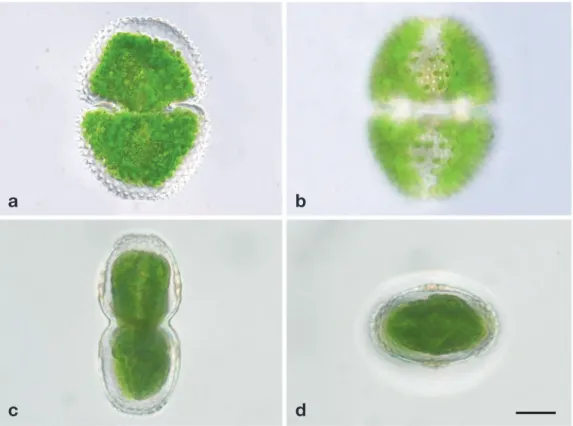
Cosmarium baccatum Scott &
Grönblad 1957 (Fig. 2) The cells are large, and a little longer than they are broad.
The median constriction is deep and narrowly linear. Semi- cells are subpyramidate shaped, and the lower angles are
Table 1. The locational information of three sites which collected the phytoplankton in 2016
Sites Location Latitude Longitude pH
1 Hwaseodong Paldal-gu Suwon-si Gyeonggi-do 37°16′48.3″ 126°59′12.3″ 7.2
2 Buk-ri Cheoin-gu Yongin-si Gyeonggi-do 37°09′11.3″ 127°09′22.3″ 7.2
Fig. 1. Microscopic photographs of Coelastrum rugosum(Rich) Tsarenko. Scale bar represents 10μm.
a b
c d
Fig. 2. Microscopic photographs of Cosmarium baccatum Scott & Grönblad. Scale bar represents 20μm.
a b
c d
Fig. 3. Microscopic photographs of Cosmarium norimbergense Reinsch. Scale bar represents 10μm.
a b
c d
Fig. 4. Microscopic photographs of Staurastrum connatum var. pseudoamericanum Grönblad. Scale bar represents 10μm.
a b
c d
rotund. The lateral margins are convex and decidedly con- vergent toward the apex. The apex margin is truncated, and the margins are granular-undulate. In the face of the semi- cells, large granules are regularly arranged in longitudinal, oblique or concentric series. On each side of the isthmus are 3 or 4 large warts, a low swelling in the midregion bear- ing different pattern granules. The vertical view is broad- ovate shaped with a slight and conspicuous inflation at the mid-region on either side. From the lateral view, the semi- cell is circular, and the margins are granular-undulate, with 20-22 undulations along the margin. The length is 91-92 μm, the width is 66-69 μm, and the isthmus is 25-27 μm.
These specimens are larger than the previously recorded species.
Ecology: We collected this species from the mesotrophic reservoirs at the Buk-ri reservoir, Gyeonggi-do.
Distribution: Florida, Virginia (Prescott et al. 1981); South- eastern United States: Homestead, Masaryk, Punta Gorda, Chiefland (Scott and Grönblad 1957).
Site of collection: Buk-ri reservoir, Gyeonggi-do (August 5, 2016)
Specimen Locality: KTSN 120000207785
Cosmarium norimbergense Reinsch 1867
(Fig. 3) The cells are small, about as broad as they are long. The median constriction is deep and the sinus is closed. The semicell is transversely rectangular, and the lateral margin is retuse but subparallel to a truncate apex, which is as wide as the base of the semicell, and the basal angle is broadly rounded. From the lateral view, the semicell is circular and from the vertical view, the cell is elliptic. The length is 39- 45 μm, the width is 25-36.4 μm, and the isthmus is 5.6-11 μm.
Ecology: We collected this species from eutrophic reser- voirs.
Distribution: Worldwide distribution (Croasdale and Flint 1988; Broady et al. 2012).
Site of collection: Seo-ho, Gyeonggi-do (June 15, 2016).
Specimen Locality: KTSN 120000207786
Phylum Charophyta
Class Conjugatophyceae (Zygnematophyceae) Order Desmidiales
Family Desmidiaceae
Genus Staurastrum Meyen ex Ralfs 1848
Staurastrum connatum var.pseudoamericanum
Grönblad (Fig. 4)
The cells are larger than S. connatum. The ventral mar- gins are convex, and the apical margins are straight towards the outside. The cell becomes thin and pointed towards the end. The median constriction is narrow and open, and the apex is either flat or slightly concaved. From the vertical view, the cell is triangular with each margin being slightly concaved. The length of the cell is 38-43 μm, the width is 33.5-43.5 μm without the spines, and the isthmus is 11-12 μm.
Ecology: We collected this species from mesotrophic reser- voirs.
Distribution: Germany, Finland (Hirano 1959).
Site of collection: Buk-ri Reservoir, Gyeonggi-do (August 6, 2016)
Specimen Locality: KTSN 120000207787
ACKNOWLEDGEMENT
This research was supported by a grant from the Nak- donggang National Institute of Biological Resources, fund- ed by the Ministry of Environment (MOE) of the Republic of Korea (The 2016 project Finding of Freshwater Biore- sources Microalgae and Biodiversity Research of Diatoms in Freshwater Habitat) and the National Institute of Biolog- ical Resources, also funded by the MOE (NIBR201701204).
REFERENCES
Alonso GL, RD Fetter and CS Goodman. 1996. Genetic anal- ysis of Laminin A in Drosophila: extracellular matrix con- taining laminin A is required for ocellar axon pathfinding.
Dev. 122:2611-2622.
Ben-Amotz A, A Katz and M Avron. 1982. Accumulation of β-carotene in halotolerant algae: purification and charac- terization of β-carotene-rich globules from D. bardawil (Cholorophyceae). J. Phycol. 18:529-537.
Bold HC and MJ Wynne. 1978. Introduction to the Algae.
Structure and Reproduction. Prentice-Hall, Englewood Cliffs. New Jersey.
mill effluents for biofuel applications. Bioresour. Technol.
101:3097-3105.
Chung J. 1993. Illustration of the freshwater algae of Korea.
Academy Publ. Co. Korea.
Chung YH. 1968. Illustrated encyclopedia of fauna & flora of Korea, vol. 9, Fresh water algae. Samhwa Publ. Co. Seoul.
Croasdale H and EA Flint. 1988. Flora of New Zealand: Des- mids. Volume II. ISBN 0-477-01353-8. DSIR, Botany divi- sion, Christchurch.
Graham LE, JM Graham and LE Wilcox. 2009. ALGAE, sec- ond editioon. Pearson.
Guiry MD and GM Guiry. 2017. AlgaeBase. World-wide elec- tronic publication, National University of Ireland, Galway, Available from: http://www.algaebase.org.
Hegewald E, M Wolf, A Keller, T Friedl and L Krienitz. 2010.
ITS2 sequence-structure phylogeny in the Scenedesma- ceae with special reference to Coelastrum(Chlorophyta, Chlorophyceae), including the new genera Comasiella and Pectinodesmus. J. Phycol. 49:325-335.
Hirano M. 1959. Flora Desmidiarum Japonicarum, 5. Contr.
Biol. Lab. Kyoto University 7:226-301.
Hirose H, M Akiyama, M Hirano, K Imahori, T Ioriya, H Kasaki, H Kobayasi, S Kumano, E Takahashi, K Tsumura and T Yamagishi. 1977. Illustrations of the Japanese fresh- water algae. Uchidarokakuhe, Tokyo.
Kim HS. 2012. Algal Flora of Korea. Vol. 6, No. 1. Freshwater green algae. Jeonghaeng Publ. Co. Seoul.
Kim HS. 2013a. New records of fresh-water green algae(Chlo- rophytes) from Korea. Kor. J. Eco. Environ. 36:303-314.
Kim HS. 2014a. Desmids from Korea; 1. Desmidiaceae. 1 (Micrasterias). Kor. J. Eco. Environ. 37:285-298.
Kim HS. 2014b. Records of desmids(Chlorophyta) newly found in Korea. Kor. J. Eco. Environ. 37:299-313.
Kim YJ. 2013b. Taxonomic review of families Botrycoccaceae and Characiaceae, Order Chlorococcales, and Class Chlo- rophyceae in Korea. Kor. J. Eco. Environ. 36:327-338.
Kim YJ. 2013c. Taxonomic and ecological study of the fam- ilies Hydrpdictyaceae and Coelastraceae, Order Cholro- clccales, and Class Chlorophyeae in Korea. Kor. J. Eco.
Environ. 37:351-363.
ed). Schweiz Verg, Stuttgart.
Lee OM. 2015. Additions to the six taxa of the genus Cosmar- ium(Dsmidiaceae, Charophyata) in Korea. Kor. J. Eco.
Environ. 38:629-636.
Lee OK and JH Kim. 2015. National List of Species of Korea (Green algae). Jeonghaeng Publ. Co. Seoul.
Prescott GW, CEM Bicudo and WC Vinyard. 1982. A synopsis of North American Desmids. Part II. Section 4. The Uni- versity of Nebraska Press, Lincoln.
Prescott GW, HT Croasdale, WC Vinyard and CEM Bicudo.
1981. A synopsis of North American Desmids. Part II. Sec- tion 3. The University of Nebraska Press, Lincoln.
Roessler PG. 1990. Environmental control of glycerolipid metabolism in microalgae: commercial implications and future research directions. J. Phycol. 26:393-399.
Scott AM and R Grönblad. 1957. New and interesting desmids from the southeastern United States. Acta Societatis Scien- tarum Fennicae, Nova Series B 2:3-62.
Shao KT. 2003-2014. TaiBNET(Catalogue of Life in Taiwan).
http://taibnet.sinica.edu.tw. Taiwan.
Shin HJ, JH Im, HC Jung and OM Lee. 2015. Nine taxa of newly recorded species of chlorophytes(Chlorophyceae and Trebouxiophyceae, Chlorophyta) in Korea. Kor. J. Eco.
Environ. 38:637-646.
Shin HJ, MA Song and OM Lee. 2013. A study of nine newly reported species of the order Chlorococcales(Chlorophyta) in Hongcheon river, Korea. Kor. J. Eco. Environ. 36:315- 325.
Song MA and OM Lee. 2014a. A study of newly recorded gen- era and species of aerial algae in the order Cholorococcales (Chlorophyta) from the Hongcheon-river, Korea. Kor. J.
Eco. Environ. 37:315-325.
Song MA and OM Lee. 2014b. A study of eight newly reported species of Cholrophyte and Eustigmatophyte. Kor. J. Eco.
Environ. 37:341-350.
Song MA and OM Lee. 2015. A study of newly recorded gen- era and species of filamentous blue-green algae(Cyano- phyceae, Cyanobacteria) in Korea. Kor. J. Eco. Environ.
38:619-627.
Sournia A. 1978. Phytoplankton Manual. UNESCO, Paris.
Stein JR. 1973. Handbook of phycological methods, culture methods and growth measurements. Cambridge University Press, Cambridge.
Stoermer EF and Ladewski TB. 1978. Phytoplankton associ- ations in Lake Ontario during IFYGL. Univ. Michigan, Great Lakes Res. Div. Spec. Rep. No. 62.
West W and GS West. 1908. A Monograph of the British De- smidiaceae. Vol. 3. Ray Society. London.
Received: 20 August 2017 Revised: 12 September 2017 Revision accepted: 12 September 2017