Print ISSN: 2288-4637 / Online ISSN 2288-4645 doi:10.13106/jafeb.2021.vol8.no10.0097
Factors Affecting Financial Independence of Young Adults:
An Empirical Study in Vietnam
Lan NGUYEN
1, Quyen Thi TRINH
2, Thao Ngoc Minh TRAN
3Received: June 15, 2021 Revised: August 29, 2021 Accepted: September 06, 2021
Abstract
Nowadays, with the constant enhancement in the health of the economy, the average income and living standard have accordingly increased, making the need for financial independence a favorable choice. This research aims to identify the factors affecting the financial independence of young people. The authors implement quantitative analysis, with a set of primary data collected from a survey of 2664 Vietnamese people aged from 18 to 28. The research results demonstrate the considerable impact of monetary, psychological, group-related, and family-related factors on the financial independence of young people. The results of the sample analysis provide adequate evidence to reject the correlative relationship between family and group factors and the financial independence of young people. In addition, there are 3 factors, including demographic factors, monetary factors, and psychological factors, all have varying degrees and directions of influence on young people’s financial independence. Most of the mentioned variables reflect a positive effect on financial independence. The only exception is the education variable, illustrated by its negative standardized beta value. A significant difference in financial independence between genders also is reported, suggesting that males seem to have a higher level of financial independence than females.
Keywords: Financial Independence, Young People, Vietnam JEL Classification Code: E44, F31, F37, G15
& Paprocki, 2006). Take Vietnam as a case in point. The country has been highly ranked in terms of GDP growth rate for the last few years (Chien & Zhang, 2012; Nurbayev, 2015). As a result, the potential for financial independence and personal finance is widened, as seen by the rapid growth of financial independence and personal finance in various local metropolitan areas. Yet, those who are not aware of the concept may handle their financial needs based on pure intuition. In other words, their actions are primarily driven by emotions, which, in most cases, generate bad financial decisions, or worse, mismanagement of the company’s predetermined calculations (Borjas et al., 2020). In reality, the ultimate rational decision would be struck based on risk management, or any other way that makes investing assets churn out more profits.
When asked about the potential of the Vietnamese financial market towards financial literacy, the CEO of Vingroup, who is the richest among Vietnamese people - Mr. Vuong Pham, said that he had started his path in monetary independence as a start-up since he was a junior student at the university and that spreading the knowledge of financial independence is the perfect way for others to
1
First Author and Corresponding Author. Faculty of Accounting and Auditing, Van Lang University, Ho Chi Minh City, Vietnam [Postal Address: 45 Nguyen Khac Nhu Street, Co Giang Ward, District 1, Ho Chi Minh City, Vietnam] Email: [email protected]
2
Faculty of World Economy and International Affairs, National Research University - Higher School of Economics, Russia.
Email: [email protected]
3
Faculty of Economic Statistic, National Economics University, Vietnam. Email: [email protected]
© Copyright: The Author(s)
This is an Open Access article distributed under the terms of the Creative Commons Attribution Non-Commercial License (https://creativecommons.org/licenses/by-nc/4.0/) which permits unrestricted non-commercial use, distribution, and reproduction in any medium, provided the original work is properly cited.
1. Introduction
With the constant enhancement in the health of the
economy, the average income and living standard have
accordingly increased, making the need for financial
independence a favorable choice. In fact, more and more
people are familiarizing themselves with this concept,
especially among the youngsters (Bea & Yi, 2019; Blau
explore his as well as their own business path (Nguyen, 2017). Moreover, he went on to remark that the Vietnamese educational system should promote individualism as a new vantage point for students. The educational platform is most impactful in the sense that it enables each individual to think for themselves.
Within psychological spheres, competence is the combination of certain cognitive characteristics that match the prerequisites of a particular activity, thus making sure that the result lives up to the desired expectations (Borjas et al., 2020). Such competence stems partly from inborn prowess, but mostly from continuous practice. Furthermore, there are two famous schools of thought on competence, namely the American and the English concepts. These two concepts formulate the competency model, which has been applied to various aspects of life. Most apparently, many adolescents are choosing to drop out of high schools or universities on account of their family conditions, feelings of a misfit among peers, or the inability to catch up with academic schoolwork (Borjas et al., 2020; Butterbaugh et al., 2020).
Whatever the reason might be, it renders the individual to be more self-reliant. Not to mention, their families at the same time expect the children to be able to fend for themselves, rather than fall back on parents for financial backing or be a freeloader. At this point, the question of money; which revolves around making, investing, saving, and spending it;
emerges. Everyone knows that it takes knowledge to make money and invest (Hill et al., 2017). Yet not everyone knows that the same goes for saving and spending.
In general, a great amount of knowledge is required to follow any financial principles effectively. This is understandable, as the financial market is such a convoluted, diverse melting pot (Fan et al., 2018). Meanwhile, the amount of knowledge required is directly proportional to the complexity of the market. Simply put, the higher the returns, the riskier the investment. Yet, when speaking of knowledge, it is inherently built to cater to specific spheres (Cui et al., 2019; Fan et al., 2018). In workplace develop- ment, there are three distinct categories of knowledge, namely design knowledge, process knowledge, and dissemi- nation knowledge (Macpherson et al., 2020). For instance, say you are planning to invest in stocks as a long-term investment strategy. Your design knowledge would focus on analyzing financial statements or determining the model in which stocks operate. As for your process knowledge, you have to have an understanding of securities, macroeconomics, or other economic dynamics in relevant fields to make changes to the model on demand. Finally, dissemination knowledge, in this case, refers to market behavior, which involves the silent participation of indirect economic agents. Many people argue that it suffices to hire financial consultants to compensate for their lack of financial knowledge (Fan et al., 2018; Mendola, 2020). However, financial consultants tend
to have conflicting opinions, which, in some cases, carry shady motives. At this point, only a well-informed trader can sieve out better investment plans.
Attitude is the direct manifestation of emotions and behaviors towards another entity (Butterbaugh et al., 2020).
It is formed, adjusted, and reinforced by hands-on experience.
This interactive experience gradually deepens in terms of mentality, reasoning, and emotions. As a result, attitude affects a person’s behavior, regarding what to perceive and how to react upon encountering an event. Hence, a positive attitude plays a crucial part in personal finance management (Xiao et al., 2014). However, a positive attitude must come hand in hand with knowledge and skills, otherwise, it might become exaggerated optimism.
The development of Vietnam for the last 30 years deserves honorable praise (Luc, 2018). The 1986 economic and political reformation acted as leverage to the economy, quickly transforming Vietnam from being one of the poorest countries in the world to a country with a low-average income. Statistically speaking, GDP per capita has increased 2.7 times throughout the 2002–2018 period (Chien & Zhang, 2012). As of 2019, the corresponding figure was 2,700 USD, making it the second consecutive year with a GDP growth rate of more than 7% (Huong et al., 2021; Nguyen, Bui & Nguyen, 2019). At the same time, it allowed more than 45 million people to escape poverty. According to Mr. Nam Pham - the Head Department of Population and Labour Statistics, General Office of Statistics of Vietnam, the figure for labor entry experienced a decrease in the first quarter of 2021, compared to the last quarter and even the corresponding period of 2020 (Huong et al., 2021).
However, GDP per capita was recorded to see an increase, making it a positive sign in the big economic picture.
Besides, the average monthly income in the first quarter of 2021 was seen to reach 200 USD, which was 13 USD more than the previous quarter, and 5 USD more than the 2020 counterpart. The 2020 period witnessed a significant increase in the average income of laborers participating in agriculture, forestry, and fishery, which together rose by 5.2% (Nguyen et al., 2020). Meanwhile, the corresponding figures for the service and industrial sector remain of smaller scale, being 1.5% and 0.8% respectively. More notably, the monthly average income of salaried employees in the first quarter of 2021 was shown to reach 330 USD, which was 23 USD more than the last quarter, and 7 USD more than the corresponding 2020 period (Hoang et al., 2019). Every dimension considered, the Vietnamese market is projected to grow even further along with the increasing productivity, paving the way for more financial independence literacy, and hopefully more financially independent individuals in the next 10 to 30 years.
Nevertheless, the trend had shifted following the
outburst of the COVID-19 pandemic. GDP only grew by
2.9% in 2020, which was a decrease of 3.1% compared to the corresponding figures of the year 2019 (as reported by the General Office of Statistics of Vietnam). Not to mention, both the quality and quantity of the Vietnamese workforce experienced a plummet in the first quarter of 2021. To prove our point, there was a staggering 200,000-employee cut down in 2020, making the total workforce 600,000 short compared to the same period in the pre-COVID stage (Nguyen et al., 2020). The rate of labor entry was estimated to be about 68.7%, decreasing by 1.6% less than its previous quarter and 1.1% less than the correlated 2020 period. The same figures remain 66.7% and 69.9% in the urban and rural areas respectively (Harvie, 2008; Hoang et al., 2019).
Regarding age ranges, the labor entry rate is higher in rural areas than in urban ones, most discernible in the 15–24 age group, being 48% and 42% individually; and the upper-55 age group, being 47.9% and 35% respectively (Huong et al., 2021). Such statistics call for an urgent need for financial independence among both young people and those of working age.
We may have high hopes to set financial independence as a goal for the youngsters as of now. In reality, many students continue to be financially dependent on their families even after graduation. In other words, it is a big challenge for the current young generation, demanding a realistic viewpoint and effort from young people (Nguyen
& Hoang, 2018). For the above-mentioned rationale, we decided to choose “Factors influencing the choice of financial independence in young people” as our research topic. Hereby, we delve into finding and evaluate those factors in the youth’s personal finance decisions. From this standpoint, we hope to encourage early financial autonomy in life, in the hope that young people will not feel a sense of perplexity once transitioned into society. In fact, the discussion of financial independence has sparked much interest among many field researchers, allowing youths to feel more transparent about financial literacy, thus being able to grasp a deeper understanding of their own financial strategy. Our research also borrows reference to others, including “FIRE”, which stands for Financial Independence & Retire Early. Other citations also point out that taking early working experiences such as part-time jobs or internships while still being an undergraduate does promote independence. These experiences equip students with better communication skills, which will allow them to quickly adapt to the changing demands and relationships in their social circle. They are also proved to form better self- discipline, specifically regarding lifestyle and work routine.
Every aspect considered, we decide to conduct this research to clarify the myths, incorporate more transparent financial literacy, and, most importantly, cater to young people’s need for financial independence in a more systematic manner.
2. Literature Review and Hypotheses 2.1. Literature Review
The financial independence state is not only crucial for young adults and their families but also the economic well- being of our society (Mendola, 2020; Xiao et al., 2014).
It is one of the most critical steps towards establishing a brighter future and allowing each individual to be in control of his life. However, it is no mean feat, as financial freedom requires reasonable spending habits (Macpherson et al., 2020).
Financial freedom also marks the milestone of their adulthood (Cui et al., 2019). Thus, our research revolves around this central question: How can young adults be financially self-reliant? We believe that being able to cover the expenses at a tender age provides the basic premise to be financially independent in adulthood, which bears direct relevance to our central question. Conflicting outcomes in the research of Xiao et al. (2014), Bea & Yi (2019), and Cui et al. (2019) on financial independence among young people motivated us to pose two questions: What factors influence young people’s decision on financial independence? And to what extent do those factors influence them? In answering those questions, this research evaluates the economic self-efficacy of adolescents and finds out whether it bears enduring effects until their adulthood, regarding social standing and financial independence. The implications of such research also show an intimate link between their parents’ jobs and their personal economic development.
This aspect of financial self-sufficiency is critical in the development of academic and professional accomplishments as they go into adulthood. Hence, it is accurately referred to as a financial independence propeller.
The primal 1996 research from Whittington and Peters gives a warranted view that it is in young people’s best interest to be financially independent if they live within communities. In reverse, young people, who have been to college, have already earned their income, yet still, live with their parents, are not considered financially independent (Whittington & Peters, 1996). Moreover, both genders’ financial independence competency demonstrates a similar fluctuating pattern. Females’
figures are shown to rise steadily to 22 years old, then
drop in a short interval, and again rise considerably from
26. Meanwhile, the correlated figures for males are 21 and
25 respectively. Yet, our research argues that age is not a
crucial factor, rather a peripheral element, in determining
financial independence in young people. Moreover, our
research proves that individuals with income can be
regarded as financially independent even if they still live
with their parents.
Rarely is an experience in close proximity of families considered as a source of financial independence. Another research demonstrates that parents do play a pivotal role in socializing finance to their children (Cui et al., 2019;
Mendola, 2020). As mentioned, young people’s financial independence is closely associated with their parents’
economic state. The 1996 research even goes on to pinpoint that the latter has a diminishing effect on young women’s financial autonomy, while not showing any effect on that of young men (Whittington & Peters, 1996). Young people growing up in wealthy families also show better financial outcomes. To justify this point, they are more proactive in preparing their college applications or opening their checking and saving accounts, which provide the basic pillars for their financial planning (Hill et al., 2017). Parenting style can also greatly affect young people’s awareness of financial autonomy. However, prior research does little to reveal that the parent-children talk on future career paths actually provides more transparency on the latter’s financial independence (Blau & Paprocki, 2006; Macpherson et al., 2020). That is another aspect that we are highlighting in this research. We further believe that parents present the most iconic model for their kids to emulate, even more than any authority figure. Yet, the case depends on how close the parents-children relationship is (Xiao et al., 2014).
These macroeconomic patterns instigate in young adults’
forceful propulsion to pursue tertiary education to enhance their capabilities in an increasingly competitive labor market. The openness of tertiary education has brought about apparent benefits to young people (Borjas et al., 2020;
Butterbaugh et al., 2020), yet at the same time extending the duration in which they depend on their parents, in most cases financially. According to the American National Centre for Education Statistics, 53% of students entering colleges for four-year programs, starting in 1995, actually earn their bachelor’s degree in five years (Mendola, 2020;
Xiao et al., 2014). Not to mention, tuition fees are increasing progressively, forcing students to embrace a fat student loan soon after their graduation. Students have to turn to their parents for limited financial backing, the federal fund for more loans, and part-time jobs for meager income (Bea &
Yi, 2019). On the other side of the spectrum, many students land straight to graduate schools once able to afford them.
Yet, on average, people who eventually earn their BA have
$22,000 as accumulated debts upon graduation. Fresh graduates even have to set aside 8% of their monthly income to pay for such debts (Hill et al., 2017).
In these challenging circumstances, one may ask, why do some young adults seem to sail through them easily, while others do not? How do they manage to cover their staggering expenses? How are they so confident in managing their personal finance? Our short answer is that they possess laudable awareness of financial independence, which also
manifests clearly in other functions of their personal life (Hill et al., 2017). This topic is of great importance regardless of time and region as individual financial issues are directly associated with young people’s state of life as well as the development of the social community (Hill et al., 2017; Mendola, 2020).
In the context of the intensifying situation of the COVID-19 pandemic across the world, personal income resources severely suffered, making the class of young people more vulnerable than ever (Borjas et al., 2020; Butterbaugh et al., 2020).
Meanwhile, only a few former studies have managed to cover the topic, and the nature of the research is rather regional and cannot be applied to other countries considering the dissimila- rities with references to cultural norms and living styles.
On top of that, previous research reflects some limitations in terms of data collection such as working on secondary resources, which is often not up-to-date and does not take the current circumstances into account. It is surprising that this phenomenon goes largely unnoticed in the scope of contemporary economic sociology. It may be explained by the disproportionate focus on macroeconomic levels of the picture, at the same time failing to take into consideration the microeconomic precursors of financial independence such as experience and social psychology.
With that in mind, this research further explores other niche factors, such as personal psychology, peers, and personal economy, which is a novel point of our research.
This point allows young people to better understand the financial struggles that they themselves are facing. Even better, we hope that they can face such problems head-on, and be an independent economic agent. There is a close- knit connection among the three listed factors, with personal psychology being most impactful on young adults because it can trigger a chain reaction in a community.
2.2. Research Hypotheses
The research hypothesis greatly affects the nature of data processing in terms of its relevance. At this point, we link it to previously discussed factors such as demographic, monetary, psychological, family, and group factors. These factors can be reasoned as follows.
2.2.1. Demographic Factors
Aside from other research, Xiao et al. (2014)
corroborated that there is a logical variation between
financial independence and demographic factors, in which
the latter directly and positively influences the former. By
investigating the financial behaviors of American young
adults, Xiao et al. (2014) indicated that the level of financial
independence of college graduates was higher than those
who had never attended college or were currently in college
but did not differ from those who had dropped out of college.
It means that education level is positively linked to the financial independence of the young.
H1: Demographic factors are directly proportional to young people’s financial independence.
2.2.2. Monetary Factors
Economic self-efficacy plays a pivotal role in fostering accomplishment-related behaviors, especially those asso- ciated with personal finance (Bandura, 1977). Other indicators also point out that higher degrees of economic resources, such as personal income and assets are positively relevant to the grade of financial independence. Similarly, Xiao et al. (2014) confirmed the positivity in the relationship between monetary factors such as young adults’ income, assets, work status, and financial independence. Empirical evidence suggests that the level of financial independence of those whose income and work are stable is higher than those who have unstable income (Macpherson et al., 2020).
Thus, economic self-efficacy is an important factor in the attainment of youths’ financial independence.
H2: Monetary factors are directly proportional to the attainment of young people’s financial independence.
2.2.3. Psychological Factors
Young adults’ thinking patterns have an influential effect on their financial independence, especially regarding their attitudes towards shopping habits and the tendency to jump on the shopping bandwagon. Shopping has become such a habit for young people, which is not a bad one (Fan et al., 2018; Macpherson et al., 2020). Even though they have yet to achieve the desired level of financial independence, a large majority of young people spend excessively on shopping. On a worse scale, the jumping-on-the-bandwagon attitude, or being enslaved to the fad, is to blame for their overspending.
Meanwhile, others manage to buy such things with their income and without an allowance from their parents (Xiao et al., 2014). Psychological factors are pervasive, even contagious in young people, which sales managers and marketing schemes capitalize on to make profits. In other words, shopping habits and herd mentality have a huge role to play in forming the psychological salience of financial independence.
H3: Psychological factors are directly proportional to young people’s financial independence.
2.2.4. Family-Related Factors
Families also serve as a critical component in forming young people’s financial independence, especially the parents’ income. However, this is a tricky issue because
parents rarely discuss or be upfront about their exact earnings with their children, and children have few reasons to inquire about it. Nevertheless, we factor it into the equation because there is a proven link between parents’ income and children’s financial independence. To be precise, parental income is negatively associated with the child’s financial independence (Whittington & Peters, 1996). Another research also indicates that parents’ backing in terms of finance, housing, jobs, and care plays a critical role in the child’s economic well-being (Cui et al., 2019). Youths who were raised in a more financially privileged condition have better outcomes, such as graduating from high school or applying to colleges (Hill et al., 2017). Parents also have a positive influence on young adults’ financial independence in the sense that direct communication on financial-related matters and future orientation mildly yet clearly affect the child’s current and future economic behaviors (Fan et al., 2018). Such conditions provide the basic tenets to be financially independent.
H4: Family factors are directly proportional to young people’s financial independence.
2.2.5. Group-Related Factors
Peers, as someone who spends most of their time around young adults, have a big role to play in shaping the latter’s financial independence. Friends’ spending power and competency of financial independence psychologically render young adults’ to reflect on their own financial autonomy, as to how dependent they have been on their families, what they can do to become less dependent or start right away in making their own money. Parents tend to affect young adults in the lower age bracket (Brown et al., 1993) while peers have a greater impact on students older in age, mostly after reaching the college threshold (Xiao et al., 2014).
H5: Group-related factors are directly proportional to young people’s financial independence.
3. Research Methodology 3.1. Data Collection and Analysis
In assessing how the external and internal factors affect
financial independence, this research aims to illuminate
readers in a comprehensible way. We conducted a digital
survey to collect objective and subjective opinions of young
people from 15 to 32 years old on whether or not financial
independence is a positive trait. The research lists five
independent variables, namely demographic factors (DF),
monetary factors (MF), psychological factors (PF), family-
related factors (FF), and group-related factors (GF) while
asking respondents relevant questions in divided sections.
This survey is posted on many social media platforms, in the hope that people can easily gain access to it, find it related, and commit to their answers. After receiving such feedback, our research eliminates lazy and unhelpful answers, such as ones using the same scale for every question. Then, the cleaned dataset is projected onto Excel before being processed in SPSS. For your information, SPSS is a software platform for data analysis, using statistics as the foundation for further interpretation. It is widely utilized in market research, case study, and psychological research. It also allows us to gather, clean, analyze, calculate, summarize, and present data as we wish to. At the same time, it calculates statistical parameters and encourages interpretations. To be concrete, the six steps involved in quantitative analysis with SPSS are frequency analysis, descriptive analysis, reliability coefficient analysis (also known as Cronbach’s Alpha), exploratory factor analysis (or EFA), correlation analysis, and regression analysis.
3.2. Research Model
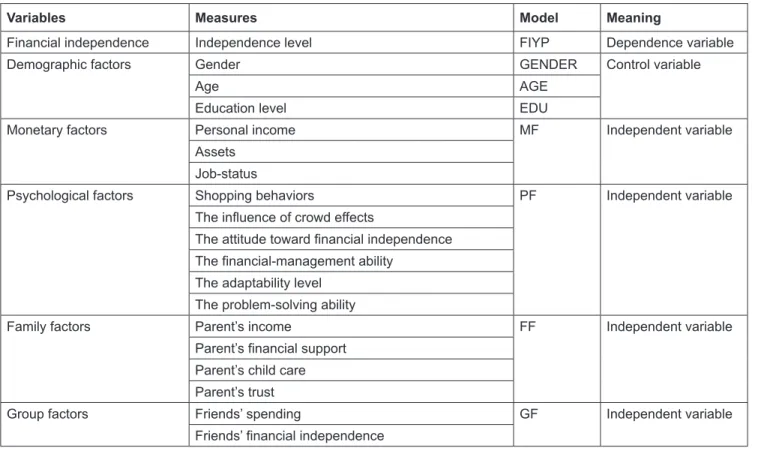
To test the impact of five independent variables including demographic effect, monetary effect, psychological effect,
family-related effect, and group-related effect on the level of financial independence of young people, we use SPSS version 16 to test the following model (Table 1):
Research model: FIYP = α + β
1DF + β
2MF + β
3PF + β
4FF + β
5GF + u
In which α is the intercept, β
1, β
2, β
3, β
4, and β
5are coefficients, and u is the error.
4. Results
4.1. Reliability Test with Cronbach’s Alpha
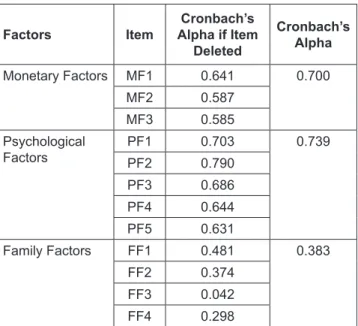
To analyze the reliability, the research team conducted a Cronbach’s Alpha test. The testing result shows that only two groups of variables achieved positive results (Table 2).
The variable MF has Cronbach’s alpha coefficient = 0.700 > 0.6, which means that this factor is well-used for the research model. More specifically, for each item of the monetary factors, the Cronbach’s alpha of deleted items MF1, MF2, MF3 are 0.641, 0.587, and 0.585 respectively, which are less than 0.700. Therefore, there will be no items deleted from the monetary factors. In other words,
Table 1: List of Variables in the Research Model
Variables Measures Model Meaning
Financial independence Independence level FIYP Dependence variable
Demographic factors Gender GENDER Control variable
Age AGE
Education level EDU
Monetary factors Personal income MF Independent variable
Assets Job-status
Psychological factors Shopping behaviors PF Independent variable
The influence of crowd effects
The attitude toward financial independence The financial-management ability
The adaptability level The problem-solving ability
Family factors Parent’s income FF Independent variable
Parent’s financial support Parent’s child care Parent’s trust
Group factors Friends’ spending GF Independent variable
Friends’ financial independence
the independent variable MF’s three components are all well-used. As a result, the monetary factors are reliable and well-used. Thus, the monetary factors are a reliable and well-used scale.
With regards to the variable PF, it has Cronbach’s alpha coefficient = 0.739 > 0.6, which means this factor is well-used.
The Cronbach’s alpha of deleted items of PF1, PF3, PF4, and PF5 are 0.703, 0.686, 0.644, and 0.631 respectively, which are less than 0.739. Therefore, there is no item that will be
removed from the psychological factors. On the other hand, PF2 has Cronbach’s alpha of deleted item = 0.790 > 0.739, which means that PF2 will be removed from the model. PF6 will be removed because of the validity of the questionnaire.
Thus, PF1, PF3, PF4, and PF5 in the psychological factors are reliable and well-used scales.
In terms of Family Factors, it has Cronbach’s Alpha coefficient = 0.383 < 0.6, which means Family Factors are not suitable for the model, therefore, we proceeded to remove it from the research model.
In general, there are 3 factors and 10 items: Monetary Factors (MF1, MF2, and MF3), Psychological Factors (PF1, PF3, PF4, and PF5), and Group Factors (GF1, GF2) which are qualified and meet the conditions to conduct the next steps.
4.2. Exploratory Factor Analysis (EFA)
Next, the Exploratory Factor Analysis (EFA) was used to identify significant factors that could explain most of the variation and validate the constructs in the data. After analyzing data on SPSS with the Principal Components Analysis method and Varimax Rotation, the research team obtained the observational results (Table 3).
First, to determine the suitability of the EFA test for this study, Barlett and KMO (Kaiser-Meyer-Olkin) tests were used. The coefficient KMO = 0.757 showed that factor analysis with data set is appropriate; p-value with sig. = 0.000 from Barlett’s test of Sphericity are statistically significant;
Total variance explained = 66.679 shows that the model explains 66.679% of the variation of the observed variables.
Furthermore, three factors are defined from the test, all of Table 2: Summary of Cronbach’s Alpha Results
Factors Item Cronbach’s
Alpha if Item Deleted
Cronbach’s Alpha
Monetary Factors MF1 0.641 0.700
MF2 0.587
MF3 0.585
Psychological
Factors PF1 0.703 0.739
PF2 0.790
PF3 0.686
PF4 0.644
PF5 0.631
Family Factors FF1 0.481 0.383
FF2 0.374
FF3 0.042
FF4 0.298
Table 3: Summary of EFA Result
Component
Initial Eigenvalues Extraction Sums of Squared
Loadings Rotation Sums of Squared Loadings
Total % of
Variance Cumulative
% Total % of
Variance Cumulative
% Total % of
Variance Cumulative
%
1 3.103 34.478 34.478 3.103 34.478 34.478 2.491 27.683 27.683
2 1.735 19.278 53.756 1.735 19.278 53.756 2.073 23.037 50.72
3 1.163 12.923 66.679 1.163 12.923 66.679 1.436 15.958 66.679
4 0.719 7.986 74.664
5 0.571 6.346 81.01
6 0.541 6.01 87.02
7 0.479 5.321 92.341
8 0.438 4.87 97.211
9 0.251 2.789 100
KMO 0.757
Sig. 0
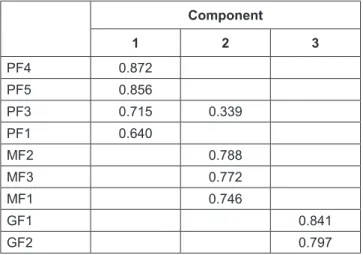
them have the Eigenvalues > 1, thus they will be retained in the analytical model (Table 4).
Additionally, the result indicates one variable, namely, the psychology of self-financial independence (PF3) uploaded in more than one component, but its factor loading in factor 1 is larger than itself in factor 2, therefore, we decided to keep this variable in factor 1. As a result of the reliability measurement of the independent variables using Cronbach’s Alpha test and exploratory factor analysis, the new research model was developed. Thus, the research model includes fours factors that are equivalent to twelve variables. It also has a dependent variable and four independent variables as follows:
FIYP = α + β
1DF + β
2MF + β
3PF + β
4GF + u 4.3. Correlation Analysis
To evaluate the correlation between variables in the model, the Pearson test was performed (Table 5). Overall, between a dependent variable (FIYP) and four independent variables, there is a linear positive relationship. The result illustrates that the correlation between them is statistically significant by confirming Sig. = 0.00. The Pearson correlation is positive (r > 0) and ranges from 0.053 to 0.589.
The Pearson’s correlation results show that Psychological Factor (PF) is strongly correlated with the Financial Independence of Young People (FIYP) by having the strongest correlation (r = 0.589). In contrast, GENDER has the least relation with a dependent variable. Regarding the correlation between independent variables, most of the variables are related to each other, except for the pairs of AGE and Group Factors. Therefore, multi-collinearity can occur between these pairs of variables. To prove this case,
the VIF coefficient will be used when conducting regression analysis in the next section.
4.4. Regression Analysis
The value of R
2equals 0.476, indicating that the 47.6%
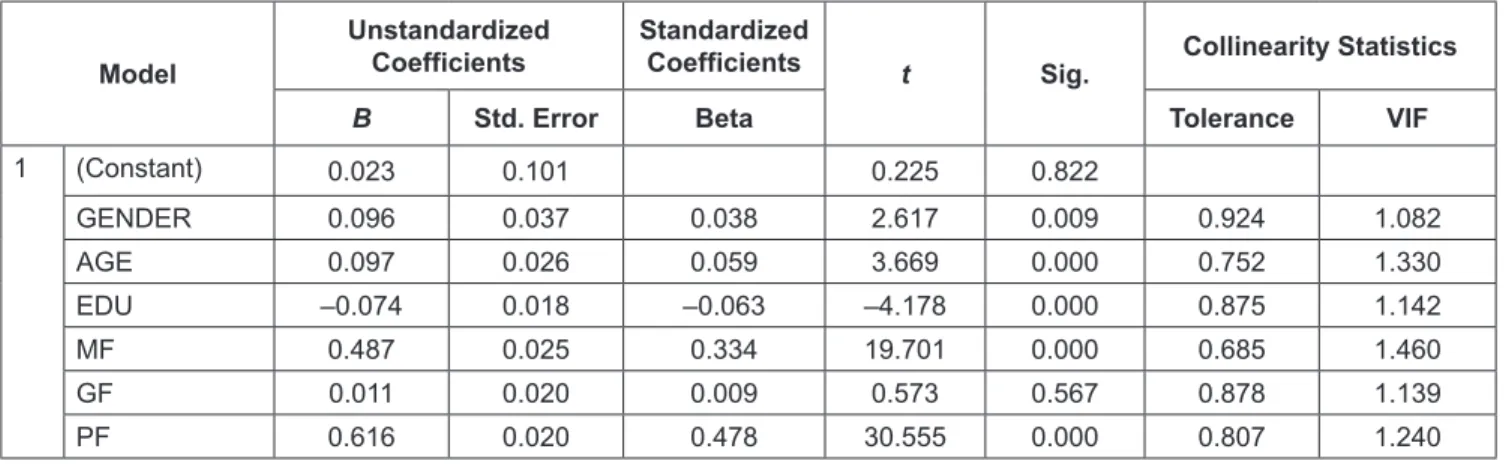
variation in the dependent variable is explained by the change in the independent variables. In other words, the 47.6% variation in the level of financial independence of young people is explained by the change in four independent variables, including demographic factors EF (GENDER, AGE, EDU), psychological factors PF, monetary factors MF and group factors GF. In addition, the Durbin-Watson value is equal to 1.853, falling in the interval of between 1.5 and 2.5, which shows that in the model, the first-order sequence autocorrelation does not occur. Furthermore, the significance value (of F test) is equal to 0.000, less than 0.05, implying that the multiple linear regression model fits the data set and can be used in the analysis (Table 6).
According to the results of the table, the significance value of the group factors GF is equal to 0.567, which is by greater than 0.05 with a confidence level of 95%, rejecting the relation between this variable and the financial independence of young people, Simultaneously, the corresponding figures for the remaining factors, namely demographic factors EF (more specifically GENDER, AGE, EDU), monetary factors MF and psychological factors PF are 0.009, 0.000, 0.000, 0.000 and 0.000, respectively, which are all less than 0.05. This implies a certain level of influence of these factors on young people’s independence in terms of finance.
Furthermore, the analysis of standardized beta shows that almost all of the aforementioned factors have a positive effect on financial independence. In other words, the level of financial independence of young people increases with the growth of each explanatory factor, with the only exception of the EDU variable. In addition, the degree of influence varies depending on the control variables. Specifically, PF and MF are the two most dominant factors determining the level of financial independence of young people. The standardized betas of these two variables are 0.478 and 0.334, respectively, showing that if the values of PF and MF increase by 1%, a 0.478% and 0.334% of improvement in the level of independence in terms of finance will be achieved. In contrast, the group of demographic factors has a rather moderate impact, with the absolute values of the standardized beta of GENDER, AGE, and EDU ranging from nearly 0.040 to just over 0.060. In particular, if the values of GENDER and AGE rise by 1%, the level of financial independence will get better by 0.038% and 0.059%, respectively, and a 1% increase in EDU can lead to a 0.063% decrease in young people’s level of financial independence.
Table 4: Rotated Component Matrix Component
1 2 3
PF4 0.872
PF5 0.856
PF3 0.715 0.339
PF1 0.640
MF2 0.788
MF3 0.772
MF1 0.746
GF1 0.841
GF2 0.797
Table 5: Pearson’s Correlation Results
GENDER AGE EDU FIYP MF GF PF
GENDER Pearson Correlation 1 0.061** –0.221** 0.053** 0.114** –0.113** –0.083**
Sig. (2-tailed) 0.002 0.000 0.006 0.000 0.000 0.000
N 2664 2664 2664 2664 2664 2664 2664
AGE Pearson Correlation 0.061** 1 0.080** 0.317** 0.493** 0.029 0.199**
Sig. (2-tailed) 0.002 0.000 0.000 0.000 0.133 0.000
N 2664 2664 2664 2664 2664 2664 2664
EDU Pearson Correlation –0.221** 0.080** 1 0.056** 0.064** 0.259** 0.205**
Sig. (2-tailed) 0.000 0.000 0.004 0.001 0.000 0.000
N 2664 2664 2664 2664 2664 2664 2664
FIYP Pearson Correlation 0.053** 0.317** 0.056** 1 0.526** 0.155** 0.589**
Sig. (2-tailed) 0.006 0.000 0.004 0.000 0.000 0.000
N 2664 2664 2664 2664 2664 2664 2664
MF Pearson Correlation 0.114** 0.493** 0.064** 0.526** 1 0.102** 0.337**
Sig. (2-tailed) 0.000 0.000 0.001 0.000 0.000 0.000
N 2664 2664 2664 2664 2664 2664 2664
GF Pearson Correlation –0.113** 0.029 0.259** 0.155** 0.102** 1 0.273**
Sig. (2-tailed) 0.000 0.133 0.000 0.000 0.000 0.000
N 2664 2664 2664 2664 2664 2664 2664
PF Pearson Correlation –0.083** 0.199** 0.205** 0.589** 0.337** 0.273** 1
Sig. (2-tailed) 0.000 0.000 0.000 0.000 0.000 0.000
N 2664 2664 2664 2664 2664 2664 2664
**Correlation is significant at the 0.01 level (2-tailed). Source: Survey result.
Table 6: Coefficients
aModel
Unstandardized
Coefficients Standardized
Coefficients t Sig. Collinearity Statistics
B Std. Error Beta Tolerance VIF
1 (Constant) 0.023 0.101 0.225 0.822
GENDER 0.096 0.037 0.038 2.617 0.009 0.924 1.082
AGE 0.097 0.026 0.059 3.669 0.000 0.752 1.330
EDU –0.074 0.018 –0.063 –4.178 0.000 0.875 1.142
MF 0.487 0.025 0.334 19.701 0.000 0.685 1.460
GF 0.011 0.020 0.009 0.573 0.567 0.878 1.139
PF 0.616 0.020 0.478 30.555 0.000 0.807 1.240
a