* Corresponding author : Kyung-Il Sung, Mailing address: Department of Feed Science and Technology, College of Animal Life Sciences, Kangwon National University, Chuncheon, Republic of Korea, 200-701. Tel: +82-33-250-8635, Fax:
+82-33-242-4540, E-mail: [email protected]
Effects of Cultivars and Seeding Dates on Chemical Composition and Energy Content of Switchgrass (Panicumvirgatum L.) in Republic of Korea
Do-Hyeon Ji
1, Byong-Wan Kim
1, Mohammad Mahdi Sargolzehi
2, Shin-Gon Kang
3, Bae-Hun Lee
1, Jing-Lun Peng
1, Jalil Ghassemi Nejad
1, Doo-Hong Min
4and Kyung-Il Sung
1*
1
Department of Feed Science and Technology, College of Animal Life Sciences, Kangwon National University, Chuncheon, 200-701, Republic of Korea,
2Department of Animal Science, College of Agriculture, Ferdowsi University of Mashhad, Mashhad, Iran,
3Planning and Coordination Division, National Institute of Animal Science, Suwon, 441-706, Republic of
Korea,
4Department of Agronomy, College of Agriculture, Kansas State University, Manhattan, Kansas, USA.
ABSTRACT
The objective of this study was to determine the best performing switchgrass (Panicumvirgatum L.) cultivar with three different seeding dates as a bioenergy source in Republic of Korea. Split-plot in time with three replications was performed and three switchgrass cultivars, Carthage (CT), Cave-in-Rock (CIR), and Forestburg (FB) were used in this experiment from 2009 to 2012.
Plots were seeded on April 23, May 4, and May 13, 2009 and were harvested once in November each year. No fertilizer was applied to the field for the first year; however, in second and third years (June 2010 and May 2011, respectively), N, P2O5 and K2O fertilizers were applied in 67,45 and 90 kg h a-1, respectively. Soil pH (5.9) and climate condition including temperature (10.4~17.5℃) and precipitation (89.4~109.8 mm month-1) were suitable for switchgrass cultivation. Total dry matter yields were higher in CT and CIR compared to FB and were 16.9, 15.9, and 4.5 ton ha-1, for CT, CIR, and FB, respectively (p<0.0001).
The samples were analyzed for dry matter (DM), crude protein (CP), neutral detergent fiber (NDF), acid detergent fiber (ADF), crude fiber (CF), ether extract (EE), and ash. No significant differences in energy content (p = 0.96) and chemical composition among cultivars (p>0.05) were found. Seeding dates did not affect DM yield (ton ha-1), chemical composition and energy content significantly (p>0.05). Significant difference was observed for heights among CT, CIR, and FB (177.59, 169.98, and 94.89 cm, respectively, p = 0.0002). In conclusion, based on soil characteristics and climate condition in Korea compared to other countries, switchgrass can be cultivated successfully. Considering dry matter yield and energy content of these three cultivars of switchgrass CT and CIR adapted better to climate in Middle Eastern of Republic of Korea than Forestburg for bioenergy purpose.
(Key words : Bioenergy, Cultivar, Seeding date, Republic of Korea, Switchgrass)
Ⅰ. INTRODUCTION
Switchgrass as a perennial, deep-rooted, warm-season grass tolerates a wide range of soil and climatic conditions and is widely acclaimed as a conservation plant for erosion control, pasture and hay land forage, wildlife habitat, and native prairie restoration (Lee et al., 2010; Alderson and Sharp, 1995). Switchgrass is a native species of North America’s tallgrass prairie and is widely considered as ideal raw material for a new generation of biofuels made from non-food crops. The U.S. Department of Energy has designated switchgrass as one of the principal biofuel species recommended for combustion, gasification, and liquid fuel
production (McLaughlin et al., 1996). Switchgrass can be an
ideal energy crop because of commercial seed availability
of high-yielding cultivars adapted to different geographical
regions of adaptation, relative ease of seeding and establish-
ment, compatibility with conventional farming equipment for
establishment and harvest management. Moreover, production
of large amounts of biomass under a wide range of
environmental conditions, excellent wildlife cover provided
(Wright, 2007), delineation of management regimes establish
strong stands of switchgrass (McLaughlin and Adams Kszos,
2005). Tolerance to biotic and abiotic stress agents
(McLaughlin, 1992), great potential to protect the environment
through carbon sequestration and erosion control (Dewald et
al., 1996; Liebig et al., 2008) are some of advantages of switchgrass. Switchgrass is estimated to provide 60 GJ ha
-1year
-1of net energy and producing 540% more renewable energy than nonrenewable energy which has consumed (Schmer et al., 2008).
During 2012, Republic of Korea imported more than 2.5 million barrels oil daily. As sustainability of modern economics is based in part on the capacity of countries to ensure their energy supplies (Mkoma and Mabiki, 2011), it is necessary to introduce new energy sources in Republic of Korea that can be achieved by Korean own resources. One of the best choices is biofuels, since these are derived from biomass, and there are more than 1.5 million hectares highly productive soils in Republic of Korea beside more than 8 million hectares poor lands that are not suitable for grain crops. It is because of deficiency in plant nutrients, but a good fertilizer-use plan can improve their condition for plant biomass production (Beinroth et al., 2001).
Although switchgrass is mostly well-known for biomass production, but its original use as forage mainly has been investigated (Parrish and Fike, 2005). Bates et al. (2008) reported that switchgrass can actually produce high quality forage with as high as 16~17% CP. It is recommended that if switchgrass is planted primarily for biofuel production, there is potential to harvest the early growth through haying or grazing for the biofuel market.
Therefore, this study was conducted in Republic of Korea to evaluate switchgrass performance with different cultivars and seeding dates if it can be considered as a source of bioenergy.
Ⅱ. MATERIALS AND METHODS
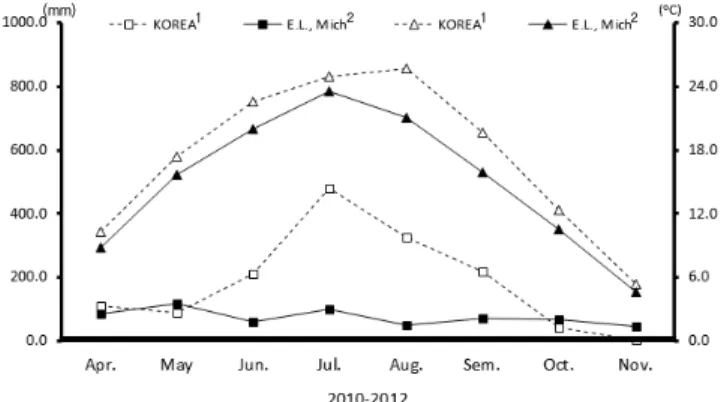
This study was conducted from 2009 to 2012 in Chuncheon (37°55’03.64”N, 127°46’22.71”E), Gangwon-do, Republic of Korea. Three switchgrass cultivars including Carthage (CT), Cave-in-Rock (CIR) and Forestburg (FB) were used in this experiment with three different seeding dates including April 23, May 4, and May 13. The field was divided into three parts which had 3 plots (cultivars) and 3 sub-plots (seeding dates) with 3 replications. Monthly average temperature and precipitation during the experiment from April to November is reported for 2010 to 2012 (Fig. 1).
Soil pH is measured and was 5.9 which was suitable for switchgrass cultivation (Table 1). Monthly Average temperature during seeding dates in April-May was 10.4 to 17.5℃ while the precipitation was 109.8 to 89.4 mm month
-1from 2010 to 2012 (Fig. 1). No fertilizer applied to the field for the first year (2009), but in second, third and fourth years (2010, 2011 and 2012, respectively), N, P
2O
5and K
2O fertilizers were applied in 67, 45 and 90 kg ha
-1, respectively.
The amount of seed used for seeding was 32.5, 32.5 and 26.5 kg ha
-1for CT, CIR and FB, respectively. Pure live seed (PLS) calculated by multiplying the purity decimal by the germination decimal (Bughrara et al., 2007). The field was prepared for distances of 20 cm between each row.
Each year during November, plant heights were measured and then all were harvested. The harvesting height was considered 15 cm above the ground. Immediately after harvesting, samples were sent to laboratory for further analysis.
Dry matter (DM), crud protein (CP), crud fiber (CF), neutral detergent fiber (NDF), acid detergent fiber (ADF), ether extract (EE) and Ash were measured according to AOAC procedure (1990). Energy was measured as calories using a bomb calorimeter (PARR 1261 Isoperibol, Kyoto, Japan).
Statistical analyses were performed using SAS system v.
9.1 (SAS Institute. Inc. Cary, NC, USA). Split-plot design was carried out to analyze data by ANOVA. The T test was used to measure significant differences between means.
It is well documented that switchgrass will reach to its optimum production level in the second or third year after seeding (Sanderson et al. 1996; McLaughlin et al. 1999;
Christian et al. 2002; Samson 2007), and due to establishment management and variable data, data for the first year (2009, seeding year) were not considered in statistical analysis.
The model used for analyzing data was as follow:
Y
ijk= µ + C
i+ S
j+ (CS)
ij+ P
k+ ε
ijkwhere:
Y
ijk= mean of each observation trait µ = overall mean
C
i= effect of cultivar S
j= effect of seeding date
(CS)
ij= interaction of cultivar × seeding date P
k= effect of plot
ε
ijk= residual effects
To evaluate if switchgrass in its last harvesting date
Table 1. Field soil characteristics
pH EC*
(ds/m)
NH
4-N (mg/kg)
NO
3-N (mg/kg)
OM**
(g/kg)
P
2O
5(mg/kg) CEC*** Ex. Cation (cmol(+)/kg)
Ca K Mg Na
5.9 0.04 10.00 20.40 26.70 140.20 6.50 3.69 0.44 0.56 0.09
* Electrical conductivity.
** Organic matter.
*** Cation-exchange capacity.
(mm) 1 2 1 2
Fig. 1. Monthly average temperature and precipitation during the experiment (2010~2012)
1Average temperature of each month.
2Total precipitation of each month.
(November) can be considered as forage, a comparison between chemical compositions of CT, CIR and FB cultivars of switchgrass and some conventional forages were also estimated. For this reason, forage chemical compositions reported by Gadberry (2004) were used and these forages were considered as conventional forages. This comparison was performed by using a T test. By performing the T test, a similarity range for each chemical composition of switchgrass cultivars was arranged. Finally, the percentage of conventional forage with similar characteristics to switchgrass cultivars was calculated.
Ⅲ. RESULTS
Soil characteristic was measured while soil pH was 5.9 and P
2O
5was 140.2 (mg kg
-1) which were in the normal range for better growth of switchgrass (Table 1). DM yields (ton ha
-1) in the second, third, and fourth production years (2010~2012) were significantly higher in CT and CIR than FB (p<0.0001) while there were no significant differences among seeding dates (April 23, May 4 and May 13, Fig. 2).
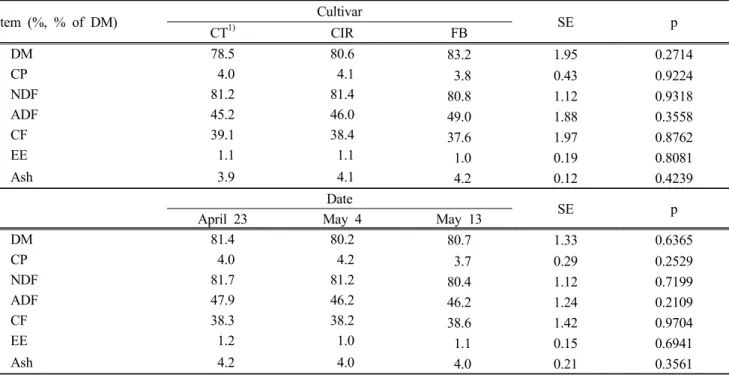
Chemical compositions including CP, ADF, NDF, CF, EE, and Ash were not different among the cultivars and seeding dates (p>0.05, Table 2). However, Ash content tended to be lower in CT than CIR and FB while EE tended to be higher in CT compared with CIR and FB.
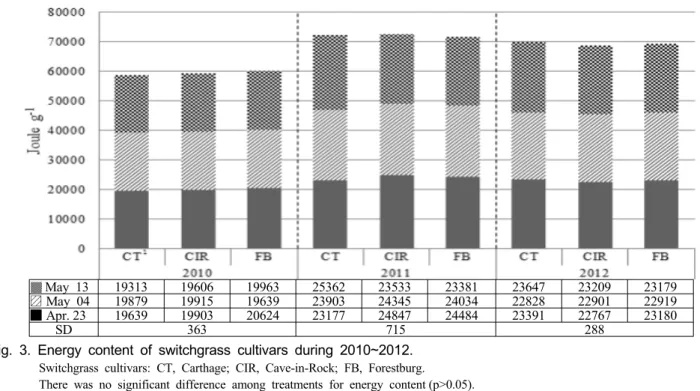
Energy content was higher in CT when compared with FB considering DM yield (p<0.05, Fig. 3). No difference was observed among seeding dates in energy content (p>0.05, Fig. 3).
Chemical composition of CT, CIR and FB when compared with other conventional forages (Gadberry, 2004) showed that almost for all of them there are some forages having similar range of chemical compositions of switchgrass cultivars (Table 3). Significant difference was observed for height among CT, CIR and FB (177.59, 169.98 and 94.89
cm, respectively; p=0.0002).
Ⅳ. DISCUSSION
The basic specification for a species to be suitable as a biomass crop is a high yield of dry matter, preferably with low moisture content and low concentrations of minerals at harvest (Christian et al., 2002). For establishing switchgrass, soil pH should be 5.0 or above, although a pH of 6.0 is highly recommended (Bughrara et al., 2007) which was defined 5.9 in the present experiment (Table 1). Soil test which indicates medium or higher phosphate (110~190 mg kg
-1P
2O
5) then no fertilizer is needed at seeding (Bughrara et al., 2007). In this study P
2O
5was defined to be 140.2 which considered in the normal range for switchgrass cultivation.
One main point which should be considered for FB is
changing its optimum location for growing compared with
CT and CIR. Casler et al. (2004) has shown that upland
populations cannot be moved south of their point of origin
by more than one plant hardiness zone, and lowland
populations should not be moved north of their point of
origin by more than one hardiness zone without expecting
severe losses in biomass yield and survival. In the United States it is reported that CIR and FB are better adapted to mid and northern latitudes (McLaughlin and Adams Kszos, 2005). Most parts of the United States land is located between 30
thand 50
thparallel north, while Republic of Korea is located between 34° N and 38° N, which demonstrates that Republic of Korea is located below the mid-latitudes of the United States. Although the climate condition in Korea and United State is not partially same;
however, climate condition including temperature (℃) and precipitation (mm month
-1) which was reported in the present experiment (Fig. 1) indicates that Republic of Korea lands is suitable for these cultivars. During seeding date temperature and precipitation showed similarity between Korea and USA (the part which switchgrass is cultivated- East Lansing, Michigan). However, Korea during June to August experiences rainy season which shows dramatic increase in precipitation compare to East Lansing, Michigan, USA (Fig. 1). These results are in acceptance with McLaughlin
and Adams Kszos (2005 finding FB better adopted to higherlatitude but does not support their similar conclusion for CIR.
There were no significant differences among switchgrass cultivars for DM (Table 2). However all of cultivars represented lower DM compared to that was reported by McLaughlin et al. (1996) (78.5, 80.6 and 83.15% for CT, CIR and FB, respectively vs. 85~87%). It indicates almost unsuitable condition for bailing and transporting beside reduction in energy produced per units of harvested biomass. It is reported that low nitrogen content beside higher amounts of cellulose are necessary for bioenergy purposes (Rutz and Janssen, 2007). Cellulose is broken down by either an acid or enzyme into fermentable sugars prior to fermentation. But, nitrogen reduces the conversion efficiency of fuels into energy, and also can become an air pollutant after combustion. Acid detergent fiber (ADF) is mostly composed of cellulose (Saha et al., 2010) and there was no significant difference (p = 0.3558) among CT, CIR and FB for this composition. There was no significant difference for CP among switchgrass cultivars. Nevertheless, it seems likely that FB has almost higher amounts of ADF, lower CP, higher DM and more energy production than CT and CIR.
Emerging bioenergy systems hold the promise of helping to reduce dependence on foreign oil, increase rural prosperity, and reduce gas emission. Meeting the energy demands of the future requires the development of transformative, ecologically based agricultural systems. These requirements if fulfilled ensure sustainable environmental, economic, and social outcomes. Successful bioenergy systems require strategic approaches that pose many scientific researches, economic, data management, and communication challenges. These are some strategies to reduce costs for biomass production and improving opportunities to develop a sustainable production system including sustainable agricultural production. In this study switchgrass as a new bioenergy source which has been successfully examined in some other researches (Lee at al., 2010; Christian et al., 2002) is introduced. The first generation biofuels refer to the fuels that have been derived from sources like starch, sugar, animal fats and vegetable oils. The second generation biofuels which are also known as advanced biofuels, are fuels that can be manufactured from various types of biomass (Rutz and Janssen, 2007). As the biomass is considered for second generation biofuel production, cultivars with greater amounts of biomass are more desired. Based on the present study during 2010 to 2012, CT and CIR produced higher biomass than FB (16.9 and 15.9 vs. 4.5 ton ha
-1year
-1), which are better fit to biofuels purposes in Republic of Korea. However, FB had represented some characteristics that make it difficult to exclude it totally from comparisons in upcoming periods. Although the average annual yield of FB were significantly lower than CT and CIR, there was an annually increase in this cultivar’s yield, and on the other hand, a slight decrease in CT and CIR annual yields (Fig. 2). An important extension point about switchgrass for Republic of Korean farmers, which was clearly observed in the present findings and was in consistent with other reports (Lee et al., 2010; McLaughlin et al., 1999; Samson, 2007) is the low and variable production of switchgrass in the first seeding year. This might be explained by switchgrass characteristics which allocate so much energy for root establishment and therefore, it has low biomass production in the first year.
For this reason, switchgrasses typically are not harvested
during the first growing season but, in the second and third
May 13 13.5 15.2 6.6 14.1 18.2 9.0 14.0 14.3 13.5
▨ May 04 16.2 14.1 7.2 18.9 17.9 10.5 13.5 14.4 12.1
■ Apr. 23 17.4 15.0 7.1 16.9 14.9 10.8 15.1 13.5 14.2
SD 4.3 3.7 0.8
Fig. 2. Changes in dry matter yield (ton ha
-1) of switchgrass cultivars according to seeding dates during 2010~
2012.
Different characters are representing significant difference.
The first year was not considered in statistical analysis.
1)CT: Carthage, CIR: Cave-in-Rock, FB: Forestburg.
Table 2. Effects of cultivars and seeding dates on chemical composition of switchgrass
Item (%, % of DM) Cultivar
SE p
CT
1)CIR FB
DM 78.5 80.6 83.2 1.95 0.2714
CP 4.0 4.1 3.8 0.43 0.9224
NDF 81.2 81.4 80.8 1.12 0.9318
ADF 45.2 46.0 49.0 1.88 0.3558
CF 39.1 38.4 37.6 1.97 0.8762
EE 1.1 1.1 1.0 0.19 0.8081
Ash 3.9 4.1 4.2 0.12 0.4239
Date SE p
April 23 May 4 May 13
DM 81.4 80.2 80.7 1.33 0.6365
CP 4.0 4.2 3.7 0.29 0.2529
NDF 81.7 81.2 80.4 1.12 0.7199
ADF 47.9 46.2 46.2 1.24 0.2109
CF 38.3 38.2 38.6 1.42 0.9704
EE 1.2 1.0 1.1 0.15 0.6941
Ash 4.2 4.0 4.0 0.21 0.3561
1)CT: Carthage, CIR: Cave-in-Rock, FB: Forestburg.
years after seeding, they will reach to their two-third and the final production capacity. Dry matter content is an important criterion for bioenergy. In the present study, higher DM yield (Fig. 2) in CT and CIR compared with
FB (16.9, 15.9 and 4.5 ton ha
-1, respectively) resulted in
higher energy content (Fig. 3). As transportation of moisture
and its vaporization during combustion process are energy
consuming, feedstocks with greater amounts of dry matter
May 13 19313 19606 19963 25362 23533 23381 23647 23209 23179
▨ May 04 19879 19915 19639 23903 24345 24034 22828 22901 22919
■ Apr. 23 19639 19903 20624 23177 24847 24484 23391 22767 23180
SD 363 715 288
Fig. 3. Energy content of switchgrass cultivars during 2010~2012.
Switchgrass cultivars: CT, Carthage; CIR, Cave-in-Rock; FB, Forestburg.
There was no significant difference among treatments for energy content (p>0.05).
1)CT: Carthage, CIR: Cave-in-Rock, FB: Forestburg
Table 3. Percentage of conventional forage
1)having lower, similar or higher chemical composition compared with switchgrass cultivars
Item
Switchgrass cultivars
CT
2)(%) CIR (%) FB (%)
L
3)R H L R H L R H
CP 1.6 1.6 96.7 1.6 1.6 96.7 1.6 1.6 96.7
NDF 96.7 1.6 1.6 96.7 1.6 1.6 96.7 1.6 1.6
ADF 93.0 4.7 2.3 93.0 4.7 2.3 93.0 2.3 4.7
CF 89.3 10.7 0.0 89.3 10.7 0.0 89.3 0.0 10.7
EE 2.2 2.2 95.6 2.2 0.0 97.8 2.2 2.2 95.6
Ash 67.2 17.2 15.5 70.7 17.2 12.1 12.1 12.1 75.9
1)Forage used in this estimation between over 50 species of forages and cultivars Gadberry 2004.
2)CT: Carthage, CIR: Cave-in-Rock, FB: Forestburg.
3)L, Lower than; R, in the Range; H, Higher than switchgrass cultivar characteristics.
are more desired (McLaughlin et al., 1996).
Lemus et al. (2002) reported 139 and 118 cm height for CT and also lower yield for CT compared with our observations (9.9 vs. 16.9 ton ha
-1). Garland (2008) stated that for the United States, upland varieties usually grow 150 to 180 cm tall and lowland varieties are mostly 210 to 300 cm tall. Casler et al. (2004) classified FB and CIR as upland varieties and Lemus et al. (2002) classified CT as one of lowland varieties. In the present experiment CT, CIR and FB had 177.6, 170.0 and 94.9 cm height, respectively.
Switchgrass cultivars, i.e., CT, CIR and FB represented comparable chemical compositions with conventional forages in their last harvesting time. Beside switchgrass advantages in biomass production, the presence of some conventional forages having chemical compositions below or above switchgrass cultivars indicate that switchgrass can be considered as forage not only in early growing times but also in the last harvesting time. However, switchgrass is classified among poor quality forages such as wheat straw, corn cobs and foxtail hay millets.
Results of this study suggest that CT and CIR are better
switchgrass cultivars than FB for bioenergy due to higher DM yield and higher energy contents. Because seeding date did not affect switchgrass characteristics significantly, it is recommended, from the practical point, to perform seeding in late April to prevent farmers in Korea from overlapping works.
Ⅴ. ACKNOWLEDGMENTS
This study was supported partially by 2013 Research Grant from Kangwon National University (No. 120131242).
Ⅵ. REFERENCES
Alderson, J.S. and Sharp W.C. 1995. Grass varieties in the United States. CRC Press. pp.194-198.
AOAC. 1995. Offical methods of analysis. 16th ed. Association of Official Analytical Chemists, Washington, DC, USA.
Bates, G., Keyser P., Harper C. and Waller J. 2008. Using switchgrass for forage. UTBiofuels Initiative. The University of Tennessee Institute for Agriculture. UT extension SP701-B.
Available from:
https://utextension.tennessee.edu/publications/documents/SP701-B.pdf Beinroth, F.H., Eswaran H. and Reich P.F. 2001. Land quality and
food security in Asia. In: Bridges et al. (Eds.). Responses to land degradation, proceedings of the 2nd international conference on land degradiation and desertification, Khon Kaen, Thailand, Oxford press, New Delhi, India.
Bughrara, S., Leep, R., Min, D.H., Hudson, D. and Dietz, T. 2007.
Switchgrass as a Biofuel for Michigan. MSU Extension Bulletin E-2987. p. 4.
Casler, M., Vogel, K., Taliaferro, C. and Wynia, R. 2004. Latitudinal adaptation of switchgrass populations. Crop Science 44:293-303.
Christian, D., Riche A. and Yates N. 2002. The yield and composition of switchgrass and coastal panic grass grown as a biofuel in Southern England. Bioresource Technology 83:115-124.
Dewald, C., Henry, J., Bruckerhoff, S., Ritchie, J., Dabney, S., Shepherd, D., Douglas, J. and Wolf, D. 1996. Guidelines for establishing warm season grass hedges for erosion control.
Journal of Soil and Water Conservation 51:16-20.
Gadberry, S. 2004. Composition of some livestock feeds, cooperative extension service, University of Arkansas, US department of agriculture, and county governments cooperating, Extension Publication FSA3043. Available from:
http://www.uaex.edu/publications/pdf/FSA-3043.pdf
Garland, C.D. 2008. Growing and harvesting switchgrass for ethanol production in Tennessee. University of Tennessee, Department of Agricultural Economics, Extension Publication SP701-A.
Available from:
http://utextension.tennessee.edu/publications/spfiles/SP701-A. pdf.
Lee, K.H., Moon, H.S., Kim, M.H., Koo, H.N., Park, J.Y., Kim, B.Y. and Sung, K.I. 2010. Growth characteristics and chemical composition according to cultivar and harvesting time of switchgrass (Panicum virgatum L.). Proceeding of Korean society of grassland and forage science. Chungju. Korea. pp. 160-161.
Lee, J.K., Park, H.S., Hwangbo, S., Kim, W.H., Lim, Y.C., Seo, S., Kim, J.D. and Jang, Y.S. 2010. Effects of different planting dates on growth characteristics, yield and forage quality of switchgrass (Panicum virgatum) in central region. Proceeding of Korean society of grassland and forage science. Chungju. Korea.
pp. 162-163.
Lemus, R., Brummer E.C., Moore K.J., Molstad N.E., Burras C.L.
and Barker M.F. 2002. Biomass yield and quality of 20 switchgrass populations in southern Iowa, USA. Biomass and Bioenergy 23:433-442.
Liebig, M.A., Schmer, M.R. and Vogel, K.P., Mitchell, R.B. 2008.
Soil carbon storage by switchgrass grown for bioenergy. Bio Energy Research 1:215-222.
McLaughlin, S. 1992. New switchgrass biofuels research program for the Southeast. Proceedings of the Annual Automobile Technology Development Contractors’ Coordination Meeting, Dearborn, Michigan, November 2-5, 1992. pp. 111-115.
McLaughlin, S., Samson, R., Bransby, D. and Wiselogel, A. 1996.
Evaluating physical, chemical, and energetic properties of perennial grasses as biofuels. Proc. Bioenergy. pp. 1-8.
McLaughlin, S., Bouton, J., Bransby, D., Conger, B., Ocumpaugh, W., Parrish, D., Taliaferro, C., Vogel, K. and Wullschleger, S.
1999. Developing switchgrass as a bioenergy crop. Perspectives on new crops and new uses. pp. 282-299.
McLaughlin, S.B. and Adams Kszos, L. 2005. Development of switchgrass (panicum virgatum) as a bioenergy feedstock in the United States. Biomass and Bioenergy 28:515-535.
Mkom, S.L. and Mabiki, F.P. 2011. Theoretical and practical evaluation of Jatropha as energy source biofuel in Tanzania. In:
Marco Aurélio dos Santos Bernardes (Ed.), Economic Effects of Biofuel Production, InTech. Rijeka, Croatia. p. 1.
Parrish, D.J. and Fike J.H. 2005. The biology and agronomy of switchgrass for biofuels. BPTS 24:423-459.
Rutz, D. and Janssen, R. 2007. Biofuel technology handbook.
Munich, Germany, WIP Renewable Energies. p. 128.
Saha, U.K., Sonon, L.S., Hancock, D.W., Hill, N.S., Stewart, L.,
Heusner, G.L. and Kissel D.E. 2010. Common terms used in animal feeding and nutrition. p. 3.
Samson, R. 2007. Switchgrass production in Ontario: A management guide. Resource efficient agricultural production (REAP)-Canada.
pp. 1-4.
Sanderson, M., Reed, R., McLaughlin, S., Wullschleger, S., Conger, B., Parrish, D., Wolf, D., Taliaferro, C., Hopkins A. and Ocumpaugh, W. 1996. Switchgrass as a sustainable bioenergy crop. Bioresource Technology 56:83-93.
Schmer, M.R., Vogel, K.P., Mitchell, R.B. and Perrin, R.K. 2008.
Net energy of cellulosic ethanol from switchgrass. Proceedings of the national academy of sciences 105:464-469.
Wright, L. 2007. Historical perspective on how and why switchgrass was selected as a “model” high-potential energy crop.
ORNL/TM-2007/109 Oak Ridge, TN: Bioenergy Resources and Engineering Systems. p. 1.
(Received March 10, 2014 / Revised May 2, 2014 / Accepted May 8, 2014)