www.kwss.or.kr
1Agronomy Division, Coconut Research Institute, Lunuwila 61150, Sri Lanka.
2Faculty of Agriculture, University of Peradeniya, Peradeniya, Sri Lanka.
* Corresponding author:Phone) +94-77-9351163, Fax) +94-31-2257391, E-mail) [email protected]
(Received August 24, 2011; Revised September 6, 2011; Accepted September 10, 2011)
Ⓒ 2011 Korean Society of Weed Science
The Allelopathic Effects of Lantana camara on Seed Germination and Growth of
Selected Bioassay Species
Senarathne, S. H. S.
1*, R. D. V. Fernando
2and U. R. Sangakkara
2ABSTRACT The allelopathic effects of Lantana camara L. (Family:Verbenaceae) on germination and seedling establishment of some agricultural crops and weed species have been identified. Aqueous extracts of dry leaves and contaminated soil where L. camara is grown were used to verify allelopathic effect on seed germination of five bioassay species; Raphanus sativas, Capsicum annum, Lycopersicum esculantem, Crotalaria juncia and Chromoleana odorata. Fifty seeds from each bioassay species were placed in a petri dish containing leaf extracts or contaminated soil, and seed germination were examined after 3 days. The plant house experiments were carried out to evaluate the impact of L. camara contaminated soil and leaf debris using L. esculantem as the indicator plant. Seed germination of L.
esculentem, C. junica and Capsicum annum was significantly inhibited by L. camara contaminated soil.
However, the degree of inhibition varied among the bioassay species. The aqueous extract of dry leaves of L. camara was highly phytotoxic and it significantly reduced seed germination of all bioassay species.
There was a decline in plant height, leaf area and shoot dry weight of tomato only in early growth stages when grown in L. camara contaminated soils. However, incorporation of leaf debris into soil affected the vegetative growth of tomato in early stages when the leaf debris concentration was increased. Growth recovered at the latter part of the life cycle. On the basis of these results it can be concluded that the allelochemicals in L. camara contaminated soils are harmful to the seed germination of crop species. The adverse effect was present only during the early growth stages and it did not suppress the latter part of the plant growth. These responses are attributed to allelopathic effects which need confirmation under field conditions.
Key words: allelopathy; germination; Lantana camara; weed seed.
INTRODUCTION
Allelopathy is the negative effect of chemicals released by one plant species on the growth or reproduction of another plant species (Weidenhamer et al. 1989; Schenk et al. 1999; Callaway and Aschehoug, 2000). Allelopathy also is described as interference in the growth of neighboring plants or microorganisms by allelochemicals that are released through volatilization, eluviations and decomposition of the plant or root exudates during growth (Rice 1984; Putman and Tang 1986). Allelochemicals also can indirectly affect plants through the inhibition of microorganisms, including nitrogen fixing and nitrifying bacteria (Rice 1964), and ectomycorrhizae (Walker et al. 1999). Allelopathy widely exists in nature and plays a vital role in crop cultivation systems, controlling weeds, preventing crops from disease and insect infection.
L. camara L. (Family:Verbenaceae) is considered as an invasive woody shrub, and is found throughout Sri Lanka. Its toxic properties against cattle, small ruminants (Ghisalberti 2000), spores of liverwort Aserella angusta (Kothari and Chaudhary 2001), cyanophyte Microcystis aerugina (Kong et al. 2006), antimicrobial activity on Bacillus subtillis has been well documented (Loset et al. 2000; Misra and Laatsch 2000). Further, the toxic effects brought out by allelopathy of Lantana on root growth of soya bean and wheat have also been reported (Oudhia 2000; Oudhia and Tripathi 2000). On the other hand, some beneficial effects of L. camara have also been recognized. It is used, either along or together with other plants such as Croton lacciferus as mulch in paddy fields in the conventional agricultural practices for pest control. Allelochemicals of Lantana are composed of Lantadene A and Lantadene B, volatile oils such as caryophyllene, cieol and pinene (Kong et al. 2006; Abdel-Hady et al. 2005). However, its effect on weeds has not been reported.
The present study was undertaken to determine the alleopathic activity of L. camara on seed germination of selected bioassay species. The study focused on
some important vegetables and weed species, namely L.
esculentum, Raphanus sativas, C. annum, C. junica and Chromoleana odorata, which are a noxious weeds in coconut plantations. The aim of the study was to identify the impact of Lantana on germination of selected weed and crop species and seedling growth of L. esculentum.
MATERIALS AND METHODS
The experiments were carried out in the plant house of the Coconut Research Institute located in the Low country Intermediate Zone of the North Western province of Sri Lanka from March to August 2007. In the plant house, the photo-synthetically active radiation (PAR) ranged between 500∼1,150 µmol m
-2s
-1and the average day and night temperatures were in the range of 30∼34
℃ and 26∼30℃, respectively. Relative humidity varied between 35∼60% during the day and 20∼27% during the night. In the bioassay, R. sativas, C. annum, L.
esculentem, C. junica and C. odorata seeds were used as the test species due to their high sensitivity to the phytotoxic activity of L. camara as observed in a preliminary study. Seeds of the selected weed species namely C. odorata and C. junica were collected from five different locations in the major coconut growing regions of Sri Lanka between in March 2007 and were stored at 5℃ under dark conditions. Seeds of radish (R.
sativa), chillie (C. annum), and tomato (L. esculentem) were taken from the Seed and Plant Material Development Centre, Department of Agriculture, Sri Lanka. The selected treatments of the experiments were arranged in a Complete Randomized Design (CRD) with ten replicates (each Petri dish and pot representing one replication of a single species in each trial) in the respective studies.
Effect of residual toxicity of contaminated soil
on seed germination of bioassay species
Contaminated soil (top soil obtained from an area
covered by a well grown canopy of Lantana plants
continuously for 5 years) was collected to a depth of 5 cm. Soil from a field that did not have Lantana camara was used as a control. These soils were of the same soil group with similar chemical and physical properties. Soil was classified as Madampe soil series (light textured high productive soil series; bulk density =
1.48±0.02 g cm
-3; total available water = 5.71±0.89%;
penetrometer resistance = 240±16.3 N cm
-2) was located in Bandirippuwa Estate, Lunuwila in the low country Intermediate climate zone (08
o02N, 79
oE, 35m altitude) (Senarathne et al. 2010).
The two soils were dried at room temperature and sieved through a 2 mm mesh. Ten grams of test and control soils were uniformly spread on separate 9 cm diameter petri dishes, fifty seeds of the bioassay species were placed uniformly on these soils and covered with the same soil. Soil was adequately moistened with distilled water. The dishes were kept in plant house at 27∼30℃. Each treatment was replicated ten times.
Effect of aqueous extracts of dry leaves on seed germination of bioassay species
Dry leaves of L. camara were cut into small pieces, dried under full sunlight for 1 week and ground to a powder with an electrical grinder (Thomas Wiley, Thomas Company, U.S.A). The dried powdered leaves were immersed in distilled water in the ratio of 1:20 w /v and agitated for 24 hours on an orbital shaker at room temperature (29℃). The extract was strained through two layers of filter paper (Whatmans No. 02).
The extract was refrigerated at 5℃ until use. One concentration of the dry leaf aqueous extract was used in this experiment. Fifty seeds each of selected bioassay species were placed separately in 9 cm diameter petri dishes lined with cotton wool and 5 ml volumes of the leaf extracts was added per dish, distilled water was used for the control. The perti dishes were kept in a plant house for 72 hours at 28∼30℃. Treatments were replicated ten times.
Effect of residual toxicity of contaminated soil on growth of Lycopersicum esculentem
Soils obtained from Lantana grown and Lantana free fields were dried at room temperature and sieved through a 2 mm mesh. Uniform three weeks old tomato seedlings were transplanted in polythene bags (28 cm diameter, 40 cm height and 500 gauges) filled with either of the two soils, to determine the impact of Lantana contaminated soil on growth and yield of tomato. Each treatment had 16 replicates and one polythene bag was referred to as a replicate.
Effect of Lantana debris on growth of Lycopersicum esculentem
Mature Lantana leaves were collected from a coconut estates and air dried for one week. The dried leaves were grounded using a laboratory mill (Thomas-wiley, Thomas Company, U.S.A.) and kept in a refrigerator until use.
The soil was prepared by mixing four rates of Lantana leaves as given below
T
1- 0 g of leaf debris / kg soil (control) T
2- 10 g of leaf debris / kg soil T
3- 20 g of leaf debris / kg soil T
4- 30 g of leaf debris / kg soil
Uniform three weeks old tomato seedlings were transplanted in separate polythene bags (28 cm diameter and 40 cm height and 500 gauges) filled with these prepared soils to determine the impact of Lantana leaf debris on growth and yield of tomato. Sixteen replicates of each treatment were used, where one polythene bag was a replicate.
Data collection
Germination of R. sativas, C. annum, L. esculentem,
C. junica and C. odorata were recorded daily for 12
days according to the method of the Association of
Official Seed Analysis (1985) to determine the germi-
nation percentage using the following formula.
Treatment
Seed germination %
Raphanus
sativas
Lycopersicum esculentem
Capsicum annum
Crotalaria junica
Chromoleana odorata
T1 ControlT2 Lantana camara Significance LSD (P = 0.05)
76 69 ns
-
78 42
**
26.5
89 35
**
24.4
58 17
* 29.5
42 38 ns
*Significant **Highly Significant.
Table 1. Effect of residual toxicity of contaminated soil on seed germination of selected bioassay species.
Germination % = No of Germinated seeds
* 100 Total no of seeds
Statistical analysis
An Analysis of Variance (ANOVA) using Statistical software SAS was carried out and the significance was tested using Least Significant Differences (LSD) at 5%
probability (<B31>SAS Institute 1999</C>).
RESULTS AND DICUSSION
Residual toxicity of contaminated soil on seed germination of selected bioassay species Seed germination of bioassay species in soil from the field with Lantana for 5 years was lower than those in the soil from the area without Lantana (Table 1). These demonstrated that soil collected from the L. camara rhizosphere had a strong inhibitory effect on the seed germination of L. esculentem, C. junica and C. annum.
However, there was no significant difference of the allelopathic effect of L. camara on R. sativas and C.
odorata seeds. The lowest germination percentage (17%) was recorded in C. junica seeds, when those seeds were sown on the L. camara contaminated soil, while the highest germination percentage was found in R. sativas (69%) seeds when grown in the same soil (Table1). This is in agreement with the results of Chung and Miller (1995) who reported the inhibitory effect of soil collected from the surrounding area of
alfalfa plants on their test bioassay species. This inhibition may be due to the release of phytotoxic substances by the root itself or through interaction between microorganisms and tissue litter.
However, this interpretation needs further study because several factors are involved in allelopathic activity and seed germination. In addition, the alteration of the physico-chemicals characteristics of the soil may affect the quantitative and qualitative of phyto-chemicals, which, in turn influences the allelopathic expression of plants (De Moral and Muller 1970). However, Achhireddy and Singh (1984) reported that soil collected under Lantana had no effect on germination and growth of milkweed (Asclepias syriaca) vine. However, in our experiment L. camara contaminated soil inhibited germination of the above species to a greater extent than the control treatment.
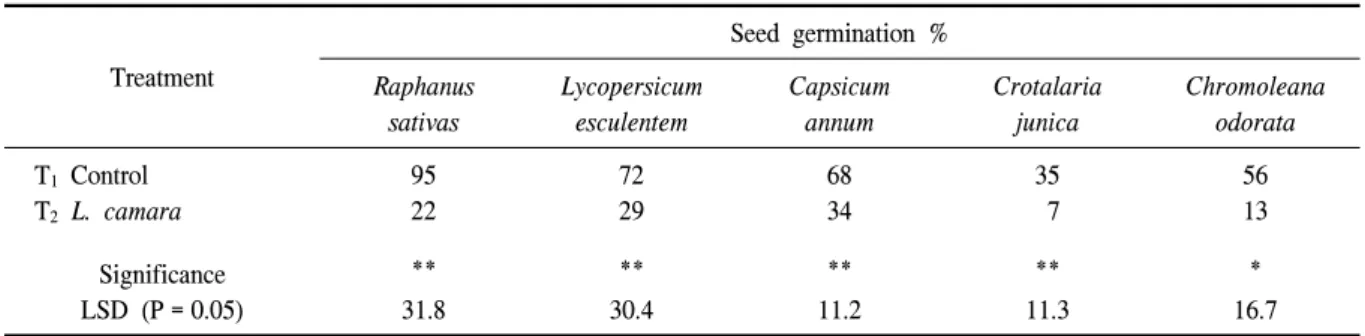
Effect of aqueous extracts of dry leaves on seed germination of selected bioassay species Application of L. camara dried leaf extract significantly reduced the seed germination and the lowest germination percentages (7% and 13%) were found in C. juncia and C. odorata, while the highest germination percentage (34%) was found in C. annum seeds (Table 2).
These results are supported by the findings of Helgeson
and Konzak (1950) where aqueous extracts of field
bindweed (Convolvulus arvensis) and Canada thistle
(Crisium arvense) inhibited the germination of seeds
and growth of seedlings of many crops. Overall results
Treatment
Seed germination %
Raphanus
sativas
Lycopersicum esculentem
Capsicum annum
Crotalaria junica
Chromoleana odorata
T1 ControlT2 L. camara Significance LSD (P = 0.05)
95 22
**
31.8
72 29
**
30.4
68 34
**
11.2
35 7
**
11.3
56 13
* 16.7
*Significant **Highly Significant.
Table 2. Effect of dried leaf extract on seed germination of selected bioassay species.
suggested that allelopathic effect of dried leaves extract of L. camara significantly (P≥0.05) suppressed the seed germination of all the bioassay species seeds.
Effect of residual toxicity of contaminated soil on growth of Lycopersicum esculentem
The seedling height, leaf area and shoot dry weight of tomato plants increased with time, irrespective of the soil type (Fig. 1, 2 and 3). However, the shoot growth of plants grown on the Lantana contaminated soil was significantly reduced up to 6
thweek after planting when compared to that of plants grown in non-contaminated soil. At the latter part of the vegetative growth period there were no significant differences.
This clearly implies an allelopathic effect on the measured parameters only in the early vegetative growth period, due to the contamination of the soil by Lantana. Results reported here are contrary to those of
Fig. 1. Effect of Lantana-contaminated soil on plant height
of Lycopersicum esculentem. The vertical bars indicate SE of the mean.Fig. 2. Effect of Lantana-contaminated soil on leaf area of Lycopersicum esculentem. The vertical bars indicate
SE of the mean.Fig. 3. Effect of Lantana-contaminated soil on shoot dry
weight of Lycopersicum esculentem. The vertical bars indicate SE of the mean.Achhireddy and Singh (1984) which indicated that soil
collected under Lantana had no effect on germination
and growth of milkweed vine. It should be noted that
response to allelochemicals varies widely among
species (Whittaker 1970).
Effect of Lantana leaf debris on growth of Lycopersicum esculentem
The effect of the Lantana camara leaf debris on the shoot growth of Lycopersicum esculentem seedlings in the soil incorporated with the debris was investigated because the tomato shoots were found to be the most sensitive in a preliminary study. The plant height of tomato plants increased with time in all four treatments, showing a typical sigmoid growth pattern. Generally, the application of leaf debris reduced plant height of tomato at early growth stages. The allelopathic effect emerged at the 3
rdweek after planting and the effect was observed until the 9
thweek after planting. The allelopathic impact was not present at the last sampling 12 weeks after planting (Fig. 4).
However, the leaf area of tomato plants grown in the control treatment was significantly decreased that of plants grown in other three treatments. The allelopathic
Fig. 4. Effect of Lantana camara leaf debris on plant height
of Lycopersicum esculentem. The vertical bars indicate SE of the mean.Fig. 5. Effect of Lantana camara leaf debris on plant leaf
area of Lycopersicum esculentem. The vertical bars indicate SE of the mean.Vertical bars indicate ± SE of the mean