40(3) : 178 183 (2009)
178
건조온도에 따른 비파 잎의 생리활성 변화
엄효진·김선민·표병식·이경인
*
동신대학교한약재산업학과
Changes of Physiological Activity by Drying Temperature in Leaf of Eriobotrya japonica
Hyo-Jin Eom, Sun-Min Kim, Byoung-Sik Pyo and Kyoung-In Lee
*Dept. of Oriental Medicine Materials, Dongshin University, Naju, Jeonnam, 520-714, Korea
Abstract −
In DPPH radical and nitric oxide scavenging ability, the extract of lowest temperature condition(40-15H ; 15 hours at 40
oC for drying) exhibited highest activity. The total phenolic and flavonoid contents of each extracts were found to be 120.4~193.3 mg/g and 86.91~94.55 mg/g respectively. It is shown that 40-15H was the highest content in each compound. In antimicrobial activity, a lower drying temperature conditions were found to be more strong activities in disc diffusion assay and each extracts showed MIC of identical level against every tested microbial strains. However 100-2H(2 hours at 100
oC for dry- ing) was exhibited MIC of slightly low level against some strains. And every extract showed fine cell viabilities(101.7~122.9%) against RAW 264.7 cell. In anti-proliferation activity against AGS, each extract showed a similar inhibition activity. However in anti-proliferation activity against HeLa, a lower drying temperature conditions showed more strong activities.
Key words −
Eriobotrya japonica, antioxidative, antimicrobial, cytotoxicity, drying temperature.
비파
( Eriobotrya japonica Lindl.)
나무는장미과(Rosaceae)
의상록소교목으로서겨울철에개화하여이듬해
6
월에수확하는과실수이다
.
중국이원산지로최대생산국이며,
일본이나스페인
,
브라질,
인도등에서도재배되고있다.
또한최근에는국내에서도남해안지역을중심으로재배가증가 하고있는추세에있다
.
한방관련의서나민간요법에서는비파가진해
,
거담,
구토,
토혈등에효과가있으며,
호흡진정과갈증해소에도효능이뛰어난것으로전하고있다
.
특히비파잎은청폐
(
淸肺),
지해(
止咳),
화위(
和胃),
지구(
止嘔),
소담
(
消痰),
해서독(
解暑毒)
등의효능이있는것으로알려져있다
.
1-3)일본과중국등의최근연구에따르면비파종자추출물 이활성산소종
(reactive oxygen species; ROS)
을제거하거나산화적스트레스를억제하며
,
4,5)LDL oxidation
을방지하는효과가있음이확인되었다
.
6)비파잎에서는항당뇨효과와항염증및항암효과를나타내는물질의존재를확인 하기도하였다
.
7,8)국내에서는비파과실의성분분석이나비파부위별용매추출물의항산화및항균활성에관한연구
,
9-13)비파잎의특정성분을이용한
peroxynitrite
소거능에대한연구
, nitrite
소거능및항돌연변이효과에관한연구등이진행되었다
.
14,15)비파잎은연중언제나수확이가능한특성을가지고있 으며
, ursolic acid
나oleanolic acid, amygdalin
과같은생리활성성분이함유되어있어서새로운기능성소재로의개 발잠재성이높은생약재임으로비파의기능성에대한다 양한연구가필요한실정이다
.
저자들의선행연구에서비파잎의생리활성이건조를실시한것보다건조하지않은생 잎의추출물에서더우수한것으로확인하였다
.
16)그러나생약재의경우유통이나가공
,
저장등을위해대부분건조의과정을거치게되어있어실제활용에있어효과적인건조 조건의탐색이필요하게된다
.
열풍건조는생약재의건조에있어서가장많이사용되는방법으로다양한건조방법중 에비교적경제적인방법으로평가되고있지만건조시간을 줄이는등의목적으로필요이상의높은온도를사용하는 경우변색등으로인한물리적
,
관능적인품질저하뿐만아니라생약재가가지고있는다양한생리활성물질의변화 를초래하여결과적으로약효를떨어뜨리게되는경우가발 생하게된다
.
*교신저자(E-mail):[email protected] (Tel):82-61-336-3118
따라서본연구에서는비파잎을다른온도조건으로열 풍건조한것을재료로하여항산화활성과항균활성
,
암세포증식저해및세포독성에미치는건조온도의영향에대하 여조사하였다
.
재료 및 방법
실험재료 − 본실험에사용된비파잎은
2008
년7
월전남농업기술원과수연구시험장에서채취한것을
4
oC
이하로냉장보관하면서사용하였다
.
균주 및 세포주 − 항균활성실험에사용된미생물균주 중
MRSA(methicillin resistance Staphylococcus aureus ,
CCARM3696)
는서울여자대학교항생제내성균주은행에서분양받았으며
, Bacillus cereus (KCTC1012), Staphylococcus aureus (KCTC3881), Vibrio vulinificus (KCTC2959), Stap- hylococcus epidermidis (KCTC1917)
와세포독성실험에사용된동물세포주인
RAW 264.7
은한국생명공학연구원생물자원센터
(BRC)
에서분양받은것을실험에사용하였다.
또한암세포증식저해측정에사용된
AGS(human gastric
adenocarcinoma, CRL-1739)
와HeLa(Uteri cervix cancer
cell)
는한국세포주은행(KCLB)
에서분양받은것을사용하였다
.
시료의 조제 − 비파의신선한잎을수세하여물기를제거 한뒤
40-60-80-100
oC
의네가지온도조건에서수분함량이
5%
이하가되도록dry oven
에서건조하였다.
이때건조에소비된시간은각각
15-5-3-2
시간이었으며,
상압가열건조법으로측정한수분함량은각각
4.24-3.13-3.21-2.86%
로나타났다
.
각건조온도별시료는40-15H, 60-5H, 80-3H,
100-2H
등건조에소비된시간과병행하여표기하였다.
건조가완료된시료는
80%
에탄올을추출용매로하여90
oC
에서
2
시간동안2
회반복하여환류추출을실시하였으며,
추출액은여과후감압농축과동결건조의과정을거쳐분말 화한것을
-20
oC
로냉동보관하면서실험에사용하였다.
총 페놀성 화합물 함량 측정 −
Folin-Denis
법을이용하여각추출물의
total phenolic compound
함량을측정하였다
.
17)1 mg/ml
농도로methanol
에용해시킨시료액80
µl
와Folin-Denis reagent 80
µl
를혼합하여3
분간반응시킨뒤, 10% Na
2CO
3를80
µl
를혼합하여암실에서60
분간반응시킨후상등액
120
µl
를취하여700 nm
에서흡광도를측정하였다
.
표준물질로tannic acid
를이용하여검량선을작성하고
phenolic compound
함량을mg/g
으로나타내었다.
총 플라보노이드 함량 측정 − 페놀성화합물중특히여
러가지기능성을나타내는것으로알려진
flavonoid
함량을알아보기위해
Lee
등의방법을변형하여다음과같이측정하였다
.
18)1 mg/ml
농도로methanol
에용해시킨시료액10
µl
와1 N-NaOH 10
µl, diethyleneglycol 200
µl
를혼합하여
37
oC
에서1
시간동안반응시킨후420 nm
에서흡광도를측정하였다
.
표준물질로rutin
을이용하여검량선을작성하고
total flavonoid
함량을mg/g
으로나타내었다.
DPPH radical 소거능 측정 − 건조온도별비파잎추출물 의항산화활성을비교하기위해
1,1-diphenyl-2-picrylhydrazyl (DPPH)
을사용하여radical
소거능을측정하였다.
19)각추출물을
methanol
에0.1~20 mg/ml
의다양한농도로용해시킨시료액
10
µl
와300
µM
로용해시킨DPPH
용액190
µl
를혼합하여
15
분간암실에서반응시킨후microplate reader (BIO-TEK, USA)
를사용하여517 nm
에서흡광도를측정하였다
.
측정된흡광도를바탕으로50%
의DPPH radical
을소거하는데 필요한 농도
(SC
50)
를계산하였다.
대조군으로ascorbic acid (vitamin C)
를사용하였다.
Nitric oxide 소거능 측정 −
Nitric oxide
소거능은Marcocci
등의방법을변형하여다음과같이측정하였다.
20)10 mM sodium nitroferri-cyanide(III) dihydrate 50
µl
와 증류수에일정농도로용해시킨시료액
30
µl
를혼합한후25
oC
에서
150
분 동안 반응시켰다. 1% sulfanilamide(in 30%
acetic acid) 60
µl
를 혼합하고5
분후 다시0.1% N- (naphtyl)ethylenediamine dihydrochloride(in 60% acetic acid) 60
µl
를혼합하여30
분간실온에서반응시킨후microplate reader(BIO-TEK, USA)
를사용하여520 nm
에서흡광도를측정하였다
.
대조군으로ascorbic acid(vitamin C)
를사용하였으며
,
시료액 대신증류수를사용한대조군의결과를기준으로소거능을계산하였다
.
Disc diffusion assay에 의한 항균활성 측정 − 각추출 물의항균활성은각균주를대상으로
disc diffusion assay
로측정하였다
.
21)항균시험용평판배지는계대배양된각균주를멸균면봉을이용하여
200
µl
씩도말하여준비하였고,
시료를
disc
당5 mg
이되도록paper disc(8 mm)
에천천히흡수시킨뒤건조과정을거쳐용매를휘발시킨후평판배지 위에밀착시킨상태로
37
oC
에서24
시간배양한후disc
주변에생성된저해환
(clear zone, mm)
을측정하여항균활성을비교하였다
.
최소저해농도(MIC)의 측정 − 각각의유해균주에대한최 소저해농도
(minimum inhibitory concentration)
의 측정은broth micro dilution assay
를이용하였다. 10
5CFU/ml
농도의균액을
96well plate
에분주하고최종시료농도가0.5, 1.0, 2.5, 5 mg/ml
가되도록하여30~37
oC
에서24
시간동안배양하였다
.
배양후600 nm
파장에서흡광도를측정하여시료를포함하지않은배양액의흡광도를기준으로
30%
이상저해한농도를
MIC
로결정하였다.
MTT assay에 의한 세포생존율 측정 − 건조온도별비파 잎추출물의정상세포및암세포에대한세포독성정도를
확인하기위해
MTT assay
를이용한세포생존율을측정하였다
.
22)96 well plate
에RAW 264.7
과AGS
세포주는1×10
4cells/well, HeLa
는1×10
3cells/well
농도로100
µl
씩분주하여
24
시간동안37
oC, 5% CO
2조건으로incubator
에서배양한후
0.5~10.0 mg/ml
농도의각추출물을10
µl
씩처리하여다시
24
시간동안배양하였다. MTT
시약을10
µl
를가하여다시
4
시간동안반응시킨후well
바닥에형성된
formazan
이흩어지지않게상등액을제거하고DMSO
를100
µl
가하여30
분방치한뒤microplate reader(BIO-TEK,
USA)
를사용하여540 nm
에서흡광도를측정하였다.
추출물을넣지않은대조군의흡광도를
100%
로하여상대적인세포생존율을구하였다
.
통계처리 − 모든측정값은평균값
±
표준편차(mean±SD)
로표시하였고
,
각실험군간의통계학적분석은windows
용SPSS 12.0
을이용하였다.
각군간의측정치비교는one- way analysis of variance(ANOVA)
를시행하였으며,
유의성은신뢰구간
p <0.05
에서의미를부여하였다.
결과 및 고찰
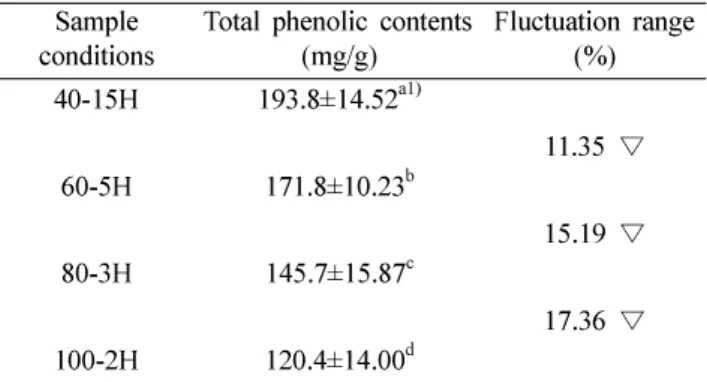
총 페놀성 화합물 및 플라보노이드 함량 − 건조온도에따 른비파잎의항산화및기타의활성변화와연관성탐색을 위해총페놀성화합물과플라보노이드함량을측정하여각 각
Table I
과II
에나타내었다.
건조온도별비파잎추출물의총페놀성화합물의함량은
40-15 H
에서193.8±14.52 mg/g
으로가장높게나타났으며
,
매20
oC
의건조온도상승에따라
11.35~17.36%
의감소를보임으로써건조온도가페놀성화합물의함량에높은영향을줌을알수있었다
.
그러나플라보노이드함량에서는건조온도에따라다소간의함량변 화를보이기는했지만통계적으로유의한수준은아닌것 으로나타났으며
,
결과적으로플라보노이드이외의페놀성화합물함량변화에건조온도가영향을미침을알수있었 다
.
페놀성 화합물은식물의 대표적인2
차대사산물로hydroxyl
기를가지는방향족화합물로서다양한생리활성에관여하는것으로알려져있으며
,
특히항산화활성은페놀성화합물의종류나함량이미치는영향이큰것으로알려
져있다
.
23-25)한편,
플라보노이드는전형적인페놀성화합물로서
C
6-C
3-C
6의기본구조를가지며, flavonoid
의polyphenolic
한성질은
superoxide, hydroxy radical
과같은세포손상을초래하는
free radical
을없애주는 항산화활성을 나타낸다
.
26)DPPH radical 소거능 및 nitric oxide 소거능 − 건조온 도별비파잎추출물의항산화활성을비교하기위해실시한
DPPH radical
소거능은각종생약재의항산화활성을측정및비교하는보편적인방법으로
,
27,28)본실험에서는원래의radical
을50%
소거하는데필요한시료의농도인SC
50을구 하여Table III
에나타내었다.
그리고퇴행성질환의중요한요인으로작용하고
superoxide
음이온과쉽게반응하여반 응성이매우높고독성이강한peroxynitrite(ONOO
-)
를생성하는
nitric oxide(NO)
를소거할수있는능력을측정하여Table I.
Total phenolic compound content in dried leaf extract of E. japonica
Sample
conditions Total phenolic contents
(mg/g) Fluctuation range 40-15H 193.8±14.52
a1)(%)
11.35
▽60-5H 171.8±10.23
b15.19
▽80-3H 145.7±15.87
c17.36
▽100-2H 120.4±14.00
d1)
Values are mean ± SD (n=5). Different superscript letters in the same column show significant differences at
p<0.05 by one-way ANOVA.
Table II.
Total flavonoid content in dried leaf extract of E.
japonica Sample
conditions Total flavonoid contents
(mg/g) Fluctuation range 40-15H 94.6±6.70
a1)(%)
5.07
▽60-5H 89.8±7.40
a3.23
▽80-3H 86.9±16.31
a1.73
△100-2H 88.4±11.14
a1)
values are mean±SD (n=5). Different superscript letters in the same column show significant differences at
p<0.05 by one-way ANOVA.
Table III.
Antioxidant ability of dried leaf extract from E.
japonica by DPPH radical scavenging test Sample
conditions SC
50(mg/ml) Relative
ability (%) Fluctuation range (%) 40-15H 0.97±0.08
a1)18.56
21.1
▽60-5H 1.23±0.06
b14.63
28.4
▽80-3H 1.72±0.03
c10.47
24.9
▽100-2H 2.29±0.08
d7.86
VC
2)0.18±0.01 100.00
1)
Values are mean±SD (n=5). Different superscript letters in the same column show significant differences at
p<0.05 by one-way ANOVA.
2)
VC : ascorbic acid(vitamin C, positive control).
Fig. 1
에나타내었다.
건조온도별비파잎추출물의DPPH radical
소거능에서대조군인ascorbic acid(vitamin C)
에비해각각
7.86~18.56%
의상대적인SC
50을보였다.
건조온도와의연관성이유의성있게나타나매
20
oC
의건조온도증가에 따라
21.2~24.9%
의소거능저하를 나타냈다.
이는Table I
의총페놀성화합물함량과유사한양상의변화로총페놀성화합물함량이항산화활성의변화에직접적으로 영향을주는요인이라는판단을할수있었다
.
29)Nitric oxide
소거능에서도
DPPH radical
소거능에서의결과와마찬가지로낮은건조온도조건인
40-15 H
와60-5 H
의소거능이상대적으로높은건조온도조건인
80-3 H
와100-2 H
와확실한차이가존재함을알수있었다
.
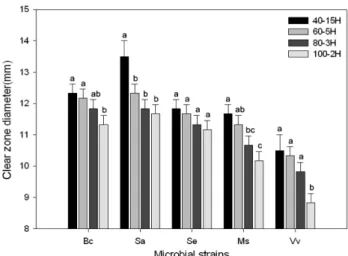
항균활성 − 건조온도별비파잎의기본적인항균력의차
이를확인하기위해
5
종의병원성미생물을대상으로disc
diffusion assay
를실시하여결과를Fig. 2
에나타내었다.
실험에사용된모든균주에서비파잎추출물의항균활성이확 인되었으며
,
특히Staphylococcus aureus
와Bacillus cereus
에대해상대적으로높은항균활성을가지는것으로나타 났다
.
건조온도증가에따라모든시험균주에서예외없이항균활성이감소하는것으로나타났다
.
다만Staphylococcus
epidermidis
의경우통계적으로유의한감소는아닌것으로나타났다
.
또한비파잎추출물의유해균주에대한최소저해농도
(Minimum inhibitory concentration, MIC)
를측정한결과인
Table IV
에서보는바와같이가장높은건조온도조건인
100-2H
에서다른조건의시료에서보다높은농도의MIC
가나타남으로써높은건조온도가항균활성의저하에영향을미치는요인임을확인할수있었다
.
MTT assay에 의한 세포생존율 − 비파잎추출물의세포 독성을확인하기위해대식세포주
(macrophage)
인RAW 264.7
을대상으로실시한
MTT assay
의결과를Table V
에나타내었다
.
실험이실시된모든농도및모든건조온도조건에Fig. 1.
Nitric oxide scavenging ability of dried leaf extract from E. japonica . Values are mean±SD (n=3). Different superscript letters in the same concentration show significant differences at p <0.05 by one-way ANOVA.
VC, ascorbic acid(vitamin C).
Fig. 2.
Antimicrobial activity of dried leaf extract from E.
japonica by disc diffusion assay. Diameter of clear zone including disc diameter of 8mm and sample concentration is 5mg/disc.
Bc ;Bacillus cereus ,
Sa ;Staphylococcus aureus ,
Se;
Staphylococcus epidermidis ,
Ms ;methicillin resistance Staphylococcus aureus ,
Vv ;Vibrio vulnificus. Values are mean±SD (n=3). Different superscript letters in the same color of bar(same strain) show significant differences at p <0.05 by one-way ANOVA.
Table IV.
Minimum inhibitory concentration of dried leaf extract from E. japonica Sample
conditions Minimum inhibitory concentration (mg/ml)
S. aureus S. epidermidis B. cereus V. vulnificus MRSA
40-15H 0.5
1)0.5 0.5 0.5 2.5
60-5H 0.5 0.5 0.5 0.5 2.5
80-3H 0.5 0.5 0.5 0.5 2.5
100-2H 0.1 0.5 0.5 1.0 2.5
1)
Values are minimum concentrations showed growth inhibition more than 30% in every plates(n=3).
서
100%
이상의세포생존율을보였는데, RAW 264.7
과같은정상세포에대한비파잎추출물의세포독성은안전한
수준임을알수있었다
.
반면Fig. 3
과4
에서보는바와같이위암세포주인
AGS
와자궁경부암세포주인HeLa
에대해서는일정수준이상의암세포저해효과를가지는것으로 나타났다
.
위암세포(AGS)
에대해서는5 mg/ml
농도처리군에서
74.1~81.7%, 1 mg/ml
농도처리군에서13.6~21.0%
의증식저해율로모든건조온도조건에서유사한증식저해
율을보였으나
60-5H
조건의추출물에서다소낮은저해율을보였다
.
자궁경부암세포(HeLa)
는건조온도의영향이보다명확하게나타났는데
, 5 mg/ml
농도처리군의낮은건조온도조건인
40-15H
와60-5H
에서는72.2~73.4%
의증식저해율을 보였으나
80-3H
와100-2H
에서는 각각36.7%,
18.3%
로현저히낮아짐을확인할수있었다.
결 론
생약재의이용에있어서필수적으로거쳐야하는단계인 건조에서중요한변수로알려져있는건조온도에따른비 파잎의생리활성변화를확인하고자서로다른온도조건 으로건조를실시한비파잎에탄올추출물을대상으로항 산화
,
항균및암세포증식저해율등을비교하였다.
생리활성을나타낼수있는총페놀성화합물과플라보노이드함 량측정에서플라보노이드의경우건조온도에따른유의적 인함량차이를나타내지않았으나총페놀성화합물은건 조온도가낮을수록높은함량을나타냈다
.
항산화활성의정도를평가할수있는
DPPH radical
과nitric oxide
소거능에서도가장낮은건조온도조건인
40-15 H
의추출물이높은활성을보였으며
,
항균활성에서도건조온도가높아짐에따라항균활성이감소됨을확인할수있었다
.
정상세포에대한세포독성은모든조건의추출물이유사한수준으로독 성이없음을볼수있었으며
,
암세포주에대한저해활성에서는주목할만한수준의증식저해활성이있음과동시에 암세포주에따라서는건조온도가증식저해율변화에유의 한영향인자임을알수있었다
.
이상의결과로볼때비파잎을건조시키기위해열풍건조의방법을사용할경우온 도를
60
oC
이하로관리하는것이생리활성물질의보존에유리할것으로판단된다
.
Table V.
RAW 264.7 cell viability of dried leaf extract from E. japonica by MTT assay Sample
conditions RAW 264.7 cell viability (%)
0.5 mg/ml 1.0 mg/ml 5.0 mg/ml 10.0 mg/ml
40-15H 101.7±1.79
1)105.0±2.18 109.3±1.98 105.1±3.75
60-5H 102.4±6.12 108.6±2.02 111.1±3.50 122.9±8.45
80-3H 107.0±5.25 108.4±6.40 104.8±5.78 108.8±4.10
100-2H 105.6±4.77 108.1±1.55 113.8±4.89 120.9±2.59
1)
Values are mean±SD(n=3).
Fig. 3.
Anti-proliferation activity of dried leaf extract from E.
japonica against AGS by MTT assay. Values are mean±SD (n=5). Different superscript letters in the same concentration show significant differences at p <0.05 by one-way ANOVA.
Fig. 4.
Anti-proliferation activity of dried leaf extract from E.
japonica against HeLa by MTT assay. Values are mean±SD
(n=5). Different superscript letters in the same concentration
show significant differences at p <0.05 by one-way ANOVA.
인용문헌
1.
한방약리학 교재편찬위원회(2005)
한방약리학, 290-292,
도서출판신일상사
,
서울.
2.
정보섭,
신민교(2003)
圖解 鄕藥(
生藥)
大事典, 610-612,
영림사
,
서울.
3. Park, M. Y. (2006) Germplasm evaluation and breeding of Eriobotrya japonica Lindl. Ph.D. Thesis in Department of Horticulture Graduate School Chonnam National University , 4. Hamada, A., Yoshioka, S., Takuma, D., Yokota, J., Cui, T., 4-6.
Kusunose, M., Miyamura, M., Kyotani, S. and Nishioka, Y.
(2004) The effect of Eriobotrya japonica seed extract on oxi- dative stress in adriamycin-induced nephropathy in rats. Biol.
Pharm. Bull .
27: 1961-1964.
5. Yokota, J., Takuma, D., Hamada, A., Onogawa, M., Yoshioka, S., Kusunose, M., Miyamura, M., Kyotani, S. and Nishioka, Y. (2006) Scavenging of reactive oxygen species by Eriobotrya japonica seed extract. Biol. Pharm. Bull .
29: 467-471.
6. Koba, K., Matsuoka, A., Osada, K. and Huang, Y. S. (2007) Effect of loquat( Eriobotrya japonica ) extracts on LDL oxi- dation. Food Chemistry .
104: 308-316.
7. Chen, J., Li, W. L., Wu, J. L., Ren, B. R. and Zhang, H. Q.
(2008) Hypoglycemic effects of a sesquiterpene glycoside isolated from leaves of loquat( Eriobotrya japonica (Thunb.) Lindl.). Phytomedicine .
15: 98-102.
8. Banno, N., Akihisa, T., Tokuda, H., Yasukawa, K., Taguchi, Y., Akazawa, H., Ukiya, M., Kimura, Y., Suzuki, T. and Nish- ino, H. (2005) Anti-inflammatory and antitumor-promoting effect of the triterpene acid from the leaves of Eriobotrya japonica . Biol. Pharm. Bull .
28: 1995-1999.
9. Cho, Y. S., Park, S. K. and Lee, H. Y. (1991) Composition of free sugars, organic acids and free amino acids in loquat flesh. J. Korean Soc. Food Nutr .
20: 89-93.
10. Lee, B. Y., Park, E. M., Kim, E. J., Choi, H. D., Kim, I. H.
and Hwang, J. B. (1996) Analysis of chemical components of korean loquat( Eriobotrya japonica Lindl.) fruit. Korean J.
Food Sci. Technol .
28: 428-432.
11. Bae, Y. I. and Shim, K. H. (1998) Nutrition components in different parts of korean loquat( Eriobotrya japonica Lindl.).
Korean J. Postharvest Sci. Technol .
5: 57-63.
12. Bae, Y. I., Chung, Y. C. and Shim, K. H. (2002) Antimi- crobial and antioxidant activities of various solvent extract from different parts of loquat( Eriobotrya japonica Lindl.).
Korean J. Food Preserv .
9: 97-101.
13. Bae, Y. I., Jeong, C. H. and Shim, K. H. (2005) Antioxidative and antimicrobial activity of epicatechin isolated from leaves of loquat( Eriobotrya japonica ). J. Food Sci. Nutr .
10: 118- 14. Soung, D. Y., Kim, J. S., Chung, H. Y., Jung, H. A., Park, J. 121.
C. and Choi, J. S. (1999) Flavonoids and chlorogenic acid from Eriobotrya japonica scavenge peroxynitrite. Natural Product Sciences .
5: 80-84.
15. Bae, Y. I., Jeong, C. H. and Shim, K. H. (2002) Nitrite-scav- enging and antimutagenic effects of various solvent extract from different parts of loquat( Eriobotrya japonica Lindl.).
Korean J. Food Preserv .
9: 92-96.
16. Lee, K. I. and Kim, S. M. (2009) Antioxidative and anti- microbial activities of Eriobotrya japonica Lindl. leaf extracts. J. Korean Soc. Food Sci. Nutr.
38: 267-273.
17. Amerine, M. A. and Ough, C. S. (1980) Method for analysis of musts and wine, 176-180, Wiley & Sons, Chichester.
18. Lee, Y. C., Hwang, K. H. and Han, D. H. (1997) Composition of Opuntia ficusindia . Korean J. Food Sci. Technol .
29: 847- 19. Ku, K. M., Kim, K. U., Lee, S.C. and Kang, Y. H. (2006) 853.
Screening of cancer preventive activities from medicinal plants. Korean J. Medicinal Crop Sci .
14: 590-591.
20. Marcocci, L., Maguire, J. J., Droy-Lefaix, M. T. and Packer, L. (1994) The nitric oxide-scavenging properties of Ginkgo biloba extract EGb 761. Biochem. Biophys. Res. Commun .
201
: 748-755.
21. Collins, C. H., Lyne, P. M. and Grange, J. M. (1995) Collins and Lyne's microbiological methods, 178-205, Butterworth- Heinemann Ltd., Oxford.
22. Shin, K. M., Park, Y. M., Kim, I. T., Hong, S. P., Hong, J. P.
and Lee, K. T. (2003) In vitro antiinflammatory activity of amygdalin in murine macrophage Raw264.7 cells. Kor. J.
Pharmacogn .
34: 223-227.
23. Liu, R. H. (2004) Potential synergy of phytochemicals in can- cer prevention : mechanism of action. J. Nutr . 3479S-3485S.
24. Manach, C., Williamson, G., Morand, C., Scalbert, A. and Remesy, C. (2005) Bioavailability and bioefficacy of polyphenols in humans. Am. J. Clin. Nutr .
81: 230S-242S.
25. Ryu, S. W., Jin, C. W., Lee, H. S., Lee, J. Y., Sapkota, K., Lee, B. G., Yu, C. Y., Lee, M. K., Kim, M. J. and Cho, D. H.
(2006) Changes in total polyphenol, total flavonoid contents and antioxidant activities of Hibiscus cannabinus L. Korean J. Medicinal Crop Sci .
14: 307-310.
26. Dewick, P. M. (2002) Medicinal natural products, 149-151, Wiley & Sons, Chichester.
27. Jo, H. W. and Park, J. C. (2008) Phenolic compounds isolated from the leaves of Angelica keiskei showing DPPH radical scavenging effect. Kor. J. Pharmacogn .
39: 146-149.
28. Yin, Y., Heo, S. I., Jung, M. J. and Wang, M. H. (2009) Anti- oxidant and antidiabetic effects of various sections of Astragalus membranaceus . Kor. J. Pharmacogn .
40: 1-5.
29. Chon, S. U. (2008) Antioxidant activity and cytotoxicity of methanol extracts from aerial parts of several edible weed species. Kor. J. Weed Sci . 28(2): 171-180.
(2009년 7월 16일 접수)