AbstrAct
Objective Fixed-dose combination (FDC) prescribing enhances adherence to medication. However, there are limited data regarding the usefulness of FDC drugs across different risk groups. The aim of this study was to explore the relationship between FDC discontinuation and clinical outcomes.
Methods From January 2008 to December 2014, patients with FDC prescriptions who visited a cardiology outpatient clinic at a tertiary university hospital in Daegu, Republic of Korea were retrospectively identified. The 10-year atherosclerotic cardiovascular disease (ASCVD) risk score and 20 conventional cardiovascular (CV) risk factors were assessed. Patients were classified according to FDC continuation, together with a tertile of 20 risks.
CV events were defined as the composite of admission for worsening heart failure or diabetes, stroke, ischaemic heart disease, and CV death.
results 502 patients were prescribed with one of the following FDC products: calcium channel blocker (CCB) plus angiotensin receptor blockers (ARB), CCB plus statins, and ARB plus diuretics. During follow-up (mean 2.8±2.4 years), 203 discontinuations (40.4%) occurred.
FDC-discontinued patients had lower ASCVD risk scores (24.8% vs. 28.8%, p<0.001), and patients with <6 risk factors discontinued FDC frequently. During follow-up, 57 events (11.4%) were reported: 30 (14.8%) in FDC- discontinued patients and 27 (9.1%) in FDC-continued patients (p=0.062). In multivariate models accounting for events, FDC discontinuation (p<0.001) and high ASCVD risk score (p=0.017) were associated with CV events.
conclusions FDC discontinuation was common among patients attending the cardiology outpatient clinic. Our analyses suggest that FDC discontinuation in patients at high ASCVD risk may have an impact on CV event rates.
IntrOductIOn
Fixed-dose combination (FDC) products containing multiple drugs have been widely used and are avail- able for the treatment of various cardiovascular (CV) disorders such as hypertension, hyperlipi- daemia, ischaemic heart disease, and heart failure.
FDC products are produced to simplify, easily administer, and enhance adherence to the prescrip- tion of multiple drugs.1–6
Regarding the prescribing of FDC drugs, most physicians put a premium on patient compli- ance, which can be enhanced by maintaining an FDC regimen.6–8 Because of this enhanced
compliance, FDC can benefit patients as a result of the increased convenience, efficacy, and synergistic effects of lower doses of each drug component.9 Unfortunately, there are still some weaknesses asso- ciated with the use of FDC products, including titration limitation, lack of availability, and increased costs.10 Despite these disadvantages, a growing number of FDC formulations are in production today.9 11
However, there are limited data or evidence regarding the definite benefits of FDC therapy in outpatient clinics. In addition, the consistency of FDC treatment across different risk groups is still unclear. Thus, the aim of this study was to explore which patients could adhere to and benefit from a continuous FDC regimen and to evaluate the rela- tionship between the discontinuation of FDC and adverse CV outcomes.
PAtIents And MethOds Patients
This is a retrospective observational study focusing on FDC administration. From January 2008 to December 2014, patients who visited the cardi- ology outpatient clinic of a single tertiary university hospital in Daegu, Republic of Korea, to eval- uate either cardiac function or disorders and had received an FDC prescription, were identified via electronic medical records (EMR) (figure 1). The inclusion criteria were as follows: (1) age >18 years old; (2) FDC prescription provided at a cardi- ology outpatient clinic and not during admission;
(3) the FDC drugs only included lipid- or blood pressure-lowering drugs (ie, no antiplatelet medi- cations); and (4) there were available data on CV risk factors. Patients were excluded if: (1) they had received any earlier prescription of FDC medi- cation during the baseline period in other hospitals;
(2) non-CV FDC therapy was prescribed concom- itantly; or (3) they had a malignant neoplasm or a psychiatric disorder. The index date was the first FDC prescribing date. The types of FDC included were restricted to three combinations of CV drugs:
calcium channel blocker (CCB) plus angiotensin receptor blocker (ARB); CCB plus statins; and ARB plus diuretics. The study protocol conforms to the ethical guidelines of the Declaration of Helsinki.
This research was approved by the institutional review board; written informed consent was waived because of the retrospective nature of this study.
Implications of prescribing a fixed-dose combination in clinical cardiology practice: a retrospective
observational study using a single medical centre database in Korea
Hyungseop Kim, Hyuck-Jun Yoon, Hyoung-Seob Park, Yun-Kyeong Cho,
Chang-Wook Nam, Seongwook Han, Seung-Ho Hur, Yoon-Nyun Kim, Kwon-Bae Kim
to cite: Kim H, Yoon H-J, Park H-S, et al. Heart Asia 2017;9:1–7.. doi:10.1136/
heartasia-2017-010885 Division of
Cardiology,Department of Internal Medicine, Keimyung University Dongsan Medical Center, Daegu, Republic of Korea
correspondence to Dr Hyungseop Kim, Keimyung University Dongsan Medical Center,56 Dalseong-Ro, Jung- Gu, Daegu 41931, Republic of Korea; khyungseop@ dsmc. or. kr Received 20 January 2017 Revised 22 May 2017 Accepted 24 May 2017
data acquisition and variables
With thorough review of the EMR, 20 conventional CV risk factors were collected, and each risk factor was dichotomized with the following cut-off values: age (≥60 years old), body mass index (≥25 kg/m2), systolic blood pressure (≥140 mmHg), total cholesterol (≥200 mg/dL), triglycerides (≥150 mg/
dL), high-density lipoprotein (HDL) cholesterol (≤45 mg/
dL in men, ≤55 mg/dL in women), low-density lipoprotein (LDL) cholesterol (≥150 mg/dL), fasting glucose (≥110 mg/
dL), and creatinine (≥1.1 mg/dL). The following data were also used as risk factors: smoking and alcohol consumption; medical history of heart failure, dyslipidaemia, diabetes mellitus, hyper- tension, ischaemic heart disease, stroke, and peripheral vascular disease; family history of premature coronary heart disease (<55 years old in men, <65 in women); and chronic renal replace- ment therapy with dialysis or transplantation.
Furthermore, baseline CV risk score was assessed using the American College of Cardiology (ACC)/American Heart Associ- ation (AHA) atherosclerotic CV disease (ASCVD) algorithm to calculate the 10-year risk of a CV event. In case the values of risk factors were outside the predefined range, the minimal or maximal value within each reference value range was entered.
Follow-up and cardiovascular events
The EMR were extracted and all the medical prescriptions were reviewed for discontinuation of FDC during follow-up of the outpatient clinic visit. FDC discontinuation was defined as
any discontinuation or splitting of the FDC treatment. However, a change in titration with the same FDC formula or the addition of any other medication concomitantly with the FDC was not considered to be a discontinuation. During review of the EMR of all the patients, CV events were defined as the composite of admission for controlling worsening heart failure or diabetes, stroke, ischaemic heart disease, and CV death. All events were evaluated and updated by reviewing the EMR or through tele- phone contact by a clinical physician. The follow-up duration was obtained from the index date of first prescribing FDC therapy to the occurrence of an event or last clinic visit (censored due to loss to follow-up). Follow-up completeness regarding the discontinuation of FDC and the CV events were 94.5% and 89.7%, respectively, which were obtained by the index devised by Clark et al.12 The study patients were followed for a mean of 2.8±2.4 years after the index date with respect to the CV events.
statistics
Continuous variables are presented as mean±SD in cases of normal distribution and categorical variables as a number with the percentage. The 10-year ASCVD risk score for each patient was calculated using the pooled cohort equations provided by the ACC/AHA. Conventional CV risk scores were calculated for each patient by assigning one point to each risk and classi- fying the patients into tertiles according to the 20 risk factors (lower tertile ≤4, 5 ≤ mid tertile ≤7, and upper tertile ≥8).
The 20 conventional risk factors were compared using the χ2 Figure 1 Study flow chart showing the number of participants in the study. FDC, fixed-dose combination; CCB, calcium channel blocker; ARB, angiotensin receptor blocker.
test for categorical variables, and one-way analysis of variance was performed for continuous variables among the three tertiles.
Both the continuation of FDC and event-free survival curves were constructed to evaluate the adherence of FDC and the CV outcomes, respectively, using the Kaplan-Meier method and compared using the log-rank (Mantle-Cox) test. The significant variables (p<0.05) in the univariate Cox analysis were included in a multivariable analysis. The Cox proportional hazard regres- sion model was performed to obtain the HR with 95% CI for the discontinuation of FDC and the adverse CV events. The statis- tical analyses were performed using the Statistical Package for Social Science version 13.0 (SPSS Inc, Chicago, IL, USA). A value of p<0.05 was considered to be statistically significant.
results
baseline cardiovascular risk factors of whole study patients A total of 502 patients (40% male, mean age of 73 years) were analysed, and the types of prescribed FDCs were as follows: CCB plus ARB (n=254, 50.6%); CCB plus statins (n=145, 28.9%);
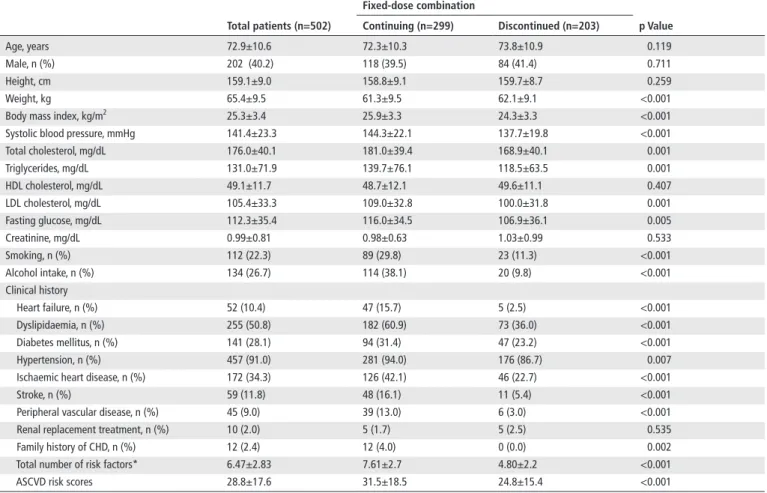
and ARB plus diuretics (n=103, 20.5%). There were 203 discon- tinuations (40.4%) of FDC therapy during a mean follow-up period of 2.8±2.4 years (table 1). The FDC-discontinued patients showed more favourable baseline characteristics and laboratory results compared with the FDC-continuing patients.
The prevalence of medical illness and family history of prema- ture coronary heart disease were less frequently reported in the FDC-discontinued patients. The review of conventional risk
factors and the ASCVD risk score revealed a small numbers of risk factors and low 10-year predicted risk scores, respectively, in the FDC-discontinued group.
Association between maintenance of Fdc and risk factors The 10-year ASCVD risk scores were lower in the FDC-discon- tinued group, irrespective of event occurrence (table 2). These findings were also consistent in the case of using conventional risk factors. Compared with the other tertiles of the number of conventional risk factors, the patients in the lower tertile did not maintain their FDC prescription and frequently split their FDC into multiple-drug prescriptions. Furthermore, the upper tertile showed significantly more events reported in the FDC-discon- tinued group compared with the respective lower and mid tertile groups.
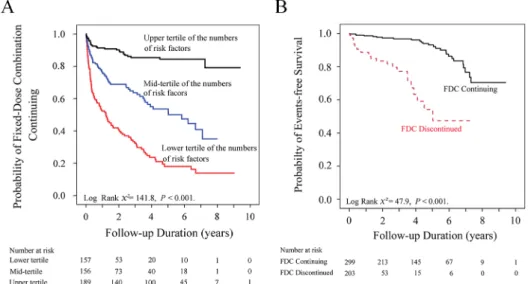
Adverse CV events occurred more frequently in the discon- tinued group; however, the discontinued group had a smaller number of risk factors, even in patients experiencing CV events (figure 2). In the patients who discontinued their FDC, the mean number of risk factors was 6.0. The likelihood of maintaining or continuing FDC was significantly higher in patients with >6 risk factors compared with those having ≤6 risk factors. Together with the 10-year ASCVD risk score, the small number of risk factors significantly contributed to discontinuing FDC therapy on univariate and multivariate analysis (table 3). The lower tertile group failed to continue FDC more easily than the upper or mid tertile groups in the early phase of treatment (figure 3A).
table 1 Baseline characteristics of whole study populations according to the discontinuation of fixed-dose combination therapy total patients (n=502)
Fixed-dose combination
p Value continuing (n=299) discontinued (n=203)
Age, years 72.9±10.6 72.3±10.3 73.8±10.9 0.119
Male, n (%) 202 (40.2) 118 (39.5) 84 (41.4) 0.711
Height, cm 159.1±9.0 158.8±9.1 159.7±8.7 0.259
Weight, kg 65.4±9.5 61.3±9.5 62.1±9.1 <0.001
Body mass index, kg/m2 25.3±3.4 25.9±3.3 24.3±3.3 <0.001
Systolic blood pressure, mmHg 141.4±23.3 144.3±22.1 137.7±19.8 <0.001
Total cholesterol, mg/dL 176.0±40.1 181.0±39.4 168.9±40.1 0.001
Triglycerides, mg/dL 131.0±71.9 139.7±76.1 118.5±63.5 0.001
HDL cholesterol, mg/dL 49.1±11.7 48.7±12.1 49.6±11.1 0.407
LDL cholesterol, mg/dL 105.4±33.3 109.0±32.8 100.0±31.8 0.001
Fasting glucose, mg/dL 112.3±35.4 116.0±34.5 106.9±36.1 0.005
Creatinine, mg/dL 0.99±0.81 0.98±0.63 1.03±0.99 0.533
Smoking, n (%) 112 (22.3) 89 (29.8) 23 (11.3) <0.001
Alcohol intake, n (%) 134 (26.7) 114 (38.1) 20 (9.8) <0.001
Clinical history
Heart failure, n (%) 52 (10.4) 47 (15.7) 5 (2.5) <0.001
Dyslipidaemia, n (%) 255 (50.8) 182 (60.9) 73 (36.0) <0.001
Diabetes mellitus, n (%) 141 (28.1) 94 (31.4) 47 (23.2) <0.001
Hypertension, n (%) 457 (91.0) 281 (94.0) 176 (86.7) 0.007
Ischaemic heart disease, n (%) 172 (34.3) 126 (42.1) 46 (22.7) <0.001
Stroke, n (%) 59 (11.8) 48 (16.1) 11 (5.4) <0.001
Peripheral vascular disease, n (%) 45 (9.0) 39 (13.0) 6 (3.0) <0.001
Renal replacement treatment, n (%) 10 (2.0) 5 (1.7) 5 (2.5) 0.535
Family history of CHD, n (%) 12 (2.4) 12 (4.0) 0 (0.0) 0.002
Total number of risk factors* 6.47±2.83 7.61±2.7 4.80±2.2 <0.001
ASCVD risk scores 28.8±17.6 31.5±18.5 24.8±15.4 <0.001
*Conventional risk factors include age, body mass index, systolic blood pressure, total cholesterol, triglycerides, HDL cholesterol, LDL cholesterol, fasting glucose, creatinine, smoking, alcohol, heart failure, dyslipidaemia, diabetes mellitus, hypertension, ischaemic heart disease, stroke, peripheral vascular disease, chronic renal replacement therapy, and family history of premature coronary heart disease.
ASCVD, atherosclerotic cardiovascular disease; CHD, coronary heart disease; HDL, high-density lipoprotein; LDL, low-density lipoprotein
Adverse events during follow-up
During the study period, a total of 57 CV events (11.4%) occurred: 13 (2.6%) episodes of heart failure, 16 (3.2%) isch- aemic heart disease events, 12 (2.4%) strokes, 7 (1.4%) episodes of worsening diabetes, and 9 (1.8%) CV deaths. No significant difference was found in the occurrence of CV events according to discontinuation of FDC (30 events (14.8%) in the FDC-dis- continued patients vs 27 (9.1%) in the FDC-continued patients, p=0.062). However, in the Kaplan-Meier analysis, the patients who discontinued their FDC showed an unfavourable prognosis throughout the follow-up period (figure 3B). Both discontinuing the FDC and high ASCVD risk score were significantly asso- ciated with worse CV outcomes, although the upper tertile of the number of risk factors influenced the occurrence of adverse outcomes only in univariate analysis (table 4). The patients who discontinued their FDC therapy had nearly an eightfold greater risk of experiencing an adverse CV event.
dIscussIOn
Recently, the frequency of FDC prescriptions has increased to encourage medication compliance.1 2 4 6 This is because FDC therapy is convenient and reduces the total pill count.
Despite the advantages of FDC agents, they can be inflexible if dosing titration is required but the appropriate FDC dosage is unavailable.9 10 These findings might result in a high frequency of FDC discontinuation, and most of it could happen within 1 year, particularly in those with low ASCVD risk scores. However, it is still unclear why FDC discontinuation is more frequent than expected, despite its convenience. Our study revealed that two aspects should be considered: the patients’ perception regarding
FDC and disease severity, and the appropriate subset of patients to whom FDC should be prescribed.
The patients’ knowledge of their disease underlies the main- tenance of and adherence to FDC therapy.13 14 Therefore, it is reasonable to presume that those patients with many risks and serious conditions have a high level of disease insight, and these high-risk patients would be more likely to adhere to their FDC regimen to improve or enhance their health status.15 However, some low risk patients believe that discontinuation of FDC would not contribute to immediate or early discomfort and may be ignorant of the importance of long-term medica- tion within the CV disease spectrum. This belief would deem their disorders trivial and lead to poor compliance and FDC discontinuation.15–17 Conversely, strong adherence results in a good response of blood pressure control and a low frequency of adverse drug reactions.18 19
The experience of a serious illness, per se, would also be strongly associated with adherence. Although patients who had more outpatient visits, underwent an interventional proce- dure or surgical operation, and had been hospitalised showed better adherence than those who had not, all of these experi- ences are usually considered as either high risk or a vulnerable state; thus, the compliance of these patients is critical to prevent their condition from deteriorating.20 21 The majority of high-risk patients are willing to have good compliance even if they are only being treated for hypertension or hypercholesterolaemia.
Interestingly, in the current study, nearly half of the patients in the lower tertile failed to continue FDC therapy within 1 year, while the upper tertile showed good adherence. Therefore, in regard to the enhancement of adherence, assertive encourage- ment or insight of FDC would be required in the early stage of treatment to prevent dropout.
There were limited data about the usefulness of FDC prescrip- tions regarding prevention of CV events.1–3 5 6 In the current study, a high rate of FDC discontinuation was observed in the low and mid tertile, or low ASCVD risk score group. According to the UMPIRE study, the adherence outcomes regarding blood pressure and cholesterol were significantly favourable in patients with a high estimated CV risk (>15% of 5-year CV risk) and smokers.1 Those results would suggest the importance of FDC in high-risk patients in terms of preventing CVD.1–3 Those were in accordance with our results and could be explained by the simplicity of a single polypill and the strong motivation in established or high risk patients to stay healthy.22 Therefore, in patients with established CV diseases or at high risk, a clear benefit of FDC was observed as indicated in cases of clustering risk factors such as dyslipidaemia, hypertension, and diabetes.3 23 Among the high-risk patients, the benefit gain would increase by controlling the outcomes of many clustering risk factors using a simple prescription. Although the effect of FDC on CV events table 2 Association between fixed-dose combination discontinuation and risk scores, numbers or events
AscVd risk scores, (%) events/total, n (%)
events
(+) (n=57) events (−)
(n=445) p Value
tertiles of the number of conventional risk factors*
p Value lower (n=157) Mid (n=156) upper (n=189)
FDC continuing 43.2±17.8 30.3±18.2 0.001 0/44 (0) 8/93 (8.6) 19/162 (11.7) 0.054
FDC discontinued 33.5±15.8 23.3±14.9 0.001 12/113 (10.6) 8/63 (12.7) 10/27 (37.0) 0.002
p Value 0.033 <0.001 0.021 0.431 0.002
*Conventional risk factors include age, body mass index, systolic blood pressure, total cholesterol, triglycerides, HDL cholesterol, LDL cholesterol, fasting glucose, creatinine, smoking, alcohol, heart failure, dyslipidaemia, diabetes mellitus, hypertension, ischaemic heart disease, stroke, peripheral vascular disease, chronic renal replacement therapy, and family history of premature coronary heart disease.
ASCVD, atherosclerotic cardiovascular disease; FDC, fixed-dose combination; lower tertile, ≤4 risk numbers; 5 ≤ mid tertile, ≤7 risk numbers; upper tertile, ≥8 risk numbers.
Figure 2 Association between the number of risk factors and fixed- dose combination (FDC) discontinuation or cardiovascular events.
Compared with the FDC-continuing group, the FDC-discontinued group has a small number of risk factors, irrespective of event occurrence.
was not obtained because of the low incidence of events (11%) in the Cochrane database and a relatively short follow-up period (2 years) in the UMPIRE trials,1 6 24 both the physician’s insight and efforts to control risk factors could affect the long-term CV prognosis in patients using FDC as shown in our study, which was designed for the intensive and broad control of clustering risk factors.
Although there was no significant association between the total number of risk factors and the development of CV events in the FDC-continuing group (p=0.054), the discontinuation of FDC therapy was strongly related to CV events (p=0.002).
However, considering the limited data about FDC in real- world practice, it is not easy to determine to what extent FDC discontinuation would contribute to CV adverse outcomes. In the present analysis, FDC discontinuation appeared to be more important than other factors including ASCVD risk score or factors. This is because the maintenance of FDC therapy could modify or reduce risk factors, indicating improved clinical results.1 2 Thus, the FDC-discontinued patients would be exposed again to high CV risk including uncontrolled hyper- tension or unfavourable lipid profile over time, although they had low risk score or factors at the time of receiving their FDC
prescription. This might frame a concept that FDC discontinu- ation could not control risk factors, particularly in modest- or high-risk patients. Besides, the patients who discontinued their FDC therapy (and may have required up or down titration with non-FDC drugs) were compelled to obtain much more compli- cated regimens, resulting in either low compliance or increased frequency of side effects.
Ultimately, not all patients are believed to require FDC therapy.
This makes it crucial to select the most appropriate candidates.
The strong relationship between discontinuing FDC and the occurrence of CV events was observed and was most profound in the upper tertile, which was compatible with the findings of the SPACE study; the definite benefit of FDC was consistently observed in high-risk patients regarding blood pressure and dyslipidaemia.2 The importance of FDC appeared to be signifi- cant in the patients with many risk factors. Another explanation is that it appears likely that patients either with few risk factors or without a diagnosis of a high-risk condition would not need a multipotent FDC. Therefore, the advantages of an FDC over a multi-pill regimen may be greater for high-risk patients or those who require a simple drug regimen, in addition to the definite advantage of reducing pill counts.
table 3 Univariable and multivariable Cox analysis for discontinuation of fixed-dose combination therapy
univariable Multivariable
hr (95% cI) p Value hr (95% cI) p Value
Types of FDC
CCB and statin 1 (Reference) – –
CCB and ARB 1.009 (0.699 to 1.458) 0.960
ARB and diuretics 0.747 (0.527 to 1.059) 0.101
ASCVD risk scores, % 0.981 (0.972 to 0.989) <0.001 0.984 (0.975 to 0.990) 0.003
Tertiles of the numbers of conventional risk factors*
Lower tertile 1 (Reference) – 1 (Reference) –
Mid tertile 0.430 (0.316 to 0.586) <0.001 0.432 (0.314 to 0.593) <0.001
Upper tertile 0.113 (0.174 to 0.173) <0.001 0.114 (0.072 to 0.179) <0.001
*Conventional risk factors include age, body mass index, systolic blood pressure, total cholesterol, triglycerides, HDL cholesterol, LDL cholesterol, fasting glucose, creatinine, smoking, alcohol, heart failure, dyslipidaemia, diabetes mellitus, hypertension, ischaemic heart disease, stroke, peripheral vascular disease, chronic renal replacement therapy, and family history of premature coronary heart disease.
ARB, angiotensin receptor blocker; ASCVD, atherosclerotic cardiovascular disease; CCB, calcium channel blocker; FDC, fixed-dose combination; lower tertile, ≤4 risk numbers; 5 ≤ mid-tertile,
≤7 risk numbers; upper tertile, ≥8 risk numbers.
Figure 3 (A) Kaplan-Meier curve for continuation of the fixed-dose combination (FDC) according to tertiles of the numbers of risk factors. Nearly half of the patients in the lower tertile showed discontinuation of FDC within 1 year of prescription, whereas those in the upper tertile had good adherence of FDC. (B) Kaplan-Meier curve for the primary outcome of adverse events according to FDC continuation or discontinuation.
There were several limitations to the present study. First, this was a retrospective study and the adherence to FDC therapy could not be evaluated using objective tools or programmes such as the Morisky Medication Adherence Scale. In cases of discontinued FDC, the reason for discontinuation could not be obtained for the entire patient cohort. In addition, the frequency of clinic visits and the socioeconomic status of the cohort were not assessed. These could cause self-selection bias, resulting in a biased sample. This is because a patient’s compliance, moti- vation, and prior medical illness experience are closely related to FDC continuation or clinical outcomes. Second, FDC of dual anti-platelet therapy (DAPT) or non-CV drugs were excluded.
While the FDC of DAPT is widely used for coronary artery disease, the discontinuation or splitting of DAPT into mono- therapy could be suggested for preventing the complication of bleeding after 6–12 months of coronary stents. Those may cause the important distortion or concerns for analysis of prescrip- tion or response of FDC. Third, the inclusion of individuals with prevalent ischaemic heart disease in the ACC/AHA pooled cohort equation calculation may lead to erroneous risk esti- mation. This would affect the underestimation of the ASCVD risk score. Last, we recognised that there were also limitations
regarding the statistical analysis. A restricted cubic spline curve was performed because the relationship between the discontin- uation of FDC and the number of risk factors was non-linear and showed an exponential distribution. Also, it was difficult to analyse all the risk factors and to consider adding all of them into a multivariable analysis. Therefore, each risk factor was dichotomised and risk scores were calculated.
In conclusion, the high frequency of FDC discontinuation was found in the lower and mid tertile groups, particularly during the early phase of treatment. With respect to the CV outcomes, the FDC-discontinued patients at high ASCVD risk score showed an unfavourable prognosis; thus it would be necessary to encourage FDC adherence in these patients.
Acknowledgements The authors would like to acknowledge M-Y Kim, RN, and J-H Jeon, RN, for their significant contribution to this study.
contributors Study design: HK; data collection: HJY, HSP, YKC; data analysis: HK, CWN, SH, SHH; manuscript writing: HK; manuscript approval: YNK, KBK.
competing interests None declared.
ethics approval IRB, Keimyung University Dongsan Medical Center.
Provenance and peer review Not commissioned; externally peer reviewed.
data sharing statement Nothing.
© Article author(s) (or their employer(s) unless otherwise stated in the text of the article) 2017. All rights reserved. No commercial use is permitted unless otherwise expressly granted.
reFerences
1 Thom S, Poulter N, Field J, et al. Effects of a fixed-dose combination strategy on adherence and risk factors in patients with or at high risk of CVD: the UMPIRE randomized clinical trial. JAMA 2013;310:918–29.
2 Webster R, Patel A, Selak V, et al. Effectiveness of fixed dose combination medication ('polypills') compared with usual care in patients with cardiovascular disease or at high risk: a prospective, individual patient data meta-analysis of 3140 patients in six countries. Int J Cardiol 2016;205:147–56.
3 Lafeber M, Webster R, Visseren FLj, et al. Estimated cardiovascular relative risk reduction from fixed-dose combination pill (polypill) treatment in a wide range of patients with a moderate risk of cardiovascular disease. Eur J Prev Cardiol 2016;23:1289–97.
4 Bryant L, Martini N, Chan J, et al. Could the polypill improve adherence? The patient perspective. J Prim Health Care 2013;5:28–35.
5 Patel A, Cass A, Peiris D, et al. A pragmatic randomized trial of a polypill-based strategy to improve use of indicated preventive treatments in people at high cardiovascular disease risk. Eur J Prev Cardiol 2015;22:920–30.
6 Bahiru E, de Cates AN, Farr MR, et al. Fixed-dose combination therapy for the prevention of atherosclerotic cardiovascular diseases. Cochrane Database Syst Rev 2017;3:CD009868.
table 4 Univariable and multivariable Cox analysis for adverse events
univariable Multivariable
hr (95% cI) p Value hr (95% cI) p Value
Types of FDC
CCB and statin 1 (Reference) – –
CCB and ARB 1.11 (0.55 to 2.28) 0.768
ARB and diuretics 0.93 (0.47 to 1.82) 0.822
Discontinuation of FDC 6.193 (3.504 to 10.94) <0.001 7.590 (4.042 to 14.26) <0.001
ASCVD risk scores, % 1.020 (1.006 to 1.035) 0.005 1.026 (1.008 to 1.045) 0.017
Tertiles of the numbers of conventional risk factors*
Lower tertile 1 (Reference) – 1 (Reference) –
Mid tertile 1.382 (0.630 to 3.021) 0.420 1.122 (0.516 to 2.438) 0.772
Upper tertile 2.190 (1.083 to 4.451) 0.030 1.527 (0.643 to 3.629) 0.338
*Conventional risk factors include age, body mass index, systolic blood pressure, total cholesterol, triglycerides, HDL cholesterol, LDL cholesterol, fasting glucose, creatinine, smoking, alcohol, heart failure, dyslipidaemia, diabetes mellitus, hypertension, ischaemic heart disease, stroke, peripheral vascular disease, chronic renal replacement therapy and family history of premature coronary heart disease.
ARB, angiotensin receptor blocker; ASCVD, atherosclerotic cardiovascular disease; CCB, calcium channel blocker; FDC, fixed-dose combination; lower tertile ≤4 risk numbers; 5 ≤ mid-tertile
≤7 risk numbers; upper tertile ≥8 risk numbers.
Key messages
What is already known about this subject?
Fixed-dose combination (FDC) drugs are increasingly prescribed to enhance adherence, but discontinuation of FDC is also common in the real-world setting.
What does this study add?
Patients who discontinued their FDC drugs had lower 10-year atherosclerotic disease (ASCVD) risk scores or a smaller number of risk factors. Nearly half of the patients with <4 risk factors discontinued their FDC medication within 1 year of prescription.
The discontinuation of FDC therapy and high ASCVD risk scores were related to cardiovascular (CV) events.
how might this impact on clinical practice?
Despite the advantage of FDC therapy, clinicians need to bear in mind that the discontinuation of FDC drugs in patients at high ASCVD risk may contribute to the occurrence of adverse CV events.
7 Bosworth HB, Granger BB, Mendys P, et al. Medication adherence: a call for action.
Am Heart J 2011;162:412–24.
8 Yusuf S, Attaran A, Bosch J, et al. Combination pharmacotherapy to prevent cardiovascular disease: present status and challenges. Eur Heart J 2014;35:353–64.
9 Webster R, Rodgers A. Polypill treatments for cardiovascular diseases. Expert Opin Drug Deliv 2016;13:1–6.
10 Angeli F, Reboldi G, Mazzotta G, et al. Fixed-dose combination therapy in hypertension: cons. High Blood Press Cardiovasc Prev 2012;19:51–4.
11 Wertheimer AI. The economics of polypharmacology: fixed dose combinations and drug cocktails. Curr Med Chem 2013;20:1635–8.
12 Clark TG, Altman DG, De Stavola BL. Quantification of the completeness of follow- up. Lancet 2002;359:1309–10.
13 Christensen AJ, Howren MB, Hillis SL, et al. Patient and physician beliefs about control over health: association of symmetrical beliefs with medication regimen adherence. J Gen Intern Med 2010;25:397–402.
14 Kronish IM, Ye S. Adherence to cardiovascular medications: lessons learned and future directions. Prog Cardiovasc Dis 2013;55:590–600.
15 Murray KA, Murphy DJ, Clements S-J, et al. Comparison of uptake and predictors of adherence in primary and secondary prevention of cardiovascular disease in a community-based cardiovascular prevention programme (MyAction Westminster).
J Public Health 2014;36:644–50.
16 Halava H, Korhonen MJ, Huupponen R, et al. Lifestyle factors as predictors of nonadherence to statin therapy among patients with and without cardiovascular comorbidities. CMAJ 2014;186:E449–56.
17 Anderson DR, Emery CF. Irrational health beliefs predict adherence to cardiac rehabilitation: a pilot study. Health Psychol
2014;33:1614–7.
18 Bramlage P, Ketelhut R, Fronk EM, et al. Clinical impact of patient adherence to a fixed-dose combination of olmesartan, amlodipine and hydrochlorothiazide. Clin Drug Investig 2014;34:403–11.
19 Mazzaglia G, Ambrosioni E, Alacqua M, et al. Adherence to antihypertensive medications and cardiovascular morbidity among newly diagnosed hypertensive patients. Circulation 2009;120:1598–605.
20 Oosterom-Calo R, van Ballegooijen AJ, Terwee CB, et al. Determinants of adherence to heart failure medication: a systematic literature review. Heart Fail Rev 2013;18:409–27.
21 Cholowski K, Cantwell R. Predictors of medication compliance among older heart failure patients. Int J Older People Nurs 2007;2:250–62.
22 Wood F, Salam A, Singh K, et al. Process evaluation of the impact and acceptability of a polypill for prevention of cardiovascular disease. BMJ Open
2015;5:e008018.
23 Lafeber M, Spiering W, van der Graaf Y, et al. The combined use of aspirin, a statin, and blood pressure-lowering agents (polypill components) and the risk of vascular morbidity and mortality in patients with coronary artery disease. Am Heart J 2013;166:282–9.
24 Castellano JM, Sanz G, Peñalvo JL, et al. A polypill strategy to improve adherence: results from the FOCUS project. J Am Coll Cardiol 2014;64:2071–82.
single medical centre database in Korea retrospective observational study using a combination in clinical cardiology practice: a Implications of prescribing a fixed-dose
Kwon-Bae Kim
and Chang-Wook Nam, Seongwook Han, Seung-Ho Hur, Yoon-Nyun Kim Hyungseop Kim, Hyuck-Jun Yoon, Hyoung-Seob Park, Yun-Kyeong Cho,
doi: 10.1136/heartasia-2017-010885
2017 9:
Heart Asia
http://heartasia.bmj.com/content/9/2/e010885
Updated information and services can be found at:
These include:
References
http://heartasia.bmj.com/content/9/2/e010885#ref-list-1
This article cites 24 articles, 4 of which you can access for free at:
service Email alerting
box at the top right corner of the online article.
Receive free email alerts when new articles cite this article. Sign up in the
Notes
http://group.bmj.com/group/rights-licensing/permissions
To request permissions go to:
http://journals.bmj.com/cgi/reprintform
To order reprints go to:
http://group.bmj.com/subscribe/