1. Introduction
1)The cellular phone network which has been used mostly for voice service is changing to include more data and multimedia message services. High resolution camera phones have made image transfer more popular. It can only be expected that multimedia messenger or video phone service causing increased traffic will be widely used in the near future. The most important factors to be considered in wireless multimedia services are delay, packet loss and high cost in wireless channel.
For delay sensitive applications such as video
* 강원대학교 전기전자정보통신공학부 교수,
공학박사
** 카네기 멜론 대학 방문연구원
streaming, transmission control protocol (TCP) is not usually used at transport layer because TCP induces long delay to recover lost packets.
Therefore, user datagram protocol (UDP) is used instead for real time applications.
End-to-end retransmission can be used in some applications to handle error packets.
However end-to-end retransmission always requires round-trip delay, which is usually larger than the tolerable delay limit (e.g., 150ms) for interactive applications. Many algorithms have been studied to alleviate this problem: some algorithms utilize source coding[1,2,3], and others utilize channel coding with forward error correction (FEC) at the expense of bandwidth expansion [4,5].
For delay sensitive applications such as video conferencing, the receiver does not usually
패킷 다이버시티를 이용한 무선 상향 링크의 성능 개선 Performance Improvement of Wireless Uplink Channels Using
Packet Diversity
이 구 연
*김 화 종
*정 충 교
*이 용
**Lee, Goo-Yeon Kim, Hwa-Jong Jeong, Choong-Kyo Lee, Yong
Abstract
In this paper, we introduce a packet diversity scheme to increase uplink channel utilization in a wireless network where forward error correction is used. The packet diversity allows neighbor base stations to receive uplink packets from a mobile terminal in order to increase the utilization of the uplink channel. By allowing multiple base stations to receive the same packets, we can improve the error correction capability in an uplink channel. By incorporating the packet diversity we can reduce the parity overhead of each packet for a given tolerable loss probability, which improves the link efficiency.
Keywords : packet diversity, cellular, FEC, Reed-Soloman, link utilization
request retransmission and tolerates packet losses. In the paper, we introduce a packet diversity with FEC (Forward Error Correction) to improve uplink wireless channel utilization for these applications. Mobile phone channel suffers high error rate and limited bandwidth, which results in high transmission cost for mobile phone users.
The packet diversity scheme suggested in this paper allows nearby base stations to capture the uplink packet from a mobile terminal. In a traditional cellular phone system, a mobile terminal communicates with the home base station of its cell, except when handover is occurring. With the proposed packet diversity scheme the utilization of uplink channel is much improved even when neighbor base stations receive weak signal from a mobile terminal in other cell.
Many diversity schemes have been introduced in wireless communications including frequency and time domain schemes [6], and in wired networks including path diversity schemes [7-11]. However packet diversity scheme similar to the one proposed in this paper has not yet been introduced.
2. Packet Diversity Scheme
In the paper, we analyze the link utilization improvements available by applying the packet diversity to traditional cellular networks. A Reed-Solomon(RS) coding is used for FEC in the packet diversity scheme. A transport layer message is divided into k packets. With RS(n, k) coding, k information packets are sent with r =n-k parity packets. We call the n packets a block in this paper. At the receiver, forward error correction can be done successfully when the number of error packets is less than or equal to t =
, where y stands for the integer part of y.In a conventional cellular network, a base station ignores the signals from mobile terminals out of its cell. However, the uplink signal from a mobile terminal can be captured by nearby base stations as well as by the home base station of the mobile terminal. When the packet diversity scheme is implemented, each base
station is modified to capture packets from outside cell terminals and may relay them to proper destination if requested to do. This requires additional processing burden at the base stations. However, the overall wireless link utilization can be improved dramatically. The benefits clearly dwarf the processing costs at base stations.
Let A0 be the probability that the home base station of a mobile terminal successfully receives a packet from that mobile terminal.
Error detecting code is used for each packet for error detection. A0 is mainly determined by the wireless channel environment, transmitting power and the packet size.
For a higher error rate channel, A0 will be smaller and we should use more parity packets for a given data loss threshold. The more parity packets are used, the less channel efficiency is given due to its overhead. The packet diversity scheme is proposed in the paper to alleviate the link efficiency problem of a high error channel especially for the wireless multimedia applications.
The proposed scheme is described as follows.
MOBI LE TERMI NAL: The mobile terminal determines the value of n and r at the beginning of a session negotiation with the destination device. A mobile terminal constructs a block composed of k data packets and r =n-k parity packets by applying RS coding, and transmits the block with UDP protocol.
H OM E BASE STATI ON: When the home base station of a mobile terminal receives a packet from the mobile terminal, it relays the packet to the destination if the packet is error free. However, if the base station receives a packet in error, it sends queries to neighbor base stations if they happen to have received the same packet without error, and asks the base station that received the packet successfully to relay the packet to the destination. If no base station near the mobile terminal has received the packet successfully, the packet is lost and can not be delivered to the destination.
NEI GH BOR BASE STATI ON: Each base station implementing the packet diversity algorithm tries to catch uplink packets from mobile terminals in the neighbor cells. Packets arrived in error are discarded and error-free
packets are kept for a time T. When a base station receives a query from other base station that asks a specific packet's successful arrival, ACK will be sent to the inquiring base station if it has received that packet successfully and the specific packet is sent to the proper destinations.
After time T, all received packets are discarded.
DESTI NATI ON: At the destination, received packets are combined to reconstruct the block. If the number of error packets is less than or equal to t, the original message will be recovered with RS decoding , otherwise the message can not be constructed. If the message loss rate at destination exceeds a given tolerable loss probability, then the session may renegotiate to increase the parity size r in RS coding.
3. Analysis and Results
Fig.1 shows the operation of the packet
diversity scheme in a cell of a specific mobile terminal and its neighbor cells.
Let A0 be the probability that the home base station receives a packet successfully from a specific mobile terminal M, which is in the cell. Let us assume that there are V neighbor base stations that might capture the packets from M. Let Ai be the probability that base station i (
≦ ≦
) receives the packet without error. Then we assume that Ai ( ≦ ≦
) are independent each other because the distances between the neighbor base stations are far enough. Further assuming that the error rate in the wired network (connecting the base stations and the destination device) is much less than that of a wireless channel, we can express the probability that the destination device will receive a packet without error asB = 1 -i
∏
V= 0(1 -Ai). (1)A
0A
1A
3A
4A
5A
6A
2Base Station
Mobile Terminal
Fig. 1 The operation of packet diversity schemeA block is composed of n packets. Let the random variable d denote the number of error packets out of n packets in a block, then the probability distribution of d is given by
P[d=j] = n!
j!(n -j)! (1- B)jBn-j
(
0≤ j ≤ n
). (2) In RS coding, the original message can be recovered when the number of error packets is less than or equal to t, therefore the probability that a block can be successfully received at the destination Gpd isGpd=P[d≤t] =
∑
tj= 0
n!
j!(n - i)! (1- B)jBn-j .
(3)
For a specific session of communication, if the tolerable block loss probability at the receiver is given by x, then the packet diversity should satisfy
1- Gpd ≤ x , or Gpd≥1 - x. (4)
Let
t
pd, min be the value of t which minimizes Gpd that satisfies above equation.Let us consider the case that packet diversity is not used, i.e., only one base station receives packets from a mobile terminal. Let the random variable g denote the number of error packets out of n packets, then the probability distribution of g is given by
P[g= j] = n!
j!(n - j)! (1 - A0)jAn0-j
(0<= j <= n). (5)
Then the probability that a message is received successfully at the receiver Gnpd is
Gnpd=P[g≤t] =
∑
tj= 0
n!
j!(n - i)! (1 - A0)jAn0-j
. (6)
Without the packet diversity scheme, if the tolerable block loss probability at the receiver for a specific session of communication is given by x, then we have
1- Gnpd ≤ x , or Gnpd ≥ 1 - x. (7)
Let tnpd, min be the value of t which
minimizes Gnpd that satisfies above equation.
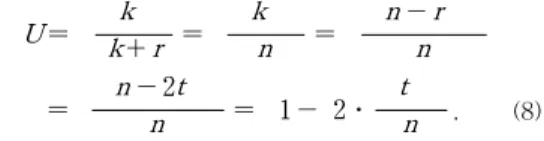
A mobile terminal sends data in the unit of blocks or n (=k +r) packets, and each packet has an error detection code field. Assuming that the size of the error detection field is small comparing to the packet size, we can express the link efficiency U as
U = k
k+ r = k
n = n - r
n
= n - 2t
n = 1 - 2⋅ t
n . (8)
When the tolerable block loss probability at the receiver is x, Upd and Unpd, the link efficiencies with and without packet diversity scheme respectively, are given by
Upd= 1 - 2⋅ tpd, min
n and
Unpd= 1 - 2⋅ tnpd, min
n . (9)
The link efficiency is increased from Unpd to Upd by using the packet diversity.
When a mobile terminal is located close to its home base station, A0 will be close to 1.
However Ai (i=1∼V) would be very small because the distance between the mobile terminal to each neighbor base station would be far. If the mobile terminal is in the handoff state, then A0 and Aj (j is the new home base station after handoff) would have similar values.
Fig. 2 shows link utilizations with and without packet diversity as a function of tolerable message loss probability x, when V
=6, A0 =0.9, A1 =0.2, A2 = A6 =0.1, A3 =
A4 = A5 =0.05.
Fig. 2 shows that the packet diversity improves the utilization of uplink channel even when packet capture probabilities at neighbor base stations are relatively small (e.g., 0.1 or 0.05). In packet diversity, the limited and expensive wireless channel resource can be efficiently used by sacrificing the efficiency in relatively cheap wireline links between base stations and processing overhead at base stations.
As mobile multimedia services are becoming increasingly popular, wireless channels will suffer shortage of bandwidth. In Fig. 2, for example, packet diversity improves 20% of utilization, which means that 20% more traffic can be accommodated in wireless channel by using the packet diversity scheme.
In traditional cellular networks, cell planning is a challenging task because finding optimal
locations of base stations not to interfere each other is difficult. With the packet diversity
scheme, however, cell plan optimality is not a requirement for efficient use of the uplink channels, because spillover signals improves the packet capture probability in neighbor cells. For further study of the paper, we need to choose optimal sizes of n and r which can maximize the link utilization. The error rate of wireless channel depends on the channel characteristics and distance between a mobile terminal and base stations. As a mobile terminal is moving, the channel characteristics and Ai (
=0∼V) also change in time and location. This means that the optimal value of n and r should vary in time, and requires further research.4. Conclusion
In the paper, we introduced packet diversity
0.6 0.65 0.7 0.75 0.8 0.85 0.9
0 0.02 0.04 0.06 0.08 0.1 0.12 0.14 0.16 0.18 0.2
Tolerable message loss probability
L in k u ti liz a ti o n ..
Link utilization with packet diversity Link utilization with no packet diversity
Fig. 2 Link utilization with packet diversity(
U
pd) and link utilization without packet diversity(U
npd) as a function of tolerable message loss probability x (V
=6,A
0 =0.9,A
1 =0.2,A
2 =A
6 =0.1,A
3=
A
4 =A
5 =0.05, n =255)with FEC to improve uplink wireless channel utilization. With the packet diversity, each base station is modified to capture packets from outside cell terminals. The efficiency of the limited and expensive wireless channel resources can be improved with the additional processing at the base stations and the increased traffic in relatively cheap wirelinks between base stations.
For example, our analysis showed that the packet diversity improves the utilization of uplink channel by about 20% even when the packet capture probabilities at neighbor base stations were small. This improvement did not require any rigorous antenna location optimization.
References
[1] J. A. Robinson and Y. Shu, “Zerotree Pattern Coding of Motion Picture Residues for Error-Resilient Transmission of Video Sequences”, IEEE Journal on Selected Areas in Communications, vol. 18, No. 6 pp.
1099-1110, June 2000
[2] G. De Los Reyes, A. Reibman, S. Chang, and J. Chuang, “Error-resilient Transcoding for Video over Wireless Channels”, IEEE Transactions on Multimedia, vol. 18, pp.
1063-1074, June 2000.
[3] W. Tan and A. Zakhor, “Real-Time Internet Video Using Error Resilient Scalable Compression and TCP-Friendly Transport Protocol,” IEEE Transactions on Multimedia, vol. 1, pp. 172-186, June 1999.
[4] W. Tan and A. Zakhor, “Error control for video multicast using hierarchical FEC”, in Proceedings of 6th International Conference on Image Processing, October 1999, vol. 1, pp. 401-405.
[5] H. Ma and M. Zarki, “Broadcast/multicast mpeg-2 video over wireless channels using header redundancy FEC strategies”, in Proceedings of The International Society for Optical Engineering, November 1998, vol.
3528, pp. 69-80.
[6] H.V, Poor and G.W. Wornell, “Wireless Communications: Signal Processing Perspectives”, Prentice Hall, 1998.
[7] D.G. Andersen, H. Balakrishnan, M.F.
Kaashoek, and R. Morris, “The case for resilient overlay networks”, in Proceedings
of HotOS VIII, May 2001.
[8] J. Apostolopoulos, “Reliable video communication over lossy packet networks using multiple state encoding and path diversity”, in Proceedings of The International Society for Optical Engineering, January 2001, vol. 4310, pp.
392-409.
[9] Stefan Savage, Tom Anderson, Amit Aggarwal, David Becker, Neal Cardwell, Andy Collins, Eric Hoffman, John Snell, Amin Vahdat, Geoff Voelker, and John Zahorjan, “Detour: a case for informed internet routing and transport”, IEEE Micro, vol. 19, no. 1, pp. 50-59, January 1999.
[10] M.O. Rabin, “Efficient dispersal of information for security, load balancing, and fault tolerance”, Journal of the Association for Computing Machinery, vol. 36, no. 2, pp. 335-348, April 1989.
[11] T. Nguyen and A. Zakhor, “Path Diversity with Forward Error Correction (PDF) System for Packet Switched Networks”, IEEE Infocom'2003, pp. 663-672, April 2003