• 검색 결과가 없습니다.

Study on Anti-oxidant and Anti-inflammatory Activity of the Tissue-cultured Shoot Clumps from Raoulia australis

N/A
N/A
Protected

Academic year: 2021

Share "Study on Anti-oxidant and Anti-inflammatory Activity of the Tissue-cultured Shoot Clumps from Raoulia australis"

Copied!
9
0
0

로드 중.... (전체 텍스트 보기)

전체 글

(1)

Vol. 40, No. 4, December 2014, 349-357 http://dx.doi.org/10.15230/SCSK.2014.40.4.349

라울리아 신초 추출물의 항산화 및 항염 효능에 관한 연구

박 창 민 ⋅ 한 나 경 ⋅정 민 석⋅백 기 엽*⋅최 종 완

(주)한국화장품제조 기술개발연구소, *충북대학교 첨단원예기술개발센터 (2014년 8월 14일 접수, 2014년 8월 29일 수정, 2014년 12월 15일 채택)

Study on Anti-oxidant and Anti-inflammatory Activity of the Tissue-cultured Shoot Clumps from Raoulia australis

Chang-Min Park , Na-Kyeong Han, Min-Seok Joung, Kee-Yoeup Paek

*

, and Jong-Wan Choi

R&D Center, Hankook Cosmetics Manufacturing Co., Ltd., 74, Daeseong-ro 547Beon-gil, Samseong-myeon, Eumseong-gun, Chungcheongbuk-do 369-834, Korea

*Research Center for The Development of Advanced Horticultural Technology, Chungbuk National University, 52 Naesudong-ro, Heungdeok-gu, Chungcheongbuk-do 361-763, Korea

(Received August 14, 2014; Revised August 29, 2014; Accepted December 15, 2014)

요 약: 본 연구에서는 생물반응장치를 이용하여 조직 배양된 라울리아 신초에 대하여 화장품 성분으로써 응용 가치를 평가하였다. 조직 배양한 라울리아 신초에 대한 항산화 및 항염 활성 효과를 연구하였다. 라울리아는 뉴 질랜드나 호주에서 자생하는 국화과의 야생초본식물이다. 이미 몇몇 보고 된 논문에서 라울리아는 기관지염, 수 막염 그리고 호흡기 질병 등을 유발하는 바이러스에 대한 증식 억제 활성이 있다고 보고되었다. 실험 결과 조직 배양된 라울리아 신초 추출물은 자연 상태의 라울리아 추출물과 비교하여 항산화 활성 및 항염 활성 효과가 우수 하였다. 조직 배양된 라울리아 신초 추출물은 자연에서 자란 라울리아 추출물보다 50 µL/mL 농도에서 10∼

25% 항산화 활성을 증가시켰다. 또한 조직 배양된 라울리아 신초 추출물은 LPS로 유도된 대식세포에서 iNOS와 COX-2의 단백질 발현이 자연에서 자란 라울리아 추출물보다 억제되었다. 본 연구의 결과들로, 조직배양 한 라 울리아 신초 추출물은 피부 보호를 위한 천연 화장품 성분으로써 우수한 가능성을 제공할 수 있을 것으로 사료된다.

Abstract: In this study, the shoot clumps extract of tissue-cultured Raoulia australis using the bioreactor culture system was tested for use a natural cosmetic ingredient. Tissue-cultured R. australis shoot clumps extract was tested anti-oxidant and anti-inflammatory activity for a cosmetic application. R. australis is a wild herbaceous plant of the asteraceae grow- ing in New Zealand and Australia. Previous studies have reported anti-viral activity of the inhibitory effects for the growth of viruses induced meningitis, bronchitis and respiratory diseases but other biological effects are unknown. The shoot clumps extract of tissue-cultured R. australis showed higher anti-oxidant effect and anti-inflammatory effect than the natural R. australis extract. In DPPH, NBT and ABTS assay, the shoot clumps extract of tissue-cultured R. australis enhanced radical scavenging activity (up to 10 ∼25% at 50 µL/mL) more than the natural R. australis extract. Also, the shoot clumps extract of tissue-cultured R. australis inhibited expression of iNOS and COX-2 protein in LPS-stimu- lated Raw 264.7 macrophages more than the natural R. australis extract. From this study, the shoot clumps extract of tissue-cultured R. australis displayed strong possibility as a new natural cosmetic ingredient for skin-care products.

Keywords: Raoulia australis, anti-oxidation, biological activity, anti-inflammation, shoot clumps

1)

† 주 저자 (e-mail: [email protected])

call: 043)879-7653

(2)

1. Introduction

Raoulia australis, a wild herbaceous plant of the com- positae growing in New Zealand and Australia has been widely used as ground cover plants for landscape in Europe, America and Australia. However, R. australis re- cently has been known to contain raoulic acid[1]. Raoulic acid, known as terpene-based material comprising of 25 carbons, which has been reported on growth inhibition effect on virus activity such as bronchitis, meningitis and respiratory diseases[2]. Generally, the tissue-cultured plant has a benefit to solve the drawbacks such as a rare- ness, long time and high cost for growing herb. This study has examined whether the shoot clumps extract of tissue-cultured R. australis can be utilized as a new cos- metic resource for skin care as a part of our continuous program to find new ingredients for functional cosmetics from natural resources. We artificially cultured the shoot clumps of R. australis using the bioreactor culture system for this study[3]. Several studies have reported antiviral activity of R. australis but other efficacies as a cosmetic ingredient for skin improvement are unknown pre- viously[4]. Although pharmacological studies have been reported, R. australis has not been subjected to a system- atic cosmetic evaluation to determine its propriety in practical application. We compared the shoot clumps ex- tract of tissue-cultured R. australis with natural R. aus- tralis extract on biological activities such as anti-oxidant activity, anti-inflammatory activity and cytotoxic activity in order to investigate the possibility of the shoot clumps extract of tissue-cultured R. australis. We measured its anti-oxidant and anti-inflammatory activities by hydrogen donating ability, superoxide anion scavenging, hydroxyl radical scavenging[5] and inducible nitric oxide (iNOS), cyclooxygenase2 (COX-2), nitric oxide (NO), and Prostaglandin E 2 (PGE 2 ) which are known as factor asso- ciated with inflammation[6,7]. In the present study, we suggest the possibility of applying it to the cosmetics through the in vitro experiments of cosmetic efficacy evaluation.

2. Materials and Methods

2.1. Reagents and Cell Culture

Antibodies against COX2, iNOS and ß-actin were pur- chased from Santa Cruz Biotechnology (Santa Cruz, CA, USA). 1,1-diphenyl-2-picrylhydrazyl (DPPH), nitroblue tetrazolium (NBT) and 2,2’-azino-bis-3- ethylbenzthiazo- line-6-sulphonic acid (ABTS) were purchased from sig- ma-aldrich (St. Louis, MO, USA). The mouse macro- phage-like cell line, RAW 264.7 macrophages (obtained from Korean Cell Line Bank) were maintained in Dulbecco’s modified Eagle’s medium (DMEM, WelGENE, Korea) supplemented with 10% heat-in- activated fetal bovine serum (FBS, Gibco BRL, USA), 100 U/mL penicillin (Gibco BRL, USA) and 100 µg/mL streptomycin (Gibco BRL, USA) at 37 ℃ in a humidi- fied atmosphere containing 5% CO 2 .

2.2. Preparation of shoot clumps extract cultured from R. australis

The tissue-cultured R. australis shoot clumps were provided by Research Center for the Development of Advanced Horticultural Technology in Chungbuk National University. Extraction : After dried, 10 g the natural R. australis or the shoot clumps of tissue-cultured R. australis were immersed in 900 g with mixed solvent of 70% ethanol and 30% 1,3-butyleneglycol with suffi- cient time and mixed enough for 72 h in room temper- ature using agitator. Then, the solution was filtered with a filter paper (5C, TOYO, Japan), followed by the re- moval of ethanol from the filtrate at 50 ∼60 ℃ to obtain the natural R. australis extract and the shoot clumps ex- tract of tissue-cultured R. australis.

2.3. Plant tissue culture process

Seeds were disinfected with 70% ethanol for 10 s fol-

lowed by surface sterilization with 2% sodium hypo-

chlorite for 10 min. The sterilized seeds were cultured on

MS medium with gelrite and sucrose. Cultures were

maintained in the culture room at 25 ℃ and 16 h photo-

period with a photon flux density of 50 µM m -2 s -1 for 4 weeks.

(3)

2.4. Cell cytotoxicity

Cells (1 × 10 5 cells/well) were seeded in 10% FBS/

DMEM medium and incubated in 5% CO 2 incubator at 37 ℃ after treatment with extracts for indicate times.

Measurement of mitochondrial activity to form purple formazan by MTT was used to assess the cytotoxicity following extract treatment: MTT (0.5 mg/mL), one tenth of the original culture volume, was added to each culture and incubated for 3 h at 37 ℃ in 5% CO 2 . The purple formazan formed by viable cells was dissolved by the ad- dition of DMSO and absorbance at the dual ranges of 540 nm and 630 nm was measured by using spectrophotometer.

2.5. Free radical scavenging activity

The DPPH (1,1-diphenyl-2-picrylhydrazyl) assay fol- lowed the method of Brand-Williams et al. [7]. The working solution was prepared 0.2 mM DPPH and then stored at –20 ℃ until needed. Then, the absorbance was taken at 540 nm and its anti-oxidative activity was calcu- lated as compared with blank control.

2.6. ABTS radical cation scavenging activity The procedure followed the method of Roberta R et al. [8] with some modifications for ABTS assay. The stock solutions included 7 mM ABTS ⋅+ solution and 2.4 mM potassium persulfate solution. The working solution was then prepared by mixing the two stock solutions in equal quantities and allowing them to react for 12 h at room temperature in the dark. The solution was then di- luted by mixing ABTS ⋅+ solution with methanol. Then, the absorbance was taken at 734 nm and its ABTS ⋅+

scavenging activity was calculated as compared with blank control.

2.7. Superoxide radical scavenging activity

The procedure followed the method of F. Liu et al. [9]

with some modifications for NBT assay. Superoxide anion scavenging activity was measured using xan- thine-xanthine oxidase system as a source of superoxide and nitroblue tetrazolium (NBT). Then, the absorbance was taken at 540 nm and its SOD-like activity was cal-

culated as compared with blank control.

2.8. Determination of total phenolic content

The total phenolic content in extracts was determined as described by Lee et al. [10] with modifications. To 0.05 mL of the extract with 2.55 mL distilled water, 0.1 mL (2 N) folin –ciocalteu reagent was added. The sol- ution was thoroughly mixed and allowed to stand for 6 min before 0.5 mL of 20% (w/v) sodium carbonate sol- ution was added. The color developed after 30 min at room temperature, and the absorbance was measured at 760 nm with a UV visible spectrophotometer (UV- 1650PC; Shimadzu, Kyoto, Japan). Measurements were compared to a standard curve for prepared gallic acid solution (Sigma Chemical Co., St. Louis, MO, USA).

2.9. Determination of total flavonoid content

The total flavonoid content in extracts was determined as described by Lee et al. [10]. To 0.25 mL of the ex- tract or a (+)-catechin standard solution (Sigma chemical Co., St. Louis, MO, USA), 1.25 mL distilled water and 0.075 mL 5% (w/v) of sodium nitrate solution were added. After 6 min, 0.15 mL of 10% (w/v) aluminum chloride solution was added, and the mixture was al- lowed to stand for 5 min before 0.5 mL of 1 M sodium hydroxide solution was added. The absorbance was measured at 510 nm with a UV visible spectrophotometer (UV-1650PC; Shimadzu, Kyoto, Japan). The absorbance measurements were integrated by comparison with an ex- ternal standard calibration curve.

2.10. Nitrite production assay

Nitrate in the media was measured by the Griess assay and was used as an indicator of NO synthesis in cells [11]. In brief, an equal volume of the culture super- natants in Raw 264.7 macrophages and Griess solution (1:1 mixture (v/v) of 1% sulfanilamide and 0.1%

N-(naphthyl) ethylenediamine dihydrochloride in 5%

H 3 PO 4 was added into 96-well plates for 10 min at room

temperature. Absorbance was measured using an UV

spectrophotometer at 540 nm.

(4)

Figure 1. Scheme of the whole procedure of the R. australis cultured by the bioreactor culture system. A) and D) is a picture of the natural R. australis and the shoot clumps of tissue-cultured R. australis by the bioreactor culture system.

B) and C) is a picture of proliferation of the shoot clumps of tissue-cultured R. australis in solid and liquid medium.

2.11. Prostaglandin E2 release assay

Raw 264.7 macrophages were seeded at a density of 1 × 10 6 cells into 6 well plates and cultured at 37 ℃ in 5% CO 2 . After 1 day, fresh medium containing 10% se- rum was added to cells, which were treated a various concentrations of sample and then stimulated in the pres- ence of LPS (1 µg/mL) for 24 h. The culture super- natants were used to quantify by the enzyme immuno- assay kit according to the protocols of the manufacturers.

2.12. Western blot analysis

Raw 264.7 macrophages were treated with various concentrations and lysed in lysis buffer as described previously. After differentiation, cells were lysed in lysis buffer. The lysates were clarified by centrifugation at 12,000 × g for 15 min at 4 ℃ and protein content was measured by 12.5% SDS-PAGE and blotted to nitro- cellulose membrane (0.2 mm, Amersham, Arlington Heights, IL). The membrane was blocked with 5%

non-fat skim milk in TBS-T and incubated with the pri- mary and secondary antibodies. Immunoblots were vi- sualized by enhanced chemiluminescence (Amersham,

UK), according to the manufacturer’s protocol [12].

2.13. Statistical analysis

Data are represented as mean ± SD. Comparisons be- tween groups were used to the paired Student’s t-test.

Asterisk ( ** p < 0.01; 0.01 < * p < 0.05; @ p < 0.01;

0.01 < @ p < 0.05) was considered to be statistically significant.

3. Results

3.1. The natural R. australis and the shoot clumps of tissue-cultured R. australis by the bioreactor culture process

Plant tissue cultures have been developed for preserva- tion of this valuable plant. Natural and tissue-cultured R.

australis shoot clumps was tested as shown in Figure 1A) and 1D). They were proliferated by the bioreactor culture system using solid medium and liquid medium as shown Figure 1B) and 1C). We compared the natural R.

australis extract with the shoot clumps extract of tis- sue-cultured R. australis about biological activities.

3.2. Comparative study of anti-oxidant activity on the shoot clumps extract of tissue-cultured R.

australis and the natural R. australis extract First, we studied the anti-oxidant effect of the shoot clumps extract of tissue-cultured R. australis and the nat- ural R. australis extract to compare the tissue-cultured R.

australis shoot clumps extract with the natural R. aus-

tralis extract on biological activities. Three assays were

treated with various concentrations and anti-oxidant ac-

tivities were measured using DPPH, NBT and ABTS as-

say as described in Materials and Methods. The shoot

clumps extract of tissue-cultured R. australis more strong

anti-oxidant activity than the natural R. australis extract

in hydroxyl radical scavenging activity, ABTS ⋅+ radical

scavenging activity and superoxide anion scavenging ac-

tivity respectively. As shown in Figure 2 and Figure 3,

the shoot clumps extract of tissue-cultured R. australis

more enhanced scavenging activity about 25% and 15%

(5)

Figure 2. DPPH free radical scavenging activities of extracts from the natural R. australis and the shoot clumps extract of tissue-cultured R. australis. The results were represented as mean ± standard deviation (S.D.) of three independent experiments. ** p < 0.01; 0.01 < * p < 0.05 vs. control.

0.01 < @ p < 0.05 vs. the treated group with natural R.

australis extract.

Figure 3. Superoxide anion radical scavenging activities of extracts from the natural R. australis and the shoot clumps extract of tissue-cultured R. australis. The results were represented as mean ± standard deviation (S.D.) of three independent experiments. ** p < 0.01; 0.01 < * p < 0.05 vs. control.

Figure 4. ABTS radical scavenging activities of extracts from the natural R. australis and the shoot clumps extract of tissue-cultured R. australis. The results were represented as mean ± standard deviation (S.D.) of three independent experiments. ** p < 0.01; 0.01 < * p < 0.05 vs. control.

0.01 < @ p < 0.05 vs. the treated group with natural R.

australis extract.

than the natural R. australis extract in 50 µL/mL concentration. To certificate the anti-oxidant effect of the tissue-cultured R. australis shoot clumps extract, we in

vestigated ABTS ⋅+ radical scavenging activity. As shown in Figure 4, the shoot clumps extract of tissue-cul- tured R. australis enhanced scavenging activity about 28% more than the natural R. australis extract at 50 µL/mL concentration on ABTS assay.

3.3. Determination of the total phenolic content and total flavonoid content of the shoot clumps extract of tissue-cultured R. australis and the natural R. australis extract

The total phenolic and total flavonoid compounds help

to inhibit many of the oxidative reactions caused by free

radicals such as superoxide and hydroxyl radical. We in-

vestigated the amount of total phenolic and total fla-

vonoid compounds of the shoot clumps extract of tis-

sue-cultured R. australis and the natural R. australis

extract. The amount of phenolic compounds in the shoot

clumps extract of tissue-cultured R. australis (4.72 ±

0.048 mg/g DW) was higher than the natural R. australis

extract (3.41 ± 0.056 mg/g DW). Furthermore, the

amount of flavonoid compounds in the shoot clumps ex-

tract of tissue-cultured R. australis (2.52 ± 0.051 mg/g

DW) was higher than the natural R. australis extract

(6)

Sample Total phenolic content (mg/mL)

Total flavonoid content (mg/mL)

R. Austalis extract 3.41 ± 0.06 1.77 ± 0.05

R. Austalis

shoot clumps extract 4.72 ± 0.05 ** 2.52 ± 0.05 **

The results were represented as mean ± standard deviation (S.D.) of three independent experiments. ** p < 0.01 vs. the natural R.

australis extract

Table 1. The Total Phenolic Content and Total Flavonoid Content of the Natural R. australis Extract and the Shoot Clumps Extract of Tissue-cultured R. australis

Figure 5. Effects of the natural R. australis extract and the shoot clumps extract of tissue-cultured R. australis on cell viability and nitrite production in LPS-stimulated Raw 264.7 macrophages. The results were represented as mean ± standard deviation (S.D.) of three independent experiments.

** p < 0.01; 0.01 < * p < 0.05 vs. LPS alone. 0.01 < @ p

< 0.05 vs. the treated group with natural R. australis extract.

(1.77 ± 0.047 mg/g DW). The phenolic and flavonoid compounds of the shoot clumps extract of tissue-cultured R. australis were significantly higher than the natural R.

australis extract as shown in Table 1.

3.4. Comparative study of anti-inflammatory activity of the shoot clumps extract of tissue-cultured R. australis and the natural R. australis extract First, we analyzed total nitrite production and prosta- glandin E 2 release in Raw 264.7 macrophages to inves- tigate the anti-inflammatory effect of the natural R. aus- tralis extract and the shoot clumps extract of tissue-cul- tured R. australis. To evaluate the cytotoxicity of the nat- ural R. australis extract and the shoot clumps extract of

tissue-cultured R. australis against Raw 264.7 macro- phages, cytotoxicity was carried out by the MTT assay.

The results of this investigation were shown in Figure 5.

The natural R. australis extract and the shoot clumps ex- tract of tissue-cultured R. australis didn’t show any cyto- toxicity up to 10 µL/mL in the presence of LPS. In order to assess the anti-inflammatory activity of the natural R.

australis extract and the shoot clumps extract of tis- sue-cultured R. australis, Raw 264.7 macrophages were exposed to LPS in the presence or absence of extracts and nitrite production was measured in the medium. The shoot clumps extract of tissue-cultured R. australis in- hibited LPS –induced nitrite production in a dose-depend- ent manner more than the natural R. australis extract as shown in Figure 5. The shoot clumps extract of tis- sue-cultured R. australis, especially at 10 µL/mL, sig- nificantly reduced the LPS-induced nitrite production. On the other hand, prostaglandin E 2 is another key in- flammatory mediator. Therefore, we investigated the shoot clumps extract of tissue-cultured R. australis on prostaglandin E 2 production in LPS –stimulated Raw 264.7 macrophages.

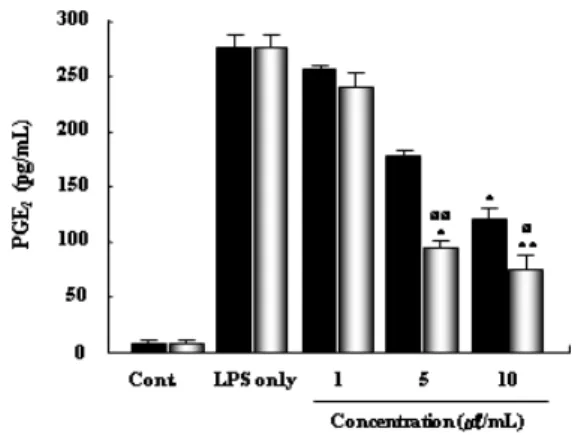
The shoot clumps extract of tissue-cultured R. aus- tralis inhibited LPS –induced prostaglandin E 2 production in a dose-dependent manner more than the natural R.

australis extract as shown in Figure 6. Comparing to in-

hibition of nitrite production, the shoot clumps extract of

tissue-cultured R. australis, especially at 5 µL/mL, sig-

nificantly reduced the LPS-induced prostaglandin E 2

production.

(7)

Figure 6. Effect of the natural R. australis extract and the shoot clumps extract of tissue-cultured R. australis on prostaglandin E 2 release in LPS-stimulated Raw 264.7 macrophages. The results were represented as mean ± standard deviation (S.D.) of three independent experiments.

** p < 0.01; 0.01 < * p < 0.05 vs. LPS alone. 0.01 < @ p

< 0.05 vs. the treated group with natural R. australis extract.

Figure 7. Effects of the natural R. australis extract and the shoot clumps extract of tissue-cultured R. australis on iNOS and cyclyoxygenase-2 expression in Raw 264.7 macrophages.

Cells were pre-incubated for 12 h with indicated concentrations of the natural R. australis extract and the tissue-cultured R. australis shoot clumps extract stimulated for 12 h with 1 µg/mL of LPS.

3.5. Inhibition of iNOS and COX-2 expression in LPS-stimulated Raw 264.7 macrophages We investigated the anti-inflammatory effects of the shoot clumps extract of tissue-cultured R. australis and the natural R. australis extract on iNOS and COX-2 pro- tein expression to identify the mechanism using a murine macrophage RAW 264.7 cell model. iNOS and COX-2 protein expression were markedly reduced by the shoot clumps extract of tissue-cultured R. australis and the nat- ural R. australis extract in Raw 264.7 macrophages as shown in Figure 7. Comparing the shoot clumps extract of tissue-cultured R. australis with the natural R. aus- tralis extract, the shoot clumps extract of tissue-cultured R. australis, especially at 5 µL/mL, significantly in- hibited COX-2 and iNOS protein expression more than the natural R. australis extract.

4. Discussion

The R. australis has been well known as ground cover plants for landscape in New Zealand or Australia, but R.

australis can’t grown in Korea because of climate and environment. Therefore, we investigated whether the tis- sue-cultured R. australis shoot clumps have efficacy as a

cosmetic ingredient for skin care. In this study, we aimed to examine the anti-oxidant effect and anti-inflammatory effect of the shoot clumps extract of tissue-cultured R.

australis and natural R. australis. Generally, tissue-cul- tured plants have a benefit to solve the drawbacks such as a rareness, long time and high cost for growing herb.

Also, the tissue culture plants are significantly different from natural plant about bioactive compounds or contents depending on the culture conditions (Various tissue cul- ture medium, cytokinin, auxin, nitrogen source, air con- dition and density etc.). Especially, the plant tissue cul- ture conditions involved in levels of plant secondary me- tabolites such as phenols, flavonoids, polyphenols, toco- pherols, and derivatives of cinnamic acid [13,14].

Phenolic compounds and flavonoid compounds are very important plant constituents because of their radical scav- enging ability resulting from their hydroxyl groups [15-18]. The results showed different outcome with the shoot clumps extract of tissue-cultured R. australis and the natural R. australis extract. The shoot clumps extract of tissue-cultured R. australis has more strong anti-oxi- dant effect than the natural R. australis extract on inves- tigation by DPPH, ABTS and NBT assay. It is consid- ered that the shoot clumps extract of tissue-cultured R.

australis more contained the amount of total flavonoid,

total phenol and another plant compounds. These phe-

nolic and flavonoid compounds have anti-oxidant

(8)

properties. On the investigation of total phenolic content and total flavonoid content, the shoot clumps extract of tissue-cultured R. australis as more total phenolic com- pound and total flavonoid compound than the natural R.

australis extract. In addition, we investigated the signal- ing molecules involved in LPS-stimulated inflammatory response production in murine RAW 264.7 macrophages.

We found that the shoot clumps extract of tissue-cultured R. australis inhibited LPS –induced NO and prostaglandin E 2 production through suppression of iNOS and COX-2 expression more than the natural R. australis extract.

These results showed clearly that the shoot clumps ex- tract of tissue-cultured R. australis has higher anti-oxi- dant activity and anti-inflammatory activity in compar- ison with the natural R. australis extract. From this study, the tissue-cultured R. australis shoot clumps ex- tract displayed strong possibility as a new natural cos- metic ingredient for skin-care products.

Acknowledgments

This study was supported by a grant of the Korea Healthcare technology R&D Project, Ministry for Health, Welfare & Family Affairs, Republic of Korea (Grant No : HN10C0007).

References

1. S. J. Bloor, Raoulic acid: A novel bioactive C 25 ter- peneacid from Raoulia australis, Tetrahedron Lett., 34, 5617 (1993).

2. H. J. Choi, J. H. Song, C. H. Lim, S. H. Baek, and D. H. Kwon, Anti-human rhinovirus activity of raoulic acid from Raoulia australis, J. Med. Food, 13(2), 326 (2010).

3. M. B. Ali, E. J. Hahn, and Y. K. Paek, Copper-in- duced changes in the groth, oxidative metabolism, andsaponin production in suspension cultured roots of Panax ginseng in bioreactors, Plant Cell Rep., 25, 1122 (2006).

4. H. J. Choi, J. H. Song, C. H. Lim, S. H. Baek, and

D. H. Kwon, Antiviral activity of raoulic acid from Raoulia australis against picornaviruses, Phytomedicine, 16(1), 35 (2009).

5. M. S. Blois, Antioxidants determination by the use a stable free radical, Nature, 181, 1198 (1958).

6. R. G. Kim, K. M. Shin, S. K. Chun, S. Y. Ji, S. H.

Seo, H. J. Park, J. W. Choi, and K. T. Lee, In vitro anti-inflammatory activity of the essential oil from Ligularia fischeri var. spiciformis in Murine macro- phage Raw 264.7 cells, Yakhak Hoeji, 46(5), 343 (2002).

7. W. Brand-Williams, M. E. Cuvelier, and C. Berset, Use of free radical method to evaluate antioxidant activity, Lebensmittel Wissenschaftund Technologie, 28, 25 (1995).

8. R. Roberta, P. Nicoletta, P. Anna, P. Ananth, Y.

Min, and R. E. Catherine, Anti-oxidant activity ap- pling an improved ABTS radicla cation decoloriza- tion assay, Free Radical Biology & Medicine, 26(9), 1231 (1999).

9. T. Liu, N. Xiao, Y. Liu, B. Wilson, J. Li, Y. Wang, X. Cao, and Z. Liu, The anti-inflammatory effects of ethyl acetate on Lipopolysaccharide /D-galactos- amine challenged mice and Lipopolysaccharide acti- vated RAW264.7 cells, Biochem. Biophys. Res.

Commun., 26(3), 518 (2012).

10. E. J. Lee, S. H. Moh, and K. Y. Paek, Influence of inoculum density and aeration volume on biomass and bioactive compound production in bulb-type bubble bioreactor cultures of Eleutherococcus kore- anum Nakai, Bioresource Technology, 102, 7165 (2011).

11. L. C. Green, D. A. Wagner, J. Glogowski, P. L.

Skipper, J. S. Wishnok, and S. R. Tannenbaum, Analysis of nitrate, nitrite and [15N]-nitrate in bio- logical fluids, Anal. Biochem., 126(1), 131 (1982).

12. C. M. Park, M. J. Park, H. J. Kwak, H. C. Lee, M.

S. Kim, S. H. Lee, I. C. Park, C. H. Rhee, and S.

I. Hong, Ionizing radiation enhances matrix metal-

loproteinase-2 secretion and invasion of glioma cells

through Src/epidermal growth factor receptor-medi-

(9)

ated p38/Akt and phosphatidylinositol 3-kinase/Akt signaling pathways, Cancer Res., 66(17), 8511 (2006).

13. J. Andrej, F. Juraj, P. Ivana, and M. Tibor, Approaches to flavonoid production in plant tissue cultures, Biologia, Bratislava, 59(6), 697 (2004).

14. A. Matkowski, Plant in vitro culture for the pro- duction of antioxidants —a review, Biotechnol. Adv., 26(6), 548 (2008).

15. J. I. Gong, D. Xia, J. Huang, Q. Ge, J. Mao, S. Liu, and Y. Zhang, Functional components of bamboo shavings and bamboo leaf extracts and their anti- oxidant activities in vitro, J. Med. Food, 13, (2014).

16. M. I. Kacem, G. Simon, R. Leschiera, L. Misery, A.

ElFeki, and N. Lebonvallet, Anti-oxidant and anti-in- flammatory effects of Ruta chalepensis L. extracts on LPS-stimulated RAW 264.7 cells, In Vitro Cell Dev.

Biol. Anim., 2, (2014).

17. R. B. Mansour, I. B. Jilani, M. Bouaziz, B.

Gargouri, N. Elloumi, H. Attia, Z. Ghrabi-Gammar, and S. Lassoued, Phenolic contents and antioxidant activity of ethanolic extract of Capparis spinosa, Cytotechnology, 7, (2014).

18. K. N. Sunil Kumar, A. Saraswathy, S. Amerjothy, T.

Susan, and B. Ravishankar, Total phenol content and in vitro anti-oxidant potential of Helicanthus elastica (Desr.) danser-A less-explored indian mango mis- tletoe, J. Tradit. Complement Med., 4(4), 285 (2014).

19. A. A. Alafiatayo, A. Syahida, and M. Mahmood,

Total anti-oxidant capacity, flavonoid, phenolic Acid

and polyphenol content in ten selected species of

zingiberaceae rhizomes, Afr. J. Tradit. Complement

Altern. Med., 11(3), 7 (2014).

수치

Figure 1. Scheme of the whole procedure of the R. australis cultured by the bioreactor culture system
Figure 2. DPPH free radical scavenging activities of extracts  from the natural  R. australis and the shoot clumps extract  of tissue-cultured  R
Table 1. The Total Phenolic Content and Total Flavonoid Content of the Natural R. australis Extract and the Shoot Clumps  Extract of Tissue-cultured  R
Figure 7. Effects of the natural R. australis extract and the  shoot clumps extract of tissue-cultured  R

참조

관련 문서

The results of measuring the 1,1-diphenyl-2-picrylhydrazyl radical scavenging activity by treating the phenolic compound with thinning green ball apple at a concentration of

Radical scavenging activity using ABTS and total antioxidant activity using FRAP method also showed that Paulownia extract had high antioxidant effect.. RAW264.7 cells

Alternatively, organic formulated plant tissue culture media was standardized using coelomic fluid (20 mL/L filter sterilized using 0.45 µm) in vermicompost extract (30%) medium

Its antioxidative effect showed a significant DPPH-radical scavenging activity at concentrations of 1-100 μg/mL, while SH extract showed highly a DPPH-radical scavenging activity

Effect of lactic acid bacteria (LB-20) fermentation on superoxide radical scavenging activity of Hizikia fusiforme water extract.. of

In sum- mary, we found that the adventitious root extract cul- tured from Echinacea angustifolia enhanced the radical scavenging activity and superoxide anion scavenging

Anti-oxidant activities of Celosia cristata ethanol extract in the DPPH radical scavenging activity assay.. ROS 중 가장 먼저 생성되는 것이 superoxide