에키네시아 조직 배양체 추출물의 생리활성에 관한 연구
박 창 민†⋅정 민 석⋅고 두 진⋅백 기 엽*⋅최 종 완
(주)한국화장품제조 기술개발연구소, *충북대학교
(2011년 7월 29일 접수, 2011년 9월 16일 수정, 2011년 9월 19일 채택)
Study on Biological Activities of Adventitious Roots Cultured from Echinacea angustifolia
Chang-Min Park†, Min-Seok Joung, Du-Jin Ko, Kee-Yoeup Paek*, and Jong-Wan Choi
R&D Center, Hankook Cosmetics Manufacturing Co., Ltd., 76-1, Yongseong-Ri, Samseong-Myeon, Eumseong-Gun, Chungcheongbuk-Do 369-834, Korea
*Research Center for The Development of Advanced Horticultural Technology, Chungbuk National University (Received July 29, 2011; Revised September 16, 2011; Accepted September 19, 2011)
요 약: 일반적으로 쌍떡잎식물 국화과 허브의 한 종인 에키네시아는 미국 북미 대평원에 서식하는 야생 식물로 수세기 동안 감기나 또 다른 바이러스 감염에 의한 질병에 대하여 면역 기능을 증진시키는 전통 식물 약제로 널리 사용되어 왔다. 본 연구에서는 생물반응장치를 이용하여 조직 배양된 에키네시아 식물체에 대하여 화장품 성분으로써 응용 가치 를 평가하였다. 이미 몇몇 보고된 논문에서 에키네시아는 조직재생, 상처 치유, 그리고 염증 억제 등의 약리학적 활성에 대한 연구가 진행되었다. 본 연구에서는 생물반응장치를 이용하여 조직 배양된 에키네시아 추출물에 대하여 화장품 성 분으로서 효능, 효과를 평가하였다. 실험 결과 조직배양된 에키네시아 추출물은 항산화 효과 및 단백분해효소 발현 억제 효과가 자연 상태의 에키네시아 추출물과 비교하여 우수한 결과를 보였다. 이러한 결과들은 피부보호를 위한 화장품 성분으로서 응용 가능성을 제공할 수 있을 것으로 사료된다.
Abstract: The
Echinacea, which has been commonly known as a species of composite herb of dicotyledonous plant, has been used in native American traditional medicine for the treatment of diseases like colds or other infections in North America. We artificially cultured the adventitious roots of
Echinacea angustifoliausing the bioreactor culture system from
Echinacea angustifoliaand evaluated the efficacy as a cosmetic ingredient for skin care. Several studies previously have reported neogenesis, wound healing and inflammatory inhibition effect of
Echinacea angustifoliabut other efficacies were not well known. In the present study, we investigated the cosmetic efficacy to know applicable value of adventitious roots cultured from
Echinacea angustifoliaas a cosmetic ingredient. The adventitious roots ex- tract of
Echinacea angustifoliahas superior anti-oxidant effect and matrix metalloproteinase-2 inhibitory effect, com- pared to natural
Echinacea angustifolia. These results indicate that the adventitious roots extract cultured from
Echinacea angustifoliapresents a new possibility of being applicable to skin care and anti-wrinkle products as a cos- metic ingredient.
Keywords: Echinacea angustifolia, matrix metalloproteinase, anti-oxidant, collagenase
1. Introduction
1)
Echinacea is a traditional perennial medicial herb in
† 주 저자 (e-mail: [email protected])
North America. Echinacea is a genus in the Asteraceae family. There are nine different species of Echinacea and they are herbaceous perennial. The three Echinacea species which have been found the most in herb prod- ucts are Echinacea angustifolia, Echinacea purpurea
and Echinacea pallida[1]. American Indians have long used Echinacea angustifolia as a herbal remedy against colds, wound, sores, snakes and insects bites, especially as a herbal tea to strengthen the immune system[2].
Echinacea has great values in herbal medicines because of its pharmacological activities.
Several studies previously have reported anti-oxidant and immuno-enhancing effects of Echinacea angustifo- lia extract[3,4]. Nowadays, the abilities of Echinacea are well known by many studies. Echinacea has the capacity to activate human macrophages and stimulate the phagocytosis[5,6]. It also has a mild antibacterial and fungicidal activity and increases fibroblasts helping to stimulate new tissue development. Furthermore, the roots of Echinacea help activate different immune sys- tem mechanisms for the human body[7,8]. In the pres- ent study, we artificially cultured Echinacea angustifo- lia adventitious roots using the bioreactor culture sys- tem and compared the adventitious roots cultured from Echinacea angustifolia with the natural Echinacea an- gustifolia in order to investigate if Echinacea angustifo- lia cultured by the bioreactor culture system can be used as a cosmetic ingredient for skin care products.
2. Materials and Methods
2.1. Reagents and Cell Culture
Antibodies against MMP-1, pro-collagen type Ⅰ and β-actin were purchased from Santa Cruz Biotechnology (Santa Cruz, CA). echinacoside, 1, 1-diphenyl1-2-pi- crylhydrazyl (DPPH), nitroblue tetrazolium (NBT) and 2,2'-azino-bis-3-ethylbenzthiazoline-6-sulphonic acid (ABTS) were purchased from sigma-aldrich (St. Louis, MO, USA). Other commercially available reagents and solvents were used as received. Mouse fibroblast cell lines NIH-3T3L1 (obtained from American Type Culture Collection) were maintained in Dulbecco’s modi- fied Eagle’s medium (DMEM, WelGENE, Korea) sup- plemented with 10 % heat-inactivated fetal bovine se- rum (FBS, Gibco BRL, USA), 100 U/mL penicillin (Gibco BRL, USA) and 100 µg/mL streptomycin (Gibco BRL, USA) at 37 ℃ in a humidified atmosphere con- taining 5 % CO2.
2.2. Preparation of Adventitious Roots Cultured from Echinacea angustifolia
Echinacea angustifolia adventitious roots were ob- tained from Research Center for The Development of Advanced Horticultural Technology, Chungbuk National University. Culture: The initial medium pH was ad- justed to 6.0 before autoclaving (at 121 ℃ and 1.2 kg cm-2 pressure for 15 min), and the cultures were kept under darkness at 25 ℃. These adventitious roots were sub-cultured monthly. Adventitious roots (10 g L−1, 2 cm long) were inoculated in 500-mL shake flasks con- taining 200 mL half strength MS medium with 5 % (w/v) sucrose and IAA, IBA, or NAA. Extraction:
After dried, 3 g of Echinacea angustifolia adventitious roots were immersed in 97 g of 70 % ethanol solution and 30 % 1,3-butyleneglycol (1,3-BG) for sufficient time and mixed enough for 48 h in 45 ℃ using agitator.
Then, the solution was filtered through a filter paper, followed by the removal of ethanol from the filtrate at 50 ∼ 60 ℃ to obtain Echinaceaangustifolia adventitious roots extract of 80 %.
2.3. UV Irradiation
Cells were plated in 6 well cell culture dishes and in- cubated at 37 ℃ under humidified 5 % CO2 and 95 % air in culture medium until 70 % to 80 % confluent.
Then cells were exposed 5.8 J/cm2 (UVA) from high intensity UV lamp (UVGL-58, San Gabriel, CA91778 U.S.A).
2.4. Cell Cytotoxicity by MTT Assay
Cells (1 × 10⁵ cells/well) were seeded in 10 % FBS/
DMEM medium and incubated in 5 % CO2 incubator at 37 ℃ after treatment with Echinacea angustifolia adventitious roots extract for indicate times. Measure- ment of mitochondrial activity to form purple formazan by MTT was used to assess the cytotoxicity of cell fol- lowing extract treatment: MTT (0.5 mg/mL), one tenth of the original culture volume, was added to each culture and incubated for 3 h at 37 ℃ in 5 % CO2. The purple formazan formed by viable cells was dissolved by the addition of DMSO and absorbance at the dual ranges of 540 nm and 630 nm was measured by using
spectrophotometer.
2.5. Free Radical Scavenging Activity
The DPPH(1,1-diphenyl1-2-picrylhydrazyl) assay was done according to the method of Brand-Williams et al.
[9]. The working solution was prepared 0.2 mM DPPH and then stored at –20 ℃ until needed. Then, the ab- sorbance was taken at 540 nm and its anti-oxidative activity was calculated as compared with blank control.
2.6. Superoxide Radical Scavenging Activity
The procedure followed the method of F. Liu et al.
[10] with some modifications for NBT assay. Superoxide anion scavenging activity was measured using xan- thine-xanthine oxidase system as a source of super- oxide and nitroblue tetrazolium (NBT). Then, the ab- sorbance was taken at 540 nm and its SOD-like activ- ity was calculated as compared with blank control.
2.7. ABTS Radical Cation Scavenging Activity
The procedure followed the method of R. Roberta et al.[11] with some modifications for ABTS assay. The stock solutions included 7 mM ABTS·+ solution and 2.4 mM potassium persulfate solution. The working sol- ution was then prepared by mixing the two stock sol- utions in equal quantities and allowing them to react for 12 h at room temperature in the dark. The solution was then diluted by mixing ABTS·+ solution with methanol. Then, the absorbance was taken at 734 nm and its ABTS·+ scavenging activity was calculated as compared with blank control.
2.8. Collagenase Activity Assay
The procedure followed the method of Wunsch et al.
[12] with some modifications for collagenase activity assay. Sample is mixed with Substrate buffer 900 uL [10 mg azocollagen, 50 mM Tris-HCl buffer pH 7.5, 5 mM Ca(C2H3O2)2] and preincubate for 10 min at 25 ℃.
Then, 100 uL enzyme (5 ug/mL) mix a substrate con- tained sample and incubate 20 min at 25 ℃. Then, the absorbance was taken at 540 nm and its collagenase in- hibitory activity was calculated as compared with blank control.
2.9. Western Blot Analysis
Cells were treated with various dose and lysed in ly- sis buffer as described previously[13]. After differ- entiation, cells were lysed in lysis buffer. The lysates were clarified by centrifugation at 12,000 × g for 15 min at 4 ℃ and protein content was measured by 12.5
% SDS-PAGE and blotted to nitrocellulose membrane (0.2 mm, Amersham, Arlington Heights, IL). The membrane was blocked with 5 % non-fat skim milk in TBS-T and incubated with the primary and secondary antibodies. Immunoblots were visualized by enhanced chemiluminescence (Amersham, UK), according to the manufacturer’s protocol. Densitometric analysis for pro- tein bands was done using Scion Image NIH Image program.
2.10. Echinacoside Content in the Adventitious Roots of E. angustifolia
A Agilent technologies HPLC equipped with Agilent 1200 series HPLC and variable wavelength detector was used in the analysis. A reversed-phase column (Waters Nova-Pak C18 4 µm 150 mm × 3.9 mm µm) was used. The gradient elution system consisted of 0.1
% phosphoric acid (A) and acetonitrile (B). Separation was achieved using the following gradient: 0 ∼ 13 min: 10 ∼ 22 % B, 13 ∼ 14 min: 22 ∼ 40 % B, 14
∼ 14.5 min: 40 ∼ 40 %, 14.5 ∼ 15 min: 40 ∼ 10 % B, 15 ∼ 20 min: 10 ∼ 10 % B. The column temper- ature was set at 35 ℃. The flow rate was 1.5 ml/min.
The UV detection wavelength was 330 nm. The mean values of three replicates were calculated. Standard sol- ution were prepared by echinacoside (cromadex) 5 mg, dissolved in water 50 mL.
2.11. Statistical Analysis
Data are presentated as mean ± SD. Comparisons be- tween groups were used to the paired Student’s t-test.
Asterisk (**, p < 0.01; *, 0.01 < p < 0.05) was consid- ered to be statistically significant.
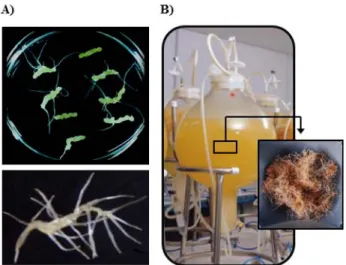
Figure 1. The Echinacea angustifolia cultured by the bio- reactor culture system. Figure 1A is a picture of induction and growth of Echinacea angustifolia adventitious roots culturing by MS (Murashige and Skoog, 1962) medium.
Figure 1B is the Echinacea angustifolia adventitious roots culturing by the bioreactor culture system using liquid me- dium and picture of the dried adventitious roots of Echinacea angustifolia.
Figure 2. DPPH free radical scavenging activities of the adventitious root extract cultures from Echinacea angusti- folia and Echinacea angustifolia root extract. Assay were treated with various concentrations of the extract and free radical scavenging activity measured by DPPH assay as described in materials and methods. The results were rep- resented as mean of standard deviation (S.D.) of three in- dependent experiments.**, p < 0.01; *, 0.01< p <0.05 versus control.
3. Results
3.1. The Aventitious Roots of Echinacea angustifolia Cultured by the Bioreactor Culture System Tissue culture protocols have been developed for preservation of this valuable plant. Figure 1A is the picture of induction of adventitious roots of Echinacea.
angustifolia by plant hormone after 5 weeks of culture.
Figure 1B is the adventitious roots of Echinacea an- gustifolia cultured by the bioreactor culture system us- ing liquid medium. We extract the dried Echinacea an- gustifolia adventitious roots and investigate the efficacy as cosmetic ingredient.
3.2. Antioxidant Activity of the Adventitious Roots Extract of Echinacea angustifolia and Roots Extract of Echinacea angustifolia
To investigate the effect of the adventitious roots extract of Echinacea angustifolia, we first studied the antioxidant effect of Echinacea angustifolia adventi- tious roots extract. Three assays were treated with various concentrations of the extract and antioxidant
activities were measured using DPPH, NBT and ABTS assay as described in Materials and Methods. The ad- ventitious roots extract of Echinacea angustifolia en- hanced the hydroxyl radical scavenging activity and superoxide anion scavenging activity more than roots extract of Echinacea angustifolia in a dose dependent manner in DPPH assay (Figure 1) and NBT assay (Figure 2). In DPPH assay and NBT assay, the adven- titious roots extract of Echinacea angustifolia enhanced scavenging activity about 15 % more than roots extract of Echinacea angustifolia in 0.2 % concentration. To certificate the antioxidant effect of the adventitious roots extract of Echinacea angustifolia, we investigated ABTS․+ radical scavenging activity using ABTS assay.
As shown in Figure 3, the adventitious roots extract of Echinacea angustifolia significantly enhanced the scav- enging activity more than roots extract of Echinacea angustifolia. In ABTS assay, the adventitious roots ex
Figure 3. NBT superoxide radical scavenging activities of the adventitious root extract cultures from Echinacea an- gustifolia and Echinacea angustifolia root extract. Assay were treated with various concentrations of the extract and free radical scavenging activity measured by NBT as- say as described in materials and methods. The results were represented as mean of standard deviation (S.D.) of three independent experiments.**, p < 0.01; *, 0.01< p
<0.05 versus control.
Figure 4. ABTS radical scavenging activities of the ad- ventitious root extract cultures from Echinacea angustifo- lia and Echinacea angustifolia root extract. Assay were treated with various concentrations of the extract and free radical scavenging activity measured by ABTS assay as described in materials and methods. The results were rep- resented as mean of standard deviation (S.D.) of three in- dependent experiments.**, p < 0.01; *, 0.01< p <0.05 versus control.
tract of Echinacea angustifolia enhanced scavenging activity about 20 % more than roots extract of Echinacea angustifolia in 0.2 % concentration.
3.3. Cell Cytotoxicity by the Adventitious Roots Extract of Echinacea angustifolia
To investigate inhibitory effects of proteinase and collagenase as well as antioxidant effect by the adven- titious roots extract of Echinacea angustifolia, we first studied the effect of cytotoxicity in NIH3T3-L1 cells treated with the adventitious roots extract of Echinacea angustifolia and roots extract of Echinacea angustifolia as described in Materials and Methods. Cell cytotoxicity was measured by MTT assay. As shown in Figure 5, the adventitious roots extract of Echinacea angustifolia did not have cytotoxicity until 0.2 % concentration for 24 h.
3.4. Inhibitory Effect of Matrix Metalloproteinases by the Adventitious Roots Extract of Echinacea angustifolia
To know the other effect of Rubus coreanus extracts, we examined expression of matrix metalloproteinase-2 and matrix metalloproteinase-9 enhancing the degrada- tion extracellular matrix (ECM) components related with skin wrinkle in cell lysate as described in Materials and Methods. As shown in Figure 6, Echinacea angus- tifolia adventitious roots extract significantly reduced the expression of MMP-2 more than Echinacea angus- tifolia roots extract as compared with the UV-treated cells at a concentration without any cytotoxicity. On the other hand, matrix metalloproteinase-9 expression was not affected by Echinacea angustifolia adventitious roots extract and Echinacea angustifolia roots extract.
Figure 5. Cell viability of the adventitious roots extract cultured from Echinacea angustifolia and Echinacea an- gustifolia root extract. NIH3T3-L1 mouse fibroblast cells were treated with various concentrations and cell viability measured by MTT assay described in materials and methods. The results were represented as mean of stand- ard deviation (S.D.) of three independent experiments. **, p < 0.01; *, 0.01 < p <0.05 versus control.
Figure 6. Inhibtion of MMP-2 and MMP-9 by the ad- ventitious roots extract cultured from Echinacea angusti- folia and Echinacea angustifolia root extract in NIH3T3- L1 cells. Cells were lysed in lysis buffer and subjected to western blot for the detection of MMP-2 and MMP-9 as described in materials and methods. NIH3T3- L1 cells were treated with indicated concentration and compared with Echinacea angustifolia root extract. Western blot bands were subjected to densitometric scanning using the Scion image NIH image software. The results were repre- sented as mean of standard deviation (S.D.) of three in- dependent experiments. Bars represent the mean ± S. D.
* p < 0.05 versus control, @ p < 0.05 versus UV alone.
3.5. Inhibitory Effect of Collagenase
In addition, we examined whether the adventitious roots extract of Echinacea angustifolia have an in- hibitory effect of collagenase activity relating with skin wrinkle. As shown in Figure 7, the adventitious roots extract of Echinacea angustifolia inhibited the collage- nase activity in a dose-dependent manner. Collagenase inhibitory activity of the adventitious roots extract of Echinacea angustifolia was enhanced more than Echinacea angustifolia roots extract as compared with roots extract of Echinacea angustifolia.
3.6. Echinacoside Content in the Adventitious Roots of Echinacea angustifolia
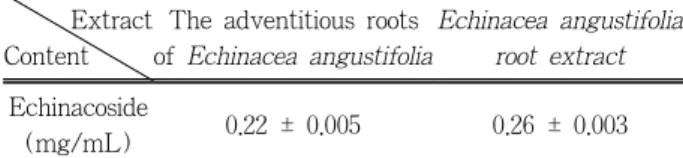
Among the bioactive substances of Echinacea angus- tifolia, the Echinacoside which is a kind of derivates of Caffeic acid is exist in great quantities. Therefore, we compared the content analysis of the cultured adventi- tious roots of Echinacea angustifolia with that of the natural Echinacea angustifolia extracts. As shown in Table 1, we realized that the adventitious roots of
Echinacea angustifolia include more Echinacoside than natural Echinacea angustifolia extracts through the Table 1.
4. Discussion
Generally, tissue-cultured plant has a benefit to solve the drawbacks such as a rareness, long time and high cost for growing herb. Although the Echinacea angus- tifolia has been well known as herb to remedy of neo-
Figure 7. Inhibition of the adventitious roots extract cul- tured from Echinacea angustifolia and Echinacea angusti- folia root extract on collagenase. Assay were treated with various concentrations of the extract and collagenase in- hibitory activity measured by collagenase assay as de- scribed in materials and methods. The results were repre- sented as mean of standard deviation (S.D.) of three in- dependent experiments. **, p < 0.01; *, 0.01< p <0.05 versus control.
genesis, wound healing, inflammation, hypertension, diabetes, heart and liver disease as a traditional medi- cine, we investigated whether the adventitious roots cultured from Echinacea angustifolia have efficacy as a cosmetic ingredient for skin care in this study. In sum- mary, we found that the adventitious root extract cul- tured from Echinacea angustifolia enhanced the radical scavenging activity and superoxide anion scavenging activity more than Echinacea angustifolia roots extract in measurement using DPPH, NBT and ABTS assay for antioxidant activities. The adventitious root extract cultured from Echinacea angustifolia significantly re- duced the expression of MMP-2 more than Echinacea angustifolia roots extract as compared with the UV- treated cells. Also, the adventitious roots of Echinacea angustifolia include more echinacoside than natural Echinacea angustifolia extracts. As a result, we suggest
Table 1. Echinacoside Content of the Adventitious Roots of Echinacea angustifolia and Echinacea angustifolia Root Extract
Extract Content
The adventitious roots of
Echinacea angustifoliaEchinacea angustifolia root extract
Echinacoside
(mg/mL) 0.22 ± 0.005 0.26 ± 0.003
that the adventitious roots cultured from Echinacea an- gustifolia could be cosmetic ingredient for skin care with antioxidant activity, inhibitory effect of collage- nase activity and inhibition of proteinase expression re- lated with skin wrinkle.
Acknowledgments
This study was supported by a grant of the Korea Healthcare technology R&D Project, Ministry for Health, Welfare & Family Affairs, Republic of Korea (Grant No : A103017).
Reference
1. S. S. Percival, Use of echinacea in medicine, Biochem Pharmacol, 60(2), 155 (2000).
2. B. Barrett, Medicinal properties of echinacea: a critical review, Phytomedicine, 10(1), 66 (2003).
3. S. Osowski, M. Rostock, H. H. Bartsch, and U.
Massig, Pharmaceutical comparability of different therapeutic Echinacea preperations, Forsch Komple- mentarmed Klass Naturheilkd, 7(6), 294 (2000).
4. R. A. Burger, A. R. Torres, R. P. Warren, and V.
D. Caldwell, Echinacea-induced cytokine production by human macrophages, Int. J. Immunopharmacol., 19(7), 371 (1997).
5. F. Pellati, S. Benvenuti, L. Magro, M. Melegari, and F. Soragni, Analysis of phenolic compounds and radical scavenging activity of Echinacea spp, J.
Pharm. Biomed. Ana, 35(2), 289 (2004).
6. B. D. Sloley, L. J. Urichuk, C. Tywin, R. T. Coutts, P. K. Pang, and J. J. Shan, Comparison of chemical components and antioxidants capacity of different echinacea species, J. Pharm. Pharmacol., 53(6), 849
(2001).
7. E. H. South and J. H. Exon, Multiple immune func- tions in rats fed echinacea extracts, Immunophar- macol Immunotoxicol, 23(3) 411 (2001).
8. M. Sharma, R. Schoop, and J. B. Hudson, Echinacea as an antiinflammatory agent: the influence of physiologically relevant parameters, Phytother Res., 23(6), 863 (2009).
9. W. Brand-Williams, M. E. Cuvelier, and C. Berset, Use of free radical method to evaluate antioxidant activity, Lebensmittel Wissenschaftund Technologie, 28, 25 (1995).
10. F. Liu, V. E. C. Ooi, and S. T. Chang, Free radical scavenging activities of mushroom polysaccharide extracts, Life Sci., 60, 763 (1997)
11. R. Roberta, P. Nicoletta, P. Anna, P. Ananth, Y.
Min, and R. E. Catherine, Antioxidant activity ap- pling an improved ABTS radicla cation decoloriza- tion assay, Free Radical Biology & Medicine, 26(9), 1231 (1999).
12. E. Wunsch and H. G. Heindrich, On the quantita- tive determination of collagenase, Hoppe Seylers Z Physiol Chem., 333, 149 (1963).
13. C. M. Park, M. J. Park, H. J. Kwak, H. C. Lee, M.
S. Kim, S. H. Lee, I. C. Park, C. H. Rhee, and S.
I. Hong, Ionizing radiation enhances matrix metal- loproteinase-2 secretion and invasion of glioma cells through Src/epidermal growth factor receptor- mediated p38/Akt and phosphatidylinositol 3-kin- ase/Akt signaling pathways, Cancer Res., 66(17), 8511 (2006).