Phylogenetic Characterization of White Hanwoo Using the Mitochondrial Cytochrome b Gene
Jae-Hwan Kim, ChangYeon Cho, SeungChang Kim, Sung Woo Kim, Seong-Bok Choi and Seong-Su Lee*
Animal Genetic Resources Research Center, NIAS, Namwon 590-832, Korea
Received June 19, 2015 /Revised August 10, 2015 /Accepted August 10, 2015
The goals of this study were to identify sequence variations in the mitochondrial cytochrome b (mtDNA cyt b) gene in White Hanwoo (Wh) and the genetic relationship between the Wh and other breeds. When whole sequences of the mtDNA cyt b gene in 14 Wh cattle were determined, a silent mutation and two haplotypes were detected in the Wh cattle. The major haplotype, H1, was found in 13 of 14 individuals in the Wh cattle. Haplotype diversity and nucleotide diversity were 0.143 and 0.00013, respectively. Compared to previous reports, these levels of genetic diversity are lower than other Korean and Chinese breeds. To identify the genetic relationship among Korean, Chinese, Japanese, and European cattle breeds, the neighbor-joining (NJ) tree was constructed based on Dxy genetic distances. Two distinct groups were identified and classified as A and B. Wh was found in the A group, which consisted of Bos taurus breeds. From calculating the Dxy genetic distances, Wh was found to be genetically more closely related to two breeds, Heugu (0.00018) and Yanbian (0.00021), than to other breeds. In conclusion, Wh is genetically related to Chikso, Heugu, and Yanbian breeds based on maternal inheritance. The results of this study will be useful for efficient management and sustainable utilization of Wh.
Key words :
Cattle, cytochrome b, mtDNA, relationship, White Hanwoo
*Corresponding author
*Tel : +82-63-620-3537, Fax : +82-63-620-3590
*E-mail : [email protected]
This is an Open-Access article distributed under the terms of the Creative Commons Attribution Non-Commercial License (http://creativecommons.org/licenses/by-nc/3.0) which permits unrestricted non-commercial use, distribution, and reproduction in any medium, provided the original work is properly cited.
Journal of Life Science 2015 Vol. 25. No. 9. 970~975 DOI : http://dx.doi.org/10.5352/JLS.2015.25.9.970
서 론
백한우는 2009년에 한우 사육농가에서 발생되었으며, 그 후 몇몇 타 농가에서도 확인되었다. 이에 따라 국립축산과학원 가축유전자원센터는 2009년과 2010년에 정읍 및 대전지역 농 가로부터 백한우 3두(수컷 1두, 암컷 2두)를 수집한 후 지속적 인 증식을 통해 현재 14두를 보존 및 관리하고 있다. 백한우는 모발과 망막에 색소가 전혀 없는 전형적인 백색증(albinism) 을 보이는 한우로 추정되나, 그 외의 표현형적인 결함은 나타 나지 않았다[14].
소의 알비노 발생에 대한 몇몇 연구가 보고되어 있다[4, 6, 15]. 특히 “Snowdrop”이라는 알비노 소가 보고되었는데, Tyrosinase (TYR) 유전자 exon 2 영역(GenBank accession no.
AY046527 기준 929~930번째 사이에 C 염기의 삽입)에서 격자 이동돌연변이(frame-shift mutation)가 동정되었으며, 이 변이 가 동형접합일 경우 발생한다[20]. 반면에 백한우인 경우는
“Snowdrop”과는 달리 TYR 유전자의 exon 2 영역 중 871번째 염기치환(c.871G>A)에 의한 A 염기의 동형접합에 의해 발생
한다고 보고되었다[14].
최근 들어 생물자원에 대한 국제패러다임 변화로 자원 보유 국의 배타적 권리를 인정하고 있다. 이에 따라 자원의 수집·확 보, 보존과 함께 활용을 위한 특성평가에 많은 노력을 기울이 고 있다. 전세계 가축유전자원의 현황 파악 및 다양성 보존을 위해 국제식량노업기구(FAO)와 가입국들의 협력으로 범지구 적활동계획(GPA)을 추진하고 있으며[3], 자원보유국들은 소, 돼지, 양, 말, 염소 등의 가축유전자원들에 대한 유전적 다양성 평가 및 계통유전학적 분석 결과를 보고하고 있다[5, 10, 13, 19, 22].
백한우는 백모색의 특징을 보이기 때문에 한우산업의 안전
적 유지를 위해 도태 대상이지만, 새로운 육종소재, 인간 유전
질환 동물모델 등 미래의 충분한 활용가치를 생각한다면 보존
해야 되는 유전자원이다. 따라서 국립축산과학원 가축유전자
원센터에서는 백한우의 멸종 방지를 위해 보존, 관리 및 증식
을 추진하고 있으며, 또한 FAO 산하의 가축다양성정보시스템
(DAD-IS, http://dad.fao.org/)에 등재하여 우리의 자원임을
전세계에 알렸다. 하지만 최근에 보고된 번식관련 연구[12]를
제외하면 아직까지 백한우에 대한 분자유전학적 특성평가는
전무한 실정이다. 따라서 본 연구는 모계유전특성에 기초해서
가축의 유연관계 분석에 대표적으로 적용하고 있는 mtDNA
cyt b 유전자 분석을 통해 백한우 집단의 유전적 다양성 파악
및 계통유전학적 특성 분석을 위해 수행하였다.
Table 1. Genetic diversity of White Hanwoo based on sequence variation in the complete mtDNA cyt b gene
Region Population Sample size Number of
polymorphic sites
Number of haplotypes
Haplotype diversity
Nucleotide diversity
mtDNA cyt b White Hanwoo 14 1 2 0.143 0.00013
Table 2. Information on reference sequences for comparison with White Hanwoo
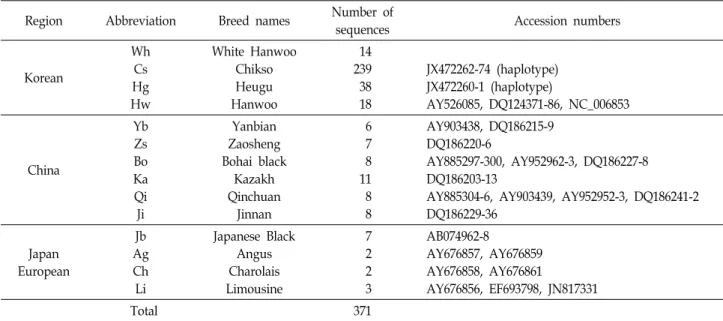
Region Abbreviation Breed names Number of
sequences Accession numbers
Korean
Wh Cs Hg Hw
White Hanwoo Chikso Heugu Hanwoo
14 239 38 18
JX472262-74 (haplotype) JX472260-1 (haplotype)
AY526085, DQ124371-86, NC_006853
China
Yb Zs Bo Ka Qi Ji
Yanbian Zaosheng Bohai black
Kazakh Qinchuan
Jinnan
6 7 8 11 8 8
AY903438, DQ186215-9 DQ186220-6
AY885297-300, AY952962-3, DQ186227-8 DQ186203-13
AY885304-6, AY903439, AY952952-3, DQ186241-2 DQ186229-36
Japan European
Jb Ag Ch Li
Japanese Black Angus Charolais Limousine
7 2 2 3
AB074962-8
AY676857, AY676859 AY676858, AY676861
AY676856, EF693798, JN817331
Total 371
재료 및 방법
시료 수집 및 DNA 추출
본 연구에서는 국립축산과학원 가축유전자원센터에서 보 존 및 관리되고 있는 백한우 14두를 공시하였다(NIAS 2015-600). Genomic DNA는 Sucrose-Proteinase K 방법[1]을 이용하여 추출하였으며, NanoDrop ND1000 (Thermo Scientific, USA)을 이용하여 genomic DNA의 농도 측정 후 PCR 증폭을 위한 주형으로 이용하였다. 백한우와의 유전적 비교를 위해서 기존 보고에서 이용된 칡소 및 흑우의 개체별 서열을 이용하였으며[8-9], 한우 및 10개 외래품종에 대한 80 개 서열은 Genbank database로부터 수집하였다(Table 2).
유전자 증폭 및 서열결정
소 mtDNA cyt b 유전자에 대한 전체 coding 영역을 증폭하 기 위해 기존에 보고된 primer와 증폭방법을 적용하였다[9].
PCR 반응은 Taq polymerase 1.5 unit (TaKaRa, Japan), 10 pmol primer 각각 1.5 μl, genomic DNA 20 ng 등과 함께 증류 수를 첨가하여 최종 25 μl로 반응하였다. PCR 증폭은 anneal- ing 온도를 60℃로 하여 35회 반복 수행하였다. 증폭산물은 1.5% agarose 전기영동 상에서 확인 후 QIAquick PCR Purification Kit (Qiagen, USA)로 정제하였다. ABI 3130xl Genetic Analyzer (ABI, USA)를 통한 direct-sequencing으로 서열을 분석하였다. 분석된 서열은 소 mtDNA genome 서열
(GenBank accession no.V00654)을 기준으로 cyt b 유전자의 전체서열을 결정하였으며, GenBank database에 등록하였다 (KT151960-61).
유전특성 및 계통유전학적 분석
본 연구에서 결정된 백한우 cyt b 유전자의 서열을 대상으로 CLUSTAL W 프로그램[21]을 이용하여 다중염기정렬을 실시 하였다. 변이부위 탐색, 유전적 다양성 확인, haplotype 결정,
Dxy 유전거리는 DNASP (ver. 5.1) 프로그램[16]을 사용하였다. 또한 계통유전학적 위치를 확인하기 위해서 Dxy 유전거리 를 토대로 neighbor-joining (NJ) tree를 작성하였다[18].
결과 및 고찰
염기변이 동정 및 유전적 다양성 확인
본 연구에서는 백한우 14두에 대한 mtDNA cyt b 유전자의 염기서열을 결정하였다. 전체 길이는 1,140 bp였으며, 개시코 돈 ATG, 종료코돈 AGA로 모든 개체에서 동일하게 나타났다.
또한 4개 염기 중 G 염기 구성비율이 13.4%로 A(31.2%), C (30.2%), T(25.2%) 염기에 비해 상대적으로 낮게 나타났다. 이 러한 결과는 기존에 보고된 재래소(칡소, 흑우) 및 외래품종의 결과와 매우 유사하였다[2, 8, 9].
백한우 14개 cyt b 유전자 서열의 다중염기정렬에서 1개의
염기치환변이(GenBank accession no. DQ186215 기준 924번
Table 3. Distribution of mtDNA haplotypes in 13 cattle breeds based on cyt b gene sequences
Haplotype Cattle breeds1)
Total
Wh Cs Hg Hw Yb Zs Bo Ka Qi Ji Jb Ag Ch Li
H1 H2 H3 H4 H5 H6 H7 H8 H9 H10 H11 H12 H13 H14 H15 H16 H17 H18 H19 H20 H21 H22 H23 H24 H25 H26 H27 H28 H29 H30 H31 H32 H33 H34 H35
13 1
169 2 41
1 4 2 5 4 2 3 3 2 1
33
5 10
4
1 1 1 1
5
1 5
1
1 2
1
1 1 3
1
1
3 1 1 1 1 1 1
3
1
2
1 1
3
3
1 1
4
2
1 1
1 1
1 2
1
252 3 56 1 4 2 5 4 2 3 3 2 1 1 1 1 1 1 1 9 1 3 1 2 1 1 1 1 1 1 1 1 1 1 1
Total 14 239 38 18 6 7 8 11 8 8 7 2 2 3 371
1)All abbreviations are given in Table 2.
째 C 혹은 T)가 동정되었으며, 염기 삽입/결실변이는 확인되 지 않았다. 동정된 염기변이는 silent mutation으로 아미노산 치환은 발생하지 않았다. 염기변이에 의해서 2개의 haplotype 으로 분류되었으며, 유전적 다양성을 나타내는 haplotype 다 양성 지수는 0.143, 염기변이율은 0.00013으로 나타났다(Table 1). mtDNA cyt b 유전자 분석을 통한 기존보고에 따르면 칡소 및 흑우의 haplotype 다양성 지수는 0.4709 및 0.235, 염기변이 율은 0.00055 및 0.00021로 백한우가 상대적으로 낮게 나타났 으며[8, 9], 중국의 18개 품종들과의 비교에서도 역시 백한우가 현저히 낮은 수치를 보였다[2]. 백한우에서 유전적 다양성이 낮게 나타나는 원인은 농가에서 3두를 수집하여 증식하였기
때문인 것으로 판단되며, 이처럼 낮은 유전적 다양성을 향상 시키기 위해서는 농가 모니터링을 통해서 백한우의 추가적인 수집이 필요할 것으로 사료된다.
Haplotype 분류
백한우의 계통유전학적 특성을 파악하기 위해서 재래소 및
외래소 품종들과의 haplotype 분포 및 유연관계를 분석하였
다. 이를 위해서 칡소 239두와 흑우 38두에 대한 서열을 이용
하였으며, 외래소 품종은 GenBank database에서 수집하여 분
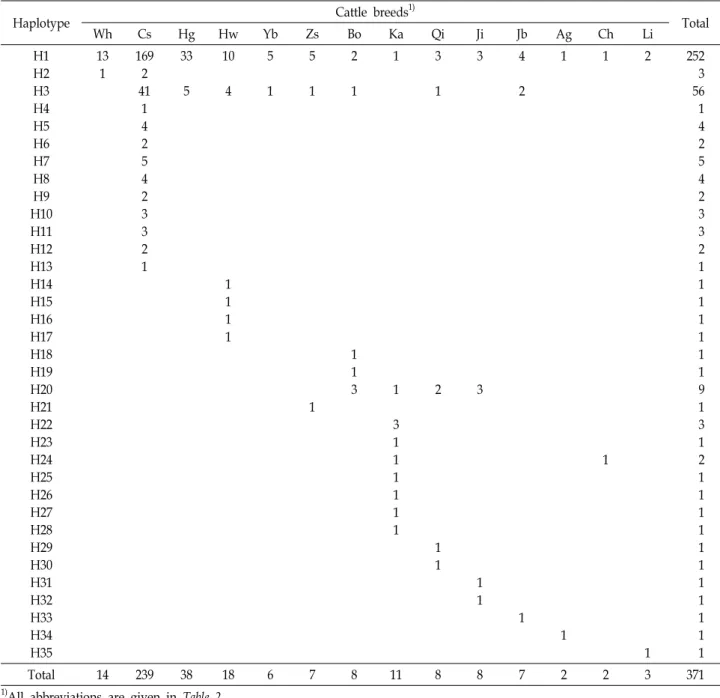
석에 활용하였다(Table 2). 전체 35개 haplotype(H1-H35)으로
분류되었다(Table 3). H1은 전체 371두 중 252두를 포함하면서
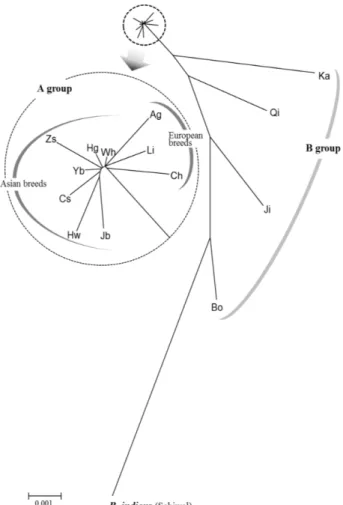
Fig. 1. Phylogenetic relationship among 13 cattle breeds from the B. taurus lineage and a breed from the B. indicus lineage (GenBank accession no. JN117614-5). The tree was constructed with the neighbor-joining method on the basis of Dxy distances. The bar scale indicates genetic distance. Abbreviations for population or breed are the same as those in Table 2.
67.9%의 가장 높은 분포율을 보였으며, 분석에 이용된 모든 품종의 개체들이 포함되었다. 하지만 Kazakh, Qinchuan, Jinnan, Bohai Black 등 중국 4개 품종 및 Angus, Charolais 등 유럽 2개 품종에서는 H1 분포율이 50% 미만으로 나타났다.
H3은 371두 중 56두(15%)가 포함되어 두 번째로 높은 분포율 을 보였으며, 백한우를 제외한 3개 재래품종, 4개 중국 품종 및 일본흑우의 개체들이 포함되었다. 이런 결과는 전체 35개 의 haplotype 중 H1과 H3이 한국, 일본, 중국의 품종들에서 상대적으로 높은 빈도로 나타나는 major haplotype임을 시사 한다. 백한우는 H1에 13두, H2에 1두 등 2개의 haplotype에 속하였으나, 분포율이 두 번째로 높은 H3에서는 나타나지 않 았다. 백한우 1두가 속한 H2에는 단지 칡소 2두만 포함되었는 데, 이러한 결과는 H2에 속하는 개체의 수는 적지만 백한우와 칡소 일부 개체들이 동일한 모계특성을 가지고 있음을 의미한 다.
계통도 작성 및 유연관계 분석
한국, 중국, 일본 및 유럽의 소 품종간 유연관계를 확인하기 위하여 Dxy 유전적 거리를 산출하였고, 이를 토대로 neigh- bor-joining (NJ) tree를 작성하였다. 이 과정에서 Bos indicus에 속하는 파키스탄의 Sahiwal 품종 3개 서열(GenBank ac- cession no. JN17611-3)을 포함시켰다. NJ tree에서 전체적으로 2개 group (A, B)으로 분류되었다(Fig. 1). B group은 Kazakh, Qinchuan, Jinnan, Bohai Black 등 4개 중국품종으로 구성되어 있었으며, 이를 제외한 나머지 아시아 및 유럽 품종은 A group 에 포함되었다. Cai 등(2007)은 mtDNA cyt b 유전자 분석에 기초하여 중국의 18개 소 품종에 대한 유전적 다양성 및 유연 관계 분석을 수행하였다[2]. 이들은 중국 품종 중 Zaosheng, Kazakh, Qinchuan, Jinnan, Bohai Black 품종은 B. taurus 종과
B. indicus 종의 모계유전 특성을 모두 가지고 있음을 보고하였다. 이러한 특징에 의해서 Kazakh, Qinchuan, Jinnan, Bohai Black 품종이 다른 품종들과 독립적인 group을 형성하는 것으 로 판단된다. 하지만 같은 특성을 보유하고 있는 Zaosheng 품종은 B group이 아니라 A group에 속하였는데, 이는 B. tau-
rus의 모계특징이 85.7%로 높게 나타나기 때문으로 판단된다[2]. Zaosheng 품종을 제외하면 B. taurus 종에 속하는 품종들 과 백한우가 A group에 포함되었다. 이 group은 아시아 품종 과 유럽 품종으로 구분되었으며, 백한우는 아시아품종과 유럽 품종 사이에 위치하였다. 기존보고에 따르면, 한국과 일본의 소 품종은 모두 B. taurus종으로 아직까지 B. indicus종이 보고 된 바는 없다[7, 11, 17]. 이러한 결과는 백한우가 B. taurus종임 을 증명하는 것이며, 또한 백한우의 계통유전학적 위치는 14 두 중 13두가 모든 품종에서 나타나는 major haplotype인 H1 에 속하였기 때문인 것으로 판단된다.
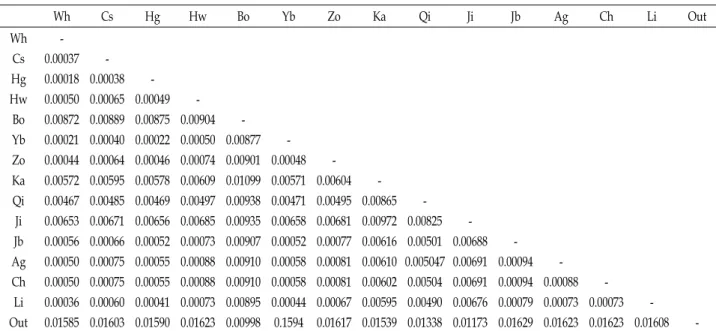
Dxy 유전적 거리 산출 결과, 백한우는 흑우(0.00018),
Yanbian(0.00021)과 가장 가까운 유전적 거리를 보였다(Table
4). 유전거리는 비교된 개체 혹은 집단 간에 나타나는 염기서 열의 유사성에 근거하며, 유전거리가 낮을수록 유전적 유연관 계가 높음을 의미한다[2, 11]. 따라서 백한우와 흑우 및 Yanbian 품종이 상대적으로 유전적 유연관계가 높은 것으로 확인되었다. 이러한 결과는 한반도와 가까운 중국 동북부에 분포하는 Yanbian 품종이 칡소 및 흑우와 가까운 모계유전양 상을 보인다는 기존 연구보고와 유사하였다[8, 9].
이상의 결과를 종합해보면, 본 연구를 통해서 백한우가 한 국 재래품종, 일본흑우 그리고 일부 중국품종인 Yanbian과 가 까운 유연관계를 보였으며, 특히 흑우, Yanbian와 0.0018~
0.0021 범위의 가까운 유전적 거리를 보였다. 또한 백한우와
칡소 사이에서 동일한 haplotype이 확인되어 칡소와도 유전
적 연관성이 존재하였다. 본 연구의 결과는 백한우의 효율적
인 보존 및 관리를 위해 자료로 활용이 가능할 것으로 판단된
다. 백한우의 유전적 특성을 조금 더 명확히 분석하기 위해서
Table 4. Dxy genetic distances among 14 cattle breeds based on mtDNA cyt b gene sequences
Wh Cs Hg Hw Bo Yb Zo Ka Qi Ji Jb Ag Ch Li Out
Wh Cs Hg Hw Bo Yb Zo Ka Qi Ji Jb Ag Ch Li Out
- 0.00037 0.00018 0.00050 0.00872 0.00021 0.00044 0.00572 0.00467 0.00653 0.00056 0.00050 0.00050 0.00036 0.01585
- 0.00038 0.00065 0.00889 0.00040 0.00064 0.00595 0.00485 0.00671 0.00066 0.00075 0.00075 0.00060 0.01603
- 0.00049 0.00875 0.00022 0.00046 0.00578 0.00469 0.00656 0.00052 0.00055 0.00055 0.00041 0.01590
- 0.00904 0.00050 0.00074 0.00609 0.00497 0.00685 0.00073 0.00088 0.00088 0.00073 0.01623
- 0.00877 0.00901 0.01099 0.00938 0.00935 0.00907 0.00910 0.00910 0.00895 0.00998
- 0.00048 0.00571 0.00471 0.00658 0.00052 0.00058 0.00058 0.00044 0.1594
- 0.00604 0.00495 0.00681 0.00077 0.00081 0.00081 0.00067 0.01617
- 0.00865 0.00972 0.00616 0.00610 0.00602 0.00595 0.01539
- 0.00825 0.00501 0.005047
0.00504 0.00490 0.01338
- 0.00688 0.00691 0.00691 0.00676 0.01173
- 0.00094 0.00094 0.00079 0.01629
- 0.00088 0.00073 0.01623
- 0.00073 0.01623
- 0.01608 -
1)All abbreviations are given in Table 2.
는 다양한 비교시료 확보와 함께 상염색체, Y 염색체 상에 존 재하는 유전자 혹은 초위성체에 대한 추가분석이 필요할 것으 로 사료된다.
감사의 글
본 연구는 농촌진흥청 연구사업(백한우 집단의 유전적 다 양성 탐색 및 유전특성 구명, PJ01096702)의 지원에 의해 이루 어진 것임.
References
1. Birren, B., Green, E. D., Klapholz, S., Myers, R. M. and Roskams, J. 1997. Genome analysis: A Laboratory Manual (USA: Cold Spring Harbor Laboratory Press).
2. Cai, X., Chen, H., Lei, C., Wang, S., Xue, K. and Zhang, B. 2007. mtDNA diversity and genetic lineages of eighteen cattle breeds from Bos taurus and Bos indicus in China.
Genetica 131, 175-183.
3. FAO (Food and Agriculture Organization of the United Nations). 2007. Global Plan of Action for Animal Genetic Resources and the Interlaken Declaration. available at http://www.fao.org/docrep/010/a1404e/a1404e00.htm.
4. Foreman, M. E., Lamoreux, M. L., Kwon, B. and Womack, J. E. 1994. Mapping the bovine albino locus. J. Hered. 85, 318-320.
5. Georgescu, S. E., Manea, M. A., Dudu, A. and Costache, M. 2011. Phylogenetic relationships of the Hucul horse from Romania inferred from mitochondrial D-loop variation.
Genet. Mol. Res. 10, 4104-4113.
6. Greene, H. J., Leipold, H. W., Gelatt, K. M. and Huston,
K. 1973. Complete albinism in beef Shorthorn calves. J.
Hered. 64, 189-192.
7. Kikkawa, Y., Takada, T., Sutopo, Nomura, K., Namikawa, T., Yonekawa, H. and Amano, T. 2003. Phylogenies using mtDNA and SRY provise evidence for male-mediated in- trogression in Asian domestic cattle. Anim. Genet. 34, 96-101.
8. Kim, J. H., Byun, M. J., Kim, M. J., Suh, S. W., Ko, Y. G., Lee, C. W., Jung, K. S., Kim, E. S., Yu, D. J., Kim, W. H.
and Choi, S. B. 2013. mtDNA diversity and phylogenetic state of Korean cattle breed, Chikso. Asian Australas. J. Anim.
Sci. 26, 163-170.
9. Kim, J. H., Byun, M. J., Kim, M. J., Suh, S. W., Kim, Y. S., Ko, Y. G., Kim, S. W., Jung, K. S., Kim, D. H. and Choi, S. B. 2013. Phylogenetic analysis of Korean black cattle based on the mitochondrial cytochrome b gene. J. Life Sci. 23, 24-30.
10. Kim, K. I., Lee, J. H., Li, K., Zhang, Y. P. and Lee, S. S., Gongora, J. and Moran, C. 2002. Phylogenetic relationships of Asian and European pig breeds determined by mitochon- drial DNA D-loop sequence polymorphism. Anim. Genet. 33, 19-25.
11. Kim, K. I., Lee, J. H., Lee, S. S. and Yang, Y. H. 2003.
Phylogenetic relationships of Northeast Asian cattle to other cattle populations determined using mitochondrial DNA D-Loop sequence polymorphism. Biochem. Genet. 41, 91-98.
12. Kim, S. W., Choi, J. S., Choe, C. Y., Kim, D. G., Ko, Y. G., So, C. S. and Seong, H. H. 2015. Studies on the estimation of pregnancy rate of White Hanwoo (albino Korean native cattle) with sexed semen. J. Emb. Trans. 30, 45-50.
13. Lai, S. J., Liu, Y. P., Liu, Y. X., Li, X. W. and Yao, Y. G.
2006. Genetic diversity and origin of Chinese cattle revealed by mtDNA D-loop sequence variation. Mol. Phylogenet. Evol.
38, 146-154.
14. Lee, S. S., Han, S. H., Cho, I. C., Ko, M. S., Jung, H. Y.,
Kim, N. Y., Kim, J. H. and Yoon, D. H. 2012. A molecular marker and genetic method for detection of albino in Bos taurus coreanae. Korea patent 10-2010-0133249.
15. Leipold, H. W., Huston, K. and Gelatt, K. N. 1968. Complete albinism in a Guernsey calf. J. Hered. 59, 218-220.
16. Librado, P. and Rozas, J. 2009. DnaSP v5: A software for comprehensive analysis of DNA polymorphism data.
Bioinformatics 25, 1451-1452.
17. Mannen, H., Kohno, M., Nagata, Y., Tsuji, S., Bradley, D.
G., Yeo, J. S., Nyamsamba, D., Zagdsuren, Y., Yokohama, M., Nomura, K. and Amano, T. 2004. Independent mi- tochondrial origin and historical genetic differentiation in North Eastern Asian cattle. Mol. Phylogenet. Evol. 32, 539-544.
18. Saitou, N. and Nei, M. 1987. The neighbor-joining method:
A new method for reconstructing phylogenetic trees. Mol.
Biol. Evol. 4, 406.
19. Serrano, M., Calvo, J. J., Martínez, M., Marcos-Carcavilla,
초록:mtDNA cytochrome
b분석을 통한 백한우의 계통유전학적 특성 분석
김재환․조창연․김승창․김성우․최성복․이성수*
(농촌진흥청 국립축산과학원 가축유전자원센터)
본 연구는 mtDNA cytochrome b (cyt b) 유전자의 염기변이를 동정하고 이를 토대로 백한우의 계통유전학적 유연관계를 파악하기 위하여 실시하였다. 백한우 14두에 대한 mtDNA cyt b 유전자 전체서열 내에서 염기의 삽입 /결실변이 없이 1개의 silent mutation이 동정되었고, 2개의 haplotype으로 분류되었다. 14두 중 13두가 major haplotype인 H1에 포함되었으며, 나머지 1두는 칡소와 같은 haplotype에 속하였다. Haplotype 다양성지수 및 염 기변이율은 각각 0.143, 0.00013으로, 기존에 보고된 한국 재래소 및 중국소 품종들보다 현저히 낮게 나타났다. 한 국, 일본, 중국 및 유럽 소 품종과의 유전적 유연관계를 확인하기 위해서 Dxy 유전거리 산출 및 neighbor-joining tree를 작성하였다. 2개의 group (A, B)으로 분류되었으며, 백한우는 B. taurus 계열인 A group에 포함되었다. Dxy 유전거리 산출 결과, 백한우는 흑우(0.00018) 및 Yanbian (0.00021) 품종과 가까운 유연관계를 보였다. 이상의 결과 를 종합해보면, 모계유전특성에 기초하여 백한우는 칡소, 흑우 및 Yanbian과 유전적으로 높은 연관성을 보였다.
이러한 결과는 백한우의 효율적인 관리 및 지속가능한 활용을 위한 중요한 자료로 이용될 수 있을 것으로 사료된 다.
A., Cuevas, J., González, C., Jurado, J. J. and Díez de Tejada, P. 2009. Microsatellite based genetic diversity and pop- ulation structure of the endangered Spanish Guadarrama goat breed. BMC Genet. 10, 61.
20. Schmutz, S. M., Berryere, T. G., Ciobanu, D. C., Mileham, A. J., Schmidtz, B. H. and Fredholm, M. 2004. A form of albinism in cattle is caused by a tyrosinase frameshift mutation. Mamm. Genome 15, 62-67.
21. Thompson, J. D., Higgins, D. G. and Gibson, T. I. 1994.
CLUSTAL W: improving the sensitivity of progressive mul- tiple sequence alignment through sequence weighting, posi- tion-specific gap penalties and weight matrix choice. Nucl.
Acids Res. 22, 4673-4680.
22. Tolone, M., Mastrangelo, S., Rosa, A. J. M. and Portolano, B. 2012. Genetic diversity and population structure of Sicilian sheep breeds using microsatellite markers. Small Ruminant Res. 102, 18-25.