논문 2015-52-9-17
스마트 RFID 태그를 이용한 소비자 입맛을 위한 홍어 발효 모니터링 시스템의 설계
( The Design of Skate Fermentation Monitoring System for Consumer Taste Using The Smart RFID Tag )
정 성 부*, 김 주 웅*, 이 웅 건***
( Sung Boo Chung, Joo Woong Kim
ⓒ, and Wung Gun Lee )
요 약
최근 들어 건강에 대한 관심이 증가하면서 발효 식품에 대한 관심과 소비가 증가하고 있다. 대표적인 발효 식품으로 홍어가 있다. 홍어의 경우 각자의 취향에 따라 선호하는 정도가 매우 다르다. 그래서 홍어의 발효 정도를 수치화하여 보여줄 수 있다 면, 사람들은 각자의 취향에 맞게 홍어를 먹을 수 있을 것이다. 본 논문에서는 스마트 RFID 태그를 이용하여 소비자의 취향에 맞는 홍어의 발효 정도를 모니터링 하는 시스템을 제안한다. 제안하는 시스템은 RFID 태그, NH3센서, 리더기 및 서버로 구성 되어 있다. 제안하는 시스템의 유용성을 확인하기 위해, 홍어 발효에 대한 실험을 한다. 제안한 모니터링 시스템은 홍어의 발 효 정도를 Very Low, Low, Medium, Strong의 4등급으로 보여준다. 스마트 RFID 태그를 통해, 홍어의 발효 정도를 확실하게 추정한다.
Abstract
Recently, people are consuming more fermented food for its health benefits. When we think of fermented food, skate comes to mind. However, there are different preferences depending on the degree of fermentation. Thus, if there is a system that shows the degree of the fermentation on skate, people can eat according to their taste. This paper proposes a design of skate fermentation monitoring system for consumer taste using the smart RFID tag. The proposed system consists of the RFID tag, NH3 sensor, reader, and server. In order to confirm the usefulness of the proposed system, we performed experiments on the skate fermentation. The proposed monitoring system can show the skate fermentation at 4 grades: None, Low, Medium, and Strong. With the smart RFID tag, we successfully estimated the skate fermentation.
Keywords: smart RFID tag, NH3 sensor, skate fermentation, consumer taste, monitoring system
Received ; July 31, 2015 Revised ; August 16, 2015 Accepted ; September 3, 2015
* 정회원, 서일대학교 컴퓨터응용과
(Department of Computer Application, Seoil University)
** 학생회원, 동국대학교 전자전기공학부
(Division of Electronics and Electrical Engineering, Dongguk University)
ⓒ Corresponding Author(E-mail: [email protected])
※ “The present research has been conducted by the Research Grant of Seoil University in 2015"
Ⅰ. Introduction
Although there's an increase in the number of people who demand fermented food for its health benefits, many do not know the difference between fermentation and decomposition. Decomposition is a process of spoiling or losing its original characteristics by saprogenic bacteria, while
fermentation is not the work of saprogenic bacteria but that of its own enzyme that causes breakdown without inflicting fatal bodily harm. Fermented skate, which is often called “soul food”, is one of the most popular fermented food in Korea. It does have the most awful smell, but it is tasty food; many people enjoy fermented skate according to their preference from barely fermented to completely fermented. Thus, if there is a system that allows people to conveniently check the level of fermentation, people will be able to enjoy fermented skate according to their taste[1∼3].
Also recently, RFID(Radio Frequency IDentification) technology has replaced existing barcode to facilitate network and intelligent product management and distribution while ensuring security, safety, and environmental friendliness. In particular, as RFID and sensor technologies have advanced, more and more attention is being paid to smart RFID tags to fuse such technologies; even fermented skate has been supplied through smart RFID tags. The smart RFID technology, therefore, is evidently very widely used[4∼10].
This paper proposes a design of skate fermentation monitoring system for consumer taste using the smart RFID tag. The proposed system consists of RFID tag, NH3 sensor, reader, and server. In order to confirm the usefulness of the proposed system, we performed experiments on skate fermentation. The proposed smart RFID tag measures the concentration of ammonia(NH3) gas, and transmits it to a server. The measured information can be calculated and can be displayed as one of 4 grades:
Very Low, Low, Medium, and Strong. This system provides convenience for people to choose the level of fermentation by merging food and information technology.
Ⅱ. Proposed monitoring system
Fig. 1 shows the block diagram of the proposed그림 1. 스마트 RFID 홍어 발효 모니터일 시스템의 블 록선도
Fig. 1. Block diagram of Smart RFID skate fermentation monitoring system.
skate fermentation monitoring system for consumer taste using the smart RFID tag.
1. Smart RFID Tag
(1) RFID Tag
Fig. 2 illustrates the block diagram of smart RFID tag. The smart RFID tag consists of a 915MHz antenna, impedance matching circuit, power harvester, demodulator, modulator, MCU(Micro Control Unit), interface circuit, and sensor. It sends data values regarding production-related histories along with information on skate fermentation change to the RFID reader. The MCU uses MSP430, while the demodulator demodulates data using ASK(Amplitude Shift Keying) and modulator is modulated using FSK(Frequency Shift Keying)[8-9].
그림 2. 스마트 RFID 태그의 블록선도 Fig. 2. Block diagram of smart RFID tag.
(2) Sensor
A fish such as skate, which lives in deep depths of the seas, has nitrogen waste accumulated in its muscles and when it dies, such element is
그림 3. 암모니아 센서 Fig. 3. NH3 sensor.
Characteristics Content
Supply Voltage 4.9V to 5.1V
NH3 detection range 0.1-100ppm Storage temperature
range -40/120°C
Storage humidity range 5/95%RH
표 1. 암모니아 센서의 특성
Table 1. Characteristics of ammonia sensor.
decomposed creating ammonia which could be used, along with oxygen, in measuring the levels of fermentation. We use MICS-5914 as the main NH3
gas detection sensor, which is a commercial product[11]. Fig. 3 shows the NH3 sensor. This sensor is small and requires low power consumption. Fig. 4 shows as a function of NH3 concentration as measured on an engineering test bench. The characteristics of the ammonia sensor are shown in Table 1.
We designed the interface circuit of this sensor for accurate data measurement. So the accuracy and the precision of gas sensor output is very important.
Therefore in order to get a precise measurement of sensor value, we use the amplifier to amplify the resolution, but amplifier to amplified the noise too.
Therefore we remove the noise using the noise filter, and then amplify the signal. There is some small noise could not be removed from noise filter. So we use RC filter to remove the noise again. Through the interface circuit like above the data can be obtained more accurate and precise. Fig. 5 is the interface
그림 4. MICS-5914의 센서 특성
Fig. 4. Sensor characteristics of MICS-5914.
그림 5. MICS-5914의 인터페이스 회로 Fig. 5. Interface circuit of MICS-5914.
그림 6. 제작된 스마트 RFID 태그 사진
Fig. 6. Picture of the manufactured smart RFID Tag.
circuit of the gas sensor. The interface circuit constructed 3 parts as noise filter, amplifier and LPF(Low Pass Filter). Fig. 6 shows the manufactured smart RFID tag.
2. RFID Reader and server
The 900MHz RFID reader is a speedway revolution UHF RFID reader by IMPINJ[12]. This reader can
그림 7. RFID 리더기 Fig. 7. RFID reader.
그림 8. 서버의 소프트웨어 구성
Fig. 8. The composition of server software.
read and write RFID tags by 10cm∼10m, as shown in Fig. 7.
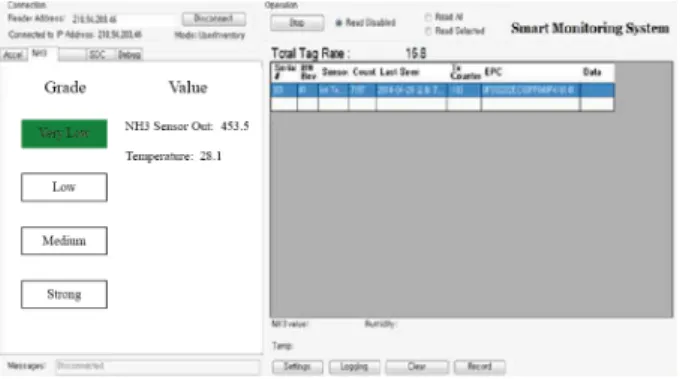
Data received from an RFID reader is stored in a server. Then, the server determines the skate fermentation level using the data received from the RFID reader and then displays the grade on the monitor screen. A skate fermentation quality grade is determined based on current NH3. There are 3 levels of hierarchy for the server software. Fig. 8 shows the hierarchy of servser software. At the top level is the Main Frme GUI, and the bottom level is the LLRP/Ethernet code. In the middle is a wrapper for the LLRP code called RFID reader.
Ⅲ. Experiment and result
We experiment to measure the ammonia gas
concentration in the container is covered with straw containing the skates at a constant temperature, and fig. 9 shows experimental pictures of the demo system.
그림 9. 실험 사진
Fig. 9. Pictures of the experiment.
Status NH3 Sensor
Out (mV) Content
Very Low ∼600 very weak taste
Low 600∼700 weak taste
Medium 700∼950 generally taste
Strong 950∼ strong taste
표 2. 홍어의 발효 등급
Table 2. Description of fermentation on skate.
그림 10. 12°C에서의 실험 결과
Fig. 10. Experiment result with fixed temperature of 12°C.
그림 11. 28°C에서의 실험 결과
Fig. 11. Experiment result with fixed temperature of 28°C.
그림 12. 홍어 발효에 대한 모니터링 화면
Fig. 12. The monitoring screen of skate fermentation.
First was an experiment to determine the degree of fermentation on skate. Using the ammonia gas sensor can detect gas concentration and judge the degree of fermentation on skate. The degree of fermentation on skate was expressed in four grades: Very Low, Low, Medium, and Strong. We have confirmed by experiments the output voltage of the sensor for each grade. Table 2 is description of each grade from experiment data.
The second experiment shows the degree of fermentation on skate, and the experimental results are shown in fig. 10∼11. This graphs show the change in ammonia concentration with temperature fixed at 12°C and 28°C respectively.
It can be observed with the graphs that as the time passes, the concentration of ammonia increases, and raising the level of fermentation. Fig. 12 shows the monitoring screen of the skate fermentation.
Ⅳ. Conclusion
Recently, people have been consuming more fermented food for its health benefits. One of the most popular fermented foods in Korea is fermented skate, which is also considered as “soul food”. skate is recommended for those who are concerned about arthritis, crapulence, skin care, flu, diet, gastritis and etc. However, as the second smelliest food in the world, people's preference toward fermented skate varies according to the level of fermentation. Thus,
with a system that allows people to conveniently check the level of fermentation of skate, people can enjoy fermented skate because they can consume it according to their tastes.
This paper proposed a design of skate fermentation monitoring system for custom taste using the smart RFID tag. The proposed system consists of RFID tag, NH3 sensor, reader, and server. In order to confirm the usefulness of the proposed system, we performed experiments on skate fermentation. The experiment measured the concentration of ammonia gas at a constant temperature in a container containing the skates covered with straw, and monitored the four grades according to the measured results. The results under 600mV were put in Very Low, 600∼700mV in Low, 700∼950mV in Medium, and over 950mV in Strong. According to the experiment results, at 12°C, the level of fermentation reached Strong after 100 hours, while it reached the level Strong after 70hours at 28°. This system provides convenience for people by letting them choose the level of fermentation that they prefer through merging food and information technology.
REFERENCES
[1] K. Y. Park, “Increased Health Functionality of Fermented Foods”, Food Industry and Nutrition, vol. 17, no. 1, (2012) pp. 1-8.
[2] S. B. Lee, K. H. Koh, J. Y. Yang and S. H. Oh,
“Fermented Food Science”, Hyoil Publishers, Korea (2001).
[3] K.H. Eom, N.T. Van, L. Sen, K.K. Jung and J.W. Kim, “The Configuration of Fruit State Monitoring System Using the RFID System”, International Journal of Multimedia and Ubiquitous Engineering, vol. 8, no. 4, (2013), pp.
343-352.
[4] S. Ahson and M. lyas, “RFID Handbook”, Taylor & Francis Group, Boca Raton (2008).
[5] P. Kumar, H. W. Reinitz, J. Simunovic, K. P.
Sandeep and P. D. Franzon, “Overview of RFID technology and its applications in the food industry” Journal of Food Science, vol. 74, issue
저 자 소 개 정 성 부(정회원) 1979년 동국대학교
전자공학과 학사 졸업 1981년 동국대학교
전자공학과 석사 졸업 2002년 동국대학교 전자공학과
박사 졸업 2013년 미국 Marquette Univ. 초청 현재 서일대학교 컴퓨터응용과 교수
<주관심분야 : 제어, RFID, 인공지능>
김 주 웅(정회원) 1996년 동국대학교
전자공학과 학사 졸업 1998년 동국대학교
전자공학과 석사 졸업 2003년 동국대학교
전자공학과 박사 졸업 현재 서일대학교 컴퓨터응용과 조교수
<주관심분야 : 지능시스템, USN, SMPS >
이 웅 건(학생회원) 2011년 동국대학교
전자전기공학부 입학 현재 동국대학교
전자전기공학부 재학
<주관심분야 : RFID, 로보틱스, 융 합시스템>
8 (2009) pp. R101-R106.
[6] Y. T. Park and Y. B. Kim, “On the Accuracy of RFID Tag Estimation Functions”, Journal of International and Communication Convergence Engineering, vol. 10, no. 1, (2012) pp. 33-39.
[7] M. H. Baek, B. G. Kim and H. J. Kim, “Design and Implementation of the Recording Processing Supporting System Using RFID”, Journal of International and Communication Convergence Engineering, vol. 9, no. 6, (2011) pp. 629-632.
[8] A. P. Sample, D. J. Yeager, P. S. Powledge, A.
V. Mamishev and J. R. Smith, “Design of an RFID-Based Battery-Free Programmable Sensing Platform”, IEEE Transactions on Instrumentation and Measurement, vol. 57, no.
11, (2008) pp. 2608-2615.
[9] R. Vyas, V. Lakafosis, A. Rida and N.
Chaisilwattana, “Paper-Based RFID-Enabled Wireless Platforms for Sensing Applications”, IEEE Transactions on Microwave Theory and Techniques, vol. 57, no. 5, (2009) pp. 1370-1382.
[10] N. Pesonen, K. Jaakkola, J. Lamy, K. Nummila and J. Marjonen, “Smart RFID Tags”, in Development and Implementation of RFID technology, Edited C. Turcu, InTech, Vienna (2009) pp. 159-178.
[11] Ammonia: http://en.wikipedia.org/wiki/Ammonia [12] http://www.impinj.com/
Speedway_Revolution_UHF_RFID_Reader.aspx