Inhibitory Efficacy of Angelica gigas Nakai on Microphthalmia-associated Transcription Factor (MITF), Tyrosinase Related Protein-1 (TRP-1), Tyrosinase Related Protein-2 (TRP-2), and Tyrosinase mRNA Expression in Melanoma Cells (B16F10)
Soo-Yeon Lee and Jin-Young Lee*
Department of Herbal Cosmetic Science, Hoseo University, Chungnam 336-795, Korea
Received September 26, 2013 /Revised November 12, 2013 /Accepted November 12, 2013
The purpose of this study was to research the whitening effects of the extract from Angelica gigas Nakai, which is one of the most widely used herbal medicines in Asia. For whitening effects, the ty- rosinase inhibition effect of theA. gigas Nakai extract was shown to be greater than 70% at 1,000 μg/
ml concentration. The result of measuring the cell toxicity effect of the extract from A. gigas Nakai on melanoma cells showed 99% toxicity at 500 μg/ml concentration. The microphthalmia-associated transcription factor (MITF), tyrosinase related protein-1 (TRP-1), tyrosinase related protein-2 (TRP-2), and tyrosinase mRNA expression inhibitory effect by reverse transcription-PCR of the extract fromA.
gigas Nakai were decreased by 85.7%, 123.9%, 68.8%, and 208%, respectively, at 50 μg/ml concentration. All these findings could verify that extract from A. gigas Nakai could have an effect on whitening. Moreover, extract from A. gigas Nakai has great potential as a cosmetic ingredient.
Key words : Angelica gigas Nakai., Microphthalmia-associated transcription factor, tyrosinase related protein-1, tyrosinase related protein-2, tyrosinase
*Corresponding author
*Tel : +82-41-540-9552, Fax : +82-41-540-9538
*E-mail : [email protected]
This is an Open-Access article distributed under the terms of the Creative Commons Attribution Non-Commercial License (http://creativecommons.org/licenses/by-nc/3.0) which permits unrestricted non-commercial use, distribution, and reproduction in any medium, provided the original work is properly cited.
Journal of Life Science 2013 Vol. 23. No. 11. 1336~1341 DOI : http://dx.doi.org/10.5352/JLS.2013.23.11.1336
서 론
최근 급속한 산업화에 따른 환경 오염과 오존층의 파괴로 인해 자외선 조사량의 증가와 평균 수명의 연장 및 레저 활동 이 증가하고 있으며, 이로 인해 자외선의 영향으로 야기되는 피부 변화가 증가하고 있는 추세이다[19, 31]. 멜라닌은 자외선 흡수에 의한 피부 세포의 손상을 억제할 목적으로 생성이 되 지만 자외선의 영향을 받기 쉬운 기관인 피부는 계속적으로 자외선에 노출되면 과도한 멜라닌 합성과 축적은 기미, 주근 깨, 홍반, 검버섯 등의 시각적으로 좋지 않은 질병을 야기한다 [9, 28]. 멜라닌(melanin)은 적갈색 또는 흑갈색의 고분자 화합 물로서 멜라닌 세포(melanocyte)내 멜라닌 소체(melanosome) 라는 소기관에서 단계적 효소 반응에 의해 합성된다[11]. 멜라 닌의 생합성 과정에 작용하는 주요 효소는 polyphenol oxi- dase의 일종인 tyrosinase로서 구리를 함유한 효소이며 ty- rosine을 L-3,4-dihydroxyphenylalanine (L-DOPA)으로 변환 하고 효소적 산화반응을 거쳐 dopaquinone으로 변환시킨다 [6, 12]. Tyrosinase 이외에도 잘 알려진 효소로는 tyrosinase
related protein-1 (TRP-1)과 dopachrome tautomerase (DCT) 등이 있다. TRP-1은 mouse에서 5,6-dihydroxyindole-2-car- boxylic acid (DHICA)를 indole-5,6-quinone-2-carboxylic acid (IQCA)로 산화하는 효소이다[27, 29]. 따라서 미백 활성 연구 개발에 있어서 멜라닌 생성을 억제하는 경로와 이미 생성된 멜라닌의 분해를 촉진하는 단계에 관여하는 효소의 활성 조절 이 중요시 되고 있으며, tyrosinase, TRP-1, TRP-2의 활성 억제 효과의 검증은 유용한 1차 평가방법으로 인정 되고 있다[18].
본 연구에서 사용된 당귀(Angelica gigas Nakai)는 미나리과 다년생초목의 뿌리를 꽃이 피기 전에 채취하여 건조한 것으로 한국과 중국, 일본 등에 분포한다. 꽃이 흰색인 중국과 일본산 당귀와 달리 한국산 당귀는 자주색을 띄는 것이 특징이다[2, 3]. 당귀 주근의 길이는 3∼7 cm이고 지름 2∼5 cm이며, 가지 뿌리의 길이는 15∼20 cm이며, 특이한 방향성 냄새가 있다.
또한 주근 및 뿌리에 있는 파목은 정유가 스며 나와 흑색으로 되어 있고 생약 전체는 점성이 있으며 맛은 약간 쓰다[23]. 당 귀의 대표적인 성분은 coumarin계의 decursin, decursinol an- gelate와 nodakenin, umbelliferon, β-sitosterol 등이 알려져 있다[1]. 당귀는 자궁기능 조절, 진정, 진통, 이뇨, 비타민 E 결핍증 치료작용, 항균작용 등의 약리 작용을 가지고 있어, 한방에서 많이 사용되었으며 주로 아시아 지역에서 천연물 의약품으로 널리 사용되고 있으며, 특히 뿌리 추출물에는 de- cursins과 decursinol angelate가 약 90%의 매우 높은 농도로 존재하며, 항산화 효과 등의 효능을 갖고 있는 것으로 보고되 어 있다[16]. 식품 뿐만 아니라 화장품에 첨가물로 많이 쓰이는
항산화제인 BHT와의 비교시험에서 당귀 뿌리 추출물은 우수 한 항산화 효과를 나타내었으며, 이는 활성산소에 의한 피부 의 노화, 주름 트러블 등을 예방해 줄 것으로 기대되고 있다 [17].
따라서 본 연구에서는 당귀 추출물의 tyrosinase 저해활성 및 미백인자 인 MITF, TRP-1, TRP-2, tyrosinase의 mRNA 발 현억제 효과를 확인하여 미백용 화장품 소재로서의 가능성을 살펴보고자 한다.
재료 및 방법 재료
본 실험에 사용한 당귀(Angelica gigas Nakai)는 대전대학교 부속 한방병원에서 구입 정선하여 사용하였으며 원산지는 한 국 경북 청송군 부남면이다. 당귀 100 g에 증류수 2,000 ml를 가하여 열탕 추출기에서 2시간 추출하여 얻은 액을 흡입 여과 하여 이를 감압 증류장치로 농축하여, 이를 다시 동결 건조기 를 이용하여 완전 건조한 당귀 추출물 24.4 g을 냉동 보관(-84
℃)하면서 적당한 농도로 희석하여 사용하였다.
실험 방법
Tyrosinase 저해 활성 측정
Tyrosinase 저해활성 측정은 Yagi 등의 방법[30]에 따라 측 정하였다. 반응구는 67 mM sodium phosphate buffer (pH 6.8) 80 μl에 10 mM L-DOPA (Sigma, USA)를 녹인 기질액 40 μl 및 시료용액 40 μl의 혼합액에 200 U/ml mushroom tyrosinase (Sigma, U.S.A) 40 μl을 첨가하여 37℃에서 10분간 반응시켜 반응액 중에 생성된 DOPA chrome을 492 nm에서 측정하였다. Tyrosinase 저해활성은 시료용액의 첨가구와 무 첨가구의 흡광도 감소율로 나타내었다.
저해율(%)=(1- 시료첨가군의 흡광도 ) × 100 무첨가군의 흡광도
세포 배양
본 실험에 이용한 세포의 배양은 10% FBS와 1% penicillin/
streptomycin (100 U/ml)을 첨가한 DMEM 배지를 사용하였 으며, 37℃, 5% CO2세포배양기에 적응시켜 계대 배양하였다.
3-(4,5-dimethylthiazol-2-yl)-2,5-diphenyl tetrazolium bromide (MTT) assay에 의한 세포 생존율 측정
세포 생존율 측정은 Carmichael의 방법[7]에 따라 측정하였 다. 멜라노마 세포(B16F10)을 96 well plate에 5×10⁴ cells/
well이 되게 0.18 ml 분주하고, 시료를 농도 별로 조제하여 0.02 ml 첨가한 후 37℃, 5% CO2세포배양기에서 24시간 배양 하였다. 대조군은 시료와 동량의 증류수를 첨가하여 동일한 조건으로 배양하였다. 여기에 5 mg/ml 농도로 제조한 MTT 용액 0.02 ml를 첨가하여 4시간 배양한 후 배양액을 제거하고
각 well당 DMSO 0.15 ml를 가하여 실온에서 30분간 반응시킨 뒤 ELISA reader로 540 nm에서 흡광도를 측정하였다. 세포 독성 측정은 시료용액의 첨가군과 무첨가군의 흡광도 감소율 로 나타내었다.
세포 생존율(%)=(1- 시료첨가군의 흡광도무첨가군의 흡광도 ) × 100 Total RNA 분리 및 cDNA 합성
세포를 100 mm culture dish에 세포를 분주한 뒤 24시간 동안 배양한 후 sample을 농도별로 처리하여 24시간 동안 배 양하였다. 배지 상등액을 제거한 후 trizol lysis buffer를 각 well에 1 ml씩 분주하여 세포를 lysis 한 후 chloroform 200 μl를 분주하여 20초간 위아래로 흔들어주었다. 그 후 13,200 rpm에서 20분간 원심 분리하여 상층액을 isopropanol 500 μl 이 들어있는 튜브에 옮겨 섞었다. 다시 13,200 rpm에서 20분간 원심분리 하였고, 그 상층액을 제거 한 후 75% EtOH-dieth- ylpyrocarbonate water를 각 튜브에 1 ml씩 분주하여 13,200 rpm에서 5분간 원심분리 한 뒤 상층액을 제거한 뒤 실온에서 건조시켰다. DEPC를 50 μl씩 분주하여 녹인 후 96 well plate 에 RNA 5 μl와 멸균수 195 μl 를 첨가하여 260 nm, 280 nm에 서 각각 흡광도를 측정하여 total RNA양을 측정하였다. Oligo (dT) 15 primer (500 μg/ml) 1 μl, 추출한 RNA (2 μg)와 nucle- ase free water로 10 μl를 맞추고 75℃에서 5분간 반응시킨 후 5X reaction buffer, MgCl2, PCR necleotide mix, rnasin in- hibitor, reverse transcriptase, nuclease free water를 첨가하여 25℃에서 5분, 42℃에서 60분, 70℃에서 15분간 반응시켜 cDNA를 합성시켰다.
Reverse transcription-polymerase chain reaction 미백인자인 microphthalmia-associated transcription fac- tor (MITF), tyrosinase related protein 1 (TRP-1), tyrosinase related protein 2 (TRP-2), tyrosinase의 mRNA 발현을 알아보 기 위하여 polymerase chain reaction (PCR)을 실시하였다.
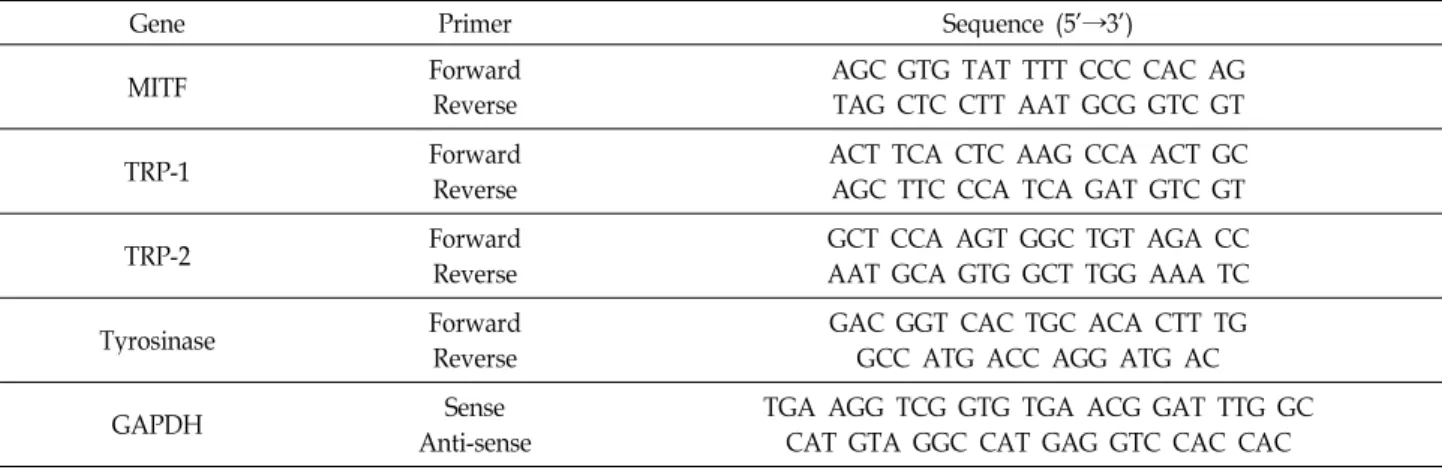
실험에 사용한 primer sequences는 Table 1과 같다. PCR tube 에 Go Flexi DNA polymerase, primer, 합성한 cDNA를 첨가 하여 잘 섞은 후 PCR을 실행하였다. Glyceraldehyde-3-phos- phate dehydrogenase (GAPDH)는 94℃에서 30초, 55℃에서 45초, 72℃에서 45초(35 cycles), tyrosinase는 94℃에서 30초, 60℃에서 45초, 72℃ 45초(40 cycles), TRP-1, TRP-2, MITF는 94℃에서 30초, 58℃에서 45초, 72℃에서 45초(40 cycles)를 하 였다. PCR로 합성 시킨 후 0.002% ethidium bromide를 첨가 한 1.5% agarose gel에 100 V에서 40분간 전기영동 후 LAS 4,000을 이용하여 밴드를 확인하여 분석 정량하였다.
통계처리
모든 실험은 3회 반복으로 행하여 평균치와 표준편차로 나 타내었고, 결과 통계처리는 SPSS10.0 (Evanston, IL, USA) software를 사용하였으며, 유의차 검증은 분산분석 (analysis
Table 1. Sequence of the primers used for RT-PCR
Gene Primer Sequence (5’→3’)
MITF Forward
Reverse AGC GTG TAT TTT CCC CAC AG
TAG CTC CTT AAT GCG GTC GT
TRP-1 Forward
Reverse ACT TCA CTC AAG CCA ACT GC
AGC TTC CCA TCA GAT GTC GT
TRP-2 Forward
Reverse GCT CCA AGT GGC TGT AGA CC
AAT GCA GTG GCT TGG AAA TC
Tyrosinase Forward
Reverse GAC GGT CAC TGC ACA CTT TG
GCC ATG ACC AGG ATG AC
GAPDH Sense
Anti-sense TGA AGG TCG GTG TGA ACG GAT TTG GC
CAT GTA GGC CAT GAG GTC CAC CAC
Fig. 1. Inhibition rate of Angelica gigas Nakai. extract on tyrosinase. ■ AG: A. gigas Nakai. extracted with ethanol. Results are means ± SD of triplicate data.
(Significant as compared to control. *p<0.05, **p<0.01,
***p<0.001)
Fig. 2. Cell viability of extract from Angelica gigas Nakai. on melanoma cell (B16F10). After B16F10 cells (1×10⁵cells) were started in medium for 24 h the cells were treated with 5, 10, 50, 100, 500 and 1,000 μg/ml of extracted ofA. gigasNakai. for 24 h. Each value represents mean
± SD of three individual experiments. (Significant as compared to control. *p<0.05, **p<0.01, ***p<0.001) of variance ANOVA)을 한 후 α=0.05 수준에서 Turkey’s HSD
test에 의해 유의성을 분석하였다.
결과 및 고찰 Tyrosinase 저해활성 측정 결과
멜라닌 생성에 있어서 가장 중요한 역할을 하는 tyrosinase 효소는 melanosome 내에 tyrosin을 산화시켜 DOPA를 만드 는 tyrosine hydroxylase로 DOPA를 산화시켜 dopachrome을 만드는 DOPA oxidase로 작용하여 최종적으로 melanon poly- mer를 합성하게 된다[24, 26]. 따라서 이 반응을 억제하게 되면 melanin 생합성을 억제할 수 있어, 기미, 주근깨, 검버섯 등과 같은 과잉색소증 치료 등 광범위하게 이용될 수 있으며 피부 미백제의 개발에 있어서 tyrosinase 활성 억제 실험은 유용한 평가법으로 인정되고 있다[10, 13, 14]. 따라서 본 연구에서는 당귀 추출물이 피부 내에서 melanin 중합체 생합성을 효과적 으로 저해할 수 있는 tyrosinase 저해활성을 농도별로 측정한
결과를 Fig. 1에 나타내었다.
당귀 추출물의 경우 1,000 μg/ml에서 70% 이상의 활성을 나타내었음을 확인할 수 있었다. 이는 Choi 등[8]의 치자, 행인 지실에서 각각 36%, 33%, 15%의 저해 활성을 나타낸다는 결 과와 비자의 물, 에탄올, 열수 추출물의 tyrosinase 저해활성을 측정한 결과 당귀 추출물과 같은 농도인 1,000 μg/ml의 농도 에서 각각 21.32%, 3.38%, 4.09%의 활성을 나타내었다고 보고 한 Jeon 등[15]의 결과와 비교하였을 때 당귀 추출물의 ty- rosinase 저해 활성이 우수함을 확인할 수 있었다.
멜라노마 세포(B16F10)의 생존율 확인
세포 생존율을 확인하기 위한 MTT assay은 MTT 시약이 세포 내로 흡수 되어 미토콘드리아의 succinate dehydrogen- ase에 의해 노란색 수용성 MTT tetrazolium을 자주색을 띄는 비수용성의 MTT formazan으로 환원시킨다. MTT formazan 의 흡광도는 550 nm 근처 파장에서 최대가 되며, 이는 대사적
Fig. 3. MITF mRNA expression rate of extract from Angelica gigasNakai. on melanoma cell (B16F10). After B16F10 cells (5×10⁵ cells) were started in serum free medium for 1 h the cells were treated with 5, 25 and 50 μg/ml of extract ofA. gigasNakai. for 24 h. Each values repre- sents mean ± SD of three individual experiments. (Signi- ficant as compared to control. *p<0.05, **p<0.01, ***p<0.001)
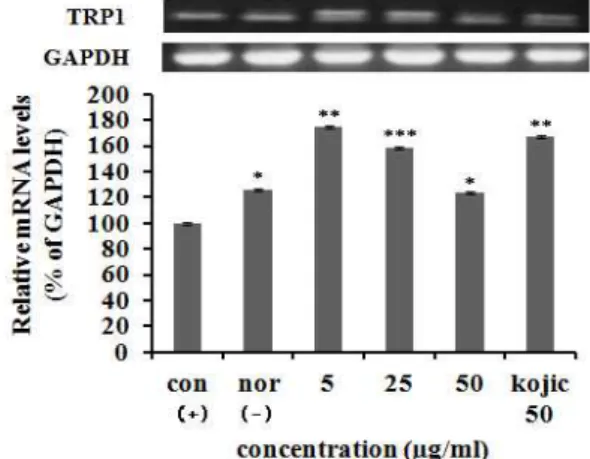
Fig. 4. TRP-1 mRNA expression rate of extract fromAngelica gigas Nakai. on melanoma cell (B16F10). After B16F10 cells (5×10⁵ cells) were started in serum free medium for 1 h the cells were treated with 5, 25 and 50 μg/ml of extract ofA. gigasNakai. for 24 h. Each values repre- sents mean ± SD of three individual experiments. (Signifi- cant as compared to control. *p<0.05, **p<0.01, ***p<0.001)
Fig. 5. TRP-2 mRNA expression rate of extract fromAngelica gigas Nakai. on melanoma cell (B16F10). After B16F10 cells (5×10⁵ cells) were started in serum free medium for 1 h the cells were treated with 5, 25 and 50 μg/ml of extract ofA. gigasNakai. for 24 h. Each values repre- sents mean ± SD of three individual experiments.
(Significant as compared to control. *p<0.05, **p<0.01,
***p<0.001) 으로 왕성한 세포의 농도를 반영하는 것이다[22]. 당귀 추출물
에 의한 멜라노마 세포(B16F10)의 생존율을 MTT assay에 의 해 확인 한 결과 Fig. 2와 같이 나타내었다. 당귀 추출물은 1,000 μg/ml의 농도에서 70% 이상의 높은 세포 생존율을 확인 할 수 있었다. 이는 Bae [5]가 보고한 승마갈근탕 구성약제의 경우 승마 열수 및 에탄올 추출물 500 μg/ml에서 각각 52.1%, 46.2%의 세포 생장 억제능을 나타내었으며, An 등[4]의 내소 황련탕 복합처방의 경우 100 μg/ml에서 열수 추출물과 에탄 올 추출물이 각각 55%, 38% 이하의 낮은 증식억제 효과를 나 타내었다는 연구결과와 비교하였을 때 당귀 추출물의 멜라노 마 세포(B16F10)에 대한 세포 독성이 적은 것을 확인할 수 있 었다. 따라서 이하의 멜라노마 세포(B16F10)에서의 미백 관련 신호 전달 인자 측정은 생존율이 100% 이상의 농도인 5, 25, 50 μg/ml의 농도로 실험하였다.
MITF, TRP-1, TRP-2, tyrosinase의 mRNA 발현억제 효과 확인
생체 내 tyrosin으로부터 멜라닌 생성은 주로 산화적 반응 에 의해서 일어나는데 이때 작용하는 주요 효소는 tyrosinase 이다. 하지만 최근에는 tyrosinase 뿐만 아니라 MITF, TRP-1, TRP-2 등과 같은 효소를 이용하여 melanin 합성 억제에 대한 연구가 이루어지고 있다[25]. TRP-1은 TRP-2에 의해 생성된 DHICA를 산화시켜 IQCA를 생성하는데, IQCA는 흑갈색을 나타낸다. 또한 MITF는 tyrosinase 발현을 조절하므로 MITF 의 억제는 tyrosinase의 발현억제를 통하여 melanin 색소 생성 을 억제할 수 있다[21].
본 연구에서는 당귀 추출물이 melanin 합성에 관계된 주요 효소인 MITF, TRP-1, TRP-2, tyrosinase mRNA에 미치는 영
향을 알아보기 위하여 멜라노마 세포(B16F10)에 5, 25, 50 μ g/ml의 샘플을 농도별로 처리한 후 24시간 뒤에 PCR으로 mRNA 발현량을 측정하여 Fig. 3∼6과 같이 나타내었다. 이때 세포의 여러 조건에서도 그 발현 정도의 차이가 거의 없는 house keeping gene인 GAPDH를 positive control로 사용하 였다. Fig. 3∼6에서 보는 바와 같이 당귀 추출물을 5, 25, 50 μg/ml을 농도별로 처리한 B16F10군에서는 MITF, TRP-1, TRP-2, tyrosinase mRNA 발현이 당귀 추출물을 처리하지 않 은 군보다 감소하는 것을 확인할 수 있었으며. MITF, TRP-1,
Fig. 6. Tyrosinase mRNA expression rate of extract fromAngelica gigasNakai. on melanoma cell (B16F10). After B16F10 cells (5×10⁵cells) were started in serum free medium for 1 h the cells were treated with 5, 25 and 50 μg/ml of extract ofA. gigasNakai. for 24 h. Each values represents mean ± SD of three individual experiments. (Significant as compared to control. *p<0.05, **p<0.01, ***p<0.001)
tyrosinase mRNA 발현이 비교군인 50 μg/ml의 농도의 Kojic acid보다 감소한 것을 확인할 수 있었다. 이는 Na [20]의 목단 피 추출물의 경우 tyrosinase, MITF의 발현을 억제시키지 못한 결과와 비교하여 당귀 추출물은 농도 증가 시 감소되는 것을 확인할 수 있었다. 따라서 이와 같은 결과로 당귀 추출물이 멜라노마 세포(B16F10)에 대하여 멜라닌 색소 생성 억제 및 MITF, TRP-1, TRP-2, tyrosinase의 억제 효과를 가지고 있는 것으로 보임에 따라 미백 관련 기능성 화장품 소재로서의 가 능성이 있음을 확인하였다.
References
1. Ahn, K. S., Sim, W. S. and Kim, I. H. 1995. Decursin: a cyto- toxic agent and protein kinase C activator from the root of Angelica gigas. Planta Med62, 7-9.
2. Ahn, K. S., Sim, W. S., Kim, H. M., Han, S. B. and Kim, I. H. 1996. Immunostimulating components from the root of Angelica gigasNakai. Korean J Pharmacogn 27, 254-261.
3. Ahn, M. J., Lee, M. K., Kim, Y. C. and Sung, S. H. 2008.
The simultaneous determination of coumarins in Angelica gigasroot by high performance liquid chromatography-di- ode array detector coupled with electrospray ionization/
mass spectrometry. J Pharm Biomed Anal 46, 258-266.
4. An, B. J., Lee, C. E., Son, J. H., Lee, J. Y., Park, T. S., Park, J. M., Bae, H. J. and Pyeon, J. R. 2005. Antioxidant, anti- cancer and antibacterial activities of Naesohwangryntang and its ingredients. Korean J Herbol 20, 17-26.
5. Bae, H. J. 2007. A study on the development of Korean herb cosmetic applying Seungmakalgeuntang of the oriental medicine complex prescription. MS thesis, Daegu Haany University, Gyeongbuk, Korea.
6. Boissy, R. E., Sakai, C., Zhao, H., Kobayashi, T. and Hearing, V. J. 1998. Human tyrosinase related protein-1 (TRP-1) does not function as DHICA oxidase activity in contrast to mur- ine TRP-1. Exp Dermatol7, 198-204.
7. Carmichael, J., DeGraff, W. G., Gazdar, A. F., Minna, J. D.
and Mitchell, J. B. 1987. Evaluation of a tetrazolium based semiautomated colorimetric assay: assessment of chemo- sensitivity testing. Cancer Res47, 936-942.
8. Choi, B. W., Lee, B. H., Kang, K. J., Lee, E. S. and Lee, N.
H. 1998. Screening of the tyrosinase inhibitors from marine algae and medicinal plants.Korean J Pharmacogn29, 237-242.
9. Ferguson, C. A. and Kidson, S. H. 1997. The regulation of tyrosinase gene transcription. Pigment Cell Res10, 127-138.
10. Han, H. S., Park, J. H., Choi, H. J., Son, J. H., Kim, Y. H., Kim, S. and Choi, C. 2004. Biochemical analysis and physio- logical activity of perilla leaves.Korean J Food Cult19, 94-105.
11. Hearing, V. J. 1999. Biochemical control of melanogenesis and melanosomal organization.J Invest Dermatol Symp Proc 4, 24-28.
12. Hearing, V. J. and Tsukamoto, K. 1991. Enzymatic control of pigmentation in mammals. .FASEB J 5, 2902-2909.
13. Imokawa, G. and Mishima, Y. 1980. Isolation and character- ization of tyrosinase inhibitors and their differential action on melanogenic subcellular compartment in amelanotic and melanomas. Br J Dermatol103, 625-633.
14. Imokawa, G. and Mishima, Y. 1981. Biochemical character- ization of tyrosinase inhibitors using tyrosinase binding af- finity chromatography. Br J Dermatol 104, 531-539.
15. Jeon, H. S., Lee, Y. S. and Kim, N. W. 2009. The antioxidative activitiesTorreya nuciferaseed extracts.J Korean Soc Food Sci Nutr 38, 1-8.
16. Kang, Y. G., Lee, J. H., Chae, H. J., Kim, D. H., Lee, S. H.
and Park, S. Y. 2003. HPLC analysis and extraction methods of decursin and decursinol angelate inAngelica gigasroots.
Korean J Pharmacogn 34, 201-205.
17. Kohen, R. 1999. Skin antioxidant: their role in aging and in oxidative stress-new approaches for their evaluation. Biomed Pharmacother 53, 181-192.
18. Mallick, S., Singh, S. K., Sarkar, C., Saha, B. and Bhadra, R. 2005. Human placental lipid induces melanogenesis by increasing the expression of tyrosinase and its related pro- tein in vitro. Pigment Cell Res18, 25-33.
19. Matsumura, Y. and Ananthaswamy, H. N. 2004. Toxic ef- fects of ultraviolet radiation on the skin. Toxicol Appl Pharmacol 195, 298-308.
20. Na, S. H. 2009.Paeonia suffrutucosaAndr (PSA) inhibits mel- anin synthesis in mouse B16 melanoma cells. Ph. D. Thesis.
Kyung Hee University. Korea.
21. Oh, H. C., Lim, K. S., Hwang, C. Y., Youn, I. H. and Kim, N. K. 2007. A study on the melanin synthesis inhibition and whitening effect of bombysis corpus. J Korean Orient Med Ophthalmol Otolaryngol Dermatol 20, 1-13.
22. Park, J. G., Kramer, B. S., Steinberg, S. M., Carmichael, J., Collins, J. M., Minna, J. D. and Gazdar, A. F. 1987. Chemo- sensitivity testing of human colorectal carninoma cell lines using a tetrazolium-based colorimetric assay.Cancer Res47,
초록:멜라노마 세포에서 당귀추출물의 MITF, TRP-1, TRP-2, tyrosinase mRNA 발현 억제 효과 이수연․이진영*
(호서대학교 한방화장품과학과)
아시아에서 한방약초로 널리 알려진 당귀 추출물의 미백활성을 알아보기 위하여 tyrosinase 저해활성을 측정한 결과 1,000 μg/ml의 농도에서 70% 이상의 활성을 나타내었다. 또한 당귀 추출물에 대한 멜라노마 세포(B16F10)의 세포생존율을 확인한 결과 500 μg/ml의 농도에서 99% 이상의 세포생존율을 확인할 수 있었다. 미백 관련 인자인 MITF, TRP-1, TRP-2 및 tyrosinase의 mRNA 발현량을 측정한 결과 50 μg/ml의 농도에서 각각 85.7%, 123.9%, 68.8%, 208%로 당귀 추출물을 처리하지 않은 군보다 감소하였음을 확인할 수 있었다. 이러한 연구 결과에 따라 당귀 추출물이 melanin 합성과 관련이 있는 유전자 발현의 억제효과가 있음을 확인할 수 있었으며, 미백 화장품 소재로서의 가능성을 확인하였다.
5875-5879.
23. Park, J. H., Lee, J. Y. and Keon, S. J. 2005. Pharmacognostical studies on the dang gui from Korea. Korean J Pharmacogn 36, 141-144.
24. Pavel, S. and Muskiet, F. A. 1980. Eumelanin (precursor) metabolites as markers for pigmented malignant melanoma, a preliminary report. Cancer Detect Prev6, 311-316.
25. Parvez, S., Malik, K. A., Ah, K. S. and Kim, H. Y. 2006.
Probiotics and their fermented food products are beneficial for health. J Appl Microbiol100, 1171-1185.
26. Prota, G. 1990. Recent advances in the chemistry of melano- gensis in mammals. J Invest Dermatol 75, 122-128.
27. Sánchez-Ferrer, A., Rodríguez-López, J. N., García-Cánovas,
F. and García-Carmona, F. 1995. Tyrosinase a compre hen- sive review of its mechanism. Biochim Biophys Acta1247, 1-11.
28. Shin, J. Y. 2001. Screening natural products that have activi- ties against skin aging.J Korean Soc Food Sci Nutr14,568-572.
29. Veronique, D. M. and Friedrich, B. 1999. Tyrosinase and re- lated proteins in mammalian pigmentation.FEBS Lett381, 165-168.
30. Yagi, A., Kanbara, T. and Morinobu, N. 1986. The effect of tyrosinase inhibition for aloe. Planta Med3981, 517-519.
31. Yu, Y. G., Jeong, M. S., Choe, J. Y. and Kim, J. Y. 2005.
A study on whitening effect ofEphedra sinicaextracts.J Soc Cosmet Scientists Korea 31, 153-159.