1. 서 론
지금까지의 콘크리트 구조물 지하 방수에 있어서 주로 사 용된 방수공법으로는 아스팔트계, 가황고무계, 점착형시트재 등 시트계 방수재를 이용한 외 방수공법을 주로 사용하였다.
그러나 시공과정에서 시트 방수공법은 조인트 부분에 대한 시공 품질 확보와 콘크리트 균열 발생 시 방수층이 함께 파단 되는 등 구조물의 거동에 취약하다는 점(Jang, 2010), 시공 후 경화 또는 건조 공정이 요구되어져 시공이 길어진다는 등의 문제점이 나타나(Oh, 2006) 최근 들어 방수층이나 외벽방수 의 품질 확보와 구조물 거동에 대한 하자 발생률을 줄이고자 아스팔트 씰과 아스팔트 방수시트를 복합으로 사용하는 복합 공법이 지하주차장 상부, 옥상부, 외벽방수 중심으로 국내에 서 널리 사용되어지고 있다. 특히 이와 같은 방수공법은 최근
들어 LH공사에서 공동주택을 사용하는 국민이 체감할 수 있 도록 지하 주차장 외벽 바깥면에 방수층을 설계 및 시공하는 등 지하 환경개선을 위해 노력하고 있어 앞으로 민간부분까 지 그 활용성이 크게 기대되는 방수공법이다. 그러나 일부 민 간 건설 현장에서 아스팔트 씰의 누유현상으로 인해 매스컴 에 오르내리면서 아스팔트 씰의 적정품질 확보가 중요시되는 시점이다(Kim, 2016). 특히 건축 구조물 중 지하구조물의 경 우 지하수 영향을 받기 쉽다는 점을 고려하여 지하구조물에 사용되는 방수층을 구조체의 압력, 수압, 함수량 등에 따라 고 려해야 될 필요성이 있다(Im, 1999; Oh, 2010). 따라서, 본 연 구에서는 국내에 사용 중인 아스팔트 씰계 제품을 대상으로 실내 고온 환경 하 씰재 단독의 흘러내림 특성에 대해 실험하 고, 선행 연구에서의 옥외에 설치된 콘크리트 구조물 4면의 외측벽면 및 방수컴파운드의 온도 측정 결과 서측벽면의 상 승온도가 가장 높았던 연구 결과(Kim, 2016)를 토대로 옥외 에 설치된 콘크리트 구조물의 서측면에 아스팔트 씰과 아스 팔트 방수시트의 복합공법을 시공하여 옥외 수직부 흘러내림 에 대한 특성을 검토하고자 한다.
Journal of the Korea Institute for Structural Maintenance and Inspection Vol. 22, No. 1, January 2018, pp.001-005
https://doi.org/10.11112/jksmi.2018.22.1.001 pISSN 2234-6937
eISSN 2287-6979
온조도건에 따른 외벽방수용 아스팔트 씰계 재료의 흘러내림 특성에 관한 실험
엄태호1, 김영삼2*, 신홍철3, 조재우4, 김영근4
Experimental Study on the Characteristics of Asphalt Seal Waterproofing Material for Underground External Walls According to Temperature
Tae-Ho Um1, Young-Sam Kim2*, Hong-Chul Shin3, Jae-Woo Cho4, Young-Geun Kim4
Abstract:
The present study investigated the characteristics of vertical sagging down of high temperature in chamber and characteristics of vertical sagging down in the outdoor asphalt sheet and asphalt seal under korea ltimate condition using asphalt seal products of solvent based type, solventless type, water dispersion type, and heat melting type, which are currently applied in Korea. Prior to the investigation of outdoor vertical sagging down characteristics, the assessment of sagging down performance of single use of sealing products at 20°C, 40°C, 60°C was conducted and the result showed that sagging down did not occur at 20°C but some solventless type, water dispersion type specimens at 40°C had sagging down up to 10 mm. In addition, some solventless type, water dispersion type specimens had sagging down up to 55 mm at 60°C. For specimens to which asphalt seal and renovated asphalt sheet were layered over the outdoor concrete vertical surface, sheet sagging and sagging down occurred up to 50 mm in water dispersion specimens after three month later since the construction in summer.Keywords:
Waterproofing materials of asphalt seal, Sagging down characteristics, External wall waterproofing1정회원, 한국건설생활환경시험연구원, 연구원
2정회원, 한국건설생활환경시험연구원, 선임연구원, 교신저자
3정회원, 한국건설생활환경시험연구원, 책임연구원
4정회원, 한국건설생활환경시험연구원, 수석연구원
*Corresponding author: [email protected]
Korea Conformity Laboratories(KCL), 73, Yangcheong3-gil, Ochang- eup, Cheongwon-gu, Cheongju-si, Chung cheongbuk-do, Republic of Korea
∙본 논문에 대한 토의를 2018년 2월 1일까지 학회로 보내주시면 2018년 3월호 에 토론결과를 게재하겠습니다.
Copyright Ⓒ 2018 by The Korea Institute for Structural Maintenance and Inspection. This is an Open Access article distributed under the terms of the Creative Commons Attribution Non-Commercial License (http://creativecommons.org/licenses/by-nc/3.0)which permits unrestricted non-commercial use, distribution, and reproduction in any medium,
2. 실험 계획
2.1 실험 개요
본 실험에 사용하기 위한 아스팔트 씰계 방수재료 및 아스 팔트 방수시트는 현재 현장에서 사용되어 지고 있는 제품을 대상으로 하였으며, 실험 계획으로는 Table 1과 같이 실내 촉 진 흘러내림 저항성(20, 40, 60°C) 및 옥외 수직부 흘러내림 저항성(3개월)으로 계획하였다. 아스팔트 씰계 방수재료로는 재료 구분 별로 용제 분산형, 수분산형, 무용제형, 가열용융형 이 있으며, 각각의 재료 특성에 대해 Table 2에 나타내었다. 옥 외 수직부 흘러내림 저항성에 사용된 아스팔트 시트의 두께 는 2.0 mm, 단위면적 질량 2 950 g/m2을 갖는 것으로 실험을 계획하였다.
2.2 실험 방법
외벽 방수에 설계 및 시공되어지는 아스팔트 씰계 방수재 료를 대상으로 다음과 같은 실험 방법을 계획하였다.
1. 아스팔트 씰계 방수재료를 외벽 바깥면에 시공 시 나타 날 수 있는 문제점으로 여름철 기온 및 일사에 의한 콘크 리트 표면온도 및 방수재료의 온도 상승으로 수직부에
서 아스팔트 씰계 방수재료의 흘러내림이 발생될 수 있 다. 이에 따라 국내에서 사용 중인 아스팔트 씰계 방수재 료 20종(용제분산형, 수분산형, 무용제형, 가열용융형) 을 대상으로 현장 시공 시 발생할 수 있는 흘러내림 저항 성을 아스팔트 씰계 방수재료 단독으로 20°C, 40°C, 60°C에서의 흘러내림 특성을 검토한다.
2. 1과 동일한 씰계 방수재료를 대상으로 현장 시공과 유사 한 시공방법인 콘크리트 수직 벽면 부에 아스팔트 씰계 방수재료를 시공한 후 그 상부에 개량아스팔트 방수시트 를 적층시켜 방수시트 및 아스팔트 씰계 방수재료의 흘 러내림 저항성을 검토한다.
2.3 실내 촉진 흘러내림 저항성 실험
실내 촉진 흘러내림 실험으로 200 mm × 300 mm의 플렉시 블판(CRC보드 : Cellulose fiber Reinforced Cement board)에 3 mm의 두께로 시공한 후 아스팔트 씰계 방수재료를 약 20 °C 에서 168시간 동안 수평으로 양생을 실시하였다. 양생된 후에 는 20°C, 40°C, 60°C 챔버 내에서 수직으로 설치 후(Photo 1) 168시간 동안 정치하여 아스팔트 씰계 방수재료의 흘러내림 저항성을 평가한다.
2.4 옥외 수직부 흘러내림 저항성 실험
우리나라 서산지역의 자연적인 기후환경에서 아스팔트 씰 계 방수재료를 콘크리트 수직 바탕면에 시공한 후 씰 도포 면 적과 동일한 면적의 개량아스팔트 방수시트를 가열 후 접착 시킨 다음 시트 및 씰계 재료의 수직부 흘러내림 저항특성을 평가한다. 또한, 바탕면은 오픈컷 방식으로 시공하는 콘크리
Table 2 Characteristics of asphalt seal waterproofing materials
Definition Characteristics Quantity of
used materials
Solvent based type
Dissolved seal of asphalt, synthetic rubber, filler in a solvent
- Membrane formed by volatilization drying of the solvent - It's liquid phase when initial construction and gradually becomes
- Solid phase as breakable at low temperature by elapsed time - Generally low rubber content
9 EA
Water dispersion
type
Dispersed seal of emulsified asphalt, synthetic rubber, filler in water
- Membrane formed by drying water - Generally low viscosity - Long drying and curing time
1 EA
Solventless type
Mixed seal of asphalt, synthetic rubbers, filler in oil that is not dried below 100°C
- Developed for repair injection material of wet cracked structure, and also applying new waterproofing region
- High solid content over 95%
- Semi-heated construction due to high viscosity in ordinary temperature
7 EA
Heat melting type
Mixed seal of asphalt, synthetic rubbers, filler, oil and applying over 100 ℃ of
temperature
- Needed hot water heating device - Smoke generated during construction - Cured so immediate that it's used bridge deck
3 EA Table 1 Experimental plan
Composition of the specimens Experimental items Plan 1 Asphalt seal(3.0 mm) sagging down resistace of
high temperature
Plan 2
Asphalt seal(1.0 mm) + Asphalt waterproof sheet
(2.0 mm)
sagging down resistace of
Outdoor exposure
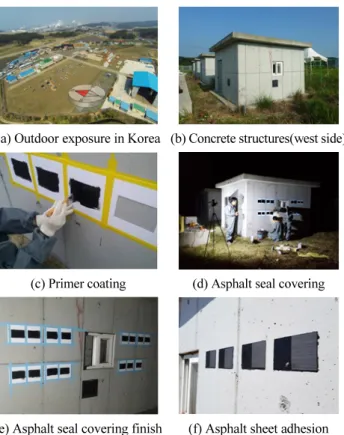
트 건설구조물의 수직벽면을 모사하기 위하여 콘크리트 구조 물을 사용하였으며, 4면 벽면 중 일사에 의해 벽면의 상승온 도가 가장 높은 서측면에 아스팔트 씰계 방수재료 및 아스팔 트 방수시트를 Photo 2와 같이 적층 시공한다. 콘크리트 구조 물은 동서남북 방향이 되도록 배치하여 외벽면 및 방수층의 온도를 실시간 측정(Fig. 1)함으로써 사전 실험을 통해 수직벽 의 온도가 가장 높이 올라가는 서측면을 대상으로 아스팔트 방수시트의 흘러내림 길이를 버니어 캘리퍼스로 수직 흘러내 림 길이를 측정한다.
3. 실험 결과
3.1 실내 촉진 흘러내림 저항성 실험
국내 아스팔트 씰계 방수재료 20종을 대상으로 20°C, 40°C, 60°C에서 168시간 가열촉진 후 아스팔트 씰계 방수재료 단독 의 흘러내림에 대한 실험결과 20°C에서 용제분산형, 수분산 형, 무용제형, 가열용융형 모두 흘러내림이 발생하지 않은 것 으로 확인되었다. 40°C에서는 용제분산형, 가열용융형의 아 스팔트 씰계 방수재료가 흘러내림이 발생하지 않았으나, 무 용제형 및 수분산형은 일부 약 10 mm정도 흘러내린 것으로
확인되었다. 또한, 60°C에서도 용제분산형, 가열용융형은 흘 러내림이 발생하지 않았으나, 무용제형 및 수분산형은 일부 55 mm이상이 흘러내린 것으로 확인되었다(Figs. 2~3).
3.2 옥외 수직부 흘러내림 저항성 실험
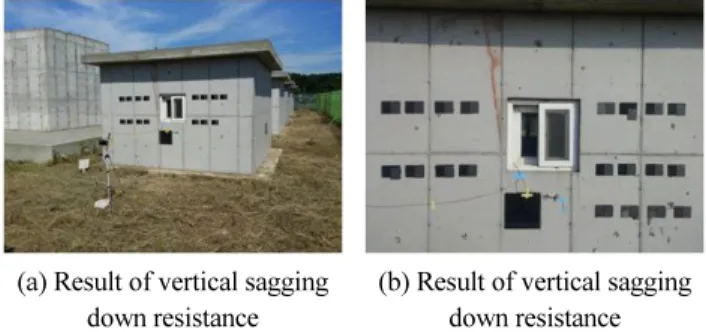
국내 아스팔트 씰계 방수재료 20종을 대상으로 콘크리트 구조물의 서측면에 현장 시공과 유사한 시공 방법으로 콘크 리트 수직 벽면에 아스팔트 씰계 방수재료와 개량아스팔트 방수시트를 2016년 8월에 시공(Photo 2~3)하였으며, 3개월경
(a) Preparation of substrate (b) Asphalt seal covering
(c) Specimen sagging down (d) Experiment at 20°C
(e) Experiment at 40°C (f) Experiment at 60°C Photo 1 Experiments of sagging down resistance at 20°C, 40°C and 60°C
(a) Outdoor exposure in Korea (b) Concrete structures(west side)
(c) Primer coating (d) Asphalt seal covering
(e) Asphalt seal covering finish (f) Asphalt sheet adhesion Photo 2 Experiments of vertical sagging down resistance at out door exposure
Concrete surface &
waterproofing compound temperature measuring
5 outside concrete wall 2 waterproofing layer
Fig. 1 Real-time measurement of temperature at concrete walls and
waterproofing layer
과 후의 흘러내림 저항성을 실험하였다. 시공 후 약 3개월 간 의 콘크리트 구조물 및 방수층의 온도 측정 결과 Fig. 4~5과 같이 최대 온도 55°C를 나타냈다. 이때의 아스팔트 씰계 방수 재료 및 아스팔트 방수층의 흘러내림 저항성 실험 결과는 Fig. 6과 같으며 용제분산형, 가열용융형의 경우 흘러내림 이 발생하지 않은 것으로 확인 되었다. 수분산형의 경우 약 57 mm이상 아스팔트 방수시트가 흘러내린 것으로 확인되었 으며, 일부 무용제형에서는 약 10 mm 이상 흘러내린 것으로
확인되었다.
4. 결 론
콘크리트 구조물 외벽면에 시공되는 아스팔트 씰계 재료의 외벽 방수 시공에 있어 흘러내림 특성을 실험적으로 검토한 결과 다음과 같은 결론을 얻을 수 있었다.
Fig. 2 Result of resistance to sagging down at 40°C
Fig. 3 Result of resistance to sagging down at 60°C
Fig. 4 Monitering result of temperature measurement (Aug. 10 to Nov. 11)
Fig. 5 Trend of daily temperature at concrete structures and water- proofing layer of north, east, south, west side
(a) Result of vertical sagging down resistance
(b) Result of vertical sagging down resistance Photo 3 Experiments of vertical sagging down resistance at out door exposure
Fig. 6 Result of vertical sagging down resistance
1) 씰계 방수재료 도포 후 168시간 동안 양생시키고 20°C, 40°C, 60°C에서 168시간동안 실내 촉진 후 흘러내림 저항 성을 평가하였을 때 40°C에서 용제분산형, 가열용융형의 아스팔트 씰계 방수재료는 흘러내림이 발생하지 않았으 나, 일부 무용제형, 수분산형에서 최대 10 mm 흘러내림이 발생하였으며, 60°C에서 또한 용제분산형, 가열용융형에 서는 흘러내림이 발생하지 않았으며, 일부 무용제형, 수분 산형에서 최대 55 mm이상 흘러내림이 발생되었다. 이는 용제분산형의 경우 용제의 증발로 인하여 아스팔트 씰계 방수재료의 경화로 인하여 흘러내림이 발생되지 않은 것 으로 판단되며, 가열용융형의 경우 연화점이 높아 흘러내 림이 발생되지 않은 것으로 판단된다. 일부 연화점이 낮은 수분산형과 무용제형에서 가열 시 40°C와 60°C에서 흘러 내림이 발생된 것으로 확인되었다.
2) 우리나라 서산지역의 자연적인 기후환경에서 아스팔트 씰계 방수재료와 아스팔트 방수시트를 콘크리트 수직 바 탕면에 시공한 후 아스팔트 씰과 방수시트의 흘러내림 저 항성의 3개월 간의 평가결과 또한 일부 무용제형, 수분산 형에서 흘러내림이 발생한 것을 확인할 수 있었다. 3개월 간의 콘크리트 벽면 및 아스팔트 방수층의 표면온도를 측 정한 결과 최대온도 55°C로 실내 촉진 60°C와 유사한 온 도로 확인되어 옥외 수직부 흘러내림 또한 실내 촉진과 같 은 이유로 흘러내림이 발생 된 것으로 판단된다.
3) 이를 통해 일부 수직벽에서 흘러내림 특성에 대한 품질기 준, 가이드 등의 확립이 요구되며 업계에서도 수직벽면용 씰계 재료의 경우 현재 품질수준에서 흘러내림 저항성을 향상시키려는 품질개선 노력을 기울여야 할 것으로 사료 된다.
향후 6개월, 12개월까지 수직 벽면의 흘러내림 저항성에 대 해 평가할 예정이며, 아스팔트 씰계 방수재료의 시공 전 옥외 에서의 야적으로 밀도 차에 의한 재료분리의 문제에 대해 평 가로 저장안정성에 대해 실험 하고자 한다. 이러한 추가적인 연구를 통해 현장에서 예견되는 하자 발생을 저감시키기 위 해 품질기준 확립 등의 노력을 계속해 나가야 할 것으로 사료 된다.
감사의 글
이 논문은 국토교통부 주거환경연구사업의 연구비지원 (17RERP-B082204-04)에 의해 수행되었습니다.
References
Im, C. J. (1999), A Study for Waterproofness of Underground Structures, Dong-Eui Institute of Technology 論文集, 25, 95-112.
Im, C. J., and Bae, M. O. (2000), Application for a Composite Waterproof Method of Asphalt mastic Film and Sheet on Concrete Structures, Journal of Korea Concrete Institute, 12(2), 793-800.
Jang, H. S., Kang, H. J., Song, J. Y., and Oh, S. G. (2006), An experimental study about the water leakage structure of waterproofing layer performance demobilization method using of stick expansion type complex of flexible material, Journal of the Korea Institute of Building Construction, 5(2), 79-83.
Kim, Y. S., Um, T. H., Kim, Y. S., Shin, H. C., Kim, Y. G., and Choi, S. K. (2016), Basic Experiment to Improve the Quality of Asphalt Seal Waterproofing Material, Journal of Korean Recycled Construction Resources Institute, 297-298.
Korea Conformity Laboratories, Development of Building Technology to Improve the Living Performance Closely Related with Lifestyle to Realize the Housing Welfare., Second Report.
Oh, S. G. (2010), A Study on Guidelines for the Repair of Water- Leakage.
Oh, S. G., Song, J. Y., Kim, J. S., and Lee, N. K. (2006), A Study on the Field Application Analysis for High Adhesive Spray Type of Degenerated and Rubberized Asphalt Membrane Material, Journal of the Korea Institute of Building Construction, 6(4), 85-92.
Received : 01/06/2017 Revised : 02/03/2017 Accepted : 11/13/2017