• 검색 결과가 없습니다.

Effects of Wound Dressing with Thiophanate-Methyl Paste on Compartmentalization of Pruning Wounds

N/A
N/A
Protected

Academic year: 2021

Share "Effects of Wound Dressing with Thiophanate-Methyl Paste on Compartmentalization of Pruning Wounds"

Copied!
6
0
0

로드 중.... (전체 텍스트 보기)

전체 글

(1)

220

F OREST S OCIETY

Effects of Wound Dressing with Thiophanate-Methyl Paste on Compartmentalization of Pruning Wounds

Kyu Hwa Lee* and Kyung Joon Lee

Department of Forest Sciences, Seoul National University, Seoul 151-921 Korea

Abstract : This study was conducted to examine the effects of wound dressing with thiophanate-methyl paste on the compartmentalization of pruning wounds in Acer palmatum . A total of thirty field-grown trees were used for three different treatments, such as no dressing, dressing once right after pruning cut, and dressing twice, one more dressing treatment one year after initial dressing. Wound closure rate (WCR) and discolored/wound area ratio (D/W ratio) two years after treatment were measured. Variations of extractives, holocellulose and lignin at the treated branch unions were also examined. The WCR of no dressing treatment of 70.9% was significantly lower than those of the two dressing treatments (85.4% and 82.7%, respectively), while the difference between dressing once and twice was not significant. The D/W ratio of no dressing treatment (39.3%) was significantly higher than those of the two dressing treatments (around 30%). Generally, at the branch core of the treated union, contents of extractives and lignin were higher and holocellulose contents were lower than the branch core of the union with living branch. Among the branch core of treated union, no dressing treatment showed a relatively lower holocellulose (63.5%), and relatively higher extractives (2.8%) and lignin (26.6%) than dressing once (66.2%, 1.7%, 26.1%, respectively).

Key words : Acer palmatum, wound closure, extractives, holocellulose, lignin, discolored area

Introduction

Constant efforts were made to find an ideal wound dressing which should prevent decay, stimulate wound closure, and improve tree appearance, but to date no dressing commercially available has been shown to pre- vent decay (Dujesiefken et al ., 2005; Gilman, 2002; Har- ris et al ., 2004; Schwarze et al ., 2000; Shigo, 1986).

Shigo and Wilson (1977) applied asphalt, polyure- thane, and shellac to protect wounds on red maple and American elm, and found that none affected vertical extensions of the discolored and decayed wood or the presence of decay fungi. Various wound dressings rang- ing from commercial tree paints, orange shellac, asphalt paints, creosote paints, and house paint to grafting wax were advised to use over the years. But current research indicates that these materials are not effective in protect- ing trees from wood-rotting organisms (Hartman et al ., 2000).

A few effective results were reported from the exper- iments with plastic wrap (Shortle and Shigo, 1978) and some plant growth regulators (Ha, 2004; Hartman et al .,

2000). But most authors do not recommend wound dressing (Gilman, 2002; Harris et al ., 2004; Hartman et al ., 2000), and American National Standards Institute (2001) even prescribes that wound treatments should not be used to cover wounds or pruning cuts, except when recommended for disease, insect, mistletoe, sprout con- trol, or for cosmetic reasons.

Regardless of those prevailing recommendations, applying thiophanate-methyl paste (Topsin Paste

TM

) on the tree wounds is generalized practice in Korea without any experimental tests. This study was conducted to examine the effect of wound dressing with the thiophanate-methyl paste on the compartmentalization of pruning wounds.

The tree species selected for this experiment was Acer palmatum which is broadly planted in the urban forest of Korea.

Materials and Methods

1. Tree species for the study

Thirty field-grown A . palmatum (Japanese maple) trees, which were growing in Yeoju, Gyeonggi, Korea (37.10.841 N, 127.38.900 E), were used for this study.

The trees were 13-year-old, 10.3 cm thick in average diameter at 30 cm above the ground, and 360 cm tall in

*Corresponding author

E-mail: [email protected]

(2)

average height in April 2007 (Table 1).

2. Experimental design

The thirty trees were allocated according to the random- ized block design. The stand of the trees was divided into three blocks, which were border, intermediate between border and interior, and interior of the stand. Each block of the treatments consisted of ten trees.

3. Treatment

Pruning wounds were treated by three different ways, which were ‘no dressing’ as a control in treatments,

‘dressing once’, dressing right after pruning cut, and

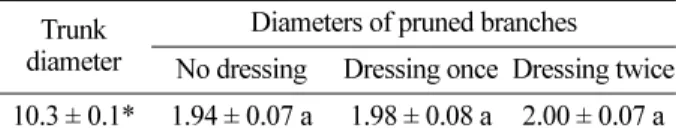
‘dressing twice’, one more dressing treatment one year after initial dressing. The sizes of the branches for prun- ing cuts were between 1 cm and 4 cm in diameter at 1.5 cm above the branch bark ridge (BBR). The number of removed branches per tree was multiples of three, depending on the branch density of the tree, to allocate the same number of wounds with similar sizes by treat- ment. Consequently, average diameters of pruned branches by treatment were not significantly different (Table 1).

The pruning wounds were dressed with thiophanate- methyl paste (Topsin Paste

TM

, a product of Nippon Soda Co., Ltd.). Pruning and wound dressing treatments were made in mid-summer (August 17, 2007) before most decay fungi were sporulating in the fall (Hartman et al ., 2000; Shigo, 1989). All the treated trees were harvested two years after initial treatments.

4. Pruning cuts

Pruning cuts were conformable with the American National Standard (American National Standard Institute, 2001). A pruning cut was made close to the trunk or par- ent limb, without cutting into the BBR or collar, or leav- ing a stub (Figure 1). In case where branch collar was not readily apparent, the cut bisected the angle between its BBR and an imaginary line perpendicular to the branch.

5. Measurements

1) Branch and stem diameter and area of pruning wound prior to pruning, diameters of branches and stems at

1.5 cm above the BBR were gauged with a caliper.

Immediately after each cutting, horizontal width and ver- tical length of the pruning wound crossing the center of the cut branch were measured to estimate the wound area.

2) Discolored area

The harvested samples were dissected with a cleaver along the medial longitudinal plane and shaved with a sharpened knife to measure discolored areas formed after the branch removal. The area of discolored stem tissue on the medial longitudinal surface was estimated by the length of pruning wound (B-B’) and the deepest pene- tration of discolored wood into the trunk (H-H’) with the formula squaring the area of a triangle supposing the Table 1. General description of experimental trees ( Acer

palmatum ) and experimental conditions; average trunk diameter at 30 cm above ground in April 2007, and average diameter of pruned branch by treatment. Means with the same letter are not significantly different at P < 0.05.

unit: cm Trunk

diameter Diameters of pruned branches No dressing Dressing once Dressing twice 10.3 ± 0.1* 1.94 ± 0.07 a 1.98 ± 0.08 a 2.00 ± 0.07 a

*Mean ± standard error

Figure 1. A pruning cut was made close to the stem without cutting into the branch bark ridge, or leaving a stub. A branch too large to support with one hand was precut to avoid splitting of the wood or tearing of the bark (American National Standard Institute, 2001).

Figure 2. A diagram of a branch union sample split along the medial longitudinal plane one year after pruning cut.

Length of pruning wound (B to B’) and depth of the

discolored wood (H to H’) were used for measuring the

area of discolored wood inside the pruning wound.

(3)

shape of discolored wood as a triangle (Figure 2). The length of H-H’ was measured along the imaginary line perpendicular to the pruning wound.

6. Determinations of extractives, holocellulose and lignin Chemical analyses for the tissues of the branch core, and the above and below core were performed to exam- ine the changes of their chemical properties two years after treatments. Two trees from each treatment were selected for the analyses. A total of sixteen branch union samples, eight from each tree, were collected from each

treatment. The eight samples of each tree consisted of four with pruning wounds and the other four with living branches.

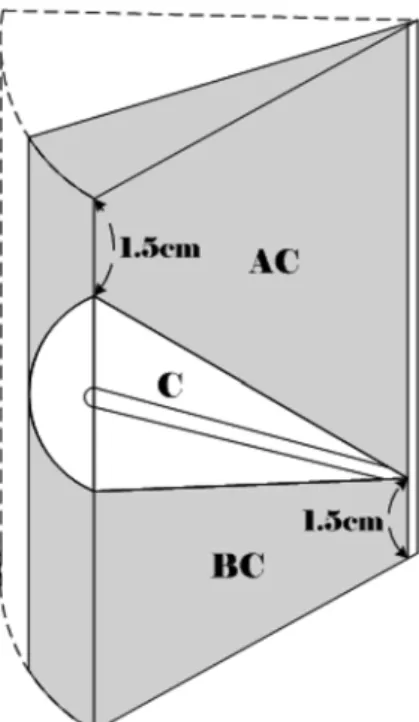
The samples were dissected with a cleaver along the medial longitudinal plane, and the parts beyond an imag- inary line perpendicular to the stem pith at 1.5 cm above the BBR and an imaginary line perpendicular to the stem pith at 1.5 cm below the end of branch pith were trimmed off (Figure 3). The trimmed samples were air-dried, split into three parts (core of branch, above and below core), and then ground through a 40 mesh screen.

The content of the extractives, was determined by the soxhlet method (Technical Association of Pulp and Paper Industry, 1994). Two grams of sample in a thimble filter was extracted by 150 mL of ethanol/benzene mix- ture (1:2 v/v) using a soxhlet extractor with reflux con- denser at 80

o

C for 6 hours. The extracted solution was evaporated under reduced pressure. The extractive was dried at 105±1

o

C and then weighed. The extractive-free sample left in the thimble filter was used for analyses of holocellulose and Klason lignin.

The content of holocellulose was determined as the delignified residue by NaClO

2

(Wise et al ., 1946). The 1.25 g of extractive-free sample in 250 mL flask was treated with 75 mL of distilled water, 0.5 g of NaClO

2

and 0.1 mL of CH

3

COOH at 80C for 1 hr. This proce- dure was repeated 2 more times. The solution was fil- tered by using a glass filter (1G3, Iwaki, Japan), and then washed with 250 mL of cold distilled water and 25 mL of acetone, successively. The filtrated residue was dried at 105±1

o

C and then weighed.

Klason lignin was analyzed according to the standard NREL procedures (National Renewable Energy Labora- tory, 2005). The 0.3 g of extractive-free sample in 50 mL flasks was hydrolyzed with 3 mL of 72% H

2

SO

4

at 30

o

C for 1 hr. The hydrolysate was then transferred to 100 mL flask and diluted to 4% H

2

SO

4

by adding 84 mL of distilled water. The flasks were sealed and autoclaved for 1 hr at 121

o

C. The solution was then filtered by Figure 3. A diagram of a branch union sample dissected

along the medial longitudinal plane. The parts beyond an imaginary line perpendicular to the stem pith at 1.5 cm above the branch bark ridge and an imaginary line perpendicular to the stem pith at 1.5 cm below the end of branch pith were trimmed off. The trimmed sample was divided into three parts, the core of branch (C), above core (AC) and below core (BC) for chemical analyses of those tissues.

Table 2. Indicators to analyze the changes in the area of pruning wound, and development of discolored wood on the medial longitudinal surface two after treatments.

Indicators Formulae

Wound Closure Rate (WCR, %)

PWA

y0

: area of pruning wound at the time of treatments PWA

y+2

: area of pruning wound 2 years after treatments Discolored/Wound Area Ratio

(D/W ratio)

DA

y+2

: area of discolored stem tissue on the medial longitudinal surface two years after treatments PWA

y0

: area of pruning wound at the time of treatments

WCR PWA

y0

– PWA

y 2+

PWA

y0

--- 100 ×

=

D W ratio ⁄ DA

y 2+

PWA

y0

---

=

(4)

using a glass filter (1G4, Iwaki, Japan). The filtrated res- idue was dried at 105±1

o

C and then weighed.

7. Data analysis

Indicators of wound closure rate (WCR) and discol- ored/wound area ratio (D/W ratio) were introduced to examine the changes of abilities to compartmentalize the pruning wounds after the treatments (Table 2). The WCR represented the enclosing extent of the pruning wound during two years after treatments, and the D/W ratio was computed by comparing the area of discolored stem tissue on the medial longitudinal surface two years after treatments with the area of pruning wound at the time of pruning. In the CODIT model (Shigo and Marx, 1977), the WCR indicated vitality of the cambium around the wound which formed wall 4 after the tree was wounded, while the D/W ratio expressed the ability of a tree to limit the spread of wood discolorations and decays with wall 1, 2 and 3 which were already present in the wood at the time of the pruning.

The two-way Repeated Measures ANOVA was used to calculate the ratio of the variance among the means to the variance within the samples. Since the covariance matrix did not satisfy the sphericity, univariate tests of hypotheses for within subject effects could not be used.

Instead, multivariate test was used. It provided several statistics such as Wilks’ lambda, Pillais trace, Hotelling- Lawley trace and Roy’s greatest root (Hair et al . 2006).

Using these statics, P -value was calculated by asymp- totic F distribution. The statistical difference among the means of the treatments was determined using the Dun- can’s multiple comparison procedure (Davis, 2007; Nor- man and Streiner, 1998). SAS 9.1 (SAS Institute Inc., USA) was used for the analysis, and the significance level, α -value, was 0.05 unless otherwise specified.

Results and Discussion 1. Wound closure and stem discoloration

Table 3 shows variations of the WCR and the D/W ratio by treatment two years after treatments. The WCR of no dressing treatment of 70.9% was significantly lower (P < 0.05) than those of the once and twice dress-

ing treatments (85.4% and 82.7%, respectively), while the difference between dressing once and twice was not significant. This implied that the dressing after develop- ment of the woundwood was not inefficacious. On the contrary, the D/W ratio of no dressing treatment (39.3%) was significantly higher (P < 0.01) than those of the two dressing treatments (around 30%), and the difference between dressing once and twice was not significant, either.

Many studies confirmed that the use of wound seal- ants was not an adequate substitute for good compart- mentalization and rapid wound closure (Harris et al ., 2004; Schwarze et al ., 2000; Shigo, 1983). Only a few researches reported effectiveness of the dressing on the wound closure. Application of a lanolin slowed drying of wounds and hastened initiation of callus growth (McQuilkin, 1950), and plant hormones have been found to be variable in their effects on the callus production (Ha, 2004; Hartman et al ., 2000).

Topsin Paste

TM

is a fungicide to control a canker on the apple tree ( Valsa ceratosperma ), and its ingredients are 3% of thiophanate-methyl and 97% of a mixture of colorants, antifreezes and solvents. Considering the expressed ingredients, it is hard to discuss this result of the rapid wound closure by applying the fungicide. Further researches are necessary to determine the major compo- nents of the fungicide to promote the callus production.

Low discoloration at the treated pruning wounds might be resulted from several events. The wound dressing might protect the exposed cambium from the dieback, which could be helpful to the wound closure, and the fast closure of pruning wound would restrict the decay process of the wounds (Shigo and Larson, 1969). In addition, the applied fungicide might have slowed down the rate of decay process (Acquaah, 2002), and the paste might prevent wounds from drying up (McQuilkin, 1950).

2. Variations of wood chemical property

Figure 4 shows variations of the extractives, holocel- lulose and lignin in the three parts (above core, branch core and below core) among the branch unions with dressing treatments and the unions with living branches.

Generally, at the branch cores of the treated unions, the contents of extractives and lignin were higher, and the contents of holocellulose were lower than those at the branch cores of the unions with living branches. Among the treated unions, no dressing treatment showed rela- tively lower holocellulose (63.5%), and relatively higher extractives (2.8%) and lignin (26.6%) than dressing once (66.2%, 1.7%, 26.1%, respectively).

A tree begins to form a protective chemical shield, a reaction zone, around and immediately behind the Table 3. Variations of wound closure rate (WCR), and

discolored/wound area ratio (D/W ratio) by treatment two years after treatments. Means with the same letter are not significantly different at P < 0.05.

Treatments WCR (%) D/W ratio (%) No dressing 70.9 ± 3.2* a 39.3 ± 1.1 a Dressing once 85.4 ± 2.2 b 30.7 ± 0.9 b Dressing twice 82.7 ± 2.5 b 29.8 ± 1.3 b

*Mean ± standard error

(5)

wound (Shigo, 1979; Shigo and Marx, 1977). As time goes by, the xylem compromised by the wound starts to re-wet, and a region corresponding to the site of forma- tion of the colored reaction zone becomes wetter than the adjacent healthy wood. This water may carry sec- ondary metabolites produced by the elicited xylem parenchyma cells to developing reaction zone and would permit their accumulation in the nonliving cells of the differentiated wood (Pearce, 2000). So the branch core of pruned branch union contained more extractives than the other parts of above and below core of the union.

Formation of lignin is another defense mechanism in the wood tissues to protect trees from wounding and microbial invasion (Yamada, 2001). Geiger et al. (1986) reported an increase of 25-30% in lignin-like materials in the wood of Hevea brasiliensis taproots close to the infection front of Rigidoporus lignosus . Increases of lig- nin contents at the core of no dressing treatment by about 23% comparing with the core of the control (21.6%) in the present study would result from the lig- nification of exposed xylem tissues as a defense mech-

anism of the trees.

Conclusions

This study showed that the dressing of pruning wounds with thiophanate-methyl paste (Topsin Paste™) at the time of pruning was effective in the wound clo- sure and slowing the discoloration of wounded tissue.

However it was hard to find the cause of the effective- ness with the expressed ingredients. Further study is required to identify the effective ingredients in wound protection, which contribute to the tree health.

Literature Cited

1. Acquaah, G. 2002. Horticulture: principles and practices (2nd ed.). Pearson Education, Inc., Upper Saddle River, 2. American National Standard Institute. 2001. American NJ.

National Standard for Tree Care Operations-Tree, Shrub, and Other Woody Plant Maintenance-Standard Practices (Pruning). ANSI A300 (Part 1)-2001 Pruning. American National Standard Institute, New York, NY.

3. Davis, J.M. 2007. Statistics Using SAS Enterprise Guide.

SAS Institute Inc., Cary, NC.

4. Dujesiefken, D., Liese, W. and Shortle, W. 2005. Response of beech and oaks to wounds made at different times of the year. European Journal of Forest Research 124:

113-117.

5. Geiger, J.P., Rio, B., Nicole, M. and Nandris, D. 1986.

Biodegradation of Hevea brasiliensis wood by Rigi- doporus lignosus and Phellimus noxius . European Jour- nal of Forest Pathology 16: 147-159.

6. Gilman, E.F. 2002. An illustrated guide to Pruning (2nd ed.). Delmar, Albany, NY.

7. Ha, T.J. 2004. A study of the growth of large old trees and the formation of calloses after surgery on the trees.

Thesis for Ph.D. Sangmyung University, Seoul, Korea.

8. Hair, J.F., Jr., Black, W.C., Babin, B.J., Anderson, R.E.

and Tatham, R.L. 2006. Multivariate data analysis (6th ed.). Pearson Prentice Hall. Upper Saddle River, NJ.

9. Harris, R.W., Clark, J.R. and Matheny, N.P. 2004. Arbo- riculture (4th ed.). Prentice Hall, Upper Saddle River, NJ.

10. Hartman, J.R., Pirone, T.P. and Sall, M.A. 2000. Pirone's Tree Maintenance (7th ed.). Oxford University Press, Inc., New York, NY.

11. McQuilkin, W.E. 1950. Effects of some growth regu- lators and dressings on healing of tree wounds. Journal of Forestry 48: 423-428.

12. National Renewable Energy Laboratory. 2005. Biomass Analysis Technology Team Laboratory Analytical Pro- cedure. National Renewable Energy Laboratory, US Department of Energy.

13. Norman, G.R. and Streiner, D.L. 1998. Biostatistics-the Figure 4. Variations of extractives, holocellulose and lignin in

the three parts (ac: above core, c: branch core, bc: below

core) by treatment. D0: no dressing, D1: dressing once,

D2: dressing twice, Co: control-branch union with living

branch.

(6)

bare essentials. B.C. Decker Inc., Hamilton, Ontario.

14. Pearce, R.B. 2000. Decay development and its restric- tion in trees. Journal of Arboriculture 26: 1-11.

15. Schwarze, F.W.M.R., Engels, J. and Mattheck, C. 2000.

Fungal strategies of wood decay in trees. Springer-Ver- lag, Berlin.

16. Shigo, A.L. 1979. Tree decay - an expanded concept.

USDA Forest Service, Durham, NH.

17. Shigo, A.L. 1983. Targets for proper tree care. Journal of Arboriculture 9: 285-294.

18. Shigo, A.L. 1986. A new tree biology. Shigo and Trees, Associates, Durham, NH.

19. Shigo, A.L. 1989. Tree pruning: a worldwide photo guide for the proper pruning of trees. Shigo and Trees, Associates, Durham, NH.

20. Shigo, A.L. and Larson, E.H. 1969. A photo guide to the patterns of discoloration and decay in living north- ern hardwood trees. USDA Forest Service, Upper Darby, PA.

21. Shigo, A.L. and Marx, H.G. 1977. Compartmentaliza-

tion of Decay In Trees. USDA Forest Service.

22. Shigo, A.L. and Wilson, C.L. 1977. Wound dressings on red maple and American elm: effectiveness after five years. Journal of Arboriculture 3: 81-87.

23. Shortle, W.C. and Shigo, A.L. 1978. Effect of plastic wrap on wound closure and internal compartmentaliza- tion of discolored and decayed wood in red maple.

Plant Disease Reporter 62: 999-1002.

24. Technical Association of Pulp and Paper Industry. 1994.

Solvent extractives of wood and pulp; S.L. (T-204 OM- 25. Wise, L.E., Murphy, M. and D'Addieco, A.A. 1946. 88).

Chlorite holocellulose, its fractionation and bearing on summative wood analysis and on studies on the hemi- celluloses. Paper Trade Journal 122: 35-43.

26. Yamada, T. 2001. Defense mechanisms in the sapwood of living trees against microbial infection. Journal of Forest Research 6: 127-137.

(Received January 21, 2010; Accepted March 22, 2010)

수치

Figure 2. A diagram of a branch union sample split along the medial longitudinal plane one year after pruning cut.
Table 2. Indicators to analyze the changes in the area of pruning wound, and development of discolored wood on the medial longitudinal surface two after treatments.
Table 3 shows variations of the WCR and the D/W ratio by treatment two years after treatments

참조

관련 문서

Salty taste intensity scores for chicken rice porridge of salt solution and various level of soy sauce solution ··· 26 Fig.. Photograph of Salad dressing

Environment Council Decision (EU) 2015/146 of 26 January 2015 on the signing, on behalf of the European Union, of the agreement between the European Union and its Member

ƒ Instead of having a bricklayer bend over and pick up a brick from a pile of bricks on a relatively unadjustable brickstand, rotate the brick to find the best side, and then

It considers the energy use of the different components that are involved in the distribution and viewing of video content: data centres and content delivery networks

2) Serum Cortisol, ACTH 3) Serum TSH and Free T4 4) Serum Prolactin and GH 5) Serum 25OHD and PTH.. What is the most common laboratory. abnormality expected in this

After first field tests, we expect electric passenger drones or eVTOL aircraft (short for electric vertical take-off and landing) to start providing commercial mobility

1 John Owen, Justification by Faith Alone, in The Works of John Owen, ed. John Bolt, trans. Scott Clark, &#34;Do This and Live: Christ's Active Obedience as the

손질한 원료를 미리 조리(또는 훈제)한 후 통조림에 넣고 식물성 오일을 넣어 만들어 진 캔 저장 식품3. 2 양념류 수산 통조림 canned