http://dx.doi.org/10.12925/jkocs.2017.34.3.443
갈근 추출물이 사염화탄소로 유발된 흰쥐의 간 손상에 대한 보호효과
김옥경
✝대진대학교 과학기술대학 식품영양학과
(2017년 7월 24일 접수: 2017년 8월 18일 수정: 2017년 8월 29일 채택)
Protective Effects of Extract of Puerariae radix on Hepatic injury Induced by Carbon Tetrachloride In Rat.
Ok-Kyung Kim✝
Department of Food Science and Nutrition, Dae Jin University, Pochen-Si 487-711, Korea
(Received July 24, 2017; Revised August 18, 2017; Accepted August 29, 2017)
요 약 : Dawley 계 숫컷 흰쥐(200∼210g)를 정상군, CCl4-대조군, CCl4-실험군으로 나누어 실험군은 갈근 에탄올 추출물을 1,000mg/kg,b.w의 용량으로 1일1회7일간 경구 투여 후 사염화탄소를 0.6mg/kg,b.w의 용량으로 복강내 주사 후 다음날 개복하여 혈청내의 Alanine aminotransferase(ALT), Aspartate aminotransferase(AST), Alkaline phosphatase(ALP), Glutamyltranspeptidase(γ-GT), Lactate dehydro-genase(LDH)의 활성도와 중성지방, 콜레스테롤 함량을 측정한 결과 갈근 추출물 투여 군에서 CCl4-대조군과 비교하여 유의적인 감소(p<0.05)를 나타내었으며, HDL-콜레스테롤은 유의적인 증가(P0.05)를 나타내었다. 간조직중의 지질과산화 함량과 Catalase(CAT),Glutathione peroxiddase (GSH-Px)의 항산화 효소 활성은 유의적인 감소를 나타내었다. 반면에 간 조직중의 glutathione 함량은 유의적인 증가를 나타내었다. 이 실험 결과 갈근 에탄올 추출물은 사염화탄소 투여에 의한 간 손상을 억제하는 보호물질과 항산화 물질을 함유하고 있음을 알 수 있었다.
주제어 : 갈근 추출물, 사염화탄소, 간 독성 보호작용, 지질대사, 항산화작용
Abstract : This study was done to investigate the protective effects of ethanol extract
puerariae radix
(Pr) on carbon tetrachloride(CCl4) intoxicated rats. Male sprague Dawley rats(200∼210g)was used. experimental groups were divided into normal group, CCl4-control group, and ethanol extract CCl4-treated group. CCl4-treated groups were injected with CCl4 0.6mg/kg.b.w(i.p). The activities of Alanine aminotransferase(ALT), Aspartate aminotransferase(AST), Alkaline phosphatase(ALP), Glutamyltranspeptidase(γ-GT), Lactate dehydrogenase(LDH) in extract pretrated group was significantly decreased(p<0.05) compared to the CCl4-control group. The contents of triglyceride,
✝
Corresponding author
(E-mail: [email protected])
cholesterol and lipid peroxide were significantly decreased(p<0.05). whereas content of HDL-choresterol was significantly increased.(p<0.05). In addition, activities of hepatic catalase(CAT), glutathione peroxidase(GSH-Px) in the extract pretreated rats were significantly decreased(p<0.05) compared to the CCl4-control group. but the content of glutathione(GSH) was significantly increased(p<0.05). These results suggest that extract of
puerariae radix
(Pr) has hepatoprotective effect in the CCl4-intoxicated rats.Keywords : puerariae radix
(Pr), carbon tetrachloride, lipid metabolism, hepatoprotective effect, antioxidation.1. 서 론
생존의 필수 물질인 산소는 체내의 여러 대사 과정을 거쳐 free radical을 만들어 유해 세균의 살균 작용이나 노화된 단백질의 제거등에 이용되 지만 과량으로 만들어진 free radical이 소거되지 않으면 생체의 노화나 질병으로 이어진다[1-3].
이들 세포독성을 일으키는 유리기 생성의 화학적 물질로는 사염화탄소(CCl4), 클로르포름, 에탄올, 브로모벤젠 등이 있으며 특히 화합물의 합성이나 혼합물의 분리를 위해 용매로 사용되고 있는 CCl4는 생체 세포 SER에 복합 다기능 산화 기구 에 의하여 trichloromethyl radical(․CCl3)를 만들 고 이는 O2와 결합하여 trichloromethyl peroxy radical(․OOCCl3)을 생성하며 이들은 세포막의 인지질인 polyenoic fatty acid의 methyl carbon 을 공격하여 과산화지질을 생산하여 간세포 괴사 를 일으킨다[4-6]. 그러나 이러한 유리기에 대한 생체 조직은 superoxide dismutase, glutathione s-transferase, catalase 등과 같은 내인성 제거제 [7]와 식품에 많은 vitamin A, C, E, flavonoid계 색소, polyphenol류 등의 생리활성 물질들이 유 리기에 의한 조직 손상을 방어한다[8]. 한편 본 실험에 사용한 갈근(
Puerariae radix.
P.r)은 콩과 에 속하는 낙엽성 다년생 넝쿨 식물로 산과 들에 널리 자생하고 있으며 뿌리를 약용 또는 식용으 로 이용하고 있으며[9], 한방에서는 고혈압, 관상 동맥경화증, 협심증, 노인성 당뇨등에 이용되고 있다[10]. 갈근에 대한 연구로는 Miura등[11]의 갈근 수용성 추출물의 혈압강하작용, Zeng등[12]의 혈중 catecholamine농도, 심박수의 감소등을 보고하였으며, Fan등[13]은 혈압 및 말초혈관 저 항을 감소시킨다고 보고하였다. 또한 갈근의 약리 학적 성분으로는 flavonoid 계 화합물인
daidzein, gesterin, puerarol과 kaldonein등이 보 고 되었고[14-19], flavonoid 화합물은 alcohol dehydrogenase와 mitochodria glycoside의 저해 제로 알려져 있으며[20,21] 배당체인 pueraria glycoside는 과산화지질 생성을 억제하는 항산화 작용과 보간 작용이 있음이 보고[22,23]되었다.
따라서 본 실험에서는 갈근 에탄올 추출물을 1일 1회 7일간 경구투여하여 사염화탄소로 유발된 간 독성에 대한 보호 작용에 미치는 영향을 검토 하 고자 하였다.
2. 실 험
2.1. 실험재료 및 기기
2.1.1. 시료의 제조
본 실험에 사용된 갈근은 경동시장(거창산)에서 구입하여 사용하였으며 갈근 150 g을 에탄올 1000 ml에 넣고 85℃가 유지되는 추출장치에서 농축하여 에탄올 추출물을 얻는다.
2.1.2. 시약
carbon tetrachloride (Janssen Co., Japan), olive oil (Yakuri Japan) sodium azide, glutathione, glutathione reductase, NADPH, cumene hydroperoxide, 1-chloro-2,4- dinitrobenzene(CDNB), 5,5‘-dithiobis (2-nitrobenzoic acid(DTNB), xanthine, xanthine oxidase, cytochrome C, sodium deoxylcholate, 1,1,3,3,-tetraethoxypropane, thiobarbituric acid, bovine serum albumin (Sigma Co., U.S.A.)을 사용하였으며, alanine aminotransferase (ALT), aspartate
aminotransferae(AST), alkaline phosphatase (AlP), γ-glutamyltransferase(γ-GT), cholesterol, HDL-cholesterol, triglyceride (TG) kit (영동제약, Korea), lactate dehydrogenase (LDH) kit (아산제약, Korea)를 사용하였고, 추 출용 유기용매와 나머지 기타 시약은 특급시약을 구입하여 사용하였다.
2.1.3. 기기
Rotary vaccum evaporator (Eyela Co.
Japan), deep freezer (Hanil Co. Korea), Centrifuge (Hanil Co., Korea), UV spectrometer (Kontron Uvicon 923 Italy), Homogenizer (Omni, U.S.A.), Ultracentrifuge (Sorval, U.S.A.) 등을 사용하였다.
2.2. CCl4를 이용한 실험동물의 급성 독성 유발
체중 200±10 g 내외의 Sprague-Dawley계 수 컷 흰쥐를 1주일간 적응시킨 후 평균 체중 210±10 g인 것을 3군으로 나누어 사용하였고, 동물실 온도는 22~25 ℃의 동물 사육실에서 고 형사료(삼양유지 Co.) 및 물을 자유로이 섭취토 록 하였다. 실험군은 갈근 추출물을 1,000 mg/
㎏,b.w.로 정상군과 대조군은 증류수를 7일간 경 구 투여 후 최종 추출물 투여 6시간 후에 Rao 등의 방법[24]을 보완, 수정하여 흰쥐에게 CCl4
0.6 mg/kg [CCl4 : olive oil = 3 : 2(v/v)로 1.0 mg/kg]씩 복강 내 투여하여 급성 간 독성을 유 발시켰다.
2.3. 효소원 조제 및 분석
CCl4 를 복강 투여 후 18시간 동안 절식시키 고 흰쥐를 에틸에테르로 마취하여 복부를 절개하 여 심장에서 직접 채혈하고 3,000 rpm에서 20분 간 원심분리하여 혈청을 분리하였다. 적출한 간은 생리식염수로 장기 표면에 묻어 있는 혈액을 씻 은 후 여지로 남아 있는 생리식염수를 제거한 다 음 무게를 측정한 후 –70 ℃에 냉동 보관하였다 가 본 실험에 사용하였다.
효소원의 조제 및 혈청중의 ALT, AST, ALP, γ-GT, LDH활성도, bilirubin, cholesterol, HDL-cholesterol, triglyceride의 함량과 간 조직 중의 지질과산화물, GSH함량, cytosol 분획중의 GST, Catalase 및 GSH-Px의 활성도, 단백질 함 량은 Kim[25]의 방법에 따라 측정하였다.
2.4. 통계처리
모든 실험 결과는 평균치와 표준 ± 표준 오차 로 계산하였고, 각 군간의 차이는 Student,s t-test를 실시하여 p값이 5% 미만일 때 유의성이 있다고 판정하였다.
3. 결과 및 고찰
3.1. 갈근추출물의 수율
갈근 150 g을 에탄올 1,000 ㎖에 넣고 85 ℃ 가 유지되는 추출장치에서 4시간씩 3회 추출 후 회전식 진공 농축기에서 농축하여 38 g의 에탄올 추출물(수율25 %)을 얻었다.
3.2. ALT 및 AST 활성도
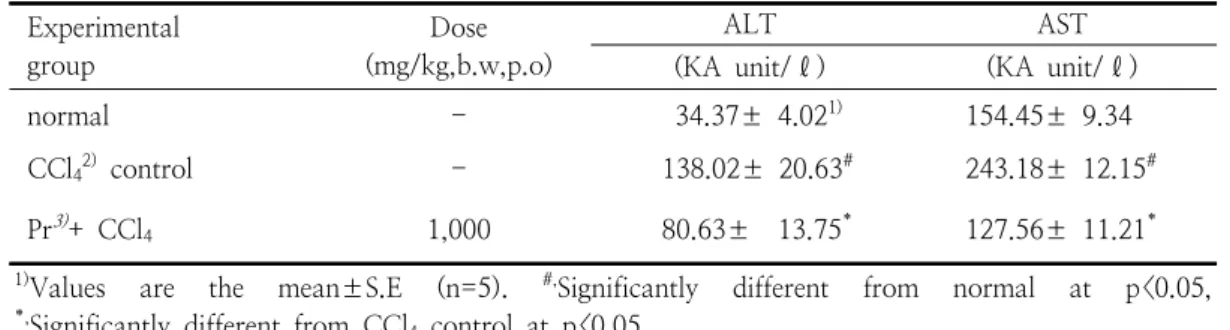
추출물 투여에 의한 ALT 및 AST 활성도는 Table 1 과 같다. CCl4 로 유발된 혈청중의 이 들 효소는 간세포의 괴사와 간조직의 파괴가 진 행됨에 따라 혈중으로 유리되어 높은 활성치를 나타낸다는 Hayes[26]의 보고와 같이 정상군과 비교하여 대조군에서 각각 유의적인 증가를 나타 내었다. 그러나 추출물을 투여한 실험군에서 대 조군과 비교하여 유의적인 감소(p<0.05)를 나타 내었다. 이 결과 갈근 추출물이 CCl4 에 의한 간 손상의 보호 작용이 있음을 알 수 있었다.
3.3. AIP,
γ
-GT, LDH 활성도 및 Bilirubin 함량갈근 추출물 투여에 의한 alkaline phosphatase (AIP),
γ-
GT 및 LDH 활성도는 Table 2와 같 다. 정상군과 비교하여 대조군에서 이들 활성도가 유의적인 증가를 나타내었다. alkaline phosphatase는 간담도계 질환이나 신장 및 골조 직의 질환이 있을 때 증가를 나타내며[28],γ
-GT는γ
-glutamylpeptide를 가수분해하여γ
-
glutamyl기를 다른 peptide나 아미노산에 전이 시키는 효소로써 간세포의 변성 또는 괴사가 되 면 혈중으로 유출되어 활성이 증가[29]되며, LDH도 transaminase와 마찬가지로 간조직이 파 괴되면 혈액중으로 방출되어 증가를 나타낸다고 보고하였다. 본 실험에서도 정상군과 비교하여 대 조군에서 이들 활성도가 유의적인 증가를 나타내 었다. 갈근 추출물 투여에 의해 AIP, γ-GT, LDH 활성도와 bilirubin함량이 유의적인 감소르 나타내었다. 이들 효소의 활성이 억제된 것은 갈Experimental group
Dose (mg/kg,b.w,p.o)
ALT AST
(KA unit/ℓ) (KA unit/ℓ) normal - 34.37± 4.021) 154.45± 9.34 CCl42) control - 138.02± 20.63# 243.18± 12.15# Pr3)+ CCl4 1,000 80.63± 13.75* 127.56± 11.21*
1)Values are the mean±S.E (n=5). #,Significantly different from normal at p<0.05,
*,Significantly different from CCl4 control at p<0.05,
2)CCl4 0.6 mg/kg, b.w. [CCl4 : Olive oil = 3:2 (v/v)] was i.p. injected one time after the sample pretreatment.
3)
puerariae radix
(Pr)Table 1. The Effects of Extract of
puerariae radix
on the Serum ALT and AST Activities in CCl4Intoxicated Rats
Experimental group
Dose (㎖/kg,b.w,p.o)
AIP γ-GT LDH Bilirubin
(KA units/㎖) (mu/㎖) (Wrobleski
units/㎖) (mg/ml) normal - 20.08± 1.891) 12.07± 1.19 318.24± 41.53 0.53± 0.23 CCl2) control - 32.37± 1.83# 32.04± 7.36# 547.09± 32.36# 4.78± 0.86#
SS
3)+ CCl4 1,000 21.43± 2.41* 28.34± 3.01* 329.47± 29.08* 2.68± 0.73*1,2),3),#,*: See the legend of Table 1.
Table 2. The Effects of Extract of
puerariae radix
on the Serum AIP,γ
-GT and LDH Activities and content of Bilirubin in CCl4 Intoxicated Rats근 추출물이 CCl4 에 의한 간조직의 손상이나 간 세포막을 안정시켜서 나타나는 결과로 사료된다.
3.4. Triglyceride, cholesterol 및 HDL-cholesterol 함량
갈근 추출물이 지질 함량에 미치는 영향은 Table 3과 같다. TG와 cholesterol 함량은 정상 군과 비교하여 대조군에서 유의적인 증가를 나타 내었다. 이는 정상적인 간세포는 지질의 합성과 이용의 균형을 이루지만 CCl4 와 같은 물질에 의 해 손상을 받으면 반응성이 높은․CCl4 기가 생성 되어 간세포의 기능을 저하시켜 관상동맥이나 췌 장질환 특히 지질대사와 지방간의 중요 지표가 되는 이들 물질이 증가한다는 보고[26]와 유사하 였다. 그러나 추출물 투여에 의해 유의적인 감소 (p<0.05)를 나타내었다. HDL-cholesterol은 정상 군과 비교하여 대조군에서 유의적인 감소를 나타
내었으나 추출물 투여에 의해 유의적인 증가 (p<0.05)를 나타내었다. 이는 갈근 추출물이 CCl4 에 의한 간손상을 억제한 결과 정상적인 지 질대사가 이루어진 것으로 사료된다.
3.5. 간 조직 중의 과산화지질 및 glutathione 함량
추출물 투여에 의한 간 조직중의 과산화지질 및 glutathione 함량은 Table 4와 같다. 과산화 지질은 유리기들에 의해 세포막 지질의 불포화지 방산들이 산화적 분해를 일으키는 것으로 과산화 지질의 지표인 malondialdehyde (MDA) 함량은 정상군과 비교하여 대조군에서 유의적인 증가를 나타내었다. 이 결과는 CCl4 와 같은 xenobiotics 의 대사 또는 내적인 요인(oxygen free radical generating system)에 의해 생성된 oxygen free radical이 관여된 결과 증가되었다는 보고[29,30]
Experimental group
Dose
㎎/㎏,b.w,p.o)
TG cholesterol HDL-cholesterol
(㎎/㎗) (㎎/㎗) (㎎/㎗)
normal - 173.24± 3.501) 52.13± 6.81 32.93± 1.21 CCl42) control - 102.83± 9.54# 82.41± 6.31# 10.28± 3.15#
P.r
3) + CCl4 1,000 51.93± 7.65* 61.34± 6.01* 21.74± 2.06*1),2),3),#,* : See the legend of Table 1.
Table 3. The Effects of Extract of
puerariae radix
on the Serum TG, cholesterol and HDL-cholesterol Contents in CCl4 Intoxicated RatsExperimental group
Dose (mg/kg,b.w,p.o)
Lipid peroxide Glutathione (MDA nmoles/g
of tissue) (moles/g of tissue) normal - 3.83± 0241) 10.05± 0.73 CCl42) control - 12.36± 2.07# 6.07± 0.26# P.r3) + CCl4 1,000 6.95± 0.83* 11.83± 0.37*
1)2),3),#,* : See the legend of Table 1.
Table 4. The Effects of Extract of
puerariae radix
on the Hepatic Lipid Peroxide and Glutathione Contents in CCl4 Intoxicated Rats와 유사한 결과를 나타내었으나 추출물 투여에 의해 유의적인 감소(p<0.05)를 나타내었다. 따라 서 본 실험 결과 갈근 추출물이 CCl4 에 의하여 생성된 대사산물인 trichloromethyl radical 등의 free radical 생성을 억제하거나 소거하여 간 조 직중의 지질과산화물의 함량을 감소시켜 손상된 간기능을 회복시킨 것으로 사료되며, glutathione 은 비효소계 물질로써 생체내에서 친전자성 물질, hydroxyl radical과 같은 물질의 강력한 소거제이 며 또한 GSH-Px의 기질로 알려져 있다[31]. 본 실험 결과 추출물이 oxidative stress의 감소 결과 glutathione의 소모를 덜어주어 그 함량이 증가된 것으로 사료된다.
3.6. 간 조직중의 GST, Catalase 및 GSH-Px의 활성도
간 조직중의 GST, Catalase 및 GSH-Px의 활 성도는 Table 5와 같다. GST는 microsome에서 약물대사 효소와 함께 유도되는 성질을 갖으므로 [33,34] 사염화탄소와 같은 유독물질을 무독화
시키기 위해 기질성 유도작용의 하나로 추출물 투여시 증가된 것으로 사료되지만 유의성은 없었 다. Catalase는 체내에서 지방의 자동산화, 유기 물의 산화, superoxide dismutase에 의해 생성된 H2O2를 GSH-Px와 함께 O2나 H2O로 분해 배 설시키는 산화 환원 효소의 하나로, 본 실험 결 과 추출물 투여군에서 유의적인 감소(p<0.05)를 나타내었다. 한편 GSH-Px는 H2O2를 제거하면서 환원형 glutathione(GSH)을 산화형 glutathione (GSSG)으로 전환시키는 효소[36]로써, 본 실험 결과 CCl4 대조군에서 유의적인 증가를 나타내 었다(p<0.05). 이는 CCl4의 투여로 다량의 H2O2
가 생성되어 이를 분해하기 위하여 증가한 것으 로 사료된다. 그러나 추출물 투여군에서 유의적인 감소(p0.05)를 나타내었으며, 이 결과는 갈근 추 출물이 이들 항 산화 효소 활성을 감소시킨 것으 로 사료된다.
Experimental group
Dose
(mg/kg,b.w,p.o) GST1) Catalase2) GSH-Px3) normal - 381.40± 54.214) 510.57± 81.66 2.13± 0.15 CCl6) control - 248.56± 22.47# 1324.09± 296.15# 3.31± 0.17# P.r6)+ CCl4 1,000 295.65± 23.01 746.66± 182.18* 2.14± 0.33*
1)nmoles/mg/protein/min, 2)nmoles NADPH/mg/protein/min,
3) nmols NADPH/mg/protein/min
4),5),6),#,* : See the legend of Table 1.
Table 5. The Effects of Extract of
puerariae radix
on the Cytosolic GST, Catalase and GSH-Px Activities in CCl4 Intoxicated Rats4. 결 론
본 연구는 갈근의 에탄올 추출물을 1,000 mg/kg.b.w 용량으로 1일 1회 7일간 경구 투여 후 60 mg/kg.bw의 용량으로 사염화탄소를 복강 내 투여한 후 간 손상에 대한 보호 효과를 측정 한 결과 다음과 같았다.
1. 사염화탄소 투여로 증가된 ALT, AST, AIP, γ-GT 및 LDH 활성치, bilirubin 함량이 추출물 투여로 유의성 있는 감소(p<0.05)를 나타내었다.
2. 사염화탄소 투여로 증가된 triglyceride 과 cholesterol 함량이 추출물 투여로 유의성 있는 감소(p<0.05)를 나타내었고, HDL- cholesterol 함량은 유의성 있는 증가 (p<0.05)를 나타내었다. 간조직중의 과산화 지질 함량 저하와 GSH 함량의 유의적인 증가(p<0.05)를 나타내었다. 또한 Catalase, GSH-Px 등의 항산화 효소 활성도 유의적 인 감소(p<0.05)를 나타내었다.
따라서 본 실험 결과 갈근 에탄올 추출물이 사 염화탄소와 같은 xenobiotics 투여에 의해 생성되 는 free radical scavenging 작용을 하는 물질을 함유하는 것으로 추정되며 이 물질 분리와 반응 기전에 대한 연구가 이루어져야 할 것으로 사료 된다.
References
1. J., Neuzil, J. Gebick, and R. Stocker, Radical induced chain oxidation of proteins and its inhibition by chain breaking antioxidants.
Biochem. J
. 293:601-606(1993).
2. D. Steinberg, S. Pathasarathly, T.E. Carew, J.C. Khoo, and J.L Witztum, Beyond cholesterol. Modifications of low density lipoproteins that increase its atherogenicity.
N. Engl. J. Med
. 320: 915-923(1989).3. W. Gary, and D. Cynthia, Leaf The role of oxidative stress in HIV disease. free radical.
Biology and Medicine.
19:523-528(1995).
4. A. G. Gilman, Carbon tetrachloride.
The Pharmacological basis of therapeutics
7:1635-1636(1985).
5. J. V. ,Bruckner W. F. Mackenzie, and S.
Muralidhara, Oral toxicity of carbon tetrachloride : Acute, subacute and subchronic studies in rats.
Fund. Appl.
Toxicology
6: 16-34(1986).6. T.C. Butler, Reduction of carbon tetrachloride in vivo and reduction of carbon tetrachloride and chloroform in vitro by tissues and constituents.
J.
Pharmacol. Exp. Ther.
134: 311-319 (1990).7. H. M Hassan, Free Radical
Biol. Med
., 5.377-385(1988).
8. T. Byers and G. Perry, Dietary carotenes, vitamin C and vitamin E as protective antioxidants in human cancers.
Ann. Rev.
Nutr
., 12, 135-159(1992).9. S. J. Lee, Banchokangmok. Komunsa., Seoul, Vol.3, p537(1980).
10. J.Her : Donguibokam. Namsandang, Seoul, Vol.3.(1984).
11. K.Miura, R.Takeda. H. Nakamoto and HSsaito, The chemical and pharmacological study of Puerariae radix.
J. Appl. Pharmacol.
, 5, 247(1971).12. C.Y. Zeng, Y.P Zhou, and L.L.Fan, Pharmacological studies on radix parariae Iv. Chunhwa I
Hsueh Tsa Chin,
59, 479(1979).13. L.L.Fan, G.Y. Zeng, Y.P.Zhou, L.Y. Zang and Y. cheng, Pharmacological studies on radix parariae.
Chin. Med. J.,
95,145 (1982).14. S. Liu, J. Wang, C. Liu, G. Wen, A study on processing of the root of pueraria lobata(willd) ohwiby HPLC,
Zhonggno zhong yao za zh
i 23: 723(1998).15. W.M.Keung, B.B. Vallee, Daidzini, A potent selective inhibtor of human mitochodrial aldehyde dehydrogenase,
prot.
Natl Acad Sci
. USA 90 : 1247(1993).16. T. Sato. A. Kawamoto, Y. Tamura, T.
Fujii, Mechanism of antioxidant action of pueraria glycoside(PG)-1(an isoflavonoid) antioxidant
chem. pharm. Tokyo Japan
40,721(1993).17. W.M. Keung, B.L Vallee, Kudzu, Root an ancient chinese source of modern antidipsotropic agents
phytochemistry
47:499(1978).
18. T. Kurihara , M. Kikuchi, Studies on the constituents of flowers, V on the components of flower of pueraria thunbergiana benth. (2) isolation of a new isoflavoneglycoside
Yakugaku jasshi
75:1283(1975).19. N. P. Peter,, K. H. T. Benny, H. T. Chee,
The metabolism of hypoglycemic action of the semi-purified fractions of Averrhoa bilimbi in streptozotocin diabetic rats.
Life Sciences.
70: 535(2001).20. E. Rabbo and T.C. Terkildsen, On the enzymatic determination of blood glucose.
Scandinav
J. Lab. Invest
. 12: 402(1967).21. J. D. Belcher, and J. O. Egan, A microenzymatic method to measure cholesterol and triglyceride in lipoprotein subfractions separated by density gradient ultracentrifugation from 200 microliters of plasma or serum.
J. Lipid Res
. 32:359(1991).
22. J. C. Murat, and A. Serfaty, Simple enzymatic determination of Polysaccharide (Glycogen) content of animal tissue.
Clinical Chemistry
20: 1576(1974).23. E.S. Baginski, P.P. Foa, and B. Zak, Glucose 6-phosphatase in methods of enzymematic Analysis Vol. 2.
Academic Press
, New York, 876(1983)24. V. C. Rao and H. M. Nehendale, Colchicine Antimiosis Abolishes CCl4
Autoprotection,
Toxicol. Pathol
., 19, 597 (1991).25. O. K.Kim, The Effects of
Sedum sarmentosum
Bunge Extract using Super Critical Carbon Dioxide on Lipid Metabolism, Lipid Peroxidation and Antioxidation in Carbon Tetrachloride Induced Hepatotoxicity in Rats.J. of Korean Oil Chemist
’s Soc.
21, 204~213 (2004).26. A. W. Hayes, Principles and Methods of Toxicology, p.407
Raben Press,
New York(1982).27. A. F. Hofmann and H. Popper, Ursodeoxycholic Acid for Primary Biliary Cirrhosis,
Lancet,
2, 398(1987).28. J. B. Whitfield, R. E. Pounder, G. Neale, and D. W. Moss, Serum γ-Glutamyl Transpeptidase Activity in Liver Disease,
Gut,
13, 702(1972).29. E. G. Han and S. Y. Cho, Effect of
Codonopsis lanceolata
Water Extract onthe Activities of Antioxidative Enzymes in Carbon Tetrachloride Treated Rats,
J.
Korean Soc. Food Sci. Nutr
., 26, 1181 (1997).30. R. O. Recknagel, E. A. Glende, and A.
M. Hruszkewyez,Chemical Mechanism in Carbon Tetrachloride Toxicity. In Free Radicals in Biology, W. A. Prayor (ed), p. 97, Academic Press, New York (1997).
31. M. J. Burkitt and J. Duncan, Effects of Trans Resveratrol on Copper Dependent Hydroxyl Radical Formation and DNA Damage : Evidence for Hydroxyl Radical Scavening and a Novel, Glutathione Sparing Mechanism of Action,
Archives of Biochem. Stry. and Biophysics
381, 253 (2000).32. J. P. Prohaska, and H. E Ganther, Glutathione peroxidase activities of glutathione-s-transferase purified from rat liver.
Biochem. Biophys. Res. Comm
. 76:487-492(1977).
33 J. M. Mates,, C. Perez, and I. Castro, Antioxidant enzymes and human diseases.
Clin. Biochem
. 32: 595-603(1999).34. A. Deisseroth and A. L. Dounce, Catalase Physical and Chemical Properties, Mechanism of Catalysis and Physiological Role,
Physiol
.Rev
., 50, 3(1970).35. G. Aykac, The Effects of Chronic Ethanol Indigestion on Hepatic Lipid Peroxide, Glutathione, Glutathione Peroxidase and Glutathione Transferase in Rats,