• 검색 결과가 없습니다.

Oxygen-Response Ability of Hydrogen-Reduced Nanocrystalline Cerium Oxide

N/A
N/A
Protected

Academic year: 2021

Share "Oxygen-Response Ability of Hydrogen-Reduced Nanocrystalline Cerium Oxide"

Copied!
6
0
0

로드 중.... (전체 텍스트 보기)

전체 글

(1)

DOI: 10.4150/KPMI.2011.18.3.250

Oxygen-Response Ability of Hydrogen-Reduced Nanocrystalline Cerium Oxide

Dong-Won Lee *

Powder Technology Research Group, Korea Institute of Materials Science (KIMS), Changwon, Kyungnam 641-830, Korea

(Received March 17, 2011; Revised April 22, 2011; Accepted May 4, 2011)

Abstract The potential application of ultrafine cerium oxide (ceria, CeO

2

) as an oxygen gas sensor has been investigated. Ceria was synthesized by a thermochemical process: first, a precursor powder was prepared by spray drying cerium-nitrate solution. Heat treatment in air was then performed to evaporate the volatile components in the precursor, thereby forming nanostructured CeO

2

having a size of approximately 20 nm and specific surface area of 100 m

2

/g. After sintering with loosely compacted samples, hydrogen-reduction heat treatment was per- formed at 773K to increase the degree of non-stoichiometry, x, in CeO

2-x

. In this manner, the electrical con- ductivity and oxygen-response ability could be enhanced by increasing the number of oxygen vacancies. After the hydrogen reduction at 773K, CeO

1.5

was obtained with nearly the same initial crystalline size and surface. The response time t

90

measured at room temperature was extremely short at 4 s as compared to 14 s for normally sin- tered CeO

2

. We believe that this hydrogen-reduced ceria can perform capably as a high-performance oxygen sen- sor with good response abilities even at room temperature.

Keywords: Cerium oxide, Oxygen gas sensor, Nanoparticles, Thermochemical process

1. Introduction

Oxygen gas sensors have been actively developed for a wide variety of applications such as in medical incubators for infants and in various oxygen provid- ers; exhaust gas sensors have also been employed in gasoline-powered automobiles [1]. Currently, the most widely used oxygen gas sensors are oxygen-ion-con- ductor cells made of yttrium-stabilized zirconia (YSZ);

they are used for measuring the oxygen concentra- tion in exhaust gases [2]. In this sensor, a cell-type structure is employed to detect the differences in the oxygen concentration between a reference electrode and a sensing electrode. This not only makes the device structure complicated, but it is also difficult to reduce the sensor size; moreover, the working tem- perature is also relatively high (~1123K) [3].

On the other hand, a resistive type of oxygen sen-

sor made of single-phase oxides has exhibited some promising features such as high oxygen-sensing capabilities, short response times and accom- plished by easy particle refinement to nanometer scale, relatively low working temperatures and easy miniaturization of sensor devices due to its simple sensing mechanism [3, 4]. Among the materials for resistive oxygen sensors, a good candidate is cerium oxide (ceria, CeO

2

) [5, 6]. The high oxy- gen sensibility of ceria, with its wide range of oxy- gen non-stoichiometry (CeO

1.5~2.0

), originates from its unique crystal structure in which significant amounts of oxygen vacancies provide good electri- cal mobility [7].

Furthermore, particle refinement causes many defects in surfaces, which leads to an increase of the × value in CeO

2-x

; this in turn increases electrical conducti- vity. Hence, the particle refinement is very important

*Corresponding Author : [Tel : +82-55-280-3524; E-mail : [email protected]]

(2)

to increase electrical conductivity. In our previous work, nanostructured ceria powders having a size of 20 nm and specific surface area of 100 m

2

/g were synthesized by thermochemical processes and the oxygen response time ( t

90

) was studied [8]. More- over, it was also reported that micron-sized ceria par- ticles showed rapid increase in electrical conductivity with the degree of non-stoichiometry after hydrogen-reduction heat treatment [9]. In this study, we have attempted to understand the effects of hydrogen-reduction heat treatment on t

90

and the powder properties of nano-sized ceria produced by thermochemical processes.

2. Experimental

The thermochemical processes consisted of two simple steps: (1) the preparation of the precursor by spray drying of cerium-nitrate solution and (2) the formation of ceria during heat treatment of the pre- cursor in air. Subsequently, the spray-dried precur- sor was heat treated at 673K for 2 h in air to remove any volatile moisture content and NO

3

components.

Simultaneously, the cerium component was oxidized to form nanostructured cerium oxide. The produced powders were compacted loosely at 1.5 Pa/cm

2

and sintered at 1273K for 1 h in air. The dimensions of the plate-type sintered specimens were approxi- mately 0.5 mm × 5 mm × 12 mm. The sintered sam- ples were then heat-treated from 473K to 1273K in hydrogen at a flow rate of 1 l/min.

All the powders and sintered specimens were examined by using a scanning electron microscope (HITACHI S4200) and Cu X-ray diffraction (RIKAKU R2000). The electrical resistance was measured using a multimeter (KEITHLEY 2000);

here, four-probe-type platinum electrodes (5 mm × 5 mm) were contacted on both sides of a sintered plate. Finally, the oxygen response times, t

90

were obtained from the resistance profiles that varied with sudden changes in the oxygen partial pressure from 0.2 to 0 at room temperature.

3. Results and Discussion

During the spray drying, helically generated drop- lets were dried inside the chamber, leading to the formation of amorphous particles comprising Ce-O- NO

3

components and small amounts of moisture.

The particles were fully transformed into the cerium oxide phase after the removal of volatile compo- nents by heat treatment in air at 673K. The forma- tion of the amorphous phase by spray drying and the nanosized oxide particles by the de-binding heat treatment has been studied previously [9, 10].

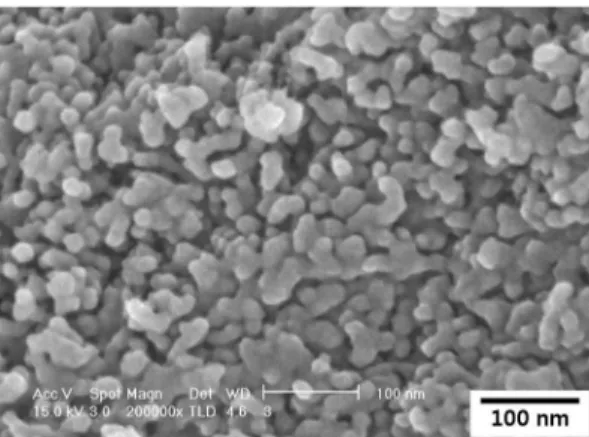
Fig. 1 shows the morphology of the ceria particles after the de-binding treatment. The ceria particles were extremely fine and nearly spherical with a diameter of approximately 15 nm. Further, they were loosely agglomerated with a specific surface area of 110 m

2

/g. Moreover, the phase was revealed to be pure cerium oxide (JCPDS file No. 34-0394) [8].

In the next step, to prepare the sample for electri- cal resistivity measurements, the de-binding pow- ders were loosely compressed and sintered at 1273K for 2 h; its SEM microstructure is shown in Fig. 2.

The low-magnification figure (Fig. 2a) shows a flat surface well formed by die compaction, while the size of internal particles still remained approxi- mately 40 nm with a good porous structure (Fig. 2b).

It is interesting that gradual weight loss occurred

Fig. 1. SEM microstructure of cerium oxide particles obtained

after debinding heat treatment in air at 673K for 2 h.

(3)

during the continuous heating at 5

o

C/min in hydro- gen atmosphere as result of the reduction effect of the reaction CeO

2

+ xH

2

→ CeO

2-x

+ xH

2

O. In the

thermogravimetric profile shown in Fig. 3, it was found that the stoichiometry decreased to CeO

1.5

by the reduction effect at 773K, and it further decreases at elevated temperatures.

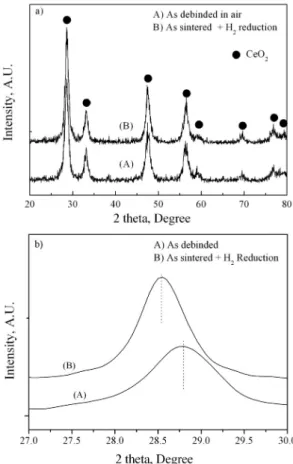
The X-ray diffraction patterns in Fig. 4 show that at 873K, the samples were sintered and further hydrogen-reduced. Both the normal and magnified images shown the ceria phase; moreover, the magni- fied profile showed left-shift for the reflection at the (111) plane by hydrogen heat treatment. Such peak shifting obviously resulted from an increase in the lattice parameter caused by the formation of oxygen deficiencies [11].

Sample characterizations were obtained after hydro- gen-reduction heat treatment at various temperatures (Fig. 5). Fig. 5 indicates that the particle coarsening Fig. 2. SEM microstructures at (a) low and (b) high mag-

nifications for ceria sample sintered at 1273K for 1 h.

Fig. 3. Thermogravimetric (TG) profile during heating of sintered sample at heating rate of 5 °C/min in hydrogen atmosphere.

Fig. 4. X-ray diffraction patterns measured in samples sin-

tered and further H

2

-reduced at 773K for 1 h (a) normal

and (b) magnified patterns reflected at (111) crystal plane.

(4)

was inhibited until 773K, and the specific area was maintained at around 100 m

2

/g. It can be theorized that the hydrogen reduction occurs particularly on the particle surface. The lattice parameter reached maxi- mum value around 773K but decreased with higher temperatures due to the core-bulk effect of particle coarsening.

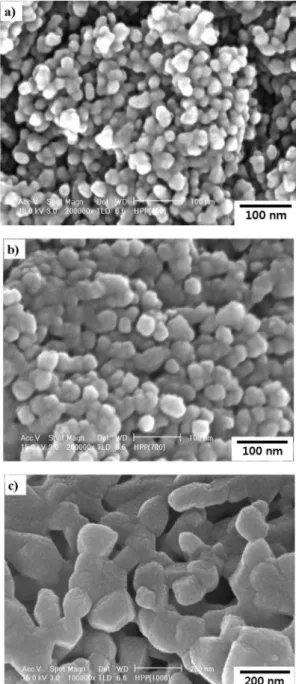
SEM microstructures of the ceria samples that were hydrogen-reduced for 1 h at 573K, 973K, and 1273K are shown in Fig. 6. Slight coarsening of the particles occurred at 973K, while at the elevated temperature of 1273K, the particle growth was con- siderable, which is probably a result of crystal insta-

bility due to the oxygen deficiencies. Finally, from Fig. 3, Fig. 4 and Fig. 5, it can be decided that the optimum temperature for H

2

-reduction heat treat- ment was 773K; the maximum values of the lattice parameter and surface areas were obtained at this Fig. 5. Changes in crystal sizes, surface areas, and lattice

parameters of ceria samples obtained after hydrogen- reduction heat treatments at various temperatures for 1 h.

Fig. 6. SEM microstructures of ceria samples hydrogen-

reduced for 1 h at (a) 673 K, (b) 973K, and (c) 1273K after

sintering.

(5)

temperature.

It is important to conduct detailed measurements of the lattice parameters from the results of X-ray diffraction patterns obtained in the ceria samples before and after the hydrogen heat treatment at 773K. The extrapolation technique was used to define it [12].

a

i

is each lattice parameter measured by each peak reflected at each ( h

i

, k

i

, l

i

) plane; it is given by the following equation:

a

i

= ( h

i2

+ k

i2

+ l

i2

)

1/2

× λ/2 sin θ (1) Further, f(θ

i

) is a function obtained using the fol- lowing equation, wherein the theta-value corre- sponds to the ( h

i

, k

i

, l

i

) peak.

f(θ

i

) = cos

2

θ

i

/ sin θ

i

+ cos

2

θ

i

i

(2) In other words, the real lattice parameter can be defined as f(θ

i

) approaches zero. Fig. 7 shows the results of applying the above concept; the lattice parameter measured in the samples sintered and hydro- gen treated were 5.416 and 5.442 , respectively.

This clearly demonstrates the considerable increase in the lattice parameter by hydrogen reduction [11].

The slight difference in the lattice parameter values between the sintered sample and the JCPDS stan- dard can be explained by the different particle sizes or sample structures of the used ceria materials.

Finally, the oxygen response-abilities of the sin-

tered and post H

2

-reduced samples are compared.

Ceria is known to a n-type semiconductor, and its electrical conductivity is dominated by the mobility of the electrons trapped by cerium and oxygen vacancies [7]. From the formation of one oxygen vacancy, 2 electrons can contribute to the conductiv- ity as follows:

2Ce

xCe

+ O

xo

= 2Ce’

Ce

+ V

**o

+ 1/2O

2

Here Ce

xCe

and O

xo

are regular lattice ions whereas Ce’

Ce

and V

**o

are charged defects; Ce’

Ce

represents the electron trapped by Ce

xCe

while V

**o

represents the doubly ionized oxygen vacancies. Accordingly, the high density of mobile electrons, Ce

xCe

may help to increase the response ability against any sudden changes in the oxygen partial pressure. It has also been considered that the electron density as well as the vacancy density is higher in the H

2

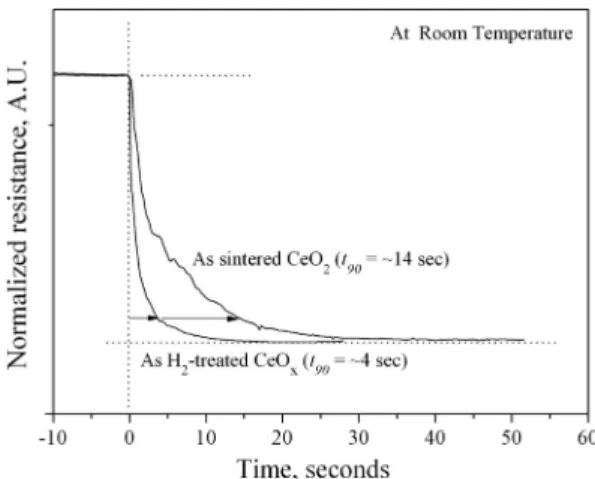
-reduced sam- ple due to the oxygen reduction effect. The normal- ized resistance profiles measured at room temperature - with the sudden changes from air to argon atmosphere - are compared in Fig. 8. Actually, the resistance sig- nal could not be detected at room temperature in nor- mal micron-sized ceria sample by our multi-meter because it was nearly non-conducting material.

The response time t

90

was obtained after normaliz- ing the actual resistance profiles. It is considerably

Fig. 7. Determination of lattice parameters of sintered and

hydrogen-reduced ceria. Fig. 8. Comparison of the response times t

90

of sintered and

hydrogen-reduced ceria.

(6)

shorter (4 s) than that in the sintered sample (14 s).

In our previous work, t

90

in sintered nano-ceria was 3~5 s at 973K [8]. Moreover, it has been reported that t

90

is 8~35 s at 1080~1275K in 1 mm ceria [13], 8 s at 1080 K in 200 nm ceria [14], and 10~11 s at 888~936K in 100 nm ceria [15]. Therefore, it must be emphasized that t

90

obtained in this study is very short even at room temperature. Therefore, it is believed that the developed H

2

-reduced ceria can perform as a high-performance O

2

-sensor with good response abilities even at room temperature.

4. Conclusions

Nanostructured ceria particles having a size of approximately 15 nm were successfully synthesized by thermochemical processes. Precursor powder was prepared by spray drying cerium-nitrate solution and then heat-treating at 673K in air to evaporate vola- tile components, thereby forming nanostructured ceria.

The average grain size of sintered ceria at 1273K was approximately 40 nm. By hydrogen reduction of the sintered sample, the lattice parameter and non- stoichiometric degree were increased. The response time t

90

of the hydrogen-reduced specimen was 4 s, which is considerably shorter than that of normal sintered nano-ceria, 14 s. This H

2

-reduced ceria can capably perform as a high-performance O

2

-sensor even at room temperature. We are now investigating

sensor reliability as well as device miniaturization techniques to maximize the resistance signal.

References

[1] M. Ogita, K. Higo, Y. Nakanishi and Y. Hatanaka:

Appl. Surf. Sci., 175 (2001) 721.

[2] D. Pribat and G. Velasco: Sens. Actuat., B13 (1998) [3] N. Izu, W. S. Shin and N. Murayama: Sens. Actuat., 173.

B94 (2003) 222.

[4] N. Izu, W. S. Shin and N. Murayama: Sens. Actuat.,

B100 (2004) 411.

[5] U. Lamp, J. Gerblinger and H. Meixner: Sens. Actuat.,

B7 (1992) 787.

[6] J. Gerblinger, W. lohwasser, U. Lampe and H. Meix- ner: Sens. Actuat., B26-27 (1995) 93.

[7] H. J. Beie and A. Gnorich: Sens. Actuat., B4 (1991) [8] D. W. Lee, J. H. Yu, T. S. Lim and T. S. Jang: Materi- 393.

als Science Forum, 534-536 (2007) 61.

[9] H. A. Al-Madfaa and M. M. Khader: Mater. Chem.

and Phys., 86 (2004) 180.

[10] D. W. Lee and B. K. Kim: Materials Letters., 58 (2004) 378.

[11] S. Tsunekawa, R. Sivamohan, S. Ito, A. Kasuya and T.

Fukuda: Nanostruct. Mater., 11 (1999) 141.

[12] D. W. Kim and B. K. Kim: Scripta Materialia, 48

(2003) 1513.

[13] N. Izu, W. Shin and N. Murayama: Sens. Actuat., B87

(2002) 99.

[14] N. Izu, W. Shin, N. Murayama and S. Kanzaki: Sens.

Actuat., B87 (2002) 95.

[15] N. Izu, W. Shin, I. Matsubara and N. Murayama: Sens.

Actuat., B94 (2003) 222.

수치

Fig. 1 shows the morphology of the ceria particles after the de-binding treatment. The ceria particles were extremely fine and nearly spherical with a diameter of approximately 15 nm
Fig. 4. X-ray diffraction patterns measured in samples sin- sin-tered and further H 2 -reduced at 773K for 1 h (a) normal and (b) magnified patterns reflected at (111) crystal plane.
Fig. 6. SEM microstructures of ceria samples hydrogen- hydrogen-reduced for 1 h at (a) 673 K, (b) 973K, and (c) 1273K after sintering.
Fig. 7. Determination of lattice parameters of sintered and

참조

관련 문서

The thickness of crose-sectional is decreased, the roughness of top surface is decreased as a function of the oxygen gas flow rate was increased.. The structure and

Micro- and nano-sized pores were formed on the surface of the alloy using PEO and anodization methods, and the pore shape change according to the Zr

• Concentration gradient of the oxidizing component, H 2 O 2 in the etch solution close to the surface and inside the thin surface oxide, during a wet chemical

Piattelli M, Scarano A, Paolantonio M, lezzi G, Petrone G, Piattelli A : Bone response to machines and resorbable blast material titanium implants: An experimental stydy

The value relevance of accounting information is measured by the earnings response coefficient(ERC) and the explanatory power(R 2 ) of

Oxidative injury and inflamma- tory periodontal disease: The challenge of anti-oxidants to free radicals and reactive oxygen species.. The role of oxygen and

load and differential output have a superior p p high frequency response over differential amplifiers with current mirror load and. amplifiers with current mirror load

• The tetrahedral structure of silica (Si0 2 ), which contains covalent bonds between silicon and