Antimicrobial, Antioxidant, and Anti-diabetic Activities of Rodgersia podophylla
Su-Jin Pyo
1, Yun-Jin Lee
1, Deok-Gyeong Kang
1, Ho-Jun Son
2, Gwang Hun Park
2, Jong-Yi Park
3and Ho-Yong Sohn
1*
1Department of Food and Nutrition, Andong National University, Andong 36729, Korea
2Forest Medicinal Resources Research Center, National Institute of Forest Science, Yeongju 36040, Korea
3Gyeongbuk Institute For Bio-Industry, Andong 36728, Korea
Received February 3, 2020 /Revised February 24, 2020 /Accepted February 26, 2020
This study aimed to investigate possible applications of Rodgersia podophylla in the food and cosmetic industry. Ethanol extracts of leaves (RP-L), branches (RP-B), and root (RP-R) were prepared, and their antimicrobial, antioxidant, and anti-diabetic activities were evaluated. The polyphenol content in the RP-R, RP-L, and RP-B extracts was 79.6, 30.4, and 16.9 mg/g, respectively. An antimicrobial activity assay showed that the RP-L and RP-R extracts exhibited strong growth inhibition of pathogenic and food spoilage Gram-positive bacteria. Furthermore, the RP-R extract inhibited the growth of the Gram- negative E. coli and P. vulgaris bacteria. All extracts showed strong scavenging activity for DPPH, ABTS, nitrite, and reducing power determined by A 700 nm. In particular, the RC
50s of the RP-R ex- tract for the DPPH anion and ABTS cation were 23.0-29.7 and 15.0-18.2 μg/ml, respectively, which are comparable to those of vitamin C (9.8 and 8.0 μg/ml, respectively). An activity assay of α-glucosi- dase and β-amylase suggested a high potential for the RP-R extract as an anti-diabetic agent. Its in- hibition levels of α-glucosidase and β-amylase at 0.5 mg/ml were 6.9 and 48.5%, respectively. This is the first report of the antimicrobial and anti-diabetic activities of R. podophylla. Our results suggest that RP-L and RP-R extracts could be developed as novel cosmeceutical and functional food resources.
Key words : Anti-diabetes, antimicrobial, antioxidant, Rodgersia podophylla
*Corresponding author
*Tel : +82-54-820-5491, Fax : +82-54-820-6281
*E-mail : [email protected]
This is an Open-Access article distributed under the terms of the Creative Commons Attribution Non-Commercial License (http://creativecommons.org/licenses/by-nc/3.0) which permits unrestricted non-commercial use, distribution, and reproduction in any medium, provided the original work is properly cited.
Journal of Life Science 2020 Vol. 30. No. 3. 298~303 DOI : https://doi.org/10.5352/JLS.2020.30.3.298
서 론
도깨비부채(Rodgersia podophylla)는 쌍떡잎식물 장미목 범 의귀과의 여러해살이풀로서 5개로 갈라진 잎의 모양이 마치 도깨비가 사용하는 부채와 같다고 하여 도깨비부채라고 부르 며, 산우, 작합산, 수레부채라고도 한다[4]. 도깨비부채는 한국 의 경북, 강원, 평북, 함남, 함북 지역 및 일본 등지에 분포하며, 1,000 m 이상의 산지 및 깊은 산에서 자란다. 국내에서는 산림 청 선정 희귀 및 멸종위기 식물로 지정되어 있다[15]. 도깨비부 채는 이름만큼 형태도 특이하며, 줄기는 곧게 서며 높이는 1 m 정도이며, 근경은 비대하고 옆으로 뻗는다. 잎은 손바닥 모 양 겹잎으로 어긋나고 큰 것은 지름 50 cm 정도이고 윗부분의 것은 1~4개의 작은 잎이 나온다. 꽃은 6월에 노란빛을 띤 흰색 으로 피며, 열매는 속이 여러칸으로 나뉜 삭과로 8월에 익는다.
한방에서는 잎과 뿌리줄기를 반룡칠, 또는 담룡천이라 하여 [4], 급만성 설사, 이질, 질염, 월경불순, 피부염, 습진, 화상에
사용하며, 자궁출혈, 코피, 대변출혈, 치질에 사용하는 등 열을 내리고 새살이 돋아나는데 우수한 효능이 있다고 알려져 있다 [4, 12]. 도깨비부채와 관련된 연구로는, 지상부로부터 항산화 활성을 가진 lignan 성분이 분리된 바 있으며[1], 간 보호 활성 이 있는 quercetin-3-O-alpha-L-(5"-O-acetyl)-arabinofurano- side [2], 항염증 활성이 우수한 신규의 rodgersinol [3]이 지상 부로부터 분리, 보고된 바 있다. 최근에는 잎 추출물의 항염증 [11] 및 암세포 생육억제 활성[12]도 보고되어 있다. 또한, 피부 미백, 멜라닌 생성 억제 연구도 지속적으로 진행되었으며[4, 16], tobacco mosaic virus에 대한 강력한 항바이러스 활성이 보고[8]된 바 있다. 그러나, 도깨비부채의 대한 연구는 식생에 대한 연구가 주로 이루어진 반면[15, 18], 유용 생리 활성에 대한 보고는 현재까지 미미한 실정이며, 특히 잎, 줄기, 뿌리 등의 부위별 항균, 항산화 및 항당뇨 활성에 관한 연구는 알려 진 바 없다. 따라서 본 연구에서는 도깨비부채의 잎, 줄기, 뿌리 의 에탄올 추출물을 조제하고, 이들의 항균, 항산화 및 항당뇨 활성을 평가하여, 도깨비 부채의 부위별 추출물을 이용한 화 장품 및 식의약품 소재 개발이 가능함을 제시하고자 하였다.
재료 및 방법
실험재료 및 시약
본 실험에 사용된 도깨비부채의 잎, 줄기, 뿌리는 국립산림
- Note -
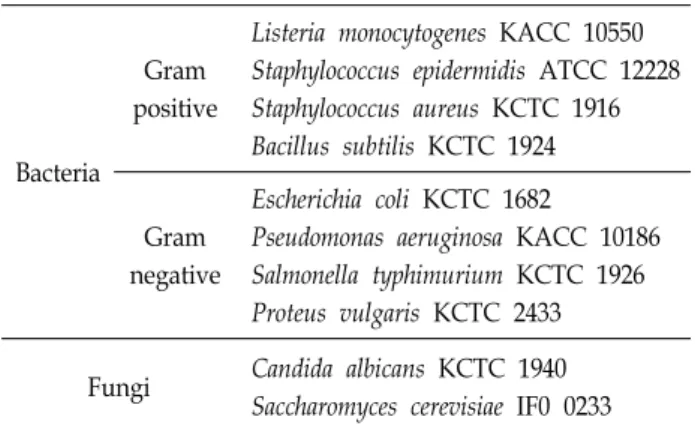
Table 1. The microorganism used in this study for disc-diffusion assay
Bacteria
Gram positive
Listeria monocytogenes KACC 10550 Staphylococcus epidermidis ATCC 12228 Staphylococcus aureus KCTC 1916 Bacillus subtilis KCTC 1924
Gram negative
Escherichia coli KCTC 1682
Pseudomonas aeruginosa KACC 10186 Salmonella typhimurium KCTC 1926 Proteus vulgaris KCTC 2433 Fungi Candida albicans KCTC 1940
Saccharomyces cerevisiae IF0 0233
과학원 산림약용자원연구소로부터 제공받았으며, 확증표본 (FM. J. S. 20180510-01)은 산림약용자원연구소에 보관하고 있 다[12]. 음건, 세절한 도깨비부채 시료들을 각각 20배의 70%
ethanol (Daejung Chemicals & Metals Co., Ltd. Korea)을 가 한 후 상온에서 7일 동안 침지하여 추출하였으며, 추출액을 filter paper (Whatsman No. 2)로 거른 후 감압 농축(Eyela Rotary evaporator N-1110S, Tokyo Rikakikai Co., Ltd. Japan) 후 동결건조하였다. 도깨비부채 잎(RP-L), 줄기(RP-B) 및 뿌리 (RP-R) 추출물들은 DMSO에 적당한 농도로 녹여, 성분 분석, 항산화 활성 및 항균 활성 평가에 사용하였다. 기타 시약은 Sigma Co. (St. Louis, MO, USA)의 시약급 이상의 제품을 구 입하여 사용하였다.
항산화 활성
RP-L, RP-B 및 RP-R 추출물의 항산화 활성은 DPPH (1,1- diphenyl-2-picryl hydrazyl) 활성 음이온 소거능, ABTS [2,2- azobis(3-ethylbenzothiazoline -6- sulfonate)] 활성 양이온 소 거능, nitrite 소거능 및 환원력(reducing power) 측정으로 평 가하였다. 활성 평가는 기존의 방법[14]과 동일하게 사용하였 으며, 활성 대조구로는 vitamin C (Sigma Co., St. Louis, MO, USA)를, 용매 대조구로는 DMSO를 사용하였다. 각각의 활성 평가는 각각 3회 반복한 실험의 평균과 편차로 표시하였다.
항균 활성
RP-L, RP-B 및 RP-R 추출물의 항균 활성은 기존의 보고된 방법과 동일하게 disc-diffusion 법으로 평가하였다[9, 19]. 항 세균 및 항진균 활성 평가에 사용된 균은 Table 1에 나타내었 다. 세균은 Nutrient broth (Difco Co., USA)에 각각 접종하고 37℃에서 24시간 동안 배양한 후 각 균주를 OD
6000.1로 조정 하여 Nutrient agar (Difco Co., USA) 배지를 포함하는 멸균 petri dish (90×15 mm, Green Cross Co., Ltd. Korea)에 100 μl 도말하고, 각각의 시료 5 μl를 멸균 disc-paper (지름 6.5 mm, Whatsman No.2)에 500 μg/disc 농도가 되도록 첨가하여
37℃에서 48시간 동안 배양하였으며, 진균의 경우에는 Sabour- aud dextrose agar (Difco Co. USA) 배지를 이용하여 동일한 방법으로 30℃에서 24시간 동안 배양 후, 생육저지환의 크기 를 측정하여 항균활성을 평가하였다[22]. 대조구로는 항세균 제인 ampicillin과 항진균제인 miconazole (Sigma Co., St.
Louis, MO, USA)을 각각 1 μg/disc의 농도로 사용하였으며, 생육저지환의 크기는 육안으로 생육이 나타나지 않는 부분의 지름을 mm 단위로 측정하였고, 3회 이상 평가 후 대표 결과로 나타내었다.
항당뇨 활성
RP-L, RP-B 및 RP-R 추출물의 항당뇨 활성은 β-amylase 및 α-glucosidase 저해 활성을 평가하여 나타내었다. β-amy- lase 활성은 다양한 부위의 도깨비부채 추출물 시료 2.5 μl (최 종 농도 0.5 mg/ml)와 50 mM phosphate buffer (pH 6.8)로 희석한 β-amylase (0.25 U/ml) 25 μl를 혼합하여 37℃에서 10 분간 반응한 후, 0.5% soluble starch (Samchun Chemicals Co., Korea) 25 μl를 가하여 37℃에서 10분간 반응하였다. 이후 10 0℃에서 5분간 가열하여 반응을 정지시켰으며, 반응액에 150 μl의 DNS (3,5-dinitrosalicylic acid) 용액을 첨가하여 100℃에 서 5분간 가열, 발색한 후 상온에서 방냉하였다. 발색액은 96 well microplate reader (Tecan Co., USA)를 이용하여 540 nm 에서 흡광도를 측정하였으며, 각각의 실험은 3회 반복한 후 평균값을 구하여 아래의 식으로 저해율을 계산하였다[19]. 한 편 α-glucosidase 저해활성은 RP-L, RP-B 및 RP-R 추출물 시료 2.5 μl (최종 농도 0.5 mg/ml)와 50 mM sodium acetate buffer (pH 5.6)로 희석한 α-glucosidase (0.25 U/ml) 25 μl를 혼합하 여 37℃에서 10분간 반응하고 1 mM p-nitrophenol glucoside 용액 25 μl를 가하여 60℃에서 10분간 반응하였다. 이후 1M NaOH 25 μl를 첨가하여 반응을 정지시키고, 405 nm에서 흡 광도를 측정하여 저해율을 계산하였다[21].
저해율(%) = [1-(시료 첨가구 효소활성/대조구 첨가구 효소 활성)] ×100
추출물의 총 폴리페놀 및 기타 분석
Total polyphenol (TP) 및 Total flavonoid 함량 측정은 기존 의 보고된 방법[20]에 따라 측정하였으며, 각각 rutin과 tannic acid를 표준시약으로 사용하였다[23]. 총당 정량의 경우에는 phenol-sulfuric acid법을 사용하였다[17].
통계분석
모든 분석결과는 3회 반복한 실험의 평균과 편차로 나타내
었다. 실험 결과는 SPSS 25.0 버전을 사용하여 mean ± SD로
나타내었으며, 각 군간의 차이는 ANOVA로 분석하였으며, 유
의수준은 p<0.05로 하였다.
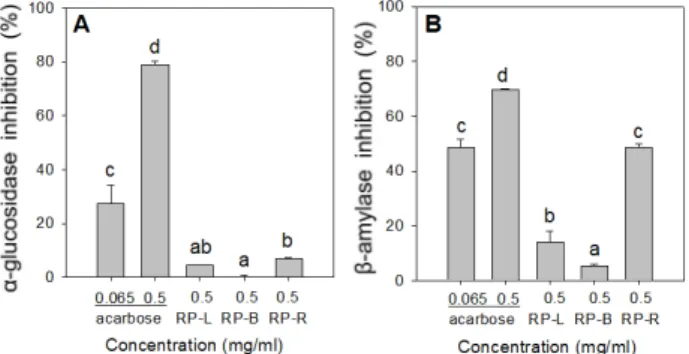
Fig. 1. Effect of the RP-L, RP-B and RP-R extracts on the activ- ities of (A) α-glucosidase and (B) β-amylase. Different superscripts within a panel differ significantly (p<0.05).
Table 2. Contents of polyphenol, flavonoids, and sugars in RP-L, RP-B and RP-R extracts
Extracts
Contents (mg/g) Total
polyphenol
Total
flavonoid Total sugar RP-L
RP-B RP-R
387.7±3.7b 84.2±1.7a 382.5±2.5b
30.4±0.2b 16.9±0.6a 79.6±2.3c
480.4±6.9c 246.2±48.3b
90.1±6.9a Different superscripts within a column differ significantly (p<
0.05).
결과 및 고찰
도깨비부채의 부위별 추출물 조제 및 이의 성분 분석 도깨비부채의 RP-L, RP-B 및 RP-R 추출물의 총 폴리페놀 및 총 플라보노이드 함량을 분석하였으며, 그 결과는 Table 2에 나타내었다. 먼저 총 폴리페놀 함량의 경우 RP-R 및 RP-L 에서 382.5~387.7 mg/g의 높은 함량을 보였으며, RP-B의 경우 84.2 mg/g으로 RP-R에 비해 20% 수준을 나타내었다. 그러나 총 플라보노이드 함량의 경우 RP-R에서 79.6 mg/g의 가장 높은 함량을 보였으며, RP-B의 경우 16.9 mg/g으로 RP-R에 비해 20% 수준을 나타내었다. RP-L의 경우 30.4 mg/g의 RP-R 과 RP-B의 중간 값을 나타내었다. 반면, 총당 함량은 RP-L에서 480 mg/g으로 가장 높게 나타났으며, RP-R의 경우 90.1 mg/g 으로 상대적으로 낮게 나타났다. 따라서 RP-R의 경우 다른 부위보다 상대적으로 높은 폴리페놀과 플라보노이드 함량을 가짐을 확인하였다. 이는 기존의 많은 보고[5, 7]에서 잎이 줄 기 및 뿌리보다 총 폴리페놀 및 총 플라보노이드 함량이 높게 나타난 것과는 다소 상이한 결과이며, RP-R 추출물이 다양한 생리활성을 나타낼 것으로 기대되었다[6].
RP-L, RP-B 및 RP-R 추출물의 항균 활성
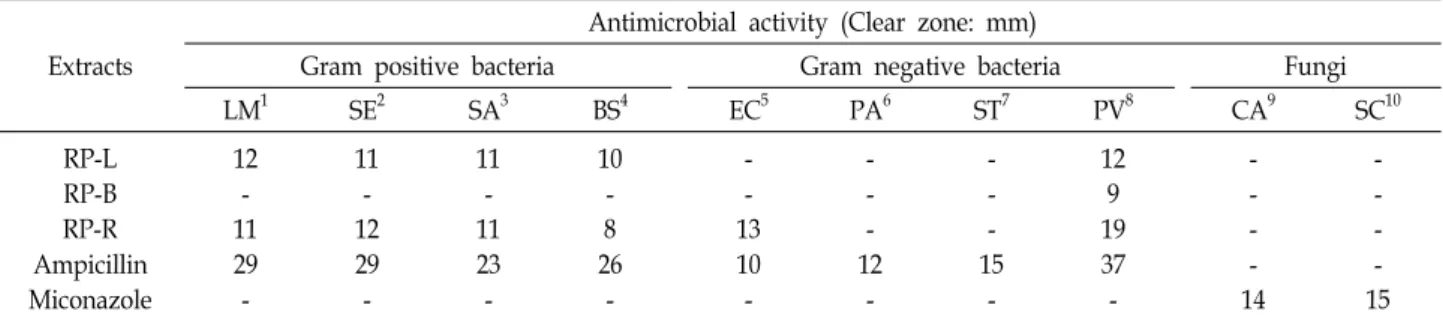
도깨비부채의 RP-L, RP-B 및 RP-R 추출물의 항세균 및 항 진균 활성을 평가한 결과는 Table 3에 나타내었다. 활성 대조 구로 사용된 ampicillin과 miconazole은 각각 강력한 항세균 및 강력한 항진균 활성을 나타내었다. RP-L 및 RP-R 추출물은 500 μg/disc 농도에서 L. monocytogenes, S. epidermidis, S. aur-
eus, B. subtilis의 그람양성균에 대한 8~12mm의 생육억제환을나타내어 우수한 항균 활성을 보였으며, 특히 RP-R 추출물의 경우 제어가 어려운 그람음성의 대장균 및 P. vulgaris에 대해 서도 우수한 항균활성이 확인되었다. 반면, RP-B 추출물에서 는 유일하게 P. vulgaris에 대해서만 미약한 항균 활성이 나타 났다. 도깨비부채의 항균활성, 특히 지하부의 그람양성 특이 적 항균 활성은 현재까지 보고된 바 없으나, 이러한 결과는 도깨비부채 잎과 뿌리를 이용한 광범위 항세균제 개발이 가능 함을 제시하고 있다.
RP-L, RP-B 및 RP-R 추출물의 항산화 활성
도깨비부채의 RP-L, RP-B 및 RP-R 추출물의 항산화 활성을 평가한 결과는 Table 4 및 Table 5에 나타내었다. 3종 부위별 추출물 모두에서 매우 강력한 DPPH 음이온 소거능, ABTS 양 이온 소거능, 환원력 및 nitrite 소거능이 확인되었다. DPPH 음이온 소거능 및 환원력 평가에서는, RP-L 추출물이 RP-B 및 RP-R 추출물보다 유의적으로 우수한 소거능을 보였으나, ABTS 및 nitrite 소거능에서는 유사한 소거능을 보였다(Table 4). 다양한 농도에서 반복된 항산화 활성 평가 결과를 이용하 여 활성이온의 50% 소거에 필요한 농도(RC
50)를 결정하였으 며, 그 결과 DPPH 음이온 및 ABTS 양이온 소거능에 대한 RP-L 및 RP-R 추출물의 RC
50은 각각 23.0~29.7 및 15.0~18.2 μg/ml를 나타내어 vitamin C의 9.8 및 8.0 μg/ml 수준과 비교 할 만 하였다(Table 5). 상기 결과는 기존의 패모[19], 우엉[13], 오미자[15], 쪽 [21], 표고버섯[22] 등의 다양한 약용, 식용, 특용 식물의 항산화 활성보다 우수하였다. 따라서 도깨비부채의 부 위별 추출물의 강력한 항산화 활성은 보고된 바 없으나, 상기 결과는 RP-L 및 RP-R 추출물의 천연 항산화제로의 실제적 이용 가능성을 제시하고 있다. 특히 도깨비부채의 광범위 항 세균 활성(Table 3), 항염증 활성[3, 10] 및 미백활성[4, 16]을 고려한다면, 도깨비부채 추출물을 이용한 기능성 화장품, 샴 푸, 패치, 마스크팩 등의 다양한 화장품 및 의약외품 개발이 가능하리라 판단된다. 현재 RP-L 및 RP-R 추출물의 활성물질 분리 및 자극성, 광과민성 등에 대한 안전성 평가가 진행되고 있다.
RP-L, RP-B 및 RP-R 추출물의 항당뇨 활성
도깨비부채의 RP-L, RP-B 및 RP-R 추출물의 항당뇨 활성평 가를 위해 α-glucosidase 및 β-amylase 저해활성을 평가하였 다. 먼저 임상에서 항당뇨제로 사용되고 있는 acarbose는 0.5 mg/ml 농도에서 각각 79.0% 및 69.6%의 α-glucosidase 및 β- amylase 저해를 나타내어 우수한 활성을 확인하였다(Fig. 1).
또한 RP-R 추출물은, 동일농도에서 α-glucosidase 및 β-amy-
lase 활성을 각각 6.9% 및 48.5% 저해하여 전분 분해를 효율적
Table 3. Anti-microbial activities of the RP-L, RP-B and RP-R extracts against pathogenic and food spoilage microorganism
Extracts
Antimicrobial activity (Clear zone: mm)
Gram positive bacteria Gram negative bacteria Fungi
LM1 SE2 SA3 BS4 EC5 PA6 ST7 PV8 CA9 SC10
RP-L RP-B RP-R Ampicillin Miconazole
12 - 11 29 -
11 - 12 29 -
11 - 11 23 -
10 - 8 26
-
- - 13 10 -
- - - 12
-
- - - 15
-
12 9 19 37 -
- - - - 14
- - - - 15 The concentration of extracts and chemicals (ampicillin or miconazole) used was 500 μg/disc and 1.0 μg/disc, respectively. 1LM:
Listeria monocytogenes, 2SE: Staphylococcus epidermidis, 3SA: Staphylococcus aureus, 4BS: Bacillus subtilis, 5EC: Escherichia coli, 6PA:
Pseudomonas aeruginosa, 7ST: Salmonella typhimurium, 8PV: Proteus vulgaris, 9CA: Candida albicans, and 10SC: Saccharomyces cerevisiae,
11-: No activity.
Table 4. Anti-oxidation activities of the RP-L, RP-B and RP-R extracts Extracts/Chemical
(mg/ml)
Anti-oxidant activity (%) Reducing power
(700 nm)
DPPH SA ABTS SA Nitrite SA
RP-L (0.5) RP-B (0.5) RP-R (0.5) Vitamin C (0.1)
74.7±1.4c 69.1±1.0b 65.4±1.5a 91.6±0.6d
89.2±0.2a 89.4±0.0a 89.6±0.0a 95.8±0.2d
45.3±2.2a 45.9±0.5a 46.6±0.0a 85.6±2.6b
1.208±0.013c 0.872±0.057a 1.073±0.068b 1.675±0.061d SA: scavenging activity. The concentrations used for DPPH, ABTS, and reducing power assay were 500 μg/ml, and nitrite scavenging activity assay was 200 μg/ml, respectively. Different superscripts within a column differ significantly (p<0.05).
Table 5. Calculated RC50s of the RP-L, RP-B and RP-R extracts
Extracts Anti-oxidant activity (RC50: μg/ml)
DPPH ABTS Nitrite
RP-L RP-B RP-R Vitamin C
23.0 135.4
29.7 9.8
18.2 51.5 15.0 8.0
240.5 241.6 245.8 15.1
으로 제어할 수 있음을 확인하였다. 이러한 강력한 전분분해 효소 저해는 최근 항당뇨 활성이 우수하다고 알려진 쪽잎 및 표고버섯 추출물보다 우수하였다[21, 22]. 반면 RP-L 및 RP-B 추출물은 상대적으로 약한 효소 저해를 보였다. 현재까지 도 깨비부채에 대한 α-glucosidase 및 β-amylase 저해활성이 보 고된 바 없으며, 이러한 결과는 RP-R 추출물을 이용한 항당뇨 제 개발이 가능함을 제시하고 있다. 상기와 같이 도깨비부채 는 현재까지 유용생리활성 평가가 매우 미진한 상태이나, RP-L 및 RP-R 추출물에서 강력한 항세균, 항산화 및 항당뇨 활성을 신규 확인하여, 향후 도깨비부채가 화장품, 식의약품 산업에서 새로운 생물자원으로 이용 가능함을 제시하였다.
감사의 글
본 연구는 2019년도 산업통산자원부 바이오테라피 산업기
반구축사업(과제번호 N0001805)에 의해 수행되었으며, 이에 감사드립니다.
The Conflict of Interest Statement
The authors declare that they have no conflicts of interest with the contents of this article.
References
1. Chin, Y. W. and Kim, J. 2004. Four novel lignans from Rodgersia podophylla. Tetrahedron Lett. 45, 339-341.
2. Chin, Y. W., Lim, S. W., Kim, Y. C., Choi, S. Z., Lee, K. R.
and Kim, J. W. 2004. Hepatoprotective flavonol glycosides from the aerial parts of Rodgersia podophylla. Planta Med. 70, 576-577.
3. Chin, Y. W., Park, E. Y., Seo, S .Y., Yoon, K. D., Ahn, M.
J., Suh, Y. G., Kim, S. G. and Kim, J. W. 2006. A novel iNOS and COX-2 inhibitor from the aerial parts of Rodgersia podophylla. Bioorg. Med. Chem. Lett. 16, 4600-4602.
4. Choi, S. Y., Kang, N. J. and Kim, H. C. 2006. Inhibitory ef- fects of root extracts on melanin biosynthesis in Rodgersia podophylla A. Gray. Kor. J. Med. Crop Sci. 14, 27-30.
5. Choi, Y. K. and Ha, B. J. 2014. Comparison of anti-oxidative and UV absorption abilities of methanolic extracts from leaves, stem, and roots of Artemisia princeps var. orientalis.
J. Invest. Cosmetol. 10, 79-82.
6. Chung, S. K., Chen, C. Y. O. and Blumberg, J. B. 2009.
Flavonoid-rich fraction from Sageretia theezans leaves scav- enges reactive oxygen radical species and increases the re- sistance of low-density lipoprotein to oxidation. J. Med. Food 12, 1310-1315.
7. Heo, S. J., Ahn, H. Y., Kang, M. J., Lee, J. H., Cha, J. Y.
and Cho, Y. S. 2011. Antioxidative activity and chemical characteristics of leaves, roots, stems and fruits extracts from Acanthopanax senticosus. J. Life Sci. 21. 1052-1059.
8. Jing, B., Ma, Z., Feng, J., Liang, H., Li, C. and Zhang, X.
2012. Evaluation of the antiviral activity of extracts from plants grown in the qinling region of china against infection by Tobacco mosaic virus (TMV). J. Phytopathol. 160, 181-186.
9. Jung, I. C. and Sohn, H. Y. 2014. Antioxidation, antimicrobial and antithrombosis activities of aged black garlic (Allium sativum L.). Kor. J. Microbiol. Biotechnol. 42, 285-292.
10. Kim, C. M. and Kang, S. S. 1986. Isolation of β-Peltboykinolic acid from Rodgersia podophylla. Kor. J. Pharmacogn. 17, 195- 198.
11. Kim, H. N., Kim, J. D., Park, S. B., Son, H. J., Park, G. H., Eo, H. J., Kim, H. S. and Jeong, J. B. 2020. Anti-inflammatory activity of the extracts from Rodgersia podophylla leaves through activation of Nrf2/HO-1 pathway, and inhibition of NF-κB and MAPKs pathway in mouse macrophage cells.
Inflamm Res. doi: 10.1007/s00011-019-01311-2.
12. Kim, H. N., Kim, J. D., Son, H. J., Park, G. H., Eo, H. J.
and Jeong, J. B. 2019. Anti-cancer activity of the leave ex- tracts of Rodgersia podophylla through β-catenin proteasomal degradation in human cancer cells. Kor. J. Plant Res. 32, 442-447.
13. Kim, M. S., Lee, Y. S. and Sohn, H. Y. 2014. Anti-thrombosis and anti-oxidative activity of the root of Arctium lappa L.
Kor. J. Food Preserv. 21, 727-734.
14. Kim, M. S., Sung, H. J., Park, J. Y. and Sohn, H. Y. 2017.
Evaluation of anti-oxidant, anti-microbial and anti-throm- bo-sis activities of fruit, seed and pomace of Schizandra chi- nensis Baillon. J. Life Sci. 27, 131-138.
15. Kim, Y. S., Lim, D. O., Oh, H. K. and Shin, H. T. 2002.
Vascular plants of taebaksan, hambaesan, geumdaebong (peak) and maebongsan in the baekkdudaegan. Kor. J. Env.
Eco. 15, 293-318.
16. Kong, Y. H., Lee, P. J. and Choi, S. Y. 2007. Action of Rodgersia podophylla root extracts on melanin biosynthesis in skin. Kor. J. Med. Crop Sci. 15, 434-436.
17. Pancham, A., Godara, S. L. and Bilma, M. A. K. 2016. Study of biochemical changes viz., total sugars (reducing and non-reducing), proteins and phenols in dry root infected groundnut plant. Annal. Biol. 32, 188-192.
18. Rho, J. H., Oh, H. K., Choi, Y. H. and Kim, Y. S. 2014. A basic study on the selection of plants for the walls of for- tresses in the case of the Jeongyi town wall in Jeju. J. Kor.
Landscape Architec. 42, 33-40.
19. Shin, Y. K., Jang, H. S., Kim, J. I. and Sohn, H. Y. 2009.
Evaluation of antimicrobial, antithrombin, and antioxidant, activity of Fritillaria thunbergii Miquel. J. Life Sci. 19, 1245- 1250.
20. Singleton, V. L., Orthofer, R. and Lamuela-Raventos, R. M.
1999. Analysis of total phenols and other oxidation sub- strates and antioxidants by means of folin-ciocalteu reagent.
Methods Enzymol. 299, 152-178.
21. Sung, H. J., Choi, O. J., Park J. Y. and Sohn, H. Y. 2019.
Evaluation of bioactivities of Polygonium tinctorium leaf : po- tential clinical uses. J. Life Sci. 29. 52-59.
22. Sung, H. J., Pyo, S. J., Park, J. Y. and Sohn, H. Y. 2019. Evalu- ation of the useful bioactivities of spent mushroom, sub- strate of shiitake. J. Life Sci. 29. 164-172.
23. Valentina, U., Fabcic, J. and Stampar, F. 2007. Sugars, organ- ic acids, phenolic composition and antioxidant activity of sweet cherry (Prunus avium L.). Food Chem. 107, 185-192.
초록:도깨비부채의 항균, 항산화 및 항당뇨 활성
표수진
1․이윤진
1․강덕경
1․손호준
2․박광훈
2․박종이
3․손호용
1*
(1안동대학교 식품영양학과, 2국립산림과학원 산림약용자원연구소, 3경북바이오산업연구원)