ISSN: 1738-7167
DOI: http://dx.doi.org/10.7731/KIFSE.2015.29.4.015
노인관련시설에서 조기반응형 스프링클러헤드의 유용성
최영상 · 공예린* · 공하성**
†
대구보건대 소방안전관리과, *로고스 국제학교, **경일대 소방방재학과
Evaluation of Early Suppression-Fast Response (ESFR) Sprinklers in Facilities and Residences for Elderly People
Young-Sang Choi · Ye-Rin Gong* · Ha-Sung Kong**
†
Dept. of Fire Fight Safety and Management, Daegu Health College
*Logos International School
**Dept. of Fire Safety, Kyungil Univ.
(Received April 30, 2015; Revised August 7, 2015; Accepted August 7, 2015)
요 약
이 연구는 노인관련시설에 스프링클러 설치유무와 종류에 따른 연기층 및 공기층의 온도변화와 연기층의 높이변화를 화재시뮬레이션을 통해 비교한 것으로 복사열은 거실에 표준반응형 헤드가 작동한 경우는 플래시오버 발생조건을 초과 하였으나 조기반응형 헤드는 플래시오버가 발생되지 않는 것으로 나타났다. 인체표면의 경우도 조기 반응형 헤드가 작동 하면 열유속의 최대값이 2,293 W/m
2에 머물러 인체화상 위험조건인 4,000 W/m
2이하가 되어 거주자가 열에 의해 인체 화상은 입지 않는 것을 알 수 있다. 화재실의 최고온도는 연기층 및 공기층 모두 인명안전기준을 초과하였으나 일정시간 후 급격히 하강하여 인명안전기준에서 요구하는 온도 이하로 유지되는 것을 알 수 있었다. 연기층의 높이는 조기반응형 헤드가 작동하면 연기층을 1.1 m 이상으로 유지할 수 있어서 표준반응형 헤드가 작동한 경우보다 연기층 하강을 더 지 연시킬 수 있음을 알 수 있다.
ABSTRACT
This study compared, through a fire simulation, temperature changes of the smoke layer and the air layer, and height fluctuations of the smoke layer, according to the sprinkler head installation and non-installation, and the sprinkler head types in elderly-care facilities. When a standard response sprinkler worked, the radiant heat exceeded the conditions for the occurrence of flashover. However the ESFR sprinkler prevented flashover. When the early response head worked, inhabitants were not damaged by radiant heat because the maximum value of the heat flux remained 2,293 W/m
2, which is less then the burn hazard criterion of 4,000 W/m
2. The highest temperature of the room when fire occurred exceeded the safety standard in all of the smoke layer and the air layer, but the highest temperature was kept below the safety stan- dard after it fell down rapidly. Because the height of the smoke layer was maintained above 1.1 m when the early response sprinkler worked, the falling of the smoking layer was much more delayed than in the case where the standard response sprinkler was used.
Keywords : Aged related facilities, ESFR sprinkler, Standard response sprinkler, Flashover
1. Introduction
Senior facilities are elderly housing welfare facilities, elderly medical welfare facilities, elderly leisure welfare facilities, elderly rehabilitate welfare facilities providing daytime and nighttime protection services (including elderly rehabilitate welfare facilities based on the elderly
long-term care act), elderly protection agency and similar facilities(1). Since the residents in the elderly related facili- ties are bed patients who are impossible for self-evacua- tion or physically disabled person who need move aid such as wheelchair, the residents can not guarantee their safety in case of the failure for the initial fire suppression. There- fore, installation of early response type sprinkler head is
†
Corresponding Author, E-Mail: [email protected]
†
TEL: +82-53-600-5402, FAX: +82-53-600-5419
mandatory(2). However, since the elderly facilities previ- ously constructed the standard enforcement installed the standard reaction type sprinkler head, there could be a diffi- culty in the initial response to fire. The investigation of conventional elderly facilities reported by Harry-Lee Hong et al.(3) for the fire safety survey of elderly nursing facilities for the evacuation safety design, Jong-Bum Kim et al.(4) for investigation of evacuation safety performance evaluation, Ji-Yeon Jung et al.(5) for activation of emergency service for aging society, Eun-Kyeong Hwang(6) for basic research of the elderly welfare facilities to improve evacuation regu- lations, and Hee-Kwon You et al.(7) for the study of the walking speed of elderly Korean people, but there is no report for the ESFR sprinkler. In this research, we com- pared with the following conditions with the elderly facili- ties including without sprinkler system, with standard response sprinkler, and with ESFR sprinkler in the result of the temperature change of smoke layer and the clear layer and the height change of the smoke layer to change the standard response sprinkler to ESFR sprinkler.
2. Fire Simulation of Fire
2.1 Overview of the program
This research used the fire simulation program of CFAST version 8.0 developed in NIST. CPAST program is developed to analyze smoke layer and clear layer for the smoke, hazard gases, and temperature. This model can cal- culate the temperature, concentration distribution of oxy- gen, carbon monoxide, and carbon dioxide, the temperature of the smoke layer, the height change of the smoke layer, the response time of the sensor and sprinkler for the fire room(8).
2.2 Flash over
The flash point of the rapid dispersion of the fire in the room is the radiation heat of 20,000 W/m2(9). People can not escape from the flash over point, which the fire spreads all over the fire room from the bottom to the ceiling, all the firing materials start to burn, shatter the windows, and spread the fire to the outside of the building, and large amount of hazardous gases and dark smoke are generated.
Therefore, it is necessary to escape before the flash over or reduce the flash over time from the elderly welfare facili- ties(10).
2.3 Human risk of burns
Human risk of burns is depending on the degree of the
radiation. The minimum radiation for the burn in case of fire is 4,000 W/m2, which happens when exposed for 30 seconds and can be changed depending on the various con- ditions(11). Since clear layer temperature depends on the air circulation heat and is important for evacuation, the clear layer temperature of the fire room should maintain below 60oC based on the life safety standards(12).
2.4 Smoke layer and clear layer
The smoke layer develops on the top of the ceiling by ris- ing the smoke from the bottom of the fire, and the lower layer of air calls clear layer. The time of developing the smoke layer can be calculated with the following equation 1(13).
(1)
where, the A is the area of the fire room (m2), g is the grav- itational force (9.81 m/s2), P is the length of the fire bound- ary, His the height of the fire room, y is the clear layer, and y is the smoke layer (H-y).
2.5 Fire sinario
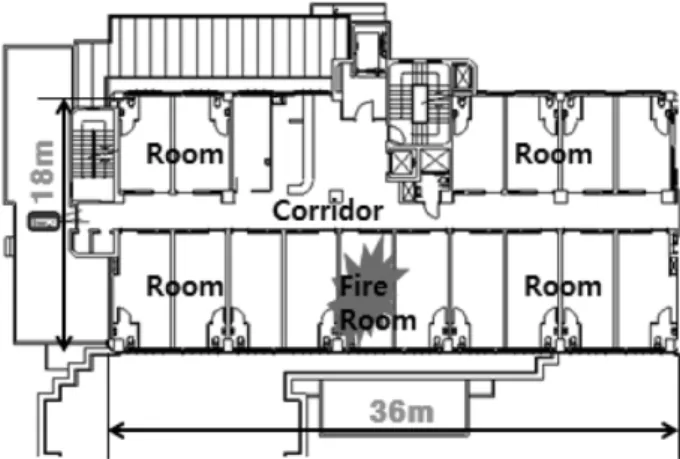
Figure 1 shows the fire simulation results and analysis for the elderly related facilities based on the architectural drawings.
Table 1 shows the input conditions of fire simulation program and input data.
2.6 Evaluation standards
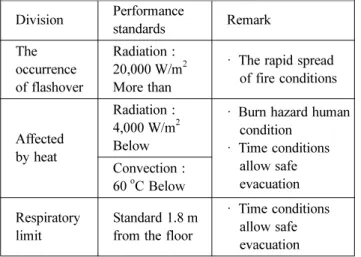
The result of the fire simulation compared with the life safety standard based on the performance-based fire protec- tion design. Life safety standards for the fire deal with radi- ation effect, toxicity, and viewing distance, which are depend on the animal tests and research results. Table 2
t = 20A P× g --- 1
y --- − 1
H ---
⎝ ⎠
⎛ ⎞
×
Figure 1. Blueprint of facility and residence for elderly people.
shows the applicable life safety standards in this research results. The fire simulation result shows that the flash over happens when the heat flux is more than 20,000 W/m2.
2.7 The response time index for the simulation of the sprinkler head
The most important characteristic of the sprinkler head is thermal sensitivity, which represents the response time index (RTI) by the heat of the head. Table 3 shows the three types of the RTI. This research investigated the RTI of the sprinklers for the standard response sprinkler and ESFR sprinkler produced by P company.
2.8 Application condition
Table 4 shows the fire simulation results for the danger- ous condition change of the fire room by radiation, danger- ous condition of the resident burn by radiation, the smoke layer temperature change of the fire room, temperature change of the clear layer, and the height change of the smoke layer with no vent and no sprinkler head, no vent with RTI 200, and no vent with RTI 40.
3. Results and Discussion
The fire simulation model of CFAST 6.0 is used in United States Institute of Standards and Technology and wide variety of other institutes and the results compared with simulation and experimental results are within 10~
25%. Therefore, the results can be reliable to predict the fire situation(15).
Table 1. Fire Simulation Program of the Input Condition to the Input Value Division Features
Object The actual active seniors facilities
Enter condition
· Simulation time : 900 seconds
· Environmental conditions : Standard atmospheric pressure (101 kPa) and temperature (20oC), Relative humidity (50%)
· Ambient conditions : Assumed to be nil-wind conditions (0 m/s)
· Fire alarm: CFAST Provides Value (Ionization smoke detectors) Application
· Sprinkler heads : Response time index of domestically produced goods (RTI) Application
· Water spray density (Spray Density) : CFAST Provides Value (7E-05 m/s) Application
· Target : Using the Effects of heat on the human body and flashover
Scale
· Building Size : Width 36 m, Length 18 m
· Corridor size and quantity : Width 36 m Length 2.3 m, 1 (Corridor)
· Fire room (Living room) : Width 3.6 m Length 7.8 m, 18 (Compartment)
· Height of the floor : Both the hallway and living room 2.4 m
· Doors (Horizontal Flow Vents) Size Based on architectural drawings: High (2.1 m), Width (1.055 m)
· Material of Room : nonflammable
Fire
· Home to a fire in the living room # 6
· Combustibles : Wood material wardrobes (1 m × 1 m × 0.5 m) 2 burning home
· Calorific value of the closet : NIST provide experimental values for Sensors · Smoke Detector Operating time : Apply a flue windows operating time
Table 2. Life Safety Standards(9,11,12) Division Performance
standards Remark
The occurrence of flashover
Radiation : 20,000 W/m2 More than
· The rapid spread of fire conditions
Affected by heat
Radiation : 4,000 W/m2 Below
· Burn hazard human condition
· Time conditions allow safe evacuation Convection :
60oC Below Respiratory
limit
Standard 1.8 m from the floor
· Time conditions allow safe evacuation
Table 3. RTI Value of the Sprinklers(14)
Division
RTI (Response Time Index)
Domestic P Inc. Response
Time Index Standard
response sprinkler
80 and
below 350 200
Special response sprinkler
51 and
below 80 -
ESFR sprinkler 50 below
040
3.1 The dangerous condition changes by oper- ating the sprinkler head
Figure 2 shows the fire simulation result without vent and sprinkler head, resulting the radiation heat flux was 53,528 W/m2 after 180 seconds of fire exceeding the flash over value of 20,000 W/m2. Therefore, flash over will hap- pen after 3 min. How ever, the heat flux was 26,400 W/m2 without vent and with RTI 200, which was drastically reduced the heat flux. The heat flux reached maximum 1,320 W/m2 after 60 s after fire and maintained less than the value there after with the ESFR sprinkler requiring installa-
tion of elderly welfare facilities. The value was far less than the flash over value, and flash over was not happen.
The head operation time was 46 s, which was 3 times faster than the standard response sprinkler operation time (137 s).
3.2 Resident’s burn hazard in the fire room by operation of sprinkler head
Thermal effect to the resident in the fire place is due to the convection and radiation. Convection is related with the air temperature to breathe the air by resident and the radiation is related with the hot smoke layer resulting to burn the resi- dent. The life safety standard limits the radiation less than 4,000 W/m2 to protect the resident from the burn and respira- tory affect. The radiation reached 27 and 11 times higher than the life safety standard in case of without sprinkler head operation and with standard response sprinkler operation, respectively, as shown in Figure 3. However, the heat flux reached maximum at 2,293 W/m2 with the operation of RTI 40, which was not affected to the resident by heat flux.
3.3 Temperature change of smoke and clear lay- ers by operation of sprinkler head
Although the temperature of the fire room reached at Table 4. Checklist in Accordance with the Applicable Condi-
tions
Conditions of application Checklist
· If you do not have a sprinkler (no vent no SP)
· Risk changes in the fire room
· Risk of burns in the fire room occupants
· Temperature changes of the smoke layer and the clear layer of the fire room
· Height changes of the smoke layer
· Risk changes in the fire room
· Risk of burns in the fire room occupants
· Temperature changes of the smoke layer and the clear layer of the fire room
· Height changes of the smoke layer
· Risk changes in the fire room
· Risk of burns in the fire room occupants
· Temperature changes of the smoke layer and the clear layer of the fire room
· Height changes of the smoke layer
· If you have a standard response sprinkler works (no vent RTI 200)
· If ESFR sprinkler works (no vent RTI 40)
Figure 2. Risk of changes in the fire chamber according to the operation of a sprinkler head.
Figure 3. Risk of burns in the fire chamber occupants of the operation of a sprinkler head.
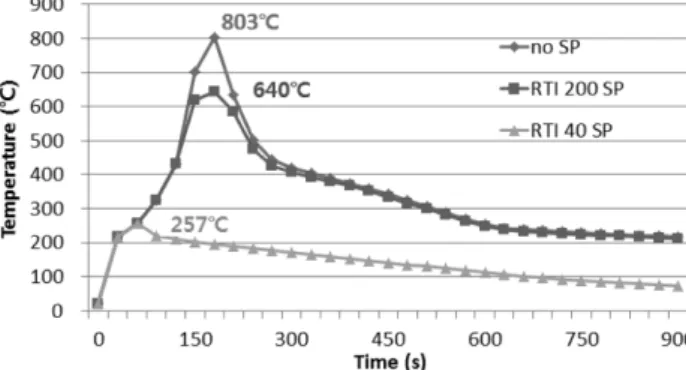
Figure 4. Smoke layer temperature changes according to the operation of a sprinkler head.
803oC without sprinkler head as shown in Figure 4, the sudden temperature rise could be prevented by operation of sprinkler head. The temperature reached at 257oC with the operation of ESFR sprinkler, which was 383oC less than the temperature operated with standard response sprinkler (640oC).
Figure 5 shows the clear layer temperatures with stan- dard response sprinkler and ESFR sprinkler, which are strongly depend on the sensor sensitivity. The ESFR sprin- kler was especially effective to save the life and reached the maximum temperature at 92oC and maintained less than 60oC.
3.4 The smoke layer height change by opera- tion of sprinkler head
The smoke layer heights reached almost to the bottom and 1.1 m of the room without sprinkler head and ESFR sprinkler, respectively. Although the 1.1 m of smoke layer height is not satisfactory to the life safety standard (1.8 m), the ESFR sprinkler prevents the early coming down the smoke layer compared with standard response sprinkler.
Therefore, installation of the ESFR sprinkler to the elderly welfare facilities is reasonable. Moreover, it is necessary to exchange from the conventional RTI 80-350 to ESFR
sprinkler (RTI 50).
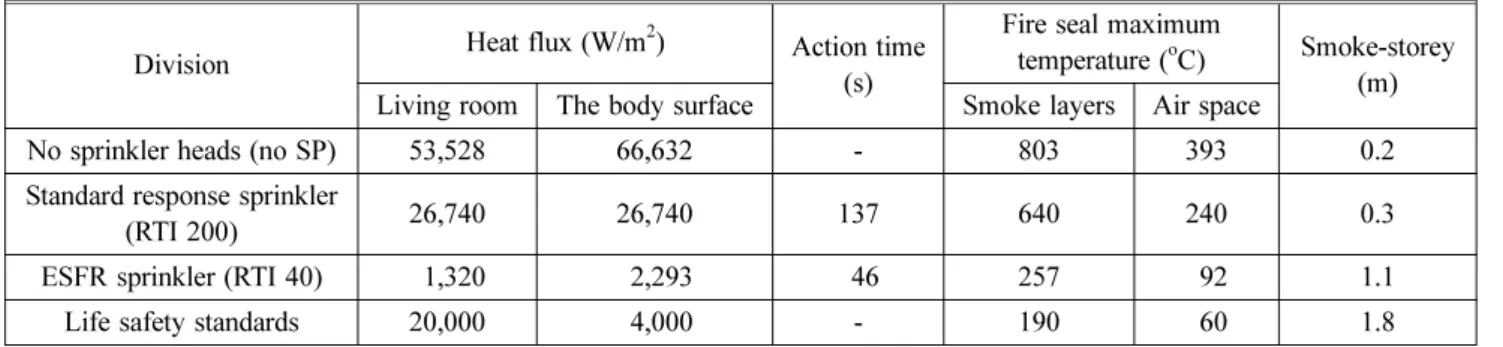
Table 5 shows the effect of the response time with/with- out sprinkler head, standard response sprinkler and ESFR sprinkler.
5. Conclusions
This research focused on the elderly related facilities without sprinkler head, standard response sprinkler, and ESFR sprinkler in case of fire for the temperature changes of smoke layer and clear layer, the height change of the smoke layer by fire simulation program. The results are followings:
(1) The heat flux in the bottom of the fire room reached 26,700 W/m2 after 180 seconds of fire with the standard response sprinkler without vent (RTI 200), which was over the flash over (20,000 W/m2). The heat flux reached maxi- mum at 1,320 W/m2 after 60 seconds, and flash over was not happen with the ESFR sprinkler. The radiation also reached 2,293 W/m2 and would not affect to the resident.
(2) Although the maximum temperatures of the smoke and clear layers were not satisfied to the life safety stan- dard, the temperature reduced thereafter and maintained the life safety standard.
Figure 5. Air temperature according to the operation of a sprinkler head.
Figure 6. Smoke layer height changes according to the oper- ation of the sprinkler head.
Table 5. Compare Simulation Results of Standard Response and ESFR Sprinkler
Division Heat flux (W/m2) Action time
(s)
Fire seal maximum
temperature (oC) Smoke-storey Living room The body surface Smoke layers Air space (m)
No sprinkler heads (no SP) 53,528 66,632 - 803 393 0.2
Standard response sprinkler
(RTI 200) 26,740 26,740 137 640 240 0.3
ESFR sprinkler (RTI 40)
01,320 02,293 046
257092
1.1Life safety standards 20,000
04,000
- 190060
1.8(3) Although the smoke layer reached to the bottom and 1.1 m of the fire room in case of the fire without sprinkler head and ESFR sprinkler, respectively. The ESFR sprin- kler prevented the early coming down the smoke layer.
Installation of ESFR sprinkler to the elderly related facil- ities reduced the fire and prevented the flash over. More- over, it is reasonable to exchange form the conventional standard response sprinkler to the ESFR sprinkler.
The diverse simulations with various space and fire con- ditions will be performed for the next project and for pro- vide the reliability.
References
1. National Legal Information Center, “Enforcement Decree Concerned at the Installation of Fire-fighting Facilities, Maintenance, and Safety Management [An Asterisk 2]”, Presidential decree No. 26033 (2015).
2. NFSC 103, “National Fire Safety Code for Sprinkler System” (2015).
3. H. R. Hong, D. G. Seo, D. E. Kim, Y. S. Kwon, H. S.
Park and Y. J. Kwon, “A Survey on Present Condition of Fire Safety Management of Elderly care Facilities for Evacuation Safety Design”, Proceedings of 2013 Spring Annual Conference, Korean Institute of Fire Science &
Engineering, p. 272 (2011).
4. J. B. Kim, J. O. Kim and E. S. Back, “A Study on the Evaluation of Evacuation Safety Function of an Elderly Care Hospital”, J. of Korean Institute of Fire Sci. &
Eng., Vol. 24, No. 3, p. 9 (2010).
5. J. Y. Jung and H. J. Hwang, “A Study on the Revitaliza- tion of the Emergency Medical Services for a Aged Soci- ety: Based on Possible Solutions to Improve Early Response System for Geriatric Emergency Patients”, J. of Korean Institute of Fire Sci. & Eng., Vol. 22, No. 5, p. 99 (2008).
6. E. K. Hwang, “The Basic Study on the Improvement of the Evacuation Regulation Related with the Elderly Facilities”, Proceedings of 2013 Spring Annual Confer- ence, Korean Institute of Fire Science & Engineering, p.
329 (2008).
7. H. K. You, E. S. Kim, J. S. Lee, S. Y. Kim and P. H.
Lee, “A Study on Walking Velocity of Old Men in Korean”, Proceedings of 2013 Fall Annual Conference, Korean Institute of Fire Science & Engineering, pp. 407- 414 (2003).
8. www.nist.gov, “CFAST-Consolidated Model of Fire Growth and Smoke Transport (Ver. 6.0) User’s Guide”, p. 1-2 (2005).
9. H. S. Sang, G. H. Lee and H. S. Kong, “Fire Protection Theory”, Wolsong Ltd., Gyeonggi, p. 15 (2015).
10. H. S. Kong, D. J. Kim, C. H. Bang, I. S. Bae, Y. S.
Back, D. Y. Ahn, S. C. Woo, I. Y. Jun and Y. S. Choi,
“Fire Protection Theory”, Yesmedia Ltd., Daegu, p. 1-33 (2015).
11. G. H. Oh, D. I. Kim, U. Y. Kim, Y. S. Kim, I. S. Oh, S. C. Woo, S. G. Lee, S. J. In and D. M. Choi, “Princi- ples of Fire Behavior”, Donghwa Technology Ltd., Gyeonggi, p. 75 (2004).
12. National Legal Information Center, “Method of Perfor- mance Based Fire Protection Design [An Asterisk 1]”, Notification of National Emergency Management (NEMA) No. 2014-31 (2015).
13. S. U. Nam, “Design & Construction of Fire Protection Systems”, Seongandang Ltd., Gyeonggi, pp. 4-38 (2015).
14. National Legal Information Center, “Approval on Model of Spring Cooler Head and Technological Criteria”, Noti- fication of Ministry of Public Safety and Security No.
2015-14 (2015).
15. J. H. Whang, U. H. Kim, Y. D. Jung, H. Jung, H. S. Jee and S. B. Pyeon, “Fire Modeling Practices”, Donghwa Technology Ltd., Gyeonggi, p. 18 (2007).