• 검색 결과가 없습니다.

A Case of Evaluation Categories on Team teaching-based Technical Writing and Presentation Class

N/A
N/A
Protected

Academic year: 2021

Share "A Case of Evaluation Categories on Team teaching-based Technical Writing and Presentation Class"

Copied!
4
0
0

로드 중.... (전체 텍스트 보기)

전체 글

(1)

13

Journal of Engineering Education Research Vol. 17, No. 5, pp. 13~16, September 2014

A Case of Evaluation Categories on Team teaching-based Technical Writing and Presentation Class

Cheolwoo Jo

*

․ Kyoung-woan Nam

**

**

Department of Control and Instrumentation Engineering, Changwon National University

**

Department of Korean Language and Literature, Changwon National University

ABSTRACT

This paper describes the evaluation procedures which was applied to the team teaching-based technical writing and presentation class. Among the various evaluations for the class, three major cases are introduced. Self-established goal evaluation, presentation evaluation and team evaluation are those. Each evaluation is designed to promote or evaluate student activities from the class.

And it was found to be effective for team-based writing class.

Keywords: Technical writing, Engineering education

I. Introduction 1)

Technical writing and presentation class becomes more and more as it is the one of the most important class for the students as well as companies which students work in the future[1, 2].

So effective teaching of the class in multi- disciplinary way becomes more and more important. Among the several approached for the technical writing class team teaching-based technical writing and presentation class was found to be effective before. But still there are problems to be solved in many areas such as collaborating between faculties in different discipline and evaluation methods and stages etc.

In this paper we describe some points about evaluating in several levels which was applied to the actual class and suggest the most effective and systematic evaluation method.

History of writing class in Korea is as long as ten years now and various methods and research examples on the adaptive way of teaching and learning method and contents has been reported. The important things for the actual technical writing class are collaboration between a faculty who can teach writing and a faculty who can teach technical writing in application area. The collaboration need not only time-sharing but also sharing of contents and methodology. The case

Received 23 September, 2014; Revised 29 September, 2014 Accepted 29 September, 2014

† Corresponding Author: [email protected]

was introduced by Nam and Jo [3].

But more important factor in this kind of team-teaching is on finding proper evaluation way. Each faculty need to provide their own way of evaluation according to their majoring area.

In presentation area, the effective way is to construct a team rather than individual preparation because mutual cross- checking procedure provides means to make better presentation in general.

In this study we are focusing on the collaborative management of a technical writing class, which is called as a team teaching- based writing class. After describing the overview of the team teaching-based technical writing class, evaluation points and results on three categories were discussed.

II. Overview of Team teaching-based Technical Writing Class

Technical writing and presentation class requires writing skills as well as technical concepts. So often one single faculty is not enough to teach a technical writing and presentation class. Team teaching-based technical writing class is run by two faculties with different background. One engineering faculty and one literature faculty. This combination can reduce some drawbacks which can be caused by the single faculty only case[3].

Total period of the semester is divided into two parts.

(2)

Cheolwoo Jo․Kyoung-woan Nam

공학교육연구 제17권 제5호, 2014

14

One part is for literature faculty, the other part is for engineering faculty. Literature faculty teaches mainly on writing principles, i.e. how to write and how to express thought in written form, correct writing way etc. Engineering faculty is more focusing on the style and practical writing, such as how to make a report in document form, how to collect materials, how to express figures and graphs in th document etc.

III. Evaluation points for each stage

1. Self-established Goal Evaluation

Self-established goal evaluation is related to raising the student’s self-respect and satisfaction, also to measure the student’s degree of achievement during the class. In some classes the goals of the semester is ready made and provided to the students. But those are not very much recognized to the students often. So we tried to make the students set their own goal and evaluate them at the last moment of the class. At the start of the semester, students are grouped together into number of teams which consists of 4~5 students per each team. Each team members are asked to write down and submit their own study goals and those are integrated together to generate a self- established goal of that class.

To the process class syllabus was provided in advance. The goal suggested by the students are merged by NGT(nominal group technique) method. The followings are major final goals drawn.

(1) Improve writing skills

(2) Learn how to revise my writing (3) Learn to collaborate

(4) Improve presentation skills (5) Promote creativity

(6) Improve verbal ability

There were some minor goals which are not chosen. They are, (1) Getting A+

(2) Practice how to write auto-biography (3) Improve to focus on things

(4) Writing a report

Self-established goal have some pros with some cons.

So these factors can be counted on analyzing the evaluation results.

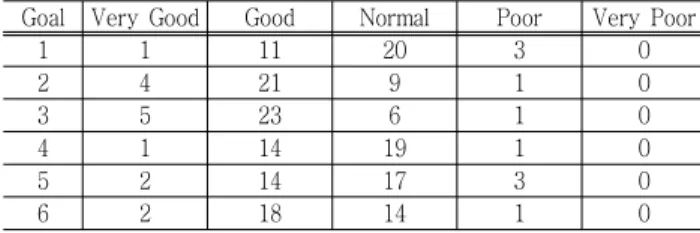
Table 1 Analysis of Self-established Goal Evaluation

Goal Very Good Good Normal Poor Very Poor

1 1 11 20 3 0

2 4 21 9 1 0

3 5 23 6 1 0

4 1 14 19 1 0

5 2 14 17 3 0

6 2 18 14 1 0

Pros:

Give students a self-motivation

Reminds students about the course goals Cons:

Sometimes student do not draw important facts → Lecturer helps!

Evaluations are performed by asking the degree of student’s satisfaction for the specific goal, which they set at the beginning of the class. 5 levels of satisfaction is checked for each goals. Then all the answer sheets are collected and statistics are computed. Based on the statistics the degree of the satisfaction from total class can be evaluated.

From the evaluation results of table1, most of the self- established goals are found to be successful. Especially students achieved better at goal number 2 and 3, which was learning how to revise my writing and how to collaborate. These mean student felt more achieved in these area. Goal number 1 and 4 were less recognized by the students and the self-achieve level was relatively low. Those were improving writing skills and improving presentation skills. To increase the self- achievement level, more feedback are required.

2. Presentation Evaluation

Presentation can be defined as a communicative way to

deliver presenter’s thought and opinion to the audiences

accurately and effectively in the limited given time. So

presentation is the transfer of the information and means

of pursuation. The key factors which makes contents and

form are participants, purpose, theme. Good understanding

of each can lead us to good presentation. Analysis of the

participants includes the analysis of presenter’s ability and

that of the request of audiences. Analysis of purpose includes

even distribution of objective aspects and subjective aspects

in current presentation. Also the theme analysis deals with

(3)

A Case of Evaluation Categories on Team teaching-based Technical Writing and Presentation Class

Journal of Engineering Education Research, 17(5), 2014 15

selection of the proper material and talking techniques.

In our case, after giving students the general principles of the presentation, actual presentation was conducted as follows.

Purpose: learning and practicing a logical and effective construction of the materials and nourishing effective spoken language communication ability

Theme: considering engineering background, students are asked to visit CECO(Changwon Exhibition Center) and prepare presentation for the visit. In CECO there are frequent exhibitions majorly related to engineering. Those can provide the students chances to experience the industry and meet peoples from the industry. They also draw interests of the students and students can have fun during the procedures and it is good place to make their own story for the technical writing class.

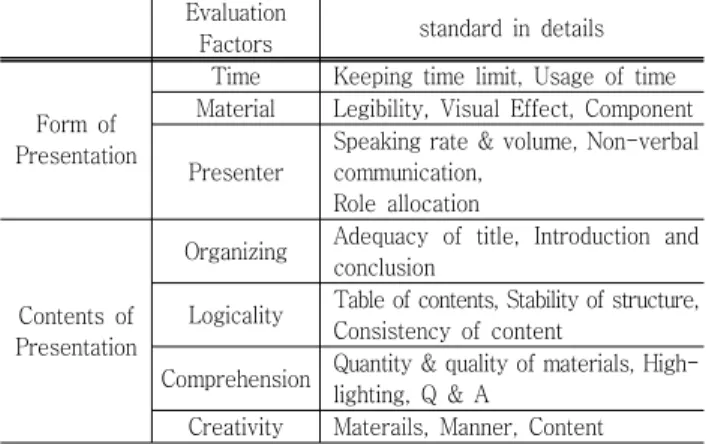
Table 2. Table for Presentation Evaluation Criteria Evaluation

Factors standard in details

Form of Presentation

Time Keeping time limit, Usage of time Material Legibility, Visual Effect, Component

Presenter

Speaking rate & volume, Non-verbal communication,

Role allocation

Contents of Presentation

Organizing Adequacy of title, Introduction and conclusion

Logicality Table of contents, Stability of structure, Consistency of content

Comprehension Quantity & quality of materials, High- lighting, Q & A

Creativity Materails, Manner, Content

Base on the detailed standard of evaluation, we evaluated the presentations of the class on the second semester of 2013. The results are as on table 3.

Table 3. Result of presentation evaluation Evaluation

Factors Good Normal Poor

Form of Presentation

Time 10 0 0

Material 3 5 2

Presenter 6 3 1

Contents of Presentation

Organizing 3 5 2

Logicality 3 5 2

Comprehension 4 6 0

Creativity 5 5 0

From the table the most prominent factor was presenter’s ability in the point of presentation form. In th content of presentation organizing and locality was the part. Considering that presentation is the process of verbal communication process, it is an expected result that presenter’s ability works the most important distinctive factor. Also in terms of the contents it was shown that education for the logical composition need to be enforced more.

Presentation schedule: time 15 minuites, 4 team members – total number of team 10.

From the final presentation, student’s are asked to present their report in written and verbal form. This is the chance which is good to evaluate the student’s achievement through the class. Faculty review and peer review was conducted.

The overall structure of presentation evaluation divided into form and contents. In terms of the form, factors of time, materials, speaker are considered. These mean the evaluation of presentation duration, visual material and talking ability of presenter. In terms of the content, organization, logicality, comprehension and creativity are evaluated. These include factors on evaluating the presenter’s ability to construct the contents effectively, the ability to build the logical structure, the ability to understand the theme, the ability to create his or her own ideas. Those criteria are described in table

3. Team Evaluation

Because this class was run by team unit. The contributions of each member are different according to the member’s efforts and knowledge etc. So to evaluate the student’s participation and contribution exactly, we evaluated the team activity into two classes, i.e. peer evaluation and faculty evaluation. By doing so we could expect the satisfaction from the student who is participating eagerly as well as a team’s subjective activity level. Also mindmap was used to promote the student’s participation. Students are asked to draw a mindmap for the each taught class. The mind maps are used to check the understanding and attendance of the team members. Mindmap was not scored and used just to estimate the attendance and the level of understanding of the team.

The evaluation procedures are as follows:

(1) Each member of a team evaluate the other members in terms of several check points

(2) A poll sheet is given to each of the team members (at the end of the semester)

(3) Team give 100 points to other members

(4) Students are asked to write the reasons for giving that point

(5) Give weight of 100% for maximum points, 90% for

(4)

Cheolwoo Jo․Kyoung-woan Nam

공학교육연구 제17권 제5호, 2014

16

middle points, 80% for minimum points Some check points in the sheet are,

(1) Degree of contribution, which means who contirubuted more to the team activities.

(2) Respect other members, which means who had given more efforts to integrate the team.

(3) Well-preparedness, which means who is more prepared for the specific class.

These evaluation points are important for team-based class running. This method is also useful to give the active participants motivation and encouraging less oriented students. The total points per each team member are added and total acquired points per member is computed.

Based on the statistics from the poll, we also found some drawbacks of this method.

(1) There are tendencies that some students share the even points and receives the same weights across the team members.

(2) Some students feel uncomfortable for this process.

But most of the students are clever to praise the hard worker.

4. Conclusions

In this paper three levels of evaluation procedures which was applied to the team teaching-based technical writing and presentation class. Self-established goal evaluation was effective to motivate the students. Team evaluation was good to draw the collaboration inside the team. Presentation evaluation was the integrated one. By presentation evaluation we could evaluate many aspects of writing ability in text including verbal ability.

According to the evaluation results, suggested evaluation methods are found to be effective to judge the students’

activity and degree of participation to the class. Some drawbacks of the evaluation process was time to perform the evaluation. To perform this kind of evaluation correctly, we will need the help of teaching assistant to process the data if the size of the class is big. It takes much time. To

relate the evaluation results to student’s participation to the class, some evaluation need to be done during the class, not at the end of the class. By doing so, we can give the students feedback to correct their behaviour and give them time to do something for the remaining part of the class.

But further development and adjustments in terms of the questionair and evaluation factors are required for the future.

References

1. Jin-sook, Nam․Pyeong-jeon, Lee, (2010), Team teaching class and its practice of using sample sentence and practice problems for 'writing of natural sciences and engineering, Korean Thought and Culture, Vol. 53, 335-357.

2. Nam, Kyoung-woan, (2011), A Study on the Management way of University Writing Class, Sarim-Eomun Yeon-Gu, Vol. 21, 149-170.

3. Nam, Kyoung-woan․Jo, Cheolwoo, (2012), Team Teaching as an Approach to Writing Education for the Engineering Students, Journal of Engineering Education Reserch Vol.

15, No. 1, 9-17.

Jo, Cheolwoo

BS. Department of Electronics, Korea University, 1983.

MS, Graducate School, Korea University, 1985.

Ph.D, Graduate School, Korea University, 1989.

Professor, Department of Control and Instrumentation, Changwon National University. 1989~Now.

Areas of Interest: Signal processing theory and application phone: 055-213-3662

Fax: 055-262-5064 E-mail: [email protected]

Nam, Kyoung woan

Department of Korean language and literature, Korea University, 1998.

MS, Department of Korean language and literature, Korea University, 2000.

Ph.D, Department of Korean language and literature, Korea University, 2005.

Professor, Department of Korean language and literature, 2009~Now.

Areas of Interest: Korean semantics, writing education phone: 055-213-3108

Fax: 055-213-3109

E-mail: [email protected]

수치

Table  1  Analysis  of  Self-established  Goal  Evaluation
Table  2.  Table  for  Presentation  Evaluation  Criteria Evaluation

참조

관련 문서

In this study, 1st and 2nd pilot studies was accomplished for revising evaluation standards and as a result, the procedure for implementing mathematics

It would be reasonable as a teacher to make efforts not only to reflect on the class on their own, but also to improve the teacher's teaching expertise

This study researches the effectiveness of deductive and inductive instructions for teaching grammar in middle school English class.. Eighty-four third-year

This study examined the achievement, satisfaction and interest of an English grammar class based on flipped learning in order to find out the effect of

The purpose of this study was to compare the microleakage of different adhesive systems (three 2-step adhesives and two 1-step adhesives) in class V

The purpose of this study is to investigate the middle school students' motivation, self-confidence and attitude toward English learning in a team-teaching

This study aims for investigating the relationship between the satisfaction based on one’s participation in physical education class and a physical self-concept

„ classifies data (constructs a model) based on the training set and the values (class labels) in a.. classifying attribute and uses it in