DOI https://doi.org/10.9725/kts.2019.35.1.30
하중 및 온도에 따른 습식 클러치 마찰재의 트라이볼로지 특성
박혜선ㆍ정구현†
울산대학교 기계공학부
Effect of Normal Force and Temperature on Tribological Properties of Wet Clutch Friction Material
Hyeseon Park and Koo-Hyun Chung
†School of Mechanical Engineering, University of Ulsan, Ulsan 44610, Korea (Received December 25, 2018; Revised January 20, 2019; Accepted January 25, 2019)
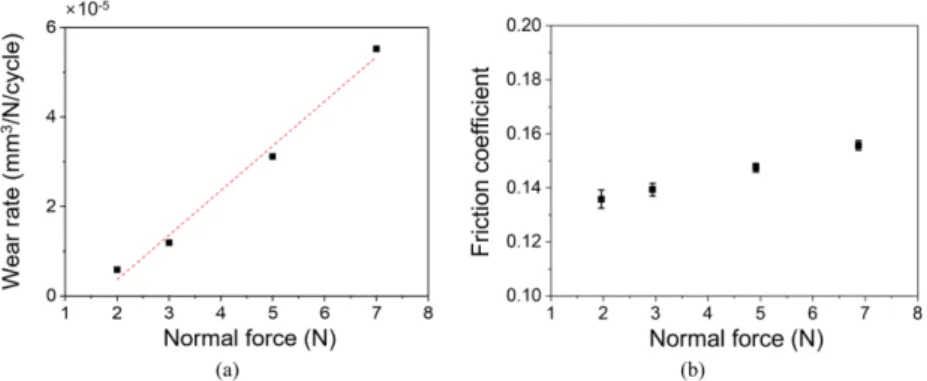
Abstract – The tribological properties of paper-based friction materials are crucial to the performance of a wet clutch system. In this work, the friction and wear characteristics of a paper-based friction material in boundary lubrication state was experimentally investigated using a pin-on-reciprocating tribotester under various normal forces and temperatures. It was found that the wear rate of the friction material increased from 5.8×10
-6mm
3/ N/cycle to 5.5×10
-5mm
3/N/cycle after 1,700 cycles of testing at 80°C as normal force increased from 2 N to 7 N. The friction coefficient was also found to increase from 0.135 to 0.155 with increasing normal force from 2 N to 7 N. The increase in contact pressure with increasing normal force may be responsible for these results. In addition, as temperature increased from 20°C to 80°C, the wear rate of the friction materials increased from 2.0×
10
-5mm
3/N/cycle to 3.6×10
-5mm
3/N/cycle while the friction coefficient decreased from 0.163 to 0.146. This result may be associated with the decrease in the hardness of friction materials with increasing temperature. Fur- thermore, plastic deformation on the friction materials was mainly observed after the test. The outcome of this work may be useful to gain a better understanding of the tribological properties of friction materials, and there- fore can contribute to the development of friction materials with enhanced performance for wet clutch systems.
Keywords – friction ( 마찰), friction material (마찰재), wear rate (마모율), wet clutch (습식 클러치)
1. 서 론
현재 전세계적으로 환경 및 에너지 문제가 대두되고 있으며, 이를 해결하기 위하여 많은 산업에서 다양한 규 제가 만들어지고 있다. 자동차 산업에서도 환경 규제를 만족시키고 에너지 효율을 개선하기 위한 많은 연구가 이루어지고 있다. 자동차에서 소모되는 총에너지의 약
38% 는 기계적 요소에서 발생하며, 이중 마찰과 관련된 에너지 손실은 약 33%인 것으로 제시되고 있다[1]. 자 동차의 변속 시스템에서는 약 15%의 에너지 손실이 발 생하는 것으로 알려지고 있는데 [2], 특히, 자동 변속기 에서 발생하는 에너지 손실은 수동 변속기에 비하여 약 5~15% 정도 큰 것으로 나타나고 있다[3]. 자동 변속기 에서 에너지 손실을 유발하는 요인 중 하나는, 기어 선 택을 위한 동력 전달 장치로써 많이 사용되는 클러치 (clutch) 로써, 클러치에서 사용되는 마찰재의 기초적 마찰 특성은 클러치의 동력전달 효율에 직접적인 영향을 끼치 며, 마찰재의 마모로 인한 성능 저하는 추가적인 에너지
†