* 정회원 ․ 교신저자 ․ 남서울대학교 GIS공학과 교수, 첨단교통환경연구소 소장 (Corresponding Author ․ Namseoul University ․ [email protected])
Received December 30, 2014/ revised January 15, 2015/ accepted February 17, 2015
Copyright ⓒ 2015 by the Korean Society of Civil Engineers
This is an Open Access article distributed under the terms of the Creative Commons Attribution Non-Commercial License (http://creativecommons.org/licenses/by-nc/3.0)
DOI: http://dx.doi.org/10.12652/Ksce.2015.35.2.0437 www.kscejournal.or.kr
지하철 승강장 및 환승정거장 유형에 따른 이용자 만족도 분석
김황배*
Kim, Hwang Bae*
Analysis of User Satisfaction by Types of Subway Platforms and Transit Stations
ABSTRACT
The layout of facilities, in relation to information and navigational displays, has great influence on subway satisfaction, and tend to vary depending on the types of subway platform and transit station. However, until now, few studies have covered such aspects as of yet.
Starting from this viewpoint, the purpose of this study was to use an IPA analysis technique to analyze that satisfaction on the importance of facilities to aid in accessibility, such as elevators and escalators, transit amenities and information and navigational displays depending on the types of platform and transit station. To do so, we've classified 15 metropolitan stations according to types of platform and transit station and analyzed differences in user importance and satisfaction as well as improvements for platforms and transit stations of similar type. By the analysis results of this study, we've concluded that the proper selection and positioning of elevator and escalator facilities and information and navigational displays was important when designing the subway station according to platform type (separate platform) and or according to the transit station type (cross, L, T types) where pedestrian flow heavily intersected. We considered that such analysis results would be helpful in the design of new stations and the enhancement of existing stations pursuant to a new direction that minimizes user inconvenience, and that improvement items should be developed first according to the platform and transit station types, which would be helpful in enhancing the efficiency of the subway improvement cost.
Key words : Subway platforms, Transit stations, User satisfaction, IPA 초 록
지하철 만족도에 큰 영향을 미치는 시설물의 배치, 정보안내의 경우 지하철 승강장 및 환승정거장의 유형에 따라 달라지게 되나, 현재 해당 항목 에 대한 연구는 미비한 실정이다. 본 연구는 이러한 관점에서 출발하여 IPA 분석 기법을 활용하여 승강장 및 환승정거장 유형에 따른 이동시설 및 환승편의시설, 정보안내의 만족도간 중요도를 분석하는 것을 목적으로 한다. 이를 위해 수도권 도시철도 환승역사 15개를 대상으로 승강장 및 환승정거장 유형에 따라 분류하고, 승강장 및 환승정거장 유형이 동일함에 따라 이용자간 중요도 및 만족도 차이, 개선항목 등을 분석하였다.
본 연구의 분석 결과 동선교차가 많이 발생되는 승강장 유형(상대식 승강장)과 환승정거장 유형(+, L, T자형)으로 지하철역을 설계하는 경우 이 동편의시설 및 정보안내표지의 적정한 위치 선정이 중요함을 도출하였다. 이러한 분석 결과는 향후 이용자의 불편이 최소화할 수 있는 방향으로 신규 역사 설계 및 기존 역사 개선시 활용이 가능하며, 승강장 및 환승정거장 유형에 따라 우선적으로 개선해야 하는 항목 도출로 지하철 개선비 용 효율성 증대 가능할 것으로 판단된다.
검색어 : 지하철 승강장, 환승정거장, 이용자만족도, IPA Transportation Engineering 교통공학
Fig. 1. Flow of This Study
1. 서 론
1.1 연구의 배경 및 목적
지하철은 2010년 기준 수도권 시민이 가장 많이 이용하는 교통수 단(36.2%)으로 수도권 및 주요 광역지자체에서 버스(28.1%)와 함께 대표적인 대중교통 수단이다.
1)그러나 2004년 서울시에서 발표한 지하철 만족도는 62.3점(100점 만점)으로 지하철 이용자들 에게 제공되는 서비스가 만족하지 못하는 것으로 나타났다.
지하철역사는 임산부, 고령자, 장애인, 유아 등 다양한 이용자들 이 존재하나, 일반 성인을 기준으로 시설물이 설계 및 배치되어 있어 지하철역사 이용시 통행거리 및 통행시간 과다 등의 불편함을 겪는다.
지하철 만족도에 영향을 미치는 시설물의 배치는 환승정거장 구조(십자형, T자형, L자형, 복층형, 평행형)와 승강장 유형(섬식, 상대식, 복합식)으로 이에 따라 이용자의 동선 길이가 달라지므로, 본 연구에서는 지하철 유형을 환승정거장 및 승강장 유형에 따라 구분하여 이동편의시설물 및 환승시설물, 정보안내표지판의 만족 도간 중요도를 분석하고자 한다.
이를 위해 상대적인 중요도와 만족도를 동시에 비교․분석하는 IPA (Important-Performance Analysis) 방법을 이용하였다.
1.2 연구 내용 및 방법
본 연구는 수도권 지하철 역사를 이용하는 이용객을 대상으로 이동편의시설물 및 환승시설물에 대한 중요도 및 만족도 조사를 실시하여, 이를 승강장 유형(섬식, 상대식, 혼합식), 환승 정거장 구조(+자형, T자형, L자형, 평행형, 복층형)으로 구분하여 각 유형 에 따라 이용자들의 중요도 대비 만족도가 낮은 항목을 도출하고자 한다.
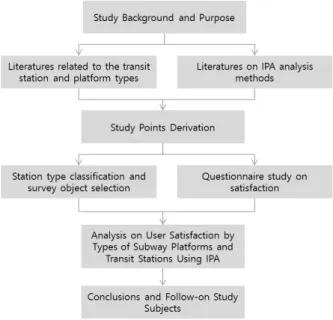
연구의 내용 및 방법을 수행과정에 따라 정리하면 Fig. 1과 같다.
첫째, 연구의 배경을 서술하고 목적을 제시하고 둘째, 지하철 환승정거장, 승강장 유형 및 IPA 분석 관련 기존 문헌을 고찰하고, 그에 따른 연구의 착안점을 도출한다. 셋째, 연구의 범위를 설정한 후, 관련 자료를 수집한다. 넷째, 수집된 자료를 이용하여 승강장 및 환승정거장 유형에 따라 IPA 분석을 수행한다. 다섯째, 앞서 분석한 결과를 이용자 유형별로 구분하여 IPA 분석을 수행하여 이용자들의 중요도 대비 만족도가 낮은 항목을 도출한다.
마지막으로 연구의 결론을 요약하며, 한계점 및 향후 연구 과제를 제시한다.
1) http://www.edaily.co.kr/news/NewsRead.edy?SCD=JG31&
newsid=01092246602711832&DCD=A00703&OutLnkChk=Y
2. 관련 문헌 고찰
2.1 환승정거장 및 승강장 유형 관련 문헌 고찰
도시철도 정거장 및 환승․편의시설 보완 설계지침에서는 승강장 유형을 크게 섬식 승강장과 상대식 승강장으로 구분하고 있다.
섬식 승강장은 열차가 진입하는 선로 사이에 섬처럼 배치된 승강장을 말하며, 상대식 승강장은 열차가 진입하는 선로를 중심으 로 양측으로 나뉘어 있는 승강장을 의미한다.
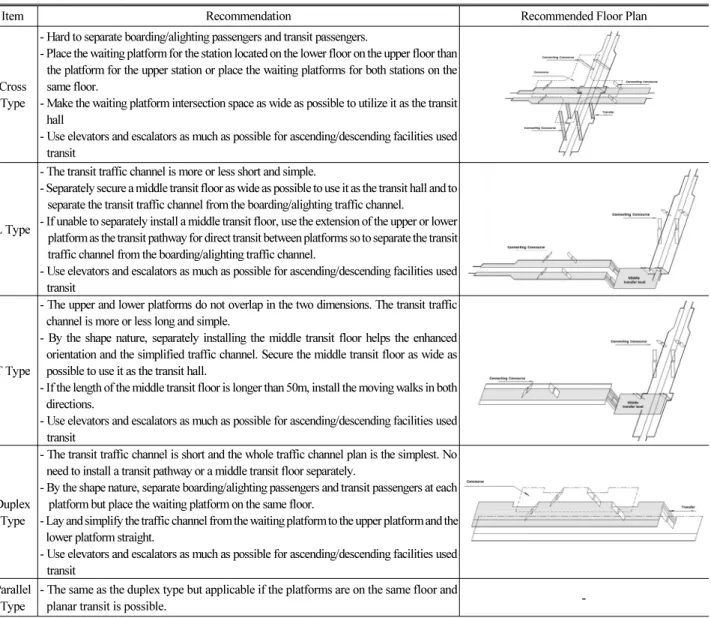
또한 환승정거장 유형은 +자형, L자형, T자형, 복층형으로 구분 되어 있으며, 조사 결과 평행형을 추가로 구분하였다. 이용자의 동선은 환승정거장과 승강장 유형에 따라 결정되며, 추가적으로 역사 내 시설물 및 출입구 위치에 따라 최종적으로 결정된다.
환승정거장별 권고사항 및 개요도는 다음의 표와 같다.
2.2 지하철 관련 IPA 분석 문헌 고찰
국내 지하철 관련 IPA 분석 연구는 지하철 서비스 특성, 이동시설 에 집중하여 연구가 진행 중에 있다.
Park et al. (2007) 은 현재 제공되고 있는 지하철 서비스 특성을 IPA 기법을 이용하여 분석하였으며, 분석 결과 지하철 서비스 향상을 위해서는 실질적으로 이용자가 느끼는 정성적인 부분에 대한 관심과 개선이 필요한 것으로 나타났다.
Oh et al. (2009) 은 지하철 호선별 제공되는 서비스를 이용자
관점에서 수행하였으며, 그 결과 각 호선별 서비스 수준이 상이하였
으며, 서비스가 제공되는 위치의 수준에 의해 지하철 이용여부가
좌우된다고 분석되었다.
Table 1. Transit Station Type
Item Recommendation Recommended Floor Plan
Cross Type
- Hard to separate boarding/alighting passengers and transit passengers.
- Place the waiting platform for the station located on the lower floor on the upper floor than the platform for the upper station or place the waiting platforms for both stations on the same floor.
- Make the waiting platform intersection space as wide as possible to utilize it as the transit hall
- Use elevators and escalators as much as possible for ascending/descending facilities used transit
L Type
- The transit traffic channel is more or less short and simple.
- Separately secure a middle transit floor as wide as possible to use it as the transit hall and to separate the transit traffic channel from the boarding/alighting traffic channel.
- If unable to separately install a middle transit floor, use the extension of the upper or lower platform as the transit pathway for direct transit between platforms so to separate the transit traffic channel from the boarding/alighting traffic channel.
- Use elevators and escalators as much as possible for ascending/descending facilities used transit
T Type
- The upper and lower platforms do not overlap in the two dimensions. The transit traffic channel is more or less long and simple.
- By the shape nature, separately installing the middle transit floor helps the enhanced orientation and the simplified traffic channel. Secure the middle transit floor as wide as possible to use it as the transit hall.
- If the length of the middle transit floor is longer than 50m, install the moving walks in both directions.
- Use elevators and escalators as much as possible for ascending/descending facilities used transit
Duplex Type
- The transit traffic channel is short and the whole traffic channel plan is the simplest. No need to install a transit pathway or a middle transit floor separately.
- By the shape nature, separate boarding/alighting passengers and transit passengers at each platform but place the waiting platform on the same floor.
- Lay and simplify the traffic channel from the waiting platform to the upper platform and the lower platform straight.
- Use elevators and escalators as much as possible for ascending/descending facilities used transit
Parallel Type
- The same as the duplex type but applicable if the platforms are on the same floor and
planar transit is possible. -
source : Ministry of Land, Transport and Maritime Affairs (2010), Supplementary Design Instructions for Urban Railway Platforms and Transit Amenities
Kim et al. (2009) 은 지하철 이용자(일반인, 장애인)를 대상으로 지하철 이동시설의 중요도-만족도 분석을 시행하였으며, 분석 결과 장애인의 경우 시설 개선시 접근과 정보제공에 대한 시설을 시급하 게 개선해야 한다고 도출되었다.
Park et al. (2010) 은 서울시 지하철 이용자를 대상으로 성인지적 관점의 중요도-만족도 조사를 실시하여 남녀간 지하철 이용특성을 IPA 분석으로 분석하였으며, 그 결과 여성이 이용하기 편리하며 안전한 지하철 이용환경을 조성하는 것이 필요한 것으로 판단하였다.
2.3 시사점
우리나라 지하철역은 승강장 구조와 환승정거장 유형에 따라
다양하게 구성되며, 각 유형에 따른 특성이 존재한다.
승강장과 환승정거장 유형간 조합에 따라 이용자 동선 및 정보안 내표지판 설치 위치 등에 차이가 발생하며 이용자 만족도가 달라지 므로 이에 대한 분석을 수행한 후 이용자 만족도를 높일 수 있는 방향으로 개선하여야 한다.
특히 기존 연구는 대부분 현재 제공되고 있는 지하철 서비스
수준과 지하철 이용자와 이동시설에 집중하고 있으나, 이동시설
유형과 지하철 노선에 따라 단순하게 분류하고 있으므로 본 연구에
서는 승강장과 환승정거장 유형 중 가장 많이 나타나는 유형을
대상으로 이동편의시설과 정보안내표지판에 대한 이용자 중요도-
만족도 분석을 수행하고자 한다.
Table 2. Subway Station Classification by Platform and Transit Station Types
Item Transit Station Type
Cross Type L Type T Type Duplex Type Parallel Type
Platform Type
Island + Island - - (1) Yeonsinnae - (2) Chungjeongno
Island + Separate (3) Sadang and Euljiro 4(sa)-ga
(4) City Hall and Seoul
Nat'l Univ. of Education (5) Euljiro 3(sam)-ga - -
Separate + Separate (6) Gangnam-gu
Office (7) Moran (8) Gasan Digital Complex (9) Jamsil (10) Jeongja and Dobongsan Separate + Separate
+ Separate - - (11) Sangbong (Intercity Bus
Terminal) - -
Separate + Island
+ Island - - (12) Dongdaemun History &
Culture Park - -
Fig. 2. Survey Sample
Table 3. Detailed Survey Items
Item Detailed survey item
Moving Amenity
Position Adequacy
Moving amenity, platform and ticket gate, entrance, moving pathway, transit pathway
and sign board Inter-facility
connectivity
Elevator to elevator, escalator to escalator, escalator to elevator, stairway to stairway
and moving walk to escalator Size
Adequacy
Stairway width, the number of entrances, the number of elevators and the number of
escalators Use
ConvenienceWaiting time, congestion and moving time
Information Indication
Facility
Facility Variety
General sign board, electronic sign board and voice information Accuracy Directional information, arrival
information and dispatch time information Size
Adequacy Installation interval and installation height Use
Convenience Visibility and Legibility
이에 다음절에서 수도권 76개 환승역사를 대상으로 조사 우선순
위를 선정한 후, 이 중 15개 역사를 중심으로 역사 유형을 분류하고 자 한다.
3. 분석방법 정립
3.1 역사 유형 분류
수도권 지하철 환승역사는 총 76개소로 이용자가 많고, 방향별 이동수요 차이가 존재하는 역을 대상으로 우선순위를 선정하고
이 중 15개 역사를 선정하였다.
이를 대상으로 승강장 및 환승정거장 유형을 분류한 결과는 다음의 표와 같이 총 12개 유형으로 분류하였다(Table 2). 조사대상 역사는 섬식+상대식 승강장인 경우 십자형 및 L자형 환승정거장이 많았으며, 상대식+상대식 승강장인 경우 평행형이 많았다.
3.2 설문조사
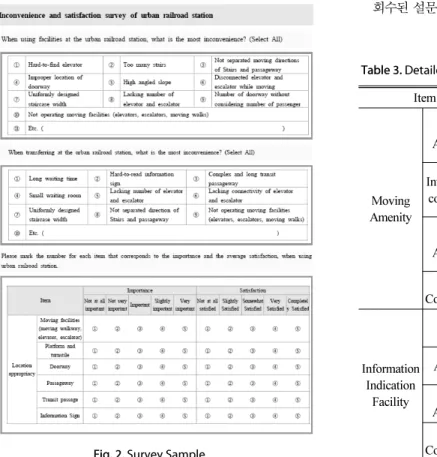
본 연구에서는 수도권 환승역사 중 총 15개 역사를 대상으로 지하철 이용자에 대해 중요도 및 만족도 설문조사를 시행하였으며, 5점 척도로 조사하였다.
회수된 설문부수는 총 382개로 설문조사 예시는 다음과 같다.
Fig. 3. Conceptual Diagram for Importance-Performance analysis
Table 4. Importance-Performance Analysis Result for Facility and Information by Platform Types
platform types
Facility Information
Disabled Passenger Ordinary Passenger Disabled Passenger Ordinary Passenger Performance Importance Performance Importance Performance Importance Performance Importance
(1) Island + Island 3.90 3.03 4.20 2.97 3.83 3.29 3.80 3.35
(5) Island + Separate 3.61 3.03 3.64 3.02 3.63 3.18 3.64 3.16
(8) Separate + Separate 3.63 3.21 4.04 3.13 3.56 3.61 4.03 3.51
설문조사 항목은 지하철역의 이동편의시설, 정보안내시설로 구 분하였으며, 이동편의시설물은 다시 위치적절성, 시설물간 연결성, 규모적정성, 이용편의성, 정보안내시설은 시설물 다양성, 정확도, 규모적정성, 이용편의성으로 구분하여 조사하였다.
세부적인 조사항목은 다음과 같다.
3.3 IPA 분석 방법
IPA는 측정된 성과요인이 우선순위를 상대적인 중요도와 만족 도를 비교하여 분석하는 기법으로 y축이 중요도, x축이 만족도가 되며, 중요하다고 판단되는 요인과 그 요인에 대한 만족도 혹은 수행도 정도를 파악하여 상대적 관계를 살펴보는 분석이다.
IPA 분석을 위해 설문을 실시하고, 조사된 결과를 바탕으로 실행격자를 작성한다. 실행격자(Action grid)는 중요도를 수직축으 로 하고 만족도를 수평축으로 하는데, 각각의 속성에 대한 평균값 (Mean Value) 또는 중앙값(Median Value)을 구하여 이를 토대로 각 속성의 위치를 실행격자 상에 표기한다. 실행격자의 사분면상에 나타난 결과를 토대로 다음과 같이 4가지 기준으로 평가한다.
3.3.1 중점 개선(Concentrate Here)
1사분면은 이용자가 아주 중요하다고 생각하는 반면 그에 대한 만족도는 매우 낮은 특징을 가지고 있으며, 이에 대한 중점개선의 노력을 기울이는 것이 필요하다.
3.3.2 우위 유지(Keep up the Good Work)
2사분면은 이용자가 중요하다고 판단하고, 그에 대한 만도도 높은 특징을 가지고 있다. 이는 현재의 서비스에 대해 상당수가 만족하고 있는 상태를 의미하기 때문에 서비스 제공자들은 이러한 상태를 지속시키는 필요하다.
3.3.3 개선 대상(Low Priority)
3사분면은 중요도와 만족도 모두 낮은 비중이 주어지고 있는 특징을 가지고 있으며, 이 경우는 이용자가 특별히 중요하다고 보지 않기 때문에 개선이 필요하긴 하나 다른 사항에 비해 우선순위 가 낮다.
3.3.4 현상 유지(Possible Overkill)
4사분면은 만족도가 높은 반면 중요도가 낮게 평가되는 특징을 가지며, 이용자들은 이러한 특징을 중요하다고 판단하지 않으므로 과잉하지 않도록 현 상태를 유지하는 것이 필요하다.
4. 분석 결과
본 절에서는 3절에서 제시한 지하철 역사 유형 중 환승정거장은
T 자형으로 동일하나, 승강장 유형에 차이가 존재하는 (1), (5),
(8)번과 승강장 유형은 동일하나, 환승정거장 유형에 차이가 있는
Table 5. Improvement Item Analysis Result for Facility and Information by Platform Types
Item
Island + Island platform Island + Separate platform Separate + Separate platform Ordinary
Passenger
Disabled Passenger
Ordinary Passenger
Disabled Passenger
Ordinary Passenger
Disabled Passenger
T - T y p e
Moving Amenity
Position Adequacy
Moving amenity, platform pathway
Moving amenity, moving pathway
Moving amenity, platform pathway,
sign board
Moving amenity, platform pathway,
sign board
platform pathway, sign board
Moving amenity, entrance, sign
board Inter-facility
onnectivity
stairway to stairway
E/V-E/V,
E/S-E/V, E/S-E/S - E/V-E/V - E/V-E/V
Size Adequacy
number of escalators
Stairway width, the number of
elevators and escalators
the number of elevators
Stairway width, the number of
escalators
the number of elevators
Use Convenience
Waiting time, congestion and
moving time
- congestion,
moving time
Waiting time,
congestion congestion congestion
Information Indication
Facility
Facility
Variety - General sign board General sign board - General sign board General sign board
Accuracy
Directional information, dispatch time information
- Directional
information
Directional information
Directional information
Directional information
Size
Adequacy - Installation
interval - Installation
interval
Installation interval
Installation interval Use
Convenience Legibility Visibility,
Legibility - - - Visibility,
Legibility
Fig. 4. Improvement Item Analysis Result for Facility and Information by Platform Types
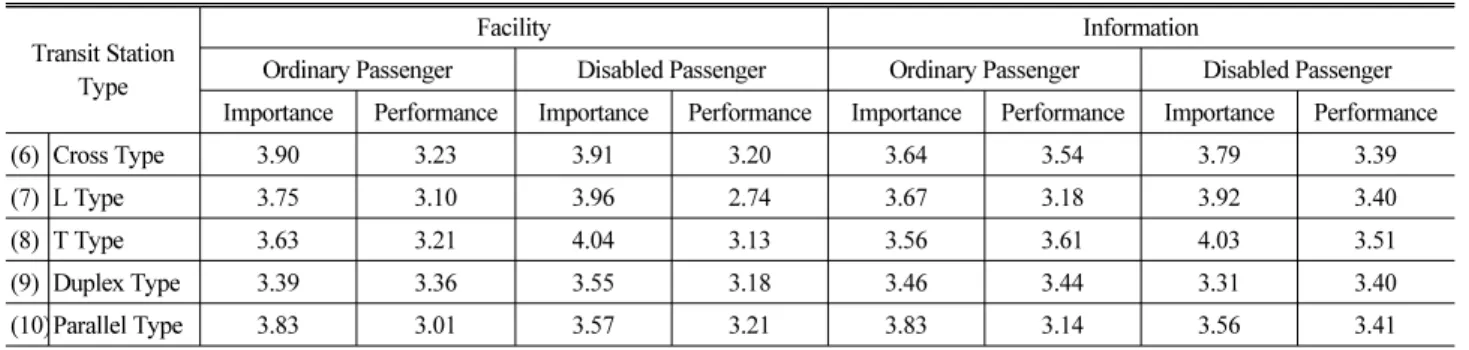
Table 6. Importance-Performance Analysis Result for Facility and Information by Transit Station Type
Transit Station Type
Facility Information
Ordinary Passenger Disabled Passenger Ordinary Passenger Disabled Passenger Importance Performance Importance Performance Importance Performance Importance Performance
(6) Cross Type 3.90 3.23 3.91 3.20 3.64 3.54 3.79 3.39
(7) L Type 3.75 3.10 3.96 2.74 3.67 3.18 3.92 3.40
(8) T Type 3.63 3.21 4.04 3.13 3.56 3.61 4.03 3.51
(9) Duplex Type 3.39 3.36 3.55 3.18 3.46 3.44 3.31 3.40
(10)Parallel Type 3.83 3.01 3.57 3.21 3.83 3.14 3.56 3.41
Table 7. Improvement Item Analysis Result for Facility and Information by Transit Station Type
Item
Separate + Separate platform
Cross Type L Type T Type Duplex Type Parallel Type
Ordinary Passenger
Disabled Passenger
Ordinary Passenger
Disabled Passenger
Ordinary Passenger
Disabled Passenger
Ordinary Passenger
Disabled Passenger
Ordinary Passenger
Disabled Passenger
Moving Amenity
Position Adequacy
Moving amenity, platform pathway
Moving amenity
Moving amenity, moving/
platform pathway
Moving amenity
platform pathway, sign board
Moving amenity, entrance, sign board
moving/
platform pathway
Moving amenity, moving/
platform pathway
moving/
platform pathway, sign board
Moving amenity
Inter-facility Connectivity
E/V-E/V, E/S-E/V, E/S-E/S
- E/V-E/V,
E/S-E/S - E/V-E/V - - - E/V-E/V
Size Adequacy
the number of elevators
number of escalators -
Stairway width, the number of escalators
the number
of elevators - the number
of elevators - -
Use Convenience
Waiting time, congestion,
moving time
-
congestion, moving
time
congestion, moving
time
congestion congestion congestion congestion
Waiting time, congestion,
moving time
congestion, moving
time
Information Indication
Facility
Facility
Variety -
General sign board,
voice information
voice information
General sign board
General sign board
General sign board
General sign board
General sign board,
voice information
-
Accuracy Directional information
Directional information, arrival information
Directional information, dispatch
time information
Directional information
Directional information
Directional information
Directional information, dispatch
time information
-
Directional information, dispatch
time information
Directional information, dispatch
time information
Size Adequacy
Installation interval, installation
height
Installation interva
Installation interva
Installation interva
Installation interval
Installation
interval - - - -
Use Convenience
Visibility, Legibility
Visibility,
Legibility - Visibility,
Legibility - Visibility, Legibility
Visibility,
Legibility Visibility Visibility Visibility
(6)~(10) 번 유형을 중심으로 이용자 중요도-만족도 결과가 어떤 차이가 존재하는지 분석하고자 한다.
우선 환승정거장 유형은 동일하나, 승강장 유형에 차이가 존재하 는 경우에 대해 분석을 하기 위해 섬식+섬식 승강장(1), 상대식+섬
식 승강장(5), 상대식+상대식 승강장(8)을 대상으로 시설물 및
정보안내에 대해 분석한 결과 다음에서 보는 바와 같이 시설물에
대한 중요도는 장애인이 일반인보다 높았으나 만족도는 낮은 것으
로 나타났다. 아는 장애인의 경우 일반인에 비해 이동편의시설물인
엘리베이터, 에스컬레이터에 많이 의존하여 이동하기 때문으로 분석되어진다. 정보안내의 경우 장애인이 일반인에 비해 중요도가 높았으나, 만족도는 낮은 것으로 분석되었다. 특히 상대식+상대식 승강장인 경우 장애인의 정보안내에 대한 중요도가 높았으나, 그에 대한 만족도가 낮은 것으로 나타났는데 이는 상대식 승강장의 특성상 목적지 방향을 잘못 선택한 경우 되돌아오기가 상대적으로 불편하기 때문으로 분석되어진다. 이와 같은 맥락에서 볼 때 섬식+
섬식 승강장이 장애인의 만족도가 일반인에 비해 높았으며, 이는 해당 승강장이 단순한 동선으로 장애인의 이해를 높인 것으로 판단된다.
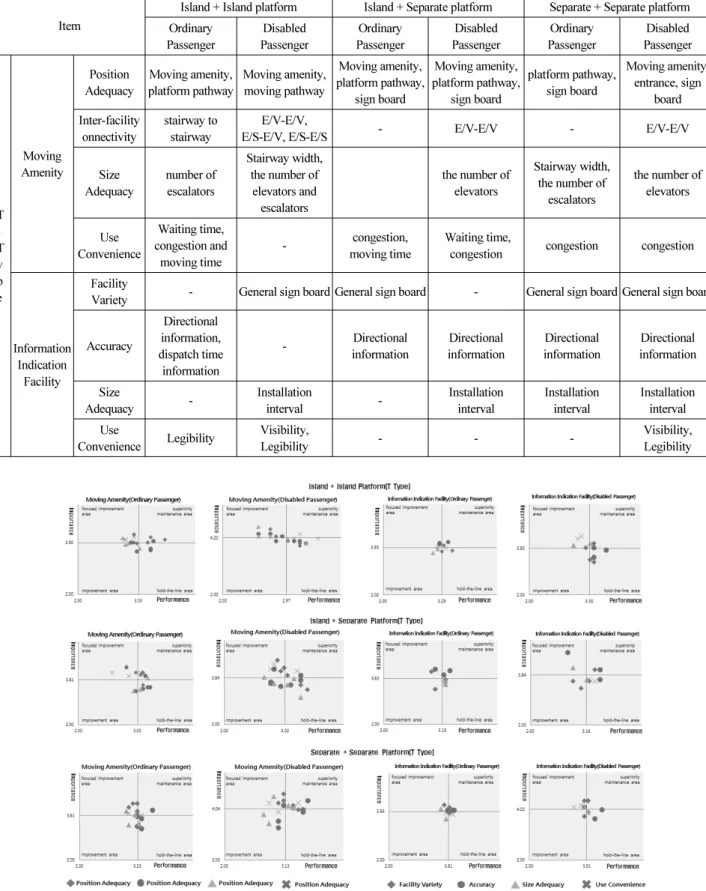
세부 개선항목을 분석한 결과 T자형으로 환승정거장 유형이 동일한 경우 섬식+섬식 승강장인 경우 일반인 및 장애인 모두 이동편의시설물의 위치 적절성과 E/S 설치개수, 정보안내표지의 가독성이, 섬식+상대식 승강장인 경우 일반인 및 장애인 모두 이동 편의시설물 및 환승통로의 위치적절성 및 혼잡도, 정보안내의 경우 방향안내, 설치간격이, 상대식+상대식 승강장인 경우 안내표지판 위치 적절성, E/S 설치개수, 혼잡도, 정보안내에서는 일반안내표지 및 방향안내, 설치간격에 대해 우선 개선을 요하는 것으로 나타났다.
이는 심도에 위치한 승강장과 이동편의시설물의 설치개수에 따라 나타난 결과 섬식+섬식 승강장인 연신내역의 경우 E/S 설치개소수 가 적었으며, 섬식+상대식 승강장인 경우 환승통로 위치가 긴 특징 을 보였다. 마지막으로 상대식+상대식 승강장인 경우 가산디지털단 지로 상대적으로 이동편의시설물이 잘 설치되어 있었으나, 출입구 가 2층에 일부 설치되어 있어 장애인이 E/V가 설치되어 있지 않아 이동이 어려운 것으로 나타났다. 특히 상대식 승강장이 조합된 경우 교차점이 많아 정보안내와 관련된 개선항목이 집중적으로 도출됨을 알 수 있었다.
승강장 유형은 동일하나, 환승정거장 유형에 차이가 있는 (6)
~(10) 번 유형 대상으로 시설물 및 정보안내에 대해 분석한 결과 다음에서 보는 바와 같이 전반적으로 일반인의 만족도가 높았으나, 평행형의 경우 시설물 및 정보안내 분야 모두 장애인의 만족도가 높은 것으로 나타났다. 이는 타 환승정거장에 대비 수평적 구조로 동선이 이루어져 있어 장애인 이용자가 타 구조에 비해 이동이 단순하여 이러한 결과가 도출되었다고 판단된다.
세부 개선항목을 분석한 결과 승강장 유형(상대식+상대식)이 동일하고, 환승정거장 유형이 상이한 경우 시설물의 위치적절성(이 동편의시설, 환승통로), 이용편의성(혼잡도 및 이동시간)과 정보안 내의 정확도(방향안내), 규모적정성(설치간격), 이용편의성(시인 성) 등의 유사한 개선항목이 도출됨을 알 수 있었다. 이는 상대식승 강장의 경우 앞서 설명한바와 같이 목적지로의 동선을 잘못 선택한 경우 되돌아 와야하는 문제점이 발생하기 때문으로 분석되어진다.
또한 +자형, L자형, T자형 등 동선 교차가 많이 발생하는 환승정거
장 유형의 경우 이동편의시설의 위치, 정보안내 중 방향안내, 설치간 격에 대해 우선 개선항목이 도출되었다. 이는 동선 선택에 대한 일반인 및 장애인 이용자 모두 혼란이 발생하고, 대부분 수직 이동동 선으로 구성되어있기 때문으로 분석되어진다.
5. 결론 및 향후연구
본 연구는 지하철 만족도에 영향을 미치는 시설물의 배치, 정보안 내의 경우 지하철 승강장 및 환승정거장의 유형에 따라 달라지므로 이동시설 및 환승편의시설, 정보안내의 만족도간 중요도를 분석하 고자 하였다.
이를 위해 수도권 76개 역사 중 15개 역사를 선정하여 승강장 및 환승정거장 유형에 따라 분류하고, 승강장 및 환승정거장 유형이 동일함에 따라 이용자간 중요도 및 만족도 차이, 개선항목 등을 분석하였으며 그 결과는 다음과 같다.
(1) 환승정거장 유형은 동일하나, 승강장 유형에 차이가 존재하는 경우 시설물에 대한 중요도는 장애인이 일반인보다 높았으나 만족도는 낮은 것으로 나타났으며, 정보안내의 경우 장애인이 일반인에 비해 중요도가 높았으나, 만족도는 낮은 것으로 분석 되었다. 특히 상대식+상대식 승강장인 경우 장애인의 정보안내 에 대한 중요도가 높았으나, 그에 대한 만족도가 낮은 것으로 나타났는데 이는 상대식 승강장의 특성상 목적지 방향을 잘못 선택한 경우 되돌아오기가 상대적으로 불편하기 때문으로 분석 되어진다.
(2) T자형으로 환승정거장이 동일한 경우 승강장 유형에 따라 개선 항목이 유사하였으며, 특히 상대식+상대식 승강장인 경우 정보 안내 관련 개선항목이 많이 도출되었다. 이는 상대식 승강장이 가지는 특성인 동선 선택의 중요성에 의한 결과라 판단되어진다.
(3) 승강장 유형은 동일하나, 환승정거장 유형에 차이가 있는 경우 시설물 및 정보안내에 대해 분석한 결과 전반적으로 일반인의 만족도가 높았으나, 평행형의 경우 시설물 및 정보안내 분야 모두 장애인의 만족도가 높은 것으로 나타났다. 이는 타 환승정 거장에 대비 수평적 구조로 동선이 이루어져 있어 장애인 이용 이 타 구조에 비해 동이 단순하여 이러한 결과가 도출되었다고 판단된다.
(4) 위의 유형의 세부 개선항목을 분석한 결과 +자형, L자형, T자형
등 동선 교차가 많이 발생하는 환승정거장 유형의 경우 이동편
의시설의 위치, 정보안내 중 방향안내, 설치간격에 대해 우선
개선항목이 도출되었다. 이는 동선 선택에 대한 일반인 및
장애인 이용자 모두 혼란이 발생하고, 대부분 수직 이동동선으
로 구성되어있기 때문으로 분석되어진다.
따라서 동선 교차가 많이 발생하는 환승정거장 유형인 +, L, T자형과 상대식 승강장이 조합하는 경우 이동편의시설물은 이동동 선 내에 설치하여 이용자들의 편의성이 확보되게 하여야 하며, 정보안내표지는 동선 결절점에 설치하여 이용자의 혼란을 최소화 할 수 있도록 하여야 한다.
이러한 분석 결과는 향후 이용자의 불편이 최소화할 수 있는 방향으로 신규 역사 설계 및 기존 역사 개선시 활용이 가능하며, 더불어 이용자 유형에 따라 중요도 대비 만족도가 낮은 승강장 및 환승정거장 유형 도출로 신규 역사 건설시 주변 인구 분포를 분석하여 해당 시설물의 설치 지양 또는 만족도를 높이기 위한 시설물 설치 제안시 활용 가능하다.
또한 승강장 및 환승정거장 유형에 따라 우선적으로 개선해야 하는 항목 도출로 지하철 개선비용 효율성 증대 가능할 것으로 판단된다.
본 연구는 수도권 76개 역사 중 15개 역사만을 대상으로 분석을 진행하였기 때문에 보다 정확한 결과값 도출을 위해 표본 수를 확보한 연구가 필요하며, 본 연구에서 도출된 세부 개선항목에 대한 기준(정보안내표지 및 이동편의시설물의 적정 위치 설계 기준) 관련 연구가 진행되어야 할 것이다.
감사의 글
This paper was studied as supported by the research fund from NamSeoul University in 2014.
References
Kim, H. B., Ahn, W. Y. and Lee, S. H. (2014). “Analysis on transit facility importance considering characteristics by types of urban railway stations.” Journal of Korean Society of Civil Engineers, Vol. 32, No. 5, pp. 487-496 (in Korean).
Kim, T. H., Sohn, S. H. and Park, J. J. (2009). “M-IPA Used comparative study on subway moving facility satisfaction of disabled and ordinary passengers.” Journal of Korean Society of Civil Engineers, Vol. 29, No. 6D, pp. 703-709 (in Korean).
Lee, S. O. and Jak, H. B. (2014). “Survey study on urban railway customer service satisfaction by MMIC path analysis: Focused on Line 9.” Proceedings of 2014 Spring Symposium of Korean Society for Railway (in Korean)
Ministry of Land, Transport and Maritime Affairs (2010). Supple- mentary design instructions for urban railway platforms and transit amenities, pp. 53-57.
Park, J. H. and Kim, D. G. (2010). “IPA Analysis on subway user satisfaction from the gender perspective.” Conference Proceedings of Korean Society of Transportation (in Korean).
Park, J. S., Kim, T. H., Yoon, S. H. and Bae, G. O. (2007). “Study on characteristics of subway user services using IPA analysis.”
Proceedings of Korean Society for Railway, Vol. 10, No. 4 pp.
420-430 (in Korean).