INTRODUCTION
Artificial vegetation island (AVI) is regarded as one of ecotechnological methods which emply macrophytes to improve the water quality of natural small ponds and large artificial impound- ment. There have been many reports on water quality improvement by using macrophytes, such as natural wetlands (Kim and Cho, 1996) and constructed wetlands (Ahn and Kong, 1998).
Improvement of water quality was made through by symbiotic and synergistic activities between macrophytes and microbes. Root part of macro- phytes plays as a medium and a food source to microorganisms. In addition, macrophytes deliver O
2to underwater via oxygen transfer organs,
which promotes the degradation of organic mat- ters by microbes (Ahn and Kong, 1998). Nutrients produced by degradation of organic matters by microorganisms are used by plants and, organics and metabolites originated from macrophytes can be reused by microbes (Wolverton, 1987).
AVI, however, does not improve water quality efficiently such as TN, TP, COD and other gen- eral parameters because of limited installed area (Shimatani, 1996; Park et al., 2001). Moreover, water column can be easily mixed by physical factors, and hence the concentrations of dis- solved matters at vegetation island area became similar to those of outer part. For water quality improvement, more than 20% of surface of lake and reservoir should be covered with AVI (Park et al., 2001). In spite of those uncertainties of
* Corresponding Author: Tel: 033) 250-8574, Fax: 033) 251-3991, E-mail: [email protected]
─
─ 266 ──
Bacterial Abundances and Enzymatic Activities under Artificial Vegetation Island in Lake Paldang
Byeon, Myeong- -Seop, Jae- -Jun Yoo
1, Ok- - Sun Kim
1, Seung- -Ik Choi
2and Tae- -Seok Ahn
1, 3*
(National Institute of Environmental Research, Inchon 404-170, Korea,
1Department of Environmental Science, Kangwon National University, Chunchon 200-701, Korea, 2Environmental Research Institute, Kangwon National University,
Chunchon 200-701, Korea, 3Kangwon Regional Environmental Technology Development Center, Chunchon, 200-701, Korea)
For analyzing function of a microbial ecosystem which was created under the artifi- cial vegetation island (AVI) installed at Lake Paldang, zooplankton and bacterial numbers and exoenzyme activities (ββ-glucosidase and phosphatase) were measured biweekly from 3 November 2001 to 20 April 2002 at AVI site and control site. Under the AVI, the water quality was worse than control site in term of comparing the environmental parameters. But, zooplankton number of AVI site was 25 times higher than that of control site. Respiratory active bacterial numbers were 3-8 times high- er at AVI site. In addition, enzymatic activities were higher at AVI site than those of control site. These results suggest that the zooplankton-phytoplankton-bacteria re- lationships are closely coupled with each other and organic materials are eliminated by respiration of zooplankton and bacterial activities.
Key words : Lake Paldang, active bacteria, artificial vegetation island, enzyme acti- vity, bacteria, water quality
water quality improvement, AVI itself is an important place for aquatic organisms. In most of Korean artificial reservoirs, the littoral zones were disturbed by heavy fluctuation of water lev- el and there is almostly no plant. This destroyed area could play no more ecological roles such as spawning place for fish such as crucian carp (Carassius auratus). As such, restoration of lit- toral zones in artificial reservoir is essential for sustaining aquatic ecosystem, and AVI could be a one of the restoration ecotechnology for creat- ing spawning and hiding place for fish and zooplankton.
In Lake Paldang, an AVI (64.8 m×41.5 m) was installed at 29 May 2000 with Phragmites comm- unis, P. japonica, Zizania latifolia and Typha an- gustata, which are common plants around Lake Paldang. Like previous studies, water quality improvement was not clearly observed, but fish and zooplankton were more abundant at AVI than outer water column (Environmental Man- agement Cooperation, 2000). Considering that there is no light under the AVI, the microorgan- isms probably have more important role under the AVI than other aquatic ecosystem. For ana- lyzing the microbial ecosystem under the AVI, we measured the total bacterial numbers, active bacterial numbers and exoenzymatic activities of β-glucosidase and phosphatase.
MATERIALS AND METHODS
Water sampling
Water sampling and field measurements were carried out biweekly from 3 November 2001 to 20 April 2002 at artificial vegetation island (AVI) and control site in Lake Paldang. Water sample was collected at three points at each site and mixed in a large bottle. Every analysis was car- ried out in triplicates.
Environmental parameters
Chemical parameters of COD, SS, TN, TP and chlorophyll a were analyzed by Standard Method (APHA, 2000). Zooplankton density was measur- ed by stereomicroscopy (SV-11, Zeiss).
Total bacterial number and respiratory active bacterial number
Water sample was mixed well and filtered on
polycarbonate membrane (pore size 0.2 µ m). Total bacterial numbers were counted with Acridine Orange staining method (Hobbie et al., 1977). To measure the respiratory active bacteria, 5 ml of water sample was mixed with 4 ml of R2A medi- um and 1 ml of 5-cyano-2, 3-ditolyl tetrazolium chloride (CTC, 5 mM) and incubated for 1 hour in dark chamber (Rodriguez et al., 1992). Counting was done by epifluorescence microscopy. For sta- tistical performance, at least 20 stages were counted.
Activities of ββ-glucosidase and phosphatase Enzyme activities were determined by modified method of Chróst (1989). Methylumbelliferyl (MUF) β-glucoside (10 mM) and MUFphosphate (10 mM) were used as substrates. The final con- centrations of MUF substrate were 50, 100, 200, and 400 µ M. After incubation for 1 hour in situ temperature, reaction was terminated by the addition of 0.5 ml of NaOH glycine buffer (0.2 M, pH 10.5), and then the concentration of MUF free acid produced was quantified by fluorescent- photometer (TD-360 Mini fluorometer, ex: 365 nm, em: 460 nm). Maximal degradation velocity (Vmax) was calculated by Lineweaver Burk equation. All enzyme activities were estimated in triplicates.
RESULTS
Environmental parameters
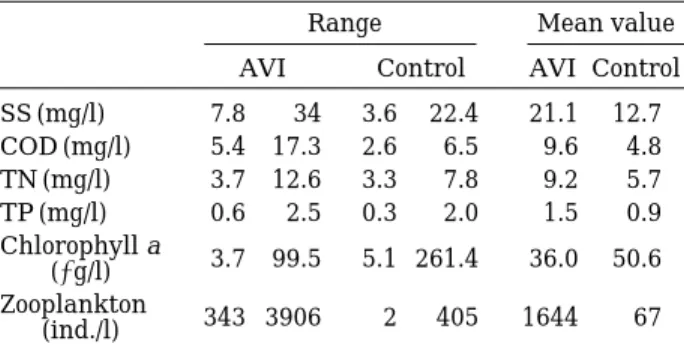
Most of the mean environmental parameters are higher at AVI site that at control site (Table 1). Also, zooplankton number of AVI site is about 25 times higher than that of control site (Fig. 1).
Table 1. The data ranges and mean values of environ- mental parameters in artificial vegetation is- land and control site.
Range Mean value
AVI Control AVI Control SS (mg/l) 7.8 34 3.6 22.4 21.1 12.7 COD (mg/l) 5.4 17.3 2.6 6.5 9.6 4.8 TN (mg/l) 3.7 12.6 3.3 7.8 9.2 5.7
TP (mg/l) 0.6 2.5 0.3 2.0 1.5 0.9
Chlorophyll a
(µg/l) 3.7 99.5 5.1 261.4 36.0 50.6 Zooplankton
(ind./l) 343 3906 2 405 1644 67
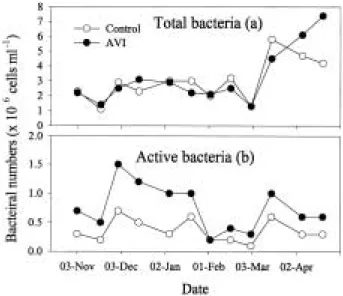
Total bacteria and respiratory active bacteria As shown in Fig. 2a, the variations of total bac- terial numbers have a similar pattern at both sites. Total bacterial numbers oscillated with a small variation from 3, Nov. 2001 to 3, March.
2002, but rapidly increased about 3-8 times in both sites after 3, March. There were no large differences in total bacterial numbers between two sites.
Respiratory active bacteria had a large tempo- ral fluctuation, but have same patterns of varia-
tion in two sites (Fig. 2b). At AVI, the active bac- terial numbers were more higher than those at control site. Particularly, in the cold season, the respiratory active bacterial numbers were higher than those of other periods. Due to the high val- ues of respiratory active bacterial numbers, the ratios of active bacteria to bacterial number in AVI site were twice higher than in control site (Fig. 3).
Enzymatic activities
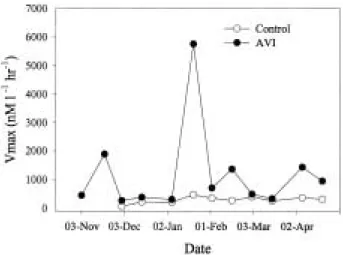
At AVI and control sites, Vmax of β-glucosid- ase was ranged 78-2358.7 nM l
-1hr
-1and 8.3- 94.8 nM l
-1hr
-1, respectively and showed a dis- tinct pattern between both sites (Fig. 4). At con-
Fig. 1. Photograph of zooplankton abundance under the artificial vegetation island installed in Lake Pal- dang.
Fig. 2. The variations of total bacteria and respiratory ac- tive bacteria in an artificial vegetation island and a control site.
Fig. 3. The variations of ratio of total bacteria to respira- tory active bacteria (%) of each sites.
Fig. 4. The variations of β-glucosidase activities in an artificial vegetation island and a control site.
trol site, the β-glucosidase activity was lower than that of AVI site and stayed constant till the end of the investigation period. But at AVI site, β-glucosidase activity had irregular fluctuation.
The Vmax of phosphatase was ranged 70.8- 480.7 nM l
-1hr
-1at control site and 271.9-5761.4 nM l
-1hr
-1at AVI site (Fig. 5). Like β-glucosid- ase activity, phosphatase activity of AVI site was higher than that of control site and exhibited irregular fluctuation.
DISCUSSION
AVI is composed of macrophytes, bed for sus- taining macrophytes and submerged media for bacterial accumulation. Macrophytes are well known as a nutrient remover, and N and P could be eliminated by regular harvesting (Ahn and Kong, 1998). To uptake these nutrients, roots of macrophytes should bee spreading into water column adsorb nutrients. But in water column, the concentration of nutrients could be low due to dilution. Thus, the nutrient concentration in water column might not be sufficient for the growth of macrophyte. For overcoming this un- certainty for supplying N and P to macrophytes, the bacteria on media play an important role of accumulating low N and P into high state.
In aquatic ecosystems, bacteria can accumulate low concentration of nutrients into biomass of high concentration of nutrients (Chróst et al., 1994). This concentrated biomass could be trans-
ferred to higher trophic level by ‘microbial loop’
(Azam and Cho, 1987).
Because of the bacterial growth on media and roots of macrophytes, the concentrations of COD, SS, T N, T P were higher at AVI than those at control site. Which were already reported (Shima- tani, 1996; Park et al., 2001). As such, a simple comparison of environmental parameters might not be proper evidence for water quality improve- ment. But, we have found out that there are higher numbers of zooplankton, active bacteria and enzymatic activities than outer water.
Zooplankton is a primary consumer of phyto- plankton. For sustaining dense population under the AVI, there must be large amounts of organic materials. There are some possible sources of organic materials. The first one is phytoplank- ton. The mean values of chlorophyll a under AVI are less than half of outer part. Chlorophyll a concentrations under AVI just after AVI installa- tion were half of outer water column. Moreover, under AVI, chlorophyll a concentration were higher at middle and lower layer than surface layer (Environmental Management Cooperation, 2000). Considering the factor that sunlight is blocked by bed and macrophytes under the AVI, large proportion of total phytoplankton came from outside of AVI by physical turbulence.
Second one is organic material released from macrophytes. Most of the emergent macrophytes, biomass of belowground part is more than 40% of whole plant biomass (Wetzel, 1983). At AVI site, the particulate and dissolved organic materials were released into water directly because below- ground part is submerged in water column. Thir- dly, attached bacteria on media and roots of mac- rophytes could play a role of source for organic materials for zooplankton growth. The submerg- ed solid surfaces such as roots of macrophytes are readily colonized by microorganisms, result- ing in the development of biofilm containing a variety of bacteria, fungi, macromolecules and particulate materials (Hunik et al., 1993). In ad- dition, between macrophyte and bacteria, there are some relationships such as symbiosis, com- mensalisms, and etc. Bacterial attachment re- quires hydrated polymer matrix (Fletcher, 1996), and attached bacteria synthesize the exopoly- saccharide to prevent detachment of daughter cells (Vadevivere and Kirchman, 1993). Thus the microorganism itself and secreted polymers by attached bacteria could provide food source to
Fig. 5. The variations of phosphatase activities in an arti- ficial vegetation island and a control site.
zooplankton.
When zooplankton population run short of phy- toplankton as a food source or increment of cya- nobacteria in ambient water column occur, they shift from algaevore to bacterivore (Shim and Ahn, 1992). We could not observe the microscopic evidence of bacterivore of zooplankton. But, because the high ratios of active bacteria and enzymatic activities under AVI were observed even though total bacterial numbers varied simi- lar at both sites, we may assume that the bac- teria could be grazed by zooplankton, because grazing pressure makes bacteria active (Guede, 1988).
Degrading activities, or β-glucosidase and phos- phatase activities, were higher at AVI than those at control site, and concentrations of water quality parameters such as particulate matters and nutrients were not high. However, the con- centrations of COD, SS, TN and TP were higher in AVI area as appeared in Table 1. As such, im- provement of water quality by AVI was not shown apparently in water quality parameters only.
β-Glucosidase is a broad specificity enzyme that catalyzes the hydrolysis of β-linked disac- charide of glucose, celluhexose, and carboxymethyl- cellulose (Barman, 1969) and it is very important and significant for glucose metabolism of micro- heterotrophs in aquatic ecosystems (Chróst, 1989). The Vmax values are higher at AVI than those at control site. According to Chróst (1991), addition of cellobiose strongly induced β-glucosi- dase synthesis. In addition, high molecular weight fraction of lake water was reported to stimulate the β-glucosidase activity (Kim et al., 1999). Thus, the higher activity in AVI was due to the diverse high molecule weight organic mate- rials originated from macrophytes and microor- ganisms.
Phosphatase are originated from phytoplank- ton and bacteria, of which substrate affinities are different (Jansson et al., 1988). When chlorophyll a concentration reached at the concentrations of 40.6 µ g/l, a 2.3 times higher than that of initial time, the phosphatase activity showed the high- est value. Afterward, chlorophyll a concentration of AVI site showed slightly higher until late February. Phosphatase activity is induced when inorganic phosphate in the water is exhausted (Ahn et al., 1993) and/or content of cellular phos- phate decreased (Chróst and Overbeck, 1987).
Therfore, phosphatase activity indicates the con-
centration of available phosphate in water column and the phosphate deficit of the phyto- plankton cell (Choi et al., 1992). But, the high TP values (Table 1) could be a source for sufficient phosphate under AVI. Therefore, high phos- phatase activity in AVI indicates another source of phosphatase in the system. A possible source is membrane bound phosphatase in phytoplank- ton (Wetzel, 1991).
With above results, a hypothetical model could be suggested. Under AVI, zooplankton play an important role. Zooplanktons graze mainly on phytoplankton coming from outside of AVI and bacteria grown on media and roots of macrophy- tes. Zooplankton grazing pressure makes bac- teria active. Also by ‘sloppy feeding’ of zooplank- ton, phytoplankton excretes phosphatase into water. By the succession of phytoplankton and zooplankton, the enzymatic activities are fluc- tuated (Fig. 4 and 5). Orthophosphate is gener- ated by phosphatase and bacteria are responsible for uptake of this orthophosphate (Currie et al., 1986). The organic materials are eliminated by the respiration of zooplankton and bacteria attached to media and roots of macrophytes and fish grazing on zooplankton and phytoplankton.
AVI itself is a newly created complex ecosys- tem with macrophyte, zooplankton, phytoplank- ton, bacteria and fish. This AVI can be useful technique for restoration and sustaining aquatic ecosystem, and indirect water quality improve- ment.
ACKNOWLEDGMENTS
This subject is supported by Ministry of Envi- ronment as “The Eco technopia 21 project”.
REFERENCE
Ahn, T.S. and D.S. Kong. 1998. Application of eco- technology for nutrient removal. Frontier in bio- logy: In Chou, C.H. and Shao, K.T. (eds). The chal- lenges of Biodiversity, Biotechnology and Sustain- able Agriculture, Academia Sinica, Taipei. pp. 209 -216.
Ahn, T.S., S.I. Choi and K.S. Joh. 1993. Phosphatase activities in Lake Soyang, Korea. Verh. Internat.
Verein. Limnol. 25: 183-186.
APHA. 2000. Standard Methods for the examination of water and wastewater. 20th ed. APHA. N.Y.
Azam, F. and B.B. Cho. 1987. Bacterial utilization of organic matter in the sea. Ecology of microbial communities. In Fletcher, M., Grey, T.R.G and Jones, J.G (eds), “Ecology of Microbials Communi- ties”, Cambridge University, Cambridge. pp. 216- 281.
Barman, T.E. 1969. Enzyme Handbook, vol. 2 Sprin- ger Verlag, Berlin. pp. 928.
Choi, S.I., T.S. Ahn and B.C. Kim. 1992. Degradation rates of organic phosphate in Lake Soyang. Kor.
J. Microbiol. 30: 113-118.
Chróst, R.J. 1989. Characterization and significance of β-glucosidase activity in lake water. Limnol.
Oceanogr. 34: 660-672.
Chróst, R.J. 1991. Environmental control of the syn- thesis and activity of aquatic microbial extoen- zymes. In Chróst R.J. (ed.), Microbial enzymes in aquatic environments, Springer Verlag, N.Y. pp.
29-59.
Chróst, R.J. and H. Rai. 1994. Bacterial secondary production. In Chróst R.J. (ed.), Microbial ecology of Lake Plussee, Springer Verlag, N.Y. pp. 92- 117.
Chróst, R.J. and J. Overbeck. 1987. Kinetics of alka- line phosphatase activity and phosphorus ava- ilability for phytoplankton and bacterioplankton in lake Plussee (north German eutrophic lake).
Microb. Ecol. 13: 229-248.
Currie, D.J., E. Bentzen and J. Kalff. 1986. Does alga bacteria phosphorus partitioning vary among lakes.
A comparative study of orthophosphate uptake and alkaline phosphatase activity in freshwater.
Can. J. Fish. Aquat. Sci. 43: 311-318.
Environmental Management Cooperation. 2000.
Report of artificial vegetation island manage- ment. EMC.
Fletcher, M. 1996. Bacterial attachment in aquatic environments: A diversity of surfaces and adhe- sion strategies. In Fletcher, M. (ed.), “Bacterial Adhesion”. John wiley & Sons, N.Y., pp. 1-24.
Guede, H. 1988. Direct and indirect influence of crus- tacean zooplankton on bacterioplankton of Lake Constance. Hydrobiologia. 159: 63-73.
Hobbie, J.E., R.J. Daley and S. Japer. 1977. Use of a nucleopore filters for counting bacteria by fluores- cence microscopy. Appl. Environ. Microbiol. 33:
225-1228.
Hunik, J.H., M.P. Hoogen, W. Boer, M. Smit and J.
Tramper. 1993. Quantitative determination of the spatial distribution of Nitrosomonas europaea and
Nitrobacter agilis cells immobilized in K Car- rageenan gel beads by a specific fluorescent anti- body labelling technique. Appl. Environ. Microbiol.
59: 1951-1954.
Jansson, M., H. Olsson and K. Peterson. 1988. Phos- phatase: Origin, characteristics and function in lakes. Hydrobiologia 170: 157-176.
Kim, J.H. and K.H. Cho. 1996. Water quality improve- ment by aquatic macrophyte: A case study in Lake Paldangho. Proceeding of Korea-Japan Joint Symposium on Ecological Engineering. pp.
3-17.
Kim, K.K., S.H. Hong, D.J. Kim, S.I. Choi, and T.S.
Ahn. 1999. The change of bacterial numbers and β-glucosidase activities by the size fraction of DOM in Lake Soyang. Kor. J. Microbiol. 35: 35- 40.
Park, H.J., O.B. Kwon and T.S. Ahn. 2001. Water quality improvement by artificial floating island.
J. Korean Env. Res. Reveg. Tech. 4: 90-97.
Rodriguez, G.G., D. Phipps, K. Ishiguro and H.F.
Ridgway. 1992. Use of a fluorescent redox probe for direct visualization of actively respiring bacte- ria. Appl. Envriron. Microbiol. 58: 1801-1808.
Sim, D.S. and T.S. Ahn. 1992. On the feeding behav- ior of zooplankton in Lake Soyang. Kor. Jour.
Microbiol. 30: 129-133.
Shimatani Y. 1996. The effect and ecosystem of an artificial vegetated island, Ukishima, in Lake Ka- sumigaura. Proc. Korean-Japan Joint Symposi- um on Ecological Engineering. pp. 39-44.
Vandevivere, P. and D.L. Kirchman. 1993. Attach- ment simulates exopolysaccharide synthesis by a bacterium. Appl. Envion. Microbiol. 59: 3280- 3286.
Wetzel, R.G. 1983. Limnology, 2nd ed. CBS College Publishing. pp. 519-614.
Wetzel, R.G. 1991. Extracellular enzymatic interac- tions: Storage, redistribution, and interspecific communication. In Chróst, R.J. (eds) “Microbial enzymes in aquatic environments”. Springer Verlag. 1991. pp. 6-28.
Wolverton, B.C. 1987. Aquatic plants for water treat- ment and resource recovery: An overview, In Reddy, K.R. and Smith, W.H. (eds) “Aquatic plants for water treatment and resource recovery”.
Magnolia Publishing Inc., Orlando, FL., pp. 141- 152.
(Received 7 Oct. 2002, Manuscript accepted 13 Dec. 2002)
⁄ ¤
팔당호에 설치된 인공식물섬에서의 세균 수와 체외효소 활성도의 변화
변명섭∙유재준
1∙김옥선
1∙최승익
2∙안태석
1, 3*
(국립환경연구원, 1강원대학교 환경학과,2강원대학교 환경연구소, 3강원지역환경기술개발센터)
팔당호에 설치된 인공식물섬에서 미생물의 역할을 알아보기 위하여 동물플랑크톤 군집 크기, 총세 균수, 활성세균수, β-glucosidase와 phosphatase의 체외효소활성도를 2001년 11월 3일부터 2002 년 4월까지 격주로 인공식물섬이 설치된 지역과 바깥지역을 대상으로 조사 분석하였다. 인공식물 섬 아래에서는 일반적으로 측정하는 환경요인들은 대조구보다 수질이 나쁜 것으로 나타났다. 그러 나, 동물 플랑크톤의 수는 대조구보다 평균 25배, 활성세균의 수는 평균3-8배, 그리고 체외효소활 성도는 훨씬 높은 값을 보였다. 이러한 결과는 인공식물섬에서는 동물플랑크톤-식물플랑크톤-수 초-세균의 밀접한 관계가 존재하고, 이 관계에 의하여 동물플랑크톤과 세균의 호흡, 분해작용으로 유기물이 제거되는 것으로 판단되었다.