738
Copyright © 2017 The Korean Society of Fisheries and Aquatic Science pISSN:0374-8111, eISSN:2287-8815
서 론
2016
년국내전복류(Haliotis spp.)
양식생산량은약12,000
톤으로패류양식총생산량인약362,000
톤의3.3%
에불과하지 만,
가치면에서는전복양식생산금액이약3,500
억원으로국내 패류양식총생산금액인약6,300
억원의55.5%
이상을차지하 는것으로나타나서국내패류양식업에있어서전복이얼마나중요한위치를차지하고있는지를잘보여주고있다
(KOSIS,
2017).
전복류의세계양식총생산양도2000
년에는2,540
톤에불과하였으나
, 2015
년에는139,594
톤으로약55
배증가하였으 며(FAO, 2017),
이러한국내외전복양식생산양의증가추세는 앞으로도지속될것으로예상된다.
전복의상업적중요성때문에국내외적으로전복의영양소요 구량
(Uki et al., 1986a, b; Mai et al., 1995a, b; Britz, 1996; Lee and Park, 1998; Gómez-Montes et al., 2003; Thongrod et al., 2003),
전복용배합사료개발(Viana et al., 1993; Britz et al., 1994; Lee, 1998; Garcia-Esquivel and Felbeck, 2009),
전복용 배합사료내어분과카제인(Uki et al., 1986; Lee et al., 1998a;
배합사료내 규조류 우점인 미세조류 오일 추출물 첨가가 까막전복(Haliotis discus)의 성장, 체조성 및 패각 색채에 미치는 영향
김희성·이기욱·정해승
1·김준
1·윤아영
1·조성환
1*·이계안
2·김근용
3한국해양대학교 해양과학기술전문대학원, 1한국해양대학교 해양생명과학부, 2㈜엔엘피, 3아쿠아진텍
Effect of Dietary Microalgae, Diatom-Dominant, Oil Extracts on
Growth, Body Composition and Shell Color of Juvenile Abalone Haliotis discus
Hee Sung Kim, Ki Wook Lee, Hae Seung Jeong1, June Kim1, Ahyeong Yun1, Sung Hwoan Cho1*, Gye- An Lee2 and Keun-Yong Kim3
Department of Convergence Study on the Ocean Science and Technology, Korea Maritime and Ocean University, Busan 49112, Korea
1Division of Marine BioScience, Korea Maritime and Ocean University, Busan 49112, Korea
2NLP Corporation, Busan 46047, Korea
3AquaGenTech, Busan 48520, Korea
Effect of dietary inclusion of microalgae, diatom-dominant, oil extracts (MOE) on growth, body composition and shell color of juvenile abalone Haliotis discus was investigated. One thousand four hundred and seventy juvenile abalone were distributed into 21 plastic rectangular containers. Seven experimental diets were prepared: MOE0, MOE0.01, MOE0.05, MOE0.1, MOE0.5, MOE1 and MOE2 diets containing MOE at the concentrations of 0, 0.01, 0.05, 0.1, 0.5, 1 and 2% at the expense of mixture of squid liver and soybean oils, respectively. The experimental diets were fed to abalone in triplicate once a day with a little leftover for 16 weeks. Weight gain and specific growth rate of abalone fed the MOE1 and MOE2 diets were higher than those of abalone fed the all other diets. The shell length and soft body weight of abalone fed the MOE2 diet were longer and heavier than those of abalone fed the all other diets.
Crude protein and ash content of the soft body of abalone were affected by dietary inclusion of MOE. The shell color of abalone fed the all experimental diets was different from that of wild abalone. In conclusion, dietary inclusion of MOE improved growth of abalone, but did not shell color of abalone.
Key words: Abalone Haliotis discus , Microalgae oil extract (MOE), Growth, Body composition, Shell color
This is an Open Access article distributed under the terms of the Creative Commons Attribution Non-Commercial Licens (http://creativecommons.org/licenses/by-nc/3.0/) which permits unrestricted non-commercial use, distribution, and reproduction in any medium, provided the original work is properly cited.
https://doi.org/10.5657/KFAS.2017.0738
Korean J Fish Aquat Sci 50(6) 738-744, December 2017
Received 31 October 2017; Revised 17 November 2017; Accepted 21 November 2017
*Corresponding author: Tel: +82. 51. 410. 4755 Fax: +82. 51. 404. 4750
E-mail address: [email protected]
Shipton and Britz, 2001; Cho et al., 2008; Cho, 2010; Jung et al., 2016; Myung et al., 2016)
및해조류(Kim et al., 2015; Jang et al., 2017)
대체원개발등에대한다양한연구가수행된바있 다.
일반적으로양식산전복은자연산전복과의패각색채차 이에따른소비자들의선호도가낮아진다.
따라서양식산전복 의패각을자연산전복과유사하게만들기위한사료첨가제개 발등에대한연구도수행된바있으며(Cho et al., 2006; Ju et al., 2016),
특히, Lim and Lee (2003)
는참전복(Haliotis discus hannai)
의경우Spirulina
와Porphyra powder
를배합사료에첨 가시패각의색채가자연산전복과유사하게나타난다고보고 한바있다.
양식산업에있어서미세조류
(microalgae)
는이매패류의전성 장단계,
전복과갑각류와몇몇어종의유생과초기먹이생물 및동물성플랑크톤의먹이로서폭넓게사용되고있다(Brown et al., 1997; Brown, 2002; Spolaore et al., 2006).
특히,
미세조 류는단백질(6%-52%),
탄수화물(5%-23%)
과지질(7%-23%)
을다양하게 함유하며,
모든종들이유사한아미노산 조성을 구성하고 있고 필수아미노산이 풍부한 것으로 알려져 있다(Brown et al., 1997).
또한미세조류에는chlorophyll (0.5%- 1%)
과carotenoids (0.1%-0.2%)
를함유하며, Dunaliella
는약14% β-carotene
을함유하는것으로알려져있다(Spolaore et al., 2006; Christaki et al., 2013). Christaki et al. (2013)
은미세 조류에다량으로함유된지용성물질인carotenoids
의특성,
추 출방법과양식산업에서의응용과중요성뿐만아니라화장품 이나약품소재로서의개발가능성및그가치에대해서잘보 고하였다.
따라서다양한carotenoids
를함유한미세조류를양 식산전복의패각색채개선용사료첨가제로서이용가능할것 으로생각된다.
최근미세조류는
biofuel
생산을위한재료로서도많은관심 을받고있으며(Li et al., 2008; Lam and Lee, 2011),
특히Nan-
nochloropsis
는실내에서대규모로바이오디젤생산에적합한미세조류로알려져있다
(Moazami et al., 2012).
또한바이오디 젤생산에이용되고남은미세조류(Nannochloropsis oceanica)
잔사(biomass residue)
는다량의단백질을함유하고있기때문 에참전복용배합사료내어분대체원으로서아주우수하다고 보고된바있다(Myung et al., 2016).
따라서본연구에서는까 막전복치패용배합사료내미세조류오일추출물(Microalgae oil extracts, MOE)
의첨가가까막전복의성장,
체조성및패각 색채개선에미치는영향을조사하였다.
재료 및 방법
미세조류 오일 추출물
미세조류오일추출방법은
Bligh and Dyer (1959), Xu et al.
(2006)
와Lee et al. (2010)
의방법을응용하였으며, MOE
는㈜
엔엘피(
부산시기장군소재)
에서제공받았다.
미세조류오일추출방법은다음과같다
. MOE
는규조류혼합미세조류분말(Navicula, Melosira, Stephanopyxis
와Odontella
우점종) 500 g
을5 L
비이커에담근후hexane 3.5 L
를첨가하였다.
교반기를 이용하여상온에서3
시간동안잘섞어주고브후너깔때기를감 압플라스크에꽂아여과지를놓고aspirator (Eyela, A1000S, Japan)
를이용하여여과한후회전증발농축기(Buchi, Vacuum controller V-850, Rotapor R-215, Vacuum pump V-700, Heat- ing bath B-491, Refrigerator Eyela cca-111, Japan)
를50°C, 241 mbar, 120 rpm
으로설정하여MOE
를수거하였다. 전복의 사육 및 관리
실험에 이용된 까막전복 치패는 전복양식장
(
제주특별자치 도제일수산)
에서구입하여사육실험조건에2
주간적응시켰 으며,
적응기간동안에는건미역을1
일1
회전체중의2-3%
정 도공급하였다. 21
개의70 L
플라스틱수용기(
가로×
세로×
높 이, 120 cm×36 cm×30 cm)
에각각70
마리의전복치패(
평균 마리당무게, 1.68 g)
를수용하였다.
플라스틱수용기는3
개의9
톤콘크리트raceway (
수량, 3
톤)
에분산수용하여서충분한 양의air
를공급해주었고,
각각의플라스틱수용기에는shelter
를넣어주어서전복의은신처를제공해주었다.
환수량은48.2 L/min/raceway
이었고,
사료의공급은1
일1
회(17:00)
충분한 양의먹이를공급(
전체중의2.5%-3.5%)
하였으며,
남은먹이는 매일제거하여 주었다. 16
주간의사육실험 기간동안수온은14.8℃-17.1℃ (Mean ± SD, 16.6 ± 0.52℃)
의범위이었으며,
빛은자연광주기를따랐다.
실험사료의 준비
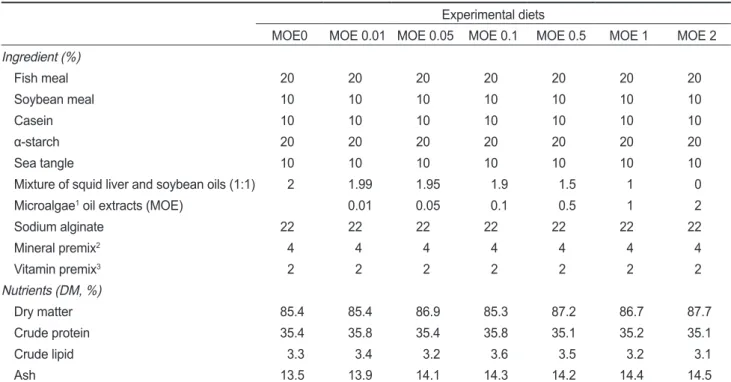
전복용실험사료의사료조성표는
Table 1
과같다.
대조구사 료(MOE0)
는주요단백질원으로어분20%,
대두박10%
와카 제인10%
를첨가하였으며,
주요탄수화물원으로α-
전분20%
를첨가하였다
.
대조구사료의주요지질원으로오징어간유와 대두유의 혼합유(1:1
혼합) 2%
를첨가하였으며,
이혼합유의0.01, 0.05, 0.1, 0.5, 1
및2%
를MOE
로각각대체한MOE0.01, MOE0.05, MOE0.1, MOE0.5, MOE1
및MOE2
사료를각각 준비하였다.
모든실험사료는전복의영양소요구량을충족하 도록설계제조하였다(Uki et al., 1986a; Mai et al., 1995a, b).
실험용배합사료의성형은각각의사료원료를잘혼합하여혼 합물
100 g
당물100 g
을가하여다시잘혼합한후,
압착하여 가로1 cm,
세로1 cm,
두께0.15 cm
가되도록실험사료를절 단하여5%
의염화칼슘수용액에담궈알긴산나트륨을칼슘염 으로치환시켰다.
제조한실험사료는그늘에서건조시킨이후냉동고
(-20℃)
에저장하면서사료공급시소량씩사용하였다.
전복의 Biological index 측정 및 일반성분분석
16
주간의사육실험종료시각각의실험구에서생존한전복20
마리씩을무작위로샘플하여냉동보관(-70°C)
하였으며,
전 복의각장,
각폭및각고는digital caliper (Mitutoyo Corpora-
tion, Kawasaki, Japan)
을이용하여측정하였고,
전중량에대 한가식부의비율을계산하였다.
전복의일일성장율(Specific growth rate, SGR)
은Britz (1996)
의방법에따라서계산하였 다: SGR=[(Ln(Wf)-Ln(Wi))/days of feeding]×100, where Ln(Wf)=natural log of the final mean weight of abalone and Ln(Wi)=natural log of the initial mean weight of abalone.
실험사료와 전복가식부의 일반성분 분석은
AOAC(1990)
에따라조단백질은Kjeldahl method (Auto Kjeldahl System, Buchi B-324/435/412, Switzerland)
과조지방(
에테르추출법)
을분석하였으며,
조회분은550°C
회화로에서4
시간동안태운후정량하였고
,
수분은105°C dry oven
에서24
시간건조시 킨후측정하였다.
전복의 패각 색채 분석
실험종료시각수조별무작위로
30
마리(
실험사료당총90
마리)
의전복을샘플하여전복패각의색채분포를한국표준 색표집(
케이비에스한국색채연구소, 1991)
에의거하여분리하 여가장빈번한상위3
가지의색채와그빈도를측정하여자연산전복과비교하여
MOE
첨가에따른전복패각의색채변화를조사하였다
.
Table 1. Ingredients (%, dry matter basis) and nutrient composition of the experimental diets
Experimental diets
MOE0 MOE 0.01 MOE 0.05 MOE 0.1 MOE 0.5 MOE 1 MOE 2 Ingredient (%)
Fish meal 20 20 20 20 20 20 20
Soybean meal 10 10 10 10 10 10 10
Casein 10 10 10 10 10 10 10
α-starch 20 20 20 20 20 20 20
Sea tangle 10 10 10 10 10 10 10
Mixture of squid liver and soybean oils (1:1) 2 1.99 1.95 1.9 1.5 1 0
Microalgae1 oil extracts (MOE) 0.01 0.05 0.1 0.5 1 2
Sodium alginate 22 22 22 22 22 22 22
Mineral premix2 4 4 4 4 4 4 4
Vitamin premix3 2 2 2 2 2 2 2
Nutrients (DM, %)
Dry matter 85.4 85.4 86.9 85.3 87.2 86.7 87.7
Crude protein 35.4 35.8 35.4 35.8 35.1 35.2 35.1
Crude lipid 3.3 3.4 3.2 3.6 3.5 3.2 3.1
Ash 13.5 13.9 14.1 14.3 14.2 14.4 14.5
1Microalgae dominantly composed of Navicula, Melosira, Stephanopyxis and Odentella oil extracts (MOE) was supplied by NLP Co. Ltd (Busan, Korea). 2Mineral premix and 3Vitamin premix were same as Jung et al. (2016)’s study.
Table 2. Survival, weight gain and specific growth rate of juvenile abalone Haliotis discus fed the experimental diets containing various levels of microalgae oil extracts for 16 weeks
Experimental diets Initial weight (g/abalone) Final weight (g/abalone) Survival (%) Weight gain (g/abalone) SGR1 (%/day)
MOE0 1.68±0.006 4.86±0.100 97.1±0.82a 3.19±0.095d 0.93±0.015d
MOE0.01 1.67±0.002 4.87±0.090 98.6±0.82a 3.20±0.089d 0.93±0.016d
MOE0.05 1.67±0.004 5.05±0.103 97.6±0.95a 3.37±0.105cd 0.96±0.019c
MOE0.1 1.68±0.001 5.32±0.069 94.3±1.43a 3.65±0.070bc 1.00±0.012bc
MOE0.5 1.68±0.002 5.42±0.089 97.1±0.82a 3.74±0.091b 1.02±0.015b
MOE1 1.68±0.002 5.79±0.061 97.1±1.43a 4.12±0.061a 1.08±0.009a
MOE2 1.68±0.001 5.99±0.114 96.7±1.26a 4.31±0.113a 1.11±0.016a
MOE, microalgae, diatom-dominant, oil extracts. 1Specific growth rate (SGR) = [(Ln(Wf)-Ln(Wi))/days of feeding]×100, where Ln(Wf)=natural log of the final mean weight of abalone and Ln(Wi)=natural log of the initial mean weight of abalone. Values (means of triplicate±SE) in the same column sharing the same superscript letter are not significantly different (P>0.05).
통계 분석
One-way ANOVA
와Duncan's multiple range test (Duncan, 1955)
로서SAS version 9.3 program (SAS Institute, Cary, NC, USA)
을이용하여실험구간의유의성을검정하였다.
결과 및 고찰
MOE
를농도별로첨가한배합사료를16
주간공급하여사육 한결과(Table 2),
까막전복치패의생존율은94.3%-98.6%
의범위로서
MOE
첨가농도별에따른유의적인차이는없었다(P>0.05).
그러나전복의증체량(Weight gain)
과일일성장율(SGR)
은MOE1
과MOE2
사료공급구가다른 사료공급구들 보다유의적으로높게나타났으며(P<0.05),
배합사료내MOE
함량과전복의증체량과 일일성장율은2
차 함수적상관관계 를보였으며(Y= -0.3257X
2+1.1578X+3.2922, R
2=0.8427, Y=
증체량
, X=MOE
함량; Y= -0.0551X
2+0.1896X+0.9457, R
2=0.8290, Y=
일일성장율, X=MOE
농도),
최대 증체량은MOE
함량1.78%
와최대일일성장율은MOE
함량1.72%
이 었다.
비록본연구에서
MOE
의영양학적인분석은이루어지지않 았지만,
전복용배합사료내MOE
첨가에따른전복의성장개선효과는이들미세조류에함유된여러가지유용성물질
,
특 히필수지방산이나지용성carotenoids
또는지용성비타민등 의영양학적개선에서기인한것으로판단된다. 5
종의해조류(Alaria esculenta, Laminaria digitata, L. saccharina, Palmaria palmatu, Ulva lactuca)
를2
종의 전복(H. discus hannai, H.
tuberculata)
에 공급시eicosapantenoic acid (EPA, 20:5n-3)
가2
종의전복성장에필수적이었으며,
또한18:3n-3
를포함 한n-3
계polyunsaturated fatty acid (PUFA)
와18:2n-6
를포 함한n-6
계PUFA
가이들전복의빠른성장에기여한다고보 고한바있다(Mai et al., 1996).
참굴(Crassostrea gigas)
과바 지락(Ruditapes decussatus)
과같은패류의먹이로서미세조류 와사료공급을비교한결과,
미세조류내함유된필수지방산,
특히20:5n-3
와22:6n-3
와같은n-3 PUFA
의중요성이잘알 려져있다(Knauer and Southgate, 1997; Fernández-Reiriz et al., 1999).
그리고배합사료내지용성비타민(A, D, E, K)
이참 전복의생존율이나성장에미치는영향에대해서보고된바있 다(Tan, 2001; Zhou et al., 2001; Fu et al., 2006; Zhang et al., 2007). Dang et al. (2011)
은전복(H. laevigata)
치패용배합사 료내미세조류인Dunaliella salina
또는Arthrospira maxima
을10%
첨가시성장이개선된다고보고하였다.
또한Duong et al. (2016)
은3
년생전복(H. laevigata)
의경우시판용배합사료Table 4. Chemical composition (%) of the soft body of juvenile abalone Haliotis discus at the end of the 16-week feeding trial
Experimental diets Moisture Crude protein Crude lipid Ash
MOE0 25.4±0.09a 21.4±0.03c 1.4±0.03a 3.2±0.06b
MOE0.01 25.6±0.08a 21.9±0.05a 1.5±0.04a 3.2±0.05ab
MOE0.05 25.6±0.06a 21.4±0.07c 1.5±0.07a 3.2±0.04ab
MOE0.1 25.6±0.09a 21.8±0.02b 1.5±0.06a 3.3±0.02a
MOE0.5 25.6±0.12a 21.1±0.05d 1.4±0.03a 3.3±0.05a
MOE1 25.6±0.07a 21.1±0.03d 1.5±0.07a 3.1±0.07b
MOE2 25.7±0.04a 20.8±0.03e 1.5±0.06a 3.2±0.04ab
MOE, microalgae, diatom-dominant, oil extracts. Values (means of triplicate±SE) in the same column sharing the same superscript letter are not significantly different (P>0.05).
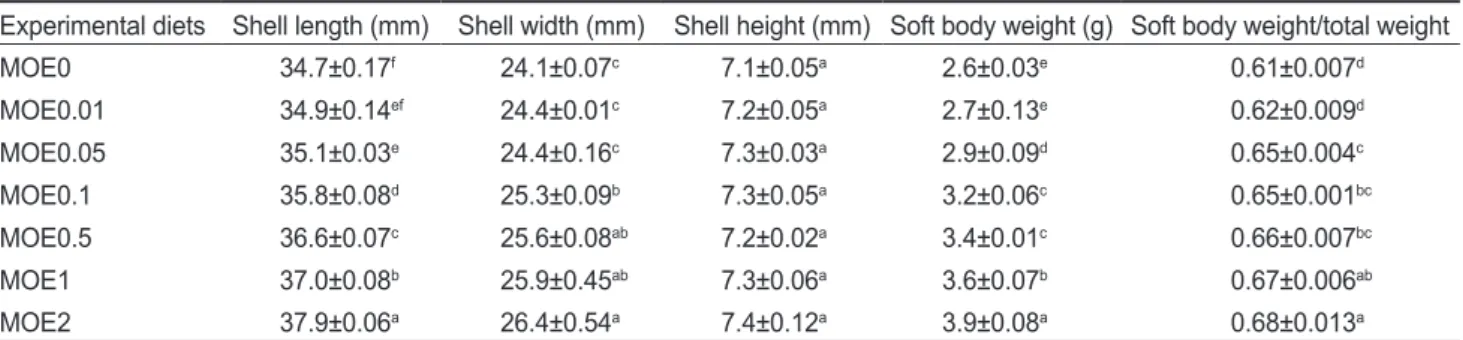
Table 3. Shell length, shell width, shell height, soft body weight and the ratio of soft body weight to total weight of juvenile abalone Haliotis discus fed the experimental diets containing various levels of microalgae oil extracts for 16 weeks
Experimental diets Shell length (mm) Shell width (mm) Shell height (mm) Soft body weight (g) Soft body weight/total weight
MOE0 34.7±0.17f 24.1±0.07c 7.1±0.05a 2.6±0.03e 0.61±0.007d
MOE0.01 34.9±0.14ef 24.4±0.01c 7.2±0.05a 2.7±0.13e 0.62±0.009d
MOE0.05 35.1±0.03e 24.4±0.16c 7.3±0.03a 2.9±0.09d 0.65±0.004c
MOE0.1 35.8±0.08d 25.3±0.09b 7.3±0.05a 3.2±0.06c 0.65±0.001bc
MOE0.5 36.6±0.07c 25.6±0.08ab 7.2±0.02a 3.4±0.01c 0.66±0.007bc
MOE1 37.0±0.08b 25.9±0.45ab 7.3±0.06a 3.6±0.07b 0.67±0.006ab
MOE2 37.9±0.06a 26.4±0.54a 7.4±0.12a 3.9±0.08a 0.68±0.013a
MOE, microalgae, diatom-dominant, oil extracts. Values (means of triplicate±SE) in the same column sharing the same superscript letter are not significantly different (P>0.05).
에포도추출물
(
항산화제와catechins
과같은polyphenol
함유)
과녹차추출물(catechins
과같은polyphenol
함유)
의첨가시고수온
(25℃)
에노출된전복의생존율이개선되었으나,
땅콩추출물이나
vitamin C
첨가에따른전복의생존율개선효과는없었 다고보고하였다.
16
주간 까막전복 사육실험 종료시전복의 각장과 가식부무게는
MOE2
사료공급구에서 다른 사료들을 공급한 실험구보다 유의적으로 길거나 무거웠으며
(P<0.05), MOE
농도 에따라서길어지거나무거워지는것으로나타났다(Table 3).
각폭은
MOE2
사료공급구가MOE0, MOE0.01, MOE0.05
와MOE0.1
사료공급구보다 유의적으로 높았으나(P<0.05),
MOE0.5
또는MOE1
사료공급구와는 유의적인 차이가 없었다
.
각고는 실험구간에 유의적인 차이가나타나지 않았다(P>0.05).
전체중에대한가식부중량의비는MOE2
사료공급 구가MOE0, MOE0.01, MOE0.05, MOE0.1
과MOE0.5
사료 공급구보다유의적으로높았으나(P<0.05), MOE1
사료공급구 와는유의적인차이는없었다(P>0.05).
전체중에대한가식부의비율도
MOE
첨가량에따라서증가하는경향을보였다.
각고를제외한전복의
biological index (
각장,
각폭,
가식부무게 와전체중에대한가식부의비율)
도전복의성장을비교적잘반 영하고있는것으로나타났으며,
유사한연구결과가보고된바 있다(Bautista-Teruel et al., 2003; Cho, 2010; Lee et al., 2017).
까막전복가식부의수분함량과조지질함량은
MOE
첨가에따른유의적인차이가나타나지않았다
(P>0.05) (Table 4).
조단백질함량은
MOE0.01
사료공급구가다른사료공급구들보다유의적으로높게나타났으며
(P<0.05), MOE2
사료공급구 에서가장낮게나타났다.
회분함량은MOE0.1
과MOE0.5
사 료공급구가MOE0
또는MOE1
사료공급구보다유의적으로 높게나타났으나(P<0.05), MOE0.01, MOE0.05
또는MOE2
사료공급구와는유의적인차이가없었다(P>0.05).
자연산전복의경우패각은주로
yellow red-orange
색을띄 지만(Table 5), MOE
를첨가한사료공급구에서동일하게주로green-yellow
색을띄는것으로나타났다.
본연구에서MOE
가함유된사료를공급한모든전복의패각색채가주로
green-yel-
low
로나타나는점을고려할때자연산전복의패각색채와유사한색소를가진미세조류를선정하여이들의
MOE
를전복용 배합사료내첨가시자연산전복패각색채에가까운색채개선 효과를기대할수있을것으로판단된다. Lim and Lee (2003)
에따르면배합사료내김(Porphyra)
분말과Spirulina
를첨가한 사료를공급한참전복의패각색채가paprika
추출물이나yeast astaxanthin
을첨가한사료를공급한전복의패각색채보다자 연산전복과유사하게나타났으며,
패각색채변화에는phyco- erythrin
이나phycocyanin
과 같은수용성단백색소가영향을 미친다고서술한바있다.
또한Ju et al. (2016)
은참전복용배 합사료내carotenoid
색소가풍부한oleopaprika carotenoid
추 출물0.5%
를첨가하여7
개월간공급한결과,
배합사료내여러 가지영양소가해조류먹이인Pacific dulse Palmaria mollis
보 다우수함에도불구하고배합사료를공급한전복이낮은성장 을보였으며, 0.5% oleopaprika carotenoid
추출물을첨가한배 합사료를공급한전복의패각색채는해조류를공급한전복의 패각색채와다르게나타나서oleopaprika carotenoid
추출물 첨가에따른전복패각의색채개선효과는없는것으로나타 났으며,
해조류를공급한전복패각의주된색소는biliverdin
과cysteine-biliverdin
이라고보고하였다.
이상의결과를고려할때
,
본실험에이용된규조류우점종혼합의미세조류오일추출물
(MOE)
은배합사료내오징어간유와대두유의혼합유대신에
1.72%
까지첨가시까막전복치패의성장을개선시켰으나
,
패각색채개선효과는나타나지않 았다.
사 사
이 논문은
2017
년도 정부(
미래창조과학부)
의 재원으로한국연구재단의 지원을 받아 수행된 기초연구사업임
(No.
2017R1A2B4009773)
이며,
이에감사드립니다.
Table 5. The hue of shell of juvenile abalone Haliotis discus at the end of 16-week feeding trialAbalone Most abundant color of shell Frequency
1 2 3 1 2 3
Wild 7.5YR-10YR1 2
MOE0 5GY2-7.5GY 7.5GY-10GY 2.5GY-5GY 34 33 16
MOE0.01 5GY-7.5GY 7.5GY-10GY 2.5GY-5GY 38 24 17
MOE0.05 5GY-7.5GY 2.5GY-5GY 7.5GY-10GY 29 25 23
MOE0.1 5GY-7.5GY 7.5GY-10GY 2.5GY-5GY 36 23 21
MOE0.5 5GY-7.5GY 7.5GY-10GY 10GY-2.5G3 36 29 11
MOE1 5GY-7.5GY 7.5GY-10GY 2.5GY-5GY 30 25 20
MOE2 5GY-7.5GY 7.5GY-10GY 2.5GY-5GY 41 29 10
MOE, microalgae, diatom-dominant, oil extracts. 1YR, yellow red-orange. 2GY, green-yellow. 3G, green.
References
AOAC (Association of Official Analytical Chemists). 1990. Of- ficial Methods of Analysis (15th edn). Association of Official Analytical Chemists, Arlington, VA, U.S.A.
Bautista-Teruel MN, Fermin AC and Koshio SS. 2003. Diet de- velopment and evaluation for juvenile abalone, Haliotis asini-
na: animal and plant protein sources. Aquaculture 219, 645-
653. https://dx.doi.org/10.1016/S0044-8486(02)00410-6.Bligh EG and Dyer WJ. 1959. A rapid method of total lipid ex- traction and purification. Can J Biochem and Physiol 37, 911-917. http://dx.doi.org/10.1139/o59-099.
Britz PJ. 1996. The suitability of selected protein sources for inclusion in formulated diets for the South African abalo- ne, Haliotis midae. Aquaculture 140, 63-73. http://dx.doi.
org/10.1016/0044-8486(95)01197-8.
Britz PJ, T. Hecht T, Knauer and Dixon MG. 1994. The devel- opment of an artificial feed for abalone farming. S Afr J Sci 90, 7-8.
Brown MR, Jeffrey SW, Volkman JK and Dunstan GA. 1997.
Nutritional properties of microalgae for mariculture. Aqua- culture 151, 351-331. http://dx.doi.org/10.1016/S0044- 8486(96)01501-3.
Brown MR. 2002. Nutritional value of microalgae for aquacul- ture. In: Cruz-Suarez LE, Ricque-Marie D, Tapia-Salazar M, Gaxiola-Cortes MG, Simoes N (eds) Advances en nutricion acuicola VI. Memorias del VI symposium Internacional de Nutricion Acuicola. 3-6th September, Cancun, Mexico.
Cho S H. 2010. Effect of fishmeal substitution with various ani- mal and/or plant protein sources in the diet of the abalone
Haliotis discus hannai Ino. Aquacult Res 41, e587-e593.
http://dx.doi.org/10.1111/j.1365-2109.2010.02561.x.
Cho SH, Park J, Kim C, Yoo J, Lee S and Choi C. 2006. Effect of the various sources of dietary additives on growth, body composition and shell color of abalone Haliotis discus han-
nai. J Aquaculture 19, 275-280. http://dx.doi.org/10.1002/
jsfa.5902.
Cho SH, Park J, Kim C and Yoo J. 2008. Effect of casein substitution with fishmeal, soybean meal and crustacean meal in the diet of the abalone Haliotis discus hannai Ino.
Aquacult Nut 14, 61-66. http://dx.doi.org/10.1111/j.1365- 2095.2007.00505.x.
Christaki E, Bonos E, Giannenas I and Florou-Paneri P. 2013.
Functional properties of carotenoids originating from al- gae. J Sci Food Agric 93, 5-11. http://dx.doi.org/10.1002/
jsfa.5902.
Dang VT, Li Y, Speck P and Benkendorff K. 2011. Effects of micro and macroalgal diet supplementations on growth and immunity of greenlip abalone, Haliotis laevigata. Aqua- culture 320, 91-98. http://dx.doi.org/10.1016/j.aquacul- ture.2011.08.009.
Duncan DB. 1955. Multiple range and multiple F tests. Biomet-
rics 11, 1-42.
Duong DN, Qin JG, Harris JO, Hoang TH, Bansemer MS, Cur- rie K, Phan-Thien K, Dowell A and Stone, DAJ. 2016. Ef- fects of dietary grape seed extract, green tea extract, peanut extract and vitamin C supplementation on metabolism and survival of greenlip abalone (Haliotis laevigata Donovan) cultured at high temperature. Aquaculture 464, 364-373.
http://dx.doi: 10.1016/j.aquaculture.2016.07.011.
FAO (Food and Agriculture Organization). 2017. Food and Ag- riculture Organization of the United Nations. Rome, Italy.
Fernández-Reiriz MJ, Labarta U, Albentosa M and Pérez- Camacho A. 1999. Lipid profile and growth of the clam spat, Ruditapes decussatus (L), fed with microalgal diets and cornstarch. Comp Biochem Physiol B 124, 309-318.
http://dx.doi.org/10.1016/S0305-491(99)00129-7.
Fu J, Zhang W, Mai K, Feng X, Xu W, Liufu Z and Tan B. 2006.
Effects of dietary vitamin A on antioxidant response of aba- lone Haliotis discus hannai Ino. Acta Oceanol Sin 25, 141- Garcia-Esquivel Z and Felbeck H. 2009. Comparative perfor-150.
mance of juvenile red abalone, Haliotis rufescens, reared in laboratory with fresh kelp and balanced diets. Aqua- cult Nutr 15, 209-217. http://dx.doi.org/10.1111/j.1365- 2095.2008.00585.x.
Gómez-Montes L, García-Esquivel Z, D´Abramo LR, Shimada A, Vásquez- Peláez C and Viana MT. 2003. Effect of dietary protein: energy ratio on intake, growth and metabolism of juvenile green abalone Haliotis fulgens. Aquaculture 220, 769-780. https://dx.doi.org/10.1016/S0044-8486(02)00533- Jang B, Kim PY, Kim HS, Lee KW, Kim HJ, Choi DG, Cho SH, 1.
Min B, Kim K and Han H. 2017. Substitution effect of sea tangle (ST) (Laminaria japonica) with tunic of sea squirt (SS) (Halocynthia roretzi) in diet on growth and carcass composition of juvenile abalone (Haliotis discus, Reeve 1846). Aquacult Nutr (in press). http://dx.doi.org/10.1111/
anu.12593.
Ju ZY, Viljoen C, Hutchinson P, Reinicke J, Horgen FD, How- ard L and Lee C. 2016. Effects of diets on the growth perfor- mance and shell pigmentation of Pacific abalone. Aquacult Res 47, 4004-4014. http://dx.doi.org/10.1111/are.12851.
Jung W, Kim HS, Lee KW, Kim YE, Choi DK, Jang B, Cho SH, Choi CY,Kim B and Joo Y. 2016. Growth and body composition effects of tuna byproduct meal substituted for fish meal in the diet of juvenile abalone, Haliotis discus. J World Aquacult Soc 47, 74-81. http://dx.doi.org/10.1111/
jwas.12255.
Kim YE, Myung SH, Kim HS, Jung W, Cho SH, Jwa MS, Kim PY, Park M and Kim B. 2015. Effect of dietary substitu- tion of sea tangle (ST), Laminaria japonica with rice bran (RB) on growth and body composition of juvenile abalone (Haliotis discus). Aquacult Res 47, 1202-1208. http://dx.doi.
org/10.1111/are.12577.
Knauer J, and Southgate PC. 1997. Growth and fatty acid com- position of Pacific oyster (Crassostrea gigas) spat fed a spray-dried freshwater microalga (Spongiococcum excentri-
cum) and microencapsulated lipids. Aquaculture 154, 293-
303. http://dx.doi.org/10.1016/S0044-8486(97)00056-2.Lam MK and Lee KT. 2012. Microalgae biofuels: a criti- cal review of issues, problems and the way forward. Bio- technol Adv 30, 673-690. http://dx.doi.org/10.1016/j.bio- techadv.2011.11.008.
Lee SM and Park HG. 1998. Evaluation of dietary lipid sources for juvenile abalone (Haliotis discus hannai). J Aquaculture 11, 381-390.
Lee SM, Yun SJ and Hur SB. 1998. Evaluation of dietary protein sources for abalone (Haliotis discus hannai). J Aquaculture 11, 19-29.
Lee J., Yoo C, Jun S, Ahn C and Oh H. 2010. Comparison of several methods for effective lipid extraction from micro- algae. Bioresour Technol 101, S75-S77. https://dx.doi.
org/10.1016/j.biortech.2009.03.058.
Lee KW, Kim HJ, Kim HS, Choi DG, Jang BI, Cho SH, Min B, Kim K and Joo Y. 2017. Effects of dietary carbohydrate sources on growth and body composition of juvenile aba- lone (Haliotis discus, Reeve). J Shellfish Res 36, 151-156.
https://dx.doi.org/10.2983/036.036/0115.
Li Y, Horsman M, Wu N, Lan CQ and Dubois-Calero N. 2008.
Biofuels from microalgae. Biotechnol Prog 24, 815-820.
http://dx.doi.org/10.1021/bp.070371k.
Lim T and Lee SM. 2003. Effect of dietary pigment sources on the growth and shell color of abalone (Haliotis discus han-
nai). J Aquaculture 36, 601-605. http://dx.doi.org/10.5657/
kfas.2003.36.6.601.
Mai K, Mercer JP and Donlon J. 1995a. Comparative studies on the nutrition of species of abalone, Haliotis tuberculata L. and Haliotis discus hannai Ino. Responses of abalone to various levels of dietary lipid. Aquaculture 134, 65-80.
http://dx.doi.org/10.1016/0044-8486(95)00043-2.
Mai K, Mercer JP and Donlon J. 1995b. Comparative studies on the nutrition of two species of abalone, Haliotis tubercu-
lata L. and Haliotis discus hannai Ino. IV. Optimum dietary
protein level for growth. Aquaculture 136, 165-180. http://dx.doi.org/10.1016/0044-8486(95)01041-6.
Mai K, Mercer JP and Donlon J. 1996. Comparative studies on the nutrition of two species of abalone, Haliotis tuberculata L. and Haliotis discus hannai Ino. V. The role of polyun- saturated fatty acids of macroalgae in abalone nutrition.
Aquaculture 139, 77-89. https://dx.doi.org/10.1016/0044- 8486(95)01158-7.
Moazami N, Ashori A, Ranjbar R, Tangestani M, Eghtesadi R and Nejad AS. 2012. Large-scale biodiesel production using microalgae biomass of Nannochloropsis. Biomass Bioenergy 39, 449-453. https://dx.doi.org/10.1016/j.biom-
bioe.2012.01.046.
Myung SH, Jung W, Kim HS, Kim YE, Cho SH, Jwa MS, Kim PY, Kim MK, Park M and Kim B. 2016. Effects of dietary substitution of fishmeal with the combined dry microalgae,
Nannochloropsis oceanica (NO) biomass residue and ca-
sein on growth and body composition of juvenile abalone (Haliotis discus). Aquacult Res 47, 341-348. http://dx.doi.org/10.1111/are.12562.
Shipton TA and Britz PJ. 2001. The partial and total replacement of fishmeal with selected plant protein sources in diets for the South African abalone, Haliotis midae L. J Shellfish Res 20, 637-645.
Spolaore P, Joannis-Cassan C, Duran E and Isambert A. 2006.
Commercial applications of microalgae. J Biosci Bioeng 101, 87-96. http://dx.doi.org/10.1263/jbb.101.87.
Tan B and Mai K. 2001. Effects of dietary vitamin K on sur- vival, growth, and tissue concentrations of phylloquinone (PK) and menaquinone-4 (MK-4) for juvenile abalone, Hal-
iotis discus hannai Ino. J Exp Mar Biol Ecol 256, 229-239.
https://dx.doi.org/10.1016/S0022-0981(00)00316-6.
Thongrod S, Tamtin M, Chairat C and Boonyaratpalin M. 2003.
Lipid to carbohydrate ratio in donkey’s ear abalone (Hali-
otis asinine, Linne) diets. Aquaculture 225, 165-174. http://
dx.doi.org/10.1016/S0044-8486(03)00287-4.
Uki N, Kemuyama A and Watanabe T. 1986a. Optimum protein level in diets for abalone. Bull Jpn Soc Sci Fish 51, 1825- 1833. http://dx.doi.org/ suisan.51.1005.
Uki N, Sugiura M and Watanabe T. 1986b. Requirement of es- sential fatty acids in the abalone Haliotis discus hannai. Bull Jpn Soc Sci Fish 51, 1835-1839. http://dx.doi.org/10.2331/
suisan.
Viana MT, Lopez LM and Salas A. 1993. Diet development for juvenile abalone Haliotis fulgens evaluation of two artifi- cial diets and macroalgae. Aquaculture 117, 149-156. http://
dx.doi.org/10.1016/0044-8486(93)90131-H.
Xu H, Miao X and Wu Q. 2006. High quality biodiesel produc- tion from a microalga Chlorella protothecoides by hetero- trophic growth in fermenters. J Biotechnol 126, 499-507.
http://dx.doi.org/10.1016/j.jbiotec.2006.05.002.
Zhang W, Mai K, Xu W, Tan B, Ai Q, Liufu Z, Ma H and Wang X. 2007. Interaction between vitamins A and D on growth and metabolic responses of abalone Haliotis dis-
cus hannai, Ino. J Shellfish Res 26 51-58. http://dx.doi.
org/10.2983/0730-8000(2007)26[51:IBVAAD]2.0.CO;2.
Zhou Q, Mai K, Tan B and Xu W. 2001. The effects of dietary vitamin E on growth, survival and carcass composition of juvenile abalone (Haliotis discus hannai Ino). Oceanol et Limnol Sin 32, 125-131.