293 https://e-jcvi.org
A 69-year-old male presented with dyspnea. Acute myocarditis was highly suspected due to cardiac enzyme elevation and fever without coronary stenosis on cardiac computed tomography (CCT) (Figure 1). On transthoracic echocardiography (TTE), left ventricular (LV) ejection fraction (EF) was severely decreased by 18%, with akinetic motion especially at the septal and apical walls. An LV apical mural thrombus was also noted. Despite sustained ventricular tachycardia and need for inotropic dose escalation due to cardiogenic shock, endomyocardial biopsy was postponed considering the risk of LV thrombus embolization.
After stabilization, cardiac magnetic resonance (CMR) imaging was performed, and diffuse edematous changes in the LV myocardium, especially at the septal and apical walls, were noted (Figure 2A) and correlated with focal low attenuating lesions on CCT (Figure 2B).
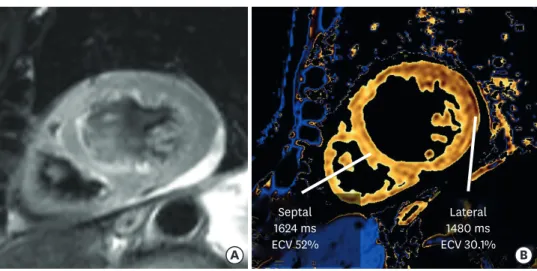
The mean native T1 value was elevated (1542 millisecond, ms, reference normal value of the native T1 was 1200 ms) and especially high in the mid-apical septum (1622 ms) (Figure 3).
Delayed enhancement sequence demonstrated myocardial thinning with subendocardial enhancement in the mid-apical septum. On two-month follow-up TTE, LVEF was
recovered to 44%. Follow-up CMR showed a markedly decreased native T1 value suggesting improvement in myocardial edema (mean 1419 ms). However, the T1 value in the mid-apical septum was still elevated (1699 ms). Mid-apical septal akinetic motion with thinning and delayed hyperenhancement was also maintained, suggesting irreversible scar formation (Figure 4). Combined with multimodality imaging results including follow up CMR, it appeared that acute fulminant myocarditis resulted in myocardial scarring, which mimicked myocardial infarction in the mid-apical septum and could be clearly identified.
J Cardiovasc Imaging. 2020 Oct;28(4):293-295 https://doi.org/10.4250/jcvi.2019.0112 pISSN 2586-7210·eISSN 2586-7296
Images in
Cardiovascular Disease
Received: Nov 13, 2019 Revised: Mar 4, 2020 Accepted: Mar 30, 2020 Address for Correspondence:
In-Cheol Kim, MD, PhD
Division of Cardiology, Cardiovascular Center, Keimyung University Dongsan Hospital, 1035 Dalgubeol-daero, Dalseo-gu, Daegu 42601, Korea.
E-mail: [email protected] Copyright © 2020 Korean Society of Echocardiography
This is an Open Access article distributed under the terms of the Creative Commons Attribution Non-Commercial License (https://
creativecommons.org/licenses/by-nc/4.0/) which permits unrestricted non-commercial use, distribution, and reproduction in any medium, provided the original work is properly cited.
ORCID iDs Jin Young Kim
https://orcid.org/0000-0001-6714-8358 In-Cheol Kim
https://orcid.org/0000-0002-5751-2328 Jae-Bum Kim
https://orcid.org/0000-0002-8820-9866 Sung Min Ko
https://orcid.org/0000-0002-7420-6269 Hyungseop Kim
https://orcid.org/0000-0001-7056-4221 Conflict of Interest
The authors have no financial conflicts of interest.
Jin Young Kim , MD
1, In-Cheol Kim , MD, PhD
2, Jae-Bum Kim , MD
3, Sung Min Ko , MD
4, and Hyungseop Kim , MD
21
Department of Radiology, Keimyung University Dongsan Hospital, Daegu, Korea
2
Division of Cardiology, Department of Internal Medicine, Cardiovascular Center, Keimyung University Dongsan Hospital, Daegu, Korea
3
Department of Cardiothoracic Surgery, Cardiovascular Center, Keimyung University Dongsan Hospital, Daegu, Korea
4