Validation of a Social Anxiety Questionnaire:
Empirical Evidence from Korean Undergraduate Students
Jee-Sun Lee 1† Jang-Won Seo 2 Seok-Man Kwon 1
1
Department of Psychology, Seoul National University, Seoul;
2Department of Psychology, Chonbuk National University, Jeonju, Korea
Social anxiety disorder (SAD) is defined as severe fear or anxiety in one or more social situations. Although knowing the specifiers of SAD could further improve our understanding of heterogeneity in the disorder, currently available psychometric instruments are insufficient to assess situationally defined social anxiety dimensions individually. Given this situation, the So- cial Anxiety Questionnaire (SAQ) has been developed to measure five anxiety-provoking situations for adults. The aim of this study was to examine the reliability and validity of the Korean version of the SAQ. A total of 564 undergraduate students participated in this study. A total of 302 samples were used for exploratory factor analysis, and a total of 262 samples were used for confirmatory factor analysis. The mean age of the participants was 20.33 years, and measures of anxiety, fear of nega- tive evaluation, and depression were analyzed. Exploratory factor analysis yielded five factors: (1) interactions with strangers, (2) speaking in public/talking with people in authority, (3) interactions with the opposite sex, (4) criticism and embarrass- ment, and (5) assertive expression of annoyance, disgust, or displeasure. Confirmatory factor analysis also supported the con- struct validity of the questionnaire. The Korean version of the SAQ showed good internal consistency, test-retest reliability, criterion validity, and convergent validity. To futher accurately understand social anxiety disorder, it is necessary to determine how the level of anxiety of each individual differs in various circumstances. In this respect, the Korean version of the SAQ is expected to be utilized as a useful tool for clinical research.
Keywords: anxiety scales, Social Anxiety Questionnaire, situationally defined social anxiety dimensions, social anxiety, social phobia
A person with social anxiety will feel nervous in various social sit- uations. When such fear becomes excessive, it can cause impair- ment in functioning. This is called social anxiety disorder(SAD) or social phobia(Morrison & Heimberg, 2013). Lifetime preva- lence of SAD is 12.1%, the highest rate aside from major depressive disorder, alcohol dependence, and specific phobia(Kessler et al., 2005). Experiencing social situations such as school, work, and in- timate relationships is unavoidable. One who suffers from SAD might experience severe distress(Quilty, Van Ameringen, Manci- ni, Oakman, & Farvolden, 2003; Wittchen, Fuetsch, Sonntag, Muller, & Liebowitz, 2000). Moreover, SAD could predict suicidal
idea and suicidal attempt(Bentley et al., 2016). Thus, a great atten- tion has been directed to understand this disorder. Part of changes in DSM-5 is about the specifier of SAD(American Psychiatric As- sociation, 2013). DSM-5(American Psychiatric Association, 2013) has proposed a ‘performance-only’ specifier based on contextual variables that are relatively stable in SAD(Heimberg et al., 2014).
This change in diagnostic criteria suggests that considering situa- tional variables to understand the heterogeneity of social anxiety disorder is clinically important. Studies focusing on the contextu- al variables of SAD have been attempted in Korea as well. Park (2003) has divided social anxiety largely into ‘social interaction situations’ and ‘performance situations’ based on social anxiety provoking situations. In addition, Shin(2012) also divided social anxiety based on the context variables; pervasive social anxiety and dominant public speaking anxiety. Not only the diagnostic
eISSN 2733-4538
†
Correspondence to Jee-Sun Lee, Department of Psychology, Seoul National University, 1 Gwanak-ro, Gwanak-gu, Seoul, Korea; E-mail: jsl1130@gmail.
com
Received Dec 6, 2018; Revised Apr 19, 2019; Accepted Apr 22, 2019
criteria for social anxiety disorder in DSM-5 has changed but also several researchers have emphasized the importance of social anxiety provoking situation in order to systematically understand social anxiety. Social anxiety measurement tools that can objec- tively evaluate various social anxiety inducing situations are limit- ed in Korea and thus, we felt the necessity of developing a scale that measures the social anxiety inducing situation which can bet- ter reflect the cultural characteristics of Koreans. The social pho- bia in the oriental region is strongly influenced by the Confucian culture and the upward mobility consciousness(as stated in Lee, Shin, & Oh, 1994), and Koreans have a tendency to emphasize what is called ‘Chemyon(social face)’ and tend to worry about oth- er’s evaluation(Oh, Huh, & Lee, 1999). As such, it is more difficult to express complaints directly toward others in societies where harmonizing in the group is valued(Song & Park, 2009). Further, social anxiety questionnaires that can classify these characteristics into dimensions are also quite limited.
Frequently used social anxiety measures such as Social Phobia Scale(SPS; Mattick & Clarke, 1998), Social Interactive Anxiety Scale(SIAS; Mattick & Clarke, 1998), and Liebowitz Social Anxi- ety Scale(LSAS; Liebowitz, 1987) have advantages in that they can measure social anxiety considering various social situations.
However, several questions have arisen related to selecting items from existing various self-report measures for assessing social anxiety disorder, selection method, and content validity(Haynes, Richard, & Kubany, 1995). For example, in case of developing SPS and SIAS, researchers have subjectively collected and selected items to measure fear and social anxiety(Mattick & Clarke, 1998).
In addition, most items in LSAS already exist in other social anxi- ety measurements and there was no detailed explanation for the validity of the scale when the scale was developed(Caballo, Sala- zar, Irurtia, Arias, & Hofmann, 2010). Furthermore, the number of factors and contents of factors in LSAS have been reported dif- ferently, ranging from three factors(Romm et al., 2011) to eight factors(Heeren et al., 2012). This indicates poor construct valid- ity.
Caballo, Arias, Salazar, Irurtia, and Hofmann(2015) have devel- oped a new social anxiety scale(Social Anxiety Questionnaire, SAQ) to improve and complement problems of previous measures of social anxiety. SAQ was developed from over 10,000 data col-
lecting social anxiety provoking situations for over six years. Vali- dation of a total of 18,467 clinical and non-clinical groups in 18 countries reflected characteristics of social anxiety provoking sit- uation in various cultures. The study of Caballo et al.(2015) yield- ed five factors: (1) Interactions with strangers, (2) Speaking in public/talking with people in authority, (3) Interactions with op- posite sex, (4) Criticism and embarrassment, and (5) Assertive ex- pression of annoyance, disgust, or displeasure. The internal consistency(Cronbach’s α) of SAQ was high for total scores in both samples. Guttman split-halves reliability of SAQ was .931 for non- clinical sample and .900 for clinical sample(Caballo et al., 2015).
Caballo et al.(2015) suggested that it would be vital to use the cut- off score corresponding to the five anxiety-provoking situations as well as the SAQ total score for selecting the clinical groups. The development of such new measure will be useful for detailed clini- cal study of social anxiety disorder.
Therefore, the primary aim of the present study was to trans- late the SAQ, which systematically classifies the social anxiety in- ducing situations through extensive data collection, into Korean version and examine the reliability and validity by using two in- dependent undergraduate student samples. The study was ad- dressed in three ways. First, with 302 undergraduate students, we conducted exploratory factor analysis. Second, with 262 under- graduate students, we conducted confirmatory factor analysis.
Third, we examined the internal consistency of SAQ and relation- ships between the scale and other measures including LSAS mea- sure.
Methods
Participants
Undergraduate students from four different universities in South
Korea(Seoul) completed the questionnaires. A total of 564 under-
graduate students completed this study. According to the rule of
thumb, 10 participants for each scale item is recommended(Nun-
nally, 1978) and over 300 participants can be graded as a good
sample size(Comrey & Lee, 1992; as quoted by Boateng, Neilands,
Frongillo, Melgar-Quiñonez, & Young, 2018). Therefore, with
SAQ consisting 30 items, a sample size of 302 were collect for EFA
while we considered 262 samples to be acceptable since it was five
times larger than measurement variables for CFA. Hence, A total of 302 samples were used for exploratory factor analysis while a to- tal of 262 samples were used for confirmatory factor analysis. Of these participants, 252(44.7%) were males and 312(55.3%) were fe- males. The mean age of these participants was 20.33 years(SD:
2.52, range: 17–36 years).
Procedures and measures
All participants provided informed consent and the question- naires were completed anonymously. Participants accessed an on- line research participation system called Qualtrics and completed measures below. Institutional Review Board(IRB) approval was obtained from the Seoul National University(IRB No. E1603/001- 004).
SAQ
SAQ is a 30-item scale designed to assess the level of unease, stress, or nervousness in response to each social situation(Caballo et al., 2015). Each item of the SAQ was answered in a 5-point Likert scale from 1(not at all or very slight) to 5(very high or extremely high), with higher scores indicating higher levels of social anxiety.
SAQ had an alpha coefficient of .92 for nonclinical samples(N=
9,066) and .87 for clinical samples(N=334)(Caballo et al., 2015).
With permission from the original author(January 11, 2016), we reviewed and revised the Korean version of SAQ and made sure it correctly reflects the contents of the original text. Bilingual col- lege student who had no prior knowledge of the concept then made a reverse translation. After reviewing and editing the re- verse translation, final Korean version of SAQ items was confirmed(Appendix 1).
Liebowitz Social Anxiety Scale: Self-Report Version (LSAS-SR)
LSAS is a 24-item scale measuring social phobia by asking partici- pants to imagine ‘‘what if you were faced with the situation”(Li- ebowitz, 1987). It was used to assess the degree of fear/anxiety (LSAS-Anxiety subscale) and avoidance(LSAS-Avoidance sub- scale) in a 4-point Likert scale(from 0 ‘never’ to 3 ‘usually’). We administered a Korean version of LSAS-SR. Adequate reliability and validity of LSAS-SR have been demonstrated previously(Park,
2003). In the present study, Cronbach’s α for anxiety subscale was .91 and .89 for avoidance subscale.
Brief version of Fear of Negative Evaluation Scale(BFNE) FNE was originally developed as a 30-item scale to assess problem- atic fear of negative evaluation(Watson & Friend, 1969). A BFNE was then developed, containing 12-item evaluated with a 5-point scale ranging from 1(not at all characteristic of me) to 5(extremely characteristic of me)(Leary, 1983). BFNE has shown high internal consistency(α=.90–.91) and 4-week test–retest reliability(α=.75) in undergraduate samples(Leary, 1983; Miller, 1995). We used the Korean version of BFNE with sound psychometric properties(Lee
& Choi, 1997). In the present study, Cronbach’s α value for BFNE was .90.
State-Trait Anxiety Inventory(STAI)
STAI was developed to assess and evaluate the level of anxiety of an individual(Spielberger, Gorsuch, Lushene, Vagg, & Jacobs, 1983).
It consists of 20 items of State Anxiety Scale to measure the current state of anxiety. It also has 20 items of Trait Anxiety Scale to evalu- ate anxiety tendency. In this study, only the Trait Anxiety Scale was used. It was used to ask respondents to indicate how they gen- erally felt based on a 4-point Likert scale ranging from 1(not at all) to 4(very much so). We used the Trait Anxiety subscale of Korean version(Kim & Shin, 1978). For the present sample, the Cronbach’s α for BFNE was .90.
Center for Epidemiological Studies-Depression Scale (CES-D)
CES-D was developed to measure current depressive symptoms in
the general population(Radloff, 1977). It assesses the degree of de-
pression on a 4-point scale to indicate the degree to which they ex-
perienced the symptom in the previous week. The scale had an in-
ternal consistency with reported alpha value of .84 for the general
population. Split-half reliability coefficients ranged from .77 to
.92(Corcoran & Fisher, 1987). A Korean version of CES-D has
demonstrated good reliability and validity(Chon, Choi, & Yang,
2001). The present study found Cronbach’s α of .92 for CES-D.
Results
Exploratory factor analysis
To investigate factor structure of the Korean version of SAQ, ex- ploratory factor analysis was conducted using SPSS 22.0 Statistics Program. First, fit index of Kaiser-Meyer-Olkin(KMO) was calcu- lated to be .88(Kaiser, 1974). Barlett’s test result indicated that it was appropriate to carry out factor analysis(χ
2[435, n=302]=
3,873.42, p<.000).
To determine the appropriate number of factors, all factors with an Eigen value of 1.0 or greater were extracted by principal axis factoring. As a result, the number of factors was 7. Extracted fac- tors had the following Eigen values: factor 1(8.919), factor 2(2.660), factor 3(1.733), factor 4(1.536), factor 5(1.431), factor 6(1.198), and factor 7(1.073). Considering additional Scree plot, five to six factors were considered appropriate.
Based on these results, factor analysis was conducted by assign- ing five and six factors. By assigning the number of factors as six
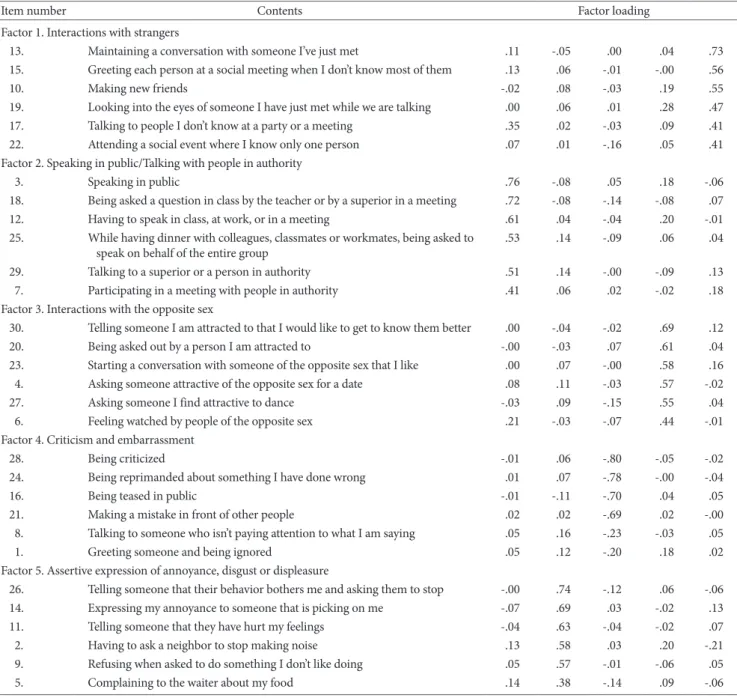
Table 1. Exploratory Factor Analysis for the Korean Version of SAQ (N=302)
Item number Contents Factor loading
Factor 1. Interactions with strangers
13. Maintaining a conversation with someone I’ve just met .11 -.05 .00 .04 .73
15. Greeting each person at a social meeting when I don’t know most of them .13 .06 -.01 -.00 .56
10. Making new friends -.02 .08 -.03 .19 .55
19. Looking into the eyes of someone I have just met while we are talking .00 .06 .01 .28 .47
17. Talking to people I don’t know at a party or a meeting .35 .02 -.03 .09 .41
22. Attending a social event where I know only one person .07 .01 -.16 .05 .41
Factor 2. Speaking in public/Talking with people in authority
3. Speaking in public .76 -.08 .05 .18 -.06
18. Being asked a question in class by the teacher or by a superior in a meeting .72 -.08 -.14 -.08 .07
12. Having to speak in class, at work, or in a meeting .61 .04 -.04 .20 -.01
25. While having dinner with colleagues, classmates or workmates, being asked to
speak on behalf of the entire group .53 .14 -.09 .06 .04
29. Talking to a superior or a person in authority .51 .14 -.00 -.09 .13
7. Participating in a meeting with people in authority .41 .06 .02 -.02 .18
Factor 3. Interactions with the opposite sex
30. Telling someone I am attracted to that I would like to get to know them better .00 -.04 -.02 .69 .12
20. Being asked out by a person I am attracted to -.00 -.03 .07 .61 .04
23. Starting a conversation with someone of the opposite sex that I like .00 .07 -.00 .58 .16 4. Asking someone attractive of the opposite sex for a date .08 .11 -.03 .57 -.02
27. Asking someone I find attractive to dance -.03 .09 -.15 .55 .04
6. Feeling watched by people of the opposite sex .21 -.03 -.07 .44 -.01
Factor 4. Criticism and embarrassment
28. Being criticized -.01 .06 -.80 -.05 -.02
24. Being reprimanded about something I have done wrong .01 .07 -.78 -.00 -.04
16. Being teased in public -.01 -.11 -.70 .04 .05
21. Making a mistake in front of other people .02 .02 -.69 .02 -.00
8. Talking to someone who isn’t paying attention to what I am saying .05 .16 -.23 -.03 .05
1. Greeting someone and being ignored .05 .12 -.20 .18 .02
Factor 5. Assertive expression of annoyance, disgust or displeasure
26. Telling someone that their behavior bothers me and asking them to stop -.00 .74 -.12 .06 -.06 14. Expressing my annoyance to someone that is picking on me -.07 .69 .03 -.02 .13
11. Telling someone that they have hurt my feelings -.04 .63 -.04 -.02 .07
2. Having to ask a neighbor to stop making noise .13 .58 .03 .20 -.21
9. Refusing when asked to do something I don’t like doing .05 .57 -.01 -.06 .05
5. Complaining to the waiter about my food .14 .38 -.14 .09 -.06
using direct oblimin method, the number of items corresponding to one factor was extremely small(less than 2) while the number of items overlapped in more than two factors. Considering these re- sults and theoretical interpretability, the optimal number of fac- tors was found to be five. After conducting factor analysis by des- ignating five factors, all items except two showed high factor load- ings of over .30 for each factor. Results of exploratory factor analy- sis for a total of 30 items of Korean version of SAQ are shown in Table 1. Also, the summary of descriptive statistics for each factor are presented in Table 2.
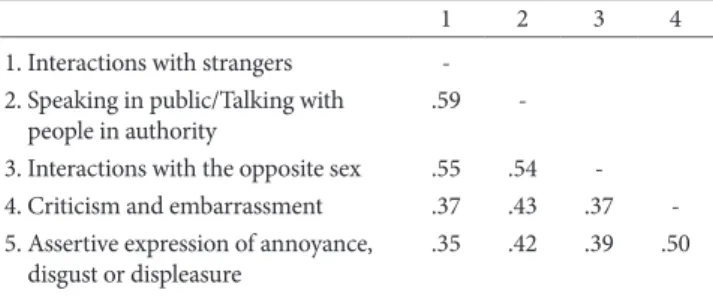
The correlation coefficient between factors ranged from r =.35 to r =.59(Table 3). Factors that showed the highest correlation were: (1) Interactions with strangers, and (2) Speaking in public/
Talking with people in authority(r =.59).
Confirmatory factor analysis
Confirmatory factor analysis was conducted using AMOS 22.0 Statistics Program. To determine the number of factors extracted by exploratory factor analysis and interpretability of each factor, confirmatory factor analysis should be done to confirm the fit of the identified factor model(Thompson, 2004). In order to confirm the validity of extracted factor and item structure through explor- atory factor analysis, additional confirmatory factor analysis was performed and fitness was identified.
First, to determine the fitness of the model, χ
2test was conducted.
It rejected the null hypothesis of the model(χ
2= 828.93, df =395).
However, χ
2test is very sensitive to sample size. When null hy- potheses are very strict, test has limitation in that the probability to reject the hypothesis is increased with increasing sample size(Cudeck & Henly, 1991; Hong, 2000). Therefore, we evaluated TLI, CFI, and RMSEA fitness index which considered model er- rors and principle of parsimony. As a result, the fitness index of the
model was .06 for RMSEA, .85 for CFI, and .84 for TLI. Although the CFI and TLI value was slightly lower than .90 suggested index as a good fit(Bollen, 1989; Hoyle, 1995), RMSEA indicated as a fair fit(Browne & Cudeck, 1993; Hong, 2000). And Raykov and Wida- man’s work(as stated in Kanter, Rusch, Busch, & Sedivy, 2009) states that CFI and TLI can vary upon sample size. In conclusion, our results show that the Korean version of SAQ consisting five factors(same as the original scale) is a valid assessment tool.
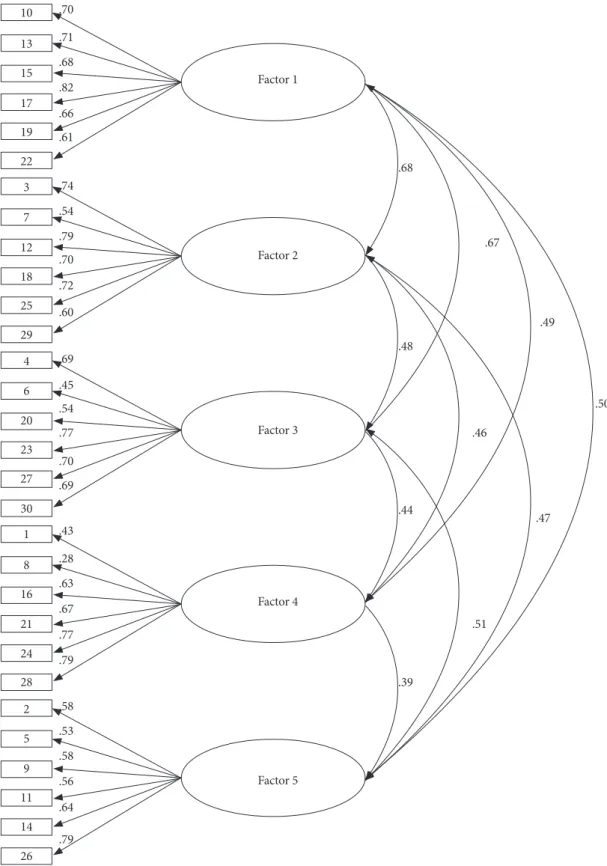
Factor structures of the Korean version of SAQ and standardized coefficient estimates of the model are presented below(Figure 1).
Latent variables’ standardized coefficient estimates by measure- ment variables ranged from .28 to .82 with statistically significant difference. Correlation between latent variables was appropriate, with r ranging from .39 to .68. This confirmed the appropriateness of 30-item SAQ with five sub-factors.
Reliability
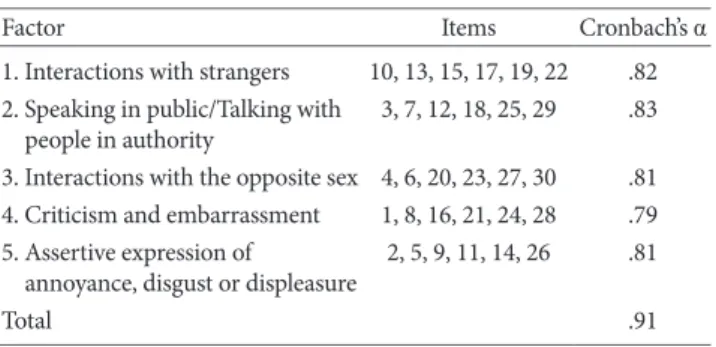
Cronbach’s α for the Korean version of SAQ was 0.91, showing ex- cellent internal consistency. Cronbach’s α for the five factors were identified as Factor 1(.82), Factor 2(.83), Factor 3(.81), Factor 4(.79), and Factor 5(.81)(Table 4). Correlation coefficient between items of SAQ and total score ranged from .37 to .67, with items 8(r =.37, p<.01) and item 20(r =.40, p<.01) having relatively low correla- tions.
Additionally, test-retest reliability was evaluated with a sample of 57 out of 302 participants at two-week intervals. Test-retest reli- ability for the Korean version of SAQ was found to be .87 over a 2-week period. These results suggest that SAQ is a relatively stable scale to measure social anxiety level in Korea.
Correlations between SAQ and other measures
Correlations between SAQ and other measures are presented in Table 2. Descriptive Statistics for the Korean Version of SAQ (N=302)
Factor M SD Skew Kurtosis
1. Interactions with strangers 13.25 4.14 .74 .60 2. Speaking in public/Talking with
people in authority 14.79 4.55 .64 .05 3. Interactions with the opposite sex 13.04 4.26 .46 -.22 4. Criticism and embarrassment 18.64 4.37 .29 -.69 5. Assertive expression of annoyance,
disgust or displeasure 15.87 4.60 .56 .05
Table 3. Factor Correlations for Korean Version of SAQ (N=302)
1 2 3 4
1. Interactions with strangers - 2. Speaking in public/Talking with
people in authority .59 -
3. Interactions with the opposite sex .55 .54 - 4. Criticism and embarrassment .37 .43 .37 - 5. Assertive expression of annoyance,
disgust or displeasure .35 .42 .39 .50
Figure 1. Confirmatory factor structures of the Korean version of SAQ.
Note. For ease of presentation, error terms for items are omitted. Factor 1=Interactions with strangers; Factor 2=Speaking in public/Talking with people in authority; Factor 3=Interactions with the opposite sex; Factor 4=Criticism and embarrassment; Factor 5=Assertive expression of an- noyance, disgust or displeasure.
10 13
Factor 1
Factor 2
Factor 3
Factor 4
Factor 5 15
17 19 22 3 7 12 18 25 29 4 6 20 23 27 30 1 8 16 21 24 28 2 5 9 11 14 26 .79
.79 .69 .60 .61
.64 .77 .70 .72 .66
.56 .67 .77 .70 .82
.58 .63 .54 .79 .68
.68
.48
.44
.39
.51 .46
.67
.49
.47
.50
.53 .28 .45 .54 .71
.58
.43
.69
.74
.70
Table 5. The Korean version of SAQ showed statistically significant correlation with LSAS(r = 65, p<.01), anxiety subscale(r= 64, p<
.01), and avoidance subscale(r =59, p<.05). Likewise, state-trait anxiety inventory(STAI-T) measuring trait anxiety had statistical- ly significant correlation with the Korean version of SAQ(r =41, p<.01). BFNE also showed significant correlation(r =49, p<.01) with the Korean version of SAQ. Moreover, depression scale(CES-D) showed significant correlation(r =32, p<.01) with the Korean ver- sion of SAQ.
Discussion
Social interaction is unavoidable in our daily lives. One who suf- fers from social anxiety may experience great distress and pain (Quilty et al., 2003; Wittchen et al., 2000). In recent years, DSM- 5(APA, 2013) has proposed a subtype based on situational vari- ables that are relatively stable in social anxiety disorder(Heimberg et al., 2014). These changes suggest that considering situational variables is clinically important to understand the heterogeneity of social anxiety disorder. Accordingly, we decided to develop and validate a Korean version of SAQ which was thoroughly estab- lished based on data collected from actual social anxiety inducing situations with five situational dimensions. Results of exploratory factor analysis revealed that factor structure of the Korean version of SAQ was consistent with factor structure of the original ques- tionnaire. Results of confirmatory factor analysis confirmed that the Korean version of SAQ was a valid scale consisting five factors.
Furthermore, there were good internal consistency and test-retest reliability. It also showed significant correlations with fear of nega- tive evaluation and anxiety. In addition, as we recognize the need for social anxiety scale which can be attributed to Koreans’ char-
acteristics such as ‘Chemyon(social face)’, upward mobility con- sciousness, the result showed that factor (4) Criticism and embar- rassment and factor (5) Assertive expression of annoyance, disgust or displeasure had the highest mean score in order. This implies that the Korean version of SAQ is a social anxiety scale that can be well applied in Korean contexts.
While general results supported the applicability of the Korean version of SAQ, there were some interesting results for discussion.
Results of exploratory factor analysis revealed that item 8(Talking to someone who isn’t paying attention to what I am saying) and item 1(Greeting someone and being ignored) had relatively low factor loadings. One possible explanation might be due to the num- ber of samples and characteristics of samples used in this study.
We additionally conducted exploratory factor analysis using the same method with a larger number of college students(N=476).
As a result, both of these two items had factor loadings higher than .30(item 8=.38, item 1=.34). Thus, we did not exclude those two items. However, future research is needed to further test this with other independent samples.
The Korean version of SAQ also showed moderate correlations with the Korean version of LSAS. These results are in line with the study conducted by Caballo and colleagues(2015). They have also found that correlations between total score of the original version of SAQ and LSAS-SR Anxiety subscale and LSAS-SR total score were moderate in both patients(.56 and .55, respectively) and non- patient samples(.65 and .67, respectively). Although both LSAS and SAQ are social anxiety measures, their moderate correlations Table 4. Internal Consistency for the Five Factors
Factor Items Cronbach’s α
1. Interactions with strangers 10, 13, 15, 17, 19, 22 .82 2. Speaking in public/Talking with
people in authority 3, 7, 12, 18, 25, 29 .83 3. Interactions with the opposite sex 4, 6, 20, 23, 27, 30 .81 4. Criticism and embarrassment 1, 8, 16, 21, 24, 28 .79 5. Assertive expression of
annoyance, disgust or displeasure 2, 5, 9, 11, 14, 26 .81
Total .91
Table 5. Correlations between the Korean Version of SAQ and Related Measures (N=302)
1 2 3 4 5 6 7
1. SAQ -
2. LSAS .65** - 3. LSAS-Anx .64** .94** - 4. LSAS-Av .59** .94** .78** - 5. STAI-T .41** .43** .40** .42** - 6. BFNE .49** .34** .38** .27** .49** - 7. CES-D .32** .35** .34** .33** .79** .31** - Note. SAQ=Social Anxiety Questionnaire (Caballo et al., 2015); LSAS=
Liebowitz Social Anxiety Scale; LSAS-Anx=LSAS-Anxiety subscale;
LSAS-Av=LSAS-Avoidance subscale; STAI-T=State-Trait Anxiety In- ventory; BFNE =Brief version of Fear of Negative Evaluation Scale;
CES-D=Center for Epidemiology Studies Depression Scale.
**p<.01.
showed that these two measures may assess somewhat different aspects of social anxiety. More specifically, while LSAS mainly measures social anxiety related to ‘performance evaluation’ situa- tion, SAQ measures social anxiety related to various situations in- cluding ‘performance evaluation’ situation, ‘interactions with op- posite sex’ situation and ‘assertive expression of annoyance, dis- gust, or displeasure’ situation. The Korean version of SAQ can measure such situations, thus allowing future social anxiety re- search to be enriched.
Although the present study provided information on cross-cul- tural applicability of the Korean version of SAQ, it has several lim- itations. First, our sample was made of students. Therefore, cau- tion is needed when generalizing our results. Since this study was done with college students, their levels of social anxiety could be lower than those of clinical samples with social anxiety disorder.
As characteristics of our sample do not reflect characteristics of social anxiety disorder group, future studies are needed to con- firm whether results of this study could be repeatedly verified for participants diagnosed as SAD. Second, our study relied fully on self-report measures which could be subjective to social desirabili- ty and other limitations. To overcome this problem, future re- search is needed to investigate whether the Korean version of SAQ is also correlated with other external and more ecologically valid criteria. Lastly, this study did not assess discriminant validity. Fur- ther study is needed to examine discriminant validity in order to support the soundness of SAQ.
Conclusion
Distinguishing the situational dimensions that cause social anxi- ety is expected to capture the heterogeneity of disability, and this trend is in line with the change of DSM-5’s subtype in social anxi- ety disorder. This study, validating the Korean version of SAQ, is expected to evaluate not only the general anxiety level but also for each dimensions’ anxiety level, thus broadening the research field in SAD for researchers who need to identify the situationally de- fined social anxiety dimensions. Results of the study demonstrate that the Korean version of SAQ has good internal consistency, test- retest reliability, criterion validity, and construct validity. It is nec- essary to confirm the level of anxiety upon various circumstances
as individuals could feel nervous depending on the situations. In this respect, the Korean version of SAQ is expected to be utilized as a useful tool for clinical research, for instance developing treat- ment programs related to specific social anxiety provoking situa- tions.
References
American Psychiatric Association. (2013). Diagnostic and statistical manual of mental disorders (5th ed.). Washington, DC: Author.
Bentley, K. H., Franklin, J. C., Ribeiro, J. D., Kleiman, E. M., Fox, K.
R., & Nock, M. K. (2016). Anxiety and its disorders as risk fac- tors for suicidal thoughts and behaviors: A meta-analytic review.
Clinical Psychology Review, 43, 30-46. doi.org/10.1016/j.cpr.2015.
11.008
Boateng, G. O., Neilands, T. B., Frongillo, E. A., Melgar-Quiñonez, H. R., & Young, S. L. (2018). Best practices for developing and validating scales for health, social, and behavioral research: A primer. Frontiers in Public Health, 6.
Bollen, K. A. (1989). Structural equations with latent variables. Ox- ford, UK: Wiley.
Browne, M. W., & Cudeck, R. (1993). Alternative ways of assessing model fit. Sage Focus Editions, 154, 136-136. doi.org/10.1177/
0049124192021002005
Caballo, V. E., Arias, B., Salazar, I. C., Irurtia, M. J., & Hofmann, S.
G. (2015). Psychometric properties of an innovative self-report measure: The Social Anxiety Questionnaire for adults. Psycho- logical Assessment, 27, 997-1012. doi.org/10.1037/a0038828 Caballo, V. E., Salazar, I. C., Irurtia, M. J., Arias, B., & Hofmann, S.
G. (2010). Measuring social anxiety in 11 countries. European Journal of Psychological Assessment, 26, 95-107. doi.org/10.1027/
1015-5759/a000014
Chon, K. K., Choi, S. C., & Yang, B. C. (2001). Integrated adapta- tion of CES-D in Korea. Korean Journal of Health Psychology, 6, 59-76.
Corcoran, K., & Fisher, J. (1987). Measures for clinical practice. New York, NY: Free Press.
Cudeck, R., & Henly, S. J. (1991). Model selection in covariance structures analysis and the “problem” of sample size: A clarifica- tion. Psychological Bulletin, 109, 512-519. doi.org/10.1037//0033- 2909.109.3.512
Haynes, S. N., Richard, D., & Kubany, E. S. (1995). Content validity in psychological assessment: A functional approach to concepts and methods. Psychological Assessment, 7, 238-247. doi.org/10.
1037/1040-3590.7.3.238
Heeren, A., Maurage, P., Rossignol, M., Vanhaelen, M., Peschard,
V., Eeckhout, C., & Philippot, P. (2012). Self-report version of the
Liebowitz Social Anxiety Scale: Psychometric properties of the French version. Canadian Journal of Behavioural Science, 44, 99- 107. doi.org/10.1037/a0026249
Heimberg, R. G., Hofmann, S. G., Liebowitz, M. R., Schneier, F. R., Smits, J. A., Stein, M. B., . . . Craske, M. G. (2014). Social anxiety disorder in DSM‐5. Depression and Anxiety, 31, 472-479. doi.
org/10.1002/da.22231
Hong, S. H. (2000). The criteria for selecting appropriate fit indices in structural equation modeling and their rationales. Korean Journal of Clinical Psychology, 19, 161-177.
Hoyle, R. H. (1995). Structural equation modeling: Concepts, issues, and applications. Thousand Oaks, CA: Sage.
Kaiser, H. F. (1974). An index of factorial simplicity. Psychometrika, 39, 31-36. doi.org/10.1007/bf02291575
Kanter, J. W., Rusch, L. C., Busch, A. M., & Sedivy, S. K. (2009). Val- idation of the Behavioral Activation for Depression Scale (BADS) in a community sample with elevated depressive symptoms. Jour- nal of Psychopathology and Behavioral Assessment, 31, 36-42. doi.
org.ssl.openlink.ajou.ac.kr/10.1007/s10862-008-9088-y
Kessler, R. C., Berglund, P., Demler, O., Jin, R., Merikangas, K. R.,
& Walters, E. E. (2005). Lifetime prevalence and age-of-onset distributions of DSM-IV disorders in the National Comorbidity Survey Replication. Archives of General Psychiatry, 62, 593-602.
doi.org/10.1001/archpsyc.62.6.593
Kim, J. T., & Shin, D. K. (1978). A study based on the standardiza- tion of the STAI for Korea. New Med J, 21, 69-75.
Leary, M. R. (1983). A brief version of the Fear of Negative Evalua- tion Scale. Personality and Social Psychology Bulletin, 9, 371-375.
doi.org/10.1177/0146167283093007
Lee, J. Y., & Choi, J. H. (1997). A study of the reliability and the va- lidity of the Korean versions of Social Phobia Scales (K-SAD, K- FNE). Korean Journal of Clinical Psychology, 16, 251-264.
Lee, S. H., Shin, Y. C., & Oh, K. S. (1994). A clinical study of social phobia for 10 years. Journal of Korean Neuropsychiatric Associa- tion, 33, 305-312.
Liebowitz, M. R. (1987). Social phobia. Modern Problems in Phar- macopsychiatry, 22, 141-173. doi.org/10.1159/000414022 Mattick, R. P., & Clarke, J. C. (1998). Development and validation
of measures of social phobia scrutiny and social interaction anx- iety. Behaviour Research and Therapy, 36, 455-470.
Miller, R. S. (1995). On the nature of embarrassability: Shyness, so- cial evaluation, and social skill. Journal of Personality, 63, 315- 339. doi.org/10.1111/j.1467-6494.1995.tb00812.x
Morrison, A. S., & Heimberg, R. G. (2013). Social anxiety and so- cial anxiety disorder. Annual Review of Clinical Psychology, 9, 249-274. doi.org/10.1146/annurev-clinpsy-050212-185631 Nunnally, J. C. (1978). Psychometric Theory. New York, NY: Mc-
Graw-Hill.
Oh, K. S., Huh, M. Y., & Lee, S. H. (1999). Correlations of Social Anxiety and Socio-Cultural Factors. Journal of Korean Neuropsy- chiatric Association, 38, 64-76.
Park, S. Y. (2003). The difference of social anxiety subtypes according to the characteristics of social anxiety-provoking situations (Mas- ter’s thesis). Seoul National University, Seoul, Korea.
Quilty, L. C., Van Ameringen, M., Mancini, C., Oakman, J., & Far- volden, P. (2003). Quality of life and the anxiety disorders. Jour- nal of Anxiety Disorders, 17, 405-426. doi.org/10.1016/s0887- 6185(02)00225-6
Radloff, L. S. (1977). The CES-D scale a self-report depression scale for research in the general population. Applied Psychologi- cal Measurement, 1, 385-401.
Romm, K. L., Rossberg, J. I., Berg, A. O., Hansen, C. F., Andreassen, O. A., & Melle, I. (2011). Assessment of social anxiety in first ep- isode psychosis using the Liebowitz Social Anxiety scale as a self-report measure. European Psychiatry, 26, 115-121. doi.org/
10.1016/j.eurpsy.2010.08.014
Shin, H. L. (2012). The differences of Anxiety Responses in Social Anxiety Subtypes Based on Feared Social Situations (Doctoral dissertation). Yonsei University, Seoul, Korea.
Song, J. Y., & Park, K. H. (2009). The sociocultural variables influ- encing social anxiety with concern for offending others. The Ko- rean Journal of Health Psychology, 14, 329-343.
Spielberger, C. D., Gorsuch, R. L., Lushene, R., Vagg, P. R., & Jacobs, G. A. (1983). Manual for the State-Trait Anxiety Inventory. Palo Alto, CA: Consulting Psychologists Press.
Thompson, B. (2004). Exploratory and confirmatory factor analysis:
Understanding concepts and applications. Washington, DC: Amer- ican Psychological Association.
Watson, D., & Friend, R. (1969). Measurement of social-evaluative anxiety. Journal of Consulting and Clinical Psychology, 33, 448-457.
doi.org/10.1037/h0027806
Wittchen, H. U., Fuetsch, M., Sonntag, H., Müller, N., & Liebowitz,
M. (2000). Disability and quality of life in pure and comorbid
social phobia. Findings from a controlled study. European Psy-
chiatry, 15, 46-58. doi.org/10.1016/s0924-9338(00)00211-x
사회불안 척도(SAQ)