서 론
문절망둑(Acanthogobius flavimanus)은 대한민국의 전 지 역과 일본, 중국에 분포하며, 주로 강의 하구나 바다로 나가 는 작은 하천의 지류에 주로 분포한다(Kim et al., 2005). 특히 본 연구해역인 낙동강 하구역에서 수행된 어류 군집연구에서 문절망둑은 주요 우점종 내지는 상위 출현종으로 출현하였다 (Kwak and Huh, 2003; Kang et al., 2012; Han et al., 2016). 대 부분의 망둑어과 어류처럼, 문절망둑 역시 상업적으로 중요한 어종은 아니지만, 많은 해안지역에서 회나 구이로 이용하고 있으며, 탐식성이 강해 낚시대상 어종으로도 인기가 높다.
지금까지 국내에서 수행된 문절망둑에 관한 연구로는 분류
학적 재검토(Kim et al., 1986, 1987; Lee, 1992), 식성(Huh and Kwak, 1999; Park et al., 2016) 및 일부 어류 군집연구(Kwak and Huh, 2003; Kang et al., 2012; Han et al., 2016)에 언급된 정도로 많은 연구가 이루어지지는 않았다. 국외에서도 문절 망둑의 식성에 관한 연구가 이루어졌으나(Kanou et al., 2005;
Workman and Merz, 2007), 문절망둑의 생활사 초기의 섭식생 태에 대한 연구는 없었다.
어류는 난 및 자치어 시기를 거쳐 성어로 가입되며, 난황을 흡수 이후 처음 외부먹이를 섭식하는 성장 초기에 초기감모 (Early Stage Mortality)가 일어나고, 이는 적절한 외부섭식이 이루어지지 못하여 발생하는 기아(starvation)가 주요 요인 중 하나이다. 기아에 의한 직접적인 사망 및 성장률의 저하로 인한 부유생활기(pelagic stage)의 증가는 다른 포식자에 의 해 피식될 확률을 증가시키고(Shepherd and Cushing, 1980), 결국 이런 과정이 어류 가입에 영향을 미친다(May, 1974;
—150 — http://www.fishkorea.or.kr
* Corresponding author: Joo Myun Park Tel: 82-54-780-5344, Fax: 82-54-780-5319, E-mail: [email protected]
낙동강 하구역에 출현하는 문절망둑 (Acanthogobius flavimanus) 자치어의 식성
최희찬·조정현·허성회1·박주면2,*
국립수산과학원 동해수산연구소, 1부경대학교 해양학과, 2한국해양과학기술원 동해연구소 독도전문연구센터
Feeding Habits of Larval Acanthogobius flavimanus from the Nakdong River Estuary, Korea by Hee Chan Choi, Jeong Hyun Cho, Sung Hoi Huh1 and Joo Myun Park2,* (Fisheries Resources and Environment Division, East Sea Fisheries Research Institute, Gangneung 25435 Republic of Korea, 1Department of Oceanography, Pukyong National University, Busan 48513 Republic of Korea, 2Dokdo Research Center, East Sea Research Institute, Korea Institute of Ocean Science & Technology, Uljin 36315 Republic of Korea)
ABSTRACT We examined the food habits of larval Acanthogobius flavimanus using 260 specimens collected from February to April 2011 in the Nakdong River estuary, Korea. We found that larval A.
flavimanus are carnivorous, feeding mainly on copepods and tintinnids. Their diet also included small quantities of larval polychaetes, macrostomids, larval bivalves, rotifers, barnacles, diatoms and unidentified materials. To assess ontogenetic changes in diet composition, the larvae were separated into three developmental stages: preflexion(<7mmNL), flexion(7~9mmNL), and postflexion(>9 mmNL). The preflexion group frequently preyed on tintinnids. But as the larvae of A. flavimanus grew, the consumption of copepods for flexion group, and polychaetes for postflexion group, increased respectively. The larvae of A. flavimanus showed one peak for feeding incidence at dusk, but the mean number of preys per individual was high until midnight.
Key words: Acanthogobius flavimanus, food habits, ontogenetic change, estuary, diel feeding
식성 연구에 사용된 문절망둑 자치어의 시료는 2011년 2월 부터 4월까지 매월 소조기에 채집하였으며, 수심이 5m 이하 의 비교적 얕은 낙동강 하구역 안쪽에 위치한 정점에서 오전 9시부터 익일 오전 6시까지 3시간 간격(낮 12시는 채집 제외, 7회/일 채집)으로 채집하였다(Fig. 1). 일주기 섭식생태 파악을 위한 시료는 가장 많은 개체가 채집된 2011년 3월에 채집한 시료를 이용하였다. 시료는 RN80 네트(망구: 80 cm, 망목: 330 μm)를 이용하여 수심 1~2m에서 약 2.5kn로 10분간 수평 채 집을 실시하였고, 정량적 분석을 위하여 네트 입구에 유량계 (Hydro-Bios Model 438 110)를 부착하였다.
채집된 표본은 5% 중성 포르말린으로 고정한 뒤, 실험실에 서 70% 에탄올로 치환하였다. 이후 문절망둑 자치어를 분리한 뒤, 척색장(notochord length: NL)을 0.1mm까지 측정하여 해 부현미경(Olympus SZ40) 하에서 위장을 분리하였다. 장내용 물은 쌍안실체현미경(Olympus CH2)을 이용하여 먹이 종류별 로 구분하였고, 출현량이 많은 먹이생물은 가능한 속(genus) 수준까지 동정하였으며, 그 외 먹이생물은 그보다 상위 분류 단계까지만 동정하였다. 먹이생물의 동정에는 Yamaji(1984), Cho(1993), Yoo(1995) 등을 참고하였다.
먹이생물은 종류별로 개체수를 계수한 뒤, 먹이생물 크기에 따라 소형 먹이생물은 17μm, 대형 먹이생물은 68μm 단위로 먹이생물의 장축과 단축을 측정하였다. 그리고 먹이생물의 부 피를 측정하기 위하여 먹이생물 종류에 관계없이 원기둥으로 가정한 뒤 장축은 높이, 단축은 밑면의 반지름을 구하는데 이 용하였고, 원기둥 부피 식인 v=πr2*h 이용해 먹이 생물의 체 적을 구하였다.
장내용물의 분석 결과는 각 먹이생물에 대한 출현빈도(fre- quency of occurrence), 먹이생물의 개체수비와 부피비로 나타 내었으며, 출현빈도는 다음과 같이 구하였다.
%F=Ai/N×100
여기서, Ai는 장내용물 중 해당 먹이생물이 발견된 문절망둑 자치어의 개체수이고, N은 위장에 내용물이 있었던 문절망둑 자치어의 개체수이다.
섭식된 먹이생물의 상대중요성지수(index of relative impor- tance, IRI)는 Pinkas et al.(1971)의 식을 이용하여 다음과 같이 구하였으나, 먹이생물의 중량비(%W) 대신 부피비(%V)를 이 용하였으며, 결과 값은 백분율로 환산하여 상대중요성지수비 (%IRI)를 구하였다.
IRI=(%N+%V)×%F
성장에 따른 먹이생물의 변화를 알아보기 위하여 문절망 둑 자치어의 시료를 발달단계에 따라 전기자어(Preflexion:
<7mmNL), 중기자어(Flexion: 7~9mmNL), 후기자어 (Postflexion: >9mmNL)로 나누어 먹이조성을 조사하였고, 척색장과 섭식된 먹이생물 크기(단축) 사이의 관계는 선형회 귀분석을 실시하였다. 그리고 성장에 따른 먹이섭식 특성 파 악을 위하여 발생단계별 개체 당 먹이의 평균 개체수(mean number of preys per gut, mN/GUT)와 부피(mean volume of prey per gut, mV/GUT)를 구하였으며, 분산분석(analysis of variance, ANOVA)을 이용하여 유의성 검정을 실시하였다.
또한 먹이생물을 얼마나 다양하게 먹고 있는가를 파악하 기 위하여 섭식 폭 지수(dietary breadth index) Bi를 구하였다 (Park et al., 2007; Huh et al., 2008).
Bi=(1/n-1)·(1/ ∑ Pij2-1)
여기서, Pij는 포식자 i의 장내용물 중 먹이생물 j가 차지하 는 비율이고, n은 총 먹이생물의 종수이다. 이 지수는 0에서 1 까지의 범위를 보이며, 1에 가까울수록 더 다양한 먹이생물을 섭식하는 종으로 볼 수 있다(Gibson and Ezzi, 1987; Park et Fig. 1. Location of the sampling area in the Nakdong River estuary, Korea.
35
128°49ʹE 128°52ʹE 128°55ʹE 128°58ʹE
al., 2007; Huh et al., 2008).
그리고 일주기에 따른 문절망둑의 섭식특성 변화를 알아보 기 위하여 가장 많은 개체가 채집된 2011년 3월에 출현한 문 절망둑 자치어를 대상으로 시간대별 섭식률과 평균 먹이생물 개체수를 분석하였다.
결 과
1. 자치어의 체장분포와 섭식참여율
본 연구에서 문절망둑 자치어의 식성 분석을 위하여 사용 된 시료는 총 260개체로, 4월에 55개체로 가장 적었고, 3월에 140개체로 가장 많았다. 문절망둑 자치어의 척색장 분포는, 2 월에는 5.3~7.2mm(mean NL(±SD)=6.0±0.3mm), 3월에 5.4~10.2mm(mean NL=7.7±1.0mm)의 범위를 보였고, 평 균 척색장은 증가하였다. 4월에는 4.8~6.7mm와 8.9~12.9 mm의 두 크기 무리의 자치어가 출현하였다(Fig. 2).
위내용물을 분석한 260개체 중 먹이를 섭식한 문절망둑 자 치어는 105개체로 섭식참여율은 40.4%였다(Table 1). 발생단 계 별 섭식률은 전기자어의 경우 33.8%로 가장 낮았으며, 후
기자어는 51.9%로 성장에 따라 섭식참여율은 증가하였다.
2. 일주기 섭식 특성
2011년 3월에 채집된 문절망둑 자치어의 일주기 섭식특성 을 살펴보면(Fig. 3), 섭식참여율의 경우 09~10h에 45%였고, 15~16h에는 40%로 약간 감소하였다. 이후 18~19h에 섭식 참여율이 95%로 크게 증가하였다. 이후 계속 감소하여 03~04 h에는 섭식참여율이 25%로 급격히 낮아졌으며, 06~07h에도 25%로 가장 낮은 섭식참여율을 보였다.
한편, 개체 당 먹이생물의 평균 개수는 09~10h와 15~16h 에 각각 2.6개체를 섭식하다가 18~19h에 9.0개체로 급격히 증가하였고. 이후 24~01h에 10.5개체로 정점을 보인 이후 평 균 먹이생물 개체수는 급격히 감소하여, 06~07h에 1.0개체로 가장 적은 개체수를 보였다.
3. 장내용물 조성
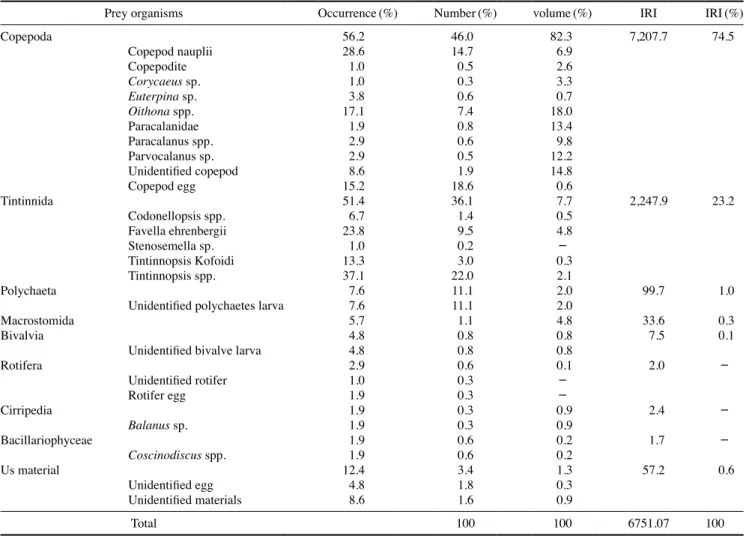
먹이를 섭식한 105개체의 위내용물 분석 결과(Table 2), 문 절망둑 자치어가 가장 선호한 먹이생물은 출현빈도 56.2%, 개체수비 46.0%, 부피비 82.3%를 보여 상대중요성지수비 74.5%를 차지한 요각류(Copepoda)로 나타났다. 요각류 중에 서 출현빈도 28.6%, 개체수비 14.7%, 부피비 6.9%를 차지한 Fig. 2. Monthly size frequency of Acanthogobius flavimanus collect-
ed in the Nakdong-River estuary.
Fig. 3. Diel changes in the number of preys per larva(●) with stan- dard deviation(vertical bar) and feeding incidence(○) of Acanthogo- bius flavimanus in the Nakdong River estuary.
Table 1. Feeding incidence (FI) of Acanthogobius flavimanus col- lected in the Nakdong-River estuary. N: number of fish examined;
NL: notochord length
Development stage N NL(mm) FI(%)
Preflexion 133 4.8~6.9 33.8
Flexion 100 7.0~8.9 46.0
Postflexion 27 9.0~12.9 51.9
Total 260 40.4
노플리우스 유생이 상대중요성지수 618.2로 가장 중요한 먹이 생물이었고, Oithona spp.가 상대중요성지수 434.3으로 그 다 음으로 중요한 먹이생물이었다. 이외에도 미동정 요각류와 요 각류 알이 비교적 많이 섭식되었다.
요각류 다음으로 많이 섭식된 먹이생물은 출현빈도 51.4%, 개체수비 36.1%, 부피비 7.7%를 보여 상대중요성지수비 23.2%
를 차지한 유종섬모충류(Tintinnida)이었다. 유종섬모충류 중에 서 Tintinnopsis spp.가 출현빈도 37.1%, 개체수비 22.0%, 부피 비 2.1%를 보여 상대중요도지수 893.9로 가장 중요한 먹이생 물이었으며, Favella ehrenbergii가 출현빈도 23.8%, 개체수비 9.5%, 부피비 4.8%로 상대중요성지수 339.3을 나타내 그 다음 으로 중요한 먹이생물이었다.
유종섬모충류 다음으로 중요한 먹이생물은 출현빈도 7.6%, 개체수비 11.1%, 부피비 2.0%를 차지하여 상대중요성지수비 1.0%를 보인 갯지렁이류(Polychaeta)이었고, 모두 부유성 유 생 단계의 개체였다.
Fig. 4. Ontogenetic changes in composition of gut contents of Acan- thogobius flavimanus by number.
Unidentified copepod 8.6 1.9 14.8
Copepod egg 15.2 18.6 0.6
Tintinnida 51.4 36.1 7.7 2,247.9 23.2
Codonellopsis spp. 6.7 1.4 0.5
Favella ehrenbergii 23.8 9.5 4.8
Stenosemella sp. 1.0 0.2 -
Tintinnopsis Kofoidi 13.3 3.0 0.3
Tintinnopsis spp. 37.1 22.0 2.1
Polychaeta 7.6 11.1 2.0 99.7 1.0
Unidentified polychaetes larva 7.6 11.1 2.0
Macrostomida 5.7 1.1 4.8 33.6 0.3
Bivalvia 4.8 0.8 0.8 7.5 0.1
Unidentified bivalve larva 4.8 0.8 0.8
Rotifera 2.9 0.6 0.1 2.0 -
Unidentified rotifer 1.0 0.3 -
Rotifer egg 1.9 0.3 -
Cirripedia 1.9 0.3 0.9 2.4 -
Balanus sp. 1.9 0.3 0.9
Bacillariophyceae 1.9 0.6 0.2 1.7 -
Coscinodiscus spp. 1.9 0.6 0.2
Us material 12.4 3.4 1.3 57.2 0.6
Unidentified egg 4.8 1.8 0.3
Unidentified materials 8.6 1.6 0.9
Total 100 100 6751.07 100
-: less than 0.1
그 외에 편형동물인 거구목(Macrostomida)와 이매패류 (Bivalvia), 윤충류(Rotifera), 만각류(Cirripedia), 규조류(Baci- llariophyceae), 이매패류(Bivalvia) 및 미동정 먹이생물이 발견 되었으나 상대중요성지수 1.0% 미만으로 먹이생물 중 차지하 는 비중은 매우 적었다.
4. 발생단계별 먹이 조성의 변화
본 연구에서 문절망둑 자치어는 발생단계에 따라 3개의 크 기그룹으로 나누어 먹이생물의 개체수를 기준으로 위내용물 의 조성 변화를 조사하였다(Fig. 4).
가장 작은 크기군인 전기자어 단계에서는 유종섬모충류가 전 체 먹이생물 개체수의 58.6%를 차지하여 가장 많이 섭식되었다.
그 다음으로 요각류가 25.3%로 많이 섭식되었다. 그 외 윤충류, 규조류 및 미동정 먹이생물이 포함된 기타 먹이생물들이 8.6%
의 개체수비를 보였고, 갯지렁이류가 5.6%를 차지하였다. 그 밖 에 거구목과 이매패류가 각각 1.0%로 소량 섭식되었다.
중기자어 단계에서는 유종섬모충류가 크게 감소하여 전체 먹이생물 개체수의 33.0%를 차지한 반면, 요각류는 크게 증 가하여 65.4%를 차지하여 가장 중요한 먹이생물이었다. 그 외 모든 먹이생물은 전기자어기에 비해 적게 섭식되었다.
후기자어 단계에서는 갯지렁이류가 전체 먹이생물 개체수 의 52.3%로 가장 우점하였다. 그 다음으로 요각류가 27.9%로 이전 크기군에 비해 크게 감소한 개체수비를 보였고, 유종섬 모충류 역시 크게 감소하여 4.5%를 차지하였다. 그 외에 기타 먹이생물이 11.7%를 차지하였는데, 미동정 먹이생물이 대부 분이었다.
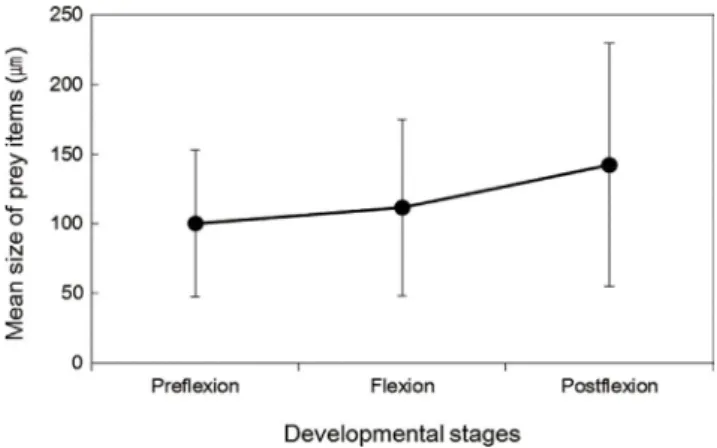
섭식된 먹이생물의 크기를 살펴보면(Fig. 5), 전기자어의 평균 먹이생물 크기가 100.4μm이었으며, 중기자어의 경우 111.5μm로 크기 차이가 거의 없었고, 후기자어의 평균 먹이 생물 크기는 142.1μm로 증가하였으며, 자치어의 발생단계에
따라 섭식된 먹이생물의 크기 역시 통계적으로 유의한 크기의 증가를 보였다(F2,209=4.390, P<0.05).
문절망둑 자치어의 발생단계별 평균 먹이생물 개체수(mN/
GUT)와 평균 먹이생물 부피(mV/GUT) 모두 전기자어에서 후기자어로 성장하면서 증가하는 경향을 보였으나(Fig. 6), 통 계적으로는 개체 당 먹이생물의 평균부피만 유의하게 중가하 는 결과를 보였다(ANOVA, F2,102=10.284, P<0.05).
문절망둑 자치어에 의해 섭식된 장내용물의 섭식 폭 지수 (dietary breadth index)는 0.18~0.30의 범위를 보였다(Fig. 7).
전기자어에서 중기자어는 0.21에서 0.30으로 증가하여 더 다 양한 먹이생물을 섭식하였으며, 후기자어에 이르러서 갯지렁 이류를 주로 섭식하여 0.18로 감소하였다.
고 찰
본 연구에서 문절망둑 자치어는 섭식참여율이 40.4%로 낮 았고, 전기자어의 섭식참여율은 33.8%로 매우 낮았고, 후기 Fig. 5. Ontogenetic changes in the mean size with standard deviation
(vertical bar) of prey items of Acanthogobius flavimanus in the Nak- dong River estuary.
Fig. 6. Variation of mean number of preys per gut(mN/GUT) and mean volume of preys per gut(mV/GUT) of Acanthogobius flavima- nus among size classes.
Fig. 7. The size-related variations of dietary breadth index of Acan- thogobius flavimanus.
율을 보였으며(Park et al., 1996), 낙동강 하구역에서 채집된 전어 자치어 역시 전체 섭식참여율이 49.7%로 낮았다(Choi et al., 2015b). 같은 청어목에 속하는 청어 자치어는 섭식 초기에 29.2%의 매우 낮은 섭식참여율을 보였다(Choi et al., 2015a).
한편 멸치과에 속하는 멸치와 웅어 자치어 역시 낮은 섭식참 여율을 보였다(Park and Cha, 1995; Choi et al., 2018). 그러나 곡선형으로 꼬인 장의 형태를 가지고 있던 농어목 자치어들 은 매우 높은 섭식참여율을 보였는데, 보구치(Cha and Park, 2001a)와 주둥치(Cha and Park, 2001b) 자치어는 각각 88.8%
와 100%의 섭식참여율을 보였고, 망둑어과(Park, 1999)의 자 치어 역시 91.0%의 섭식참여율을 보였다. 이와 같이, 꼬인 장 의 형태를 가지고 있는 종들은 채집과정 중의 외력에 의한 배 설이나 구토 때문에 발생하는 먹이생물 탈출 빈도가 적어 비 교적 높은 섭식참여율을 보이는 것으로 생각된다. 하지만 본 연구해역의 문절망둑은 겨울철 기수역에서 주로 산란 및 부화 하는 어종으로 당시 매우 낮은 수온으로 인한 활용 가능한 먹 이생물의 제한 때문에(See Choi et al., 2015c), 타계절에 출현 하는 농어목 자치어에 비해 낮은 섭식률을 보이는 것으로 생 각된다.
일주기(diel cycle) 변동에 따른 어류 식성의 변화는 흔히 관 찰된다(e.g. Huusko and Sutela, 1998; Amundsen et al., 1999;
Weliange et al., 2006). 본 연구에서 문절망둑 자치어는 18~19 h에 최고 섭식률을 보였고, 먹이생물 개체수도 평균 9.0개체로 24~01h 다음으로 많은 평균 개체수를 보여 가장 활발히 섭식 하는 시간대임을 추측할 수 있다. 이후 자정까지 섭식률은 감 소하였으나, 평균 먹이생물 개체수는 다른 시간대에 비해 높 게 나타나 야간에 활발히 섭식하는 경향을 보였다.
일반적으로 자치어 시기에는 다른 감각기관이 충분히 발달 하지 못해 시각을 이용하여 먹이를 찾는 것을 고려하여 볼 때, 야간에 이루어진 자치어의 섭식은 일반적이지 않은 현상이다 (Hunter, 1981; Blaxter, 1986). 낙동강 하구역에서 채집된 멸치 과 자치어도 야간에는 전혀 섭식활동을 하지 않아 시각에 의 존하여 먹이활동을 하는 것으로 생각된다(Choi, 2014). 한편 자치어가 어둠 속에서도 먹이를 섭식한다는 결과 보고는 다 수 존재하는데(Amundsen et al., 1999; Rao, 2003; Reiss et al., 2005), 낙동강 하구역에 출현하는 청어(Choi et al., 2015a)와
많은 선행연구에서 보고된 바 있는데(e.g. Young and Davis, 1990; Park and Cha, 1995; Park et al., 1996; Cha and Park, 2001a, b; Cass-Calay, 2003; Østergaard et al., 2004; Reiss et al., 2005; Shoji et al., 2005; Fernández and González-Quirós, 2006; Landaeta et al., 2012), 이는 작은 크기를 가진 요각류 를 자치어가 섭식하기 용이하고, 전체 해양생물 생체량의 70~90%를 차지할 정도로 우점하는 생물군이기 때문에, 최 소한의 노력으로 쉽게 섭식가능하기 때문인 것으로 생각된다 (Huh and Kwak, 1997).
한편 국내에서 보고된 망둑어과 자치어의 먹이생물을 살펴 보면, 광양만에서 채집된 망둑어과(Gobiidae spp.)는 요각류와 유종섬모충류를 섭식하였고, 그 중 요각류의 노플리우스 유생 을 주로 섭식하였다(Park, 1999). 그리고 낙동강 하구역에서 여름철에 채집된 망둑어과 자치어도 요각류를 주로 섭식하여 (Choi, 2014), 요각류가 망둑어과 자치어의 주요한 먹이생물로 판단된다.
문절망둑 자치어는 요각류 중에서도 검물벼룩목(Cyclopoida) 의 Oithona spp.를 많이 섭식하였다. Oithona spp.는 세계 어디 서나 아주 흔하게 발견되고, 생체량도 많은 분류군으로(Robins and Gallienne, 2001), 동일한 시기에 낙동강 하구역에서 조사 된 동물플랑크톤 군집조사에서도 우점 분류군으로 나타났다 (Unpubl. data). 그리고 같은 해역에서 수행된 청어 자치어 식성 연구에서도 Oithona spp.는 중요한 먹이생물로 출현하여(Choi et al., 2015a), 문절망둑 자치어가 낙동강 하구역에 많이 서식하 는 Oithona spp.를 많이 섭식한 것으로 생각된다.
자치어 섭식에 있어 먹이선택의 중요한 결정 요인 중 하나 로 먹이생물의 크기를 꼽을 수 있고(Schmitt, 1986; Theilacker, 1987), 섭식된 먹이생물의 크기는 자치어의 입크기에 의해 결 정되는 경향이 있기 때문에(Last, 1980), 자치어가 성장하면서 더 큰 먹이생물을 선호하거나, 먹이의 종류와 개수가 변하는 것은 일반적인 현상이며, 이는 자치어가 성장하면서 필요한 에 너지를 효율적으로 충족하기 위한 기작으로 생각된다(Hunter, 1981). 실제로 다양한 어류의 자치어 식성 연구에서 성장에 따 른 먹이전환 관찰되었다(Lee and Huh, 1989; Park et al., 1996;
Park, 1999; Cha and Park, 2001a, b; Gning et al., 2008; Choi et al., 2015a, b; Choi et al., 2018). 본 연구에서도 문절망둑 자치
어는 섭식 초기에 소형의 유종섬모충류를 주로 섭식하다가 성 장함에 따라 요각류로 먹이전환을 하였고, 후기자어에 이르러 서는 다시 갯지렁이류를 주로 섭식하였다. 먹이생물의 평균크 기도 발생단계에 따라 점차 증가하였고, 개체 당 먹이생물 개 수와 부피 모두 증가하는 경향을 보였는데, 이러한 섭식전략 을 통해 성장하면서 필요한 에너지 요구량을 충족시키는 것으 로 보인다.
문절망둑 후기자어의 주요 먹이생물이었던 갯지렁이류는, 국내외에서 연구된 문절망둑 치어기 이후의 개체들의 주요 먹이생물 중 하나로 나타났다(Kikuchi and Yamashita, 1992;
Huh and Kwak, 1999; Kanou et al., 2005; Park et al., 2016). 특 히 일본 Tama강 하구역에서 채집된 문절망둑 치어기(14~41 mm) 개체들의 먹이생물 전환은 요각류를 주로 섭식하던 14~17mm 개체에서 이후 갯지렁이류로 전환되는 패턴을 보 여 본 연구와 유사하였다(Kanou et al., 2005). 과양만 잘피밭 에 출현한 문절망둑도 미성어(80mm 이하) 개체들이 갯지렁 이류를 많이 섭식하는 경향을 보였다(Huh and Kwak, 1999).
따라서 문절망둑은 후기자어기부터 갯지렁이류로 먹이전환 된 이후 성장함에 따라 꾸준히 갯지렁이류를 주요 먹이로 이 용하는 것으로 판단된다.
요 약
낙동강 하구역에 서식하는 문절망둑 자치어의 식성을 밝히 기 위해 2011년 2월부터 4월까지 RN80 네트를 이용하여 채집 하였고, 그 중 260개체를 해부현미경을 이용하여 장내용물 분 석을 실시하였다. 분석결과 문절망둑 자치어는 요각류와 유종 섬모충류를 주로 섭식하였고, 그 외에도 갯지렁이 유생, 거구 목(편형동물), 이매패류 유생, 윤충류, 따개비 유생, 규조류 등 을 섭식하였다. 문절망둑 자치어는 시간대별로 다른 섭식강도 를 보였는데, 18~19시 사이에 가장 높은 섭식참여율 보였고, 개체당 먹이생물 개체수는 18~01시까지 높은 수준을 유지하 였다. 성장에 따른 문절망둑 자치어의 식성변화를 평가하기 위해 발생단계(3단계: 전기, 중기, 후기자어) 별로 먹이생물을 분석한 결과, 전기자어 시기에는 유종섬모충류를 주로 섭식하 였고, 중기자어기에는 요각류, 후기자어 시기에는 갯지렁이 유 생을 주로 섭식하였다. 문절망둑 자치어의 먹이생물의 평균크 기는 성장에 따라 유의하게 증가하였고, 개체당 평균먹이생물 평균 개체수와 평균 부피도 증가하는 경향을 보였다. 먹이생 물의 다양성을 나타내는 먹이 섭식 폭 지수는 중기자어 시기 까지는 증가하다가 후기자어에 들어 급격히 감소하였다.
사 사
이 논문은 2019년도 국립수산과학원 수산과학연구사업인
“동해 연안어업 및 환경생태 조사(R2019024)” 및 한국해양과 학기술원의 주요사업 “한국 주변 해양생태계 변동 이해 및 대 응 기반연구(PE99713)”의 지원으로 수행되었습니다.
REFERENCES
Amundsen, P.A., R. Bergersen, H. Huru and T.G. Heggberget. 1999.
Diel feeding rhythms and daily food consumption of juve- nile Atlantic salmon in the river Alta, northern Norway. J.
Fish. Biol., 54: 58-71.
Blaxter, J.H.S. 1986. Development of sense organs and behavior of teleost larvae with special reference to feeding and predator avoidance. Trans. Am. Fish. Soc., 115: 98-114.
Buskey, E.J., C. Coulter and S. Strom. 1993. Locomotory patterns of microzooplankton: potential effects on food selectivity of larval fish. Bull. Mar. Sci., 53: 29-43.
Cass-Calay, S.L. 2003. The feeding ecology of larval Pacific hake (Merluccius productus) in the California Current region: an updated approach using a combined OPC/MOCNESS to estimate prey biovolume. Fish. Oceanogr., 12: 34-48.
Cha, S.S. and K.J. Park. 2001a. Feeding selectivity of postl arvae of white croaker Argyrosomus argentatus in Kwangyang Bay, Korea. J. Kor. Fish. Soc., 34: 27-31.(in Korean)
Cha, S.S. and K.J. Park. 2001b. Food organisms and feeding se- lectivity of postlarvae of slimy Leiognathus nuchalis in Kwangyang Bay, Korea. J. Kor. Fish. Soc., 34: 666-671.(in Korean)
Chang, K.H., S.J. Hwang, M.H. Jang, H.W. Kim, K.S. Jeong and G.J.
Joo. 2001. Effect of juvenile fish predation on the zooplank- ton community in the large regulated Nakdong River, South Korea. Korean J. Limnol., 34: 310-318.(in Korean) Cho, K.S. 1993. Illustration of the freshwater zooplankton Korea.
Academy Publish Company, Seoul, 387p.(in Korean) Choi, H.C. 2014. Species composition of the ichthyoplankton and
feeding ecology of early stage in the Nakdong River estu- ary, Korea. Doctoral Thesis, Pukyong National University, Busan, 144pp.(in Korean)
Choi, H.C., I.S. Han, Y.S. Suh and S.H. Huh. 2015b. Feeding hab- its of larval Konosirus punctatus from the Nakdong River estuary, Korea. Korean J. Fish. Aquat. Sci., 48: 752-759.(in Korean)
Choi, H.C., J.M. Park, S.H. Youn and S.H. Huh. 2015a. Feeding habits of larval Clupea pallsii from the Nakdong River es- tuary, Korea. Korean J. Fish. Aquat. Sci., 48: 498-506.(in Korean)
Choi, H.C., J.M. Park and S.H. Huh. 2015c. Spatio-temporal vari- ations in species composition and abundance of larval fish assemblages in the Nakdong River estuary, Korea. Korean J.
Fish. Aquat. Sci., 48: 498-506.(in Korean)
Choi, H.C., S.H. Youn, S.H. Huh and J.M. Park. 2018. Diet com- position and feeding habits of two engraulid fishlarvae(En-
Gning, N., G. Vidy and O.T. Thiaw. 2008. Feeding ecology and on- togenetic diet shifts of juvenile fish species in and invasive estuary: The Sine-Saloum, Senegal. Estuar. Coast. Shelf Sci., 76: 395-403.
Han, K.H., S.H. Lee, J.I. Baek and B.I. Youn. 2016. Seasonal fluc- tuations in abundance and species composition of fishes collected by set net fishery in Nakdong River estuary. Envi- ron. Res., 16: 77-85.(in Korean)
Hay, D.E. 1981. Effects of capture and fixation on gut contents and body size of Pacific herring larvae. Rapp. P. -v Reun. Cons.
Int. Explor. Mer., 178: 395-400.
Huh, S.H. and S.N. Kwak. 1997. Feeding habits of Pholis nebulosa.
Korean J. Ichthyol., 9: 22-29.(in Korean)
Huh, S.H. and S.N. Kwak. 1999. Feeding habits of Acantho gobius flavimanus in the eelgrass(Zostera marina) bed in Kwang- yang Bay. J. Korean Fish. Soc., 32: 10-17.(in Korean) Huh, S.H. and S.N. Kwak and H.W. Kim. 2008. Feeding habits of
Pseudoblennius percoides(Pisces; Cottidae) in an eelgrass (Zostera marina) bed of Dongdae bay. Korean J. Ichthyol., 20: 45-53.(in Korean)
Hunter, J.R. 1981. Feeding ecology and predation of marine fish lar- vae. In: Lasker R.,(ed.), Marine Fish Larvae: morphology, ecology, and relation to fisheries. Washington University Press, Seattle, pp. 34-77.
Huusko, A. and T. Sutela. 1998. Diel feeding periodicity in larvae of the vendace(Coregonus albula L.) and influence of food availability and environmental factors on food intake. Ecol.
Freshwater Fish., 7: 69-77.
Jenkins, G.P. 1987. Comparative diets, prey selection, and predato- ry impact of co-occurring larvae of two flounder species. J.
Exp. Mar. Biol. Ecol., 110: 147-170.
Kang, E.J., H. Yang, H.H. Lee, K.S. Kim and C.H. Kim. 2012.
Characteristics of Fish fauna collected from near estuaries bank and fish-way on the bank of Nakdong River. Korean J.
Ichthyol., 24: 201-219.(in Korean)
Kanou, K., M. Sano and H. Kohno. 2005. Ontogenetic diet shift, feeding rhythm, and daily ratio of juvenile yellowfin goby Acanthogobius flavimanus on a tidal mudflat in the Tama River estuary, central Japan. Ichthyol. Res., 52: 319-324.
Kikuchi, T. and Y. Yamashita. 1992. Seasonal occurrence of gobiid fish and their food habits in a small mud flat in Amakusa.
Publ. Amakusa Mar. Biol. Lab., 11: 73-93.
Korean Fish. Soc., 20: 529-542.(in Korean)
Kim, K.S., K.H. Han, J.H. Lee, S.H. Lee, C.C. Kim, H.J. Ko and K.S. Jeong. 2007. Egg development and morphology of larva and juvenile of the konoshiro gizzard shad, Konosirus punctatus. Dev. Reprod., 11: 127-135.(in Korean)
Kwak, S.N. and S.H. Huh. 2003. Changes in species composition of fishes in the Nakdong River estuary. J. Korean Fish. Soc., 36: 129-135.(in Korean)
Landaeta, M.F., G. Lopez, N. Suarez-Donoso, C.A. Bustos and F. Balbontin. 2012. Larval fish distribution, growth and feeding in Patagonian fjords: potential effects of freshwater discharge. Environ. Biol. Fish. 93: 73-87.
Lasker, R. 1975. Field criteria for survival of anchovy larvae: the relation between inshore chlorophyll maximum layers and successful first feeding. Fish. Bull. U.S., 73: 453-462.
Last, J.M. 1980. The food of twenty species of fish larvae in the west-central North Sea. Fish. Res. Tech. Rep., Suffolk 60:
1-44.
Lee, T.W. and S.H. Huh. 1989. Early life history of the marine an- imals. 2. Age, growth and food of Chaenogobius laevis (Steindachner) larvae and juveniles. J. Korean Fish. Soc., 22:
332-341.(in Korean)
Lee, Y.J. 1992. A taxonomy study of the genera Acanthogobius and Synechogobius(Pisces: Gobiidae). Korean J. Ichthyol., 4:
1-25.(in Korean)
Matasuura, Y. 1974. Morphological studies of two pristi gasternae lar- vae from southern Brazil, in the early life history. J.H.S. Blax- ter ed. Springer-Variag, Berlin, pp. 685-701.
May, R.C. 1974. Larval mortality in marine fishes and the critical period concept. In: Blaxter J.H.S.(ed.), The Early Life History of Fish. Springer Berlin Heidelberg, New York, pp.
3-20
NFRDI(National Fisheries Research and Development Institute).
2004. Commercial Fishes of the Coastal & Offshore Waters in Korea. Hangul Graphics, Busan, 333pp.(in Korean) Østergaard, P., P. Munk and V. Janekarn. 2005. Contrasting feeding
patterns among species of fish larvae from tropical Anda- man Sea. Mar. Biol., 146: 595-606.
Park, J.H., J.M. Jeong, H.J. Kim, S.J. Ye and G.W. Baek. 2016. Feed- ing habits of yellowfin goby, Acanthogobius flavimanus in the tidal flat of Sangnae-ri, Suncheon, Korea. J. Korean Soc.
Fish. Technol., 52: 169-175.(in Korean)
Park, K.D., Y.J. Kang, S.H. Huh, S.N. Kwak, H.W. Kim and H.W.
Lee. 2007. Feeding ecology of Sebastes schlegeli in the Tongyeong marine ranching area. J. Korean Fish. Soc., 40:
308-314.(in Korean)
Park, K.J. 1999. Species composition of the ichthyoplankton and feeding ecology of early stage in Kwangyang Bay, Korea.
Doctoral Thesis, Chonnam National University, Kwangju, 131pp.(in Korean)
Park, K.J. and S.S. Cha. 1995. Food organisms of postlarvae of Japanese anchovy Engraulis japonica in Kwangyang Bay. J.
Korean Fish. Soc., 28: 247-252.(in Korean)
Park, K.J., S.S. Cha and S.H. Huh. 1996. Food organisms of poat- larval shad Konosirus punctatus in Kwangyang Bay. J. Ko- rean Fish. Soc., 29: 450-455.(in Korean)
Pinkas, L., M.S. Loiphant and I.L.K. Iverson. 1971. Food habits of albacore, bluefin tuna, and bonito in California waters. Ca- lif. Dep. Fish and Game Fish. Bull., 152: 1-105.
Rao, T.R. 2003. Ecological and ethological perspectives in larval fish feeding. J. Appl. Aquacult., 13: 145-178.
Reiss, C., I. McLaren, P. Avendaño and C. Taggart. 2005. Feeding ecology of silver hake larvae on the Western Bank, Scotian Shelf, and comparison with Atlantic Cod. J. Fish. Biol., 66:
703-720.
Schmitt, P.D. 1986. Feeding by larvae of Hypoatherina tropicalis(Pi- sces: Atherinidae) and its relation to prey availability in One Three lagoon, Great Barrier Reef, Australia. Environ. Biol.
Fish., 16: 79-94.
Shepherd, J.G. and D.H. Cushing. 1980. A mechanism for density- dependent survival of larval fish as the basis of a stock-re- cruitment relationship. J Cons. Int. Explor. Mer., 39: 160-
167.
Shoji, J., E.W. North and E.D. Houde. 2005. The feeding ecology of Morone americana larvae in the Chesapeake Bay estuarine turbidity maximum: the influence of physical conditions and prey concentrations. J. Fish. Biol., 66: 1328-1341.
Theilacker, G.H. 1987. Feeding ecology and growth energetics of lar- val northern anchovy, Engraulis mordax. Fish. Bull. US., 85:
213-228.
Watson, W. and R.L. Davis. 1989. Larval fish diets in shallow waters off San Onofre, California. Fish. Bull. U.S., 87: 569-591.
Weliange, W., U.S. Amarasinghe, J. Moreau and M.C. Villanueva.
2006. Diel feeding periodicity, daily ration and relative food consumption in some fish populations in three reservoirs of Sri Lanka. Aquat. Living Res., 19: 229-237.
Workman, L.M. and E.J. Merz. 2007. Introduced yellowfin goby, Acanthogobius flavimanus: Diet and habitat use in the low- er Mokelumne River, California. San Francisco Estuary Watershed Sci., 5: 1-13.
Yamaji, I. 1984. Illustrations of the Marine Plankton of Japan.
Hoikusha Publication, Tokyo, 538pp.(in Japanese) Yamashita, Y. 1990. Defecation of larval Japanese anchovy Engrau-
lis japnica during net sampling. Bull. Tohoku Nat̓l. Fish.
Res. Inst., 52: 29-32.
Yoo, K.I. 1995. Illustrated Encyclopedia of Fauna & Flora of Korea Vol. 35 Marine Zooplankton. Ministry of Education, 415pp.
(in Korean)
Young, J.W. and T.L.O. Davis. 1990. Feeding ecology of larvae of southern bluefin, albacore and skipjack tunas(Pisces:
Scombridae) in the eastern Indian Ocean. Mar. Ecol. Prog.
Ser., 61: 17-29.