원예과학기술지 19(1):29-33. 2001
Discrimination of Potato Varieties by Random Amplified Polymorphic DNA Analysis
Hyo Won Seo1*, Jung Yoon Yi1, Hyun Mook Cho1, Young Eun Park1, and Seung Eun Oh2
1National Alpine Agricultural Experiment Station, R.D.A., Pyongchang 232-955, Korea
2Department of Biological Sciences, Konkuk University, Seoul 143-701, Korea
*corresponding author
ABSTRACT This study was carried out to discriminate potato cultivars and breeding lines by specific molecular markers using random amplified polymorphic DNA (RAPD) analysis. The genotypes of potatoes used for analysis were eight cultivars and five breeding lines. Some of those show much phenotypic resemblances among them because
‘Jopung’, ‘Daekwan70’, ‘Gawon’, and ‘Daekwan72’ have immediate parental relationship with ‘Superior’, ‘Irish Cobbler’,
‘Namsuh’, and ‘Atlantic’, respectively. So, there are many difficulties to distinguish the varieties by the morphological characteristics. Three URP primers, URP2, URP4, and URP8 were selected for promising primers to discriminate potato genotypes or cultivars. The three URP primers were shown very high reproducibility because of the relatively high annealing temperature and long primer size. Although the results of similarity analyses did not always reflect the genetic relationship between potato varieties, the reproducible pattern of amplified DNA bands by URP primers showed possibility for molecular markers for discrimination of potato genotype or cultivar.
Additional key words: DUS test, genetic diversity, Solanum tuberosum, URP
※ Received for publication 11 December 2000. Accepted for publication 15 March 2001.
Introduction
Potato (Solanum tuberosum L., 2n=4x=48) is one of the most popular vegetables and cultivated in many countries of the temperate and subtropic area. Morphological variations have been often observed in cultivated potatoes because F1 is undergone the genetic crossover of diploid gamates. Recently, enforced Seed Industry Law requires the rapid and accurate identification of new variety to prove the originality and to protect the breeder’s right. In case of potato, newly bred varieties has registered every year and more than thousand cultivars were registered in world wide (Kawchuck et al., 1996).
Such things make difficulties to confirm of distinctness new variety’s identity. It is prescribed in the Seed Industry Law that potato cultivars should be discriminated with DUS (distinctness, uniformity and stability) test, that based on for registration of new variety to the NVL (National Varietal List). But the procedure have several limitations by various morphological markers, by personal deviation of investigator, and by relatively long period of time to observe the discriminative characteristics etc. (Kim et al., 1998). So, development of genetic markers has been recognized for one of the ideal methods. Many of the genetic analysis methods including RAPD (Demeke et al., 1993;
Williams et al., 1990) and AFLP analysis (Vos et al., 1995;
Weising et al., 1989) were developed and widely used for variety identification etc. Especially, RAPD has been used for variety identification (Demeke et al., 1993; Yae and Ko, 1995), determination of genetic diversity (Demeke et al., 1996; Lee and Kim, 2000; Vierling and Nguyen, 1992), and taxonomic studies (Adams and Demeke, 1993; Demeke et al., 1992). The results of RAPD analysis is so independent on environmental influences, tissue types and development stages that it should provide greater reproducibility than isozyme pattern (Demeke et al., 1996). Though having some defect such as the lackness of stringency, RAPD is more rapid and easier than other molecular analysis (Demeke et al., 1996). The repetitive genome sequences have different size and high level of genetic diversity among the inter and intra species. The URP primers (Patant No. 97-016981) were randomly designed from repetitive sequence of Korean Red Rice (Oriza sativa L.). The URP primers have been applied to prove the genetic diversities of various species. This study was carried out to develop the genetic markers for distinction new potato varieties, to prove the originality of newly bred potato cultivars, and to construct database of gene pools by using URP primers.
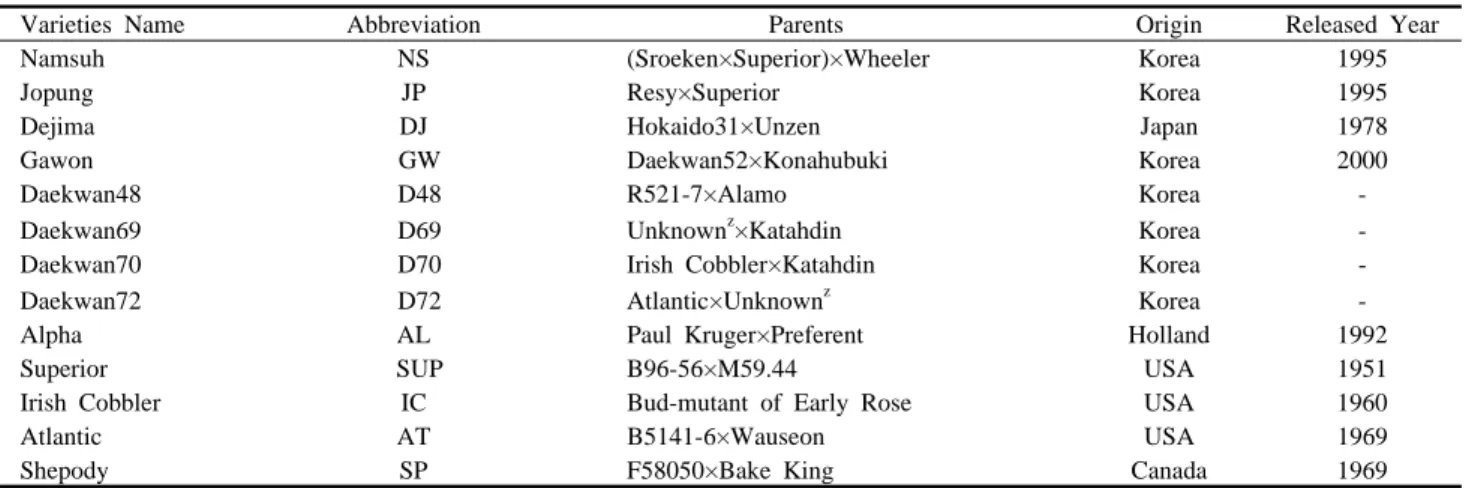
Varieties Name Abbreviation Parents Origin Released Year
Namsuh NS (Sroeken×Superior)×Wheeler Korea 1995
Jopung JP Resy×Superior Korea 1995
Dejima DJ Hokaido31×Unzen Japan 1978
Gawon GW Daekwan52×Konahubuki Korea 2000
Daekwan48 D48 R521-7×Alamo Korea -
Daekwan69 D69 Unknownz×Katahdin Korea -
Daekwan70 D70 Irish Cobbler×Katahdin Korea -
Daekwan72 D72 Atlantic×Unknownz Korea -
Alpha AL Paul Kruger×Preferent Holland 1992
Superior SUP B96-56×M59.44 USA 1951
Irish Cobbler IC Bud-mutant of Early Rose USA 1960
Atlantic AT B5141-6×Wauseon USA 1969
Shepody SP F58050×Bake King Canada 1969
zCollected from Inje, Kangwon as a native potato species in Korea
Table 1. List of potato varieties for RAPD in this study and their immediate parents.
Materials and Methods
Plant materials
Leaf tissues of potato varieties were sampled from field for breeder’s seed and in vitro cultured plantlets as a pathogen free stock at National Alpine Agricultural Experiment Station in Pyongchang, Korea. The potatoes used for RAPD analysis were seven cultivars and eight breeding lines including gene pools.
The origin and breeding parents were shown as table 1.
Preparation of potato total DNA
Potato total DNA was isolated by modified method of Teresa et al. (1995). One hundred mg of leaf tissues from young and full-expanded potato leaves was homogenized in 750 μl of microprep buffer [DNA extraction buffer (0.35 M sorbitol, 0.1 M tris base, 5 mM EDTA (pH 7.5) : nuclei lysis buffer (0.2 M tris base, 50 mM EDTA, 2 M NaCl, 2% (w/v) CTAB:5%
(w/v) sarkosyl=2.5:2.5:1)]. Then incubated in 65℃ water bath for 30 120 min. The sample tubes were filled with chloroform:isoamyl alcohol (24:1), mixed by mild vortexing and centrifuged at 10,000 rpm for 5min. The total DNAs were harvested from upper aqueous phase by ethanol precipitation and resuspended in 50 μl TE buffer (pH 8.0).
PCR and electrophoresis
PCR was performed in a volume of 20 μl containing 1.0 unit of Taq polymerase, 1.5 mM M gCl2, 0.25 mM dNTPs, 50 mM Tris-HCl (pH 8.3), 40 mM KCl, 100 pmole primer and 200 ng template DNA. Amplication was performed in a Perkin Elmer Thermal Cycler 480 (Perkin-Elmer, USA). URP random primers (Korean Patent No. 97-016981) were purchased from Seolin Scientific Co., Ltd. Seoul, Korea. These primers were designed from repetitive sequence of Korean Red Rice (Oriza sativa L.).
Amplification was performed for 40 cycles at 94℃ for 1 min, 55℃ for 1 min, and 72℃ for 2 min, for denaturation, annealing, and extension, respectively. Following the final cycle, amplified
DNA product was completed with a 10 min 72℃ extension.
Reaction products were resolved by electrophoresis in 1.2%
(w/v) agarose gel at 5.0 volt/cm for 100 min or 6.0% (w/v) of denaturing polyacrylamide gel with 7.5 M urea at 55 W constant power condition for 3 hours. The DNA bands in agarose and polyacrylamide gel were stained with EtBr and silver nitrate, respectively.
Genetic analysis
Amplified DNA fragments were scored as 1 (band present) or 0 (band absent) to calculate simple matching coefficients (Ssm= No. of monomorphic bands / No. of total bands for similarity analysis (Sokal and M ichener, 1958). For each group, estimates of similarity between all pairs of varieties were summarized in matrix form and similarity matrices were performed to graphic- ally summarize associations among the varieties. Dendrograms based on a dissimilarity index (d=1-Ssm) were generated using the unweighted pair-group method with arithmetic averages (UPGM A, Sneath and Sokal, 1973). Calculations of the similar- ities and statistics were carried out by using the NTSIS-pc program based on Nei’s estimation of similarity (Nei, 1972).
Results and Discussion
In most plants, only 20 40% of the genome consists of unique or single copy DNA sequences. And highly repetitive sequence DNA is usually present at 105~107 copy per genome (Hughes, 1996). The repetitive genome have different size and high level genetic diversity among the inter and intra species (Weising et al., 1989; Zhao and Kochert, 1992). In some crops, repetitive sequences were used for verification of genetic diversity among the varieties (Kawchuk et al., 1996; Provan et al., 1996; Rus-Kortekaas et al., 1994). The single sequence repeats (SSRs) or microsatellite were reported as a useful marker for the detection of genetic variation (Akkaya et al. 1992;
Kawchuck et al. 1996). But the URP primers that used in this
M 1 2 3 4 5 6 7 8 9 10 11 12 13 M
Fig. 1. Pattern of RAPD fragments generated with primer URP2 (upper) and 4 (lower) for the 13 potato varieties.
M, 1kb ladder; 1, NS; 2, IC; 3, AT; 4, DJ; 5, SP; 6, SUP;
7, JP; 8, D48; 9, GW; 10, D69; 11, D70; 12, AL; 13, D72.
No. Productsz Sequences
1 URP 1 5’-ATCCAAGGTCCGAGACAACC-3’
2 URP 2 5’-CCCAGCAACTGATCGCACAC-3’
3 URP 3 5’-GTGTGCGATCAGTTGCTGGG-3’
4 URP 4 5’-AGGACTCGATAACAGGCTCC-3’
5 URP 5 5’-GGCAAGCTGGTGGGAGGTAC-3’
6 URP 6 5’-ATGTGTGCGATCAGTTGCTG-3’
7 URP 7 5’-GGTGAACAGTGAGATGAACC-3’
8 URP 8 5’-TACATCGCAAGTGACACAGG-3’
9 URP 9 5’-AATGTGTGGCAAGCTGGTGG-3’
10 URP 10 5’-GATGTGTTCTTGGAGCCTGT-3’
11 URP 11 5’-GGACAAGAAGAGGATGTGGA-3’
12 URP 12 5’-GGCATTCTACCACCACAAGT-3’
zAccession numbers of SRILS UniPrimer Kit.
Table 2. The list of 12 URP primers used in RAPD of potato varieties.
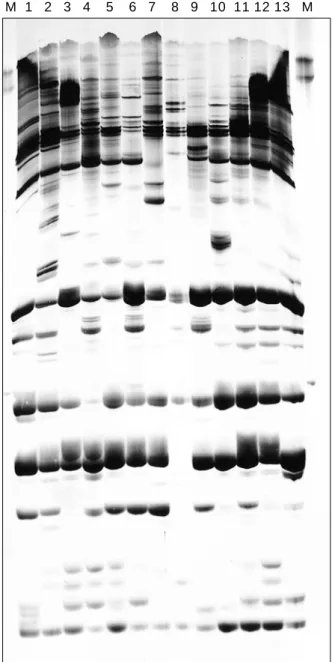
M 1 2 3 4 5 6 7 8 9 10 11 12 13 M
Fig. 2. 6% polyacrylamide gel electrophoresis of RAPD frag- ments generated with primer URP 8 for the 13 potato varieties.
M, 1kb ladder; 1, NS; 2, IC; 3, AT; 4, DJ; 5, SP; 6, SUP;
7, JP; 8, D48; 9, GW; 10, D69; 11, D70; 12, AL; 13, D72.
study, was randomly designed from repetitive sequence of rice genome but did not contained SSRs or microsatellite sequences (Table 2). In case of potato, various genetic analysis techniques for determination of genetic variants were developed including isozyme (Quirois and McHale, 1985), RAPD (Demeke et al., 1993; Hosaka et al., 1994), and AFLP analysis (Kim et al., 1998). Seven domestically recommended varieties including
‘Superior’ and six breeding lines or varieties including
‘Daekwan70’ and ‘Daekwan72’ were used for RAPD analysis by URP primers (Table 1). W e examined the all of URP primers produced commercially and selected the URP2, URP4, and URP8 primer for discrimination of potato genetic diversity (Figs.
1 and 2).
URP primers were shown very high reproducibility because of the high annealing temperature above 55℃. So, they were known to be very desirable to examine the specificity between inter and intra species by preliminary studies. Some of these genotypes have many resemblances in plant characteristics each other because ‘Jopung’, ‘Daekwan72’, ‘Gawon’, and ‘Daekwan70’
have immediate parental relationship with ‘Superior’, ‘Atlantic’,
‘Namsuh’, and ‘Irish Cobbler’ respectively. So, there are many difficulties to distinct the varieties by the morphological charac- teristics. Amplified DNA showed polymorphism when URP primers were used (Fig. 1). When URP2 primers were used, 11 among 15 bands showed polymorphism and made us possible to
NS IC AT DJ SP SUP JP D48 GW D69 D70 AL D72 1.000
0.639 1.000
0.667 0.694 1.000
0.500 0.806 0.667 1.000
0.667 0.861 0.722 0.667 1.000
0.694 0.722 0.528 0.806 0.639 1.000
0.750 0.778 0.583 0.583 0.806 0.778 1.000
0.722 0.694 0.778 0.500 0.722 0.528 0.694 1.000
0.750 0.667 0.528 0.694 0.583 0.833 0.722 0.583 1.000
0.778 0.694 0.667 0.500 0.722 0.639 0.861 0.722 0.806 1.000
0.722 0.750 0.611 0.611 0.667 0.750 0.806 0.611 0.694 0.778 1.000
0.639 0.889 0.806 0.861 0.806 0.722 0.722 0.639 0.611 0.639 0.750 1.000
0.806 0.778 0.639 0.639 0.694 0.833 0.889 0.694 0.722 0.806 0.917 0.778 1.000 Table 3. Similarity matrix of the pattern of polymorphic DNA bands generated by URP primers using Nei’s estimation (Nei,
1972).
Similarity
0 . 6 4 0 . 7 2 0 . 8 0 0 . 8 8 0 . 9 6
N S J P D 6 9 D 7 0 D 7 2 S U P D 6 8 I C A L D J S P A T D 4 8
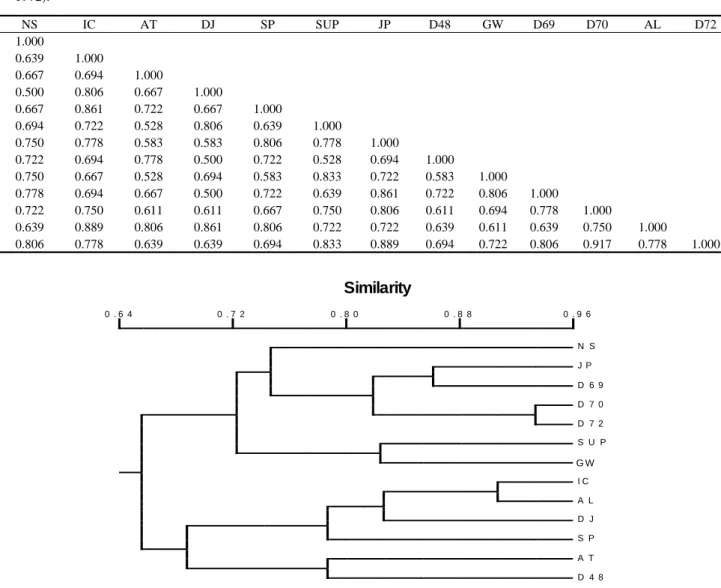
Fig. 3. Phenogram of 13 potato varieties generated by UPGMA cluster analysis of the similarity values given in Table 3.
distinct 13 varieties and lines. DNA polymorphisms on 6%
PAGE of PCR products by URP8 were shown the distinguished polymorphic band pattern but the excessive band emergence in large size bands so delicate that the exact band scoring could not perform by silver staining procedure (Fig. 2). The similarity dendrogram by DNA band profiles amplified by URP2 and 4 had little genetic relationship between ‘Irish Cobbler’ and its offsprings ‘Daekwan70’ and ‘Atlantic’ (Fig. 3). ‘Superior’ had similarity to ‘Namsuh’ and ‘Jopung’ with reflection of pedigree relationship. This is coincided with the results of Demeke et al.
(1996). These results indicated that varieties within close kinship can often be as genetically diverse as varieties with no imme- diate relationship. The ability to distinguish between genotypes using RAPD patterns is associated with the allelic state at each locus and results from the independent segregation of discrete genetic factors according to Mendellian genetic principles (Demeke et al., 1996; Quiros et al., 1993).
The UPOV (International Union for the Protection of New Varieties of Plants, 1986) guide line and Seed Industry Law regulate that the new potato cultivars should be discriminated with DUS test. It was thought that the RAPD by using URP primers is useful technique for discrimination of newly bred cultivars, breeding lines, and genetic resources of potato. And also this technique has a possibility for supportive or comple- mentary method for confirm the distinctness of newly bred potato cultivar by DUS test.
Literature Cited
Adams, R.P. and T. Demeke. 1993. Systematic relationships in Junipers based on random amplified polymorphic DNA (RAPD).
Taxon 42:553-571.
Akkaya, M.S., A.A. Bhagwat, and P.B. Gregan. 1992. Length polymorphisms of simple sequence repeat DNA in soybean.
G W
Genetics 132:1131-1139.
Demeke, T., R.P. Adams, and R., Chibbar. 1992. Potential taxono- mic use of random amplified polymorphic DNA (RAPD): a case study in Brassica; Theor. Appl. Genet. 84:990-994.
Demeke, T., L.M. Kawchuck, and D.R. Lynch. 1993. Identification potato cultivars and clonal variants by random amplified poly- morphic DNA analysis. Amer. Potato J. 70:561-570.
Demeke, T., D.R. Lynch, L.M. Kawchuck, G.C. Kozub, and J.D.
Amstrong. 1996. Genetic diversity of potato determined by random amplified polymorphic DNA analysis. Plant Cell Rpt.
15:662-667.
Hosaka, K., M. Mori, and K. Ogawa. 1994. Genetic relationships of Japanese potato cultivars assayed by RAPD analysis. Amer.
Potato J. 71:535-546.
Hughes, M.A. 1996. Plant Molecular Genetics, Addison Wesely Longman, Essex, England.
International Union for the Protection of New Varieties of Plants (UPOV). 1986. Guidelines for the Conduct of Test for Distinct- ness, Homogeneity and Stability.
Kawchuk, L.M., D.R. Lynch, J. Thomas, B. Penner, D. Sillito, and F. Kulcsar. 1996. Characterization of Solanum tuberosum simple sequence repeats and application to potato cultivar identification. Amer. Potato. J. 73:325-335.
Kim, J.H., H. Joung, H.Y. Kim, and Y.P. Lim. 1998. Estimation of genetic variation and relationship in potato (Solanum tuberosum L.) cultivars using AFLP Markers Amer. J. Potato Res.
75:107-112.
Lee, C.H. and K.S. Kim. 2000. Genetic diversity of Chrysanthemum zawadskii Herb. and the related groups in Korea using RAPDs.
J. Kor. Soc. Hort. Sci. 41:230-236.
Nei, M. 1972. Genetic distance between population. The American Naturalist 106:283-292.
Provan, J., W. Powell, and R. Waugh. 1996. Microsatellite analysis of relationships within cultivated potato (Solanum tuberosum).
Theor. Appl. Genet. 92:1078-1084.
Quirois, C.F. and N. McHale. 1985. Genetic analysis of isozyme variants in diploid and tetraploid potatoes. Genetics 111:131- 145.
Rus-Kortekaas, W., M.M. Smulders, P. Arens, and B. Vosman.
1994. Direct comparison of levels of genetic variation in tomato detected by a GACA-containing microsatellite probe and by random amplified polymorphic DNA. Genome. 37:375-381.
Sneath, P.H.A. and R.R. Sokal. 1973. Numerical Texanomy.
Terrman, San Francisco.
Sokal, R.R. and C.D. Michener. 1958. A statistical method for evaluating systematic relationships. Univ. Kans. Sci. Bull.
38:1409-1438.
Teresa, M.F., C. Julapark, and S.D. Tanksley. 1995. Microprep protocol for extraction of DNA from tomato and other herbaceous plants. PMBR. 13:207-209.
Vierling, R. and H.T. Nguyen. 1992. Use of RAPD markers to
determine the genetic relationships of diploid wheat genotypes.
Theor. Appl. Genet. 84:835-838.
Vos, P., R. Hogers, M. Bleeker, M. Reijans, T. van de Lee, M.
Hornes, A. Frijters, J. Pot, J. Peleman, M. Kuiper, and M.
Zabeau. 1995. AFLP: a new technique for DNA fingerprinting.
Nucleic Acids Res. 23:4407-4414.
Weising, K., F. Weigand, A.J. Driesel, G, Kahl, H. Zischler, and J.T. Epplen. 1989. Polymorphic simple GATA/GACA repeats in plant genomes. Nucleic Acids Res. 17:10128.
Williams, J.G.K., A.R. Kubelik, K.J. Livak, J.A. Rafalsk, and S.V.
Tingey. 1990. DNA polymorphism amplified by arbitray primers are useful as a genetic marker. Nucleic Acid Res.
18:6531-6535.
Yae, B.W. and K.C. Ko. 1995. Classification of Malus domestica cultivars by random amplified polymorphic DNA markers. J.
Kor. Soc. Hort. Sci. 36:824-628.
Zhao, X. and G. Kochert. 1992. Characterization and genetic mapping of short, highly repeated, interspersed DNA sequence from rice (Oryza sativa L.). Mol. Gen. Genet. 231:353-359.
RAPD에 의한 감자 품종의 구분
서효원1*․이정윤1․조현묵1․박영은1․오승은2
1고령지농업시험장 작물과, 2건국대학교 생명과학과
초 록
감자 DNA의 다형성을 통한 품종 및 육종 계통의 구분이 가능한 특이적 분자 마커를 찾기 위해 URP primer를 이용한 RAPD 분석 을 실시하였다. 8 가지의 감자 품종과 5가지의 감자 육종계통을 분 석 재료로 이용하였으며, 이들 중 ‘조풍’, ‘대관70호’, ‘가원’과 ‘대관 72호’는 ‘수미’, ‘남작’, ‘남서’와 ‘대서’를 각각 모본으로 이용되어 육 성되었으며, 다양한 표현형질에서 유사성을 가지고 있다. 따라서 생 육단계별 표현형질들 만으로는 각각을 구분하기 곤란한 경우가 있 다. 벼(Oriza sativa)의 repetitive sequence로부터 고안된 URP primer는 비교적 높은 annealing 온도를 가지며, 20 mer의 비교적 길이가 긴 RAPD용 primer로써 증폭산물의 다형성과 재현성이 높 아 다양한 생물종의 구분이 가능한 것으로 보고되고 있다. 국내에서 상품화되어 시판되는 URP primer 들 중에 URP2, URP4, URP8 등이 감자에 적용될 수 있을 것으로 확인하였다. 전기영동된 DNA 밴드들의 유사성을 분석해본 결과 유전적 유사도와는 차이를 나타 내고 있었다. 그러나 높은 재현성을 갖는 URP primer들에 의해 증 폭된 DNA 밴드의 다형성은 감자의 종내변이를 구분할 수 있는 분 자 마커로서 이용할 수 있을 것으로 확인되었다.
추가 주요어:DUS test, 유전적 다형성, Solanum tuberosum, URP