March 2015 | Vol. 43 | No. 1 Microbiol. Biotechnol. Lett. (2015), 43(1), 65–78
http://dx.doi.org/10.4014/mbl.1501.01004 pISSN 1598-642X eISSN 2234-7305
Microbiology and Biotechnology Letters
순천만에 자생하는 염생식물 근권에서 유래한 해양세균의 계통학적 분석 및 다양성
유영현1,2†, 박종명3†, 이명철2, 김종국1*
1경북대학교생명과학부
2농촌진흥청국립농업과학원농업유전자원센터
3롯데중앙연구소
Received: January 13, 2015 / Revised: February 17, 2015 / Accepted: February 17, 2015
해안지역은육상생태계와해양생태계가만나는전이지대 로서내륙지역에비하여염분
,
고온,
바람,
자외선및해수에대한영향을크게받는환경으로알려져있다
[3].
해안지역은크게해안사구
,
해안암반지역,
해안염습지등으로분류되며 육상지역과는달리식물이생장하기어려운환경을가진다.
국내에분포하고있는해안염습지는수심이얕으며조석간만 의차가크고경사가완만하며,
서남해안에잘발달해있다.
그리고남해안에는국내대표적인순천만이자리잡고있으 며, 2006
년에“
람사르습지”
로등재되었다.
순천만은원형에 가까운형태의만으로서모래갯벌,
갯벌등의토양형태를가지고
[14],
아주잘보존된해안염습지중에하나이다.
또한,
독립적으로적응된염생식물(Halophyte)
종들이자생하고있 고[16],
생물종다양성이높은것으로알려져있다[17].
대표 적으로자생하는염생식물은갈대(Phragmites australis),
칠 면초(Suaeda japonica),
나문재(Suaeda asparagoides),
해홍 나물(Suaeda maritima),
퉁퉁마디(Salicornia europaea)
등 이있고[13],
갈대와칠면초가우점하고있다.
염생식물은다양한미생물과상호관계를가지며
,
미생물 에의해서염,
건조,
고온,
바람등과같은환경스트레스에 면역성을가진다고알려져있으며[32, 38],
염습지로유입되 는오염물질등을분해및정화한다고알려져있다[6].
순천 만은세계5
대연안습지로알려져있지만,
국내분포하고있 는해안염습지의규모에비하여해양미생물연구는많이이 루어지지않았다.
최근에순천만에자생하고있는염생식물-
균류에 대한 연구가 보고되고 있지만[34, 44],
해양세균Phylogenetic Analysis and Diversity of Marine Bacteria Isolated from Rhizosphere Soils of Halophyte in Suncheon Bay
Young-Hyun You
1,2†, Jong Myong Park
3†, Myung-Chul Lee
2, and Jong-Guk Kim
1*
1
School of Life Science, Kyungpook National University, Daegu 702-701, Republic of Korea
2
National Agrobiodiversity Center, NAAS, RDA, Jeonju 560-500, Republic of Korea
3
LOTTE R&D Center, Seoul 150-096, Republic of Korea
The bacterial diversity of the rhizosphere soil of S. japonica native to Suncheon bay was analyzed. Ninety two strains showing different morphological characteristics were isolated from the soils around the community of S. japonica. Bacterial diversity and distributions were studied by phylogenetic analysis of the partial 16S rDNA sequences. Ninety two strains were partially sequenced and analyzed phylogenetically. These strains were composed of 5 phyla firmicutes (56.5%), gamma-proteobacteria (29.3%), alpha-proteobacteria (5.4%), actinobacteria (5.4%), bacteroidetes (3.3%) and Shannon’s diversity index (H') were dif- ferent from each of sampling sites (1.675, 1.924 and 2.04). Eleven isolates were presumed to be novel species candidates based on similarity analysis of the 16s rRNA gene sequences. Overall, Firmicutes and gamma-proteobacteria of the rhizo- sphere soil of S. japonica showed a high diversity.
Keywords: Diversity, marine bacteria, phylogenetic analysis, Suncheon Bay
*Corresponding author
Tel: +82-53-950-5379, Fax: +82-53-955-5379 E-mail: [email protected]
†
These authors contributed equally to this work.
© 2015, The Korean Society for Microbiology and Biotechnology
66 You et al.
http://dx.doi.org/10.4014/mbl.1501.01004
(Marine bacteria)
에대한연구는거의없는실정이다.
따라 서해양세균의확보및다양성연구가먼저이루어져야할 것이며,
이를토대로생태학적,
유전학적,
분자생물학적등 의다양한연구가필요할것이다.
본연구에서는순천만에 자생하고있는칠면초의근권토양에서해양세균을분리하고 이들의계통학적인유연관계를분석하고다양성을확인하고 자하였다.
이에더하여,
최근해안식생복원,
염해농경지 복원에대한연구분야에서해안·
염생식물과상호작용하며 식물생장촉진및식물면역성을유도하는해양미생물자원과 관련된연구가증가하고있는바[14, 16, 17, 18, 44],
본연 구에서는순천만자생식물과상호작용할것으로추측되는 다양한근권세균을분리하고분리균들과그들의표준균주 간계통수를확인하여유용미생물자원을확보하고자하였다.
이를위해순천만연안에서자생하는칠면초군락지3
곳 을선발하여근권토양을채취하였다(Table 1).
토양시료는 멸균tube
에담겨4
oC
를유지하여실험실로운반되었으며,
멸균된0.85% NaCl
용액과토양시료를1:1
로섞어40 rpm
으로30
분간40 rpm
으로교반하였다.
이들의supernatant
를100
µl
씩을덜어내어standard serial dilution technique
을 이용해 각각 희석배수별로tryptic soy broth (TSB;
Difco, USA)
한천배지와marine broth (MB; Difco, USA)
한천배지에도말후, 25
oC
에서7
일간항온기에서배양하였 다.
배양후형성된colony
들은그들의색,
모양,
크기등으 로분리되었으며,
획선도말을반복하여각각동일배양조건 하에서계대배양을반복하여순수분리되었다[15, 43, 44].
또한
16S rDNA
를이용한분리균의분자적부분동정을위해다음과같은과정이수행되었다
.
각각의세균을원분리배 지인MB, TSB
액체배지10 ml
에접종하여30
oC
에서180 rpm
으로18
시간전배양후100 ml
액체배지에전배양액1 ml
씩을접종하여25
oC
항온기에서180 rpm
으로5
일간진탕배 양하였다.
본배양액을4
oC
에서3,000 rpm
으로10
분간원심 분리하여균체를수집한후, boiling method (Chelex Resin Bio-RAD, USA)
를 이용해genomic DNA
를 추출하였다. 16S rDNA sequence
증폭을위해5'-AGAGTTTGATCCTGG CTCAG-3'
를forward primer
로, 5'-GGTTACCTTGTTACGACTT- 3'
을reverse primer
로 사용하여PCR
을 수행하였다[39].
PCR
조건은, 1
차적으로denaturation (95
oC, 15 min)
을실시한후
, denaturation (95
oC, 20 sec), annealing (50-58
oC, 40 sec), elongation (72
oC, 90 sec)
을35
회반복한후마지막 으로elongation (72
oC, 5 min)
을 실시하였다[18, 43, 44].
PCR product
의 염기서열 분석은ABI 3730XL DNA analyzer (Perkin Elmer, USA)
을이용하여실시되었다[37].
결정된서열은
National Center for Biotechnology Information (NCBI) public domain site
의BLAST
및EzTaxon server (http://eztaxon.org) database
를 이용하여 기준균주(type strain)
와가장상동성이높은type strain
과비교하여판별 하였다[7, 25, 33, 34].
또한순수분리된균주들에대해NCBI
의GenBank
로부터16S rDNA
서열에대한accession no.
를부여받았다
(Table 2).
우선순천만자생
S. japonica
근권3
개site
에서총92
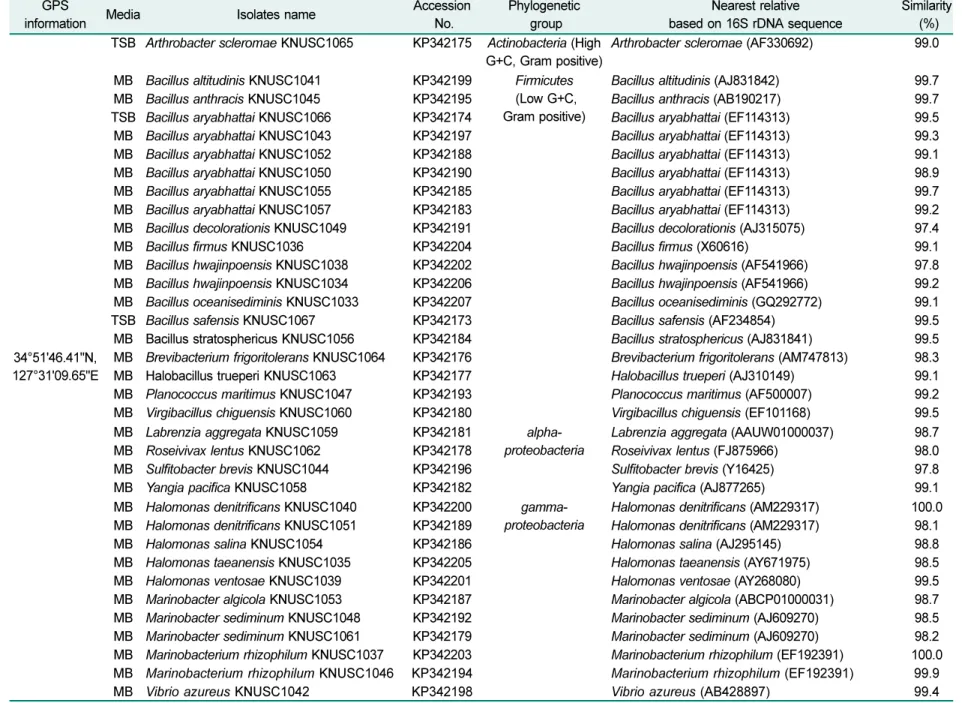
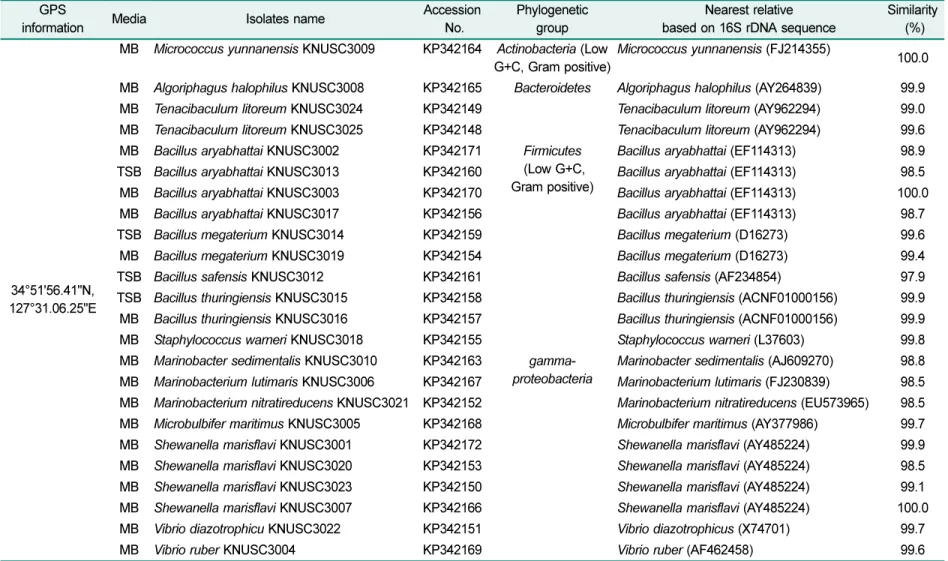
개 의세균이순수분리되었는데(Table 1), MB
고체배지에서는73
개의균주가, TSB
고체배지에서19
개의균주가분리되었 다(Table 2). MB
배지에서만분리된균주로는주로해양세 균으로보고된Shewanella, Marinobacterium, Marinobacter, Microbulbifer, Halomonas, Vibrio
속이분리되었으며[4, 5, 10],
이들은TSB
배지에서는분리되지않는경향을보였다(Table 2).
한편, TSB
배지에서는Bacillus, Paenibacillus, Arthrobacter, Sporosarcina, Microbacterium
속이주로분 리되었으며,
이들중특히Bacillus
속의종들은MB
배지에 서도분리되는경향을보였다.
일반적으로Bacillus
및연관 속의다양한종들은토양정주균(Soil microflora)
으로물질 순환에직접관여하며,
스트레스가극심한환경에서생존하 면서진화해온것으로알려져있다.
또한식물과상호작용 하여식물생장촉진(Plant growth promotion),
식물병원체 방어유도(Induction of systemic resistance)
등다양한역할 을수행하는것으로보고되었다[15, 29]. MB
배지가해양세 균분리를위해최척화된배지임을감안할때,
이들Bacillus
속의종들은해양환경에적응하면서조수간만의차이및이 에의한태양광,
자외선,
온도변화등스트레스가상존하는 갯벌환경에서생존하며염생식물과어떠한상호작용을수행 할것으로예상되어분리된Bacillus
속균주들에대해후행 연구가필요하다.
본연구에서92
종이분리되었으나일반적 으로배양가능한미생물은전체중1-2%
에해당하며,
실제 순천만식물근권에존재하는미생물종류나수는훨씬많을Table 1. The position of sampling site and isolates number.
Site no. GPS information Host plant Number of isolates Number of
isolated species 1 34°51'45.94"N, 127°31'10.12"E
Suaeda japonica
33 19
2 34°51'46.41"N, 127°31'09.65"E 35 27
3 34°51'56.41"N, 127°31.06.25"E 24 17
Total 92 51
Diversi ty o f Mar ine Bacteria Isolated from S uncheon Ba y 67
March 2015 | Vol. 43 | No. 1
Table 2. 16S rDNA sequence similarity of isolated bacteria from the rhizosphere of Suaeda japonica to the closest relatives.
GPS
information Media Isolates name Accession
No.
Phylogenetic group
Nearest relative based on 16S rDNA sequence
Similarity (%)
34°51'45.94"N, 127°31'10.12"E
MB Agromyces humatus KNUSC1018 KP342222 Actinobacteria (High G+C, Gram positive)
Agromyces humatus (AY618216) 97.3
MB Kocuria rosea KNUSC1032 KP342208 Kocuria rosea (X87756) 98.7
TSB Microbacterium pumilum KNUSC1014 KP342226 Microbacterium pumilum (AB234027) 99.2 TSB Bacillus altitudinis KNUSC1005 KP342235 Firmicutes
(Low G+C, Gram positive)
Bacillus altitudinis (AJ831842) 99.7 TSB Bacillus altitudinis KNUSC1004 KP342236 Bacillus altitudinis (AJ831842) 99.3
TSB Bacillus altitudinis KNUSC1008 KP342232 Bacillus altitudinis (AJ831842) 99.4
MB Bacillus altitudinis KNUSC1031 KP342209 Bacillus altitudinis (AJ831842) 99.4
MB Bacillus anthracis KNUSC1026 KP342214 Bacillus anthracis (AB190217) 99.7
MB Bacillus aquimaris KNUSC1016 KP342224 Bacillus aquimaris (AF483625) 98.2
TSB Bacillus aryabhattai KNUSC1000 KP342240 Bacillus aryabhattai (EF114313) 99.2 MB Bacillus aryabhattai KNUSC1015 KP342225 Bacillus aryabhattai (EF114313) 99.4 MB Bacillus aryabhattai KNUSC1022 KP342218 Bacillus aryabhattai (EF114313) 99.4 MB Bacillus aryabhattai KNUSC1019 KP342221 Bacillus aryabhattai (EF114313) 99.3 MB Bacillus aryabhattai KNUSC1025 KP342215 Bacillus aryabhattai (EF114313) 99.3 MB Bacillus aryabhattai KNUSC1027 KP342213 Bacillus aryabhattai (EF114313) 99.7 MB Bacillus aryabhattai KNUSC1028 KP342212 Bacillus aryabhattai (EF114313) 99.5 MB Bacillus aryabhattai KNUSC1023 KP342217 Bacillus aryabhattai (EF114313) 99.5 TSB Bacillus methylotrophicus KNUSC1030 KP342210 Bacillus methylotrophicus (EU194897) 99.7
TSB Bacillus safensis KNUSC1009 KP342231 Bacillus safensis (AF234854) 100.0
TSB Bacillus safensis KNUSC1001 KP342239 Bacillus safensis (AF234854) 99.7
TSB Bacillus safensis KNUSC1002 KP342238 Bacillus safensis (AF234854) 100.0
MB Bacillus selenatarsenatis KNUSC1013 KP342227 Bacillus selenatarsenatis (AB262082) 99.4 MB Halobacillus trueperi KNUSC1011 KP342229 Halobacillus trueperi (AJ310149) 99.3 TSB Paenibacillus peoriae KNUSC1003 KP342237 Paenibacillus peoriae (AJ320494) 99.4 TSB Paenibacillus xylanexedens KNUSC1007 KP342233 Paenibacillus xylanexedens (EU558281) 99.2
TSB Sporosarcina luteola KNUSC1006 KP342234 Sporosarcina luteola (AB473560) 99.2
MB Loktanella hongkongensis KNUSC1020 KP342220 alpha-proteobacteria Loktanella hongkongensis (AY600300) 98.5 MB Halomonas fontilapidosi KNUSC1017 KP342223 gamma-
proteobacteria
Halomonas fontilapidosi (EU541349) 98.7
MB Halomonas ventosae KNUSC1010 KP342230 Halomonas ventosae (AY268080) 99.5
MB Marinobacter sediminum KNUSC1021 KP342219 Marinobacter sediminum (AJ609270) 98.8
MB Marinobacterium rhizophilum KNUSC1029 KP342211 Marinobacterium rhizophilum (EF192391) 100.0
MB Marinobacterium rhizophilum KNUSC1024 KP342216 Marinobacterium rhizophilum (EF192391) 100.0
MB Microbulbifer hydrolyticus KNUSC1012 KP342228 Microbulbifer hydrolyticus (AJ608704) 98.1
68 Y ou et al.
http://dx.doi.org/10.4014/mbl.1501.01004
Table 2. Continued.
GPS
information Media Isolates name Accession
No.
Phylogenetic group
Nearest relative based on 16S rDNA sequence
Similarity (%)
34°51'46.41"N, 127°31'09.65"E
TSB Arthrobacter scleromae KNUSC1065 KP342175 Actinobacteria (High G+C, Gram positive)
Arthrobacter scleromae (AF330692) 99.0
MB Bacillus altitudinis KNUSC1041 KP342199 Firmicutes (Low G+C, Gram positive)
Bacillus altitudinis (AJ831842) 99.7
MB Bacillus anthracis KNUSC1045 KP342195 Bacillus anthracis (AB190217) 99.7
TSB Bacillus aryabhattai KNUSC1066 KP342174 Bacillus aryabhattai (EF114313) 99.5
MB Bacillus aryabhattai KNUSC1043 KP342197 Bacillus aryabhattai (EF114313) 99.3
MB Bacillus aryabhattai KNUSC1052 KP342188 Bacillus aryabhattai (EF114313) 99.1
MB Bacillus aryabhattai KNUSC1050 KP342190 Bacillus aryabhattai (EF114313) 98.9
MB Bacillus aryabhattai KNUSC1055 KP342185 Bacillus aryabhattai (EF114313) 99.7
MB Bacillus aryabhattai KNUSC1057 KP342183 Bacillus aryabhattai (EF114313) 99.2
MB Bacillus decolorationis KNUSC1049 KP342191 Bacillus decolorationis (AJ315075) 97.4
MB Bacillus firmus KNUSC1036 KP342204 Bacillus firmus (X60616) 99.1
MB Bacillus hwajinpoensis KNUSC1038 KP342202 Bacillus hwajinpoensis (AF541966) 97.8 MB Bacillus hwajinpoensis KNUSC1034 KP342206 Bacillus hwajinpoensis (AF541966) 99.2 MB Bacillus oceanisediminis KNUSC1033 KP342207 Bacillus oceanisediminis (GQ292772) 99.1
TSB Bacillus safensis KNUSC1067 KP342173 Bacillus safensis (AF234854) 99.5
MB Bacillus stratosphericus KNUSC1056 KP342184 Bacillus stratosphericus (AJ831841) 99.5 MB Brevibacterium frigoritolerans KNUSC1064 KP342176 Brevibacterium frigoritolerans (AM747813) 98.3
MB Halobacillus trueperi KNUSC1063 KP342177 Halobacillus trueperi (AJ310149) 99.1
MB Planococcus maritimus KNUSC1047 KP342193 Planococcus maritimus (AF500007) 99.2
MB Virgibacillus chiguensis KNUSC1060 KP342180 Virgibacillus chiguensis (EF101168) 99.5 MB Labrenzia aggregata KNUSC1059 KP342181 alpha-
proteobacteria
Labrenzia aggregata (AAUW01000037) 98.7
MB Roseivivax lentus KNUSC1062 KP342178 Roseivivax lentus (FJ875966) 98.0
MB Sulfitobacter brevis KNUSC1044 KP342196 Sulfitobacter brevis (Y16425) 97.8
MB Yangia pacifica KNUSC1058 KP342182 Yangia pacifica (AJ877265) 99.1
MB Halomonas denitrificans KNUSC1040 KP342200 gamma- proteobacteria
Halomonas denitrificans (AM229317) 100.0 MB Halomonas denitrificans KNUSC1051 KP342189 Halomonas denitrificans (AM229317) 98.1
MB Halomonas salina KNUSC1054 KP342186 Halomonas salina (AJ295145) 98.8
MB Halomonas taeanensis KNUSC1035 KP342205 Halomonas taeanensis (AY671975) 98.5
MB Halomonas ventosae KNUSC1039 KP342201 Halomonas ventosae (AY268080) 99.5
MB Marinobacter algicola KNUSC1053 KP342187 Marinobacter algicola (ABCP01000031) 98.7 MB Marinobacter sediminum KNUSC1048 KP342192 Marinobacter sediminum (AJ609270) 98.5 MB Marinobacter sediminum KNUSC1061 KP342179 Marinobacter sediminum (AJ609270) 98.2 MB Marinobacterium rhizophilum KNUSC1037 KP342203 Marinobacterium rhizophilum (EF192391) 100.0 MB Marinobacterium rhizophilum KNUSC1046 KP342194 Marinobacterium rhizophilum (EF192391) 99.9
MB Vibrio azureus KNUSC1042 KP342198 Vibrio azureus (AB428897) 99.4
Diversi ty o f Mar ine Bacteria Isolated from S uncheon Ba y 69
March 2015 | Vol. 43 | No. 1
Table 2. Continued.
GPS
information Media Isolates name Accession
No.
Phylogenetic group
Nearest relative based on 16S rDNA sequence
Similarity (%)
34°51'56.41"N, 127°31.06.25"E
MB Micrococcus yunnanensis KNUSC3009 KP342164 Actinobacteria (Low G+C, Gram positive)
Micrococcus yunnanensis (FJ214355)
100.0 MB Algoriphagus halophilus KNUSC3008 KP342165 Bacteroidetes Algoriphagus halophilus (AY264839) 99.9 MB Tenacibaculum litoreum KNUSC3024 KP342149 Tenacibaculum litoreum (AY962294) 99.0 MB Tenacibaculum litoreum KNUSC3025 KP342148 Tenacibaculum litoreum (AY962294) 99.6 MB Bacillus aryabhattai KNUSC3002 KP342171 Firmicutes
(Low G+C, Gram positive)
Bacillus aryabhattai (EF114313) 98.9 TSB Bacillus aryabhattai KNUSC3013 KP342160 Bacillus aryabhattai (EF114313) 98.5 MB Bacillus aryabhattai KNUSC3003 KP342170 Bacillus aryabhattai (EF114313) 100.0
MB Bacillus aryabhattai KNUSC3017 KP342156 Bacillus aryabhattai (EF114313) 98.7
TSB Bacillus megaterium KNUSC3014 KP342159 Bacillus megaterium (D16273) 99.6
MB Bacillus megaterium KNUSC3019 KP342154 Bacillus megaterium (D16273) 99.4
TSB Bacillus safensis KNUSC3012 KP342161 Bacillus safensis (AF234854) 97.9
TSB Bacillus thuringiensis KNUSC3015 KP342158 Bacillus thuringiensis (ACNF01000156) 99.9 MB Bacillus thuringiensis KNUSC3016 KP342157 Bacillus thuringiensis (ACNF01000156) 99.9 MB Staphylococcus warneri KNUSC3018 KP342155 Staphylococcus warneri (L37603) 99.8 MB Marinobacter sedimentalis KNUSC3010 KP342163 gamma-
proteobacteria
Marinobacter sedimentalis (AJ609270) 98.8 MB Marinobacterium lutimaris KNUSC3006 KP342167 Marinobacterium lutimaris (FJ230839) 98.5 MB Marinobacterium nitratireducens KNUSC3021 KP342152 Marinobacterium nitratireducens (EU573965) 98.5 MB Microbulbifer maritimus KNUSC3005 KP342168 Microbulbifer maritimus (AY377986) 99.7 MB Shewanella marisflavi KNUSC3001 KP342172 Shewanella marisflavi (AY485224) 99.9 MB Shewanella marisflavi KNUSC3020 KP342153 Shewanella marisflavi (AY485224) 98.5 MB Shewanella marisflavi KNUSC3023 KP342150 Shewanella marisflavi (AY485224) 99.1 MB Shewanella marisflavi KNUSC3007 KP342166 Shewanella marisflavi (AY485224) 100.0
MB Vibrio diazotrophicu KNUSC3022 KP342151 Vibrio diazotrophicus (X74701) 99.7
MB Vibrio ruber KNUSC3004 KP342169 Vibrio ruber (AF462458) 99.6
70 You et al.
http://dx.doi.org/10.4014/mbl.1501.01004
것으로 추측된다
[1, 30, 45].
또한 분리균들 중Ez-Taxon database
상의유사염기서열과98.5%
미만의유사도를보 이는분리주는총11
개균주로,
모두신종세균으로의가능 성을보였다(Table 2) [39].
순천만갯벌은일반적인육지,
해 양과다른독특한환경을가지고있으며,
지리·
역사적특성 으로미생물상에대한연구사례가거의없음을볼때보고 되지않은신종세균이다양하게분포할것으로된다.
시료채취지점별로는각각
33
개, 35
개, 24
개균주가순수 분리되었으나부분동정결과각각29
종, 25
종, 16
개종이분 리되어샘플링지점별로상이한수준의종다양성을보이는것으로생각된다
(Table 1).
따라서이들의계통분석및종다 양성확인을위해16S rDNA sequence
를Clustal X program
으로 다중정렬후, BioEdit Sequence Alignment Editor
를 사용해염기서열을정렬하였으며, Mega 6.0 program
을활 용하여Neighbor-Joining Tree method, Tamura nei model
에따라분석하였다[7, 25, 33, 34].
또한Shannon’s diversity index (H')
를적용하여시료채취지점별로다양성지수를분 석하였다[8, 11, 39].
그결과분리균들은크게4
개문(Phylum), 10
개목(Order), 26
개속(Genus), 51
개종(Species)
에속하 는것으로나타났다(Table 3). gamma-proteobacteria
그룹Table 3. Taxonomic composition of marine bacteria isolated from the S. japonica native to the Suncheon bay.
Phylogenetic group Order Genus Species Distribution ratio (%)
Actinobacteria (High G+C, Gram positive)
Actinomycetales Arthrobacter scleromae 1.1
Micrococcus yunnanensis 1.1
Agromyces humatus 1.1
Kocuria rosea 1.1
Microbacterium pumilum 1.1
Total 5.4
Bacteroidetes
Sphingobacteriales Algoriphagus halophilus 1.1
Flavobacteriales Tenacibaculum litoreum 2.2
Total 3.3
Firmicutes (Low G+C, Gram positive)
Actinomycetales Brevibacterium frigoritolerans 1.1
Bacilli Halobacillus trueperi 2.2
Bacillales Planococcus maritimus 1.1
Sporosarcina luteola 1.1
Staphylococcus warneri 1.1
Virgibacillus chiguensis 1.1
Paenibacillus peoriae 1.1
xylanexedens 1.1
Bacillus altitudinis 5.5
anthracis 2.2
aquimaris 1.1
aryabhattai 19.6
decolorationis 1.1
firmus 1.1
hwajinpoensis 2.2
megaterium 2.2
methylotrophicus 1.1
oceanisediminis 1.1
safensis 5.5
selenatarsenatis 1.1
stratosphericus 1.1
thuringiensis 2.2
Total 56.5
Diversity of Marine Bacteria Isolated from Suncheon Bay 71
March 2015 | Vol. 43 | No. 1
에 속하는
Oceanospirillales
목의Halomonas (H.)
속이, Alteromonadales
목에 속하는Marinobacter (M.)
속, Marinobacterium (M.)
속의종들이, Microbulbifer (M.)
속, Shewanella (S.)
속이, Vibrionales
목에속하는Vibrio (V.)
속의종들이분리되었다. alpha-proteobacteria
그룹에속하 는Rhodobacterales
목에서는Labrenzia (L.)
속, Roseivivax (R.)
속, Sulfitobacter (S.)
속및Yangia
속(Ya.)
의종들이 분리되었다. Firmicutes
문에는Actinomycetales
목에속하 는Brevibacterium (B.)
속이, Bacilli
목에속하는Halobacillus (H.)
속이, Bacillales
목에 속하는Bacillus (B.)
속의종들이 분리되었다. Bacteroidetes
문에는Sphingobacteriales
목에 속하는Algoriphagus (A.)
속이, Flavobacteriales
목에는Tenacibaculum (T.)
속의종들이분리되었으며, Actinobacteria
문에는Actinomycetales
목에속하는Arthrobacter (A.)
속, Micrococcus (M.)
속, Agromyces (A.)
속, Kocuria (K.)
속, Microbacterium (M.)
속의종들이분리되었다.
이들의비율 을정리해보면92
개전체분리균 중52
개분리균이gram
positive, low G+C contents
특성을가진firmicutes (56.5%)
로, 27
개분리균이gamma-proteobacteria (29.3%)
로, 5
개분리 균이alpha-proteobacteria (5.4%)
로, 5
개 분리균이gram positive, high G+C contents
특성을 가진actinobacteria (5.4%)
에속하였으며, 3
개분리균이Bacteroidetes (3.3%)
에 속하였다(Table 3).
선행연구에따르면,
자연환경특성및그 들의고유한기능에의해특징적미생물상을보이며,
일반적 으로 해수에서는 해양동물에 대한pathogen
이나marine bacteria
및alpha-, gamma proteobacteria
위주로 순수분 리되는것으로보고되었다[4, 5, 10].
담수에서는물질순환의 역할을담당하는beta-proteobacteia
가,
해양침적지에서는 다양한산소조건에서 물질순환의 역할을수행하는delta- proteobacteria
가주로순수분리되는것으로보고되고있다[2, 4, 5, 9, 24, 28].
그러나 본 연구에서는 이와 달리low G+C contents, gram positive bacteria
의 특징을 보이는firmicutes
가 집중 분리되었으며,
그 다음으로gamma- proteobacteria
가분리되었으며,
이는샘플링장소와관계없Table 3. Continued.
Phylogenetic group Order Genus Species Distribution ratio (%)
gamma- proteobacteria
Oceanospirillales Halomonas denitrificans 2.2
fontilapidosi 1.1
salina 1.1
taeanensis 1.1
ventosae 2.2
Alteromonadales Marinobacter algicola 1.1
sedimentalis 1.1
sediminum 3.3
Marinobacterium lutimaris 1.1
nitratireducens 1.1
rhizophilum 4.4
Microbulbifer hydrolyticus 1.1
maritimus 1.1
Shewanella marisflavi 4.4
Vibrionales Vibrio azureus 1.1
diazotrophicus 1.1
ruber 1.1
Total 29.3
alpha- proteobacteria
Rhodobacterales Labrenzia aggregata 1.1
hongkongensis 1.1
Roseivivax lentus 1.1
Sulfitobacter brevi 1.1
Yangia pacifica 1.1
Total 5.4
72 You et al.
http://dx.doi.org/10.4014/mbl.1501.01004
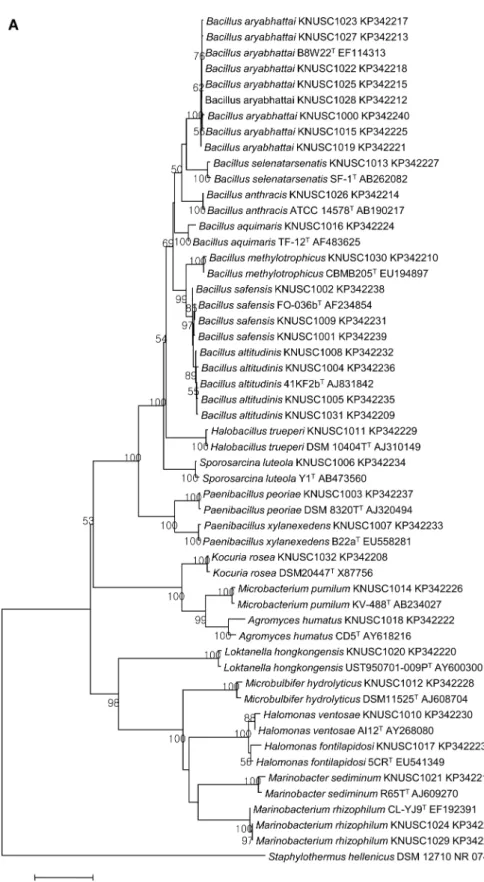
Fig. 1. Phylogenetic analysis of marine bacteria isolated from rhizosphere soils of S. japonica in Suncheon bay. This phylogenetic
tree was constructed by using the neighbor-joining method (1,000 bootstrap replications). (A) Phylogenetic relationships of bacterial
16S rRNA sequences within rhizosphere of samling site 1, (B) Site 2, (C) Site 3.
Diversity of Marine Bacteria Isolated from Suncheon Bay 73
March 2015 | Vol. 43 | No. 1
Fig. 1. Continued.
74 You et al.
http://dx.doi.org/10.4014/mbl.1501.01004
이공통적이었다
(Table 2, 3, Fig. 1A, 1B, 1C).
우선채취지 점과는상관없이종분포를살펴보면,
가장높은비율을차 지한firmicutes
문에서는그에속하는Bacillus
속에서가장 다양한종의분포를보였는데,
특히다음과같은다양한종 들과 높은 유사도를 보였다(Fig. 2). Bacillus altitudinis, Bacillus aryabhattai
의경우식물생장촉진하는gibberellins, abscisic acid, indole butyric acid
와같은물질분비에관여 하며[35],
특히B. aryabhattai
의경우연안의염스트레스환경하에서생존하며식물뿌리신장
(root elongation)
및생 장촉진(growth promotion)
효과가 보고되었다[20].
또한Paenibacillus peoriae
는광범위한식물역병균에대해길항 성을부여하는것으로보고되었다[12].
일반적으로Bacillus
속의세균들은환경적스트레스에강하다고알려진점,
특히 그들중주로식물면역성및생장촉진과관련된Bacillus
속 의주요균주들과유전적상동성이높은균주들이본연구 에서분리되었음을볼때,
본연구에서분리균들이해안환Fig. 1. Continued.
Diversity of Marine Bacteria Isolated from Suncheon Bay 75
March 2015 | Vol. 43 | No. 1
경에적응하면서염생식물의 생장에어떠한역할을할것 으로 사료되어 추가적 연구가 필요하다
.
한편Bacillus methylotrophicus
등은식물생장을촉진하며탈질화과정,
유기물산화에관여한다[23, 31, 35].
또한이들은Bacillus selenatarsenatis
와함께수계의침적환경에서크롬,
비소,
산 화성이강한중금속을환원·
응집시켜무독화하는것으로알려져있다
[33].
산화성이강한중금속은환경에축적될경우오염된토양의식물생장을저해하며
,
강력한독성을보인다.
일반적으로세균들은유·
무기물의세포내산화및및광반 응을통해환원력(reducing power)
를얻으며,
이를생명유지 및분열생장에이용한다.
중금속이온환원균의경우그들의 세포외측에서reducing power
일부를중금속이온환원에 사용하며응집·
침윤시켜무독화한다.
때문에이러한균주들 은 식물근권의 오염된 토양,
담수 저서에 생존하며bio- remediation
의역할을수행하는것으로잘알려져있다[26, 27, 33].
또한이러한역할수행을위해유사한환경적스트 레스에대한내성이필요하며,
따라서식물생장촉진및면 역성유도등의역할을수행하면서도토양에축적된유독성 물질에대한무독화및물질순환에관련된Bacillus
속균주들과상동성이높은본분리균들은염해농경지
,
오염된 토양등에서작물및식물의생존을가능하게하는등유용 미생물자원으로의가능성이있을것으로사료된다.
또한갯 벌미생물상에관한선행연구가드물었다는점,
해양환경에 서일반적으로우점한다고알려진marine bacteria
이외에 본연구에서중금속환원균주가분리된점은미생물상에대 한연구뿐만아니라,
순천만갯벌토양및염생식물이생장하 는환경자체에대한전반적인연구도필요한것으로사료된 다.
한편분리균주들과상동성이높은Bacillus taeanensis
등 다양한Bacillus
속의종들이염전등특수한고호염성해양 환경에서신종세균으로보고되고있다.
식물생장,
유·
무기물 순환,
중금속환원의역할및염분환경에적응된세균들과유 사도가높은균주들이분리된것은firmicutes
문의다양한세 균들이해양환경에적응하며순천만갯벌에고유기능을부여 하면서염생식물과상호작용하는것으로추정된다. Firmicutes
문의균주들에이어높은비율을보인gamma-proteobacteria group
중다빈도로분리된Marinobacterium
속(Fig. 2)
은 국내 다른 갯벌S. japonica
근권에서도 분리되었으며,
Halomonas
속은일반적으로해수에서분리되는세균으로알려져있다
[19].
일반적으로해양세균과염생식물혹은해안식물과의상호관계에대한연구는부족한실정으로
,
이들 이본연구에서도분리되었음을볼때식물과어떠한상호 작용을할가능성이있는균주로추가적인연구가필요하 다.
이외Shewanella marisflavi
는해양병원균으로알려져 있다[22, 42].
결론적으로,
본연구결과와선행연구들을종합 해볼때같은해양환경에속한다고하더라도갯벌의고유 한기능에따라일반해수와는상이한미생물상이형성된 것으로볼수있으며,
이렇게형성된미생물상은순천만갯 벌고유의기능을가능하게하는것으로생각된다.
이에더 하여시료채취지점별근권세균의유전학적다양성을분석 한결과다양성지수는1.675, 1.924, 2.04
로나타나,
칠면초 군락위치에따라firmicutes, gamma-proteobacteira
순으로 각phyla
의우점순은유사하지만(Fig. 1A, 1B, 1C)
유전적 다양성은상이한것으로판단된다(Table 4).
이는 같은갯 벌,
동일한종의근권일지라도채취지점에따른주변환경 변화가종우점도에영향을미치는것으로풀이된다.
본연 구에서는순천만에서자생하는염생식물S. japonica
근권 에서세균을분리·
동정하였으며그들의분포및종다양성 을확인하였고계통학적분석을실시하여갯벌특이적세균 군집의역할에대해확인하였다.
본연구결과로서해양환경 에서적응하면서,
간접적으로는근권토양에서물질순환의역 할을수행하며,
직접적으로는염생식물생존및생장에긍정 적영향을미치는식물상호작용유용미생물자원확보의기 초자료로활용될수있다.
Fig. 2. Composition of cultivable bacterial flora. (A) Firmicutes
(Low G+C, Gram positive), (B) gamma-proteobacteria.
76 You et al.
http://dx.doi.org/10.4014/mbl.1501.01004
요 약
순천만의염생식물근권에서정주하는세균의분리를위 해순천만에서우점하는자생식물인칠면초군락
3
개지점 을선발하여샘플링하였다.
시료는marine broth, tryptic soy broth
한천배지를통해분리되었으며,
형태학적인구분을통해순수분리되었다
.
분리주의16S rDNA
를분석하여 총92
균주가동정되었다.
이들의유연관계확인을위한계통 수작성결과,
각각firmicutes (56.5%), gamma-proteobacteria (29.3%), alpha-proteobacteria (5.4%), actinobacteria (5.4%), bacteroidetes (3.3%)
에속하였다. Shannon’s Diversity index (H')
를산출하였을때각각1.675, 1.924, 2.04
로,
채취지점 별로종다양성의차이를보였다.
Acknowledgments
This subject is supported by Korea Ministry of Environment as
“The Eco-Innovation Project”.
References
1. Amann RI, Ludwig W, Schleifer KH. 1995. Phylogenetic identi- fication and in situ detection of individual microbial cells with- out cultivation. Microbiol. Rev. 59: 143-169.
2. Campbell BJ, Engel AS, Porter ML, Takai K. 2006. The versa- tile ε-proteobacteria: key players in sulphidic habitats. Nat.
Rev. Microbiol. 4: 458-468.
3. Chapman VJ. 1974. Salt marshes and salt deserts of the world in ecology of halophytes. Academic Press, New York.
pp. 3-22.
4. Cottrell MT, Kirchman DL. 2000. Community composition of marine bacterioplankton determined by 16S rRNA gene clone libraries and fluorescence in situ hybridization. Appl. Environ.
Microbiol. 66: 5116-5122.
5. Cottrell MT, Kirchman DL. 2000. Natural assemblages of marine proteobacteria and members Cytophaga-Flavobacter cluster consuming low- and high-molecular-weight dissolved organic matter. Appl. Environ. Microbiol. 66: 1692-1697.
6. Dai JM, Sun Y, Culp RA, Noakes JE. 2009. A laboratory study on biochemical degradation and microbial utilization of organic matter comprising a marine diatom, land grass, and salt marsh plant in estuarine ecosystems. Aquat. Ecol. 43:
825-841.
7. Felsenstein J. 1985. Confidence limits on phylogenesis: an approach using the bootstrap. Evolution 39: 783-791.
8. Fierer N, Jackson RB. 2006. The diversity and bio-geography of soil bacterial communities. Proc. Natl. Acad. Sci. U.S.A.
103: 626-631.
9. Glöckner FO, Fuchs BM, Aman R. 1999. Bacterio-plankton compositions of lakesand oceans: a first comparison based on fluorescence- in situ-hybridization. Appl. Environ. Micro- biol. 65: 3721-3726.
10. Gonzalez JM, Moran MA. 1997. Numerical dominance of a group of marine bacteria in the α-subclass of the class Proteo- bacteria in coastal seawater. Appl. Environ. Microbiol. 63:
4237-4242.
11. Hill TC, Walsh KA, Harris JA, Moffett BF. 2003. Using ecologi- Table 4. Diversity index and distribution of rhizosphere micro-
organisms isolated from the rhizosphere of S. japonica native to the Suncheon bay.
Genera Sampling Sites
Site 1 Site 2 Site 3
Agromyces 1
Algoriphagus 1
Alteromonas
Arthrobacter 1
Bacillus 19 16 9
Demequina Erythrobacter Gordonia
Halobacillus 1 1
Halomonas 2 5
Kocuria 1
Labrenzia 1
Loktanella 1
Marinobacter 1 3 1
Marinobacterium 2 2 2
Microbacterium 1
Microbulbifer 1 1
Micrococcus 1
Paenibacillus 2
Planococcus 1
Roseivivax 1
Shewanella 4
Sporosarcina 1
Staphylococcus 1
Sulfitobacter 1
Tenacibaculum 2
Vibrio 1 2
Virgibacillus 1
Yangia 1
Total 33 35 24
Diversity index (H') 1.675 1.924 2.04
Rhizosphere bacterial strains were analyzed using Shan-
non’s diversity index (H’) at the genus level.
Diversity of Marine Bacteria Isolated from Suncheon Bay 77
March 2015 | Vol. 43 | No. 1
cal diversity measures with bacterial communities. FEMS
Microbiol. Ecol. 43: 1-11.
12. I von der Weid, Alviano DS, Santos AL, Soares RM, Alviano CS, Seldin L. 2003. Antimicrobial activity of Paenibacillus peo- riae strain NRRL BD-62 against a broad spectrum of phyto- pathogenic bacteria and fungi. J. Appl. Microbiol. 95: 1143- 1151.
13. Ihm BS, Leem JS, Kim JW, Kim HS, Ihm HB. 1998. Studies on the vegetation at the wetland of Suncheonman. Bull. Inst. Litt.
Envi. Mokpo. Nat. Univ. 15: 1-8.
14. Jang SK, Cheong CJ. 2010. Characteristics of grain size and organic matters in the tidal flat sediments of the Suncheon Bay. J. Korean. Soc. Mar. Environ. Eng. 13: 198-205.
15. Jeon SA, Sung HR, Park YM, Park JH, Ghim SY. 2009. Analy- sis of endospore-forming bacteria or nitrogen-fixing bacteria community isolated from plants rhizosphere in Dokdo island.
Korean J. Microbiol. Biotechnol. 37: 189-196.
16. Jeong SM, Lee MB. 2004. Change of estuary landscape in Suncheon Bay, South coast of Korea. J. Korean Geomorpho- logical Association. 11: 127-139.
17. Kim BS, Oh HM, Kang HJ, Park SS, Chun JS. 2004. Archaeal diversity in the tidal flat sediment as revealed by 16S rDNA analysis. J. Microbiol. 14: 205-211.
18. Kim YE, Yoon HJ, You YH, Kim H, Seo YG, Kim M, et al.
2014. Diversity and characteristics of rhizosphere microorgan- isms isolated from the soil around the roots of three plants native to the Dokdo Islands. J. Life. Sci. 24: 461-466.
19. Kim YG, Jin YA, Hwang CY, Cho BC. 2008. Marinobacterium rhizophilum sp. nov., isolated from the rhizosphere of the coastal tidal-flat plant Suaeda japonica. Int. J. Syst. Evol.
Microbiol. 58: 164-167.
20. Lee S, Ka JO, Song HG. 2012. Growth promotion of Xanthium italicum by application of rhizobacterial isolates of Bacillus aryabhattai in microcosm soil. J. Microbiol. 50: 45-49.
21. Li H, Qiao G, Li Q, Zhou W, Won KM, Xu DH, Park SI. 2010.
Biological characteristics and pathogenicity of a highly patho- genic Shewanella marisflavi infecting sea cucumber, Aposti- chopus japonicus. J. Fish. Disease. 33: 865-867.
22. Lim JM, Jeon CO, Kim CJ. 2006. Bacillus taeanensis sp.
nov.,a halophilic Gram-positive bacterium from a solar saltern in Korea. Int. J. Syst. Evol. Microbiol. 56: 2903-2908.
23. Madhaiyan M, Poonguzhali S, Kwon SW, Sa TM. 2010. Bacil- lus methylotrophicus sp. nov., a methanol-utilizing, plant- growth-promoting bacterium isolated from rice rhizosphere soil. Int. J. Syst. Evol. Microbiol. 60: 2490-2495.
24. Maidak BL, Cole JR, Parker TG, Jr CT, Saxman PR, Stredwick JM, et al. 2000. The RDP (Ribosomal Database project) con- tinues. Nucleic Acids Res. 28: 73-174.
25. Mani A, Arga CA, Jane D, Nithyalakshmy R, Kaveh E, Ehsan M. 2012. Carbohydrate degrading bacteria losely associated with Tetraselmis indica: influence on algal growth. Aquat. Biol.
15: 61-71.
26. Mauricio Gutiérrez A, Peña Cabriales JJ, Maldonado Vega M.
2010. Isolation and characterization of hexavalent chromium- reducing rhizospheric bacteria from a wetland. Int. J. Phytore- mediation. 12: 317-334.
27. Ma Y, Prasad MN, Rajkumar M, Freitas H. 2010. Plant growth promoting rhizobacteria and endophytes accelerate phytore- mediation of metalliferous soils. Biotechnol. Adv. 29: 248-258.
28. MEthé BA, Hiorns WD, Zehr JP. 1998. Contrasts between marine and freshwater bacterial community com-position:
analyses of communities in Lake George and six other Adirondack lakes. Limnol. Oceanogr. 43: 368-374.
29. Nelson DM, Glawe AJ, Labeda DP, Cann IK, Mackie RI. 2009.
Paenibacillus tundrae sp. nov. and Paenibacillus xylanexedens sp. nov., psychrotolerant, xylan-degrading bacteria from Alas- kan tundra. Int. J. Syst. Evol. Microbiol. 59: 1708-1714.
30. Olsen GJ, Lane DJ, Giovannoni SJ, Pace NR. 1986. Microbial ecology and evolution: a ribosomal RNA approach. Annu.
Rev. Microbiol. 40: 337-365.
31. QL Liu, GM YA, Miao LL, Zheng HY, Liu ZP. 2012. The char- acteristics of a novel heterotrophic nitrification-aerobic denitri- fication bacterium, Bacillus methylotrophicus strain L7.
Bioresour. Technol. 108: 35-44.
32. Rodriguez RJ, Henson J, Van VE, Hoy M, Wright L, Beckwith F, Kim Y, Redman RS. 2008. Stress tolerance in plants via habitat-adapted symbiosis. ISME J. 2: 404-416.
33. Sandana Mala JG, Sujatha D, Rose C. 2015. Inducible chro- mate reductase exhibiting extracellular activity in Bacillus methylotrophicus for chromium bioremediation. Microbiol.
Res. 170: 235-241.
34. Seo Y, Kim M, You YH, Yoon JH, Woo JR, Lee G, et al. 2012.
Genetic diversity of endophytic fungi isolated from the roots of halophytes naturally growing in Suncheon Bay. Korean J.
Mycol. 40: 7-10.
35. Siddikee MA, Chauhan PS, Anandham R, Han GH, Sa TM.
2010. Isolation, characterization, and use for plant growth pro- motion under salt stress, of ACC deaminase-producing halo- tolerant bacteria derived from coastal soil. J. Microbiol.
Biotechnol. 20: 1577-1584.
36. Sunar K, Dey P, Chakraborty U, Chakraborty B. 2015. Biocon- trol efficacy and plant growth promoting activity of Bacillus alti- tudinis isolated from Darjeeling hills, India. J. Basic Microbiol.
55: 91-104.
37. Tang YW, Von GA, Waddington MG, Hopkins MK, Smith DH, Li H, et al. 2000. Identification of coryneform bacterial isolates by ribosomal DNA sequence analysis. J. Clin. Microbiol. 38:
1676-1678.
38. Waller F, Achatz B, Baltruscha TH, Fodor J, Becker K, Fischer M, et al. 2005. The endophytic fungus Piriformospora indica reprograms barley to saltstress tolerance, disease resis- tance,and higher yield. Proc. Natl. Acad. Sci. U.S.A. 102:
13386-13391.
39. Woo PC, Lau SK, Teng JL, Tse H, Yuen KY. 2008 Then and
now: use of 16S rDNA gene se-quencing for bacterial identifi-
cation and discovery of novel bacteria in clinical microbiology
78 You et al.
http://dx.doi.org/10.4014/mbl.1501.01004