오미자농축액이 급성주정중독량 및 장기간 주정을 투여한 흰쥐의 혈중 알코올 분해율과 간 기능 보호에 미치는 영향
한찬규1․성기승1․이경원1․박성선2․정지윤1․김성수1
1한국식품연구원
2종근당건강(주)
Effects of Omija (Schizandra chinensis Baillon) Concentrate on Blood Alcohol Clearance and Hepatoprotective Function in Rats Induced by
Acute Ethanol Intoxication and Chronic Ethanol Treatment
Chan-Kyu Han1, Ki-Seung Seong1, Kyung-Won Lee1, Sung-Sun Park2, Ji-Yun Jeong1, and Sung-Soo Kim1
1Korea Food Research Institute
2Research Center, Chong Kun Dang Healthcare Corporation
ABSTRACT We investigated whether or not Schisandra chinensis (SC), a traditional herbal medicine, has protective effects against alcohol-induced fatty liver and blood alcohol clearance. Two tests focused on acute intoxication and chronic ethanol treatment were carried out. For the chronic ethanol treatment test, rats were fed ethanol by intragastric administration everyday for 8 weeks to induce alcoholic fatty liver. Ethanol treatment significantly increased blood alcohol concentration at 90 min after acute ethanol intoxication. Compared with the two ethanol-treated groups, rats administered ethanol along with SC extracts showed an approximately 13% increased blood alcohol clearance rate at 360 min. Chronic ethanol treatment significantly increased serum and hepatic triglyceride (TG) levels, and caused fatty degeneration of liver. Ethanol treatment also elevated the serum total-cholesterol (TC) level. However, after feeding of ethanol plus SC extracts, ethanol-induced elevation of hepatic TG levels reversed, whereas elevation of serum TG and TC levels was not observed after treatment with SC extracts. Ethanol treatment significantly increased γ-GT, aspartate aminotransferase, and alanine aminotransferase activities after 8 weeks. Compared with the ethanol-fed group, rats administered ethanol plus SC extracts for 4 weeks showed attenuated fatty degeneration as well as decreased hepatic function test values. SC administration also significantly increased intracellular lipid accumulation in hepatocytes and reduced steatosis score and hepatic TG levels, as measured by biochemical and histolopathological analyses. Our results indicate that the protective effects of SC are accompanied by a significant decrease in hepatic TG levels, thereby suggesting SC has the ability to prevent ethanol-induced fatty liver, by reducing hepatic TG and enzyme levels in alcoholic rats.
Key words: Omija (Schizandra chinensis), blood alcohol clearance, lipid profile, hepatic function, ethanol intoxication
Received 1 April 2014; Accepted 30 June 2014
Corresponding author: Sung-Soo Kim, Korea Food Research Insti- tute, Seongnam, Gyeonggi 463-746, Korea
E-mail: [email protected], Phone: +82-31-780-9067
서 론
2011년 우리나라 사망원인 통계를 보면 알코올 관련 사 망자 수는 총 4,493명(1일 평균 12.3명)으로 전년대비 0.9% 감소하였으나 여성 사망률이 남성보다 8배나 높고 60 대를 제외한 모든 연령층에서 사망률이 증가하는 양상을 보 였다(1). 알코올은 위장과 소장에서 빠르게 흡수된 후에 주 로 간에서 대사되는데 다량의 알코올이나 만성적인 알코올 섭취는 간 기능 손상을 유발할 수 있다(2). 간에서 알코올은
alcohol dehydrogenase(ADH)와 cytochrome P-450에 의해 아세트알데하이드로 전환되고 만성적인 섭취 시엔 microsomal ethanol oxidizing system(MEOS)에 의해 아 세트알데하이드 생성량이 증가한다(3). 정상적인 대사경로 에서는 아세트알데하이드는 mitochondiral aldehyde de- hydrogenase(ALDH)에 의해 acetate로 산화되고 TCA 회 로를 경유하여 콜레스테롤과 지방산 합성 등에 이용한다.
동양인은 서양인에 비해 ALDH2 효소가 적어 아세트알데하 이드가 몸에 더 많이 잔존하게 되고 이는 DNA를 손상시켜 암을 더 쉽게 유발시킬 수 있다. 알코올의 과도한 섭취는 간의 알코올 처리능력에 한계를 가져오게 만들고 1차적으로 대사된 아세트알데하이드가 알코올에 비해 반응성이 높아
Table 1. Experimental design for long-term ethanol administration
Group 1st phase (4 week) 2nd phase (4 week) Diet
A B C
Ethanol (40%)1) Ethanol (40%)1)
Ethanol (40%)+tap water
Ethanol (40%)+Omija concentrate (150 mg)2) Control (no ethanol)
Rat chow3) Rat chow Rat chow
1)Chivas Regal (40% of alcohol).
2)Schisandra chinensis (Turcz.) Baill. concentrate.
3)Teklad global 18% protein rodent diet (harlan 2018S).
강한 독성작용을 하므로 알코올성 간 손상 및 대사 장애를 초래하며, 알코올성 간 손상이 일어나게 되면 간세포가 파괴 되고 이때 혈액 중으로 AST(aspartate aminotransferase) 와 ALT(alanine aminotransferase) 효소가 유리되어 나오 기 때문에 AST와 ALT의 활성이 간세포 손상의 지표로 사 용되고 있다.
오미자는 오미자나무과에 속하는 오미자나무(Schizandra chinensis Baillon)의 열매로서 다섯 가지의 맛이 다양하게 조화를 이룬다는 뜻에서 불린 이름으로 비타민 C와 유기산 뿐만 아니라 페놀화합물이나 테르펜 등의 향기성분과 안토 시아닌 색소에 의한 붉은색을 지닌 식물체로(4) 간염, 두통, 신경쇠약 등의 치료 및 진해, 거담 효과를 나타내는 한약제 이다. 오미자의 약리 기능은 중추 억제 작용과 간 보호(5-8), 혈압 강하(9), 항산화 작용(10,11), 장내 미생물 개선(12, 13), 위암세포 사멸과 면역력 증강(14), 당뇨병 예방과 치료 효과(15), 항균 효과(16)가 보고되었고, 특히 in vitro 실험 에 의한 간 보호 효과가 보고되었다(17).
오미자나무속에는 주로 약용으로 쓰는 오미자와 제주도 에 분포하며 열매가 흑색을 띠는 흑오미자(S. nigra)가 있다 (18). 오미자의 성분은 schizandrin, schizandran, ethami- grenal, gomisin 등의 리그난화합물이 주를 이룬다(19,20).
에탄올을 급성으로 단회투여 한 쥐에게 오미자추출물의 경 구투여로 상승된 혈중 알코올 농도를 현저하게 감소시킨 결 과가 보고되었다(21). 본 연구에서는 알코올성 간 손상을 일으킨 흰쥐에게 오미자추출물이 혈중 알코올 분해율과 간 기능 보호에 미치는 영향을 구명하기 위한 단회성 급성주정 중독시험과 장기간 주정투여시험을 각각 수행하였다.
재료 및 방법
실험개요
본 실험에서는 알코올성 간 손상을 일으킨 흰쥐에게 오미 자추출물이 혈중 알코올 분해율과 간 기능 보호에 미치는 영향을 구명하기 위하여 단회성 급성주정중독시험 및 장기 간 주정투여시험을 각각 수행하였다. 급성주정중독시험은 주정단독투여군과 주정+오미자추출물투여군 및 주정+물 투여군으로 배치하였고, 장기주정투여시험은 주정+물투여 군, 주정+오미자추출물투여군 및 주정무투여군으로 하였 다. 두 시험에서 주정단독투여군과 주정무투여군의 설정은 단회성 시험의 경우 1회에 급성적인 주정중독을 유발시키는
시험 특성상 주정단독투여군(주정대조군)과 주정+오미자 추출물투여군 간 비교를 위해 배치하였고, 장기간 시험의 경우 4주간 주정투여 후 4주간 주정+오미자추출물투여군 과 시험 전 기간(8주) 동안 주정무투여군(일반대조군) 간 비 교를 위해 배치하였다.
단회성 급성주정중독시험
단회성 급성주정중독실험은 흰쥐에게 주정중독량(4 g of ethanol/kg of body wt.)을 투여하고 오미자추출물을 투여 한 후 60분, 90분, 150분, 240분, 300분, 360분의 혈중 에탄 올 농도를 측정하여 경시적인 알코올 분해율을 측정하였다.
실험동물 및 처리군: SD계통 수컷 흰쥐(체중, 300 g)를 처리군당 10마리씩 공시하여 주정대조군(주정), 오미자추출 물군(주정+오미자) 및 대조군(주정+물)으로 배치하였다.
주정투여량: 시험주정은 Chivas Regal(알코올 농도 40%, 용량 700 mL)로 흰쥐 체중 기준으로 투여하였다. 즉 체중 300 g일 때 주정량은 1.2 g으로 시험주정 기준(0.4 g of ethanol/mL of Chivas Regal)으로 3.0 mL를 투여하였다.
시료투여량: 주정투여 후 30분에 오미자추출물(2 mL, 150 mg)과 물(2 mL)을 경구투여 하였다.
시료채취 및 분석 항목: 혈액은 시료투여 후 60분부터 360분까지 안구채혈법으로 6회 채취하여 혈청 분리관에 넣 어 원심분리(2,500 rpm, 10 min) 하여 혈청시료를 분리하 였다. 혈중 알코올 농도는 효소법(enzyme kit)으로 분석하 였다.
장기주정투여시험
장기간 주정투여실험은 전반기(4주)는 급성 알코올성 간 손상 지표(22,23)를 참고하여 1/2 용량의 시험주정(Chivas Regal, 40% of ethanol)을 2.0 mL 경구투여 하였고, 후반기 (4주)에는 주정대조군은 시험주정과 함께 물을, 오미자투여 군은 오미자추출물을 인체시험용량(150 mg) 기준으로 1.0 mL를 경구투여 하였다. 일반대조군은 실험기간(8주) 동안 시험주정을 투여하지 않았다. 시험처리는 주정대조군(A), 오미자추출물군(B) 및 일반대조군(C)으로 하였고, 실험동 물은 평균 체중이 150 g된 수컷 흰쥐를 실험군당 14마리씩 배치하였다(Table 1).
오미자시료
실험에 사용한 오미자농축액은 종근당건강(주) 연구소
Table 2. Macronutrients of Teklad Global 18% protein rodent diet (Unit: %) Crude protein Fat (EE) Carbohydrate Crude fiber NDF1) Ash Energy density2)
18.6 6.2 44.2 3.5 14.7 5.3 3.1
1)Neutral detergent fiber. 2)kcal.
Calorie from protein, fat, and carbohydrate was 24%, 18%, and 58%, respectively.
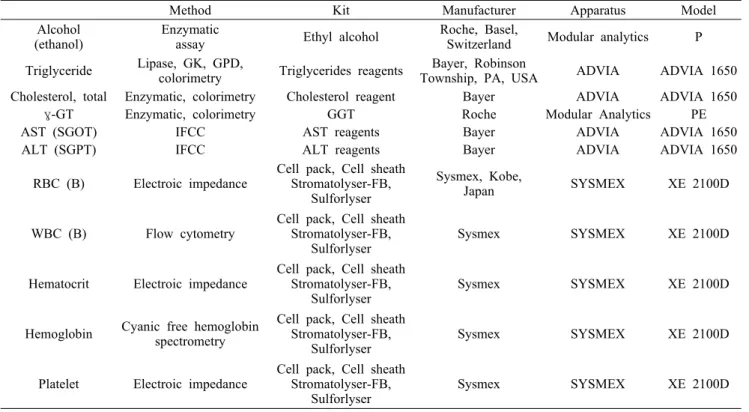
Table 3. Analytical methods of hematochemicals
Method Kit Manufacturer Apparatus Model
Alcohol
(ethanol) Enzymatic
assay Ethyl alcohol Roche, Basel,
Switzerland Modular analytics P Triglyceride Lipase, GK, GPD,
colorimetry Triglycerides reagents Bayer, Robinson
Township, PA, USA ADVIA ADVIA 1650 Cholesterol, total Enzymatic, colorimetry Cholesterol reagent Bayer ADVIA ADVIA 1650
γ-GT Enzymatic, colorimetry GGT Roche Modular Analytics PE
AST (SGOT) IFCC AST reagents Bayer ADVIA ADVIA 1650
ALT (SGPT) IFCC ALT reagents Bayer ADVIA ADVIA 1650
RBC (B) Electroic impedance Cell pack, Cell sheath Stromatolyser-FB,
Sulforlyser
Sysmex, Kobe,
Japan SYSMEX XE 2100D
WBC (B) Flow cytometry Cell pack, Cell sheath Stromatolyser-FB,
Sulforlyser Sysmex SYSMEX XE 2100D
Hematocrit Electroic impedance Cell pack, Cell sheath Stromatolyser-FB,
Sulforlyser Sysmex SYSMEX XE 2100D
Hemoglobin Cyanic free hemoglobin spectrometry
Cell pack, Cell sheath Stromatolyser-FB,
Sulforlyser Sysmex SYSMEX XE 2100D
Platelet Electroic impedance Cell pack, Cell sheath Stromatolyser-FB,
Sulforlyser Sysmex SYSMEX XE 2100D (Chungnam, Korea)에서 제공받았다. 오미자농축액은 문
경산 건조 오미자 1 kg을 추출기에 넣고 4배의 70% 발효주 정과 증류수를 가하여 70∼90°C에서 8시간씩 각각 2회 추 출하였다. 제조한 오미자추출물은 여과한 후 회전감압농축 기로 63°Brix가 되도록 농축하였고, gomisin N과 schizan- drin C의 합이 4.0∼6.0 mg/g이 되도록 표준화하였다. 제조 한 오미자농축액은 4°C에서 보관하면서 실험에 사용하였다.
동물실험윤리위원회 승인
한국식품연구원 동물실험윤리위원회에 연구계획서를 제 출하여 승인받았다(KFRI-M-13013).
실험동물의 사양관리
실험동물은 각각 평균체중 150 g과 270∼280 g된 Sprague-Dawley계 수컷 흰쥐를 중앙실험동물(주)(Seoul, Korea)에서 분양받아서 온도(22±2°C), 습도(50±5%), 명 암주기(07:00∼19:00)로 설정된 동물실험실에서 사육하였 다. 도착 후 처음 3∼4일간 고형사료로 적응시킨 후 체중에 따라 난괴법(randomized block design)으로 각각 10마리, 14마리씩 세 그룹으로 나누어 사육 케이지에 두 마리씩 수
용하였다. 실험식이는 Harlan 2018S-diet로 영양성분은 Table 2와 같다. 사육기간 동안 물과 사료는 자유급이 하였 고 오미자추출물은 매일 1회 일정시간에 경구투여 하였다.
식이섭취량은 매주 1회 잔량을 측정하였고 증체량은 매주 1회 측정하여 산출하였다. 8주간의 사육기간 최종일에 실험 동물에서 안구채혈법으로 혈액을 채취한 다음 경추탈구법 으로 희생시킨 후 복부를 절개하여 간 조직을 적출하여 생리 식염수로 혈액을 씻고 흡수지로 물기 제거 후 중량을 측정한 다음 -70°C에 보관하면서 실험에 사용하였다.
혈청 생화학치 분석
혈청 알코올(ethanol) 농도, 혈청과 간 조직 중의 중성지 방(TG)과 총 콜레스테롤(TC) 함량, 간 기능치(γ-GT, AST, ALT) 및 혈액학치(CBC)는 Table 3에 제시된 각각의 측정 용 kit를 사용하여 분석하였다.
간 조직과 혈청 지질분석
간 조직 1 g에 chloroform : methanol 혼합액(2:1, v/v)을 가하여 PoterElvehjem tissue grinder(WOS01010, Dai- han, Gangwon, Korea)로 마쇄하여 30 mL로 정용한 다음
a
a
ns ns
ns
b
b ns
a
a
0.00 0.05 0.10 0.15 0.20 0.25 0.30
60 90 150 240 300 360
Time (min)
Blood alcohol (%) .
A - Ethanol only B - Omija C - Ethanol+tap water
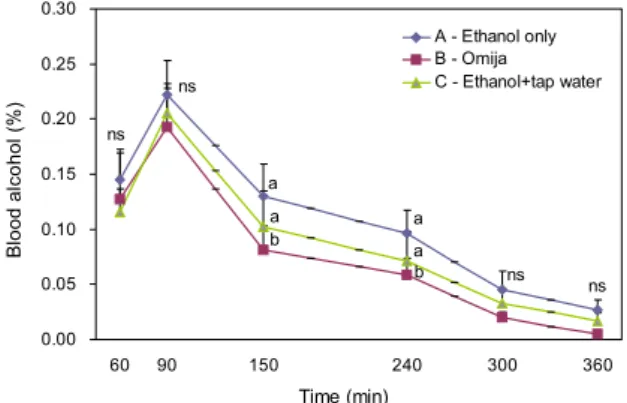
Fig. 1. Effect of Omija (Schisandra chinensis) concentrate on serum alcohol concentration in rats administered orally by acute ethanol intoxicity. Means with different letters (a,b) in the same time are significantly different at P<0.05 by Duncan's multiple range test. NS: not significant.
4°C에서 24시간 정치시켜 지질을 추출하여 이를 여과 (Whatman No. 7, Whatman, Maidstone, UK)한 후 일정량 을 취하여 용매를 모두 제거한 것을 사용하였다. 혈청과 간 조직의 중성지방과 총 콜레스테롤은 각각 TG 및 TC 측정용 kit(Asan Pharm. Co., Seoul, Korea)를 사용하여 분석하였 다.
간 조직의 병리학적 분석
간 조직을 적출하여 10%의 formalin에 고정하였다. 조직 검사 전 gum sucrose 용액에 24시간 동안 4°C에서 조직을 침수시켰다. 침수가 끝난 조직은 액체질소를 이용하여 급속 동결 하여 냉동조직절편기(Cryostat Cryocut Microtome, Reichert-Jung, Heidelberg, Germany)를 사용하여 8∼10 μm 두께로 박절한 후 gelatin으로 표면 처리된 슬라이드에 부착시켰다. 100% propylene glycol 용액에서 10분간 처 리하여 완전 탈수하였다. 60°C 오븐에 있는 Oil Red O working solution에서 15분간 염색을 실시한 다음 60%
isopropanol로 세척하였다. Alum haematoxylin 용액으로 핵 염색을 실시한 후 증류수로 세척한 다음 permount를 이 용하여 봉입한 후 현미경(ECLIPSE E600, Nikon, Tokyo, Japan)으로 관찰하였다.
통계처리
실험성적은 mean±SD로 표시하였고 실험군 간의 통계적 인 유의성 검정은 SPSS Package Program(Windows ver- sion 15.0, SPSS Inc., Chicago, IL, USA)을 이용하여 one way ANOVA(분산분석)의 Duncan's multiple test에 의해 유의확률 P<0.05에서 검증하였다.
결과 및 고찰
급성주정중독시험
흰쥐에게 단회성 급성주정중독량과 오미자추출물 시료를 투여한 후 60분부터 360분까지 여섯 번 채혈한 시점의 혈중 알코올 농도는 Fig. 1과 같다. 시료투여 후 60분과 90분의 혈중 알코올 농도는 주정대조군(A)이 각각 0.145%와 0.222%, 오미자투여군(B)은 각각 0.127%와 0.193%, 주정 과 물투여군(C)은 각각 0.116%와 0.205%로 시료투여 후 90분의 혈중 알코올 농도가 가장 높았고 실험군 간 통계적 인 차이는 없었다. 주정투여 후 150분과 240분의 혈중 알코 올 농도는 A군이 각각 0.130%와 0.096%, B군은 각각 0.081%와 0.059%, C군이 각각 0.102%와 0.071%로 감소 하였는데, B군이 다른 두 투여군(A, C)보다 통계적으로 유 의하게 낮았다(P<0.05). 주정투여 후 300분의 혈중 알코올 농도는 각각 0.045%, 0.020%, 0.033%로 B군이 낮았고, 이후 360분의 혈중 알코올 농도는 오미자투여군(B)에서는 0.005%로 거의 분해된 반면 A군과 C군에서는 각각 0.027
%, 0.017%로 나타났다. 본 실험에서 주정투여 후 60분을
기준 농도로 했을 때 주정투여 후 360분의 혈중 알코올 분해 율은 주정대조군(A) 81.4%, 오미자투여군(B) 96.1%, 물투 여군(C) 85.3%로 나타나서 B군의 알코올 분해율이 다른 두 주정군보다 평균 13% 높았다. 한편 본 시험에서는 주정과 물투여군(C)도 주정대조군(A)에 비해 경시적으로 혈중 알 코올 농도의 감소 경향을 보여 물의 음용이 혈중 알코올의 분해에 일정한 효과를 보였는데 시험 초기(60분, 90분) 이 후 150분과 240분에서는 오미자투여군(B)의 알코올 감소 효과가 유의적인 것으로 나타났고, 시험 후기(300분, 360 분)에서는 세 처리군에서 유의적인 차이는 나타나지 않았 다. 예로부터 오미자(Schizandra chinensis)는 거담, 자양 및 강장제 등으로 이용되는 한약재로서 약리 기능이 다양하 여 진정, 진해, 해열 등의 중추 억제 작용, 간 보호 작용, 혈압 강하 작용 및 알코올 해독 작용이 있다고 알려졌다(24). 이 러한 결과는 에탄올(25%, 40%)을 급성으로 단회 경구투여 한 쥐에게 오미자열매의 물 추출물 투여가 에탄올로 상승된 알코올 농도를 평균 78% 정도 감소시켰다는 보고(21)와 유 사하였다. 본 실험에 사용된 오미자추출물은 gomisin N과 schisandrin C의 합이 4.0∼6.0 mg/g으로 표준화된 시료로 오미자추출물의 간 보호 작용을 나타내는 리그난화합물의 분석치는 schisandrin 8.802±1.390 mg/g, schisandrin C 1.011±0.203 mg/g, gomisin A 0.954±0.191 mg/g, go- misin N 3.351±0.829 mg/g으로 총 리그난 함량은 14.118 mg/g으로 나타났다(25).
장기주정투여시험
장기간(8주) 주정투여에 따른 실험동물의 증체량, 식이효 율 및 간장무게는 Table 4와 같다. 시험개시 시 체중은 실험 군에서 평균 163 g이었고, 종료 시 체중은 각각 374.4 g, 368.3 g, 384.0 g으로 차이가 없었다. 식이섭취량은 일반대 조군(C)이 다소 높았고, 식이효율(FER)은 주정대조군(A)이 높았으나 통계적인 차이는 없었다. 간장무게는 일반대조군 (no ethanol)이 2.68 g으로 두 주정투여군(2.95 g, 2.84 g)
Table 4. Body weight, diet intake and organ weight in long-term ethanol administered rats
A1) B C
Initial body weight (g) Final body weight (g) Weight gain (g/day) Diet intake (g/day) Food efficiency ratio Liver weight (g/100 g bw)
163.0±7.31 374.4±29.6ns2) 3.82±1.25ns 19.27±1.15ns 0.21±0.07ns 2.95±0.16a3)
163.3±6.61 368.3±28.6 3.67±1.26 18.61±1.34 0.20±0.07 2.84±0.15a
164.5±8.24 384.0±36.4 3.89±1.51 20.17±0.69 0.19±0.08 2.68±0.14b Values are mean±SD (n=14).
1)A: ethanol control, B: Omija (Schisandra chinensis), C: control (no ethanol).
2)ns: not significant.
3)Means with different superscripts in the same row are significantly different at P<0.05 by Duncan's multiple range test.
b a a
b ab
a
0 20 40 60 80 100 120 140 160
A B C
Serum TG (mg/dL) .
0 1 2 3 4 5 6 7
Liver TG (mg/g of liver tissue) .
■ Serum
■ Liver
Fig. 2. Effect of Omija (Schisandr achinensis) concentrate on triglyceride content of serum and liver in long-term ethanol ad- ministered rats. A: ethanol control, B: Omija (Schisandra chi- nensis), C: control (no ethanol). Means with different letters (a,b) among group are significantly different at P<0.05 by Duncan's multiple range test.
ns ns
0 20 40 60 80 100 120 140 160
A B C
Serum TC (mg/dL) .
0.0 0.5 1.0 1.5 2.0 2.5 3.0
Liver TC (mg/g of liver tissue) .
■ Serum
■ Liver
Fig. 3. Effect of Omija (Schisandra chinensis) concentrate on total-cholesterol content of serum and liver in long-term ethanol administered rats. A: ethanol control, B: Omija (Schisandra chi- nensis), C: control (no ethanol). NS: not significant.
보다 유의하게 낮았다(P<0.05). 본 실험에서 종료 시 체중 과 간 무게를 측정한 결과 주정대조군(A)과 오미자추출물군 (B) 간에 유의적인 차이는 없었다(Table 4). 이러한 결과는 주정대조군의 경우 매일 주정을 투여함으로써 과량의 알코 올이 정상적으로 배출되지 못하고 체내에 지속적으로 축적 된 반면 오미자군에서는 오미자추출물의 급여가 간 조직에 서의 지질 침착을 완화시킴으로써 체중과 간장무게가 다소 감소된 것으로 사료되었다(26).
장기간(8주) 주정투여에 따른 흰쥐의 혈청과 간 조직 중 의 지질 함량은 Fig. 2 및 Fig. 3과 같다. 혈청과 간 조직의 중성지방(TG) 함량은 일반대조군(no ethanol)이 각각 76.79 mg/dL, 3.32 mg/g of liver tissue로 두 주정투여군(A, B) 보다 통계적으로 유의하게 낮았다(P<0.05). 간 조직의 TG 함량은 두 주정투여군에서는 오미자추출물군(B)과 주정대 조군(A) 간에 차이는 없었고 B군이 A군에 비해 26.5% 낮았 다(Fig. 2). 혈청 중 총 콜레스테롤(TC) 함량은 실험군 간에 유의적인 차이가 없었고, 간 조직의 TC 함량은 두 주정투여 군 간에는 오미자추출물군(B)이 주정대조군(A)보다 18.8%
낮은 것으로 나타났다(Fig. 3). 이러한 결과는 알코올성 지 방간을 유도한 흰쥐에서 Schisandra chinensis(SC)가 주정 투여로 인해 상승된 혈청과 간 조직의 지질(TG, TC) 농도를
통계적으로 유의하게 감소시켰다고 보고한 Park 등(26)의 결과와 비교할 때 TG 농도는 잘 일치되었으나 TC 농도는 통계적인 차이 없이 18.8% 감소한 것으로 나타났는데, 이는 선행연구의 주정투여량(1 g/kg body wt.)과 SC추출물의 투 여기간(5주)과 본 연구의 주정투여량과 투여기간 등의 차이 에 기인된 것으로 사료된다. 선행연구에 의하면 오미자추출 물에 의한 중성지방과 콜레스테롤 수준의 감소는 간 조직 내 지단백분해효소의 활성 증가로 혈중 TG의 분해 촉진, 간 조직 내 TG의 합성 감소, 장내 콜레스테롤 흡수 억제와 관련이 있는 것으로 보고되었고(27), 또한 SC추출물이 알코 올성 쥐의 간 조직에서 phospho-AMPK와 PPARα의 발현 을 유의하게 증가시킴으로써 알코올로 인한 지방간의 억제 를 시사하며(26), Fructus Schisandra chinensis(FSC)의 dietary pulp의 상징액과 침전물의 투여가 high cholester- ol+bile salt diet를 급여한 마우스의 혈청 TG 농도와 간의 지질과 혈당치 및 혈청 중 ALT 활성을 저하시킨 것으로 보 고했다(28).
장기간(8주) 주정투여에 따른 흰쥐의 간 기능치는 Fig.
4~6과 같다. 실험 개시 전(0) γ-glutamyltransferase(γ- GT) 활성은 A, B, C군에서 각각 2.67 mU/mL, 2.87 mU/
mL, 2.28 mU/mL로 나타났다. 실험 전기(4주) 주정투여 후 측정한 γ-GT 활성은 실험군(A, B, C)에서 각각 4.59 mU/
a a
ab ab
ns
b b
0 2 4 6 8 10 12
0 4 8
Time (week)
γ-GT (mU/mL) .
A - Ethanol only B - Omija C - No Ethanol
Fig. 4. Effect of Omija (Schisandra chinensis) concentrate on serum γ-GT activity in long-term ethanol administered rats. ns:
not significant. Means with different letters (a,b) above the bars in the same week are significantly different at P<0.05 by Dun- can's multiple range test.
a
ab
ns ns b
0 20 40 60 80 100 120 140 160 180 200
0 4 8
Time (week)
AST (U/L) .
A - Ethanol only B - Omija C - No Ethanol
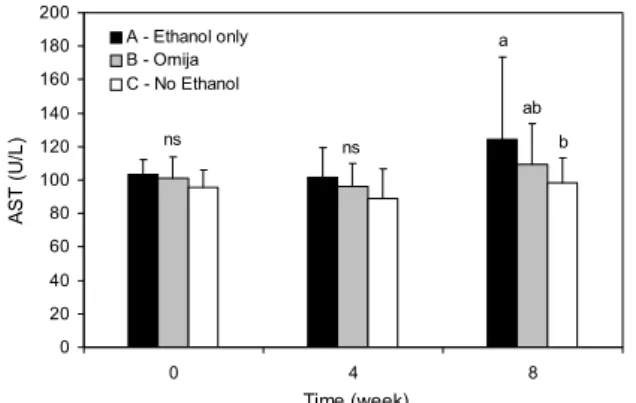
Fig. 5. Effect of Omija (Schisandr achinensis) concentrate on serum AST activity in long-term ethanol administered rats. ns:
not significant. Means with different letters (a,b) above the bars in the same week are significantly different at P<0.05 by Dun- can's multiple range test.
ns ns a
ab
b
0 20 40 60 80 100 120
0 4 8
Time (week)
ALT (U/L) .
A - Ethanol only B - Omija C - No Ethanol
Fig. 6. Effect of Omija (Schisandra chinensis) concentrate on serum ALT activity in long-term ethanol administered rats. ns:
not significant. Means with different letters (a,b) above the bars in the same week are significantly different at P<0.05 by Dun- can's multiple range test.
mL, 4.78 mU/mL, 2.46 mU/mL로 나타났다. 즉 28일 동안 매일 급성주정중독량(4 g ethanol/kg of body wt.)의 1/2 용량의 주정(Chivas Regal, 40%)을 경구투여 했을 때 γ- GT 활성은 A군과 B군에서 각각 72%, 40% 증가하였고 일 반대조군(no ethanol)은 7% 증가하는데 그쳤다. 실험 후기 (4주) 종료 시 측정한 γ-GT 활성은 B군이 26% 감소한 반면 주정대조군(A)은 다소 증가하였으나 통계적인 차이는 없었 다. 알코올 섭취로 인한 간 손상이 일어나면 간세포가 파괴 되고 이때 혈중으로 AST와 ALT가 유리되어 나오기 때문에 AST와 ALT의 활성은 간세포 손상의 지표로 사용되고 있다.
본 연구에서 AST 활성은 실험 개시 전(0)은 95.7∼103.3 U/L이었고 실험 전기(4주) 후 89.2∼101.6 U/L로 실험 개 시 전에 비해 오히려 다소 감소하였으며, 실험 후기(4주) 종 료 시에는 98.2∼124.2 U/L로 실험 전기보다 활성이 높았는 데, 오미자추출물군(109.4 U/L)이 주정대조군(124.2 U/L) 보다 약 12% 감소하였다. ALT 활성은 실험 개시 전(0) 72.00∼88.00 U/L, 실험 전기(4주) 후 60.25∼71.31 U/L,
실험 후기(4주) 종료 시에는 오미자추출물군(60.07 U/L)이 주정대조군(74.20 U/L)에 비해 약 19% 활성이 감소하였다.
이러한 결과는 알코올 투여로 지방간을 유도한 흰쥐에게 SC 추출물이 혈청 중 AST와 ALT 활성을 주정대조군보다 유의 적으로 감소시킨 선행연구(26)와 증숙오미자의 열수추출물 에는 schisandrin, gomisin과 총 폴리페놀 및 총 플라보노 이드 함량이 증가되므로 이러한 이화학적 성분 변화가 알코 올성 간 손상을 유발시킨 쥐의 혈청 중 γ-GT, AST, ALT 활성을 감소시켰다는 보고와도 비교되는 결과로 사료되었 다(29). 또한 에탄올(25%)을 급성으로 단회 경구투여 한 쥐 에게 오미자열매의 물추출물 투여가 에탄올로 상승된 AST, ALT 활성을 다소 감소시켰다는 Lee와 Lee(21)의 보고와 도 유사한 결과로 사료되었다.
장기간(8주) 주정투여에 따른 혈액학치(CBC)는 Table 5 와 같이 혈소판을 제외한 다른 혈구세포에서는 실험군 간 통계적으로 유의한 차이가 있었다(P<0.05). 즉 적혈구수 (RBC)와 헤마토크릿치(Hct)는 일반대조군(C)보다 두 주정 투여군(A, B)에서 통계적으로 유의하게 감소하였고, 백혈구 수(WBC)는 일반대조군(C)보다 주정대조군(A)에서 유의하 게 감소한 것으로 나타났다. 혈색소(hemoglobin) 함량은 두 주정투여군(A, B)에서 주정대조군(13.61 g/dL)과 오미자추 출물군(12.58 g/dL) 간에 통계적인 차이가 있었다(P<0.05).
혈소판 수는 차이가 없었다. 혈액은 산소와 영양소를 체내에 운반하는 역할을 하고, 산소는 적혈구의 헤모글로빈이 그 역할을 주로 담당한다. 적혈구와 헤모글로빈 수치가 정상보 다 낮아지면 산소공급 부족으로 빈혈(anemia)이 발생한다.
세균, 바이러스, 박테리아 등 외부 침입물질에 대항하는 백 혈구와 혈소판 수는 본 실험에서는 대체로 정상 범위 안에 있는 것으로 나타났다. 적혈구와 헤마토크릿치는 두 주정투 여군(A, B)이 일반대조군(C)보다 유의적으로 낮았는데 이 는 장기간 동안 주정을 투여한 데에 기인된 결과로 사료되었 다. 인체는 항산화계가 존재하여 산화촉진물질과 산화억제
Table 5. Effect of Omija (Schisandra chinensis) concentrate on the complete blood count in long-term ethanol administered rats Group1) RBC2) (×106/μL) WBC (×10³/μL) Hct (%) Hb (g/dL) Platelet (×103/μL)
A B C
6.14±0.32b3) 6.57±0.64b 7.17±0.42a
7.85±2.61a 7.30±1.65ab 6.87±1.49b
33.37±1.86b 35.02±2.36b 38.97±2.41a
13.61±1.05a 12.58±0.91b 13.25±0.71ab
929.7±202.38ns4) 941.8±163.04 1005.4±68.28 Values are mean±SD (n=14).
1)A: ethanol control, B: Omija (Schisandra chinensis), C: control (no ethanol).
2)RBC: red blood cell, WBC: white blood cell, Hct: hematocrit, Hb: hemoglobin.
3)Means with different superscripts in the same column are significantly different at P<0.05 by Duncan's multiple range test.
4)ns: not significant.
Table 6. Description of lipid visualization by Oil Red O staining and steatosis score in long-term ethanol administered rats Group Slide No. Oil Red O staining Steatosis score1) Treatment
A
-1 3 Ethanol (+)
control
-4 3 Ethanol (+)
control
B
-1 1 Omija (150 mg)
concentrate
-3 1 Omija (150 mg)
concentrate
C
-4 1 Negative (-)
control
-5 1 Negative (-)
control
1)Reading criteria.
Score 0: observed the steatosis under the 5% of liver tissue, Score 1: observed the steatosis in the 5∼33% of liver tissue, Score 2: observed the steatosis in the 34∼66% of liver tissue, Score 3: observed the steatosis over the 67% of liver tissue.
물질이 균형을 유지하고 있으나 환경오염, 흡연, 알코올 및 방사선 등에 지속적으로 노출이 되면 두 인자가 불균형을 이루어 oxidative stress를 유발하는 것으로 보고되었다 (30).
본 연구에서 장기간(8주) 주정투여에 따른 흰쥐 간 조직의 Oil Red O staining에서 지방변성증(fatty degeneration)의 정도, 위치 및 지방구 크기를 광학현미경을 이용하여 40배, 100배, 200배, 400배율로 관찰한 후 조직병리학적으로 판 독하여 수치화하였다. 본 실험에서 Steatosis score는 주정
대조군(A)에서 3점인 반면 오미자추출물군(B)과 일반대조 군(C)에서는 각각 1점으로 나타났다(Table 6). 조직사진 중 에서 오미자추출물군의 슬라이드번호 B-1과 B-3, 일반대 조군의 슬라이드번호 C-4와 C-5는 붉게 염색된 지방미세 과립이 세포질에 경도로 침윤(infiltration)되어 있는 반면 주정대조군의 슬라이드번호 A-1은 고도로, 슬라이드번호 A-4는 중등도로 침윤해 있음을 확인할 수 있었고, 오미자추 출물군(B)과 일반대조군(C) 간에 차이는 관찰되지 않았다 (Table 6). 따라서 간의 병리조직학적 관찰 결과 오미자추출
물의 급여가 간 실질조직에서의 지질 침착을 약화시키고 간 세포의 소포성 지방세포들을 감소시킴으로써 지방변성증의 개선 효과가 있는 것으로 판단되었다. 이러한 결과는 지방간 을 개선시키는 오미자 시료 중의 안토시아닌, 리그난 및 페 놀화합물에 의한 영향일 것으로 사료되었다. 간은 항상성과 건강유지를 위해 필수적인 중요한 기관으로 지방산의 합성 과 산화에 불균형이 초래될 경우 간 조직 내 지방 축적이 불가피하다. 그중에서 생체에 대해 유해한 이물질을 무해한 것으로 대사하는 주된 역할을 담당한다. 이러한 해독 작용의 근본은 주로 인체 내외에서 생성되거나 유입된 산물들을 수 용성 형태로 바꾸어 주로 소변을 통해서 체외로 배출시킨다 (31). 한편 저자들이 수행한 알코올 유도성 산화적 세포손상 실험에서 오미자추출물 100∼400 μg/mL를 HepG2 cell에 처리했을 때 농도 의존적으로 산화스트레스에 대한 저항성 이 증가된 것으로 나타났다(25).
요 약
본 연구는 알코올성 간 손상을 일으킨 흰쥐에게 오미자추출 물이 혈중 알코올 분해율과 간 기능 보호에 미치는 영향을 구명하기 위하여 단회성 급성주정중독시험과 장기 주정투 여시험을 각각 수행하였다. 급성주정중독시험은 흰쥐에게 급성주정중독량과 오미자추출물을 투여한 후 60분, 90분, 150분, 240분, 300분, 360분의 혈중 에탄올 농도를 측정하 여 경시적인 알코올 분해율을 측정하였다. 장기 주정투여시 험은 전반기(4주)는 급성주정중독량(22,23)을 참고하여 1/2 용량의 시험주정(Chivas Regal, 40%)을 투여하였고, 후반 기(4주)는 시험주정과 함께 물과 오미자추출물(150 mg, 1.0 mL)을 각각 투여하였다. 급성주정중독량시험에서 주정 투여 후 90분의 혈중 알코올 농도가 가장 높았고, 주정투여 후 알코올의 기준 농도 대비 360분의 혈중 알코올 분해율은 주정단독투여군(A) 81.4%, 오미자투여군(B) 96.1%, 주정 +물투여군(C) 85.3%로 오미자투여군이 다른 두 주정투여 군보다 평균 13% 더 높았다. 장기 주정투여시험에서 간장무 게는 두 주정투여군(A, B)이 일반대조군(C)보다 통계적으 로 무거웠다(P<0.05). 혈청과 간 조직의 중성지방(TG) 함 량은 일반대조군이 두 주정투여군보다 통계적으로 유의하 게 낮았다(P<0.05). 간 조직의 TG 함량은 오미자투여군(B) 이 주정대조군(A)에 비해 26.5% 낮았다. 혈청 중 총 콜레스 테롤(TC) 함량은 실험군 간에 차이가 없었고, 간 조직의 TC 함량은 B군이 A군보다 18.8% 낮았다. 주정과 오미자추출 물을 투여한 후 측정한 γ-GT, AST 및 ALT 활성은 오미자 추출물군(B)이 주정대조군(A)보다 각각 26%, 12%, 19%
감소하였다. 혈액학치(CBC)는 혈소판을 제외하고는 실험 군 간에 통계적인 차이가 있었다(P<0.05). 간세포 조직의 Steatosis score는 주정대조군이 3점인 반면 오미자추출물 군과 일반대조군에서는 각각 1점이었고, 붉게 염색된 지방 미세과립이 주정대조군에서는 고도 내지 중등도로 세포질
내에 침윤(infiltration)된 반면 오미자추출물군에서는 경도 로 침윤되었다. 본 연구에서 오미자추출물은 경시적으로 혈 중 알코올 분해율을 높여주고, 간 조직의 중성지방량과 간 기능치(γ-GT, ALT)를 감소시키는 동시에 알코올성 지방변 성을 완화시킨 것으로 나타났다. 본 연구 결과는 향후 오미 자 가공식품의 개발과 관련한 기초 및 홍보자료로 활용 가능 성이 높을 것으로 기대되는 한편 인체적용시험을 통해 알코 올성 간 기능 보효 효과와 관련된 보다 정밀한 후속 연구가 필요할 것으로 사료된다.
감사의 글
본 연구는 문경시 농업기술센터의 지원에 의한 결과로 이에 감사드립니다.
REFERENCES
1. Statistics Korea. 2013. 2012 Annual report on the cause of death statistics. http://kostat.go.kr/portal/korea/kor_nw/3/in- dex.board?bmode=read&bSeq=&aSeq=308560&pageNo
=2&rowNum=10&navCount=10&currPg=&sTarget=ti- tle&sTxt=2012. p 22.
2. Lieber CS. 1993. Aetiology and pathogenesis of alcoholic liver disease. Baillière's Clin Gastroenterol 7: 581-608.
3. Kim MJ, Lee JS, Ha OM, Jang JY, Cho SY. 2002. Effects of Pueraria thunbergiana Bentham water extracts on hepatic alcohol metabolic enzyme system in rats. J Korean Soc Food Sci Nutr 31: 92-97.
4. Sung KC. 2011. A study on the pharmaceutical and chem- ical characteristics and analysis of natural omija extract. J Korean Oil Chemists' Soc 28: 290-298.
5. Zhu M, Lin KF, Yeung RY, Li RC. 1999. Evaluation of the protective effects of Schisandra chinensis on phase Ⅰ drug metabolism using a CCl4 intoxication model. J Ethnophar- macol 67: 61-68.
6. Xing J, Guo Y, Hu H, Qu XL, Sun XZ, Liu SH, Wang H.
2012. A herbal composition of Semen Hoveniae, Radix Puerariae, and Fructus Schisandrae shows potent protective effects on acute alcoholic intoxication in rodent models.
Evid Based Complement Alternat Med doi:10.1155/2012/
638197.
7. Cheng N, Ren N, Gao H, Lei X, Zheng J, Cao W. 2013.
Antioxident and hepatoprotective effects of Schisandra chi- nensis pollen extract on CCl4 induced acute liver damage in mice. Food Chem Toxicol 55: 234-240.
8. Hikino H, Kiso Y, Taguchi H, Ikeya Y. 1984. Antihepatotoxic actions of lignoids from Schizandra chinensis fruits. Planta Med 50: 213-218.
9. Yeo SG, Ahn CW, Lee YW, Lee TG, Park YH, Kim SB.
1995. Antioxidative effect of tea extracts from green tea, oolong tea and black tea. J Korean Soc Food Nutr 24: 299- 304.
10. Toda S, Kimura M, Ohnish M, Nakashima K, Ikeya Y, Taguchi H, Mitsuhashi H. 1988. Natural antioxidants (Ⅳ).
Antioxidative components isolated from Schisandra fruit.
Shoyakugaku Zasshi 42: 156-159.
11. Huang YS, He Y, Zhang JT. 1990. Antioxidative effects of three components isolated from fruit of schisandrae.
Chinese J Pharmacol Toxicol 4: 275-277.
12. Chung KH, Lee SH, Lee YC, Kim JT. 2001. Antimicrobial activity of Omija (Schizandra chinensis) extracts. J Korean Soc Food Sci Nutr 30: 127-132.
13. Lee JY, Min YK, Kim HY. 2001. Isolation of antimicrobial substance from Schizandra chinensis Baillon and anti- microbial effect. Korean J Food Sci Technol 33: 389-994.
14. Park JH, Kim JH, Kim DH, Mun HC, Lee HJ, Seo SM, Paik KH, Ryu LH, Park JI, Lee HY. 2004. Comparison of immuno-stimulatory activities by purification process of Schizandra chinensis Baillon fruits. Korean J Medicinal Crop Sci 12: 141-148.
15. Ko BS, Park SK, Choi SB, Jun DW, Choi MK, Park SM.
2004. A study on hypoglycemic effects of crude extracts of Schizandrae Fructus. J Korean Soc Appl Biol Chem 47:
258-264.
16. Lee JY, Min YK, Kim HY. 2001. Isolation of antimicrobial substance from Schizandra chinensis Baillon and antimi- crobial effect. Korean J Food Sci Technol 33: 389-394.
17. Nakagiri R, Oda H, Kamiya T. 2003. Small scale rat hep- atocyte primary culture with applications for screening hep- atoprotective substances. Biosci Biotechnol Biochem 67:
1629-1635.
18. Kim KS, Kang SS, Ryu SN. 2002. Quantitative analysis of lignans from fruits of Schizandra chinensis. Kor J Pharmacogn 33: 272-276.
19. MacRae WD, Towers GHN. 1984. Biological activities of lignans. Phytochemistry 23: 1207-1220.
20. Kim JS, Choi SY. 2008. Physicochemical properties and antioxidative activities of Omija (Schizandra chinensis Baillon). Korean J Food & Nutr 21: 35-42.
21. Lee JS, Lee SW. 1990. Effects of water extracts in fruits of Omija (Schizandra chinensis Baillon) on alcohol metabo- lism. Korean J Dietary Culture 5: 259-263.
22. Fujii H, Ohmachi T, Sagami I, Watanabe M. 1985. Liver microsomal drug metabolism in ethanol-treated hamsters.
Biochem Pharmacol 34: 3881-3884.
23. Han CK. 1999. Effect of natural drink on the hangover- relieving function in alcohol treated rats and human volun- teers (No I01399-9935). Korea Food Research Institute, Seongnam, Korea. p 10.
24. Choi HS, Beik KY, Kim JB. 2012. Studies on antioxidative effects of Schisandra chinensis seed extract. J Kor Soc Cosm 18: 908-915.
25. Sung MS, Park SS, Kim SS, Han CK, Hur JM. 2014.
Antioxidant activity and hepato-protective effect of Schisan- dra chinensis Baill. extracts containing active components in alcohol-induced Hep G2 cells. Food Sci Biotechnol (In press).
26. Park HJ, Lee SJ, Song Y, Jang SH, Ko YG, Kang SN, Chung BY, Kim HD, Kim GS, Cho JH. 2014. Schisandra chinensis prevents alcohol-induced fatty liver disease in rats. J Med Food 17: 103-110.
27. Ock ES. 1995. Effect of Schizandra chinensis extract in hy- perlipidemic rats. J Korean Soc Food Nutr 24: 658-662.
28. Sun N, Pan SY, Zhang Y, Wang XY, Zhu PL, Chu ZS, Yu ZL, Zhou SF, Ko KM. 2014. Dietary pulp from Fructus Schisandra Chinensis supplementation reduces serum/hep- atic lipid and hepatic glucose levels in mice fed a normal or high cholesterol/bile salt diet. Lipids Health Dis 13: 46- 55.
29. Choo BK, Chung KH, Seo YB, Roh SS. 2013. Antioxidant, antiinflammation and hepato-protective activity of Schizan- drae Fructus processed with differenciated steaming number.
Kor J Herbology 28:83-92.
30. Kim HH, Park GH, Park KS, Lee JY, An BJ. 2010. Anti-ox- idant and anti-inflammation activity of fractions from Aster glehni Fr. Schm. Kor J Microbiol Biotechnol 38: 434-441.
31. Park SH, Han JH. 2004. A study of medicinal plants for applications in functional foods. 1. Effects of Schisandra fructus on the regional cerebral blood flow and blood pres- sure in rats. J Korean Soc Food Sci Nutr 33: 34-40.